LOAD BALANCING MECHANISM FOR COST
PREDICTION ON SOA INFRASTUCTURE
Rakesh C S1, Jyothi S2, Vanishree Abhay3 1
Dept of ISE ,Dr.AIT,Bangalore Karnataka,India 2
Assistant Professor, Dept of ISE ,Dr.AIT,Bangalore Karnataka,India 3
Assistant Professor, Dept of ISE ,Dr.AIT,Bangalore Karnataka,India
Abstract-- Organization of Service Oriented Applications to open Infraustructure as-a Service mists presents difficulties to framework experts. Open mists offer an expanding cluster of VM sorts with subjectively characterized CPU, circle, and system I/O capacities. A workload cost expectation approach which tackles working framework time, keeping standards to bolster proportional SOA workload execution by utilizing interchange virtual machine (VM). The workload profiles can create and assess the approach utilizing six SOAs. The procedure can enable discovering interchange based on the cost of VM's by facilitating and proposing equivalent or better execution of VM's utilization on cloud.
I. INTRODUCTION
Service Oriented Application facilitates the application components by providing service to other components by means of a communication protocol. By developing a cloud IaaS on SOAs require the capabilities of VMs in both type as well as quality where its type provide the allocation for processor cores, memory , disk and its type. Based on the number of VMs used the improvement in performance and availability can be judged by the cloud provider[1].
The cloud service providers not only offer diverse range of VMs but they can be implemented using heterogeneous
hardware results to check variation in performance. It is also seen that allotting different CPU time in large VMs. By using benchmark technique it was observed that multi core VMs were not found with 100% allotments from each core. Along with that it was found that the variation in the performance and degradation in SOA was occurred to VMs. To choose the best VM type has become more complex due to plenty of VM types, description for ability of VMs, different type of hardware and VM configurations, and performance change in resource usage with hardware sharing.
Deploying VMs for SOA we require the classification of workloads and comparison of performance capabilities in VMs . Here both methodologies are used to harness performance in SOA. Cost optimization model changes source requirements from main VM to the other VM types to achieve optimum performance. For achieving it there needs an investigation of SOA workload. The equal time for workloads by VMs is the main goal irrespective of execution time. Based on the given options the costs is calculated by taking fixed product price by quantity of VM .The result can be compared to find out the most efficient infrastructure. For the purpose the pool of VMs is considered that contains only single type of VM. Because the investigation cannot be made appropriate with mixed VMs. There is no option for providing separate infrastructure for workloads on SOA. Instead of
that the phases separately and accordingly when it is needed. The SOA hosting can be done only on VM types that satisfies the requirements of RAM and disk.
The paper finds the SOA performance across various VMs and types by using resource profiles. It predicts the variables for resource utilization specially when it wants to predict user time, kernel time, idle time and IO- wait time for CPU. The contribution is based on workload cost prediction for utilizing resource by using utilization models. It also gives a configuration types that provide same performance in most of the selected infrastructures. It provides classifying of requirements of workloads, to approximate the VM number, and to make sure if the needed performance is achieved.
The paper presents a technique for cost prediction on the workloads on the SOAs. It benefits in classification of requirements of workloads, estimation of number of VMs, and ensuring if the required performance is reached.
II. RELATIVE WORK
The Cloud Computing is popular in the industry has arised the wide variety of questions. Some questions are answered for performance and scalability issues as the application migrates from data center to the cloud. The flexible and elastic nature of cloud makes it to attract the clients and that also affects the migration target. But the problem is to migrate the applications and its difficult to run them on the cloud. Though various practices has been performed , but there is no solution for a balance between guaranteed performance and economic efficiency .That marks as a main challenge in cloud system.
The technique analyzes the performance and scales when migration of application begins from data centre to cloud. So a macro benchmark application named
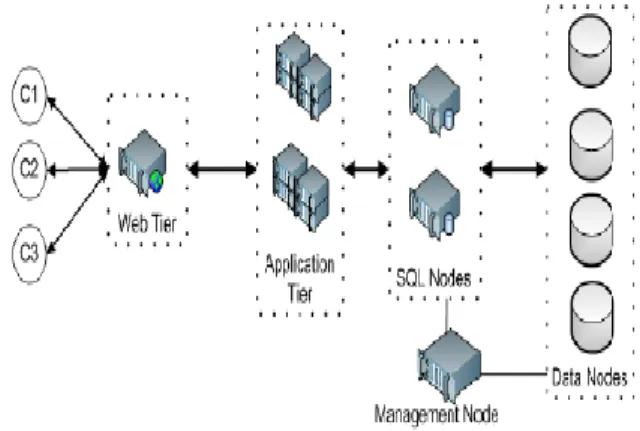
RUBBoS was developed that could perform large experimental studies on test beds. The traditional computing tool called Emulab was used as reference to compare the performance and scalability to Open circus and Amazon EC2.
Fig 1 : Deployment of RUBBos with SQL cluster.
The RUBBoS experiments were generated and were executed by Elba toolkit. But in the analysis it was found various performance issues when applied in cloud. It was also noted that the best RUBBoS could become worst in EC@ due to combing factors. So the method was not considerably success with the perspective of the user.
It is represented by macro benchmark and performance and scalability with different testing structure among them the emulab became the worst performing configuration. As it is analyzed the components with high overhead in nework processing were at system level were founded. These were found through micro benchmark experiment. So there was a need for other approach to diagnose the problem, as the process was slow because of single VM and also the was no techniques which were threshold for VM’s.
By the use of virtualization, the cloud addresses the same thread to many user with different requirements. So the researchers and scientists swear to an alternative to
different clusters. But the virtualization may cause drastic change in the performance drawback on workloads. The proposal is on the basis of evaluation on current cloud compute that has been approached. The performance is analyzed on Amazon EC2 .The results change indicate the current services need an enhancement to increase in performance. The approach cannot be deployed in all clouds , it can be analyzed only in Amazon EC2 and there is also no migration technique involved in it.
In recent decades the cloud has turned as a new delivery model where the organization stores its resource remotely and retrieve dynamically by using credit card. The main policy of cloud is pay as you go .The elasticity in cloud made a significant approach in a cost and resource saving way. The cloud environment make the user to enable elastic provision by taking different hardware's and mechanisms to enhance or reduce the capacity of server. Whereas the problem arises in choosing resource to the workload among various configurations, to make a move from one configuration to other whenever there is changes in workload, the server configuration will further not comprised linearly with respective of price and capacity of server. Another problem arises in adding capacity to the server when determining the options in new resource configurations.
One of the cost aware system named kingfisher which gives a support for elasticity by applying systems to diminish the move time and by stream lining the virtual server configuration reduces the cost. So the kingfisher prototype proves its efficiency in lab platform that could decrease the cost of virtual server where as there is no duplication technique involved to overcome duplicate data and there is no concept of shared data in the concept.
The prototype of kingfisher is applied in cloud engine, using Open Nebula cloud toolkit, that gives the optimizations and efficiency on private and public cloud. By the observations made the improvement was twice that in private cloud. Whereas there was important research on provisioning for data center. where the data center allocate resource dynamically by differing the workload requirements. The dynamic provisioning work is not been cost aware. So it has to be assumed as desired capacity given the application. In kingfisher the unit cost is assumed identical. But in cloud the choice of cloud is mattered, the core price can't be uniform. So kingfisher takes provision cost in its infrastructure. Also the main work of provisioning contains replication as main means to raise application capacity. So it must be imagined as replicable, and the increase in workload is managed by adding servers to application. Another way to increase the capacity is by migration where the migration of data is made for larger capacity. The kingfisher considers both the concepts of replication and migration when choosing best method to configure the application.Base as-an administration (IaaS) mists give another medium to sending of ecological displaying applications. Outfitting progressions in virtualization, IaaS mists can give dynamic versatile framework to better backing logical demonstrating computational requests. Giving experimental displaying "Information as-a Service" requires dynamic scaling of server foundation to adjust to changing client workloads. This paper displays the Virtual Machine (VM) Scaler, an autonomic asset chief for IaaS Clouds. They have created VM-Scaler, a REST/JSON-based web administrations application which underpins dynamic provisioning and administration to bolster logical demonstrating for the Cloud Services Innovation Platform .VM-Scaler bridles the Amazon Elastic Compute Cloud (EC2) application programming.
III. SYSTEM DESIGN
Fig 2: System Design.
The System Model contains following modules: Data Owner, Cloud server , End user and SOA Manager. Data Owner is the basic component for the Cost Prediction Methodology. It functions as the interface for the cloud owner to upload the files. The data owner module contains a login Id and password for authentication and for new owners registration option is also provided. Registration and login details are stored in Navicat MySQL. After login IP address of the remote server to which the file to the cloud updated. Once the remote address is entered owner page is displayed which contain the options to upload the file to the virtual machines. It also contain the other options to get the cost details of the cloud ,procedure to purchase the cloud and its details, Current VM's can update by data owner.
Cloud Server module is responsible for adding memory and threshold values to VM's. Threshold value is minimum that maintained by the particular VM's. Cloud Server is also maintains the details of the data owner and their files. Cloud Server calculates the workload based on Cpu utilization and total memory of VM's. It is given by,
Work Load Time = (Total CPU Utilization + Total VMs Memory) / Total Time Delay.
Cloud server provides the features to block the attackers and store their details to view. When data owner uploads the file to the VM, it is updated VM on the basis of highest remaining cost of VM's. In some cases where the cost of the individuals VM's are same ,then it updates the based on highest memory of the respective VM's. After uploading cloud server returns the remaining Cost and memory in the VM.
SOA Manager is responsible for storing and managing function of migrated files. When data owners uploads a file to the VM, If the VM contain insufficient memory to hold the data. The Cloud server sends the file to migration list of the SOA Manager and acknowledge the message to the data owner to update the VM. After updating VM, SOA Manager transfers the file to data owner VM. End user is one who operate cloud remotely to access the cloud files, by requesting the secret key. The file is encrypted by AES algorithm. The secret key is unique for specific file, if end user try to download the file without entering the secret key or entering wrong key. The end user considered as an attacker and details will be uploaded into attacker list.
IV. RESULTS
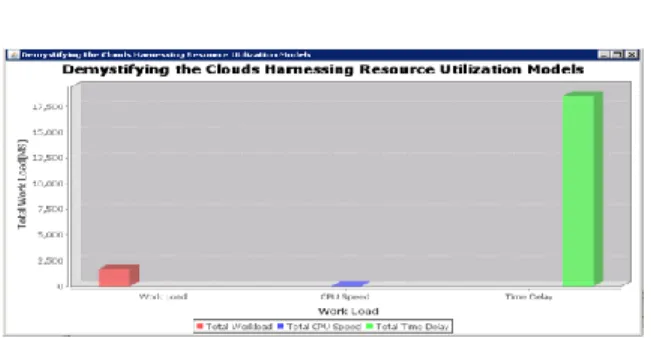
Fig 3:The Graph represents the workload after uploading of first file to VM.
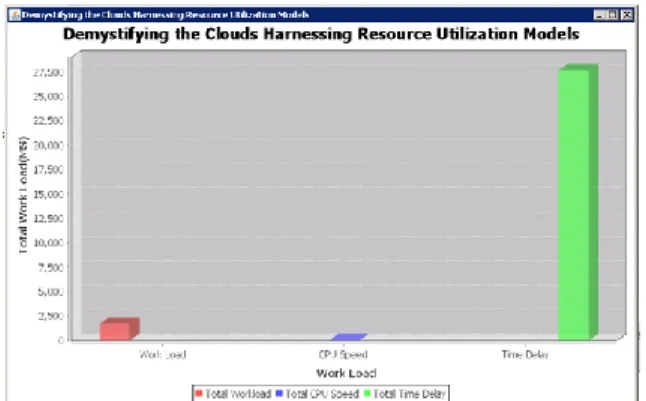
Fig 4:The Graph represents the workload after uploading of second file to VM.
The result is a graph that is plotted for total work versus workload.The graph gives the comparison of workload, CPU time and time delay. The graph is obtained on the basis of workload based on the formula that was mentioned earlier. The values obtained in graph depend on size of the file and also the type of virtual machine.
CONCLUSION
The paper depicts the workload cost forecast system to bolster facilitating SOAs utilizing any virtual machine sort to give proportional execution. The cost expectation procedure gives engineering distinct options for minimize facilitating costs for different SOA workloads. Furnished with foundation choice bolster, framework examiners are better ready to settle on educated choices that balance expense and execution tradeoffs for SOA organizations. The project anticipates the following changes: 1) VM-sorts offered by open cloud suppliers, (2) cost for the VMs, and (3) Performance of VM's. The workload cost expectation system demystifies the plenty of VM sorts offered by cloud sellers and backings further changes. Further it is enhanced by generating the movement list for a relating Virtual machine and relocating to same VM and applying AES Algorithm to improve information security to encode and unscramble.
REFERENCES
[1] Wes J. Lloyd and Shrideep Pallickara, "Demystifying the Clouds: Harnessing Resource Utilization Models for Cost Effective Infrastructure Alternatives".
[2] D. Jayasinghe, S. Malkowski, Q. Wang, J. Li, P. Xiong, and C. Pu, “Variations in performance and scalability when migrating n-tier applications to different clouds,” [3] S. Ostermann, A. Iosup, N. Yigitbasim, R. Prodan, T. Fahringer, and D. Eperma, “A Performance Analysis of EC2 Cloud Computing Serices for Scientific Computing,”
[4] U. Sharma, P. Shenoy, S. Sahu, and A. Shaikh, “A cost-aware elasticity provisioning system for the cloud". [5] W. Lloyd, O. David, M. Arabi, J. C. Ascough II, T. R. Green, J. Carlson, and K. W. Rojas, “The Virtual Machine (VM) Scaler: An Infrastructure Manager Supporting Environmental Modeling on IaaS Clouds”.
[6] Wes J. Lloyd, Shrideep Pallickara, Olaf David, Mazdak Arabi, Tyler Wible, Jeffrey Ditty, Ken Rojas. “Demystifying the Clouds: Harnessing Resource Utilization Models for Cost Effective Infrastructure Alternatives”