A High-Performance Signature Recognition
Method using Neural Network
Saeid Fazli , Shima Pouyan , HamedFathi
Abstract—Among all biological techniques for identifying persons, handwritten signature has an important role because signature of each person is provided easily and processedquickly. Having a high performance recognition system is very essential. Persian signatures are different from other kind of signatures because people usually do not write their name or a text part and they draw a shape so the processing of signatures is more difficult. In [1] we used three classifiers for identifying 360 signatures from 20 signers with a ratio of 95.625%. But theproposed system suffers froma high number of signatures and especially similar ones. In this research, we present a method for offline signature recognition. The proposed system consists of three main steps: image preprocessing, feature extraction and classification.The database includes 700 Persiansignatures from 50 individuals. We use some features to make exact detection of signatures with high similarity and we achieve 95% for recognition of 196 similar signatures. The total detectionratiofor 700 signatures is 84%.
Keywords— preprocessing; feature extraction; neuralnetwork;detection ratio; high similarity.
I. INTRODUCTION
Today, the identification and verification of signature is a fast and reliable way to identify the individuals. So require ahigh-performancedetectionsystemis very evident.
Handwritten signature recognition is divided into on-line and off-line recognition. In on-line recognition the collection of signatures is by special devices such as tablet or other devices and in the off-line recognition systems signature images are written on a paper and obtained by anoptical scanner or a camera.[3]
In online systems the time of sampling and writing the signature can be measured.
Also the pressure of pen is a good feature in this system. Although the online system can recognize signatures with
Manuscript received Dec22, 2014.
Saeid Fazli, Research Institute of Modern Biological
TechniquesUniversityof Zanjan, Zanjan , Iran. (E-mail: [email protected]).
Shima Pouyan,Department of Electrical EngineeringUniversity of
Zanjan,Zanjan , Iran. (E-mail: [email protected])
Hamed Fathi, Department of Electrical Engineering, University of
Zanjan,Zanjan , Iran. (E-mail: [email protected]).
high ratio but in some applications and places the presence of the signer is not possible or is not easy so in these places the usages of offline system areconsequential.
This paper is an offline signature recognition system and the methodof classifying is neural network.
Our method is based on three steps: 1- data collection and preprocessing, 2- extraction thefeatures and 3- data classification. Inthispaper,wehaveproposeda methodin whichaftersignatures preprocessing, we derive features that make signatures inseparable.Forbetterseparationof signatures, these featuresshouldbe selectedsothose determinedifferencesofsignatures to the system. After making a matrix of proper features, we use a classifier to allocate signatures to the correct signers.
Neural network is the classifier we use to classify the signatures. Several NN topologies were tested and finally we use a multilayer perceptron network.
The outline of this paper is as follows:
Section2 presents dataset we use in our experiments. Data preprocessing is described in section 3. Section 4 is about feature extraction. Section 5 explains the classifier and section 6 shows experimental results and in the final section conclusions are drawn.
II. DATABASE
The signature database consists of 700 signature images, scanned at a resolution of 300 dpi. They are organized into 50 sets, and each set corresponds to one signature enrollment. Each volunteer was asked to sign his or her own signatures on a white paper 14 times.
10 signatures of each person is given to train the Neural Network and 4 of them is for testing the classifier.
In our dataset we have 14 sets of signatures which are very similar to each other and so that the separation of them is difficult. So we have some especial features to make them separable. Figure 1 shows some examples of database imageswith high similarity.
Figure1. Examples of signatures from various owners with high similarity
III. PREPROCESSING
After scanning the signature images and before feature extraction step we need preprocessing. The purpose of preprocessing is to make the dataset standard and in the same condition for compare and feature extraction. Our preprocessing system contains these steps:
a. Noise reduction: before any process we need to remove noises in the signature images. Our removal technique to clean the initial image is Gaussian-filtering. Reducing these noises causesincrementin clarityof the images.
b.Background Elimination: we use a threshold to capture the signature from its background and so that we can extract features from the area which is just belong to the signature.
c. Thinning:this process is for making thickness of all data one pixel and so that all signature’s thickness will be the same. So we can eliminate the differences between pen pressures.[2]
d. Rotation: to make signatures in the same directionswe rotate them. The angle of rotation is finding by calculation the moment of order 2. Signatures are rotated in the clockwise around the centerofthescrew.
e. data area cropping: the white space of the image which is around the signature must be eliminated. For this purpose we remove the margin of image,before thefirstand after thelastpixel of the signature.[4]
f. width normalization: to make the ratio of signatures dimensions uniform we change the width and height of them so that we have same dimensions of images.[2,4]
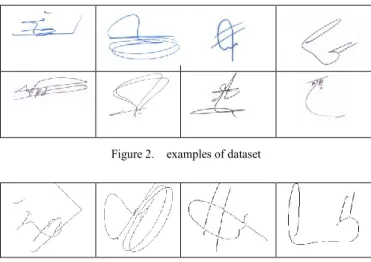
Figure 2 shows examples of database and figure 3shows the results ofthisprocess on these images.
Figure 2. examples of dataset
Figure 3. after preprocessing
IV. FEATURE EXTRACTION
The feature set is actually the input vector of Neural Network. So the learning of our classifier is depending on the input vector. The features we choose are very important for our recognition system and they must be proper enough for the classifier.
The features we use in this paper are as followed: a. Global features
1. Loop counter: the number of main loops in each signature is usually different from one signature to another. We use this feature in our system and achieve nearly 5% improvement in recognition ratio.
2. Signature height-to-width ratio:the ratio of height to width of signature gives us a value which is usually equal for each person.
3. Signature Area: this feature shows the number of signature’s pixels and it shows the density of signature.
4. The Trisurface feature: we divide signatures into three parts so that we have the area of each part and it is useful when the whole area of different signatures is the same. We name this feature,„Trisurface‟ .
5. Maximum horizontal and maximum vertical histogram: calculation of row’s and column’s horizontal and vertical histograms can be a good feature for different signatures. Finally we take the highest values asmaximum horizontal and maximum vertical histogram.
6. Horizontal and vertical center of the signature: To calculate the horizontal and vertical center of the signature, we used this way: scan column wise. For each column, those row index values, which are having black pixels, are added in the row_index_sum. Also a counter is incremented each time a black pixel in any row is found for that particular column. The same step is performed for all the columns. Cx=row_index_sum / total black pixels encountered. Scan row wise. For each row those column index values, having black pixels are added in column_index_sum. Also the counter is incremented each time a black pixel is encountered. The same step is performed for all the rows. Cy=column_index_sum/total black pixels encountered. Centre is calculated by formula (Cx+1) * total column in signature+Cy. This center as cell value is stored as center feature.
7. Edge point number of the signature: Edge point is the pixel of the signature withonly one neighbor, in 8-neighbors. b. Texture features 1. Texture homogeneity H: H = {P(i, j)}2 G−1 j=0 G−1 i=0 (1)
This feature shows
thehomogeneityorsimilarityofoccurrencematri xwithdiagonalmatrix. 2. Texture contrast C: C = n2. P(i, j) G−1 j=0 G−1 i=0 , i − j = n G−1 i=0 (2) It shows localintensitychangesineachpixelanditsneighb ors. 3. Texture entropy E: 𝐸 = 𝑃(𝑖, 𝑗) 𝐺−1 𝑗 =0 𝐺−1 𝑖=0 . log{𝑃(𝑖, 𝑗)} (3) This feature shows entropy of each image. 4. Texture correlation O: O = i. j. P i, j − (mi. mj) σi. σj G−1 j=0 G−1 i=0 (4) It shows thecorrelation of each pixelwith theneighboringpixelsin theimage.
c. Mask features
Mask features provide information about directions of the lines of the signatures. The angles of the signatures have interpersonal differences. In this system 4 different 3x3 mask features are used. Each mask is taken all around the signatures and the numbers of 3x3 parts of the signature, which are same with the mask, is calculated and so that the result is 4 features which, define angles of 45, 90, 180 and 315.
These features have noted all differences of signatures to detect the signers in high percentage.
V. CLASSIFICATION
In signature classification we should recognize the signer of a signature. So the input of classification system is a matrix of signature’s features and the output is a number which means the signer of that signature.
The main reason for the wide usages of neural networks for pattern recognition is the high ability of that which can model the complicated functions and it is easy to use.We use multilayer perceptron with one input layer, one hidden layer and one output layer.
The input layer includes17 neurons which is the number of features. The output layer has 50 neurons because of 50 kinds of signatures which mean50 persons.
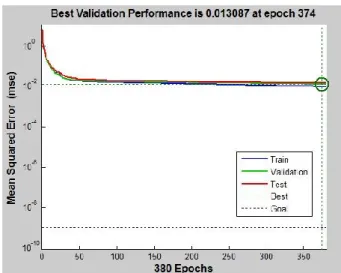
Inamulti-layerperceptronwithahiddenlayer, when deciding is on thetrainingfeatures, the problem is converting to decideonthe number of units inthe middle layer. Ascan be seen,the bestnetwork performanceis shownin Figure4. To findout the mostappropriatenumber of neurons we check the system for different number of neurons. Figure 5 shows the overallscheme of proposed multilayer neural network, thenumber of neuronsis110with a value of0.0130. Excitationfunctionsofthe middle layerandoutput layerofhyperbolictangentlineis selected.Three methodsfornetwork training have been investigated 1- Back propagation 2- Conjugate Gradient Descentand3- Levenberg-Marquardt.Theresults inTable 2 show that thebestperformancewiththe goodnumber ofiterations is for Back Propagation method.
Figure 4. Performanceof neural network with 1 hidden layer.
Figure 5. Proposed architecture of Multilayer neural network with 1 hidden layer and 110 neuron.
TABLE I. PERFORMANCE OF THE NETWORK WITH THREE LEARNING ALGORITHM
Network performance Timing (second) Iterations number Learning algorithm
0.0130 48 380 Back Propagation 0.2319 100 1680 Conjugate Gradient Descent 0.2010 100 190 Levenberg-Marquardt
VI. EXPERIMENTALRESULTS
We use 14 signatures of each person and totally 700signatures. We have 196 signatures with high similarity and we also give their features independently to the system and the result is 94.64%.
The 504 other signatures have classification ratio of 93.1% independently and finally when we give all 700 signatures as inputs to our classifier we can classify them with ratio of 84%.
Table.3 shows the performance of our classifier for 196 similar signatures belong to 14 persons, 504 other signatures belong to 36 persons and the recognition ratio for recognizing all of these 700 signatures belong to 50 persons.
TABLE II. PERFORMANCE OF CLASSIFIER FOR THREE SETS OF SIGNATURES Number of signers Number of signatures Recognition ratio (%) 14 196 95 36 504 91 50 700 85
(Paigwar et al., 2013) have reported 81.5% correct classification ratio using Neural Network and the signers number was 10.(Hairong et al., 2005)proposed a method with 94.8% correct classification ratio using SVM and the authors use 25 original signatures for each user. The number of signers is similar to our signers number but the result of our work is better.( Martinez et al.,2006)described an approach that obtains 66.5% correct classification ratio using SVM and 45.2% correct classification ratio using Neural Network. The number of users of these authors is 38. (I.A. Ismail et al.,2008)proposed verification system for 18 persons and reported 84% recognition ratio.(Özgündüz et al., 2008) have reported 75% correct classification ratio using neural network and 95% correct classification ratio using SVM. The user numbers of these authors is 70. In addition to the high efficiency of our method, the classifiers we use are simpler and the signatures we use for training the system are not a lot so the classifier can work faster and this method can be used in realisticapplications. The features we use are adequate so that ourapproach is muchsimpler and efficient based on the classifiers we use.
Table.4 shows thesepapers results and compare them with our results.
TABLE III. OTHER PAPERS RESULTS
Method Classifier Classification
ratio(%)
Hairong et al.[6] SVM 94.8
Martinez et al.[7] Neural Network 45.2
Martinez et al.[7] SVM 66.5
Özgündüz et al.[2] Neural Network 75
Özgündüz et al.[2] SVM 95
Piagwat et al.[8] Neural Network 81.5
Ismail et al. [5] Neural Network 84
VII. CONCLUSION
In this paper we propose and present a new system for signature recognition which is based on three steps: preprocessing which makes signatures standard and ready for next step, feature extraction which includes three groups of features: global features, texture features and mask features which are completely covers all aspects of signatures and finally a proper classifier. According to the low amount of features this result is very acceptableespecially in recognition of signatures with high similarity.It means the preprocessing stage was suitable, the extracted features are so useful and the optimal parameters are chosen for classifier.The recognition results of this paper provethat the method we use combined with Neural Network classifier can result well.
REFERENCES
[1]S.Fazli ,Sh.Pouyan and M.Moghaddam, “High-Performance Signature Recognition Methodusing SVM”, International Journal of advanced studies in Computer Science and Engineering, Volume 3, Issue 11, November 2014.
[2]- E. Özgündüz,T,Şentürk and M. Elif Karslıgil, “OFF-Line Signature Verification and Recognition by Support Vector Machine”,Document Analysis and RecognitionI,NinthInternational Conference on,Volume 2,pages 734-738,23-26 Sep 2008.
[3] Manoj Kumar, “Signature Verification Using Neural Network”, International Journal on Computer Science and Engineering (IJCSE),1498-1504,Sep 2012.
[4] H. Baltzakis- N. Papamarkos, “A new signature verifcation technique based on a two-stage neural network classifier”, Engineering Applications of Arti®cial Intelligence14, 95-103,2001.
[5] I . A. Ismail, M . A. Ramadan, T. El danf, A. H. Samak,“Automatic Signature Recognition And Verification Using Principal Components Analysis”, Fifth International Conference on Computer Graphics, Imaging and Visualization,Pages 356-361,2008.
[6] Hairong Lv, Wenyuan Wang, Chong Wang, Qing Zhuo ,“Off-line Chinese signature verification based on support vector machines”, Pattern Recognition Letters 26 ,2390–2399,2005.
[7]- E.F.Martinez, A.Sanchez and J.Velez, “Support Vector Machines versus Multi-Layer Perceptrons for Efficient Off-Line Signature Recognition”,Engineering Applications of Artificial Intelligence,Volume 19, Issue 6, Pages 693–704, Sep 2006.
[8]-Paigwar Shikha and Shukla Shailja, “Neural Network based offline signature recognition and verification system ” ,Research Journal of Engineering Sciences,Vol. 2(2),Pages 11-15, February 2013.