Survey on ABS Supporting Secure
Deduplication of Encrypted Data in Cloud
Priyanka Bhosale, Prof. S. H. Patil
PG Students at Dept. of Computer Engineering, JSCOE Hadapsar, Pune, Maharashtra, India
Asst. Professor at Dept. of Computer Engineering, JSCOE Hadapsar, Pune, Maharashtra, India
ABSTRACT: In public cloud storage system protecting the data and controlling the data access is a challenging issue. Cipher text Policy Attribute-Based Encryption (CP-ABE) has been adopted as a promising technique to provide flexible, fine-grained and secure data access control for cloud storage with honest-but-curious cloud servers. However numerous works have been proposed using CP-ABE scheme, in which the single attribute authority must execute the time-consuming user legitimacy verification and secret key distribution and hence it results in a single-point performance bottleneck when a CP-ABE scheme is adopted in a large-scale cloud storage system. Clients may be stuck in the waiting line for a long stretch to get their mystery keys, which results in low-efficiency of the framework. Even though the multi authority access control plans have been proposed, these plans still cannot conquer the disadvantages of single-point bottleneck and low efficiency; because of the way that each of the authority still autonomously deals with a disjoint characteristic set. In order to overcome this disadvantage, there has been proposed a novel heterogeneous framework to remove the problem of single point performance bottleneck and provide a more efficient access control scheme with an auditing mechanism. Meanwhile, in this scheme, a CA (Central Authority) is introduced to generate secret keys for legitimacy verified users and each of the authorities in this scheme manages the whole attribute set individually. This system makes performance improvement in key generation and also guarantees security requirement. Still there are some security loopholes in this system such as there is no protocol to verify owner and If the owner is compromised then he/she may put wrong data or information in the data server and users may get wrong data. There is no way to know who has used the data.CA who generates secret keys, is assumed to be fully trusted ,If CA gets compromised he can collude with any user or AA to provide secret keys to illegitimate users. In order to overcome these disadvantages, we are going to propose a new framework where there will be a protocol to verify owner and his/her data to be uploaded and a log will be maintained to know who will be accessing the data. This framework will also propose to choose one among the AAs to act as CA instead of separate CA and will have an observer to trace if CA is working properly or not. If observer finds any discrepancy it will be creating a report. This will make the system more secure and efficient.
KEYWORDS: ABE, De-dupllication, storage.
I. INTRODUCTION
The most important and popular cloud service is data storage service. Cloud users upload personal or confidential data
provide the secret key to data user then authorized party (AP) send the secret key to data owner. Both AP key and private key generate the encrypted key for encryption. AES algorithm using the encrypt content stored in cloud.
The standard ABE system fails to achieve secure deduplication which is a technique to save storage space and network bandwidth by eliminating redundant copies of the encrypted data stored in the cloud. On the other hand, to the best of our knowledge, existing constructions, for secure deduplication are not built on attribute-based encryption. Nevertheless, since ABE and secure deduplication have been widely applied in cloud computing, it would be desirable to design a cloud storage system possessing both properties. We consider the following scenario in the design of an attribute-based storage system supporting secure deduplication of encrypted data in the cloud, in which the cloud will not store a file more than once even though it may receive multiple copies of the same file encrypted under different access policies. However, endowing such a tag checking ability to the private cloud is not sufficient to achieve deduplication in the attribute-based storage system which employs CP-ABE for data encryption. In the proposed attributed-based system, the same file could encrypted to different cipher texts associated with different access policies, storing only one cipher text of the file means that users w hose attributes satisfy the access policy of a discarded cipher text (but not that of the stored cipher text) will be denied to access the data that they are entitled to. To overcome this problem, we equip the private cloud with another capability named ciphertext regeneration. Concerning the adversarial model of our storage system, we assume that the private cloud is “curious-but-honest” such that it will attempt to obtain the encrypted messages but it will honestly follow the protocols, whereas the public cloud is distrusted such that it might tamper with the label and ciphertext pairs outsourced from the private cloud (note that such a misbehavior will be detected by either the private cloud or the user via the accompanied label). Another difference between the private cloud and the public cloud is that the former cannot collude with users, but the latter could collude with users. This assumption is in line with the real world practice where the private cloud is trusted more than the public cloud. We assume that data users may try to access data beyond their authorized privileges. In addition to trying to obtain plaintext data from the cloud, malicious outsiders may also commit duplicate faking attacks as described before. We can deduce that both security and performance are critical for the next generation large-scale systems, such as clouds. There-fore, in this project, we collectively approach the issue of security and performance as a secure data replication problem. We present Division and Replication of Data in the Cloud for Optimal Performance and Security that judicially fragments user files into pieces and replicates them at strategic locations within the cloud. The division of a file into fragments is performed based on a given user criteria such that the individual fragments do not contain any meaningful information. Each of the cloud nodes (we use the term node to represent computing, storage, physical, and virtual machines) contains a distinct fragment to increase the data security.
II. LITERATURE SURVEY
Hadoop Cluster so that the response time will be acceptable for each job. In this Deduplication techniques are most widely employed to backup data and minimize network and storage overhead by detecting and eliminating redundancy among data. So which is crucial for eliminating duplicate copies of identical data in order to save storage space and network bandwidth? We present an attribute-based storage system with secure deduplication in a hybrid cloud setting, using public cloud and private cloud. Where a private cloud is responsible for duplicate detection and a public cloud manages the storage. Instead of keeping multiple data copies with the same content, the system eliminates redundant data by keeping only one physical copy and referring other redundant data to that copy. Each such copy can be defined based on user access policies. In this user will upload the file with access policies and then file type question with answer [8]. Then same file with different access policies to set the particular file to replace the reference. Where a user’s private key is associated with an attribute set, a message is encrypted under an access policy over a set of attributes, and a user can decrypt a ciphertext with his/her private key if his/her set of attributes satisfies the access policy associated with this ciphertex.
III. PROBLEM STATEMENT
An inherent drawback of the existing approaches to achieve secure de-duplication is that they cannot satisfy the standard security definition for confidentiality such as semantic security. To solve this problem, a weaker security notion called privacy under chosen-distribution attacks was put forward under the assumption that the input message is sufficiently unpredictable. We present Division and Replication of Data in the Cloud for Optimal Performance and Security (DROPS) that judicially fragments user files into pieces [10] and replicates them at strategic locations within the cloud.
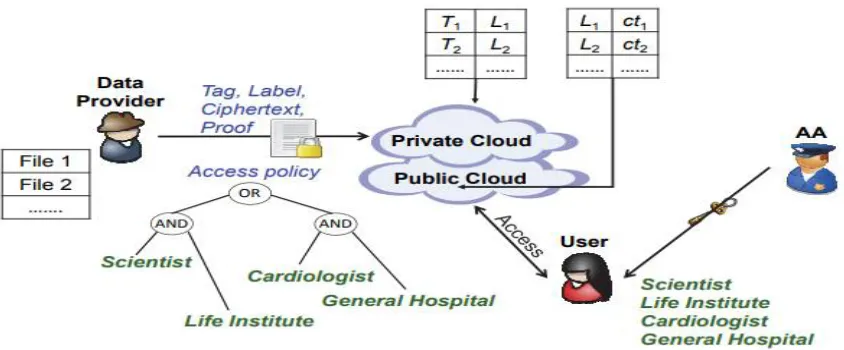
IV. SYSTEMARCHITECTURE
Figure 1. System architecture
V. ALGORITHM
Setup, Encrypt, Key Generation (KeyGen), and Decrypt.
1. Setup(1,λ) → (pars, msk). Taking the security parameter λ as the input, this setup algorithm outputs the public
parameter pars and the master private key msk for the system.
2. Encrypt(pars, M, A)→ (skT , CT). Taking the public parameter pars, a message M and an access structure A over the
universe of attributes as the input, this encryption algorithm outputs a trapdoor key skT and a tuple CT = (T, L, ct, pf), where T and L are the tag and the label associated with M respectively, ct is the ciphertext which includes the encryption of M as well as the access structure A, and pf is a proof on the relationship of tag T, label L and ciphertext ct. This algorithm is run by the data provider. Both skT and CT are forwarded to the private cloud. Note that skT can not be disclosed to any third party, so it must be sent to the private cloud in a secure manner.
KeyGen(pars, msk, A) → skA. Taking the public parameter pars, the master private key msk and an attribute set A as
the input, this attribute-based private key generation algorithm generates an attribute based private key skA for the attribute set A.
data ownership verification, scheme optimization with hardware acceleration at IoT devices for practical deployment, and development of a flexible solution to support deduplication and data access controlled by either the data owner or its representative agent.
REFERENCES
1. D. Quick, B. Martini, and K. R. Choo, Cloud Storage Forensics. Syngress Publishing / Elsevier, 2014. [Online]. Available: http://www.elsevier.com/books/cloud-storageforensics/ quick/978-0-12- 419970-5
2. K. R. Choo, J. Domingo-Ferrer, and L. Zhang, “Cloud cryptography: Theory, practice and future research directions,” Future Generation Comp. Syst., vol. 62, pp. 51–53, 2016.
3. K. R. Choo, M. Herman, M. Iorga, and B. Martini, “Cloud forensics: State-ofthe-art and future directions,” Digital Investigation, vol. 18, pp. 77–78, 2016.
4. Y. Yang, H. Zhu, H. Lu, J.Weng, Y. Zhang, and K. R. Choo, “Cloud based data sharing with fine-grained proxy re-encryption,” Pervasive and Mobile Computing, vol. 28, pp. 122–134, 2016.
5. D. Quick and K. R. Choo, “Google drive: Forensic analysis of data remnants,” J. Network and Computer Applications, vol. 40, pp. 179–193, 2014. 6. M. Islam, M. Kuzu, and M. Kantarcioglu, “Access pattern disclosure on searchable encryption: Ramification, attack and mitigation,” In Proc.of
NDSS’12, 2012.
7. C. Wang, K. Ren, S. C. Yu, and K. M. R. Urs, “Achieving Usable and Privacy-assured Similarity Search over Outsourced Cloud Data,” in Proc. of IEEE INFOCOM 2012, 2012, pp. 451-459.
8. N. Cao, C. Wang, M. Li, K. Ren. W. J. Lou, “Privacy-Preserving Multi-keyword Ranked Search over Encrypted Cloud Data,” in Proc. of IEEE INFOCOM 2011, 2011, pp. 829-837
9. J. Li, Q. Wang, C. Wang, N. Cao, K. Ren, and W. j. Lou, “Fuzzy keyword search over encrypted data in cloud computing,” in Proc. of IEEE INFOCOM’10 Mini-Conference, San Diego, CA, USA, March 2010.
10. C. Liu, L. H. Zhu, L. Li, and Y. Tan, “Fuzzy Keyword Search on Encrypted Cloud Storage Data with Small Index,” in Proc. of IEEE International Conference on Cloud Computing and Intelligence Systems (CCIS), 2011, pp. 269-273.