A Secured Authorized Data DE Duplication in
Cloud using Hash based Message Authentication
Code
S. ArunKumar N. Deepath
Department of Information Technology Department of Information Technology KCG College of Technology, Chennai 600097 KCG College of Technology, Chennai 600097
G.Sandeep Prof Mr. B.Hariharan
Department of Information Technology Assistant Professor
KCG College of Technology, Chennai 600097 Department of Information Technology KCG College of Technology, Chennai 600097
Abstract
Data Deduplication is a technique of reducing the storage space of data by eliminating the duplicate copies of the data. To maintain the security of data while duplicate check of encryption techniques is proposed. The existing deduplication technique uses a file level deduplication technique which is not in efficient manner for identifying and removing the identical files. In the proposed system block level data deduplication techniques for hashing the content of the file and to find the duplication. Hash based Message Authentication Code (HMAC) for hashing the data. For specialized user the duplicate files can be uploaded normally, but for normal users duplicated files can be uploaded by using the key generated by the admin. The proposed authorized duplicate check scheme incurs minimal overhead compared to normal operations..
Keywords: Data Deduplication, H-MAC, Hashing
________________________________________________________________________________________________________
I. INTRODUCTION
Cloud computing is a kind of Internet-based computing that deliver shared processing resources and data to computers and other devices on demand. It is a model for enabling global, on-demand access to a shared pool of configurable computing resources. Cloud storage is usually used to store a huge amount of data’s by various number of people. Data deduplication is one of the important factor to maintain in the cloud which eliminates the duplicate copies of data and saves the storage space. In hybrid cloud approach of secure authorized deduplication[1] is a well known technique to save the amount of storage space by eliminating the redundant data and to save the network bandwidth.
Data Deduplication is one of the hottest technologies in storage right now since it reduces the storage costs to store the data and on the bandwidth costs to move the data when replicating it. This is the great advantage for cloud providers, because of string less data less hardware is needed. If one can duplicate the data what you store , they can better utilize the existing storage space. The main idea of this method is reducing the storage needs by eliminating redundant data. Only one unique instance of the data is actually retained on storage media such as disks, or tape. Redundant data is replaced with a pointer to the unique data copy. For example, an email system might contain 10 instances of the same one megabyte (
MB
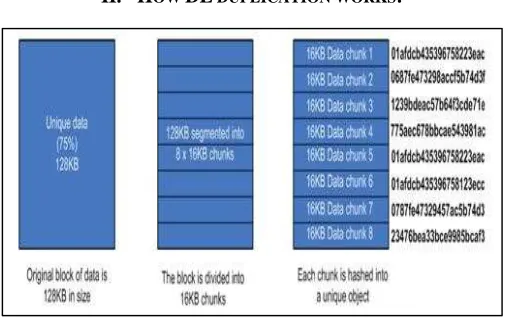
) file attachment.In simplified terms, data deduplication compares objects (usually files or blocks) find the duplicate object and removes duplicate objects ( that already exist in the data set). The deduplication process eliminates blocks that are not unique. The process consists of four steps:
Divide the input data into blocks or “chunks.” Generate hash value for each block of data.
Use these hash values to identify if another block of same data is already stored. Replace the duplicate data with a reference to the object already in the database.
Once the data is chunked, an index (hash value) can be created from the results, and the duplicate file can be found and eliminated. Only a single data of every chunk is stored.
The deduplicated data is secured by eliminating the duplicate copies of storage data. To reduce storage space and upload bandwidth in cloud storage deduplication has been a well-known technique.[3]
III. RELATED WORKS
Many people now store large quantities of personal and corporate data on Personal Computers. These often have unstable connectivity, and are vulnerable to theft or to hardware failure. Conventional backup solutions are not well adapted to this environment, and backup regimes are frequently inadequate, an algorithm which takes advantage of the data which is common between users in order to improve the speed of backups, and to reduce the storage requirements. [4]
Message-Locked Encryption (MLE), where the key under which encryption and decryption operation are performed itself obtained from the message. MLE provides a way to establish secure deduplication (secure data deduplication), a goal currently targeted by various cloud-storage providers.
Secure deduplication is a technique for removing duplicate copies of storage data, and provides security to that stored data. To reduce storage space and upload bandwidth in cloud storage deduplication has been a well-known technique. The basic idea is that we can remove duplicate copies of storage data and control the damage of stolen data if we decrease the value of that stolen information to the attacker. This makes the first attempt to address the problem of achieving efficient and reliable key management in secure deduplication. [3]
IV. ARCHITECTURE
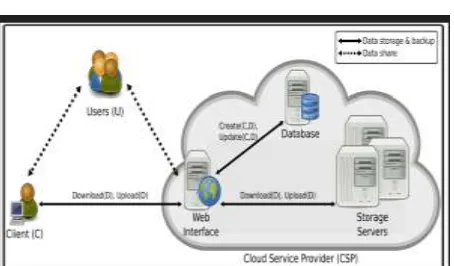
Fig. 2: Architecture for secured authorized data DE duplication in cloud using hash based message authentication code.
Proposed Work:
The duplicate file in the cloud can be removed by HMAC code and saves the storage space by removing redundant file. This proposed type of duplication is done in the block level which is used to find the duplicate copies of data.
The security of data is another important factor which is found using the AES encryption algorithm. The file which is stored in the folder is encrypted and then it is stored which provides security to the data
File Encryption:
Here we are using the secret key k to encrypt as well as decrypt data. This will use to convert the plain text to encrypted text and again encrypted text to plain text. Here we have used three basic functions,
1) Key Generation: k is the key generation algorithm that generates κ .
2) Encryption (k, M): C is the symmetric encryption algorithm that takes the secret key k and message from the data M and then outputs the cipher text C;
AES Encryption:
Fig. 3: steps involved in AES encryption algorithm
Steps of AES Encryption Standard:
1) Derive the set of round keys from the cipher key. 2) Initialize the state array with the block data of plaintext. 3) Add the initial round key to the starting state array. 4) Execute nine rounds of state manipulation.
5) Execute the tenth and final round of state manipulation.
6) Copy the final state array out as the encrypted data (cipher text).
Content based Hashing:
Hashing: Input the file and chunk the file into blocks, create hash value.
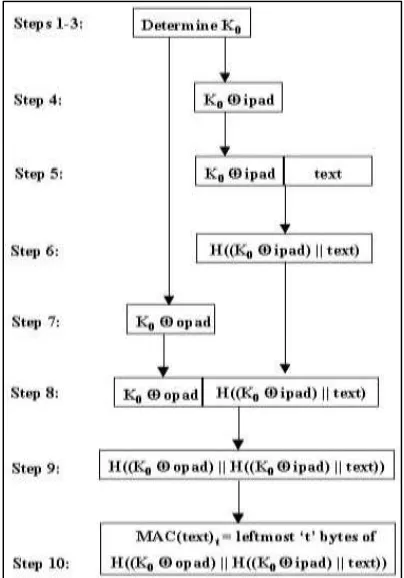
Algorithm Steps:
Step 1: If the length of K = B, set K0 = K. Go to step 4.
Step 2: If the length of K > B, hash K to obtain an L byte string: K = H(K).
Step 3: If the length of K < B, append zeros to the end of K to create a B-byte string K0 Step 4: Exclusive-Or K0 with ipad to produce a B-byte string: K0 (EXOR)ipad. Step 5: Append the stream of data 'text' to the string resulting from step 4: (K0 (EXOR) ipad) || text.
Step 6: Apply H to the stream generated in Step 5: H((K0 (EXOR)ipad) || text). Step 7: Exclusive-Or K0 with opad: K0 (EXOR )opad.
Step 8: Append the result from step 6 to step 7: (K0 (EXOR )opad) || H((K0 (EXOR )ipad) || text). Step 9: Apply H to the result from step 8:
H((K0(EXOR )opad )|| H((K0(EXOR )ipad) || text)).
Step 10: Select the leftmost t bytes of the result of step 9 as the MAC.
Implementation
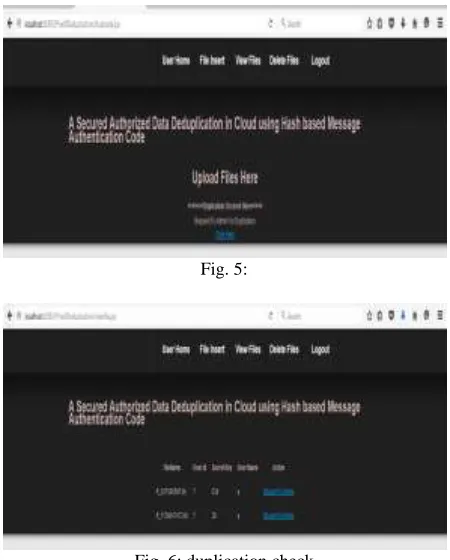
Fig. 5:
Fig. 6: duplication check
File is uploaded to the server
Uploaded file is hashed based upon the content of the file using HMAC algorithm. Duplicate check performed using HMAC hash value.
Future work
It excludes the security problems that may arise in the practical deployment of the present model. Also, it increases the national security. It saves the memory by deduplicating the data and thus provides us with sufficient memory. It provides authorization to the private firms and protects the confidentiality of the important data
V. RESULT AND CONCLUSION
REFERENCES
[1] Jin Li, Yan Kit Li, Xiaofeng Chen, Patrick P. C. Lee, Wenjing Lou. A Hybrid Cloud Approach for Secured Authorized Deduplication. In IEEE Transactions
on Parallel and Distributed Systems, 2014.
[2] J. R. Douceur, A. Adya, W. J. Bolosky, D. Simon, and M. Theimer. Reclaiming space from duplicate files in a serverless distributed file system. In ICDCS,
pages 617–624, 2002.
[3] J. Li, X. Chen, M. Li, J. Li, P. Lee, andW. Lou. Secure deduplication with efficient and reliable convergent key management. In IEEE Transactions on Parallel
and Distributed Systems, 2013.
[4] P. Anderson and L. Zhang. Fast and secure laptop backups with encrypted de-duplication. In Proc. of USENIX LISA, 2010.