
Electronic Theses and Dissertations Theses, Dissertations, and Major Papers
2017
Knowledge Migration Strategies for Optimization of
Knowledge Migration Strategies for Optimization of
Multi-Population Cultural Algorithm
Population Cultural Algorithm
Panth Parikh
University of Windsor
Follow this and additional works at: https://scholar.uwindsor.ca/etd
Recommended Citation Recommended Citation
Parikh, Panth, "Knowledge Migration Strategies for Optimization of Multi-Population Cultural Algorithm" (2017). Electronic Theses and Dissertations. 6008.
https://scholar.uwindsor.ca/etd/6008
This online database contains the full-text of PhD dissertations and Masters’ theses of University of Windsor students from 1954 forward. These documents are made available for personal study and research purposes only, in accordance with the Canadian Copyright Act and the Creative Commons license—CC BY-NC-ND (Attribution, Non-Commercial, No Derivative Works). Under this license, works must always be attributed to the copyright holder (original author), cannot be used for any commercial purposes, and may not be altered. Any other use would require the permission of the copyright holder. Students may inquire about withdrawing their dissertation and/or thesis from this database. For additional inquiries, please contact the repository administrator via email
by
Panth Parikh
A Thesis
Submitted to the Faculty of Graduate Studies
through the School of Computer Science
in Partial Fulfillment of the Requirements for
the Degree of Master of Science at the
University of Windsor
Windsor, Ontario, Canada
2017
c
by
Panth Parikh
Approved by
M. Khalid
Department of Electrical and Computer Engineering
M. Kargar
School of Computer Science
Z. Kobti, Advisor
School of Computer Science
Declaration of Previous
Publication
This thesis includes 1 original paper that have been previously published/
submitted for publication in peer reviewed conference, as follows:
Section Full Citation Publication status
3.3.1 Panth Parikh and Ziad Kobti. ”Comparative strategies for
knowledge migration in multiobjective optimization
prob-lems”. In 2017 IEEE 30th Canadian Conference on
Elec-trical and Computer Engineering , Windsor, Canada, 2017.
Accepted
I certify that I have obtained a written permission from the copyright owner to
include the above published material in my thesis. I certify that the above material
describes work completed during my registration as a graduate student at the
University of Windsor.
I declare that, to the best of my knowledge, my thesis does not infringe upon
anyone’s copyright nor violate any propriety rights and that any ideas, techniques,
quotations, or any other material from the work of other people included in my
thesis, published or otherwise, are fully acknowledged in accordance with the
standard referencing practices. Furthermore, to the extend that I have included
copyright material that surpasses the bounds of fair dealing within the meaning of
Canada Copyright Act, I certify that I have obtained a written permission from the
copyright owner to include such material in my thesis.
I declare that this is a true copy of my thesis, including any final revisions, as
approved by my thesis committee and the Graduate Studies Office, and that this
thesis has not been submitted for a higher degree to any other University or
Abstract
Evolutionary Algorithms (EAs) are meta-heuristic algorithms used for optimization
of complex problems. Cultural Algorithm (CA) is one of the EA which incorporates
knowledge for optimization. CA with multiple population spaces each incorporating
culture and genetic evolution to obtain better solutions are known as
Multi-Population Cultural Algorithm (MPCA). MPCA allows to introduce a
diversity of knowledge in a dynamic and heterogeneous environment. In an MPCA
each population represents a solution space. An individual belonging to a given
population could migrate from one population to another for the purpose of
introducing new knowledge that influences other individuals in the population.
In this thesis, we provide different migration strategies which are inspired from
game theory model to improve the quality of solutions. Migration among the
different population in MPCA can address the problem of knowledge sharing among
population spaces. We have introduced five different migration strategies which are
related to the field of economics. The principal idea behind incorporating these
strategies is to improve the rate of convergence, increase diversity, better
exploration of the search space, to avoid premature convergence and to escape from
local optima. Strategies are particularly taken from the economics background as it
allows the individual and the population to use their knowledge and make a decision
whether to cooperate or to defect with other individuals and populations. We have
tested the proposed algorithms against CEC 2015 expensive benchmark problems.
These problems are a set of 15 functions which includes varied function categories.
Results depict that it leads a to better solution when proposed algorithms used for
problems with complex nature and higher dimensions. For 10 dimensional problems
the proposed strategies have 7 out 15 better results and for 30 dimensional problems
Dedication
Acknowledgments
There are many people to whom I would like to acknowledge for their help and
support for my journey of the master thesis.
First and foremost I would pay my gratitude to my supervisor Dr. Ziad Kobti.
Under his guidance, I had enjoyed a lot working on my research work. It was a
great pleasure to work and discuss with him. Without his support, this won’t have
been possible. I would also like to appreciate the amount of time he invested in me,
the funding he provided and also the knowledge he shared with me.
I would also like to thank Mrs. Gloria Menash, secretary of the director, who always
helped me arrange the meetings with my supervisor and constantly reminding about
the meetings I had with my advisor. Also, my sincere thanks to Mrs. Karen
Bourdeau, for help and support, and taking care of all the other issues related to my
master’s degree.
I am also very thankful to my friends for their moral support and listening to my
problems for long hours.
Finally, I would like to thank my parents for their unconditional love and support.
Contents
Declaration of Previous Publication iii
Abstract iv
Dedication v
Acknowledgments vi
List of Tables viii
List of Figures ix
1 Introduction 1
1.1 Evolutionary Computation . . . 2
1.2 Game Theory . . . 6
1.3 Research Motivation . . . 7
1.4 Thesis Contribution . . . 7
1.5 Thesis Outline . . . 8
2 Related Work 9 2.1 Literature Review . . . 9
2.1.1 Evolutionary Algorithm . . . 10
2.1.2 Genetic Algorithm . . . 11
2.1.4 Cultural Algorithms . . . 15
2.1.5 Multi-population Cultural Algorithm . . . 17
2.2 Game Theory Strategies . . . 19
2.2.1 Prisoner’s Dilemma . . . 19
2.2.2 Oligopoly . . . 20
2.2.3 Duopoly . . . 21
2.2.4 Fair Division . . . 21
2.2.5 Intra-household bargaining . . . 21
2.3 Multi-Population Cultural Algorithm . . . 22
2.3.1 A multi-population cultural algorithm for the electrical gener-ator scheduling problem . . . 22
2.3.2 Heterogeneous Multi-population Cultural Algorithm . . . 23
2.3.3 A novel Multi-population Cultural Algorithm Adopting Knowl-edge Migration . . . 25
2.3.4 Knowledge Sharing Through Agent Migration with Multi-Population Cultural Algorithm . . . 27
2.3.5 Promoting diversity using migration strategies in distributed genetic algorithms . . . 27
2.4 Game Theory in Evolutionary Algorithms . . . 28
2.4.1 An Evolutionary Game-Theoretical Approach to Particle Swarm Optimization . . . 28
2.4.2 Coevolution of cooperation and layer selection strategies in mul-tiplex networks . . . 29
2.5 Conclusion . . . 31
3 Proposed Approach 32 3.1 Multi-population Cultural Algorithm with Migration . . . 32
3.3 Migration Strategies . . . 36
3.3.1 Prisoners Dilemma . . . 36
3.3.2 Oligopoly . . . 36
4 Experiments 43 4.1 Benchmark Optimization Functions . . . 43
4.1.1 Unimodal Functions . . . 44
4.1.2 Simple Multimodal Functions . . . 45
4.1.3 Hybrid Functions . . . 48
4.1.4 Composite Functions . . . 50
4.2 Experimental Setup . . . 54
4.3 Results and Analysis . . . 56
4.4 Migration Strategy Analysis . . . 68
5 Discussions, Comparisons and Analysis 70 5.1 Comparison between M3, M4 and M6 . . . 70
5.2 Comparison between M2, M5 and M7 . . . 71
5.3 Comparison between M2, M4 and M8 . . . 72
5.4 Comparison between M2, M4 and M9 . . . 73
5.5 Comparison between M3, M4 and M10 . . . 74
6 Conclusions 76
Bibliography 78
List of Tables
Table 4.1 Parameter values for algorithms . . . 55
Table 4.2 Results for M1 - M10 on F1- F7 for 10D. . . 56
Table 4.3 Results for M1 - M10 on F8- F15 for 10D. . . 59
Table 4.4 Results for M1 - M10 on F1- F7 for 30D. . . 62
Table 4.5 Results for M1 - M10 on F8- F15 for 30D. . . 64
List of Figures
Figure 1.1 Pseudo-code for EA . . . 3
Figure 2.1 Architecture of CA . . . 15
Figure 2.2 Architecture of MPCA . . . 18
Figure 2.3 PARCA model . . . 23
Figure 2.4 HMP-CA Architecture . . . 24
Figure 2.5 The structure of MCAKM . . . 26
Figure 2.6 Schematic image of the model . . . 30
Figure 3.1 Architecture of our algorithm . . . 33
Figure 4.1 3-D map for Rotated Bent Cigar Function [31] . . . 44
Figure 4.2 3-D map for Rotated Discus Function [31] . . . 45
Figure 4.3 3-D map for Shifted Rotated Schwefel’s Function [31] . . . 46
Figure 4.4 3-D map for Shifted and Rotated Katsuura Function [31] . . . 46
Figure 4.5 3-D map for Shifted and Rotated HappyCat Function [31] . . . 47
Figure 4.6 3-D map for Shifted and Rotated HGBat Function [31] . . . 47
Figure 4.7 3-D map for Shifted and Rotated Expanded Griewank’s plus Rosenbrock’s Function [31] . . . 48
Figure 4.8 3-D map for Shifted and Rotated Expanded Scaffer’s F6 Function [31] . . . 49
Figure 4.9 3-D map for Composition Function 1 [31] . . . 52
Figure 4.113-D map for Composition Function 3 [31] . . . 53
Figure 5.1 Convergence performance of M3, M4 and M6 for F8 (30D) . . 71
Figure 5.2 Convergence performance of M2, M5 and M7 for F10 (30D) . . 72
Figure 5.3 Convergence performance of M1, M3 and M8 for F7 (30D) . . . 73
Figure 5.4 Convergence performance of M2, M4 and M9 for F2 (30D) . . 73
Introduction
Optimization is finding the best result by maximizing the desired factors and
minimizing the undesired ones. Optimization problems are the problems to find the
best solution from all the feasible solutions [5]. The optimization problem is applied
to a wide range of areas like energy utilization, supply chain management, job
scheduling, solving mathematical problems and much more. Optimization problems
are distinguished by their goals of minimization and maximization. Evolutionary
algorithms (EA) has been used widely by the researchers to solve the optimization
problems. EA optimizes the problem efficiently as it contains the search space and
searches for the best possible solution in it [48]. The solutions can be either near
optimal or optimal. EA allows the exploration and exploitation of the search space.
Exploration helps to search the whole space and exploitation helps the solution to
mutate and generate offspring. The problem with EA is that it can fall into local
optima (solutions think its optimal solution, but it is not) and easily lose diversity
(solutions creates clones). Diversity can be maintained among the population by
using Multi-Population Cultural Algorithm(MPCA). MPCA is a class of EA which
is most widely used to solve multi-objective problems. Introducing migration in
from one population to another enhances the searching of unsearched spaces which
shows good potential for better solutions.
Game Theory strategies are the strategies which are used in games by the players to
cooperate or defect with the other players playing the game [13]. Game theory
strategies bring in the social factor which makes the player make a decision about
cooperating or defecting with other players for their benefit and increase their
playoffs [46]. Using game theory strategies for migration in MPCA can provide the
balance between exploration and exploitation in evolutionary algorithms. It can
make better use of the knowledge possessed by the individuals in the population to
make a decision of cooperating with some other individuals for their benefit and to
generate better results. The combination of this two different fields can cover the
major aspects of diversity, escaping from local optima, premature convergence,
exploration, and exploitation. This combination can lead to good results and
efficiently solve the optimization problems.
1.1
Evolutionary Computation
Evolutionary Computation (EC) is a set of an algorithm which is inspired by the
biological model of evolution. EC is sub-branch of artificial intelligence which is
used for metaheuristic and stochastic optimization of complex problems [48]. There
are various algorithms which come under EC, such as:
1. Cultural Algorithms
2. Genetic Algorithms
3. Differential Evolution
4. Particle Swarm Optimization
Evolutionary algorithms (EA) is a subset of EC, and hence they are also considered
as optimization algorithms. The common underlying concept in each evolutionary
algorithm is the same: given a set of the population under environmental pressure
causes natural selection. The fitness function measures the fitness of the candidates,
and the better candidates survive for the next generation, discarding the worst ones.
Evolution of each individual is carried out by applying mutation and recombination
operators on it. Mutation is applied on one candidate and as a result, we get one
new candidate while in recombination two candidates (called parents) are selected,
and it results in one or more new candidates (called offsprings). Mutation and
recombination operators lead to a new set of candidates (offsprings) which replace
the existing old candidates for the next generation. This process iterates until a
termination condition is achieved. Figure 1 depicts the pseudocode of the
evolutionary algorithm [14]. EA have been used by many researchers to solve the
multi-objective problems [8], data mining [16], management applications [3] and
much more.
Figure 1.1: Pseudo-code for EA
EA incorporating genetics into the process of evolution are known as Genetic
Algorithms (GA). GA are heuristic search algorithms based on evolutionary ideas of
abstract model of Darwinian evolution theory and biological genetics [24]. GA is
used by many researchers to solve various search and optimization problems.
However, a simple GA converges to a single optimum and is not suitable for
multi-modal optimization [2]. GA uses coevolution to evolve complex structures
which include explicit notions of modularity to provide a fair chance for complex
structures to evolve in the form of co-adopted subcomponents. This structure is
noticed when there is a need for rule hierarchies in classifier systems and
subroutines in genetic programming [45]. Coevolution can be described as two or
more individuals reciprocally affect each other in evolution. The major drawback of
coevolution is that it has a good chance of losing the diversity among the
population.
Differential Evolution (DE) is an EA which was designed by Storn and Price [45] to
solve the global optimization problems. Canonical DE was designed to deal with
continuous domain although it shows great performance on combinatorial
optimization problems. Although, it is not possible to apply DE directly on
continuous domains. Overall DE shows good performance on both space trajectory
optimization [49] and multi-area economic dispatch [43] as global optimization
problems and also on some permutation problems [34, 40, 51]. DE is one of the
popular EA due to its strong search space exploration [27]. DE makes use of
differential formulation mechanism for generating offspring from current generations.
All of the EAs are used to solve complex search and optimization problems, but
none of them uses knowledge of the agent to do so. To make use of the knowledge
possessed by the individuals or population Reynolds [41] introduced Cultural
Algorithms (CA). CA is an EA which incorporates knowledge to direct the search
process. CA show a large number of successful applications which depicts the
performance of knowledge-based EA. In CA the knowledge is extracted and
to find solutions with better quality and improves the convergence rate. CA is
inspired from the biological model of human culture and beliefs. Unlike other EAs,
CA has two components: population space and belief space. Population space is
consist of individuals in the population and belief space stores the knowledge of the
best individual of the population in the current generation. CA incorporates with
different knowledge like situational, topological, historical, normative and domain.
CAs with single population have a high chance of losing diversity and can be
difficult to implement on real world problems with the dynamic population. To
overcome this Multi-population Cultural Algorithm (MPCA) were introduced. The
major problem with standard EA used for dynamic optimization problems appears
to be that EA eventually converges to an optimum and loses its diversity which is
necessary for exploring the search space. Also, they also lose their ability to adapt
to the change in the environment. Therefore MPCA were introduced. Digalakis et.
al [11] first introduced MPCA to solve the electric generator scheduling problem.
MPCA consist of multiple populations which increases diversity in the population.
They resemble more with the real world problems where the nature of problems is
more dynamic and continuously varying over a range. In MPCA there are more
parameters which can be adjusted when compared to CA. MPCA also allows
exploring the large region of search space due to its widespread population.
Incorporating different sub-population can solve the complex optimization problems
with dynamic nature. To increase the convergence rate and to escape from local
optima, migration can be incorporated in MPCA. Migration can also increase the
diversity in the population and allows the topological knowledge to play its role in
1.2
Game Theory
Game theory is the study of how two players play the game with a defined set or
rules and regulations with an outcome [46]. Each player in a game would like to
have an outcome which provides him with a large number of playoffs as possible.
The player has some control over the outcome as his choice of strategy will influence
it. However, the outcome is not only influenced by one player choice but also from
the other players playing that game [46]. The player might cooperate or defect
depending upon the strategy they use. There is a good chance of conflict between
the players as a different player can use a different strategy. There is even a good
chance of cooperation as players may decide to cooperate with each other to obtain
an outcome with good playoffs for each player. Rational play can include a
complicated individual decision as each player will decide a strategy which is
favorable to the player itself, and also will be aware of the fact that other players
will choose a strategy which will be favorable to them [13]. It will also involve the
social decisions about how and with whom the player wants to cooperate for its
betterment.
Game theory is so useful because it comes from the generalization and abstraction
of the traditional games like chess, bridge, and poker. This abstraction and
generalization are powerful enough to deal with many varied social issues of the
society [46]. Companies following corporate strategies try to play a game. Similarly,
the political candidates try to win an election; the political parties try to defeat or
pass a bill, nations manipulating in the international arena and much more
scenarios. In our work, the biological species can be considered as a player in a
1.3
Research Motivation
The major motivation for the research has come from observing the optimization
techniques to solve the complex problems. While working on the optimization
techniques, we found there are many algorithms which can be used. The main
difficulty with most of the algorithm was that they were more problem specific and
less general. The existing algorithms try to solve the problem in static rather than
in dynamic way. After working in this field, we realized Multi-population Cultural
Algorithms (MPCA) shows a lot of potentials to solve the complex problems and
they resemble much with human culture. Exchange of knowledge among the
individuals in the environment can help them to explore and exploit the conditions
around them in a better way. We have tried to implement this idea in our work by
introducing some strategies for migration in MPCA for the better quality of results.
The migration strategies are inspired from the Game Theory model as they try to
solve economic decisions and game moves. In our thesis, we mostly focus on
implementing different migration strategies in MPCA for the better quality of
results.
1.4
Thesis Contribution
In our work, we aim to develop and evaluate different migration strategies to
improve the optimization of Multi-Population Cultural Algorithm. The migration
strategies are inspired from the Game Theory model. Migration strategies are
triggered at both individual and population level. Different migration strategies are
compared with each other to evaluate and identify the better strategy on its
performance of optimizing the complex problems. In our work, we hypothesize that
migration strategies in MPCA will lead to better performance in search
when individuals migrate from one subpopulation to another by using a particular
strategy will affect the whole population in a better way. We have developed our
MPCA framework based on the work done by Raessi [27] and implemented different
migration strategies to exchange cultural knowledge among populations. CEC 2015
[31] expensive benchmark functions have been used to test our framework and
compare it with other existing algorithms. Testing is done on both 10 and
30-dimensional functions of CEC. The functions consist of different types like
unimodal, simple multimodal, hybrid and composite functions.
1.5
Thesis Outline
The chapters of our research are organized in the following manner:
Chapter 1 contains the background, motivation and contribution of our research.
Chapter 2 describes in details the related work done in this field. It contains
literature review of Cultural Algorithms, Multi-population Cultural
Algorithms and Game theory model.
Chapter 3 describes the proposed algorithm with providing details of all the
strategies and its implementations.
Chapter 4 provides all the details of experimental approach which contains outline
of CEC functions, experimental setup and all the assumptions made.
Chapter 5 includes the evaluated results of the data mentioned in above chapter.
Chapter 6 includes the discussion in detail.
Chapter 2
Related Work
This chapter consists of all the related work used for the building of the fundamental
concepts, developing of our framework and architecture of our thesis. In this section,
we explain the literature related to Multi-Population Cultural Algorithm, Migration
and Game theory strategies. Also the research motivation and idea we got from the
published papers. The first section contains the Literature review of the related
algorithms like Cultural Algorithm, Genetic Algorithm, and Multi-Population
Cultural Algorithm. The second section of this chapter contains details of the game
theory strategies which we have used for migration in our algorithm. The third
section contains paper related to Multi-Population Cultural Algorithm and
migration while the last section consists of adoption of Game Theory in EA.
2.1
Literature Review
This section consists of detailed explanation about the evolutionary algorithm (EA),
different types of EA, Genetic Algorithm, Differential Evolution Cultural Algorithm
2.1.1
Evolutionary Algorithm
Evolutionary algorithms (EAs) are a subset of those methods which has been
successfully used in the past for optimization problems. EAs are generic
population-based meta-heuristic optimization algorithms inspired by the biological model of
evolution and the process of natural selection [14]. In EAs the population is
randomly initialized over specific search space which is called the initial population.
Then it incorporates evolutionary operators which include mutation and crossover.
This operator creates new offsprings from the parent in the population. The
selection operator selects the population with greater fitness from the parent and
offspring which serves as population for next generation. The left over individuals
are discarded from the population. This process continuous until the termination
criteria is fulfilled which can be either reaching a maximum number of predefined
generations or CPU time. EA are based on the simplified model of biological
evolution [14]. To solve a problem, a particular environment can be created where
potential solutions can evolve. Parameters of the problem shape up the environment
which helps to evolve a good solution. EAs are a group of a probabilistic algorithm
which is similar to the biological systems and artificial systems. There are many
types of EA such as:
1. Genetic Algorithm
2. Differential Evolution
3. Cultural Algorithm
2.1.2
Genetic Algorithm
Genetic Algorithms (GA) are a subset of EA; hence they are population-based
evolutionary algorithms. GA were first introduced by Holland [23] but became
popular after the works of Goldberg [4]. GA is mainly used to solve the search
related and other optimization problems. They are very useful when very less is
known about the domain. GA is consist of a group of individuals known as
population, and these individuals are used to find the optimal solution within the
specified search space. An initial random population is generated over the search
space and evolutionary operators like mutation, recombination and selection are
applied to them. In GAs after each generation, the best individuals are selected for
mutation, recombination, selection, and crossover. The individuals also exchange
knowledge among them by making use of the operators. GAs are very simple to
code, and the population is not initialized at one point. Instead, they are spread
across the search space for exploration. GAs use mutation, crossover, and selection
operator to achieve an optimal solution and enhance exploration and exploitation.
1. Selection :
The selection operator behaves similarly to the natural selection that is found
in biological systems. They select the best individuals in the current
generation based on their fitness. The individuals who are fitter are selected,
and the weaker are discarded from the generation. The fitter individuals have
a high chance of passing the knowledge from current generation to the next
generation.
2. Crossover :
This operator works similar to the biological model of reproduction. To
basis and are allowed to generate a new individual (offspring) in the next
generation. This operator enhances the exploration in the search space.
3. Mutation :
This operator is used to change or flip the solution of the individual, and
hence it is rarely used in GA.
GA are used to solve both constrained and non-constrained problems which are
based on natural selection. GA continuously modify the population in each
generation to achieve an optimal solution. GA have been used in many applications
like laser technology, image processing, VLSI, etc. GA are designed to solve the
stationary optimization problems, and according to this history, they have not
impressed much when applied to real world problems. GA also have disappointing
results when applied to the dynamic and heterogeneous environment. If GA is
applied to the dynamic environment, then there is a high chance of losing diversity
in the population.
2.1.3
Differential Evolution
We have used DE as our evolutionary algorithm in MPCA. DE has the mutation,
selection and crossover operators like every other EA. The major benefit of using
DE is that it has strong search space exploration. It incorporates a differential
formulation mechanism to generate offspring from the current individuals of the
generation [27]. This can provide diversity among the population and help to escape
from falling into local optima.
Differential Evolution (DE) is a subset of EA designed by Storn and Price [45] for
solving global optimization problems. The canonical DE was initially designed to
deal with continuous domains, but it also shows good performance on combinatorial
optimization [49] and multi-economic dispatch [43] as global optimization problems.
DE is one of the popular EA due to its good search space exploration [27]. It makes
use of differential formulation to generate offspring from the current generation. It
uses both mutation and crossover operators which are applied to all individuals of
all generations. Each individual who is also represented as a solution in the search
space is represented as a D-dimensional vector of real number values. This vector is
called the target vector denoted by Xi,g, the ith target vector of generation g:
Xi,g = [x1,i,g, x2,i,g, ..., xD,i,g] (2.1)
Where xj,i,g depicts the value for target vectorXi,g of dimension j in range 1 toD.
In each generation g the mutation operator is applied on each target vector Xi,g in
the generation to create the mutant vector Vi,g. There are many mutation strategies
for DE, while the most general one is defined in equation 3.2.
Vi,g =Xr1, g+F ∗(Xr2, g−Xr3, g) (2.2)
Where Xr1,g ,Xr2,g , and Xr3,g are three different vectors which are randomly
selected within the same generation g. Xr1,g is known as the base vector and two
other are known as perturbation vectors. F is a scale factor which is used to
determine the perturbation of the base vector Xr1,g.
In the equation 3.2 the mutant vector Vi,g is calculated without the consideration of
any value of target vector Xi,g, but modern equations may use the target vector
values or any of its information like locality. Since the general mutation strategy
includes random selected base vector and one level of perturbation it is called
DE/rand/1. Many different strategies are introduced by Price et al. [39].
A comparative study is been provided by Mezura-Montes et al. [33] to compare
that DE/best/1/binis the most competitive DE regardless of the problem domain.
Here, bin refers to the crossover operator which is described as follows and the
DE/best/1 is described in equation 3.3.
Vi,g =Xbest, g+F ∗(Xr1, g−Xr2, g) (2.3)
Where Xr1,g and Xr2,g are randomly selected target vectors within generation g,
Xbest,g represents the best solution within the same generation, and F is a scale
factor.
After implementing the mutation operator and generating the mutant of the target
vector, crossover operator is applied on both target and mutant vectors to generate
a trail vector Zi,g. The most popular and used crossover strategy is binomial
crossover for DE which is shown in equation 3.4.
Zj,i,g =
Vj,i,g ifrj ≤Cr or j =jrand
Xj,i,g otherwise
(2.4)
Where rj is random number uniformly distributed in (0,1] interval forjth dimension.
Cr is the crossover probability which could be kept fixed for all generations or
changing over the generations andjrand is a randomly selected index to make sure
that the trail vector Zi,g is different from target vector Xi,g in at least one
component.
Like all other evolutionary algorithms the final step is to implement the selection
operator in each generation. The selection operator selects the better solution
between the target vectorXi,g and trail vector Zi,g by comparing their objective
values. The selected solution is considered as target vector for the next generation
Xi,g+1 =
Zi,g if f(Zi,g)≤f(Xi,g)
Xi,g otherwise
(2.5)
2.1.4
Cultural Algorithms
Cultural Algorithm (CA) is an EA which is inspired by the model of the human
evolution process. It incorporates knowledge which is used to direct the search
spaces [41]. The knowledge is extracted by CA and then incorporated for benefiting
its search mechanism. The extracted knowledge helps the CA to find solutions with
better quality and also helps in improving the convergence rate.
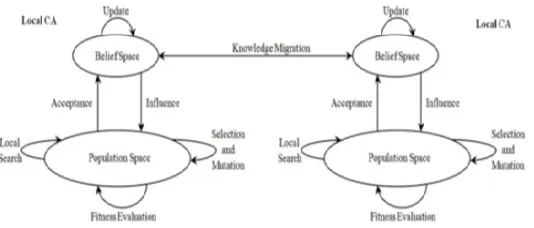
Figure 2.1: Architecture of CA
Figure 2.1 [42] illustrates the architecture of CA. As displayed in the figure, CA has
population space, unlike any other EA where individuals reside. This space is
managed by the EA like GA or DE. CA also has belief space which incorporates
with knowledge. This space stores and update the knowledge extracted over
generations. Both of the space communicate with each other by using the
acceptance and influence operators. The knowledge circulation is defined as below.
1. The belief space receives the top performing individuals in the generation g
2. The belief space updates its knowledge.
3. The belief space sends the update knowledge to the population space using
influence function in the next generation g+1.
4. The population uses the knowledge to generate offsprings for next generation
g+1 from current generation g.
5. The top individuals from the next generation g+1 are sent to the belief space
to update its knowledge.
This cycle continuous until the termination condition is reached. The population of
CA works like other EAs, but instead of using the random operators it uses
knowledge-based evolutionary operators. Cultural Algorithm consists of two
components [41].
1. Belief Space
2. Population Space
Belief Space
Belief space consists of different kinds of knowledge which are relevant to solving the
problem. Due to this belief space is divided into separate categories. These
categories contain different kinds of knowledge depending on which the population
poses in the search space. The belief space is a repository where the knowledge is
stored and is used by the population to obtain an optimal result. The belief space is
updated after every iteration by the best individual in the search space. Other
individuals in the population make use of this knowledge to move towards better
search space. Artificial belief space stores the knowledge which is gained during the
execution of the algorithm and makes use of it in the next generation and for its
1. Situational Knowledge
2. Normative Knowledge
3. Topological Knowledge
4. Historical Knowledge
5. Domain Knowledge
Population Space
Population component is the space which consist of the individual in the
population. The population component of CA is similar to that of GA. There are
two function which allows the individual to move from population space to belief
space and vice versa. The acceptance function transfers the best individual of the
population space into belief space. After that the belief space updates its knowledge
and updates the population space by making use of influence function. The
individuals in the population space makes use of this knowledge to generate
individuals for the next generation [28].
2.1.5
Multi-population Cultural Algorithm
Multi-population Cultural Algorithm (MPCA) can be considered as an extension of
cultural algorithms. They are used to solve the optimization problems similar to
CA. MPCA is CA incorporating multiple populations. The principle use of MPCA
is to solve the knowledge migration/ sharing problem faced by CA. Digalakis et al.
[11] were the first to introduce MPCA in their work to solve the electric generator
scheduling problem. In the first model of MPCA, only the best solutions coming
from each sub-populations were exchanged regarding migration rules. However, the
has a number of parameters to optimize when they are compared with the
traditional CAs. For example, the number of the subpopulations, the size of a
subpopulation, the migration rules and a number of individuals migrating. Guo et.
al [20] successfully implemented MPCA for the multi-modal optimization problem,
Yi-nan et al. [19] for interactive optimization and constrained optimization
problems. Alami et. al [2] also proposed a method of dividing the sub-population
based on fuzzy clustering and introduced the concept of cultural exchange between
the subpopulations. According to them, the cultural exchange meant to exchange
information among belief space of sub-populations. Hylnka et. al [22] also
implemented a method to migrate agent among sub-population for the optimization
problem. Raessi et. al [27] introduced a new concept to solve the optimization
problem in which the subpopulations remained the same. Instead, the optimization
parameters were divided among them.
Figure 2.2: Architecture of MPCA
There are many versions of MPCA like Multi-Population Cultural Genetic
Algorithms (MCGA), Multi-Population Cultural Differential Evolution (MCDE)
and Multi-Population Cooperative Particle Swarm Cultural Algorithm (MCPSCA).
2.2
Game Theory Strategies
To incorporate migration in our Multi-Population Cultural Algorithm, we have
made use of the game theory strategies. The conflict between the players in the
game involves difficult and complicated decisions which also involves the social
issues. We have used game theory strategies which are related to the field of
economics [46]. The strategies used for migration among subpopulations are
prisoners dilemma, oligopoly, duopoly, fair division and intra-household bargaining
[13]. We have in particular made use of this strategies out of the vivid range of game
theory strategies because we are trying to incorporate cooperative migration among
the sub-population. But in the real world, it is not the case that every person wants
to cooperate with each other, there might be many cases where people defect with
each other. As we have made use of cultural algorithms which resembles very much
with human culture and nature, so we have also introduced the defect nature in each
migration strategy. This phenomenon allows generating a migration which is very
much similar to human culture. It also involves a social impact where humans are in
a dilemma to think about themselves (which is a defect in our case) or to think for
the whole of the community (which is cooperate in our case). The migration takes
place in each strategy by the combined decision of the whole population, by the
dominators of the population or by the personal interest of the individual. All the
three scenarios when analyzed properly can provide us with results from which we
can decide which can be better for the individuals of the population.
2.2.1
Prisoner’s Dilemma
Prisoners Dilemma is most widely used and important strategy of game theory [37]
In this strategy, two criminals have committed a crime and are interrogated by the
between them. If both the criminals accept their crime, then both of them are
punished for 3 years of imprisonment. If both of them do not accept the crime, then
the punishment of imprisonment is 1 month as they are exempted and if one of
them confesses to the crime than the confessed one is set free, and 5 years
punishment of prison for other [13].
This strategy is incorporated in our algorithm as it tries to address the dilemma
which humans make while making a decision, i.e., whether to be selfish or think for
the welfare of all others affected by that decision. By introducing this strategy, we
can notice whether the individuals in the population makes a decision to cooperate
with the whole population or they focus on themselves during migration.
This strategy involves both exploitation and exploration as when individuals are
migrated they discover the new search spaces, or else they guide the population
towards their position.
2.2.2
Oligopoly
Oligopoly theory is concerned with market structures in which the actions of an
individual firm affect all other firms and are affected by other firm actions.
Oligopoly is a common market strategy where all the firms are in competition with
each other. It can result in various kind of collusion which can reduce competition
and can lead to increase in price for the consumers [13]. All oligopolistic are aware
of the actions of each other. Oligopolistic competition can give rise to many
outcomes. In some situations, the firm may use restrictive trade practice to raise the
price and restrict production. Firms often collude in an attempt to stabilize
unstable markets, so as to reduce the risks inherent in these markets for investment
and product development. In some situations, the competition between firms can be
2.2.3
Duopoly
Duopoly is a market in which two firms sell a product to a large number of
consumers. Consumers are too small to affect the market price of the product, i.e.;
the market is competitive on the buyers side. Each of the two sellers is a rational
decision maker as its action will affect both himself and his rival [13]. Even though
the interest of the seller is different, they are not wholly coincident or wholly in
conflict. The sellers must concern them with the action of other seller is likely to do
in the competitive market. The situation faced by the seller is non-cooperative in a
sense as they are barred from making binding agreements with one another.
2.2.4
Fair Division
The traditional fair division has its origin in papers by Steinhaus [44] and Dubins
and Spanier [12] who described the theory for sharing a perfect divisible cake among
’n’ people. In the method described by Steinhaus, each person cuts a slice from the
cake and pass it to another person. This continues until every person has its slice or
the cake is diminished. After the last person has its slice, the process continues
again from the first person. The very similar method described by Dubins and
Spainer, one person passes a knife continuously over the cake and at each instance
determine a well-defined piece of cake which gradually increases over the time. The
method got revised by many researchers over the period. According to the modern
theory of fair division, an allocation is fair if and only if no person prefers any other
persons share of cake to its own [Foley 1967].
2.2.5
Intra-household bargaining
Intra-household bargaining is a subfield of microeconomics which argues on the
systematic, gender and age-based power relations which tend to structure household
resource allocation [26]. Cooperative household bargaining model depicts the
effectiveness of capturing preference and externally-derived bargaining power
heterogeneity among family members; they treat individuals equally on their voice.
According to its cooperative model, every individual in the house has equal
opportunity to raise the voice in the decision of the resource allocation in the
household, and if they deflect, then the bargaining also takes place with symmetric
nature. This model of microeconomics mainly focuses on the feminine power for the
household bargaining and the lack of equal opportunity provided to them which can
lead to bad results. The results of the resource allocation of the house can improve
if every individual has equal opportunity as if they even defect than the bargaining
power does not only reside in the dominating individual of the house and each has
an equal negotiation in the bargaining.
2.3
Multi-Population Cultural Algorithm
2.3.1
A multi-population cultural algorithm for the
electrical generator scheduling problem
Authors Digalakis and Margaritis [11] were the first to introduce the
Multi-Population Cultural Algorithm. They used MPCA to solve the electrical
generator scheduling problem. The authors referred to the work of Mendes et al.
[32] and proposed a guided local search (GLS) based parallel cultural algorithm
which is a hybrid algorithm of GA and GLS procedure. The proposed algorithm is
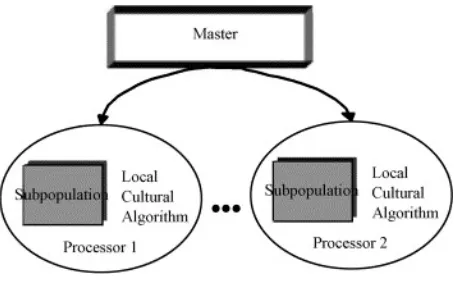
called Parallel Co-operating Cultural Algorithm (PARCA) in which the CAs were
executed concurrently by the search programs. In this, the network of workstations
was divided into two processors: a master processor and a slave processor. The
population, performing the selection, mutation, and recombination. The slave
processor was used to evaluate their simulations dispatched by the master processor.
The population was divided into several sub-populations and were isolated from
each other and managed their own local CA. The exchange of information between
the populations allowed them to co-operate and to explore the promising areas of
the search space, and also to reintroduce the previously lost genetic materials in the
population. The populations also exchange their best individuals to enhance the
search in the space. The architecture of PARCA is shown in figure 2.3 [11].
Figure 2.3: PARCA model
The authors implemented the PARCA using the message passing interface (MPI)
standard. The configurations of their system were: SGI Origin 200 and 6 Pentium
(P5/100 MHz) cluster with interconnection through Ethernet (100 MB/s) [11].
According to the authors, the algorithm showed better results of optimization but
the cost and execution time was slightly more than the existing algorithms at that
time.
2.3.2
Heterogeneous Multi-population Cultural Algorithm
Author Raessi et. al [27] stated that a group of sub-population which consists of
different cultural algorithm do not directly communicate with each other so to
the work of Digalakis et. al [11], Holland et al. [24], Koza et. al [30] and Reynolds
[41]. According to them, the evolutionary algorithms were successfully applied to
solve the optimization problems, but the issue with them was they had good
chances of immature convergence and falling into local optima. The major reason
behind this was they were not able to preserve diversity among the population over
the course of generations. The authors proposed a new framework of MPCA in
which the subpopulations remained same, but the optimization parameters were
divided among the sub-populations. Each sub-population optimized their
parameters, and a set of the partial solution was generated. These partial solutions
were combined to make the whole solution later. A detailed figure of the proposed
architecture is depicted in figure 2.4 [27].
Figure 2.4: HMP-CA Architecture
The Heterogeneous Multi-population Cultural Algorithm was implemented using
the JAVA platform by the authors. In their experiments, the population size was
1000 with 30 sub-populations, and each sub-population had 33 individuals. The
experiments were carried out for 10000 generations and 10 iterations. CEC 2012
benchmark problems were used to test the proposed algorithm, and the experiments
were carried out on 8 functions. The authors were successful in getting minimum
found over the given time. The authors explained that only one function minimum
value was not found over 10000 generations for five subpopulations, but they could
have found it if the number of generations was increased. The authors claimed to
find the minimum values of the numerical optimization functions and also their
model was efficient in both time and space complexity.
2.3.3
A novel Multi-population Cultural Algorithm
Adopting Knowledge Migration
Guo et. al [20] stated that in MPCA the information is exchanged among the
sub-populations but at the individual level and not at the population level. The
migration at the individual level does not consist of complete knowledge about the
subpopulation which can make the evolution process slow. The authors in their work
referred to the work of Reynold [41], Jin et. al [25] and Bin [36]. According to them
most of the researchers did not take into account the exchange of implicit knowledge
in MPCA. They also stated individuals of different subpopulation exchanged their
knowledge in the belief space, but the method was not entirely clear.
The authors proposed a new model of MPCA which adopted knowledge migration
known as Multi-Population Cultural Algorithm Adopting Knowledge Migration
(MCAKM). In the proposed algorithm the knowledge is exchanged implicitly among
the subpopulations instead of migrating individuals. In MPCA there are n number
of subpopulations, and each adopts their cultural algorithm and the information
among them is exchanged by migrating implicit knowledge at regular intervals. The
proposed algorithm is shown in figure 2.5 [20].
To justify their algorithm the authors implemented it on high dimensional
benchmark functions, and the performance of their algorithm was analyzed and
compared with other proposed algorithms. The experiments were done by taking
Figure 2.5: The structure of MCAKM
0.08 as the mutation probability. The experiments were run for 20 times with 100
iterations.
The authors validated their algorithm by comparing it with other cultural algorithm
and MPCAs adopting influence range. They found their algorithm performed better
compared to others and also had faster convergence speed with better solutions.
knowledge extracted from the evolution process were more efficient than others.
2.3.4
Knowledge Sharing Through Agent Migration with
Multi-Population Cultural Algorithm
Hlynka et. al [22] in their work explained that sharing of knowledge at individual/
population level was always a problem and tried to solve this in their work. Reynold
et. al [42], Kobti et. al [29], Guo et. al [20] and Raeesi et al.[27] works were referred
by the authors. The authors mentioned other researchers did not use the implicit
knowledge appropriately for migration and developed an MPCA with migration at
the agent level. The authors ran their experiment using the Repast Simulation tool.
Moving Peaks cone worlds domain was used to test their algorithm. Subpopulations
performance was calculated by transferring the agent from one subpopulation to
another over a period of time. The experiments were done by transferring 1%, 5%,
10%, 20% and 50% of the population and calculated the changes in the
sub-populations performance.
They authors found the best and worst run time for topological and situational
knowledge. They author claimed that their model performed better for only 1%
transfer of agent among the sub-populations and also mentioned when a small group
of agents moves the consistency of both the sub-populations can improve.
2.3.5
Promoting diversity using migration strategies in
distributed genetic algorithms
Power et. al [38] in their work focused on increasing diversity in the population by
introducing different migration strategies in Distributed Genetic Algorithm (DGA).
The works of Grosso [18], Tanese [47] and Braun [6] was referred by the authors.
important for problems consisting dynamic landscapes or landscapes with lots of
local optima.
In their work, the authors have focused on diversity measure when selecting an
individual for migration among the parallel GAs. The individuals to migrate were
not only selected on their fitness score but also on their location within the
population. The clones of the individuals in the population were eliminated in each
generation.
The authors have evaluated their algorithm on a number of the fitness function.
The function used for testing the fitness was the onemax problem, multi-peaked
three-dimensional landscape problems which include five hills and four valleys
problem, waves problem, one center and four neighbors problem and six hump camel
back problem. They have also experimented their algorithm on the benchmark
functions used by Digalakis et. al [11] in their work. They have compared their
migration strategy with the standard migration strategy and results depicts the
author’s strategy have outperformed on all the optimization problems they tested.
2.4
Game Theory in Evolutionary Algorithms
In this chapter, we discuss all the papers related to Game Theory Model and the
techniques implemented in Evolutionary Algorithms.
2.4.1
An Evolutionary Game-Theoretical Approach to
Particle Swarm Optimization
Author Chio et. al [10] integrated Prisoner’s Dilemma, namely cooperate and defect
into the Particle Swarm Optimization (PSO) algorithm. The authors referred to the
work of Franken et. al [15], Adbelbar et. al [1], Pavlidis et. al [35] and Cui et. al [9].
Dilemma (PD) framework, associating to each particle one of the two well-known
strategies (cooperate or defect) which are interpreted as behaviors of particles. The
authors claimed that they had a preliminary investigation in the direction of
integrating PSO and Evolutionary Game Theory.
The authors stated that the underlying idea of their work is to modify the PSO
algorithm, to make each particle in the swarm associated with a behavior (or
strategy) incorporated from the PD framework (cooperate or defect) which is used
to compute its position in next generation. Cooperate is considered as stronger
social component and the defect is considered as a stronger individual component.
The authors incorporated two strategies: flip-strategy, where a particle compares its
fitness with its previous fitness and keeps its strategy if it improves or else changes
it to another one. The other one was always C (cooperate), or D (defect) where the
particle compares its fitness with its fitness in the previous generation and keeps C
if it improves or keeps/changes to D if it decreases.
The authors compared their algorithm with 72 different PSO-EG variants. The
experiments were done on Ackley, Griewank, Sphere, Rastrigin and Rosenbrock
benchmark functions. Each experiment was done over 100 runs for both function
values and normalized error. The results showed that the changing behavior is
beneficial for the swarm especially when the dimension are increased and also for
the multimodal problems.
2.4.2
Coevolution of cooperation and layer selection
strategies in multiplex networks
Authors Hayashi et. al [21] in their work referred to the work of Gardens et. al [17],
Wang et. al [50] and Buldyrev et. al [7]. Authors in their model have developed a
co-evolutionary model of cooperation and layer selection strategies. Gardens et .al
multiplex structure of networks only when the temptation to defect was large [17].
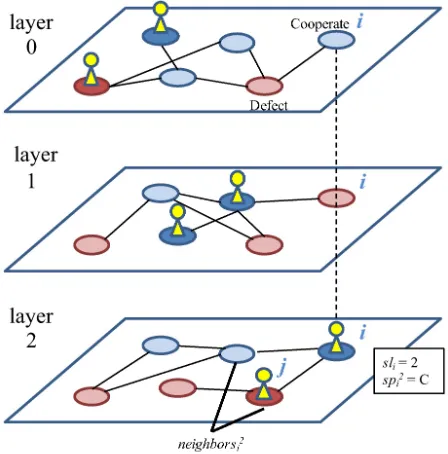
In the model of authors, each individual has a layer selection strategy and prisoner’s
dilemma game (PDG) strategy (cooperate or defect). Each individual plays PD
with the neighbor in its layer or in another layer in which it wants to move. If the
fitness of the neighbor is better than the individual, then the individual imitates its
neighbor strategy. The imitation probability is linear to the difference between the
fitness values. If the individual fitness is higher than its neighbor than the
individual keeps its strategy or else imitates its neighbor strategy. Schematic image
of the authors model is depicted in figure 2.6 [21].
Figure 2.6: Schematic image of the model
The authors evaluated their work by having 100 individuals in the population, M =
1, 3,., 19 layers and b=1.1, ., 2.1 which is the temptation to defect. The
experiments were done for five trials for each combination of layers and the
temptation to defect. The authors claimed from their experiment results that the
proportion of cooperative strategies has increased with increasing the number of
layers and is not dependent on the degree of the dilemma. Also, the increase in
selection strategies and game theory strategies.
2.5
Conclusion
From works mentioned above, we can see the Evolutionary Algorithms work
efficiently for the optimization problems. MPCA, in particular, is effective for a
dynamic population with multiple cultures. Incorporating migration in MPCA has
shown better convergence rate than the traditional MPCA. Using game theory
concepts for migration is a new idea and has shown real potential. By using the
game theory concepts for migration in MPCA can provide us with better results
when implemented to optimization problems. Integrating this two different concepts
Chapter 3
Proposed Approach
In this chapter, we will introduce the pseudo-code and framework of our proposed
algorithm. We will also discuss the design, belief space and population space used in
our algorithm in detail. Later we will introduce knowledge migration among the
subpopulations, and different migration strategies in this chapter.
3.1
Multi-population Cultural Algorithm with
Migration
In this section, we will discuss the framework of our Multi-population Cultural
Algorithm.
We have incorporated different migration strategies with the MPCA for having a
strategical migration among the subpopulations. Implementing the strategies can
provide us with better solutions in the population. Migration will be carried out by
using all the introduced strategies. Based on the nature of strategy the migration
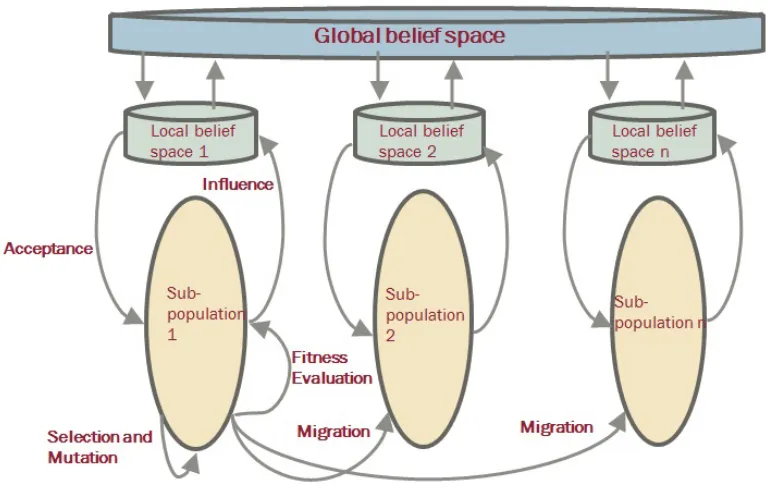
can be of two types: cooperative and non-cooperative. The proposed model known
as Knowledge Migration Strategies for Optimization of Multi-population Cultural
space which is shared by all the populations.
Figure 3.1: Architecture of our algorithm
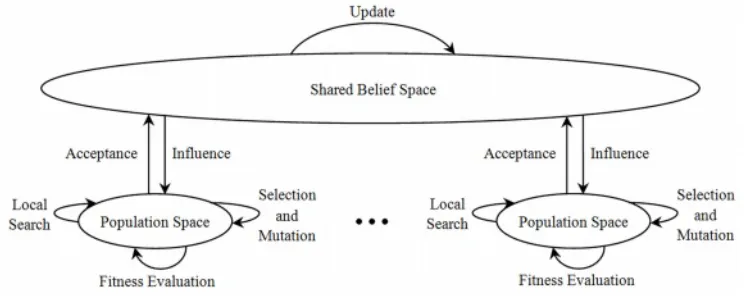
Figure 3.1 illustrates the architecture of the proposed algorithm which is composed
of a number of subpopulations which has its own belief space connected to a global
belief space. The local belief space is very simple as it stores the best individual of
that subpopulation for the current generation. Besides, these the global belief space
stores the best individual of each subpopulation. The proposed model in this
architecture incorporates the DE (DE/best/1 presented in equation 2.3 and
binomial crossover illustrated in equation 2.4) as the evolutionary operators for
every local CA. The crossover probability for the DE is random in the range of [0,1]
for each generation.
For our MPCA framework, we have made use of two different knowledge type:
situational and topological. In the local belief space, the situational knowledge is
stored as the solution of the best agent of the current generation resides in it. The
knowledge possessed by the best agent is stored by using the acceptance function,
and it is later used for guiding the other agents of the population to move towards a
better region in the search space.On the other hand, the global belief space makes
use of the topological knowledge during the migration process. All the best
individuals of each population are stored in global belief space. Each individual in
the global belief space is aware of its neighbor position which makes the migration
process simpler and effective.
3.2
Knowledge Migration Strategy for
Optimization of MPCA
In this section, we will explain all the steps to implement our proposed algorithm in
detail.
• The population is initialized in the search space randomly.
• Then, the entire population is segregated into a number of subpopulations
where each subpopulation has an equal number of agents.
• Each agent is initially assigned a strategy (i.e., cooperate or defect) during its
initialization.
• Every subpopulation has its local belief space which is connected with
• DE is applied on each subpopulation to carry out evolution and generate
offspring’s for next generations.
• Migration is done using the strategy when the migration factor is satisfied.
• This process continuous until the termination condition is satisfied.
The pseudo-code of the model is described below.
Input: Test Problems and Algorithm Parameters;
Output: Optimal or near Optimal result;
1. Initialize number of Local CA as LocalCANo;
2. Generate initial population;
3. Initialize strategy C (Cooperate) or D (Defect) to each agent in population;
4. Divide population equally among LocalCAs;
5. for Max Generation do
6. for (Each sub-population) do
7. Apply DE operator to generate offsprings;
8. Evaluate fitness of all agent;
9. Update Local Belief Space;
10. Update Global Belief Space;
11. if Migration Factor then
12. Apply Migration Strategy;
end
end
Output the best individual found so far;
end
3.3
Migration Strategies
3.3.1
Prisoners Dilemma
In this migration strategy, an agent to migrate is randomly chosen from the best
performing subpopulation. Then one more agent is selected randomly from the
same subpopulation. Both of the selected agents play prisoners dilemma with each
other. In this, the fitness of both the agents is compared with each other. If the
fitness of the migrating agent is greater than the randomly selected agent, then the
migrating agent will keep its own strategy (i.e., to cooperate or defect) or else
imitates the randomly selected agent strategy. If the migration agent strategy is
changed and if it is to cooperate then it will migrate to subpopulation who’s average
fitness is less than its own fitness value having least difference. If the changed
strategy is to defect then the agent will move to the subpopulation which contains
the best performing agent in the whole population. On the other hand, if the
migration strategy of the migrating agent is not changed when compared with its
neighbor and it is C than then the migrating agent will move to least performing
subpopulation in the context of average fitness. Else the agent will migrate to the
sub-population with the best-performing individual in the entire population. Below
is the pseudo-code of prisoner’s dilemma for the minimization problem.
3.3.2
Oligopoly
In this strategy, initially, the subpopulations are assigned a strategy either high,
medium or low in a random manner. Then the subpopulation are sorted according
to their average fitness, and the best performing 30% of subpopulations are
considered as the seller, and the rest are considered as buyers. The strategy of the
best subpopulation from the seller is chosen as selling strategy, and the strategy of
Input : Subpopulations;
Output : Agent to migrate;
1. Sort LocalCA according to Avg Fitness; 2. Select LocalCA with best Avg Fitness;
3. Select a Random Agent to Migrate (Migrate Agent);
4. Select another Random Agent from same sub-population (Random Agent); 5. if Fitness(Migrate Agent ≤ Random Agent) then
6. Migrate Agent keeps own Strategy (C or D);
else
7. Migrate Agent(Strategy) = Random Agent(Strategy); 8. Strategy Change = 1;
end
9. if Migrate Agent(Strategy) = C then
10. if Strategy Change = 0 then
11. Destination = LocalCA with highest Avg Fitness;
else
12. Destination = LocalCA with high Avg Fintess where difference between Migrate Agent and LocalCA(Avg Fintess) is least
end else
13. Destination = LocalCA with best Agent in Entire Population; 14. if Destination = Migrate Agent(LocalCA) then
15. Destination = Next best Agent in whole population;
end end
16. Migrate Agent moves to destination;
Algorithm 2:Prisoner’s Dilemma Migration Strategy
subpopulation is chosen at random from the sellers, and if the selling strategy is
high, then the best individual is to be migrated from that subpopulation if the
strategy is medium than the average performing agent and if low then the least
performing agent is to be migrated. Then a buyer is selected randomly as the
destination of the migrating agent. After the migration takes place, the buyer
subpopulation will use the buying strategy to migrate an agent from its
subpopulation to the selling subpopulation as a price of the product. It follows the
same rule of high, medium and low followed by the seller subpopulation to migrate
Input : Subpopulations;
Output : Agent to migrate;
1. Initially Strategy is assigned to all LocalCA as H(high), M(medium) and
L(low);
2. Subpopulations are arranged according to Avg Fitness;
3. Top performing 30% are considered as sellers and rest are buyers;
4. Seller Strategy = Best LocalCA Strategy;
5. Buyer Strategy = Best LocalCA(Buyer) Strategy;
6. A seller is selected at random from seller LocalCA;
7. A Buyer is selected at random from buyer LocalCA;
if 8. Seller Strategy = H then
9. Best agent of seller LocalCA is migrated;
else
if 10. Seller Strategy = M then
11. Average agent of seller LocalCA is migrated;
else
12. Worst agent of seller LocalCA is migrated;
end
end
13. Buyer returns an agent back to seller localCA by using Buyer Strategy and
follows same method of migration as seller;
Algorithm 3: Oligopoly Migration Strategy
Duopoly
In this strategy, the subpopulations are arranged according to their average fitness
selected to migrate an agent. Both the subpopulations will choose an agent to
migrate. The destination of the migrating agent is selected randomly from the rest
of the subpopulations. The best performing subpopulation will migrate its selected
individual to any other subpopulation, and in return, it will take the best
performing individual of that subpopulation. The same process is followed by the
second best-performing subpopulation for migration. Below is the pseudo-code for
the duopoly.
Input : Subpopulations;
Output : Agent to migrate;
1. Arrange subpopulations according to Avg Fitness;
2. Pick the best two subpopulations for migration;
3. Both of them will choose an agent to migrate;
4. Best subpopulation will migrate an agent randomly to any other
subpopulation;
5. In return the best subpopulation will take the best individual from the
destination subpopulation;
6. Second best sub-population will follow the same strategy as best
subpopulation;
Algorithm 4: Duopoly Migration Strategy
Fair Division
As the name suggests this strategy focuses more on fair migration technique where
the better performing subpopulations migrate their individuals to the
subpopulations performing below average. In this way, all the subpopulations have
a fair chance of improving their fitness. In this strategy, the subpopulations are
sorted according to their average fitness in descending order. If there are n


![Figure 4.1: 3-D map for Rotated Bent Cigar Function [31]](https://thumb-us.123doks.com/thumbv2/123dok_us/1377157.1170392/57.612.229.417.493.633/figure-d-map-rotated-bent-cigar-function.webp)
![Figure 4.2: 3-D map for Rotated Discus Function [31]](https://thumb-us.123doks.com/thumbv2/123dok_us/1377157.1170392/58.612.221.424.175.323/figure-d-map-rotated-discus-function.webp)
![Figure 4.4: 3-D map for Shifted and Rotated Katsuura Function [31]](https://thumb-us.123doks.com/thumbv2/123dok_us/1377157.1170392/59.612.225.420.74.221/figure-map-for-shifted-and-rotated-katsuura-function.webp)
