Reputation based Energy and QoS Efficient
Algorithm for Opportunistic Body Area
Networks
Niraj Korde1 , Urmila Deshmukh2
PG Student, Department of Electronics & Telecommunication, Indira College of Engineering and Management,
SPPU (University of Pune), Pune, India1
Associate Professor, Department of Electronics & Telecommunication, Indira College of Engineering and
Management, SPPU (University of Pune), Pune, India2
ABSTRACT: Recently significant research works reported on communication standards of wireless body area
networks (WBANs) due to emergence of WBAN in real time applications. There two primary challenges in opportunistic WBANs such as network management cost reduction and energy consumption reduction in order deliver the cost-effective and reliable services to critical patients in healthcare application. There are number solutions reported to address this challenges in recent past, however failed to cover all the aspects of WBANs communication. In this, project we propose novel opportunistic communication protocol for WBANs with aim to solve the research challenges not only the energy efficiency and network management cost reduction but also solves the problem non-reliable nodes data dissemination. Initially we proposed the novel energy-efficient and distributed network administration cost minimization system for dynamic availability and data dissemination in shrewd WBANs. At that point we proposed the estimating based approach for dependable hub data dissemination. This should be possible by notoriety based incentive strategies to rouse members to scatter dependable data in participatory sensing framework, while limiting incentive cost for keeping up adequate number of solid members. The reproduction comes about uncovers the adequacy of proposed technique.
KEYWORDS: Cost Management, Energy Management, Opportunistic communications, reliable data dissemination,
WBAN.
I. INTRODUCTION
Wireless Body Area Networks (WBAN)/Wireless Body Area Sensor Network (WBASN) comprise of sensor nodes joined in and around the human body to screen the bio signals of individual for an assortment of utilizations, for example, persistent observing, gaming and so forth. This term has been first authored by Van Dam et al (2001) and got the enthusiasm of a few analysts. Because of the progressions in MEMS and wireless communication technologies, WBAN has experienced a specialized blast in the most recent decade. The schematic outline of contrasts between Wireless Sensor Networks and Wireless Body Area Networks is given by [1]. There are huge focuses to be noted in the Wireless body area network. Instead of the wireless sensor network, the WBAN observing condition is limited to the human body, heterogeneous data rate, the prerequisite of heterogeneous data rate and more factor network topology because of body development.
The communication in the Body sensor network is arranged into two sorts, in body communication is the RF communication between obtrusive sensor nodes embedded inside the human body and on body communication is the communication between wearable sensor nodes. The MICS (Medical Implantable Communication Service) band – 402-405 MHz ought to be utilized for in body communication (Sana Ullah et al 2010a). ISM or UWB can be utilized for on body communication.
processing Unit (LPU). In this way, the LPU transmits the amassed data to the local access points (APs), which, thusly, send them to the medical servers [3], [4]. The body sensor nodes transmit the medical data to LPUs at extensive variety of data rates from 10 Kb/s to 10 Mb/s [5]. Likewise, the energy utilization rates of sensor nodes are confined as far as possible, as the battery energy of these nodes is restricted. To limit energy utilization, the sensor nodes utilize a one-hop star topology to send their medical data [6]. Be that as it may, mobility, body stances, and natural deterrents increment the dynamism in WBANs, which as often as possible changes the network topology, which, thusly, diminishes the network QoS. Moreover, the connection quality between nodes in WBANs shifts as a component of time because of different body developments, which likewise influences the inter-node connectivity [7].
Because of body developments and mobility of WBANs [6], the connection characteristics of intra-BAN and inter-BAN communication units corrupt altogether, which builds the bundle misfortune rate and reductions the life-time of the body sensor nodes? Further, the above additionally upsets data dissemination. In this manner the QoS administration cost in the network is increments to keep up reasonable QoS among WBANs. As the network connectivity foundation and QoS administration costs increment in the network, we require a network administration cost minimization structure to give dependable and savvy service to WBANs.
In this paper, we proposed energy efficient and QoS efficient communication protocol for WBAN based on energy management cost minimization and QoS management cost minimization with reliable data dissemination. In section II, the brief review of recent works conducted. In section III, the proposed methodology and algorithms presented. In section IV, the current simulation results discussed. Finally, the conclusion and future work presented in V.
II. RELATED WORKS
In this section, we represent the review of research works on practical communication protocol and energy consumption techniques for WBANs.
Samanta et al. [8], [9] investigated that link-quality-aware resource allocation cum load balancingscheme for node in WBANs. In this technique, the researcher has utilized two sub problems- dynamicresource allocation and link-quality measurementin WBANs. These research works deal with the flexibility of WBANs they does not analysis the dynamics of network management cost in the existence of body/limb activity in WBANs, due to which the total amount of network cost raising and the QoS of WBANs raising.
Elias at al. [10] innovated that an energy-aware optimal design of energy effective and cost- effective WBANs. This technique investigated a cost-effective approach; the researcher does not analysis the impacts of dynamic connectivity and opportunistic data distribution in WBANs. This raising the delay and packet eliminated of the network.
Zhao et al. [11] investigated a network cost minimization scheme for data distribution in WSNs. First, this technique does not analysis the necessity index of WBANs in manner to quantify the medical situation of the WBAN-tools patients, which is one of the unique attributes of WBAN-based communications.
Energy-efficient and reliable communications are significant demands of WBANs; these are supplies sensitive medical information due to shadowing and fading consequences in the networks, the energy consumption rate of sensor nodes increases, and additionally the reliability in statistics transmission decreases, periodically. To boom the electricity performance and reliability in statistics transmission recently wide variety of strategies reported.
Yousaf et al. [12] investigated that, a new three-level cooperative relaying scheme for WBANs. As frame sensor nodes produce clinical statistics at a variable fee, their corresponding traffic pattern is uncertain in nature. Consequently, in the presence of negative hyperlink-satisfactory, the packets drop charge of the network and the power intake of body sensor node increase.
Andreagiovanni and Nardin [13] investigated that robust approach for joint optimization of energy accuracy and data rate in WBANs under traffic unreliability. In this innovation work, the packet transmission rate of body sensor nodes is consider to be homogenous in nature, but in condition of WBANs, the packet transmission rate of body sensor nodes is heterogeneous.
Ibarra et al. [15] investigated a joint power and QoS control structure to supplies of energy and obtained the best possible QoS in WBANs. The base paper techniques are analysis the difficulty traffic ministry for the data transmission procedure. However, this technique is not used for all types of traffic management in the network.
Similarly, Seyedi at al. [16]evolved one-of-a-kind energy efficientdata transmission scheme for WBANs. As a way to provide power-green statistics transmission, the tradeoffs between energy intake and packet errors possibility is embedded into the sensor nodes. This version fails to provide QoS to WBANs in the presence of community dynamics, because of mobility.
Also, Seyedi et al. [17] investigated that a Markopv-chain based analytical approach for energy collective node in WBANs, in which the possibility of situation loss is analyzed to recognize the energy loss condition of body sensors node.
Ren et al. [18] investigated a approach which secure higher network throughput for synchronize WBANs. The base paper works does not fulfil to supplies robustness in the network management approach for WBANs.
III. PROPOSEDDESIGN
To explains the present innovation problem for dynamic WBAN communications we innovated novel opportunistic communication protocol for WBANs with goal to solve the innovation difficulty not only the energy efficient and network management cost reduction but also resolve the difficulty non-reliable nodes data distribution network management cost minimization approach for dynamic connectivity and data distribution in principle WBANS. Then innovated the cost based model for dependable node data distributed.
We added a pricing based totally approach to optimize the network management price for opportunistic WBANs. Simultaneously, the behaviours of WBANs are taken into the consideration (i.e., vital and regular condition) to offer dependable offerings. We investigated algorithms: (1) energy efficient prioritized opportunistic communications algorithm, (2) optimal network cost reduction algorithm.
As the dynamic topological disconnections as well as variations in link traits rising the energy consumption fee of opportunistic WBANs, we layout the energy-green prioritized opportunistic conversation to optimize the energy intake price of WBANs. set of rules 1 suggests the procedure for strength consumption minimization [19].
Algorithm 1: Energy Efficient Algorithm Inputs:
• B: Number of WBANs. • AP: Number of APs • b: number of sensor nodes. • T: Total time period
Output: Energy consumption rate ( ∗).
1: Measure and at time t.
2: Calculate (t) and (t) at time t.
3: if (ξ ≥ξ ) then
4: Connectivity establishment 5: Calculate at time t. 6: if ( ≥ ) then
7: Formulate opportunistic energy constraint parameter. 8: Formulate optimization problem using Equation 24. 9: end if
10: if ( ≥ ) then
11: Update waiting time Ƭ =Ƭ . 12: Optimal energy consumption rate ( ∗ ). 13: end if
14: end if
16: Return when Ƭ∗= .
Where, variable and variable are representing that the inter-BAN and intra-BAN links amongith sensor node and jth LPU node. The decision matrices are ξ is executed to recognize the opportunisticconnectivity for intra-BAN and inter-BAN communicationunits, based on the link-quality and propagation delay at time t.
Further to decreases the network management costs, we investigate another set of rules for most efficient cost minimization algorithm. This set of rules consists of, interference control price, electricity management value, records distributed cost, and QoS-making sure cost. Algorithm 2 represents the technique to decrease the community management fee.
Algorithm 2: Cost Minimization Algorithm Inputs:
• B: Number of WBANs. • AP: Number of APs • b: number of sensor nodes. • T: Total time period
Output: Cost Management Matrix ( ∗, ).
1. Measure and at time t.
2. Calculate and at time t.
3. ifξ ≥ ξ then
4. Opportunistic connectivity extraction 5. Update waiting time Ƭ =Ƭ
6. if ≥ then
7. Calculate , .
8. Calculate ,
9. end if
10. if ≥ then
11. Optimize the network management cost
12. Optimal Network Management Cost Management Matrix ( ∗, .
13. end if
14. end if
15. Update Ƭ∗ = (Ƭ + 1). 16. Return when Ƭ∗ =Ƭ .
Where, and are intra-BAN link cost and inter-BAN link cost respectively. and areData dissemination and interference management costs respectively. The and are QoS ensuring cost and energy management costs respectively.
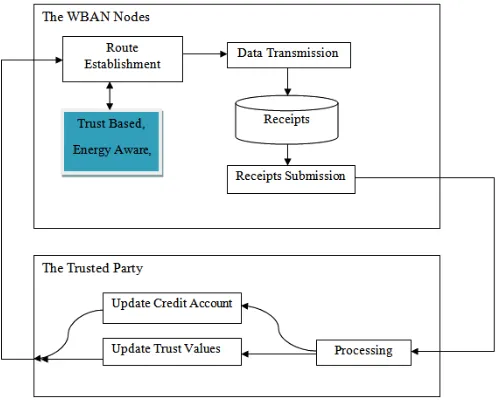
computed by using processing the price receipts. Figure 1 shownthat structure for the proposed pricing based datadistribution in WBANs
Figure 1: Pricing based data transmission
IV. RESULTS
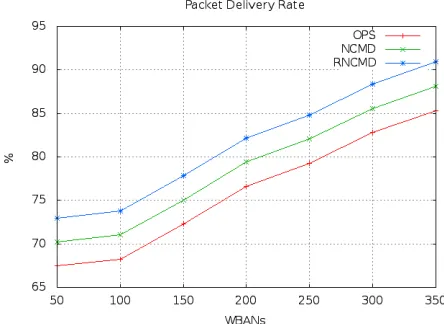
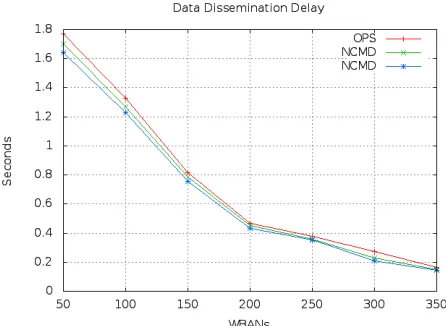
In this section, we present the current results using the network simulator NS2. We evaluated the methods using the ns-2.34 version. The network parameters and techniques represented in table 1. The proposed RNCDM method is compared with two state-of-art methods in this section such as OPS [19] and NCMD [19].
Table 1: Network Simulation Parameters
Network Area 1000 x 1000
Type of Network WBAN
Number of Nodes 50-350
Velocity 1.5 m/s
MAC 802.11
Simulation Time 30sec
Initial Energy 0.5 J
Transmitter energy consumption
16.7 nJ
Receiver energy
consumption
36.1 nJ
There are five performance metrics evaluated in this paper such as:
- Energy Consumption vs. Number of WBANs
- Data Dissemination delay vs. Number of WBANs
- PDR vs. Number of WBANs
- Number of packet drops vs. Number of WBANs
Figure 2: Average throughput performance evaluation
Figure 3: PDR performance evaluation
Figure 4: Average energy consumption performance evaluation
Figure 5: Number of packets drop performance evaluation
Similarly, the delay and average energy consumption performance is optimized using the proposed solution for the varying WBANs. The throughput and PDR performances are increasing with increased number of WBANs.
V. CONCLUSIONANDFUTUREWORK
In this paper, we proposed the network management cost reduction approach for the opportunistic WBANs in order to manage the increased cost of network management. We first designed the joint distributed network management cost reduction algorithm and energy-efficient algorithm for the dynamic data dissemination process in the opportunistic WBANs. Then we introduced pricing based data transmission for the reliable and stable route selection. The simulation results prove that proposed solution outperforms the existing routing protocols for WBANs. For future work, it will be interesting to investigate the variations in other important parameters of WBAN such as mobility speed, packet rate etc.
REFERENCES
[1] Benoit Latre, Bart Braem, Ingrid Moerman, Chris Blondia & Piet Demeester 2011, „A Survey on Wireless Body Area Networks‟, Journal of
Wireless Networks, vol. 17, no. 1, pp. 1-18.
[2] Kyung Sup Kwak, Sana Ullah & Niamat Ullah 2010, "An Overview of IEEE 802.15.6 Standard‟, 3rd International Symposium on Applied Sciences in Biomedical and Communication Technologies (ISABEL), 7-10 Nov. 2010 Rome, Italy, pp. 1-6.
[3] M. Chen, S. Gonzalez, A. Vasilakos, H. Cao, and V. C. Leung, “Body Area Networks: A Survey,” Journal of Mobile Networks and
Applications, vol. 16, no. 2, pp. 171–193, 2011.
[4] S. Moulik, S. Misra, and A. Gaurav, “Cost-Effective Mapping Between Wireless Body Area Networks and Cloud Service Providers Based on
Multi-Stage Bargaining,” IEEE Transactions on Mobile Computing, vol. PP, no. 99, pp. 1–1, 2016.
[5] K. M. S. Thotahewa, J. Y. Khan, and M. R. Yuce, “Power Efficient Ultra Wide Band Based Wireless Body Area Networks with Narrowband
Feedback Path,” IEEE Transactions on Mobile Computing, vol. 13, no. 8, pp. 1829–1842, 2014.
[6] S. Ullah, H. Higgins, B. Braem, B. Latre, C. Blondia, I. Moerman, S. Saleem, Z. Rahman, and K. S. Kwak, “A Comprehensive Survey of Wireless Body Area Networks,” Journal of Medical Systems, vol. 36, no. 3, pp. 1065–1094, 2012.
[7] “IEEE Standard for Local and Metropolitan Area Networks - Part 15.6: Wireless Body Area Networks,” IEEE Std 802.15.6-2012, pp. 1–271,
2012
[8] A. Samanta, S. Bera, and S. Misra, “Link-Quality-Aware Resource Allocation With Load Balance in Wireless Body Area Networks,” IEEE
Systems Journal (DOI: 10.1109/JSYST.2015.2458586), vol. PP, no. 99, pp. 1–8, 2015.
[9] A. Samanta, S. Misra, and M. S. Obaidat, “Wireless Body Area Networks with Varying Traffic in Epidemic Medical Emergency Situation,” in
Proceedings of IEEE International Conference on Commumications, 2015.
[10] J. Elias, “Optimal Design of Energy-efficient and Cost-effective Wireless Body Area Networks,” Ad Hoc Networks (Elsevier), vol. 13, pp. 560–574, 2014.
[11] M. Zhao, D. Gong, and Y. Yang, “Network Cost Minimization for Mobile Data Gathering in Wireless Sensor Networks,” IEEE Transactions on
Communications, vol. PP, no. 99, pp. 1–1, 2015.
[12] S. Yousaf, N. Javaid, Z. A. Khan, U. Qasim, M. Imran, and M. Iftikhar, “Incremental Relay Based Cooperative Communication in Wireless
Body Area Networks,” Procedia Computer Science, vol. 52, pp. 552–559, 2015.
[13] F. D. Andreagiovanni and A. Nardin, “Towards the Fast and Robust Optimal Design of Wireless Body Area Networks,” Applied Soft
Computing, vol. 37, pp. 971–982, 2015.
[14] S. Huang and J. Cai, “Priority-Aware Scheduling for Coexisting Wireless Body Area Networks,” in Proceedings of International Conference on
Wireless Communications Signal Processing, 2015, pp. 1–5.
[15] E. Ibarra, A. Antonopoulos, E. Kartsakli, J. Rodrigues, and C. Verikoukis, “QoS-Aware Energy Management in Body Sensor Nodes Powered
by Human Energy Harvesting,” IEEE Sensors Journal, vol. 16, no. 2, pp. 542–549, 2016.
[16] A. Seyedi and B. Sikdar, “Energy Efficient Transmission Strategies for Body Sensor Networks with Energy Harvesting,” IEEE Transactions on
Communications, vol. 58, no. 7, pp. 2116–2126, 2010.
[17] ——, “Modeling and Analysis of Energy Harvesting Nodes in Body Sensor Networks,” in Proceedings of International Summer School and
Symposium on Medical Devices and Biosensors, 2008, pp. 175–178.
[18] Z. Ren, X. Qi, G. Zhou, H. Wang, and D. Nguyen, “Throughput Assurance for Multiple Body Sensor Networks,” IEEE Transactions on Parallel
and Distributed Systems, vol. PP, no. 99, pp. 1–1, 2015
[19] Amit Samanta, Student Member, IEEE, Sudip Misra, "Energy-Efficient and Distributed Network Management Cost Minimization in