DYNAMIC MOBILE SERVER FOR LIVE CASTING APPLICATIONS
MUHAMMAD SAZALI BIN HISHAM
DYNAMIC MOBILE SERVER FOR LIVE CASTING APPLICATIONS
MUHAMMAD SAZALI BIN HISHAM
A thesis submitted in the fulfilment of the requirements for the award of the degree of
Master of Engineering (Electrical)
Faculty of Electrical Engineering Universiti Teknologi Malaysia
iii
iv
ACKNOWLEDGEMENT
As a muslim, I am very grateful to Allah for his kindness of giving me physical and mental strength to complete this thesis on time. As a child, I would like to thank my mother and father for their unconditional support and encouragement to pursue my interest besides giving financial support. I also would like to thank my siblings for their support since I am a kid.
Academically, I would like to thank my main supervisor, Assoc. Prof. Dr. Sharifah Hafizah Syed Ariffin for her willingness to guide me on my research and bears with my weaknesses. I am very thankful for her motherly kindness from the start of my research until the completion of this thesis. I also would like to thank my co-supervisor, Dr. Choong Khong Neng who always supporting and advising me on the proper way of doing a research and emphasizing me of the importance of having a vision.
I am very grateful to be a part of Telematic Research Group (TRG) of UTM. Besides that I would like to thanks MIMOS Berhad, especially the head of Wireless Communication Cluster, Dr. Mazlan Abbas for giving me the opportunity to work in MIMOS. I have been exposed to creative thinking and industrial research while working in MIMOS. Other than that, I would like to thank Ministry of Science, Technology and Innovation (MOSTI) for funding my research work.
v
ABSTRACT
vi
ABSTRAK
vii
TABLE OF CONTENTS
CHAPTER SUBJECT PAGE
DECLARATION ii
DEDICATION iii
ACKNOWLEDGEMENT iv
ABSTRACT v
TABLE OF CONTENTS vii
LIST OF FIGURES xi
LIST OF TABLES xv
LIST OF ABBREVIATIONS xvii
LIST OF APPENDICES xix
1 INTRODUCTION 1
1.1 Background 1
1.2 Problem Statement 2
1.3 Objectives 4
1.4 Scope 4
1.5 Research Contribution 5
1.6 Thesis Organization 6
2 LITERATURE REVIEW 7
2.1 Overview 7
2.2 Live Casting Applications 7
viii
2.4 Data Transmission Method 2.4.1 Unicast
2.4.2 Broadcast 2.4.3 Multicast
10 10 11 13
2.5 Real Time Data Delivery Protocol
2.5.1 Real Time Transport Protocol (RTP) 2.5.2 Real Time Streaming Protocol (RTSP) 2.5.3 Real Time Control Protocol (RTCP
14 15 16 18 2.6 Existing Delivery Infrastructures
2.6.1 Proxy Server
2.6.2 Content Delivery Network (CDN) 2.6.3 Peer to Peer (P2P)
2.6.4 Hybrid CDN-P2P
19 20 22 24 26
2.7 Server Virtualization 28
2.8 Server Mobility 31
2.9 Summary 32
3 DYNAMIC MOBILE SERVER (DMS) 34
3.1 Overview 34
3.2 Phase 1: Designing Dynamic Mobile Server 3.2.1 Architecture of DMS
3.2.2 Component Workflows and Signalling
3.2.3 Mobile Server Allocation Trigger
3.2.4 Overall System Signalling
35 35 40
45
50 3.3 Phase 2: Developing Dynamic Mobile Server
3.3.1 Application Repository 3.3.2 Client
ix
3.3.3 Mobile Server Container (MSC) 3.3.4 Mobile Server
3.3.5 Content Server
58 61 62
3.4 Summary 63
4 DMS PERFORMANCE EVALUATION 64
4.1 Introduction 64
4.2 Configuration and Signalling Test Experiment 4.2.1 Configuration and Signalling Test
Experiment Setup
4.2.2 Configuration and Signalling Test Experiment Results
67 68
69
4.3 Threshold Validation Experiment
4.3.1 Threshold Validation Experiment Setup 4.3.2 Threshold Validation Experiment Results
73 73 74
4.4 Mobile Server Allocation Experiment
4.4.1 Mobile Server Allocation Experiment Setup
4.4.2 Mobile Server Allocation Experiment Results
4.4.2.1 Configuring Background Traffic Rate
4.4.2.2 Mobile Server Allocation Time Result
4.4.2.3 Client Redirection Time Result
78 78 81 82 83 84 4.5 Performance Benchmarking Experiment
4.5.1 Performance Benchmarking Experiment Setup
x
4.5.2 Performance Benchmarking Experiment Results
4.5.2.1 Network Level Benchmarking 4.5.2.2 Application Level
Benchmarking
90
91 98
4.6 Summary 102
5 RESEARCH CONCLUSION 104
5.1 Conclusion 104
5.2 Recommendation and Future Works 107
REFERENCES 108
xi
LIST OF FIGURES
FIGURE NO. TITLE PAGE
1.1 Conventional Data Live Casting Delivery Method 3 2.1 Examples of Commercial Live Casting Applications 8
2.2 Illustration of Cloud Computing 9
2.3 Illustration of Unicast Transmission 11
2.4 Illustration of Broadcast Transmission 12
2.5 Illustration of IP Multicast 14
2.6 RTP Header Structure 15
2.7 Example of RTSP Signalling 18
2.8 General Architecture of Video Streaming using Proxy Server
20
2.9 SProxy Architecture 21
2.10 Virtual Proxy Network using Proxy Network Controller
21
2.11 General Architecture of CDN 23
2.12 Optimized Live Streaming Delivery using Constraint Server Chaining
24
2.13 Tree-based P2P (left) and Mesh-based P2P (right) 25 2.14 P2P Live Streaming System with LAN – awareness 26
2.15 General Architecture of Hybrid CDN-P2P 27
xii
2.17 Full Virtualization Architecture 29
2.18 Para-virtualization Architecture 30
2.19 OS-level Virtualization 30
2.20 Illustration if Server Live Migration 31
3.1 Network Architecture of DMS 36
3.2 DMS Prospect of Serving the Enterprise 38
3.3 System Architecture of DMS 39
3.4 System Flowchart of Application Repository 41
3.5 System Flowchart for Client 42
3.6 System Flowchart of Mobile Server Container 44
3.7 General Mobile Server Allocation Process 45
3.8 Optimized Mobile Server Allocation Process 48 3.9 Mobile Server Allocation Checking Operation
Flowchart
49
3.10 Sequence Diagram before the Mobile Server Allocation
51
3.11 Sequence Flow during Trigger to Download (TD) 52 3.12 Sequence Flow during Trigger to Load (TL) 53 3.13 Sequence Diagram After the Mobile Server Allocation 54 3.14 Software Architecture of Application Repository 55 3.15 Screenshot of Application Repository Interface 55
3.16 Software Architecture of Client 57
3.17 Screenshot of Client Browser 58
xiii
3.19 Main Dashboard of MSC 60
3.20 Registered Users with its Details 60
3.21 Active Mobile Server Indicator 61
3.22 Component Diagram of Content Server 62
4.1 Block Diagram of DMS Testbed 65
4.2 General DMS Testbed 66
4.3 Screenshot of the Client Implementation 67
4.4 Conventional Delivery Testbed for Signalling Experiment
68
4.5 DMS Testbed for Signalling Experiment 68
4.6 Exchanged Messages of Conventional Point-to-Point Testbed
70
4.7 Exchanged Messages of DMS without Active Mobile Server
70
4.8 Exchanged Messages of DMS with Mobile Server Activated
72
4.9 Testbed for Threshold Validation Experiment 73 4.10 Received Video Frame (below) that got affected
Compared to Reference Frame (above)
77
4.11 Mobile Server Allocation Testbed 78
4.12 Congestion Production by Additional Background Traffic
79
4.13 Screenshot of Iperf at the Traffic Generator 80
4.14 Average Redirection Time of Client 85
xiv
4.17 Setup C - DMS Testbed (Wired) 88
4.18 Setup D - DMS Testbed (Wireless) 89
4.19 Overall Packet Loss at each Client using Conventional Delivery Method (Setup A)
92
4.20 Overall Packet Loss at each Client using Conventional Delivery Method (Setup B)
93
4.21 Packet Loss at Client 1 against Client Arrival in Conventional Delivery Method (Setup B)
94
4.22 Overall Packet Loss at each Client in DMS (Setup C and Setup D)
95
4.23 Overall Packet Loss at Mobile Server Receiving Side 96 4.24 Available Bandwidth during Video Transmission in
Conventional Method (Setup A)
97
4.25 Available Bandwidth during Video Transmission in DMS (Setup C)
xv
LIST OF TABLES
TABLE NO. TITLE PAGE
2.1 Limitations of Current Delivery Methods or Infrastructures
33
3.1 Information included in Announcement and Registration Message
51
4.1 Configuration for Signalling Experiment Setup 69 4.2 Threshold Validity Experiment Configuration 74
4.3 Average PSNR and MOS Mapping 75
4.4 MOS Impairment Scale 75
4.5 Chosen Validation Requirement 76
4.6 Validation Experiment Results 76
4.7 Clients Configuration for Mobile Server Allocation Experiment
81
4.8 Other Components Configuration for Mobile Server Allocation Experiment
81
4.9 Overall Packet Loss at the Client at Different Background Traffic Rate
82
4.10 Mobile Server Allocation Execution Time 84
4.11 Network Configuration for all Setups 90
4.12 Average PNSR of the video received by the clients using conventional method (Setup B)
99
4.13 Average PNSR of the video received by the clients using DMS (Setup D)
100
4.14 Average Video Start-up Latency in Conventional Method (Setup A)
xvi
4.15 Average Video Start-up Latency in DMS (Setup C) 101
4.16 Performance Benchmarking Summary 103
xvii
LIST OF ABBREVIATIONS
AP - Access Point
API - Application Programming Interface
APIaaS - API as a Service
CC - CSRC count
CDN - Content Delivery Network
CSRC - Contributing Source
DaaS - Data as a Service
DMS - Dynamic Mobile Server
GUI - Graphical User Interface
HTTP - Hypertext Transport Protocol IaaS - Infrastructure as a Service
IGMP - Internet Group Management Protocol
IP - Internet Protocol
IPTV - Internet Protocol Television
ISP - Internet Service Provider
LAN - Local Area Network
LP - Loss Percentage
M - Marker
MOS - Mean Opinion Score
MSC - Mobile Server Container
PSNR - Peak Signal to Noise Ratio
N - Number of Client that requesting the same content
NKEA - National Key Economic Area
OS - Operating System
P - Padding
xviii
P2P - Peer to Peer
PaaS - Platform as a Service
PNC - Proxy Network Coordinator
QoE - Quality of Experience
QoS - Quality of Service
RTCP - Real-Time Control Protocol
RTP - Real-Time Transport Protocol
RTSP - Real-Time Streaming Protocol
RTT - Round Trip Time
SaaS - Service as a Service
SDP - Session Description Protocol
SECaaS - Security as a Service
SN - Sequence Number
SSM - Source Specific Multicast
SSRC - Synchronization Source
STaaS - Storage as a Service
TCP - Transmission Control Protocol
TD - Trigger to Download
TEaaS - Test Environment as a Service
TL - Trigger to Load
TSP - Telecommunication Service Provider
UDP - User Datagram Protocol
URL - Uniform Resource Locator
VoD - Video on Demand
VoIP - Voice over IP
WAN - Wide Area Network
xix
LIST OF APPENDICES
APPENDIX TITLE PAGE
A Configuration of VLC Streaming Server 113
B Source Code of Information Grabber Module in Client’s Web Agent
116
C Source Code of Announcement
Discovery Module in Client’s Web Agent
120
D Source Code of Redirection Listener Module in Client’s Web Agent
124
E Source Code of Registration Sender Module in Client’s Web Agent
127
F Source Code of Network Module in Mobile Server Container
CHAPTER 1
INTRODUCTION
1.1 Background
Web application development has moved towards developing rich web application which consists of a mixture of dynamic and static content [1]. Dynamic content such as live casting applications have become more popular among the Internet users. Live casting application however is not limited to just live video streaming of an event such as a live concerts or football matches. It could further include video conferencing, Voice over IP (VoIP) or even a stock trading application. Although these contents are making the Internet world more attractive, these real-time contents consume high network bandwidth which may cause network bottleneck in certain part of the network. As a result, the end user experience cannot be maintained at a certain performance threshold.
2
From the Internet Service Provider (ISP) point of view, this kind of Internet behaviour is very costly due to high amount of traffic going through the international gateways1. Nowadays web hosting has moved towards cloud infrastructure2 [4], where the distance between client and server is increased since most cloud infrastructure is located overseas. Thus this requires higher cost as the traffic pass through more international gateways. This scenario is proven as reported in Malaysia National Key Economic Area (NKEA) which stated that 80% to 90% contents accessed on the Internet in Malaysia are originating from the a remote server cloud overseas over a long distance network [5].
1.2 Problem Statement
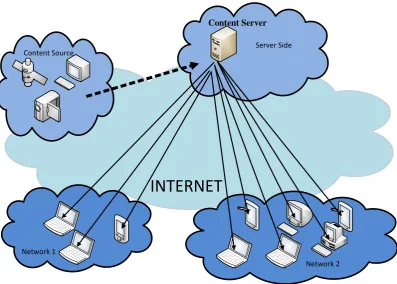
Live casting events usually attract people around the world. Moreover, the Internet has become one of the medium to view such live events. Traditionally, this live casting application on the Internet is delivered using conventional point-to-point method as shown in Figure 1.1.
1 International gateways in this thesis is referring to the network interconnection points beyond the
local Internet Service Provider (ISP) backbone
3
INTERNET
Server Side Content Source
Network 1
Network 2
Figure 1.1: Conventional Point-to-Point Delivery Method
Given the usage of live casting application on the Internet has increased rapidly, conventional point-to-point delivery method which used unicast transmission has incurred some problems. These problems need to be addressed in order to enable the application to sustain the growth of the Internet users. The identified problems are given as follows:
The number of streams of the same content3 delivered by the same source through the Internet is equal to the numbers of users that are accessing that content. Since those streams are the same type of content, unnecessary duplicated connections are established to deliver the content.
This duplicated connections obviously wasting the bandwidth available on the Internet. Higher numbers of Internet users along with other network activities will cause bottlenecks on the server and client network. This may cause the quality experience of the users degraded significantly.
4
In the view of Internet Service Provider (ISP), these duplicated connections contribute to high amount of traffic passing through the international gateways. Assuming that the content server4 has been deployed in the cloud infrastructure overseas, the distance between the users and the content server increased. Thus more international gateways are involved. The cost to sustain these traffics will increase.
High numbers of users mean higher workload on the content server. Hence, more servers have to be deployed in order to support the increasing numbers of users with acceptable performance.
1.3 Objectives
The objectives of this research are:
To develop a delivery platform of real time application for enterprise usage at the application layer - without interrupting current network infrastructure on the internet.
To develop an agent that is able to manage the users and confines the traffic locally in orders to shorten connection distance and reduce duplicated connections through the internet.
To implement a prototype as proof of concept using live video streaming scenario with performance evaluation.
1.4 Scope
The scope of this research is within a web-based live casting application platform or framework that uses live video streaming as the selected application or scenario. The delivery mechanism of the system combines IP unicast and IP multicast.
5
It also makes use of traffic redirection concept and server virtualization concept at the application level. The system is able to work in both wired and wireless environments at the client-side over a wireless access point. A prototype has been developed and evaluated in a laboratory environment.
1.4 Research Contributions
This research has been conducted to provide a platform for live casting applications where its delivery is more reliable compared to the conventional point-to-point delivery. It is also proven that the problems mentioned in Section 1.2 can be addressed by using a locally centralized solution, compared to existing decentralized peer- to-peer approach. More details of the contributions are mentioned as follows:
Duplicated connections and bandwidth consumption of the link between the client and the server have successfully been reduced compared to the conventional point-to-point delivery method. Thus, it has the potential to be practically applied with the aim of reducing the traffic cost passing through the international gateways.
User friendly application has been successfully developed using the server virtualization concept. This is because the system become generic thus various kinds of real-time application can be deployed into the system without requiring additional hardware and maintenance.
Seamless switching between two different video sources at application level has been successfully deployed. Thus, the switching does not affecting the user experience.
6
1.5 Thesis Organization
This thesis is organized as follows;
Chapter 2 discusses on literature review of the research. This includes the fundamental information related to live casting application such as real time IP protocol, cloud computing and data transmission method, and also the basic concepts of the approaches that have been opted in this research such as server mobility and server virtualization. Other than that, this chapter discusses on the closest related works that have been done previously which is more on the existing infrastructures.
Chapter 3 explains on the methodology of the research. First it explains on the first phase of the research which is designing the proposed solution which includes the architecture, the approaches that has been used to develop the system and the workflows of the system. Then, this chapter focuses on the second phases where the designs are then translated into a prototype as the implementation.
Chapter 4 discusses on the results of the experiments that have been conducted. The experiments are divided into two parts. The first part is the validation experiments while the second part is the performance benchmarking experiment.
108
REFERENCES
1. Jeon, J. Seunghwa, L. Position Paper: Toward a Mobile Rich Web Application – Mobile AJAX and Mobile Web Application. 2008
2. Malaysia Tablet and Smartphone Ownership Rising Sharply (2011, October 25).
Bintulu Weekly. Retrieved March 10, 2012, from
http://www.bintulu.org/news/2011/10/25/malaysia-tablet-smartphone-ownership-rising-sharply.php
3. Bytemobile's Mobile Internet Gateway Provides Carrier Options for Tiered Pricing (February 16, 2010). TMCnews. Retrieved March 10,2012, from http://www.bytemobile.com/newsevents/2010/archive_160210.html
4. Prodan, R. Ostermann, S. A survey and taxonomy of infrastructure as a service and web hosting cloud providers. Grid Computing, 2009 10th IEEE/ACM
International Conference on , vol., no., pp.17-25, 13-15 Oct. 2009
5. Communications Content and Infrastructure. National Key Economic Area
(NKEA). Chapter 13. 2011, from
http://www.kpkk.gov.my/pdf/tahukah_anda/ETP_bi/chapter12.pdf
6. Alstrup, S. Rauhe, T. and Brown, S. Video consumption dramatically outpaces Internet capacity: exploration, challenges and solutions. EBU Technical Review (2011).
7. Gongcai Wu and Gongxin Wu. Research on P2P live streaming system. Electronics, Communications and Control (ICECC), 2011 International
Conference on. IEEE, 2011.
8. Monaco, A. (June 7,2012). A View Inside the Cloud. theinstitute.ieee.org
(IEEE). Retrieved August 21, 2012.
9. Lee, Y. Min, O. and Kim, H. Performance evaluation technique of the RTSP based streaming server. Computer and Information Science, 2005. Fourth Annual
109
10. Andrew Tanenbaum (2003). Computer Networks. Englewood Cliffs, N. J.: Prentice Hall.
11. Alay, O. et al. An experimental study of packet loss and forward error correction in video multicast over IEEE 802.11 b network. Consumer Communications and
Networking Conference, 2009. CCNC 2009. 6th IEEE. IEEE, 2009.
12. B, Cain. et al. Internet Group Management Protocol, Version 3. RFC 3376, October 2002.
13. Bhattacharyya, S. and Ed, S. An Overview of Source-Specific Multicast (SSM). RFC 3569, July 2003.
14. Schulzrinne, H. Casner, S. Frederick, R. and Jacobson, V. RTP: A Transport
Protocol for Real-Time Applications. RFC 3550, July 2003.
15. Schulzrinne, H. and Casner, S. RTP Profile for Audio and Video Conferences
with Minimal Control. RFC 3551, July 2003.
16. Schulzrinne, H. Rao, A. Lanphier, R. Real Time Streaming Protocol (RTSP). RFC 2326, April 1998.
17. Casner, S. Session Description Protocol (SDP) Bandwidth Modifiers for RTP
Control Protocol (RTCP) Bandwidth. RFC 3556, July 2003.
18. Ma, K. J. Bartoš, R. and Bhatia, S. A survey of schemes for Internet-based video delivery. Journal of Network and Computer Applications34.5 (2011): 1572-1586. 19. Liu, J. and Jianliang, X. A survey of streaming media caching.
available at:\ n\ w. comp. hhbu. edu. hkujllstreamCaching. pdf (2003).
20. Chen, S. et al. SProxy: A caching infrastructure to support internet streaming.
Multimedia, IEEE Transactions on 9.5 (2007): 1062-1072.
21. Bolic, M. Begic, Z. and Secerbegovic, E. Virtual active network for live streaming media delivery. MELECON 2010-2010 15th IEEE Mediterranean
Electrotechnical Conference. IEEE, 2010.
22. Vakali, A. and George P. Content delivery networks: Status and trends. Internet
Computing, IEEE 7.6 (2003): 68-74.
23. Mulerikkal, J. P. and Ibrahim, K. An architecture for distributed Content Delivery Network. Networks, 2007. ICON 2007. 15th IEEE International
Conference on. IEEE, 2007.
24. Muhammad, B. T. Ravi, J. and Kawahara, T. Mobility aware server selection for mobile streaming multimedia content distribution networks. Web content caching
110
25. Bakiras, Spiridon. Approximate server selection algorithms in content distribution networks. Communications, 2005. ICC 2005. 2005 IEEE
International Conference on. Vol. 3. IEEE, 2005.
26. Mao, Shiwen. et al. On joint routing and server selection for MD video streaming in ad hoc networks. Wireless Communications, IEEE Transactions on 6.1 (2007): 338-347.
27. Wan, Jianxiong. et al. On the Optimal Request Routing Strategy in CDN Live Streaming Application. Communications (ICC), 2011 IEEE International
Conference on. IEEE, 2011.
28. Rayburn, D. Updated List of Vendors In The Content Delivery Ecosystem.
StreamingMedia. com, July (2011).
29. De Cicco, L. Saverio, M. and Vittorio P. Feedback control for adaptive live video streaming. Proc. of MMSys (2011).
30. Zhuang, Z. and Chun, G. Optimizing CDN Infrastructure for Live Streaming with Constrained Server Chaining. Parallel and Distributed Processing with
Applications (ISPA), 2011 IEEE 9th International Symposium on. IEEE, 2011.
31. Sung, M. and Chi-Moon, H. A study on architecture of CDN (Content Delivering Network) with content re-distribution function. Advanced Communication
Technology, 2009. ICACT 2009. 11th International Conference on. Vol. 1. IEEE,
2009.
32. Magharei, N. Reza R. and Yang, G. Mesh or multiple-tree: A comparative study of live P2P streaming approaches. INFOCOM 2007. 26th IEEE International
Conference on Computer Communications. IEEE. IEEE, 2007.
33. Liu, Y. Yang, G. and Chao, L. A survey on peer-to-peer video streaming systems. Peer-to-peer Networking and Applications 1.1 (2008): 18-28. 34. Karagiannis, T. Rodriguez, P. and Konstantina, P. Should internet service
providers fear peer-assisted content distribution?. Proceedings of the 5th ACM
SIGCOMM conference on Internet Measurement. USENIX Association, 2005.
35. Alhaisoni, M. Mohammed, G. and Liotta, A. Localized multistreams for p2p streaming. International Journal of Digital Multimedia Broadcasting 2010 (2010).
36. Shen, Zhijie. and Zimmermann, R. LAN-awareness: improved P2P live streaming. Proceedings of the 21st international workshop on Network and
111
37. Yin, Hao. et al. LiveSky: enhancing CDN with P2P. ACM Transactions on
Multimedia Computing, Communications, and Applications (TOMCCAP) 6.3
(2010): 16.
38. Cho, S. Joonho, C. and Shin, S. Playback Latency Reduction for Internet Live Video Services in CDN-P2P Hybrid Architecture. Communications (ICC), 2010
IEEE International Conference on. IEEE, 2010.
39. Lu, Z. et al. Scalable and reliable live streaming service through coordinating CDN and P2P. Parallel and Distributed Systems (ICPADS), 2011 IEEE 17th
International Conference on. IEEE, 2011.
40. Armbrust, M. et al. A view of cloud computing. Communications of the ACM 53.4 (2010): 50-58.
41. Habib, I. Virtualization with kvm. Linux Journal 2008.166 (2008): 8. 42. Hacking, S. and Benoît, H. Improving the live migration process of large
enterprise applications. Proceedings of the 3rd international workshop on
Virtualization technologies in distributed computing. ACM, 2009.
43. Bradford, Robert. et al. Live wide-area migration of virtual machines including local persistent state. Proceedings of the 3rd international conference on Virtual
execution environments. ACM, 2007.
44. Svard, Petter. et al. High performance live migration through dynamic page transfer reordering and compression. Cloud Computing Technology and Science
(CloudCom), 2011 IEEE Third International Conference on. IEEE, 2011.
45. Kamada, Keisuke, et al. "Design and Evaluation of Global Live Migration with Mobility Support for IP Multicast." Applications and the Internet (SAINT), 2012
IEEE/IPSJ 12th International Symposium on. IEEE, 2012.
46. Lin, C. et al. The packet loss effect on MPEG video transmission in wireless networks. Advanced Information Networking and Applications, 2006. AINA
2006. 20th International Conference on. Vol. 1. IEEE, 2006.
47. Cisco System. Cisco IP Solution Center Quality of Service User Guide, 2006. Available at:
http://www.cisco.com/en/US/docs/net_mgmt/ip_solution_center/3.0/qos/user/gui de/concepts.html
48. Cacheda, R. et al. QoS Requirements for Multimedia Services. Resource
112
49. Shillingford, N. and Christian P. A framework for route configurability in power-constrained wireless mesh networks. Ad Hoc Networks8.8 (2010): 857-871. 50. Luby, M. G. and Jerry W. M. The impact of packet loss on an IPTV
network. Online at http://www. digitalfountain. com (2007).
51. Klaue, J. Berthold, R. and Adam, W. Evalvid–A framework for video transmission and quality evaluation. Computer Performance Evaluation.
Modelling Techniques and Tools (2003): 255-272.
52. Dai, Q. and Ralf L. Impact of packet loss on the perceived video