HTTPS APPROACH TO RESIST MITM ATTACK IN SECURE SMS
MUHAMMAD MURAD KHAN
A thesis submitted in fulfillment of the requirements for the award of the degree of
Master of Science (Information Security)
Faculty of Computing Universiti Teknologi Malaysia
DEDICATION
Specially dedicated to all mighty ALLAH who gave me skill of learning and strength to memorize, my sponsor GC University Faisalabad, Pakistan and my parents, can
ACKNOWLEDGEMENT
I wish to express my gratitude to my supervisor Dr Majid Bakhtiari for his support and encouragement during this project proposal. I really appreciate his time and contributions in guiding me how to do research and craft thesis from findings. I also want to appreciate and acknowledged my other lecturers for their support during the study.
.
ABSTRACT
ABSTRAK
TABLE OF CONTENTS
CHAPTER TITLE PAGE
DECLARATION iv
DEDICATION v
ACKNOWLEDGEMENT vi
ABSTRACT vii
ABSTRAK viii
TABLE OF CONTENTS ix
LIST OF TABLES xiv
LIST OF FIGURES xv
LIST OF ABBREVIATIONS xvii
INTRODUCTION
1.1 Introduction 1
1.2 Problem Background 2
1.3 Problem Statement 7
1.4 Research Questions 7
1.5 Project Objective 7
1.6 Project Scope 8
1.7 Project Goal 8
1.8 Significance of the Project 8
1.9 Contribution 9
1.10 Organization of Report 9
1.11 Summary 10
LITERATURE REVIEW
2.1 Introduction 11
2.2 Literature review and problem identification 12
2.3 Short Messaging Service (SMS) 12
2.3.1 History 12
2.3.2 Structure 15
2.3.2.1 Transmission 16
2.3.2.2 Formats 17
2.3.2.3 Flaws 18
2.3.3 Utilization 19
2.3.3.1 Human Messaging 19
2.3.3.2 Automated Messaging 20
2.3.3.3 MITM attack 21
2.4 CIA 24
2.4.1 Confidentiality 25
2.4.1.1 Symmetric Encryption 25
2.4.1.2 Asymmetric Encryption 26
2.4.1.3 ECC & RSA Comparison 27
2.4.1.4 ECC selection criteria 28
2.4.2 Integrity 28
2.4.2.1 Message Digest 29
2.4.3 Authenticity 29
2.4.3.1 Digital Signature 29
2.5 Public Key Infrastructure (PKI) 29
2.5.1 X.509 Attributes 31
2.5.2 Secure Socket Layer (SSL) 32
2.5.3 Hyper Text Transfer Protocol Secure (HTTPS) 33
2.5.4 Attacks on PKI 35
2.5.4.1 SSL Sniffing Attack 36
2.5.4.2 SSL Stripping Attack 37
2.5.5 Solution on Android Platform 38
2.6 Summary 39
RESEARCH METHODOLOGY
3.1 Introduction 40
3.1.1 Observation 40
3.1.2 Hypothesis 41
3.1.3 Experimentation 41
3.1.4 Analysis 42
3.2 Research Framework 42
3.3 Phase 1: Study and Problem Finding 43
3.4 Phase 2: Design 45
3.5 Phase 3: Implementation and Testing 47
3.6 Framework Comparison 48
3.7 Summary 50
DESIGN OBJECTIVE & ENVIORNMENT CONFIGURATION
4.1 Introduction 51
4.2 Design Objective 51
4.3 Proposed Framework 52
4.3.1 GSM Network 52
4.3.2 SSL Layer Operation 54
4.3.3 Mobile Application 55
4.3.4 Key Distribution System 55
4.4 Configuration 56
4.4.1 Web Configuration 57
4.4.2 WAMP Server installation and Configuration 57
4.4.2.1 Installation 57
4.4.2.2 Starting WAMP Server 58
4.4.2.3 Verifying Installation 58
4.4.2.4 Hello World PHP 59
4.4.2.5 Directory Organization 59
4.4.2.6 Apache Configuration 60
4.4.3 SSL Support for Apache Server 61
3
4.4.3.1 Creating certificate for webserver 61 4.4.3.2 Apache HTTPS/SSL configuration 62 4.4.3.3 SSL configuration verification 63
4.4.3.4 Error Handelling 63
4.4.4 Key Distribution System Web Application 63
4.4.5 Mobile Application 65
4.4.5.1 IDE Setup 65
4.4.5.2 Hello World Application 66
4.4.5.3 Emulating Hello World Application 69
4.5 Summary 72
IMPLIMENTATION AND TEST
5.1 Introduction 73
5.2 Implimentation 73
5.2.1 Implimentation Objective 74
5.2.2 Selected Components 74
5.2.3 Packet Sniffing Using WireShark 75
5.2.3.1 HTTP Request 75
5.2.3.2 HTTPS Request 76
5.2.4 Web Application 77
5.2.4.1 PKDS DATABASE 78
5.2.4.2 checknumber.php 78
5.2.4.3 registernumber.php 79
5.2.4.4 getpublickey.php 80
5.2.5 Mobile Application 80
5.2.5.1 PKDS Registration 81
5.2.5.2 SEND SMS 83
5.2.5.3 READ SMS 86
5.3 Results 88
5.4 Summary 89
CONCLUSION
6.1 Introduction 90
5
6.2 Contribution 90
6.2.1 Existing versus Proposed framework 91
6.2.2 Public code repository 92
6.2.3 Applications 92
6.3 Future Work 92
6.3.1 ECC Encryption 93
6.3.2 ECC, RSA Comparison 93
6.3.3 Compression 93
6.3.4 PKDS Structure 94
6.3.5 Message Structure 94
LIST OF TABLES
Table No. TITLE Page No.
2.1 Passive MITM Attack Checklist 23
2.2 Active MITM Attack Checklist 24
2.3 NIST recommended key size 28
2.4 X.509 certificate attributes 31
4.1 HTTPS Request structure 64
4.2 ANDROID installation Directories and files 66
5.1 Private key 81
LIST OF FIGURES
Figure No. TITLE Page No.
1.1 PUD SMS Structure 3
1.2 SMS Exchange without encryption 4
1.3 SMS Exchange with encryption 4
1.4 Man in the Middle attack 5
1.5 SMS exchange over network 6
2.1 Literature Review 14
2.2 Channel divisions by BSS Interface 16 2.3 SMS Communication over OTA Interface 17
2.4 Single channel MITM attack 21
2.5 Symmetric encryption 26
2.6 Asymmetric encryption 27
2.7 X.509 Structure 30
2.8 X.509 Certificate example 32
2.9 SSL Layers 32
2.10 Client Server information exchange 34 2.11 Firefox certificate verification exchange. 35 2.12 SSL Sniffing Attack verification exchange 36 2.13 SSL Stripping Attack verification exchange 37
3.1 Research Framework 43
3.2 Interest mind map 44
3.3 Security Aspects of SMS 44
3.4 Proposed Framework 46
3.5 HTTP approach to resist MITM 49
4.1 Network MITM Attack 52
4.2 SSL layer implementation over Network 54
4.4 PHP Key Distribution System 64
4.5 New Android Application 67
4.6 New application details 67
4.7: Application folder 68
4.8 Android default activity 69
4.9 Android Virtual Device Manager 70
4.10 Virtual device settings 70
4.11 Android emulator loading 71
4.12 Eclipse Run Button 72
5.1 Framework observed components 74
5.2 HTTP sniffed packets 76
5.3 HTTPS sniffed packets 77
5.4 “mobile” Table attribute 78
5.5 checknumber.php flowchart 79
5.6 registernumber.php flow chart 79
5.7 getpublickey.php flow chart 80
5.8 Application check for public key on PKDS 81 5.9 Section 1, Key registration on PKDS 82
5.10 HTTPS application registration 83
5.11 Section 2, get recipient public key and Send SMS 84 5.12 Recipient number verification on PKDS 85
5.13 Input SMS text, encrypt and send 86
5.14 Message Inbox of recipient 87
5.15 Section 3, Read SMS 87
5.16 Select Encrypted SMS 88
5.17 Decrypted SMS. 88
LIST OF ABBREVIATIONS
3G - Third generation mobile network 4G - Fourth generation mobile network AES - Advance Encryption Standard API - Application Programming Interface
ATM - Automatic Teller Machine
AVD - Android Virtual Device
BSS - Base Station System
CA - Certification Authority
Cert - security Certificate
CIA - Confidentiality, Integrity, Authenticity
DES - Data Encryption Standard
ECC - Elliptic Curve Cryptography
EDGE - Enhanced Data for Global Evolution GPS - Global Positioning System
GSM - Global System for Mobile Communications HTML - Hyper Text Markup Language
HTTP - Hyper Text Transmission Protocol
HTTPS - Secure Hyper Text Transmission Protocol
IP - Internet Protocol
KDS - Key Distribution System
MITM - Man In The Middle
MS - Mobile Station
NIST - National Institute of Standards and Technology
OS - Operating System
OTA - On The Air
PHP - Personal Home Page - web scripting language PKDS - PHP Key Distribution System
PKI - Public Key Infrastructure
RSA - Ron Rivest, Adi Shamir and Leonard Adleman
SDK - Software Development Kit
SMS - Short Messaging Service
SMSC - Short Messaging Service Center
SQL - Standard Query Language
SSL - Secure Socket Layer
CHAPTER 1
INTRODUCTION
1.1 Introduction
Smart phones are the biggest source of getting connected to the virtual world. Every social media website has provided its applications for all ranges of smart phones. Other than connectivity to the virtual world, smart phones have enabled users to manage their office work, watch movies, capture and edit images on the go and make custom applications as a result increasing the productivity of the user. Smart phones also gear up with different sensors like GPS that can give geographical location of the user, accelerometer for x,y,z movement of mobile phone, 3D Camera etc. Because of these features, it is the most wanted gadget of today.
With so many versatile features supported by variety of mobiles, Short Messaging Service (SMS) is most commonly used function supported by all kind of mobiles. For many years SMS was used for human-to-human messaging until programmable GSM devices landed international market and started an era of automated Messages. Today Facebook, Gmail etc. send SMS for verification of the user, Banks alert their customers about ATM usage over SMS and there exist many other custom applications that alert customers over SMS. Though it’s easy and effective to communicate over SMS, it has no security. Truth is, every SMS sent can be read, Modified or even generated by third party on your behalf. So big question now is, how can we fill this security gap and how?
This project will therefore aim to study and identify different algorithms available to secure SMS, design communication methods, key management between server and end user over secure channel and finally secure sms exchange between end user mobile applications.
1.2 Problem Background
operator/SMSC information whereas PDU format is more flexible. PDU format includes SMSC information, timestamp etc. as Header and message as SMS Payload as illustrated in Figure 1.1 PUD SMS Structure. In both cases Message is transmitted as plaintext.
Figure 1.1 PUD SMS Structure
To counter this problem many researchers have put their effort in making SMS Payload secure using encryption, digital signature etc. but till now all of them have used same channel for key and message exchange allowing MITM to act as a mirror between communicating parties and executing attack. Multipurpose implementations over SMS payload were observed e.g. SMS Communication as transport layer for desktop application (Songyang Wu & Chengxiang Tan,2009), SMS use as banking services in Bangladesh (Md. Subrun Jamil & Fouzia Ashraf Mousumi,2008), Custom messaging systems that can send messages to network administrators for controlling and managing network (Stavros Vougioukas & Manos Rouincliotis,2001), enhancement of public transportation in Punjab Pakistan (Umar Farooq et al.,2010), electric power load management and monitoring system for peak loads in Malaysia using GSM communication (Azhar Fakharuddin et al.,2010) etc.
Mobile Server/Mobile
SMS[ Message ] SMS[ Reply ]
Data Sharing without Encryption
Figure 1.2 SMS Exchange without encryption
Figure 1.2 SMS Exchange without encryption illustrate sharing of information without any encryption. SMS from both sides are sent in plain text.
Mobile Server/Mobile
SMS[ (a,n,Ks) ]
SMS[ (Km) ]
Message Sharing with Encryption
K = pow( Km, a ) mod n= pow( Ks, b ) mod n
SMS[ {PuS} K ]
SMS[ {PuM} K ]
Key Exchange finished, Using Public keys for next Msg
SMS[ {Message} PuM ]
SMS[ {Reply} PuS ]
Ks = pow(a,x) mod n
Km = pow(a,y) mod n
(PuS,PrS)
(PuM,PrM)
Message
Figure 1.3 SMS Exchange with encryption
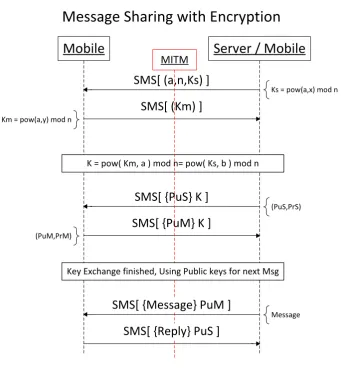
parties first use diffie-helman algorithm for key exchange, with share of public key afterwards. Similar to diffie-helman key exchange, other key exchange techniques require sharing of initial random numbers to land on a secret number on both sides which act as a key. Vulnerability in this system is identified in Figure 1.4: Man in the Middle attack.
Mobile
SMS[ (a,n,Ks) ]
Server / Mobile
SMS[ (Km) ]
Message Sharing with Encryption
K = pow( Km, a ) mod n= pow( Ks, b ) mod n
SMS[ {PuS} K ]
SMS[ {PuM} K ] MITM
Key Exchange finished, Using Public keys for next Msg
SMS[ {Message} PuM ]
SMS[ {Reply} PuS ]
Ks = pow(a,x) mod n
Km = pow(a,y) mod n
(PuS,PrS)
(PuM,PrM)
Message
Figure 1.4 Man in the Middle attack
messages and even alter them. Key exchange messages do not prove identity of sender there for MITM takes advantage and intercepts communication.
Figure1.5 SMS exchange over network
Figure1.5 SMS exchange over network, demonstrates how two mobile phone exchange SMS over network, first mobile device sends SMS it to the closest base station using standard transmission and reception channel called On-The-Air Interface, second from base station SMS is forwarded to Short Messaging Service Center over SS7,third after querying destination location, Short Messaging Service Center forwards message over SS7 to the closest base station near destination and at last through On-The-Air Interface, SMS reach its destination and a delivery report is initiated back to the sender. From source till destination, message is moved as plain text. Plain text communication over SMS will have no Confidentiality, Integrity and Authenticity (CIA).
1.3 Problem Statement
With consideration that so much effort has been put into security of SMS, still Key exchange in Secure SMS communication is susceptible to man in the middle attack which can be identified as main problem in SMS security domain therefore this project will focus on study of different solutions available to defend against MITM attack, designing new approach to avoid MITM attack and implementation of framework based on designed approach.
1.4 Research Questions
Problem statement can be broken down into following study oriented questions
i. What are possible solutions available to address Man in the middle Attack over same communication channel (GSM Network)?
ii. How can secondary communication (EDGE/GPRS/4G) channel assist in key exchange to avoid Man in the Middle Attack?
iii. How can Smartphone Application use same channel or multiple channels to exchange secret keys and SMS messages?
1.5 Project Objective
The objectives of this project are to
i. To study different solutions available for addressing man in the middle attack and HTTPS communication between internet and mobile applications, for exchange of secret keys.
application.
iii. To implement Android Secure SMS application and KDS. Android application will generate encryption keys, publish it to KDS and Send, Read secure sms whereas KDS will act as a public key repository.
1.6 Project Scope
Scope of project will involve following:
i. Mobile Operating Systems that support SMS construction using applications are Android and Symbian. This project will use Android platform to conduct experiments and generate results
ii. As project environment is offline local environment, HTTPS certificate will be self-signed and there will be no certification authority.
iii. KDS will be implemented using WAMP Server which is a collection of Apache, MySQL and PHP.
iv. RSA will be used as an encryption algorithm as it is built-in security component of Android operating system.
1.7 Project goal
To design an application framework that can guarantee defense against MITM attack for secure SMS by developing framework using smart phone application and secure web application.
1.8 Significance of the Project
left vulnerable to MITM attack. Proposed framework will not use SMS to exchange encryption keys but will use HTTPS channel for this purpose which cannot be compromised by MITM if properly configured.
1.9 Contribution
This project will do following contributions in related field of study
i. This project propose a new framework to make SMS secure by managing keys over HTTPS public key infrastructure. These keys will be distributed to mobile devices for SMS encryption and decryption.
ii. As Android and PHP web development framework are open source platforms, this research and application code will be made public over “Google code” to help community.
iii. It will contribute to Android platform for creation of Secure SMS applications that can guarantee defense against MITM attack.
iv. Concepts and techniques discussed to make SMS secure can also be applied to communication over Internet, Bluetooth, WIFI etc. on Android platform giving extra benefit to Android community.
v. Automated messaging can adopt designed framework to make business communication secure with quality of service of SMS.
1.10 Organization of Report
Chapter 2 consists of literature review. It identifies key components of the system that are GSM nodes, confidentiality integrity authenticity over SMS, public key infrastructure with HTTPS and communication protocol. For identified components literature review is presented along with current contribution in similar fields.
Chapter 3 identifies the research methodologies available and used inside the project. It identifies the operational outline, approach and techniques used throughout the project.
Chapter 4 di s cuss es desi gn and i mpl em ent at ion of the proj ect . Des i gn wil l id enti fy com ponent s used for i m pl em ent at i on and how t he y wi l l com m uni cat e wh ereas i m pl em ent at ion wil l identi f y pl at form and t ool s us ed t o i mpl em ent out li ned desi gn.
Chapter 5 will present results of the Android application and KDS. Application will be tested in a localhost environment. For this purpose application will be emulated on ANDROID emulator and HTTPS services will be provided by WAMP Server at the end results of experiments will be discussed.
Chapter 6 concludes project findings and lay foundati on for future work. Different extensions of the project are discussed inside this chapter.
1.11 Summary
REFERENCES
Buitron-Damaso, I., Morales-Luna, G., 2011. HTTPS connections over Android, in: 2011 8th International Conference on Electrical Engineering Computing Science and Automatic Control (CCE). Presented at the 2011 8th International Conference on Electrical Engineering Computing Science and Automatic Control (CCE), pp. 1–4.
Chavan, R.R., Sabnees, M., 2012. Secured mobile messaging, in: 2012 International Conference on Computing, Electronics and Electrical Technologies (ICCEET). Presented at the 2012 International Conference on Computing, Electronics and Electrical Technologies (ICCEET), pp. 1036–1043.
De Santis, A., Castiglione, A., Cattaneo, G., Cembalo, M., Petagna, F., Petrillo, U.F., 2010. An Extensible Framework for Efficient Secure SMS, in: 2010 International Conference on Complex, Intelligent and Software Intensive Systems (CISIS). Presented at the 2010 International Conference on Complex, Intelligent and Software Intensive Systems (CISIS), pp. 843–850.
Farooq, Umar, Tanveer ul Haq, Muhammad Amar, Muhammad Usman Asad, and Asim Iqbal. “GPS-GSM Integration for Enhancing Public Transportation Management Services.” In Proceedings of the 2010 Second International Conference on Computer Engineering and Applications - Volume 02, 142–147. ICCEA ’10. Washington, DC, USA: IEEE Computer Society, 2010. doi:10.1109/ICCEA.2010.183.
International Engineering Consortium, 2002,page 268
Jamil, S., and F.A. Mousumi. “Short Messaging Service (SMS) Based M-banking System in Context of Bangladesh.” In 11th International Conference on Computer and Information Technology, 2008. ICCIT 2008, 599–604, 2008. doi:10.1109/ICCITECHN.2008.4802986.
Joseph Migga Kizza, Guide to Computer Network Security, 2013
Medani, A.; Gani, A.; Zakaria, O.; Zaidan, A.A.; Zaidan, B.B. (2011) Review of mobile short message service security issues and techniques towards the solution. Scientific Research and Essays, 6 (6). pp. 1147-1165. ISSN 1992-2248
Peersman, C., S. Cvetkovic, Paul Griffiths, and Hugh Spear. “The Global System for Mobile Communications Short Message Service.” IEEE Personal Communications 7, no. 3 (2000): 15–23. doi:10.1109/98.847919.
Presented at the 2nd International Conference on Anti-counterfeiting, Security and Identification, 2008. ASID 2008, pp. 235–240.
Pochmara, J., Pałasiewicz, J., Szablata, P., 2010. Expandable GSM and GPS systems simulator, in: Mixed Design of Integrated Circuits and Systems (MIXDES), 2010 Proceedings of the 17th International Conference. Presented at the Mixed Design of Integrated Circuits and Systems (MIXDES), 2010 Proceedings of the 17th International Conference, pp. 552–556.
Puangpronpitag, S., Sriwiboon, N., 2012. Simple and Lightweight HTTPS Enforcement to Protect against SSL Striping Attack, in: 2012 Fourth International Conference on Computational Intelligence, Communication Systems and Networks (CICSyN). Presented at the 2012 Fourth International Conference on Computational Intelligence, Communication Systems and Networks (CICSyN), pp. 229–234.
System Technology (POWERCON), 1–5, 2010. doi:10.1109/POWERCON.2010.5666594.
Shirley Jordan, from smoke signals to email: moments in history, 2000
Tuchman, W., 1998. Internet besieged, in: Denning, D.E., Denning, P.J. (Eds.), ACM Press/Addison-Wesley Publishing Co., New York, NY, USA, pp. 275– 280.
Verma, R.K., Tomar, D.S., Rathore, S.K., 2011. Extraction and Verification of Mobile Message Integrity, in: 2011 International Conference on Communication Systems and Network Technologies (CSNT). Presented at the 2011 International Conference on Communication Systems and Network Technologies (CSNT), pp. 49–53.
Vougioukas, S., and M. Roumeliotis. “A System for Basic-level Network Fault Management Based on the GSM Short Message Service (SMS).” In EUROCON’2001, Trends in Communications, International Conference On.,
1:218–222 vol.1, 2001. doi:10.1109/EURCON.2001.937799.
Wang, X., Yang, Y., 2009. Method and Implementation of Sending and Receiving Mobile Phone Messages, in: International Forum on Computer Science-Technology and Applications, 2009. IFCSTA ’09. Presented at the International Forum on Computer Science-Technology and Applications, 2009. IFCSTA ’09, pp. 173–175.William Stallings, Network Security Essentials fourth Edition , 2001
Wu, Songyang, and Chengxiang Tan. “High Security Communication Protocol for SMS.” In International Conference on Multimedia Information Networking and Security, 2009. MINES ’09, 2:53–56, 2009. doi:10.1109/MINES.2009.83.