ISSN(Online): 2319-8753 ISSN (Print): 2347-6710
I
nternational
J
ournal of
I
nnovative
R
esearch in
S
cience,
E
ngineering and
T
echnology
(An ISO 3297: 2007 Certified Organization)
Website: www.ijirset.com
Vol. 6, Issue 8, August 2017
Implementation of Effective Error Correction
Architecture for (24,12) Extended Golay Code
Nimmagadda Sravani1, Mulukutla Chaitanya2
PG Scholar, Department of ECE (VLSI&ES), GPREC (Autonomous), Kurnool, AP, India1
Assistant Professor, Department of ECE, GPREC (Autonomous), Kurnool, AP, India2
ABSTRACT: With the increase in the technological advancements we are now capable of designing and using high speed communication systems and memory systems with very huge capacities. All these systems work on binary data and there is a great need to protect this information from being corrupted for which we are now using Error Correcting Codes (ECCs). The (24,12) Extended Golay Code is one of the widely used half rate linear error correcting code with significant properties. This paper presents an efficient way of implementing the necessary architecture for the encoder and decoder required for the Extended Golay Code to rectify single and double bit faults. The architectures are described with the simulation and synthesis results.
KEYWORDS: Binary Golay Code, Extended Binary Golay Code, Long division algorithm
I. INTRODUCTION
The various devices that are being used in numerous fields are predominantly working on binary data. In the present world, need for the huge storage devices and high speed communications is increasing rapidly. When these systems work under harsh environments there is a great chance for the data to get corrupted.
The errors which do not cause any damage to the hardware, but change the instruction or the data are known as soft errors, usually observed due to the material decay or noise phenomenon [1]. Error correction codes have been frequently used to improve the reliability of these systems.
Advances in semiconductor technology have fetched very high levels of integration, predominantly observed in VLSI memories. A review of error correcting codes for VLSI storage devices is presented in [2]. With the surge in the usage of highly compact memories the possibility of the no. of bits getting corrupted has also increased, leading to multiple bit errors.
The current developments in this field are analysed. The set of techniques in paper [3] are used for single-error rectification and double error identification. An interleaving scheme is proposed in [5] which is effective with multiple bit errors. A report on the geometric effect of multiple bit soft errors induced by the neutrons is presented in paper [6]. The concept of exploring the check bit design space and selective bit placement to design SEC-DED codes is presented in [7]. A mathematical model for bit-error-rate is discussed in [8].
ISSN(Online): 2319-8753 ISSN (Print): 2347-6710
I
nternational
J
ournal of
I
nnovative
R
esearch in
S
cience,
E
ngineering and
T
echnology
(An ISO 3297: 2007 Certified Organization)
Website: www.ijirset.com
Vol. 6, Issue 8, August 2017
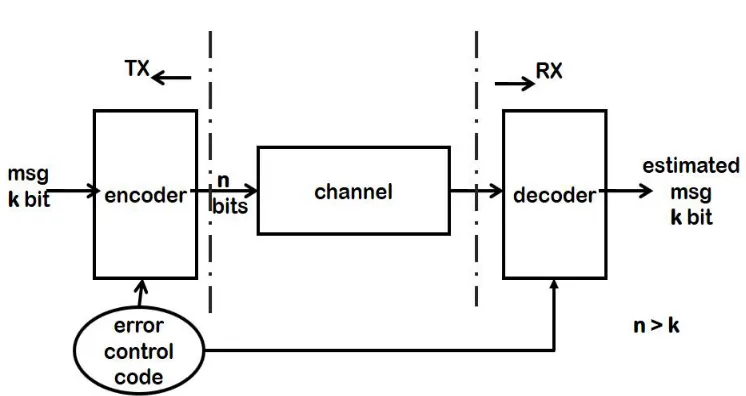
Fig 1: Concept of encoding and decoding using parity bits
II. GOLAYCODE
The binary Golay Code is represented as (23, 12, 7) which indicates that the length of the code word is 23 bits, message being 12 bits and the minimum distance between two binary Golay Codes is seven.
The extended Golay Code (24, 12, 8) can be created by appending a parity bit to the binary Golay Code. The extended code has a minimum distance of eight, and therefore can rectify 3-bit errors and identify 4-bit errors.
The addition of parity bits is preferred despite the addition of overheads in memory and time as the no. of code words with n-bits are less than the possible words of n-bits, allowing to differentiate between the message word and erroneous words. This concept is explained in Fig 2.
Fig 2: Necessity of parity bits
ISSN(Online): 2319-8753 ISSN (Print): 2347-6710
I
nternational
J
ournal of
I
nnovative
R
esearch in
S
cience,
E
ngineering and
T
echnology
(An ISO 3297: 2007 Certified Organization)
Website: www.ijirset.com
Vol. 6, Issue 8, August 2017
III.ENCODINGTECHNIQUE
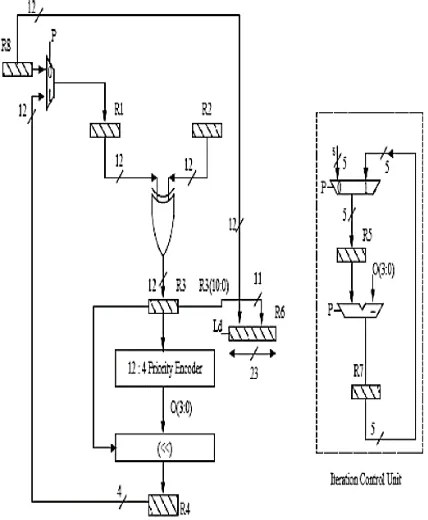
In this paper the implementation of long division algorithm is discussed. According to this algorithm at each step we perform binary XOR operation for modulo-2 subtraction of P(x) and G(x). the residual result obtained at each step during the division process is circularly left shifted by the number of leading zeros present in the result. The same no of zeros is then brought down as in the division process. This procedure is repeated till all the appended zeros are brought down.
The steps involved in the realisation of the encoded codeword are
1. A generator polynomial G(x) is considered for the generation of the check bits.
2. In order to get the 23 bit encoded codeword, we append the message M(x), which is of size 12-bit, with 11 zeros and refer it as P(x).
3. The remainder bits except the MSB developed at the end of the division operation are the check bits for G23. Appending check bits to the message gives the encoded Golay (23, 12, 7) codeword.
4. In order to generate the extended Golay codeword from the binary Golay code we add a parity bit. If the weight of the binary Golay code is even, then bit 0 is appended, otherwise 1 is appended.
As an example consider M(x) as A27h and this results the P(x) in binary as 1010 0010 0111 0000 0000 000. Hence the encoded codeword for the message A27h is A27435h. the extended Golay codeword becomes A2786Bh.
The architecture implementation of this procedure is shown in Fig 3. A Mux is used to select the P(x) at each stage. XOR gate is used for performing modulo-2 subtraction. A priority encoder is used to find the number of leading zeros in each stage. A shift register is used to perform left shift based on the output of the priority encoder. The no. of iterations to be performed is controlled by using a loop control mechanism. Here one input of the subtracter is filled initially with 11, which is same as the no. of zeros appended in the first step of the long division, and gets updated at each stage with the output of this subtracter and the output of the priority encoder being the other input. Acombination of Mux, counter, and registers is used to convert the binary Golay code into the extended binary Golay code as shown in Fig 4.
ISSN(Online): 2319-8753 ISSN (Print): 2347-6710
I
nternational
J
ournal of
I
nnovative
R
esearch in
S
cience,
E
ngineering and
T
echnology
(An ISO 3297: 2007 Certified Organization)
Website: www.ijirset.com
Vol. 6, Issue 8, August 2017
Fig 4: architecture for the conversion of binary Golay code to extended Golay code
IV.DECODING TECHNIQUE
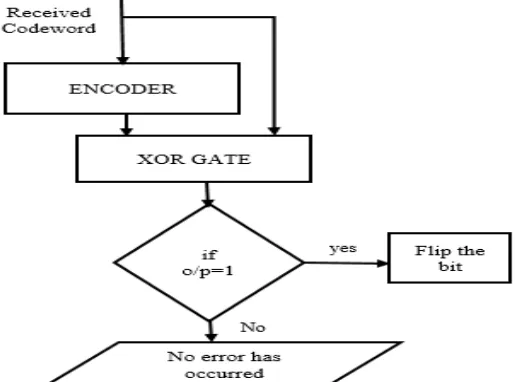
The decoder designed here is used to identify and rectify single and double bit errors. The idea is illustrated in Fig 5. In this procedure, the first twelve bits of the received codeword are separated (these bits form the message bits) and are send to the encoder to reconstruct the codeword. Now both the code words, received and reconstructed, are divided into three sets with 8-bits in each set. XOR gate is used to compare the respective bits of the received codeword and the reconstructed codeword of each set separately. If both the sets are equal, then no error has occurred, otherwise we flip the bit of the corresponding set in the respective position which is corrupted.
In this paper an erroneous input is given to the decoder as A27873h instead of A2786Bh. the decoder identified the error and rectified it to A2786Bh by flipping the corresponding bits. With this our requirement of identifying and rectifying errors in binary systems is achieved.
ISSN(Online): 2319-8753 ISSN (Print): 2347-6710
I
nternational
J
ournal of
I
nnovative
R
esearch in
S
cience,
E
ngineering and
T
echnology
(An ISO 3297: 2007 Certified Organization)
Website: www.ijirset.com
Vol. 6, Issue 8, August 2017
V. RESULTS
The simulation and synthesis of the techniques described in the paper are performed using modelsim and Xilinx tools respectively. The following are the screenshots of the obtained results.
Output of the encoder
A27h is encoded as A2786Bh
When reset is triggered
The decoder output is 000h
Decoder output when no error has occurred
ISSN(Online): 2319-8753 ISSN (Print): 2347-6710
I
nternational
J
ournal of
I
nnovative
R
esearch in
S
cience,
E
ngineering and
T
echnology
(An ISO 3297: 2007 Certified Organization)
Website: www.ijirset.com
Vol. 6, Issue 8, August 2017
Decoder output when error has occurred
A27h is the encoder input, A27873h is the decoder input. Error is detected. Value at pin error_det is 1 Decoder output is A27h
ISSN(Online): 2319-8753 ISSN (Print): 2347-6710
I
nternational
J
ournal of
I
nnovative
R
esearch in
S
cience,
E
ngineering and
T
echnology
(An ISO 3297: 2007 Certified Organization)
Website: www.ijirset.com
Vol. 6, Issue 8, August 2017
Design summary:
Timing report
VI. CONCLUSION
Effective hardware architecture for both encoder and decoder of the extended binary Golay code have been designed and implemented after verifying the proposed algorithm. The algorithm discussed in this paper is better than single error correcting algorithms as this scheme can correct double bit errors. By exploring the properties of the Golay code we can further extend this scheme to correct three bit errors or detect four bit errors.
REFERENCES
[1] R. C. Baumann, “Soft errors in advanced computer systems,” IEEE Des.Test. Comput., vol. 22, no. 3, pp. 258– 266, May/Jun. 2005.
[2] C. L. Chen and M. Y. Hsiao, “Error-correcting codes for semiconductor memory applications: A state-of-the-art review,” IBM J. Res. Develop., vol. 28, no. 2, pp. 124–134, Mar. 1984.
ISSN(Online): 2319-8753 ISSN (Print): 2347-6710
I
nternational
J
ournal of
I
nnovative
R
esearch in
S
cience,
E
ngineering and
T
echnology
(An ISO 3297: 2007 Certified Organization)
Website: www.ijirset.com
Vol. 6, Issue 8, August 2017
[4] E. Ibe, H. Taniguchi, Y. Yahagi, K. Shimbo, and T. Toba, “Impact of scaling on neutron-induced soft error in SRAMs from a 250 nm to a 22 nm design rule,” IEEE Trans. Electron Devices, vol. 57, no. 7, pp. 1527–1538, Jul. 2010.
[5] P. Reviriego, J. A. Maestro, S. Baeg, S. Wen, and R. Wong, “Protection of memories suffering MCUs through the selection of the optimal interleaving distance,” IEEE Trans. Nucl. Sci., vol. 57, no. 4, pp. 2124–2128, Aug. 2010.
[6] S. Satoh, Y. Tosaka, and S. A. Wender, “Geometric effect of multiple-bit soft errors induced by cosmic ray neutrons on DRAM’s,” IEEE Electron Device Lett., vol. 21, no. 6, pp. 310–312, Jun. 2000.
[7] A. Neale and M. Sachdev, “A new SEC-DED error correction code subclass for adjacent MBU tolerance in embedded memory,” IEEE Trans. Device Mater. Rel., vol. 13, no. 1, pp. 223–230, Mar. 2013.
[8] M. A. Bajura et al., “Models and algorithmic limits for an ECC-based approach to hardening sub-100-nm SRAMs,” IEEE Trans. Nucl. Sci., vol. 54, no. 4, pp. 935–945, Aug. 2007.