A Fast Compression Technique by Improving
the Parameters and Structure of Neural
Network Using Improved GA and Switches
Structure
Digvijay Singh Thakur 1, Prabhakar Sharma 2
M.Tech Scholar, Department of Computer Science & Engineering, Raipur Institute of Technology, Raipur C.G, India1 Assistant Professor, Department of Computer Science & Engineering, Raipur Institute of Technology,
Raipur C.G, India 2
ABSTRACT:Genetic algorithm and neural network based techniques are very powerful method for solving real life problems and has been widely studied for its applications in areas of image compression. For image compression.GA based learning for neural network is suffering from curse of very slow convergence and poor quality of compression. Neural networks for tuning usually have a fixed structure. The number of connections has to be large enough to fit a given application. This may cause the neural network structure to be unnecessarily complex and increase the implementation cost. The current work proposes a neural network with switches. By doing this, the proposed neural network can learn both the input-output relationships of an application and the network structure. The experimental results show that the technique performed efficiently then the algorithm version without switches.
KEYWORDS:Image Processing, Image Compression, Genetic Algorithm, Switches.
I. INTRODUCTION
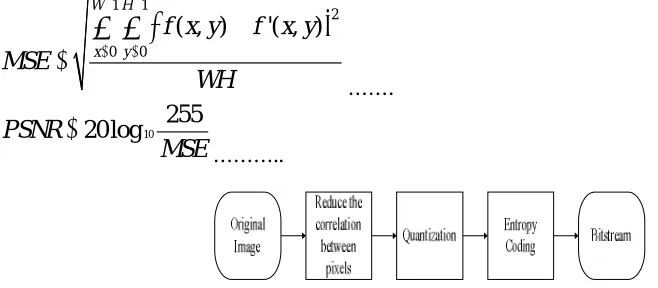
Image compression is an application of data compression that encodes the original image with few bits. The objective of image compression is to reduce the redundancy of the image and to store or transmit data in an efficient form. Fig 1.1 shows the block diagram of the general image storage system. The main goal of such system is to reduce storage quantity as much as possible, and the decoded image displayed in the monitor can be similar to the original image as much as can be.
The essence of each block will be introduced in the following sections.
The Flow of Image Compression Coding: Image compression coding is to store the image into bit-stream as compact as possible and to display the decoded image in the monitor as exact as possible. When the encoder receives the original image file, the image file will be converted into a series of binary data, which is called the bit-stream. The decoder then receives the encoded bit-stream and decodes it to form the decoded image. If the total data quantity of the bit-stream is less than the total data quantity of the original image, then this is called image compression. The compression ratio is defined as follows:
= ………. (1)
Where n1 is the data rate of original image and n2 is that of the encoded bit-stream.
In order to evaluate the performance of the image compression coding, it is necessary to define a measurement that can estimate the difference between the original image and the decoded image. Two common used measurements are the Mean Square Error (MSE) and the Peak Signal to Noise Ratio (PSNR) respectively. f(x,y) is the pixel value of the original image, and f’(x,y)is the pixel value of the decoded image. Most image compression systems are designed to minimize the MSE and maximize the PSNR. The equations for finding MSE and PSNR are as follows:-
1 1 2 0 0( , )
'( , )
W H x yf x y
f x y
MSE
WH
……. (2)
10
255
20 log
PSNR
MSE
……….. (3)
Fig 1.2: The general encoding flow of image compression
Quantization: The objective of quantization is to reduce the precision and to achieve higher compression ratio. For instance, the original image uses 8 bits to store one element for every pixel; if we use fewer bits such as 6 bits to save the information of the image, then the storage quantity will be reduced, and the image can be compressed. The shortcoming of quantization is that it is a lossy operation, which will result into loss of precision and unrecoverable distortion.
II. RELATEDWORK
of basic operations is applied to the population of the chromosomes. Selection is an operation which selects the chromosomes according to their fitness values. So, if a chromosome has higher fitness value, it will have a high chance to produce offsprings into the next generation. In the crossover operation, the selected parents are crossed to create new chromosomes by swapping genes between parents. Mutation is the last operation which alters the gene of some chromosomes (usually with low probability). The GA phases are repeated until an optimization solution is found or a termination criterion is fulfilled. For image compression the algorithm is as follows:
1.Chromosomes are initialized where each chromosome represent a codebook .The label I (I =1,2,3,…………..,M) of the training vector is viewed as agene, thus the basic individual is made up of M genes which can split into N units, each unit is made up of several labels which belong to this unit. N code words are the center vector of the training vectors in each unit. Each
4
4
block in image references its code word using 8-bits. The codebook will be an array of two dimensions and length of code word is 256, while the number of columns in the codebook will be varies according to the input image size. Each unit in codebook is classified using blocks of image using the squared error distortion using the following formula., = ∑ − ……….. (4)
Where X represent the block of training image Y represents the unit in the codebook. According to the above step the generations are initialized.
2. The chromosome with best fitness will be chosen as best representative chromosome for study image. For each individual, the programs calculate the overall distortion according to the following formula.
= ∑ ∑ ( ) − ( ) ( )
……… (5)
Fitness function for each chromosome calculated according to the formula
= ……….. (6)
3. Selection process is performed between two randomly chosen parents using Tournament Selection method. If the fitness value of the first parent is equal to the fitness value of the second parent, one of them will be selected randomly.
4. Crossover process is performed using two point crossovers by exchanging the genes between these points in each parent to produce two new offspring. This is performed with a certain probability; otherwise the two parents are copied as offspring.
5. In next step a gene is randomly selected from each individual and the center of that gene is replaced with mean to make this pixel take value nearest to its neighbor pixels.
6. The termination criteria are taken as no of generations and error values. The iteration terminates when one of the condition is satisfied.
III. PROPOSEDMETHODOLOGY
A. Problem Statement
GA based learning for neural network is suffering from curse of very slow convergence and poor quality of compression. Neural networks for tuning usually have a fixed structure. The number of connections has to be large enough to fit a given application. This may cause the neural network structure to be unnecessarily complex and increase the implementation cost.
B. Proposed Algorithm
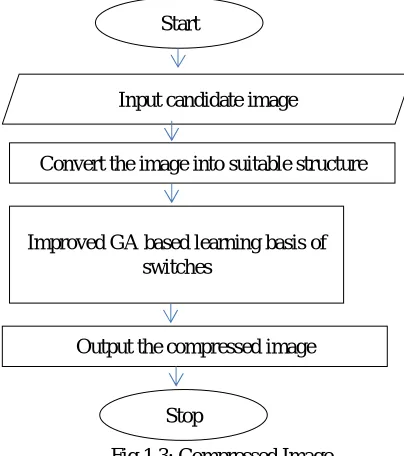
The overall image compression is carried out using Neural Network. In order to adjust the weights of the network GA based switches are used. The switches are binary functions that lie on the connections between nodes. In other words, if some parameter is greater than or equal to 0, the switch is turned on and a connection exists between the two nodes, but if is less than 0, the switch is turned o and the connection does not exist. The equation can be represented as:
( ) = 0
1 , ∈ ……….. (7)
Instead of only allowing for the removal of connections, switches have been placed on the hidden nodes within the network, thus allowing for the tuning of both connectivity and size. Users no longer have to train and test the network for various numbers of nodes, as one run-through using a rather large number of hidden nodes will allow the algorithm to turn off any unnecessary nodes and the optimal size on its own. The node switches behave in the same manner as those found on the connections. A parameter will be tuned using the GA, and will then be compared to a threshold value of 0. If the parameter is greater than or equal to the threshold, the node is turned on; if not, it is switched off.
Step 1:
1. Initialize population on the basis of training samples. 2. Evaluate fitness of the initial population.
3. Apply tournament selection operation. 4. Apply mutation operation.
5. Output best weights. Step 2:
1. Input pixel values of candidate image and split into small sub images.
2. Image compression is completed by the quantum state from the input layer to hidden layer.
3. Use GA method based on mean square error to adjust the weight, until the image reconstruction error less than target error.
4. The hidden layer output is the result of image compression.
.
Start
Input candidate image
Convert the image into suitable structure
Improved GA based learning basis of switches
Stop
IV.EXPERIMENTAL RESULTS
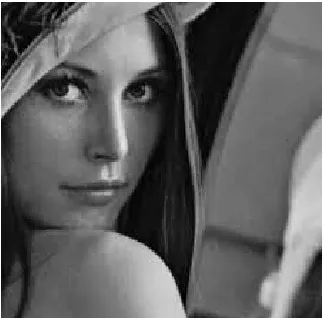
The technique pixels from perform better than other techniques the figures 1.4 and 1.5 represent the original and compressed images. The experiment was carried out using Matlab platform. The output of the experiment shows that the compressed image is very similar to the original image. The experiment outperformed the outputs of previously studied techniques.
Fig 1.4: Original Image
Fig 1.5: Compressed Image .
V. CONCLUSION
In this paper, an improved switch based algorithm for image compression is proposed. In first step the Genetic algorithm is used to produce best weights for tuning parameters for adjusting weights in Neural Network that acts as switches to switch the layer on or off. Based on the switched the neural network is used for image compression and reconstructions. It produces a good compression ratio for grey level types of images
REFERENCES
[1] Image Compression Based on Genetic Algorithm Optimization, Mohammed Omari and Salah Yaichi, 2015 IEEE.
[2] L. Xi, L. Zhang. “A Study of Fractal Image Compression Based on an Improved Genetic Algorithm,” International Journal of Nonlinear Science, 2007, vol.3, no.2, pp. 116-124.
[3] M. Melanie, “An Introduction to Genetic Algorithms”, a Bradford Book The MIT Press, 1999.
[4] A Genetic Algorithm Based K-Means Algorithm For Compressing Images, M.MaryShanthi Rani, International Journal Of Engineering And Computer Science ISSN: 2319-7242 Volume 4 Issue 9 Sep 2015.
[5] Integrated Particle Swarm Optimization and Genetic Algorithm Based Compression for Reduction of Blocking Artifacts, Prabhjeetkaur, Er. Parminder Singh, (IJCSIT) International Journal of Computer Science and Information Technologies, Vol. 6 (5) , 2015.
[6] Fractal Image Compression Based on Multi-Objective Genetic Algorithm, PrashantKashiraoAdakane and Prof. OnkarNath Thakur, International Journal Of Innovative Trends In Engineering (Ijite), 2015.
[7] H. S Soliman, M. Omari, “A neural networks approach to image data compression,” Applied Soft Computing, 2006.
[8] S. Ramakrishnan, K. Rose, and A. Gersho, “Constrained-Storage Vector Quantization with a Universal Codebook,” IEEE, 1998
[9] H. S. Soliman, M. Omari, “Universal Codebook versus Local Codebook: Applications of Image Compression Using AVQ Theory”, ANNIE 2002, University of Missouri-Rolla, MO, November 2002.
[10] H. S. Soliman, M. Omari, “Image Compression using Neural Nets, Hybrid ART/Kohonen Neural Model for Document Image Compression,” ANNIE 2002, University of Missouri-Rolla, MO, November 2002.
[11] T. Kohonen, “Self-Organizing Maps, Optimization Approaches,” Artificial Neural Networks, p 981-990, Elsevier Science Publishers B.V. (North-Holland) 1991.
[12] J. M. Zurada, “Introduction to Artificial Neural System”, PWS Publishing Company, 1995.
[13] L. Xi, L. Zhang. “A Study of Fractal Image Compression Based on an Improved Genetic Algorithm,” International Journal of Nonlinear Science, 2007, vol.3, no.2, pp. 116-124.
[14] M. Melanie, “An Introduction to Genetic Algorithms”, a Bradford Book The MIT Press, 1999.
[15] Brahimi, Z. and Saadi, K.A. (2004) Color Image Coding based on Embedded Wavelet Zerotree and Scalar Quantization, ICPR, 17th