ISSN(Online): 2319-8753 ISSN (Print): 2347-6710
International Journal of Innovative Research in Science,
Engineering and Technology
(An ISO 3297: 2007 Certified Organization)
Website: www.ijirset.com
Vol. 6, Issue 6, June 2017
Energy Efficient Routing Protocol Using
K-Means In General Self-Organized Tree-Based
Wireless Sensor Network
Rameshwar P Kharjule, Prof. S. R. Ghungrad
Department of Computer Science and Engineering, Matsyodari Shikshan Sanstha's College of Engineering and
Technology, Jalna. Dr. Babasaheb Ambedkar Marathwada University, Aurangabad. Maharashtra, India
Department of Computer Science and Engineering, Matsyodari Shikshan Sanstha's College of Engineering and
Technology, Jalna. Dr. Babasaheb Ambedkar Marathwada University, Aurangabad, Maharashtra, India
ABSTRACT: Wireless Sensor networks (WSN) is a system collection of huge number of low cost sensor nodes spread over the geographic area in order to sense the data. This network is used to collect data and transmit the messages to base station (sink). In earlier days, WSN has been received a tremendous concentration from academic, defense and industrial services etc. Yet, they have many different constraints, such as computational capabilities, storage capacity, energy supply etc. In order to overcome these problems and to improve the performance of network need not only to minimize total energy consumption but also to balance energy consumption and load in order to enhance network lifetime In recent years researchers have proposed many protocols such as LEACH, HEED, PEGASIS,TBC and PEDAP,GSTEB. In this research paper we propose, hierarchical nearest neighbor routing which organize network in to the form of clusters by using k-means clustering algorithm and then builds a routing tree by using a process where, for each round, BS selects a root node and broadcasts root coordinates to all sensor nodes in network. After that each node selects its parent. Thus k-GSTEB IS a dynamic protocol. The simulation results shows that the proposed approach performs better that other existing approaches.
KEYWORDS: Wireless Sensor Network, Routing, Network Lifetime, Clustering, balanced k-means algorithm, Tree Based Routing, Hierarchical Nearest Neighbor
I. INTRODUCTION
ISSN(Online): 2319-8753 ISSN (Print): 2347-6710
International Journal of Innovative Research in Science,
Engineering and Technology
(An ISO 3297: 2007 Certified Organization)
Website: www.ijirset.com
Vol. 6, Issue 6, June 2017
connectivity due to high error rate of wireless link, and it can be further dominated by environmental hazards. Therefore, an effective sensor fusion network must be able to provide robust communication infrastructure and survivability to cope with node failures, connectivity failures, and individual service failures.Wireless sensor networks have been become very popular in different application of daily life considering the following factors: ease of installation, reliability, cost, bandwidth, total required power, security and performance of network. All other networks were made however based on fixed infrastructure. But wireless sensor networks play a tremendous role in our day to day life.A sensor network is a network of many tiny disposable low powered devices, called sensor nodes, which are geographically distributed in order to perform an application-oriented global task. These nodes create a self-organized network by communicating with each other either directly or through other nodes by following multi-hop path. There will exists one or more nodes among sensor nodes those will serve as sink(s) that are capable of communicating with the user either directly or through the existing wired networks. The main component of the network is the sensor, which is necessary for monitoring real world physical conditions such as weather conditions such as sound, temperature, humidity, relative intensity, vibration, pressure, motion, pollutants etc. at different locations.
Also the number and position of these advanced nodes must be constrained to limit the tour length of MEs, which in turn shorten the data gathering latencyHomogeneous Sensor Network [5], some sensor nodes with shorter distance to the BS or mobile sink trajectory are recruited as polling points for the MEs to visit. This category of algorithms always limits the relay hops to a small value to reduce the energy consumption of multi-hop transmissions.In general, WSN may produce quite a substantial amount of data, so if data fusion could be used, the throughput could be reduced [9]. Because sensor nodes are deployed densely, WSN might generate redundant data from multiple nodes, and the redundant data can be combined to reduce transmission. Most of the protocols implement data fusion, but approximately all of them consider that the length of the message transmitted by each relay node be supposed to be constant. PEGASIS [9] and TBC [2] are representative protocols based on this consideration and perform far better than LEACH [7] and HEED [8] .Hence, several energy efficient and energy balancing techniques has been proposed till now. But still some issues regarding energy consumption still need to be addressed those effect the network performance. Such constraints on sensor networks are very essential to be addressed in order to improve network lifetime and network performance. In this research work a new k-means clustering based GSTEB routing protocol is proposed in order to overcome aforementioned issues in previous studies.
II. LITERATURE SURVEY
In [1] a best routing protocol is planned based on Tree on DAG (ToD), a semi structured strategy that uses dynamics forwarding on a totally created structure encompass multiple shortest path trees to take care of network measurability. The key commonplace at the rear of ToD is adjacent nodes in a very graph can have low down stretch in one of these trees in ToD, so succeeding in early aggregation of packets. A configurable top down cluster and cluster-tree formation rule, a cluster-cluster-tree self-optimization phase, a stratified cluster addressing theme, and a routing theme is planned in [2].
Routing protocol separate the network into several clusters exploitation Dijkstra rule builds a routing tree for every cluster. In routing tree, most number of youngsters for cluster nodes is decided. The protocols pay attention of congestion by routing tree, node’s neighbors average queue length and residual energy of nodes as parameters. A new tree primarily based routing protocol (TBRP) is introduced for improve network lifespan of the sensor nodes. TBRP accomplish with a more robust performance in lifespan by equalization the energy load with relation to all the nodes [3].
ISSN(Online): 2319-8753 ISSN (Print): 2347-6710
International Journal of Innovative Research in Science,
Engineering and Technology
(An ISO 3297: 2007 Certified Organization)
Website: www.ijirset.com
Vol. 6, Issue 6, June 2017
given a unique routing protocol that considers sensors power limitation and increase the network’s lifespan by eliminating extra messages between nodes [5].
Options of clusters, that higher density of packets is at the high levels of the tree and alike for topologies that have equal density of packets across the network or higher density of packets at low levels of the tree. Cluster tree and routing area unit utilized to show the potency of the schemes over existing techniques. The author given a programming rule based on congestion rate of detector nodes. In congestion-based programming rule, coloring the given network is skillful correspond to scheduling is comparable to node-based programming [6].
From the sensing area and transmit the information to BS located far away from the sensing area. A simple approach to fulfilling this task is that each sensor node transmits data directly to BS. However, when BS is located far away from the sensing field, the sensor nodes will exhaust their energy quickly due to much energy consumption. On the other hand, since the distances between each node and BS are different, direct transmission leads to unbalanced energy consumption also. To solve these kinds of problems, many protocols have been proposed. Of the protocols proposed, hierarchical protocols such as LEACH [7], HEED [8], PEGASIS [9], TBC [10] gains satisfactory solutions.
General organized [1] tree based energy-balance routing protocol is a tree based routing protocol. General self-organized tree based energy-balance routing protocol is classified under hierarchical routing protocols. The operation of GSTEB [1] is basically divided into four phases namely: initial phase, tree construction phase, self-organized data collection and transition phase and information exchanging phase.
K-means is a partitioning [2] methodology that partition the network based on different criteria’s. K-means based clustering approach makes use of basic k-means approach to create clusters into the network. In this paper the author proposed a balanced K-mean [8] based clustering algorithm to create energy efficient clusters for routing in wireless sensor networks. The LEACH protocol is enhanced by using K-means to create energy-efficient clusters for a given number of transmissions. The K-means outcome identifies the suitable cluster heads for the network. It works into two phases: setup phase and steady state phase. During set up phase, the sensor nodes are divided equally into clusters which are selected by K-Means. Depending on the size of the network and number of sensor nodes, the sensor nodes can be equally divided into n numbers of clusters while selected cluster by each node if in a cluster number of nodes exceed than the maximum permissible node than they choose another cluster. During Steady State Phase each sensor node senses and transmits data to its cluster head based on the TDMA schedule. The cluster heads receive all the data aggregate it and sends it to the base station. After transmission that network starts next round and again execute the setup and steady state phase.
In this LEACH Based on k-means [3] a new low energy consumption clustering algorithm based on LEACH is presented. In this protocol firstly, a method for obtaining the number of clusters k is given, then using the k-means algorism to divide all the sensor nodes in WSN to the k clusters, in the whole network life cycle the cluster will not change, and when the energy of cluster head is lower than some threshold, it will be changed. The data transmission between cluster heads to sink node use mixed model, namely, the cluster near the sink node using the single hop and the one far from it using the multiple hops.
III. OBJECTIVES
1. To Simulate wireless sensor network system based on a new approach method by using Java.
2. Reduce the energy consumption.
3. To design and develop a communication protocol which increases the network lifetime.
4. To efficiently disseminate query and query results into the network.
ISSN(Online): 2319-8753 ISSN (Print): 2347-6710
International Journal of Innovative Research in Science,
Engineering and Technology
(An ISO 3297: 2007 Certified Organization)
Website: www.ijirset.com
Vol. 6, Issue 6, June 2017
IV. EXISTING SYSTEM APPROACH
Tree-Based Clustering (TBC) is also an improved protocol of LEACH. It forms several clusters in the same way as LEACH, and each cluster has a head (CH). The nodes within a cluster construct a routing tree where the cluster-head is the root of it. For tree configuration, the cluster-cluster-head uses the distance information between the member nodes and itself. Each node is location-aware, it can estimate the distance between the root and itself. Every cluster is divided into some levels. The distance of a node to the root is the basis for determining its level in the cluster. TBC is an excellent protocol in which each node records the information of its neighbors and builds topography through computing, which is similar to GSTEB.
DISADVANTAGES
I. No Improved Security Features
II. Increase Routing Overhead
V. PROPOSED SYSTEM APPROACH
In this proposed system we develop hierarchical nearest neighboralgorithm for Lifetime optimization and security are two conflicting design issues for multi-hop wireless sensor networks (WSNs) with non-replenish able energy resources. In this paper we propose a General Self-Organized Tree-Based Energy-Balance routing protocol (GSTEB) which builds a routing tree using a process where, for each round, BS assigns a root node and broadcasts this selection to all sensor nodes. Subsequently, each node selects its parent by considering only itself and its neighbors’ information, thus making GSTEB a dynamic protocol. Simulation results show that GSTEB has a better performance than other protocols in balancing energy consumption, thus prolonging the lifetime of WSN. We also demonstrate that the proposed Energy Efficient cost aware secure Routing protocol can achieve a high message delivery ratio while preventing routing trace back attacks.
ADVANTAGE
I. Improved More Efficient Packet Delivery Ratio
II. Detecting And Preventing Attacks
III. Reduce Routing Overhead
VI. PROPOSED SYSTEM ARCHITECTURE
ISSN(Online): 2319-8753 ISSN (Print): 2347-6710
International Journal of Innovative Research in Science,
Engineering and Technology
(An ISO 3297: 2007 Certified Organization)
Website: www.ijirset.com
Vol. 6, Issue 6, June 2017
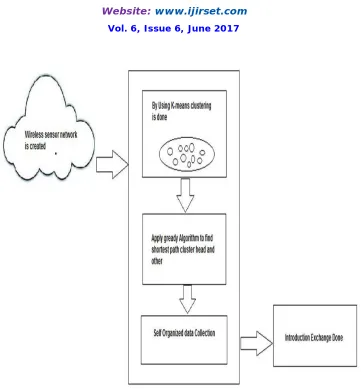
Fig No 01 Proposed System Architecture
VII. PROJECT FLOW
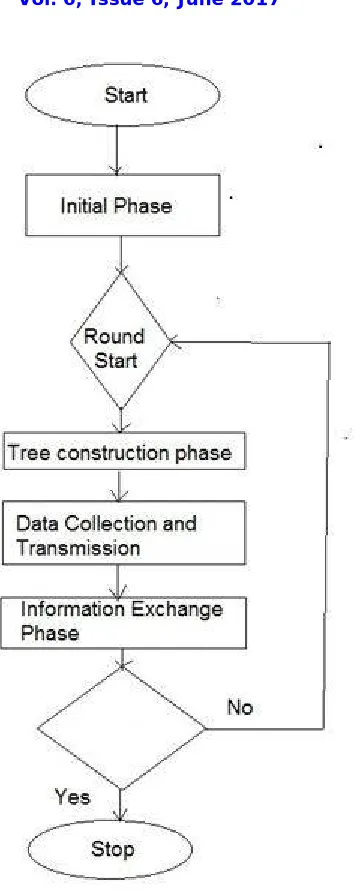
In GSTEB protocol and also obtaining efficient results, proposing a k-GSTEB routing algorithm based on k-means based clustering algorithm. The main phases or blocks of the proposed algorithm are:
1. Initial Phase
2. Tree Constructing Phase,
3. Self-Organized Data Collecting and Transmit ion
4. Phase
ISSN(Online): 2319-8753 ISSN (Print): 2347-6710
International Journal of Innovative Research in Science,
Engineering and Technology
(An ISO 3297: 2007 Certified Organization)
Website: www.ijirset.com
Vol. 6, Issue 6, June 2017
Fig No 02 Flow of the System
a. Algorithm Used
Hierarchical Nearest neighbor routing on k- means cluster based algorithm
A cluster sets up the Resemblance matrix by using the collected information. */ /* Initialization */
ISSN(Online): 2319-8753 ISSN (Print): 2347-6710
International Journal of Innovative Research in Science,
Engineering and Technology
(An ISO 3297: 2007 Certified Organization)
Website: www.ijirset.com
Vol. 6, Issue 6, June 2017
/* Clustering*/
5. While (MinV<= threshold) 6. /* keep listening. */
7. If (isMessageReceived==false) 8. Continue;
9. End if
10. If (cluster ID == MinC) 11. Merge ();
12. Else
13. Update the Resemblance matrix; 14. End if
15. End while
PROCEDCURE Merge ():
16. Merge two clusters;
17. Combineneighbor information of two clusters;
18. broadcast an Inform message to neighbors’ of the new cluster. 19. Update the Resemblance matrix;
20. Find the new minimum in the Resemblance matrix, newMinV; 21. MinV = newMinV;
22. Send an Invite message to the cluster corresponding to MinV;
Algorithm for Base Paper:- Select of cluster heads
Create Network Node =node id; Assign routing = AODV; Set Channel = 802.11;
Set Initial Energy = initial energy; Set
Residual Energy=$residual energy; Set radio range=default;
If ((node in radio range) && (next hop! =Null) {
Data collection from sensor (node all);
Create node Configure (rreq, rrep, tsend, trecv, tdrop,initial energy, residual energy); {
PacketType; TTL; Tse
nd, trecv, tdrop, rrep, rreq; }
}
For (i=0; i<nn; i++)
Energy Calculation energy[i] = initial energy[i] - final energy[i] //computer consume energy Total energy[i] = consume energy[i]
if(max energy[i] <consume energy[i]) {
ISSN(Online): 2319-8753 ISSN (Print): 2347-6710
International Journal of Innovative Research in Science,
Engineering and Technology
(An ISO 3297: 2007 Certified Organization)
Website: www.ijirset.com
Vol. 6, Issue 6, June 2017
}
If (dist<300 &&max energy [node_id] >energy neighbor [node_id]) {
Max energy node is cluster head }
VIII. CONCLUSION
From the consideration of all the above points we conclude that hierarchical nearest neighbor routing which organize network in to the form of clusters by using k-means clustering algorithm A wireless sensor network is a group of small sensor nodes which communicate through radio interface. These sensor nodes are composed of sensing, computation, communication and power as four basic working units. There are various types of restrictions on Wireless sensor networks, but limited energy, communication capability, storage and bandwidth are the main resource constraints. When we try to reduce energy consumption it leads to energy imbalance and leads to partition network which will degrade network performance and thus reduce network performance. So our concern should not focus only on reducing energy consumption but should focus to balance energy consumption throughout the network. This will leads to improve network performance and life time. In order to reduce energy consumption and balance load among various sensor nodes in the network we are applying k-means clustering algorithm and AHP scheduling algorithm to propose a new k-means based GSTEB whichis showing better results than existing routing protocols such as GSTEB etc.In future work to be carried out under the current research work included is for the enhancement of the proposed scheme by introducing new mechanisms to improve the performance parameters such as packet drop ratio, energy consumption, end to end delay, load balance etc. We can also consider some other security parameters for further more enhancements. We can also extend this research work by applying genetic algorithm to organize nodes into clusters to improve the efficiency of the GSTEB.
REFERENCES
1] Journal of Theoretical and Applied Information Technology 10 th October 2014. Vol. 68 No.1 © 2005 - 2014 JATIT & LLS. All rights reserved. ISSN: 1992-8645 www.jatit.org E-ISSN: 1817-3195107 Academy of Science, Engineering and Technology Vol:3, pp.675-681, 2009.
2] H.M. N. Dilum Bandara, Anura P. Jayasumana, and Tissa H. Illangasekare “A Top-Down Clustering and Cluster-Tree-Based Routing Scheme for Wireless Sensor Networks” International Journal of Distributed Sensor Networks Volume 2011, Article ID 940751, 17 pages.
3] Mohammad Zeynali, Leili Mohammad Khanli, and Amir Mollanejad “TBRP: Novel Tree Based Routing Protocol in Wireless Sensor Network” International Journal of Grid and Distributed Computing Vol. 2, No. 4, December, 2009. [16] A. K. M. Muzahidul Islam; Koichi Wada, Jiro Uchida and Wei Chen “A Better Dynamic Cluster-Based Structure Of Wireless Sensor Network For Efficient Routing” International Journal of Innovative Computing, Information and Control , Volume 8, Number 10(A), pp. 6747-6760,October 2012.
4] Nathalie Mitton, TahiryRazafindralambo, David Simplot-Ryl and Ivan Stojmenovic, “Towards Hybrid Energy Efficient Multi-Tree- Based Optimized Routing Protocol for Wireless Networks” Sensors 2012, vol.12, no.12, pp.17295-17319.
5] ImanALMomani, MahaSaadeh, Mousa AL- Akhras, and Hamzeh AL Jawawdeh “A Tree- Based Power Saving Routing Protocol for Wireless Sensor Networks” International Journal of Computers and Communications Issue 2, Volume 5, pp.84-92, 2011.
6] H.M. N. Dilum Bandara, Anura P. Jayasumana, and Tissa H. Illangasekare “A Top-Down Clustering and Cluster-Tree-Based Routing Scheme for Wireless Sensor Networks” International Journal of Distributed Sensor Networks Volume 2011, Article ID 940751, 17 pages.
[7] Kajal V. Shukla, “Research On Energy Efficient Routing Protocol LEACH For Wireless Sensor Networks” International Journal of Engineering Research & Technology (IJERT), ISSN: 2278-0181, Vol. 2 Issue 3, March 2013.
[8] Jennifer Yick, Biswanath Mukherjee, Dipak Ghosal, “Wireless sensor network survey”, computer networks, ISSN: 1389-1286, Vol. 58, Page No.2292-2330, April 2008.
[9] Jun Zheng and Abbas Jamalipour, “Wireless Sensor Networks: A Networking Perspective”, a book published by A John & Sons, Inc, and IEEE, 2009.
[10] G.Asha1, S.Durgadevi, Mr.K.Shankar, “The comparison between routing protocols based on lifetime of wireless sensor networks”, International Journal of Engineering Science Invention ,ISSN: 2319 – 6726,Vol. 3, Issue No 11, Page No.20-26 ,November 2014.
[11] M.sengaliappan and Dr.A.marimuthu “Improved general selforganized tree-based routing protocol for wireless sensor network" ISSN: 1992-8645, Issue No.1, Vol.68, Page No. 100-107, Oct 2014.