Vol. 4, Issue 5, May 2015
Automatic Pomegranate Deseeding Machine
K. Gomathi
1, B. Elango
2, M. Gokul Kumar
2, B. BalaMuraliSakthivel
2, B. Saravanan
2Assistant Professor (SRG), Department of Mechatronics Engineering, Kongu Engineering College, Erode, India1 UG Student, Department of Mechatronics Engineering, Kongu Engineering College, Erode, India2
ABSTRACT:Pomegranate is a commonly used fruit in our day-to-day life. They are used for juice making in various fruit stalls and one of the value added ingredients in food and have great medical value. The main objective of the project is to automate the process of deseeding the fruit. The manual process of deseeding the fruit is a time consuming one for the extraction of seeds. The proposed system is automatic deseeded, which consists of the cantilever beam fixed, and electromagnet. Cantilever beam is used to provide the tapping force over the fruit and it gets attracted by energizing of the electromagnet and by de-energizing the electromagnet, thebeam gets repelled. This action results in the striking of the cantilever beam over the outer skin of the fruit, which is kept in the inverted position over the designed bowl. This process of energizing and de-energizing the electromagnet is repeated for a specific period of time with a time delay, gives the hammering action of cantilever beam over the fruit. Then, the seeds are collected in the tray. The proximity sensor senses the presence of the fruit and it is interfaced with the microcontroller 89C51 and the process continues as per the program. The maintenance of the system is less and it is a onetime investment.
KEYWORDS: Electromagnet, automation, microcontroller.
I. INTRODUCTION
One of the oldest known fruits, found in writings and artifacts of many cultures and religions, the pomegranate is an original native of Persia. This nutrient dense, antioxidant rich fruit has been revered as a symbol of health, fertility and eternal life. It is used for juice making in various fruit stalls and for preparing salads and one of the value added ingredients in food. The fruit also have great medical value.Manual deseeding of the fruit is still prevalent, in hostels of educational institutions, marriage catering services and even in restaurants, which can cater to a whole set of varying customer tastes and preferences. The amount of fruit to be used for the dishes always remains higher than actually what’s consumed. The associated difficulties like time constraint, contamination, etc. make it pretty difficult for any person handling the job. Therein, arose a need to automate the process of deseeding, and here with a proposal, which can aid in easing the load off the people associated with it.
II. PROPOSEDMETHOD
The proposed method involves the repeated hammering action using cantilever beam over the fruit with the help of electromagnet for the deseeding process. This, when continued for the specific period of time, with time delay results in the deseeding of the fruit.The advantages of the micro controller based pomegranate deseeding machine are
i. Low cost of deseeding and easy to maintain ii. It is well-suited for domestic purpose iii. The machine consumes less power
iv.
It is compact and occupies less floor spaceIII.SYSTEMDESCRIPTION
Vol. 4, Issue 5, May 2015
electromagnet’s de-energized state, with the greater force, the cantilever beam hit the fruit. The above repeated action, for certain period of time, results in the complete deseeding of the fruit. The only thing that the human being has to do is to place the fruit over the designed bowl or place series of fruits in the conveyor setup.
IV.COMPONENTS
S No Components Description
1 DC Motor 12V, 0.5-40 kgf-cm,10 rpm 2 Electromagnet 24V,5A
3 Relay(2) 24v 4 Micro controller AT89C51
5 IC 7805 Voltage regulation to +5 V 6 BC547(2) Transistor
7 Proximity sensor Capacitive Type 8 Transformer 230V to 5V,500mA 9 Transformer 230V to 12-0-12,5A 10 Rectifier(2) Converts AC to DC
V. DESIGNCALCULATION ELECTROMAGNET DESIGN
Supply Voltage=12v DC
FMAGNET =FGRAVITY =.5*9.81=5N (approx.)
APOLE AREA = ∏/4 d2 = ∏/4 * 60e-32=2.83e-3 m2 Thus the approximate number of turns =1000
TORQUE CALCULATION FOR DC MOTOR
Weight of the body = mass*gravity =5*9.81=49.05N
Torque Developed =force*radius of the roller =49.05*0.05=2.4525Nm
Velocity of the body=3.14*D*N/60 0.05= 3.14*0.1*N/60
Speed of the motor =10rpm. Power Developed = 2*3.14*N*T/60
=2.5Watts.
FRAME AND CANTILEVER BEAM
Material: Mild steel
Length of the frame: 400mm Breadth of the frame: 300mm
Thickness of the frame: 50mm (L angle) Length of the beam: 3/4 of Base
Vol. 4, Issue 5, May 2015
Figure 1. Fabricated model
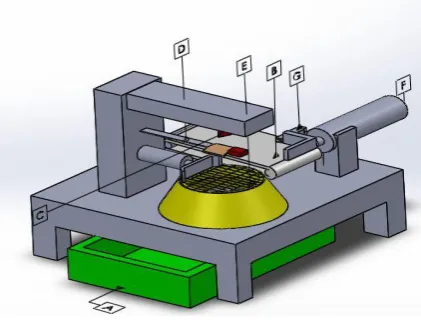
They are cut in to specific dimensions and are arc welded. One end of the designed cantilever beam is fixed at steel frame by bolt joint. The designed bowl is fixed at base of the frame, at a certain distance below the free end of the cantilever beam.The Electromagnet setup suspended by the appropriate mountings. It is held by adjustable 3/8”screw mountings. The Screw with the vertically suspended electromagnet is attached in such a way that its position can be adjusted horizontally as per the requirement. The fabricated real time mechanical setup is shown in the Figure 1, which comprises of the electromagnetic setup connected to the power supply unit. The Figure 2 shows the Solid Works model of the developed system in a 3 Dimensional manner.
Figure 2. Solid Works Model
ELECTRICAL SECTION
Vol. 4, Issue 5, May 2015
Figure 3. Proteus Diagram
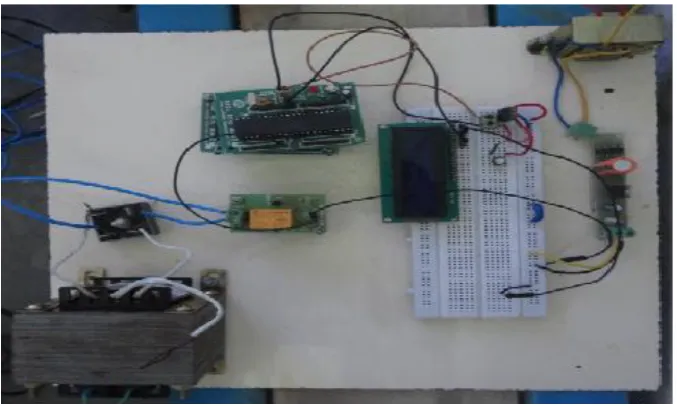
After the completion of the simulation the circuit is being fabricated with the help of relay and the microcontroller the entire circuit works. The Entire electrical circuit is being supplied with the help of the transformer, which converts the AC supply to the required DC supply for the electronics components to operate. Figure 4 gives the hardware implementation of the simulated circuit, which is being developed by using Proteus.
Figure 4. Electrical Section VII. CONCLUSION
The design of the machine is theoretically calculated, with the reference of these calculated values the further implementation and fabrication of the machine is done. also programming in microcontroller 89c51 is very
XTAL2 18 XTAL1 19 ALE 30 EA 31 PSEN 29 RST 9 P0.0/AD0 39 P0.1/AD1 38 P0.2/AD2 37 P0.3/AD3 36 P0.4/AD4 35 P0.5/AD5 34 P0.6/AD6 33 P0.7/AD7 32 P1.0 1 P1.1 2 P1.2 3 P1.3 4 P1.4 5 P1.5 6 P1.6 7 P1.7 8 P3.0/RXD 10 P3.1/TXD 11 P3.2/INT0 12 P3.3/INT1 13 P3.4/T0 14 P3.7/RD 17 P3.6/WR 16 P3.5/T1 15 P2.7/A15 28 P2.0/A8 21 P2.1/A9 22 P2.2/A10 23 P2.3/A11 24 P2.4/A12 25 P2.5/A13 26 P2.6/A14 27 U1 AT89C51 PROXIMITY SENSOR CONVEYOR MOTOR ELECTROMAGNET
PISTON - to move fruit from conveyor to bowl
WASTE REMOVING PISTON 0
(CAPACITIVE)
Vol. 4, Issue 5, May 2015
REFERENCES
[1] Faculty of mechanical engineering, “PSG Tech, Design data book”, published by Kalaikathirachchagam, 2011 revised edition [2] Mahmoud Galal El-Din Mohamed Rabi, “Fluid Power Engineering”, The McGraw-Hill Companies, Inc., ISBN: 9780071622462, 2009 [3] Muhammad Ali Mazidi and Janice Gillispiemazidi, “The 8085 Microcontroller and Embedded Systems”, Pearson Education, 2004 [4] Rajput. R.K, Strength of materials, Published by S. Chand & Company LTD. Fifth edition
[5] Theraja. B.I., “Electrical machines”, Published by S. Chand & Company LTD. Fifth edition 2010 [6] Http//: www.robokits.co.in for components specification