The Overview of Problem Solving Skill through Online Social Networking Platform
Diyana Jamari1 [email protected]
Department of Educational Sciences, Mathematics and Creative Multimedia, Faculty of Education, Universiti Teknologi Malaysia, Malaysia
Norasykin Mohd Zaid2, Hasnah Mohammed3, Zaleha Abdullah4, Baharuddin Aris5 [email protected], [email protected], [email protected], [email protected]
Department of Educational Sciences, Mathematics and Creative Multimedia, Faculty of Education, Universiti Teknologi Malaysia, Malaysia2,3,4,5
Abstract
Problem-solving skill is one of the 21st century skills needed by students to be competitive in the future working world. However, international assessment results have shown Malaysian students are still weak in problem solving and many graduates face problems securing a job due to a lack of problem-solving skill which is highly sought after by industries. Although problem-solving skills can be learned, enhanced, studied and mastered, these skills are still not sufficiently exposed and trained to students at the moment. Realizing the huge potential of social networking sites (SNS) that may serve as a promising learning platform, this paper discusses the potential of using Facebook as an informal alternative learning tool to enhance problem-solving skills among school students. The popularity and familiarity of Facebook may attract students to participate actively in discussions and encourage peer collaborations in online social problem solving environment; hence, helping to improve students’ problem-solving skill.
Keywords: Problem solving, Facebook, Social Networking Site, Social Media
1.0 Introduction
Education transformation towards 21st century learning emphasizes on producing students with critical, creative and innovative thinking as well as proficient in solving problems (Tan & Ng, 2012; Evren et al., 2012). Ministry of Higher Education has listed problem-solving skill as one of seven generic skills need to be mastered by students during their years in the university before going into the working world (Kuldas et al., 2015; Shakir, 2009). Individual competence and credibility will not only be determine based on education achievement but also on the ability of their problem-solving skill as independent employee (Osman, 2010). However, the scenario in school setting is different. The core of student’s performance assessment focuses mainly on the intellectual aspect while less account noted on the growth and development of other skills or potentials (Ali, 2008). Aware of the problems related to exam-oriented practice that emphasized on student good grades, major reorganization of primary and secondary school education was executed. Now grading system is no longer focused solely on achievement. The launched of Malaysia Education Blueprint 2013-2025 (PPPM) rationalized that students must not only be knowledgeable but also to master the skills that will enable them to compete in the future (Ministry of Education, 2012).This is in line with Learning In the 21st century framework that list problem-solving skill as one of the skills needed to survive and successful in modern working world (Ramos et al., 2013; Greiff et al., 2014).
scenario was seen in Malaysia and has been reported by the local researchers (Kuldas et al., 2015; Shakir, 2009). Despite knowing the importance of problem-solving skill, it is still inadequately trained to students even at the tertiary level, while less exposure during school years has caused skill performance to decrease below the targeted proficiency level (Kuldas et al., 2015). Latest Programme for International Student Assessment, PISA result on problem-solving skill domain has become an eye opener as Malaysian students found less competent in problem-solving and ranked below the average score of OECD standard. (Organisation for Economic Cooperation and Development, 2014). Therefore, there is a need to inculcate problem-solving skill in the early age.
Students’ low competency of problem-solving skill is largely attributed to cumulative years of rote learning strategy (Gotwals & Songer, 2013; Shakir, 2009) which is inadequate to stimulate students’ thinking thus, failed to develop analytical skill and inquisive mind. Years of teacher-centric approach and exam oriented mode in school has created a personal trait that will be hard to undo during their four years of tertiary education (Shakir, 2009). This teaching approach usually occur in one way communication, lack of student peer interaction, less focus given to skill development and only cater to lower elements in revised Bloom Taxonomy (to memorize, to understand, and to apply) (Krathwohl, 2002). Memorizing facts for the sake of exam has become a norm and this memory end up being a short term memory as it happen in a less meaningful way (Hanapi & Nordin, 2014; Umar, 2011). Although high order thinking skills (HOTS which includes problem-solving) are laid across the curriculum, it is often synonymously related with calculation subject such as Mathematics and Physics. Unaware of the presence of problem-solving in other subject, students did not know the use of this skill is actually beyond school context and can be extended to solve everyday life problem. Despite of being presented in multiple different way, characteristics of problems and steps to solve the problem remains the same.
2.0 Problem and Problem Solving
There are many definition regarding the word problem. It can be defined as a matter that prevent a person to achieve goal for which there are no clear rules or routine to solve or complete it (Mayer, 2003). Kantowski (1980) identify problem as a condition confronted by individual and known idea will not guarantee a solution as relevant knowledge need to be applied or manipulate to solve the problem. Jonassens’ (2004) idea on problem definition was the entity between a goal state and a current state. Thus, it can be understand that problem lies between present or current conditions aiming to reach goal or wanted future state. Even though with the absence of specific solutions, knowledge or idea can be manipulated and applied to reach that aim.
As for problem-solving, Economic Co-operation and Development, OECD (2014) define problem-solving as the capacity of individuals to engage in cognitive processes, to understand and solve problems based on situations that have no clear solutions. This is in line with Polyas’ (1973) problem-solving definition which is to find an unknown way out of a difficulty or to overcome the obstacle. This definition then refine by Anderson (1980) by adding sequence of cognitive operations that help to direct the process to reach goal.
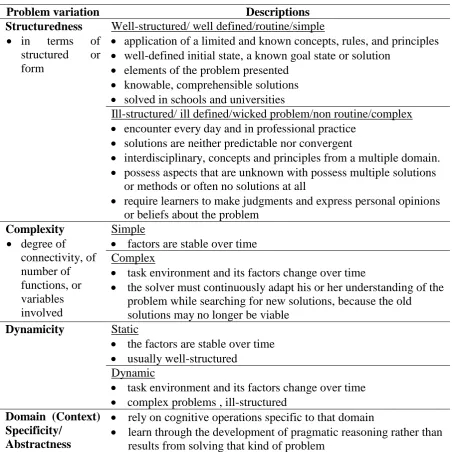
in complex form often have more than one solution. The difference between this two is based on the complexity and cognitive levels needed to solve it. Complex ill-defined problems involve more cognitive operations than simpler ones (Jonassen, 2004).
Table 1 Problem Structures
Problem variation Descriptions
Structuredness in terms of
structured or form
Well-structured/ well defined/routine/simple
application of a limited and known concepts, rules, and principles well-defined initial state, a known goal state or solution
elements of the problem presented knowable, comprehensible solutions solved in schools and universities
Ill-structured/ ill defined/wicked problem/non routine/complex encounter every day and in professional practice
solutions are neither predictable nor convergent
interdisciplinary, concepts and principles from a multiple domain. possess aspects that are unknown with possess multiple solutions
or methods or often no solutions at all
require learners to make judgments and express personal opinions or beliefs about the problem
Complexity degree of
connectivity, of number of functions, or variables involved
Simple
factors are stable over time Complex
task environment and its factors change over time
the solver must continuously adapt his or her understanding of the problem while searching for new solutions, because the old solutions may no longer be viable
Dynamicity Static
the factors are stable over time usually well-structured
Dynamic
task environment and its factors change over time complex problems , ill-structured
Domain (Context) Specificity/
Abstractness
rely on cognitive operations specific to that domain
learn through the development of pragmatic reasoning rather than results from solving that kind of problem
to make comparison, understanding equation, capability to make judgments and decisions based on specific justifications that forms a logical framework to bridge gap between the odds and the probabilities that are relevant in the process of solving problems (Anderson & Krathwohl, 2001). Creativity too play a role in solving problems as the divergence of creative thinking helps to imagine a range of ideas in searching of possible solution (Anderson & Krathwohl, 2001). After all, problem solving is to make sense of the problem, and to come up with the most appropriate solution after reasoning and judging process of the problem situation and its surrounding. Well-defined problem are often closed ended, involves facts, does not require creativity to solve or deep thought because the answer is fixed and specific (Jonassen, 2004).
Different scenarios seen in school as learning were categorized according to the hierarchy right from simple to complex stage with less emphasis on the formation of critical thinking and problem solving skills (Zohar & Dori, 2003). Teaching and learning process that gives too much focus on dense learning contents and only expose to closed ended routine problems will not help to increase students’ thinking ability (Shute & Wang, 2015). Open ended questions were less practiced in teaching and learning than low and medium level routines questions that are often repeated in class as these two has the most similarities with the exam format (Johari et al., 2014). This has resulted students’ to memorize and do drill practice to ensure maximum correct answers compared to the option to analyze and synthesize of what is being learned during the exam (Hanapi & Nordin, 2014; Umar, 2011).
Low and medium level questions are not helping to develop problem-solving skills in students (Johari et al., 2014). In the examinations, open ended section of the paper represent complex, non-routine, ill-defined problems. It has multiple logic solutions that should be easy for the students to answers however, low quality and less critical answers was observed. This indirectly portray student weakness in thinking skills (Malaysian Examination Syndicate, 2014). Students’ poor understanding on subject matter has reduced their ability to think critically and this inhibit them give good logical answers (Hanapi & Nordin, 2014). Problems that people encounter in life is in the form of ill-structured but matter content that is being taught at every level of schooling years are well-structured problems (Jonassen, 2004). If this learning pattern continues, there is doubt that students will not able to apply or manipulate the knowledge they learnt to solve problem in the context of everyday life. Therefore, different teaching approach or strategy need to be employ in order to help the student practise their thinking and at the same time improve their problem-solving ability.
3.0 Teaching of Problem Solving Skill
intelligence and world knowledge. Learning and acquiring of skill requires proactive involvement of students in classes, co-curricular and various informal activities (Noor Azean et al., 2006). Therefore, passive teaching and learning environment is unconducive and insufficient to produce educational practices that help to inculcate or improve problem-solving skill.
Based on constructivist theory, students will adjust new information with the existing knowledge in order to create new knowledge through active student-centered involvement while teacher act as a facilitator during the process. Vygotsky’s Social development theory of constructivism stipulates that learning takes place in the presence of social interaction which will help the students to achieve or accomplished learning with the assistance of more knowledgeable individual who can be a teacher, a friend or the computer in a phase called zone of proximal development (ZPD) (Wang, 2015). Thus, teaching and learning activities began to shift from teacher-centered to student-centered approach which involves more interaction in active and collaborative manner (Kivunja, 2014). This kind of approach is suggested for inculcating problem solving skill (Aka et al., 2010) as students are given space for open discussion, chance to communicate and to voice their opinions, flexibility to move around to do activities within the group and to be responsible for their own learning. These theory has been the basic for quite a number of teaching strategy and activities that can be practice to help enhance problem-solving skills. Example of a few learning strategies are problem-based learning (PBL), project-based learning (PrBL), collaborative problem solving, case studies (Kivunja, 2014).
Previous studies proved these problem based strategies yield good promising result in improving problem-solving skill among the students. Sivakkumar and Muhammad Sukri (2014) states that teaching quality and appropriate time provision are the factors that influence effective teaching. Teaching quality refers to teacher's ability to use clear and understandable language, systematic presentation, and relevant examples including good teaching material that helps to explain a concept or skill in a way that can be easily understood, repeated and practiced by students. Most of these teaching strategy applies open ended structure problem in an authentic real life situations to solve non-routine problem. The ability to solve non-routine and open ended form of problems will potentially boost students’ confidence to solve real life cases and scenarios (Kivunja, 2014) because the same criteria exist between those two (Douglas et al., 2012). This will give insights to the students on how the problem exists in the context of everyday life. However, most of it were applied in classroom setting within formal learning activities in school.
Teachers’ initiatives to improve their teaching by adopting new teaching strategy and new technology available are expected as technology is one of the elements mentioned in the 21st Century Learning framework (Greiff et al., 2014). Integration of suitable online technology to cater the needs and preference of the student will be able to help teachers to deliver their teaching effectively. Student will be attracted and motivated to take part in the activities planned. Previous online medium studies involving problem-solving skill and activities were e-learning, online forum, blog and social networking site (Noor Hidayah & Zaidatun, 2014). Just like classroom learning, online learning too involves psychological processes such as thinking, remembering, interpreting and problem-solving (Castle & McGuire, 2010). Therefore, online learning able to meet both requirements of quality and time as specified by Sivakkumar and Muhammad Sukri (2014) in providing effective teaching.
4.0 Online Platform to Inculcate Problem-Solving Skill
formally within school walls now can be done online freely through multiple online platforms. The difference is only in terms of online learning affordance regarding space and time. Online learning become more flexible as it can occur at any time with or without teacher appearance in a more subtle informal manner. This method is increasingly popular and has widespread particularly among students in higher education institutions. Collaboration among peers will encourage students to share ideas, voice out their opinions and to justify reasons (Shahizah & Zaidatun, 2014). Thus, the application of online discussion activities helps to improve problem-solving skills as well as critical thinking in informal learning environment. The same process will occur whether it is done face to face or via online so consideration should be given to explore the opportunity and possibility of the internet to promote learning at any time in any day. However, it still requires planning to avoid deviation from the original purpose. Student-centered online learning concept was known to shape the student to become responsible learner, aid in fostering communication skill and proactive attitude, groom students to become independent thinker as well as helps to educate the students regarding ethics and integrity in the process of learning (Rafiza, 2013).
Social interaction and engagement does contribute to ensure the occurrence of learning activities as learning does not happen on its own all the time regardless in online or face to face instruction (Kamaruzzaman & Rouhullah, 2009). Problem-solving is a skill that can be taught with methods that practise active student-centered approach (Aka et al., 2010) thus, online discussion can be an effective platform for teachers or peers who are expert to scaffold those who needs help in completing assignments or to solve task problem given (Shahizah & Zaidatun, 2014). This is aligned with Vygotskys’ Social Constructivism Theory (Wang, 2015). Online discussion and scaffolding activities can be more interactive and lively as students are not constrained by the structure of formal education. Flexible environment provides opportunity for students to gain knowledge. Student is unaware that they themselves become part of an active learning process due to or multilateral communication online compared to the rigid structure of passive one-way communication that usually occurs in traditional classroom. Social support that goes hand in hand with the activities and interactions will reduce negative elements that interfere with learning. Criticism and argument were accepted positively and seen as part of discussion in learning process (Gillet et al., 2008).
With the rise of internet, increase number of students found preference to information and communication technologies as learning tools outside of school. Online social media platform has the potential to be use as tool in informal learning environment to enhance problem solving skill. Informal learning also known as occasional learning is a spontaneous form of learning (Erjavec, 2013) that act as a supplementary to formal class teaching in school. This platform enables students to stay connected and continue communicate and learn at any time despite being in different location. Thus, applying social media in the formal academic context within informal setting will surely attract the students’ participation to interact. At the same time this will generate excitement and boost their motivation to actively involve as their preferred mediator is being used as the communication tool (Erjavec, 2013).
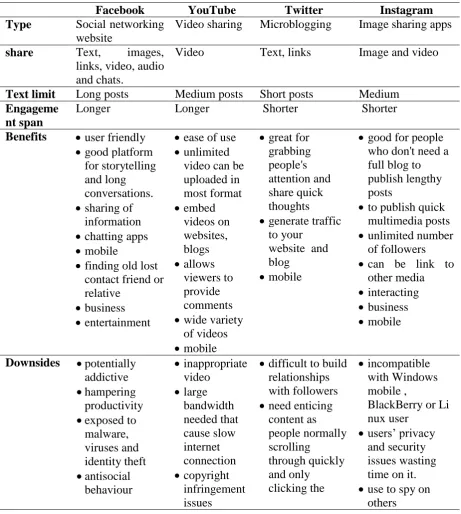
Instagram and YouTube are much related to visual aspect, thus best suited to promoting goods for the purposes of online business and how-to videos. Both Facebook and Twitter able to display link to a website or other media however, this feature is not possible within Instagram. This is important because students might need to share information from other page or website for reference during discussion and the use of hashtag is seem inadequate and appropriate in this matter. Therefore, Facebook considered to have the potential to be use in learning compared to YouTube, Twitter and Instagram. Facebook offer good platform for academic discussion plus it can be done in a special group separately. Users are not required to be in each other friend lists to be in the same group for specific purpose. This help to inhibit unwanted personal conflict, thus able to serve longer engagement span to its user.
Table 2 Differences of social media preferred by the teenagers
Facebook YouTube Twitter Instagram
Type Social networking website
Video sharing Microblogging Image sharing apps
share Text, images,
links, video, audio and chats.
Video Text, links Image and video
Text limit Long posts Medium posts Short posts Medium Engageme
nt span
Longer Longer Shorter Shorter
Benefits user friendly good platform
for storytelling and long conversations. sharing of
information chatting apps mobile
finding old lost contact friend or relative
business entertainment
ease of use unlimited
video can be uploaded in most format embed videos on websites, blogs allows viewers to provide comments wide variety
of videos mobile
great for grabbing people's attention and share quick thoughts generate traffic
to your website and blog
mobile
good for people who don't need a full blog to publish lengthy posts
to publish quick multimedia posts unlimited number
of followers can be link to
other media interacting business mobile
Downsides potentially addictive hampering
productivity exposed to
malware, viruses and identity theft antisocial
behaviour inappropriate video large bandwidth needed that cause slow internet connection copyright infringement issues
difficult to build relationships with followers need enticing
content as people normally scrolling through quickly and only clicking the incompatible with Windows mobile ,
BlackBerry or Li nux user
users’ privacy and security issues wasting time on it. use to spy on
place a strain on relationships
ones that stand out the most. user’s privacy
and security issues
5.0 Facebook as Teaching and Learning Tool
Facebook is a social networking site that allows its user to use their personal profile to share personal information, pictures and video with the other user online. It is also used for communicating, trace and connect with old and new friends, sharing news, dissemination of information, play online games and to create or be a member of certain group. Generally, communication occurs through private messages, chatting, and tagging names on pictures or by leaving a message on a friend's profile wall. Compared to other similar social networking site, Facebook is more popular among those between 18 to 25 years, whom is likely to be a student in tertiary education (Petrović, 2012). Studies conducted in the US and UK found that more than 90% of the students in this category do have at least one Facebook account (Hew, 2010). At the end of 2006, Facebook has allowed user at the age of 13 to register an account on Facebook and this has led to an increase in the number of users among school students (Petrović, 2012; Wilson et al., 2012). Generally, the purpose and criteria of social media is the same, namely to interact but type and nature of different social networking site will determine the type of activities will take place online (Salvation & Nor Azura, 2014). For example, Tribe.net and LinkedIn are business oriented sites for entrepreneurs discuss business ideas and strategies while Match.com related to those looking for potential romantic partners. However, popularity and flexibility of Facebook plus various apps that has high attraction towards students offers an opportunity to be manipulated toward learning if handled properly.
Hew (2010) in his study has listed nine use of Facebook. User normally use this medium to keep in touch with friends or family, finding new friends or connections, to express personal thoughts and feelings. Some use it just for fun while a few use it to gain popularity and acknowledgment. Another motive mentioned is the use of Facebook for learning purpose as it allow learners to approach learning from their personal perspectives and learning style (Kivunja, 2014). Studies agreed that learning activities such as interaction, collaboration, and active participation, sharing of information and resources as well as critical thinking that occurs online is the criteria that approves potential of Facebook to serve as a tool that aid learning (Petrović, 2012; Leng et al., 2011; Mazman & Usluel, 2010; Selwyn, 2007).
Integration of new technologies in learning has brought significant changes in the learning process as a whole. Many studies mentioned about the positive impact on learning through Facebook (Kirschner & Karpinski, 2010). Facebook enhanced students’ motivation, engagement, foster positive attitude (Kabilan et al., 2010; West et al., 2009), improves writing (Petrović, 2012), help in developing interpersonal skills and able to act as platform to practice critical thinking (Lampe et al., 2008). These findings enhanced positive possibility of using this media as a tool to assist pedagogy (Petrović, 2012). Learning Management Systems (LMS) was widely accepted by the student previously. However, its lack of social connectivity tools and personal profile spaces has been outshine by the Facebook as student demands learning through interaction multilateral, prefer autonomy in terms of material and source selection and connectivity in learning (Mazman & Usluel, 2010).
also to respond on other informal educational matter such as on social issues, dilemmas and frustrations faced during school years or campus life. Facebook usage is not limited to the purpose of discussion for class projects and assignments. Lecturers were found prefer to disseminate information through Facebook as it is easier to use and there is a high probability that the information will rapidly reach the students (Hew, 2010; Bosch, 2009). It has been utilised as source of quick information such as to find location of the lecture hall and topics to be discussed for the day.
Although many studies confirming the potential of social media for use in education, there are some researchers who argue otherwise. A study in the UK found that 50% of respondent agreed that social media was associated with negative effects and are not relevant for use in education. Basis of this argument was on the purpose of social media creation which was meant for chatting and socializing online. Henderson (2013) raised concern on psychological problems called Social Media Anxiety Disorder that is starting to increase among the society all around the world. Studies done by Akyildiz and Argan (2012) and Hamat et al. (2012) found that spending longer time interacting online did not contribute to academic achievement (Hargittai & Hsieh, 2010). Socializing online has negative impact on student achievement because the time that should be used for learning was wasted for non-academic activities that can affect learning. However, this statement was opposed by Salvation and Nor Azura (2014) and Mazman and Usluel (2010). The amount of time spent by students on this medium also contributes to the probability that it can be manipulated for education purpose (Mazman & Usluel, 2010). Salvation and Nor Azura (2014) argued that measuring the intensity of time spent on social media only will not provide concrete evidence that Facebook affect learning negatively because time consumption does not impact directly on student achievement. Instead, study regarding time spent online should be pair up with the purposes of using this mediator for correlations. Student who use Facebook for a long period with the purpose to discuss educational matters with peers and teacher found has improved the students’ performance similar to discussion that happen face-to-face in class (Salvation & Nor Azura, 2014).
Higher time spent in Facebook is also contributed by the fact that checking on Facebook has become part of students’ routine activities (Petrović, 2012). Thus, informal learning through Facebook become so much easier to apply. With the emergence of wide variety of mobile gadgets, informal learning via social media remain unnoticeable even though interaction and feedback from peers and teachers regarding school matters does occur. Facebook helps to create a closer relationship between teachers and students in a less formal way. Students found comfortable spending longer time communicating online than they were with the teachers in class (Fogg Phillips et al., 2011). Student acceptance of teacher as interaction partner will reduce the communication gap between them (Schwartz, 2010), which in turn could give significant impact on the instruction and guidance provided via social networks (Selwyn, 2009).
disable them to do so (Hew, 2011). This interaction allows teachers to compare and analyze the appropriate teaching methods and activities that is suitable to fit the students’ preference and at the same time able to reach targeted learning objectives (Roblyer et al., 2010; Hew, 2011).
Assessments can be made not only in the pedagogical aspects. Students’ performance can also be observed by changes in attitude, behaviour and by the way student think or argue after undergoing specific activity with the Facebook as learning tool (Roblyer et al., 2010). Facebook purpose as learning space has been obscure by fun social interaction even though the topic discussed related to academic and learning (Manca & Ranierit, 2013). Frequent use of Facebook for online learning makes students feel comfortable and less burden as they are not pressure to learn. Learners tend to do better and persist in educational settings when they feel a strong sense of social belonging and connectedness (Erjavec, 2013).
6.0 Conclusion
Teaching and learning process that focus on nurturing skill that involves thinking should not be tied only to rote learning (Gotwals & Songer, 2013). Problem-solving skill require the learner to communicate effectively and apply knowledge with the aim of achieving the goals which indirectly contribute to improving argumentative skill and decision-making skill (Kim & Tan, 2013). Obviously, students’ difficulty to solve problem should be dealt with appropriate approaches and strategies that can foster students’ way of thinking thus enhancing the skill to solve problem which is in line with the needs of the working world in the future (Overton et al., 2013).
Social media can be linked to learning by providing a promising learning platform for collaborative interaction between students and teachers (Towner & Munoz, 2011). Integrating social media as supplementary to existing teaching practices create an informal learning environment that can improve the delivery of learning and provide opportunities to embed skill learning (Mazman & Usluel, 2010). Facebook is a good user friendly medium not only for communication but for a broader engagement in the process of learning due to its affordance and reach. Introverts and students with low confidence level is given a personal space and pace to join and respond to the discussion thus, creating a meaningful learning experience. Some use it for socializing purposes while others manipulate it as alternative learning strategies to complement classroom teaching and learning activities. Activities that involves exchange of ideas, discussion, sharing materials and information to assist the learning process in turn can have positive effect on performance and development of students' problem-solving skill (Leng et al., 2011; Griffith & Liyanage, 2008).
Acknowledgments
The authors would like to thanks the Universiti Teknologi Malaysia (UTM) and Ministry of Higher Education (MoHE) Malaysia for their support in making this project possible. This work was supported by the Research University Grant (R.J130000.7831.4F468) initiated by UTM and MoHE.
References
Akyildiz, M. & Argan, M. (2012). Using Online Social Networking: Students' purposes of Facebook Usage at the University of Turkey. Journal of Technology Research, 3, 1-11. Ali, Z. (2008). Perlaksanaan Pentaksiran Kerja Kursus Kemahiran Hidup Bersepadu Di Sekolah Menengah Luar Bandar Daerah Kuantan, Pahang. Universiti Teknologi Malaysia, Skudai.
Bosch, T. E. (2009). Using Online Social Networking for Teaching and Learning: Facebook Use at the University of Cape Town. South African Journal for Communication Theory and Research, 35 (2), 185–200.
Castle, S. R., & McGuire, C. (2010). An analysis of student self-assessment of online, blended, and face-to-face learning environments: Implications for sustainable education delivery. International Education Studies, 3 (3), 36.
Çimer, A. (2012). What makes biology learning difficult and effective: Students’ views. Educational Research and Reviews, 7 (3), 61-71.
De Bortoli, L., & Macaskill, G. (2014). Thinking it through: Australian students’ skills in creative problem solving. Victoria: Australian Council for Educational Research. http://research.acer.edu.au/cgi/viewcontent.cgi?article=1018&context=ozpisa
Douglas, E. P., Ljungberg, K. L., McNeill, N. J., Malcolm, Z. T., & Therriault, D. J. (2012). Moving Beyond Formulas and Fixations: Solving Open- Ended Engineering Problems. European Journal of Engineering Education, 37 (6), 627-651.
Evren, A., Bati, K., & Yilmaz, S. (2012). The Effect of using v-diagrams in Science and Technology Laboratory Teaching on Preservice Teachers’ Critical Thinking Dispositions. Procedia-Social and Behavioral Sciences, 46, 2267-2272.
Fogg Phillips, L., Baird, D., Fogg, M.A., & B. J. (2011). Facebook for Educators. (online)
http://facebookforeducators.org/wpcontent/uploads/2011/05/Facebook-for-Educators.May-15.pdf.
Greiff, S., Holt, D.V., & Funke, J. (2013). Perspectives on Problem Solving in Educational Assessment: Analytical, Interactive, and Collaborative Problem Solving. The Journal of Problem Solving, 5 (2), 71-91.
Greiff, S., Wüstenberg, S., Csapó, B., Demetriou, A., Hautamäki, J., Graesser, A.C. & Martin, R. (2014). Domain-general problem solving skills and education in the 21st century. Educational Research Review, 13, 74-83.
Griffith, S. & Liyanage, L. (2008). An introduction to the potential of social networking sites in education. Proceedings of the Emerging Technologies Conference, University of Wollongong, 18-21.
Hamat, A., Embi, M. A., & Hassan, H. A. (2012). The use of social networking sites among Malaysian university students. International Education Studies, 5 (3), 56.
Hanapi, Z., & Nordin, M. S. (2014). Unemployment among Malaysia Graduates: Graduates’ Attributes, Lecturers’ Competency and Quality of Education.Procedia-Social and Behavioral Sciences, 112, 1056-1063.
Hew, K. F. (2011). Students’ and teachers’ use of Facebook. Computers in Human Behavior, 27, 662–676.
Hutchinson, A. (2015). Facebook, Instagram, Snapchat Most Popular Networks Among
Millennial Teens [Report]. (online)
http://www.socialmediatoday.com/social- business/adhutchinson/2015-08-12/facebook-instagram-snapchat-most-popular-networks-among (6 December 2015).
Kabilan, M. K. Ahmad, N., & Abidin, M. J. Z. (2010). Facebook: An online environment for learning of English in institutions of higher education? The Internet and Higher Education, 13 (4), 179–187.
Kamaruzaman, J. & Rouhollah, K. (2009). Preliminary Study on the Role of Social Presence in Blended Learning Environment in Higher Education. International Education Studies, 2 (4), 79.
Kim, M., & Tan H.T (2013). A Collaborative Problem-Solving Process through Environmental Field Studies. International Journal of Science Education, 35 (3), 357-387.
Kirschner, P. A., & Karpinski, A. C. (2010). Facebook?? and academic performance. Computer and Human Behaviour, 26, 1237–1245.
Kivunja, C. (2014). Theoretical perspectives of how Digital Natives learn. International Journal of Higher Education, 3 (1), 94.
Krathwohl, D. R. (2002). A revision of Bloom's Taxonomy: An overview. Theory Into Practice, 41 (4), 212-218.
Kuldas, S., Hashim, S., Ismail, H. N., & Samsudin, M. A. (2015). The Need for an Academic Resilience Approach to Cognitive Task Performance of Malaysian Students in Secondary Schools and Higher Education. Pertanika Journal of Social Sciences & Humanities, 23 (3).
Lampe, C., Ellison, N., & Steinfeld, C. (2008). Changes in use and perception of Facebook. In Proceedings of the ACM conference on computer supported cooperative work, New York, 721–730.
Leng, G. S., Lada, S., Muhammad, M. Z., Ibrahim, A. A. H. A., & Amboala, T. (2011). An exploration of social networking sites (SNS) adoption in Malaysia using technology acceptance model (TAM), theory of planned behavior (TPB) and intrinsic motivation. Journal of Internet Banking and Commerce, 16 (2), 1-27.
Madge, C., Meek, J., Wellens, J., & Hooley, T. (2009). Facebook, social integration and informal learning at university: ‘It is more for socialising and talking to friends about work than for actually doing work’. Learning, Media and Technology, 34, 141–155. Malaysian Examinations Syndicate (LPM). (2014). Kupasan Mutu Jawapan Biologi Kertas 2
Peperiksaan SPM Tahun 2013. (atas talian)
http://apps2.moe.gov.my/lponline/v1/index.php?option=com_content&view=article&id =65:kmj-spm-2013&catid=25&Itemid=120&lang=en
Manca, S. & Ranierit, M. (2013). Is it a tool suitable for learning? A critical review of the literature on Facebook as a technology-enhanced learning environment. Journal of Computer Assisted Learning, 29, 487-504.
Mayer, R. E. (2003). Learning and Instruction. NJ: Prentice Hall.
Mayer, R. E., & Wittrock, M. C. (2006). Problem solving. In P. A. Alexander & P. H. Winnie (Eds.) Handbook of educational psychology. NJ: Lawrence Erlbaum. 287–303.
Mazman, S. G., & Usluel, Y. K. (2010). Modelling educational usage of Facebook. Computers & Education, 55, 444-453.
Ministry of Education (MOE). (2012). Pelan Pembangunan Pendidikan Malaysian 2013-2025. (online) http://www.moe.gov.my/userfiles/file/PPP/Preliminary-Blueprint-ExecSummary-BM.pdf
Minners, J. (2012). Survey says: College graduates not prepared for the workforce. LexisNexis Legal Newsroom. (online) http://www.lexisnexis.com/legalnewsroom/lexis- hub/b/careernews-and-trends/archive/2012/02/01/survey-says-college-graduates-not-prepared-for-theworkforce.aspx
Noor Hidayah, C. L., & Zaidatun, T. (2014). A Meta-Analysis Of Research Of Problem Solving Activities In Online Discussion. Proceedings of International Education Postgraduate Seminar (IEPS) 2014, Johor Bahru.
Organisation for Economic Cooperation and Development (OECD). (2014). PISA 2012 Results: Creative Problem Solving (Volume V). Students' Skills in Tackling Real-Life
Problems. (online)
Overton, T., Potter, N., & Leng, C. (2013). A Study of Approaches to Solving Open-ended Problems in Chemistry. Chemistry Education Reseacrh and Practice, 14, 468-475. Petrović, N., Petrović, D., Jeremić, V., Milenković, N., & Ćirović, M. (2012). Possible
educational use of Facebook in higher environmental education. ICICTE 2012 Proceedings, 355-362.
Polya, G. (1973). How to solve it. Princeton, NJ: Princeton University Press. (Original work published 1945).
Prensky, M. (2001). Digital Natives, Digital Immigrants, Part 1, On the Horizon, 9 (5), 3-6. http://dx.doi.org/10.1108/10748120110424816
Ramos, J. L. S., Dolipas, B. B., & Villamor, B. B. (2013). Higher Order Thinking Skills and Academic Performance in Physics of College Students: A Regression Analysis. International Journal of Innovative Interdisciplinary Research, 4, 48–60.
Robinson, P. (2015). Facebook vs. Twitter: Social Media Strategy Differences. (online) http://www.meltwater.com/blog/facebook-vs-twitter-social-media-strategy-differences/ (6 December 2015).
Roblyer, M. D., McDaniel, M., Webb, M., Herman, J., & Witty, J.V. (2010). Findings on Facebook in higher education: A comparison of college faculty and student uses and perceptions of social networking sites. Internet and Higher Education, 13, 134-140. Salvation, M., & Nor Azura, A. (2014). The Influence of Social Network Sites (SNS) upon
Academic Performance of Malaysian Students. International Journal of Humanities and Social Science, 4, 10(1), 131-137.
Schwartz, H. L. (2010). Facebook: The New Classroom Commons? Education Digest: Essential readings condensed for quick review. 75 (5), 39-42.
Selwyn, N. (2009). Faceworking: Exploring students’ education-related use of Facebook. Learning, Media and Technology, 34, 157–174.
Shahizah, S., & Zaidatun, T. (2014). Promoting Critical Thinking through Asynchronous Online Discussion Forum: The Theoretical Framework. Proceedings of International Education Postgraduate Seminar (IEPS) 2014, Johor Bahru.
Shazaitul Azreen, R., & Maisarah, M. S. (2015) The Perception of Critical Thinking and Problem Solving Skill among Malaysian Undergraduate Students. Procedia - Social and Behavioral Sciences, 172, 725–732.
Silva, E. (2009). Measuring Skills for 21st-Century Learning. The Phi Delta Kappan, 90 (9), 630–634.
Sivakkumar, B., & Muhammad Sukri, S. (2014). Kerangka konseptual kesedaran guru dalam melaksanakan pentaksiran berasaskan sekolah (PBS) di sekolah menengah semenanjung Malaysia. Proceedings of International Education Postgraduate Seminar (IEPS) 2014, Johor Bahru.
Shakir, R. (2009). Soft skills at the Malaysian institutes of higher learning. Asia Pacific Education Review, 10 (3), 309-315.
Tapscott, D. (2009). Grown up Digital: How the Net Generation is Changing Your World. New York: McGraw-Hill.
Wang, R. (2015). LS Vygotsky and education. British Journal of Educational Studies, 63 (1), 112-114.
Wilson, R. E., Gosling, S. D & Graham, L. T. (2012). A Review of Facebook Research in the Social Sciences. Perspectives on Psychological Science, 7 (3), 203–220.