JURNAL BIOEDUKATIKA
http://journal.uad.ac.id/index.php/BIOEDUKATIKA2338-6630 (Print) | 2541-5646 (Online)
Improving student problem-solving skill and cognitive learning
outcome through the implementation of
problem-based learning
Rusdi Hasan a, 1, *, Marheny Lukitasari b, 2, Vemy Juniarti a, 3, Irwandi a, 4
a Biology Education Department, Faculty of Teacher Training and Education, Universitas Muhammadiyah Bengkulu, Indonesia
b Biology Education Department, Faculty of Teacher Training and Education, Universitas PGRI Madiun, Indonesia
1[email protected]*, 2 [email protected], 3 [email protected], 4 [email protected] * Corresponding author
ARTICLE INFO ABSTRACT
Article history Problem-solving is one of the competencies in the learning innovation that students must possess to prepare life challenges in the 21st century. This study aimed to improve student problem-solving skill and cognitive learning outcome through the implementation of problem-based learning (PBL) model in learning biology at the senior high school. This research is a quasi-experimental research with pretest and posttest design. Two classes were chosen randomly from five classes of 10th-grade students for conducting research by implementing PBL and direct instruction learning models as an experiment and control (conventional) class, respectively. The problem-solving skill was measured by the essay test as well as the cognitive learning outcome at the end of the research and was analyzed by t-test. The result showed that students in the PBL class have a higher improvement in problem-solving skill. The student skill to problem-problem-solving in the PBL class was also significantly higher than the conventional class. In addition, students in the PBL class have a higher cognitive learning outcome than the conventional class. This finding indicates that the PBL model can be implemented in the learning practices, especially in biology, to develop the problem-solving skill of students.
This is an open access article under the CC–BY-SA license.
Received Revised Accepted January 15 2019 Mey 18 2019 June 20 2019 Keyword: Cognitive Learning outcome Problem-based learning Problem-solving
Introduction
In the modern era, education is a necessity that must be fulfilled in the process of life because the advance of a country is a reflection of their educational quality. The high quality of education will produce qualified and reliable human resources in solving and anticipating problems encountered. Problem-solving is
one of the learning skills in the 21st century that students should have besides
critical thinking, creative thinking,
collaborative and communicative skills (Bialik, Fadel, Trilling, Nilsson, & Groff,
2015; Trilling & Fadel, 2009). Formal
education includes teaching and learning processes that involve teachers and students to have the largest portion of developing human resources. Education, in
essence, is an absolute requirement for the development of human resources towards a better future. A qualified human resource, who can build himself, society and his people, can be developed through a
process of quality education (Sunhaji,
2014). Therefore, the quality of education
must always , according to the dynamics of the current world development.
Learning is a process that carried out by someone to obtain a change in the form of new behavior that gained from his/her own experience as interaction with the
environment (Slameto, 2013). A
high-quality education will be able to guide students optimally for learning and gaining high achievements. Students are the subject and object in learning activities. Therefore, students are the core of learning activities to achieve certain goals. The activeness of students is not only
demanded physically but also
psychologically. If only students are physically active, but their minds and mental are less active, then the learning objectives are not likely to be achieved
(Suprijono, 2013).
The precise learning strategy that teachers used in the classroom affect the learning quality, including in biology (Kusumaningtias, Zubaidah, & Indriwati,
2013). Using the right learning strategy can
increase efficiency and effectiveness in the teaching and learning process. The reality in the field was found that many ways to teach biology that teacher use less varies of learning strategy. Most teachers still used conventional teacher-center learning, such as the lecture and question and answer methods. In addition, the teacher has not fully utilized the potency that students have. Thus, it leads students to tend to be passive and less stimulated to think creatively and to solve problems fluently.
Students need to develop their problem-solving skills to face overcome the problems encountered. The teacher is
expected to provide sufficient
opportunities for students to learn through problem-solving. Through well-designed learning, it is hoped that these abilities can be quickly and more easily mastered by students, so they can solve problems that are well-given and master concepts. In reality, students have difficulty to connect and apply the theoretical knowledge that has been obtained to real problems.
Learning model plays important role in the learning process. It does not only affect
a positive influence on learning outcomes, but also create a fun, meaningful learning atmosphere, and can improve students' understanding and learning outcomes. The problem is in Senior High School 1 North Bengkulu currently that conventional learning models still dominate the learning
processes such as lecture, regular
discussions methods, and direct
instruction. These student-centered
learning make students passively in receiving information from the teacher, lack mastery of concepts, and tend only memorize the material given by the teacher. It causes students to be less able to solve problems and the low of students' cognitive learning outcome. This condition was reflected by the average of midterm test results of the last biology subjects (62.65) below the minimum completeness criteria (70) of schools for biology subject.
The application of suitable student-centered learning models is needed to be relevant and support the achievement of teaching goals so that students can think actively and be allowed to try their abilities
in various activities (Hasan, Lukitasari,
Darmayani, & Santoso, 2019; Siswanto,
Maridi, & Marjono, 2012). One of the
learning models that can make students learn actively is PBL. This model has been applied elsewhere that enable to improve student critical thinking (Rusdi Hasan &
Syatriandi, 2018), problem-solving in
mathematics (Kudsiah, Dantes, & Sariyasa,
2013; Minarni, 2012) and science process
skill (Handika & Wangid, 2013). According
to Widodo & Widayanti (2013), the PBL
model is focused on selected problems so that students not only learn concepts related to the problem but also the scientific method in solving the problem. Therefore, to improve the skill of problem-solving and cognitive learning outcome of students in Senior High School 1 North Bengkulu, PBL model was implemented in biology learning. The learning topic in this research was Environmental Pollution, the exciting topic that student face either contextually at their environment or globally on our planet.
Method
This research was the non-equivalent group design of quasi-experiment research
(Sugiyono, 2007), conducted at Senior High
School 1 North North Bengkulu in 2017/2018 academic year. The population
was 10th-grade students consisting of five classes with a total of 132 students. The sample was two classes that randomly chosen for experiment and control classes. PBL was conducted in the experiment class, while conventional (direct instruction) learning was conducted in the control class, respectively. The learning topic in this study was Environmental Pollution.
The student skill in problem solving and cognitive outcome was measured by using an essay test and analyzed
statistically with a t-test. Problem-solving test consisted six components: identifying problems, formulating problems, finding alternative solutions, choosing the best solution, solving and working out the problem, and quality of problem-solving
(Paidi, 2008) as shown at Table 1. Cognitive
learning outcome essay test consisted of
C1-C4 levels question of Bloom’ cognitive
taxonomy. The essay test was given before and after the learning process conducted as pretest and posttest, respectively.
Table 1. Components and indicators of problem-solving assessment
No
. Components Indicators problem-solving skill
1 Identify problems Students can determine the problem and show the phenomena that exist in the problem
2 Formulate problems Students can formulate problems in the form of questions 3 Find alternative
solutions Students can write alternative solutions or how to solve problems that will be solved 4 Choose the best
alternative solutions Students can choose or determine alternative solutions, which can solve problems 5 Solve and complete
problems Students can solve problems that are by the problem 6 Quality of
problem-solving Students succeed in solving problems correctly, rationally, and can be scientifically justified
Results and Discussion
Student’ problem solving skill
Both the experiment and control classes have the same number of students. The scores of pretest and posttest of problem-solving skill between the two
classes are shown in Table 2. By the mean
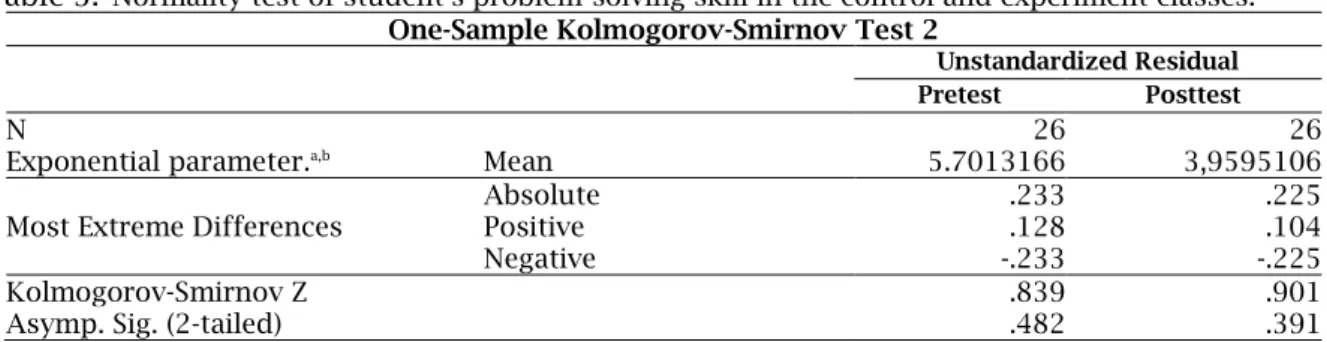
scores of 37 and 35 between experiment and control classes, the data of pretest of problem-solving normally distribute (sig
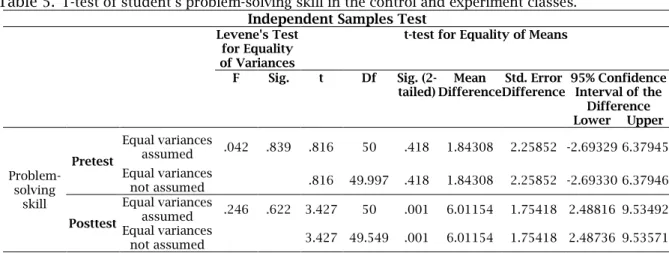
0.482>0.05) and homogenous variance (sig 0.839>0.05) as shown at Table 3 and Table 4, respectively. Statistical analysis using t-test shows that students' problem-solving abilities obtain sig (2 tailed) or p-value of 0.418 more than alpha 0.05, t-value of 0.816 less than t-table 2.008 (Table 5). Thus, there is no difference in the initial skill of students' problem-solving skill for both classes.
Table 2. Students problem-solving skill in the experiment and control classes based on the pretest and posttest scores.
Pretest Posttest
Experiment Control Experiment Control
Number of students 26 26 26 26 Total scores 967.36 919.44 2022.24 1865.94 Highest score 54.17 52.08 87.50 82.64 Lowest score 26.39 25.69 67.36 61.11 Mean 37.21 35.36 77.78 71.77 Improvement - - 40.57 36.41
Table 3. Normality test of student’s problem-solving skill in the control and experiment classes. One-Sample Kolmogorov-Smirnov Test 2
Unstandardized Residual Pretest Posttest
N 26 26
Exponential parameter.a,b Mean 5.7013166 3,9595106
Most Extreme Differences Absolute Positive .233 .128 .225 .104
Negative -.233 -.225
Kolmogorov-Smirnov Z .839 .901
Table 4. Homogeneity test of student’s problem-solving skill in the control and experiment classes. Test of Homogeneity of Variances
Levene Statistic df1 df2 Sig.
Pretest .042 1 50 .839
Posttest .246 1 50 .622
The average posttest score of problem-solving skill, both experimental and control classes raise to 77.78 and 71.77, respectively (Table 2). The data have a normal distribution (0.391>0.05) and homogenous variance (0.622>0.05), as
shown in Table 3 and 4, respectively.
Statistical analysis using t-test obtained p-value 0,001 less than alpha 0.05 and t-value 3.427 more than t-table 2.008. Thus, there is a significant difference in problem-solving skill between experiment and control classes.
The results of the study showed that there is a significant influence of the PBL model on increasing students' problem-solving skill in environmental pollution topic in Senior High School 1 North Bengkulu. The increase in problem-solving skill using the PBL model was significantly higher than the conventional class. This finding supports the results of previous
research conducted by Amalia, Syarifuddin,
& Nilawasti (2014), Siswanto et al. (2012),
and Khoiriyah & Husamah (2018) on Junior
High School students in Padang, Surakarta, and Malang respectively. This improvement was an effect of the PBL characteristic in which students have been introduced the
problems about the material they learned since the beginning of learning processes. Thus, students from the beginning of learning process were motivated to solve the problem by using their knowledge, seeking new knowledge, developing and constructing that knowledge together with their group under the guidance of the teacher. In this study, we found that students seemed very interested and challenged to solve the environmental
pollution problems presented in a
contextual manner found in their daily life.
Hung (2016) stated that the essential
element of PBL is a problem so that the PBL must start with a problem. Whereas Widayati, Prayitno, & Ariyanto (2015) insisted that PBL oriented toward real-life problems that require students to be able to solve existing problems by using their thinking skills and construct the concepts continuously by reasoning through the whole syntax of PBL. Therefore, Amalia et
al. (2014) urged that the PBL process is
more meaningful because the learning started from real problems, so students are interested in knowing more about solving the problem given.
Table 5. T-test of student’s problem-solving skill in the control and experiment classes. Independent Samples Test
Levene's Test for Equality of Variances
t-test for Equality of Means F Sig. t Df Sig.
(2-tailed) Difference Mean Difference Std. Error 95% Confidence Interval of the Difference Lower Upper Problem-solving skill Pretest Equal variances assumed .042 .839 .816 50 .418 1.84308 2.25852 -2.69329 6.37945 Equal variances not assumed .816 49.997 .418 1.84308 2.25852 -2.69330 6.37946 Posttest Equal variances assumed .246 .622 3.427 50 .001 6.01154 1.75418 2.48816 9.53492 Equal variances not assumed 3.427 49.549 .001 6.01154 1.75418 2.48736 9.53571
PBL can improve students' problem-solving skills because in the learning process students are required to solve the problems presented by collecting as much information as possible, then analyze to find the correct solution of existing problems. The solution to these problems does not have to possess only a single
correct answer, meaning students are also
required to learn creatively and
independently, especially in exploring solutions in solving problems. Students are expected to be knowledgeable and able to see the relationship of learning with aspects that exist in their environment so that students not only learn the concept
but also see facts in real terms. These conditions supported PBL to have a significant effect on the problem-solving abilities of the student in learning environmental pollution and more effective than the conventional model effect.
The PBL aims to help and direct students to develop their knowledge flexibly in learning experiences through problems solving encountered in their real life (Hmelo-Silver, 2004, 2013). In the PBL class, students were encouraged to investigate problems to find explanations of existing problems, explore and deepen the way they think by using alternative thinking and analyzing data. The student explores multiple learning resources media that available in the class, such as a book, internet through a smartphone to find new knowledge and connect to the problems
they encounter. A previous report (Fitriani,
Milama, & Irwandi, 2017; Saputri &
Febriani, 2017) explained the increasing
problem-solving skill was caused by the benefits of the PBL model, where students become more aware and increase their understanding because their knowledge obtained was more close to everyday life. We found that as the lesson conducted, the increasing student focuses on relevant knowledge, encouraging students to think, to find the new knowledge and to find the basis of their arguments based on the data that supports the reasoning. We found that as the lesson conducted, the increasing student focus on the relevant knowledge, encouraging students to think and to find the new knowledge and the basis of their arguments according to the data that supports the reasoning. PBL leads students to develop their thinking skill to improve
their problem-solving skill. The
Improvement of student’ skill to solve
problems was better in PBL class also caused by the design of problems contextually assisted by the images that contain the problems presented about real life environmental issue. In the image display, information is included, which makes the problem complex enough to motivate the students to find a solution. The design of the presentation of problems as described above was enough to get students provided various temporary answers. Based on the temporary answers held, each group collected diverse data or information. The different ways of collecting data in each group produced a variety of alternative problem-solving as
well. An alternative solution in solving problems enriches the knowledge of students.
The PBL leads the student's skill to solve problems with high-level thinking. In solving problems, students are expected to have an understanding of what is learned.
Learning experiences through direct
involvement of students will make them more active in learning. PBL encourages students to learn actively in the learning process to solve the problems. Therefore, in this study, PBL improved students' problem-solving skill in environmental pollution material as compared to the learning with the conventional model. The steps in PBL directed and encouraged students to develop their thinking scientifically to solve problems so as to foster creative and critical thinking in dealing with problems in real life (Avalos,
Martín, Pérez-Urria, & Pintos, 2010;Barrett,
2017; Hoi, Bao, Nghe, & Nga, 2018;
Khoiriyah & Husamah, 2018; Moutinho,
Torres, Fernandes, & Vasconcelos, 2015;
Pepper, 2009).
Student’ Cognitive Learning Outcome
Table 6 shows the cognitive knowledge
score of students at pretest and posttest in both the experiment and control classes. The average score of cognitive knowledge of students prior experiment was started to show comparable result between experiment and control class. The data have a normal distribution (0.442>0.05) and homogenous variance (0.346>0.05), as
shown in Table 7 and 8, respectively.
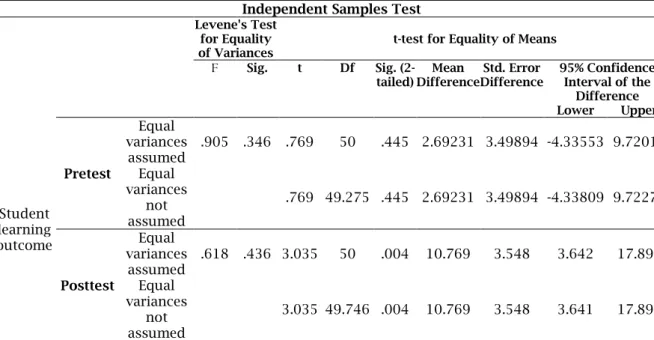
Statistical analysis using a t-test, as shown
in Table 9, was obtained that there was no
difference in cognitive score between experiment and control classes obtained before the experiment was started (sig 0.445>0.05).
Cognitive learning outcome scores increased at posttest in either experiment or control classes by 40.39 and 32.39, respectively (Table 6). The average score of experiment class was more than ten points higher in the experiment class compared to control. The data have a normal
distribution (sig 0.51>0.05) and
homogenous variance (0.436>0.05), as shown in Table 7 and 8, respectively. Based on the t-test, p-value 0.004 less than alpha 0.05 and t-value 3.035 more than t-table 2.008 (Table 9), thus the cognitive learning score significantly different between the experiment and the control class. PBL
implementation significantly improves
cognitive learning outcome at the experiment class compared to conventional learning in biology. Table 6. The cognitive learning outcome of students in the experiment and control classes based on
the pretest and posttest scores.
Pretest Posttests
Experiment Control Experiment Control
Number of students 26 26 26 26 Total scores 1050 980 2100 1820 Highest score 60 62 100 91 Lowest score 21 20 62 50 Mean 40.38 37.69 80.77 70 Improvement - - 40.39 32.39
Table 7. Normality test of student learning outcome in the control and experiment classes. One-Sample Kolmogorov-Smirnov Test 2
Unstandardized Residual Pretest Posttest
N 26 26
Exponential parameter.a,b Mean 10.0402299 10.4453441
Most Extreme Differences Absolute Positive .250 .153 .238 .106
Negative -.250 -.228
Kolmogorov-Smirnov Z .866 .821
Asymp. Sig. (2-tailed) .441 .510
Table 8. Homogeneity test of student learning outcome in the control and experiment classes. Test of Homogeneity of Variances
Levene Statistic df1 df2 Sig.
Pretest .042 1 50 .346
Posttest .618 1 50 .436
The improvement of learning outcome in the experimental class occurred because the PBL model can generate students' thinking skills based on existing problems so that the learning process seem more active and collaboration among students appeared in the group. In addition, the material that was used suited the PBL due to it was encountered in their daily life. Thus, the implementation of learning with the PBL model had a positive impact on the achievement of student learning outcomes. Students did not just accept material but can make an understanding of their own material. Previous research found that the improvement of the student learning outcomes in the PBL class was in relation to student activeness (Widodo & Widayanti,
2013) as a positive impact of getting used
to in solving of a complex problem (Fitri &
Ramdiah, 2017). PBL has advantages over
conventional learning since, during the learning process, PBL directed students to learn deeply rather than surface learning
(Pepper, 2009) so that the student
remember more easily the lessons. In
contrast, conventional learning was
dominated by the teachers so the students
only as passive listeners, which caused students difficult to remember the lessons.
PBL can improve student learning outcome through the steps in PBL that stimulate students to learn to solve problems. These steps include expressing ideas, cooperating in groups, seeking information, asking questions or opinions, answering questions, and communicating the results of discussions. Based on the observations during the learning process students in the experimental class are more active than the control class seen in the process of discussion in small groups to solve problems and students are more active in giving back responses to answers given by friends and in answering questions that have been given by the teacher. Collaboration among students in the groups was very visible from the way they work out the tasks in the form of problems they must resolve. Whereas in the student control class it was not as active as the PBL class due to the teacher-centered learning was not encourage students to learn actively in the learning process.
Table 9. T-test of student learning outcome in the control and experiment classes. Independent Samples Test
Levene's Test for Equality
of Variances t-test for Equality of Means F Sig. t Df Sig.
(2-tailed) Difference Mean Difference Std. Error 95% Confidence Interval of the Difference Lower Upper Student learning outcome Pretest Equal variances assumed .905 .346 .769 50 .445 2.69231 3.49894 -4.33553 9.72014 Equal variances not assumed .769 49.275 .445 2.69231 3.49894 -4.33809 9.72271 Posttest Equal variances assumed .618 .436 3.035 50 .004 10.769 3.548 3.642 17.897 Equal variances not assumed 3.035 49.746 .004 10.769 3.548 3.641 17.897
Conclusion
The PBL model improved problem-solving skill of students than the conventional model due to the students in PBL class were encouraged to solve problems by using the knowledge they already have, explore to find new knowledge, and elaborating the knowledge to find explanations of existing problems. Cognitive learning outcomes of students in the experimental class are superior to the
conventional class because students
acquire essential knowledge and concepts from the subject matter, and students are also more skilled at developing ideas. The activity of students influenced the learning outcomes because it makes them more aware of the material being studied. Students who were active in the learning process both at the time of observation, discussion and giving ideas for problem-solving and during the presentation, the level of understanding will be better knowledge and learning outcome gained. This result shows that PBL successfully to
improve the student’ problem-solving skill
and cognitive learning outcome in the environmental pollution topic. Further implementation of PBL on other suitable topic needs to be approved.
References
Amalia, J., Syarifuddin, H., & Nilawasti, Z.
(2014). Pengaruh penerapan
pembelajaran berbasis masalah
terhadap kemampuan pemecahan
masalah siswa kelas VIII SMPN 8
Padang. Jurnal Pendidikan
Matematika, 3(2), 38–43.
Avalos, A., Martín, L., Pérez-Urria, E., & Pintos, B. (2010). Problem-based learning and the use of new learning- teaching methodology. In
Proceedings of INTED2010
Conference (pp. 3004–3009).
Valencia: IATED. Retrieved from https://eprints.ucm.es/13821/1/Pr oblem-Based_Learning_and_the_use _of_New_learning-Teaching_Method ology_(proceedings).pdf
Barrett, T. (2017). A new model of
problem-based learning: Inspiring concepts, practice strategies and case studies
from higher education. Maynooth:
AISHE. Retrieved from
https://www.aishe.org/wp-content/ uploads/2017/05/Full-Book-A-New- Model-Of-Problem-Based-Learning-Terry-Barrett_book.pdf
Bialik, M., Fadel, C., Trilling, B., Nilsson, P., & Groff, J. (2015). Skills for the 21 st Century: What Should Students
Learn? Boston, Massachusetts:
Center for Curriculum Redesign. Fitri, N., & Ramdiah, S. (2017). Pengaruh
model pembelajaran problem based learning (PBL) terhadap hasil belajar kognitif siswa kelas XI SMA Negeri
Kota Banjarmasin. Jurnal
Pendidikan Hayati, 3(4), 125–135.
Retrieved from http://ejurnal.
stkipbjm.ac.id/index.php/JPH/articl e/view/279/234
Fitriani, D., Milama, B., & Irwandi, D. (2017).
Pengaruh model pembelajaran
berbasis masalah terhadap
kemampuan literasi sains siswa pada materi laju reaksi. Edusains,
9(2), 117–126. Retrieved from
http://journal.uinjkt.ac.id/index.ph p/edusains/article/view/1402/pdf Handika, I., & Wangid, M. N. (2013).
Pengaruh pembelajaran berbasis
masalah terhadap penguasaan
konsep dan keterampilan proses sains siswa kelas V. Jurnal Prima
Edukasia, 1(1), 85–93. https://doi.
org/10.21831/jpe.v1i1.2320
Hasan, R, Lukitasari, M., Darmayani, O., & Santoso, S. (2019). The variation pattern of cooperative learning models implementation to increase the students creative thinking and
learning motivation. Journal of
Physics: Conference Series, 1157(2),
022075. https://doi.org/10.1088/
1742-6596/1157/2/022075
Hasan, Rusdi, & Syatriandi, B. (2018).
Pengaruh model pembelajaran
berbasis masalah (PBM) terhadap kemampuan berpikir kritis dan hasil belajar biologi siswa SMA Negeri 06 Kota Bengkulu. In
Prosiding Seminar Nasional
SIMBIOSIS II (pp. 329–341). Madiun:
UNIPMA. Retrieved from http://
prosiding.unipma.ac.id/index.php/s imbiosis/article/view/651
Hmelo-Silver, C. E. (2004). Problem-based learning: What and how do students
learn? Educational Psychology
Review, 16(3), 235–266. https://doi.
org/10.1023/B:EDPR.0000034022.1 6470.f3
Hmelo-Silver, C. E. (2013). Creating a learning space in problem-based learning. Interdisciplinary Journal of
Problem-Based Learning, 7(1), 24–
39.
https://doi.org/10.7771/1541-5015.1334
Hoi, P. T. T., Bao, D. Q., Nghe, P. K., & Nga,
N. T. H. (2018). Developing
problem-solving competency for students in teaching biology at High
School in Vietnam. American
Journal of Educational Research,
6(5), 539–545. https://doi.org/
10.12691/education-6-5-27
Hung, W. (2016). All PBL starts here: The
problem. Interdisciplinary Journal
of Problem-Based Learning, 10(2).
https://doi.org/10.7771/1541-5015 .1604
Khoiriyah, A. J., & Husamah, H. (2018). Problem-based learning: Creative thinking skills, problem-solving skills, and learning outcome of
seventh grade students. JPBI (Jurnal
Pendidikan Biologi Indonesia), 4(2),
151–160. https://doi.org/10.22219/
jpbi.v4i2.5804
Kudsiah, M., Dantes, N., & Sariyasa, S.
(2013). Pengaruh pembelajaran
berbasis masalah terhadap sikap
dan kemampuan memecahkan
masalah matematika siswa kelas V Gugus 3 Suralaga Tahun Pelajaran
2012/2013. Jurnal Pendidikan
Dasar Ganesha, 3. Retrieved from
https://media.neliti.com/media/pu blications/121292-ID-pengaruh-pe mbelajaran-berbasis-masalah-t.pdf Kusumaningtias, A., Zubaidah, S., &
Indriwati, S. E. (2013). Pengaruh problem based learning dipadu strategi numbered heads together terhadap kemampuan metakognitif, berpikir kritis, dan kognitif biologi.
Jurnal Penelitian Kependidikan,
23(1), 33–47. Retrieved from https://www.researchgate.net/profi le/Siti_Zubaidah5/publication/3224 67159_Pengaruh_Problem_Based_Le arning_Dipadu_Strategi_Numbered_ Heads_Together/links/5a59fb4f0f7 e9b5fb38553cc/Pengaruh-Problem- Based-Learning-Dipadu-Strategi-Numbered-Heads-Together.pdf Minarni, A. (2012). Pengaruh pembelajaran
berbasis masalah terhadap
kemampuan pemecahan masalah
matematis. In Prosiding Seminar
Nasional Matematika dan
Pendidikan Matematika (pp. 92–
102). Yogyakarta: Universitas Negeri Yogyakarta.
Moutinho, S., Torres, J., Fernandes, I., & Vasconcelos, C. (2015). Problem-based learning and nature of science: A study with science
teachers. Procedia - Social and
Behavioral Sciences, 191, 1871–
1875. https://doi.org/10.1016/
J.SBSPRO.2015.04.324
Paidi, P. (2008). Pengembangan perangkat
pembelajaran biologi yang
strategi metakognitif serta
efektivitasnya terhadap
kemampuan metakognitif,
pemecahan masalah, dan
penguasaan konsep biologi siswa
SMA di Sleman-Yogyakarta.
Universitas Negeri Malang, Malang. Pepper, C. (2009). Problem-based learning
in science. Issues in Educational
Research, 19(2), 128–141. Retrieved
from http://iier.org.au/iier19/pepp
er.pdf
Saputri, D. A., & Febriani, S. (2017). Pengaruh model problem based learning (PBL) terhadap kemampuan pemecahan masalah peserta didik pada mata pelajaran biologi materi pencemaran lingkungan kelas X MIA SMA N 6 Bandar Lampung. Biosfer: Jurnal Tadris Biologi, 8(1),
40–52. https://doi.org/10.24042/
biosf.v8i1.1262
Siswanto, S., Maridi, M., & Marjono, M. (2012). Pengaruh model problem based learning (PBL) terhadap kemampuan memecahkan masalah dan hasil belajar kognitif biologi siswa kelas VII SMP Negeri 14
Surakarta Tahun Pelajaran
2011/2012. Jurnal Pendidikan
Biologi, 4(2), 53–59. Retrieved from https://jurnal.uns.ac.id/bio/article/ view/5564
Slameto. (2013). Belajar dan Faktor-Faktor
Yang Mempengaruhinya. Jakarta:
Rineka Cipta.
Sugiyono. (2007). Metode Penelitian
pedidikan pendekatan kuantitatif,
kualitatif, dan R&D. Bandung:
Alfabeta.
Sunhaji, S. (2014). Kualitas sumber daya manusia (kualifikasi, kompetensi
dan sertifikasi guru). Jurnal
Kependidikan, 2(1), 142–160. https:
//doi.org/10.24090/jk.v2i1.546
Suprijono, A. (2013). Cooperative Learning.
Yogyakarta: Pustaka Belajar.
Trilling, B., & Fadel, C. (2009). 21st Century Skills: Learning for Life in Our
Times. San Francisco, CA: John
Wiley & Sons.
Widayati, T. U., Prayitno, B. A., & Ariyanto, J. (2015). Perbedaan kemampuan memecahkan masalah dan retensi menggunakan model PBL dan ceramah bervariasi pada materi keanekaragaman hayati Indonesia siswa kelas X MIA SMA Negeri 2
Surakarta Tahun Pelajaran
2014/2015. Bio-Pedagogi, 4(1), 53–
58. Retrieved from https://
www.jurnal.fkip.uns.ac.id/index.ph p/pdg/article/view/7336
Widodo, W., & Widayanti, L. (2013). Peningkatan aktivitas belajar dan hasil belajar siswa dengan metode problem based learning pada siswa kelas VIIA MTs Negeri Donomulyo
Kulon Progo Tahun Pelajaran
2012/2013. Jurnal Fisika Indonesia,
17(49), 32–35. Retrieved from
https://journal.ugm.ac.id/jfi/article /view/24410