A
Universal Relation Approach For Natural Query In
Logic Database System
ABSTRACT
HARm ODIN SELAMA T
Fakulti Sains Komputer dan Sistem Maklumat, Universiti Teknologi Malaysia,
54100 Jalan Semarak, Kuala Lumpur.
Recent advances in Artificial Intelligence and Relational Database systems have contributed to the development of Logic Database systems. A lot of research in logic database have been encompassed on the query evaluation and optimization techniques. Very litde effort has been put to the development of the user's query system to facilitate the naive users interacting with the database. Currently, the form of query is based on the primitive logic form. Therefore, this project aims at developing a prototype natural query system to the logic database as a compromise between the primitive logic query and the natural language query systems. This paper describes a conceptual framework of the natural query system. The concept of predicate universal relation is introduced as an interface to bridge the natural query and the corresponding primitive logic query. The concept of data types is employed as a tool towards the construction of the predicate universal relation. We believe this is the flrst attempt towards a natural query system for logic database via a universal relation approach.
Keywords: query interface, logic database, deductive database, universal relation, query processing, query language, natural query, flrst order logic, data types
INTRODUCTION
The integration of concepts from artiflcial intelligence and database management creates a promise of more intelligent use and manipulation of data. Recent advances in Artificial Intelligence and Relational Database systems have contributed to the development of Logic Database (sometimes called Deductive Database) systems. Logic database is based on flrst-order predicate logic [Lloyd 1983]. Every logic database user would expect that in the future, databases will be easier to access and use. At present users have to learn complex, formal logic query which require considerable knowledge about the database structure. Tl)e inuJtediate consequence is that the ability to utilise data is limited. A lot of research in logic database have been focussing on the query evaluation and optimization techniques. Currently, the form of query to the logic database is based on the primitive logic form. Very little effort has been put to the development of the user query language to facilitate the naive users interacting with the database:
Accesses to information systems and its databases by she end-users have traditionally been via a computer specialist who transforms the user's request into some formal database query, languages. Com-puters understand a formal language which is usually difficult to comprehend by ordinary people. On the other hand, the easiest way for humans to commutticate with computers is to talk in terms of natural language (NL). The link connecting the end-users and database system is therefore an interface which hide the users from the technical details of the system. Several studies have focus on the natural language support to facilitate end-user accesses. Many researchers have experimented such systems and high-lighted some of the issues [Barr' 1982]. However, H.W. Beck noted that developing programs that can process natural language has been and is still a difficult task [Beck 1990].
the database is necessary. This is the drawback that is intended to be overcome by the universal relation as an interface between the user's view and the actual database structure. In this approach, only the attribute names are required in the query formulation.
The motivation of this project is therefore the simplification of user's view of the logic database whereby the knowledge of the predicate/relation names and of which attributes/arguments belong to which predicate is no longer required. This project aim at developing a prototype natural user query language for the logic database as a compromise between the primitive logic query and the natural language query systems. This paper describes a conceptual framework of the natural query processing system. It begins with a brief introduction of the logic database system considered in this project. Section 3 briefly introduces the concept of data types followed by the notion of universal relation assumptions in Section 4. Section 5 introduces the notion of predicate universal relation and discuss how data types is used as a mechanism in the definition and construction of the predicate universal relation. Section 6 introduces our version of natural query language with respect to predicate universal relation and followed by the framework of the query interpretation.
LOGIC DATABASE
An Introduction
In this section, we will briefly introduce the syntax and semantics of logic database (LDB). LDB (sometimes known as deductive database) evolved from the combined applications oflogic programming and relational database systems [Lloyd 1983, Gallaire 1977]. An LDB expressed in First Order Predicate Logic (FOPL) has the capability of reasoning. It consists of a collection of facts (extension) and rules (intension). There is no direct specification of algorithm to be executed but requires specification of objects, properties of objects and relationships between objects. In most LDB and AI systems, rules and facts are used to represent assertional knowledge about the domain of discourse in the form of Horn clauses. J. W. Lloyd and D. Jacobs conclude that relational database is a special kind of logic database [Jacobs 1985].
From a conceptual point of view, an LDB may be viewed as a Prolog program [Clocksin 1984]. J. W. Lloyd has demonsrated this concept by means of using Prolog clauses to represent facts, and how simple deductions can be carried out Lloyd 1983]. It is shown that LDB offers the expressibilty of logic in the form of FOPL for data modelling, at the same time allowing the possibility of space saving by having large number of tupples collapse into a general rule. S. A. Naqvi noted that when FOPL is coupled with databases, it has the ability to capture the semantics of database operations and the integrity constraints on the data in one consistent and uniform language, at the same time increased functionality [Naqvi 1986] This section defines the form of the logic database considered in our project.
Definition 1.1: An alphabet of a first order language is composed of a set of variables, a set of constants, a set of predicates,a set of connectives, a set of quantifiers, a set of punctuation symbols.
Variables correspond to attributes which have an association to their respective set of domain values. This concept is normally denoted by Ai/Dom(Ai) where Ai represent an attribute or variable and Dom(Ai) represent its permissable set of domain values with respect to that attribute.
Definition 1.2: A term is defined inductively as follows: • A variable is a term.
• A constant is a term.
Definition 1.3: A we/1-formedformula (wfl) is defined inductively as follows:
• If pis an n-ary predicate and t~. ... , tn are terms, then p(t1, ... , tn) is a formula (called an atomic formula or an atom).
Definition 1.4: The first order language given by an alphabet consists of all formulas constructed from the symbols of the alphabet.
Definition 1.5: A closed formula is a formula with no free occurrences of any variable (a free variable is a
variable which is not quantified).
Definition 1.6: A literal is an atom or the negation of an atom. A positive literal is just an atom. A negative literal is the negation of an atom.
Definition 1.7: A clause is a formula of the form
(LtV ... VLm),
where each Li (0 £ i £ m) is a literal.
In the following, a clause (At V ... V A~c V-. Bt V ... V -., Bn), where At, ... , A~c, -., Bt, ... , -., Bn are atoms, will be denoted by
At, ... , A~c"-.Bt, .... , -.Bn.
Thus, in this notation, all the variables are assumed to be unversally quantified, the commas in the
antecedent Bt, ... , Bn denote conjunction and the commas in the consequent At, ... , A1c denote disjunction.
Definition 1.8: A database clause is aclause of the form A"Bl, ... ,Bn
which contains precisely one positive literal (i.e. A). A is called the head and Bt, ... , Bn is called the body of the database clause.
Definition 1.9: A logic database is a finite set of database clauses.
Definition 1.10: A logic database L, is a theory composed of an extensional database (denoted by EDB)
and an intensional database (denoted by IDB). The EDB is a set ground instances of atoms defining
the extensions of the base predicates. The IDB is a set of deduction rules defining the virtual
predicates.
Definition 1.11: A goal clause is a clause of the form
< -Bt, ... ,Bn
that is, a clause with an empty consequent. Each Bi (i = l..n) is called a subgoal of the goal clause.
Definition 1.12: A Horn clause is a clause which is either a database clause or a goal clause.
Models of a Logic Database
The declarative semantics of a logic database is given by the model-theoretic semantics of first order logic.
This section introduces the notion of interpretations and models which play a particular role in the theory.
Model-Theoratic Semantics
M. H. Van Emden and R. A. Kowalski noted two kinds of semantics; operational anci fixpoint. Which have
been defined for programming languages Emden 1976]. Operational semantics defines the input-output
relation computed by a' program in terms of the individual operation evoked by a program inside a
machine. The meaning of the program is the input-output relation obtained by executing the program on
the machine. As the machine independent alternative to operational semantics, fixpoint semantics defines
the meaning of a program to be the input-output relation which is the minimal fixpoint of a transformation
associated with the program. Fixpoint semantics is a special case of model-theoretic semantics.
Model-theoretic semantics provides a simple method for determining the denotation (meaning) of a predicate symbol p in a database L;
d(p)
= {(t.,
... , tn)ILI=
p(t., ... , tn)},where the notation X
I
=
Y means that X logically implies Y. d(p) is the denotation of p as determined by the model-theoretic semantics. The completeness of first-order logic means that there exists an inference system X 1- Y itT X1=
Y.Definition 2.1: An interpretation o f first order language consists of the following: • A non-empty set D, called the domain of the interpretation.
• For each constant a, the assignment of an element a' in D. • For each n-ary predicate p, the assignment of a relation p' on Dn.
It follows from thin definition that the domains are interpreted as unary predicates. Given a domain d, we will note a (Ed instead of Dom(a) when convenient.
Defrnition 2.2: Let I be an interpretation and let F be a closed formula. Then I in a model for F if the truth value of F wrt I in true.
Definition 2.3: LetS be a set of closed formulas and I be an interpretation. We say I is a model for S if I is a model for each formula of S.
Definition 2.4: LetS be a set of closed formula of a first order language L. We say that Sis satisfiable if L has an interpretation which is a model for S. S is valid if every interpretation of L is a model for S. S is
unsatisfiable if it has no models.
Definition 2.5: LetS be a set of closed formulas and F be a closed formula of a first order language L. We say that F is a logical consequence of S denoted by S
I
=
F if, for every interpretation I of L, I is a model for S implies that I is a model for F.Proposition 2.1: Let S be a set of closed formula of a first order language. Then F is a logical consequence of S iff S U ( •F) is unsatisfiable.
Proof: The proof can be found in [Lloyd 1984].
The basic problem in logic programming is, given a set of database clauses Land a goal G, to show that LU (•G) is unsatisfiable. However, only a specific class of interpretations, namely the Herbrand interpretations, needs to be investigated to prove the unsatisfiablity of L U C•6). We therefore focus our attention on Herbrand interpretation.
Definition 2.6: A ground term is a term not containing variables. Similarly, a pound atom is an atom not containing variables.
Definition 2.7: Let L be a first order language. The Herbrand universe Hu is the set of all ground terms, which can be formed out of the constants appearing in L.
Definition 2.8: Let L be a first order language. The Herbrand base Hb is the set of all ground atoms which can be formed by using predicates from L with ground terms from the Herbrand universe as arguments.
Definition 2.9: Let L be a first order language. An interpretation I for L is a Herbrand interpretation if the following conditions are satisfied:
Definition 2.10: Let L be a first order language and S be a set of closed formulas of L. A Herbrand model for S is a Herbrand interpretation for L which is a model of S.
Proposition 2.2: Let S be a set of clauses and suppose S has a model. Then S has a Herbrand model.
Proof: Let I be an interpretation of S. We define a Herbrand interpretation I' of S as follows: I'= (p(tt, ... , tn)(EHblp(tt, ... , tn) is true wrt 1).
It is straightforward to see that if I is a model, then I' is a model.
A Herbrand interpretation simultaneously associates, with every n-ary predicate symbol in L, a unique n-ary relation over Hu. The relation {(t1, ••• , tn)lp(tt, ... , t0 ) CE I) is associated by I with the predicate symbol
pin L.
• A ground atomic formula A is true in a Herbrand interpretation I iff A CE I. • A ground clause L1 V ... V
Lm
is true in I iff at least one literal Li is true in I.• In general, a clause Cis true in I iff every ground instances C s of Cis true in I. (C sis obtained by replacing every occurrences of a variable in C by a term in the Herbrand universe Hu. Different occurrences of the same variable are replaced by the same term).
• A set of clauses A is true in I iff each clause in A is true in I.
Proposition 2.3: Let S be a set of clauses. Then S is unsatisfiable iff S has no Herbrand models.
Proof: If S is satisfiable, then proposition 2.2 shows that it has a Herbrand model.
The Her brand models of a logic database are subsets of its Her brand base. Therefore, there exists a unique minimal model called the least Herbrand model, which is the intersection of all Herbrand models of the database.
Least Herbrand Model
The least Herbrand model is of central importance in the theory as it contains precisely the set of ground atoms which are the logical consequences of the database. Every logic database has a least Her brand model. Intuitively, this model reflects all information expressed by the database and nothing more [Nilsson 1990]. Logic databases as Horn theories have the 'model-intersection property'.
Proposition 2.4: Let L be a logic database and Let M(L) be the set of all Herbrand models of L, then LM(L), the intersection of all Herbrand models of L, is itself a model of L (that is, a Herbrand interpretation of L).
Proof: Clearly LM(L) is a Herbrand interpretation for L. Now, suppose LM(L) is not a model. Then, LM(L) falsifies a ground instance C q of a clause C CE A. Let C q as A ·'Bt , .... Bn (n > = 0). It follows that,
*
Are LM(L)*
Bt, ... , Bn (ELM(L)Thus for some iCE I, Are M(L) and Bt, ... , Bn (E M(L). It follows that Cis false in M(L) contrary to the assumption that M(L) is a model.
Theorem 2.1: Let L be a logic database. Then ML {p (E Hb
I
LI=
p)Proof: We have that
p(t., ... ,to) is a logical consequence of L iff Ll = p(tt, ... , t0 ),
iff L U {-,p(tt, ... , t0 )} has no model,
iff L U { -,p(tt, ... ,to) has no Herbrand model, iff -,p(t1, ... , t0 ) is false wrt all Herbrand models of L, iff p(tt, ... , t0 ) is true in all Herbrand models of L, iff p(tt, ... , t0 ) CE ML (LM(L))
If L contains the predicate symbol p, then the meaning or denotation d(p) is the relation associated with p by the Herbrand interpretation LM(L). In symbols,
d(P)
=
{(tt, ... , to)Jp(tt, ... , t0 ) CE LM(L))for any set of clauses in a database L.
Answer Substitutions
This section introduces the concept of answer substitution based on unification theory, which provides a declarative understanding of the desired output from a logic database and a go(!.l.
Definition 2.11: A substitution q is a finite set of the form (vt/t1, ••• , v0/tn}, where
• each Vi is a variable
• each ti is a term distinct from Vi • all the Vi are distinct
• if vi is a variable, ti is a constant
Each element Vi/ti is called a binding for Vj. q is called a pound substitution if the Vi are all ground terms.
Definition 1.12: An expression is either a term, a literal or a conjuction or a disjunction of literals. A simple expression is either a term or an atom.
Definition 2.13: Let q
=
(vtftt, ... , vn/tn) be a substitution and E be an expression. Then Eq, the instance of E by q, is the expression obtained from E by simultaneously replacing each occurrence of the variable Vi in E by the term ti (i=
l..n)Definition 2.14: Let L be a logic database and G be a goal. An answer substitution for L U {G} is a sub-stitution for variables ofG, that is a subsub-stitution whose domain is included in the set of variables of G.
Definition 2.15: Let L be a logic database, 6 be a goal··- A., ... , Ak and q be an answer substitution for LU {G}. We say that q is a correct answer substitution for L U {G} if ((A1 L. .. L A~c)q) is a logical consequence of L.
THE TYPE SYSTEM IN LOGIC PROGRAMS
applicative language which is used in the ML type checker [Milner 1978]. Each call conforms to the type declaration of that object. Each construct in the language is associated with a type and using that information, well-typing is defined. They noted simply that the only additions to the language are type declarations, which an interpreter can ignore if it so desires, with the guarentee that a well-typed program will be have identically with or without type checking. Roland Dietrich and Frank Hagl enhanced Mycroft and O'Keefe's type checker to deal with polymorphic subtypes by adding modes to the program [Dietrich 1988].
Prateek Mishra on the other hand, has a different view of typing and type checking in Pro log where a type-inference system would detect goals which can never succeed [Mishra 1984]. The type of a predicate describes all terms for which the predicate may succeed, and for any term not described by the type of the predicate, the predicate cannot succeed.
Eyal Yardeni and Ehud Shapiro in their recent research in typ .. ·ystem for logic programs [Yardeni 1991 ], have developed a theory of type system for pure logic programs which addresses the question of type declaration, type inference and well-typing. Their work was based on a restricted class of types, called regular types and sub-class of logic programs, called regular unar) logic (RUL) programs, for which type checking is decidable. They noted that their theoretical model is a suitable basis for type systems for concrete logic programming languages. The notion of the following type system is primarily due to Eyal Yardeni and Ehud Shapiro [Yardeni 1?91]. The formalisation of how to declare the type of a program by regular unary logic (RUL) program is shown.
Definition 3.1: Let S be a set of first-order formulas, and L a first-order language. The signature of S, sig(S), is the minimal set containing all predicates, function symbols and constant that appear in S. Similarly, we define the signature of L, sig(L), to be the signature of all formulas that can be constructed in L. A logic program defines a signature.
Defination 3.2: Let Hb be the Herbrand base of a program P. Define the mapping Tp : 2Hb -> 2Hb as follows : let I be a Herbrand interpretation. Then,
TP (I) = {A <E Hbl A "B~, ... , Bn < < C <E P and Bt, ... /Bn (E I}
otation A < < L B means that A is a ground instances of B over L. Van Emden and Kowalski [Emden 1976] proved that the intersection of all Herbrand models for p is equal to Tp0 w, where w is the first
infinite ordinal, which is the meaning of the program denoted by d(P).
Definition 3.3: With each term t we associate a labelled tree, which we refer to as the associated tree oft. The edges and the leaves of the tree are labelled according to the construction rules as follows:
(I) if tis a constant or a variable symbol, then make a leaf and label it with t. (2) ift = f(tt, ... , T n), f is of arity n. then:
(a) make a new node associated with t
(b) for all i <E [1 .. n] construct recursively the subtree associated with ti. and draw an edge. labelled f(n.i), from the new node to the root of the subtree.
a
Definition 3 4: LetS be a set of ground terms. Define paths(S)
=
Ut <E s paths(t). The tupple-distributiveclosure of S is
a(S)
=
{tI
tis a term and path s(t) C paths(S)}.S is tupple-distributive if a(S) = S.
Intuitively, the tupple-distributive closure of a set of terms is the set of all terms constructed recursively by permuting each argument position among all terms that have the same functor-arity combination.
Example 3.1: If S = {f(a,b), f(c.d)). then paths(S) = (f(2.l)a, f(2,2)b. f(2,l)c. f(2,2)d) and a(S) = (f(a.b),
f(a.d). f(c.b). f(c.d)).
Definition 3.5: Let p/n be a predicate of n-arity in a program P. Then the meaning of a programme P is
d(P)p/n = {(p(t1, ... , tn)Jp(tt, ... , tn) <E d(P)).
We extend the notions of paths and tupple-distributivity to include atoms.
Claim: Let P be a program with different predicates p 1, ... , P0 • Then a(d(P)) = a(d(P)p1) U ... U a(d(P)pn)
Definition 3.6: A type is a recursively enumerable (r.e.) tupple-distributive set of ground atoms with a finite signature. The association of a type to a program is intended to mean that only ground atoms
that are elements of the type may be derived from the program. It determines the set of permissable
values an argument variable may take.
Definition 3.7: LetS be a programme. Then,
Ss,
=
(f(n,i)I
f/n <E sig (S),i (E (l, ... ,n}} U {cI
c <E sig(S)is a constant)Definition 3.8: A set of ground terms S with a finite signature is regular iff there exists a regular language
L C Ss* such that for every term t, t <E S iff paths(t) C L. A logic,program Pis regular if d(P) is
regular.
Lemma 3.1: For every regular set of terms ·S, paths(S) is regular.
The proof can be found in [Yardeni 1991].
Definition 3.9: Two terms are top-level unifiable if at least one of them is a variable or they have the same principle function symbol.
Definition 3.10: A regular unary logic (RUL) programme P is a logic program satisfying the following syntactic rules.
(1) Every predicate in Pis unary.
(2) No two head arguments of clauses of the same predicate are top-level unifiable.
(3) Every body goal of every clause in P is of the form p(x), where p is a predicate name and x is a variable.
(4) Every variable in a clause occurs exactly once in its head and once in its body (note that the arguments off acts (clauses with empty bodies) are ground terms).
Definition 3.11: Let p be a unary predicate and A be a set of atoms. Define A/p to be the set {t 1 p(t) (E A}.
Theorem 3.1: (1} RUL programmes are regular.
(2) For every regular set of terms S there exists a R UL programme P with a predicate P such that S
=
d(P)/p.Proof: The proof can be found in [Yar91].
Exampk 3.2: a simple logic programme with type declaration is as shown below,
I'latural ::
=
0; s(O).Procedure plus (Natural, Natural, Natural).
plus ( 0, X, X).
plus(s(X), Y, s(Z)) <~plus (X, Y, Z).
The semantic interpretation (or role) of each argument in a relationship defined by a predicate is given special attention. is We associate a type in a logic programme to data type with respect to the role of an argument. This in view that the naive users only communicate in terms of the real world definition. Every defined predicates in a database reflects the real world to be model and every argument in a relationship has a semantic role. We therefore view an argument at the schema level to posses a semantic property identified
by an argument's (attribute's) identifier which reflect the meaning of the real world.
Dt.finiton 3.13: Let Ai :: ai,l; ai,2i ... ; ai,n and Aj :: aj,li aj,2i ... ; aj,n(i7r j) be data types and p(t1, T2 be a predicate with a semantic interpretation as customer T1 lives at address T2. Let the arguments T1 is of type Ai and t2 is of type Aj. lft1 and t2 are ground terms, then t1 <E Ai and t2 <E Aj such that Ai and Aj are said to be defined as data types 'customer' and 'address' respectively.
The notion of data type is thus associated to an attribute's identifier in a relationship-of a predicate. It may
be viewed as an abstraction of meaning. Usually, a designer has in mind the type of arguments associated to a predicate which may be interpreted as the set of values defined by the database. That is, we can think of a predicate as true for its arguments if and only if those arguments form a tupple of the corresponding relation which is an element of a least Herbrand model.
Definition 3.U: Let p(t1, ... , t0 ) be apredicate in a database L. Let ML be the least Herbrand base of L.
Then the meaning of a database w.r.t. the predicate pis,
d(L)p(tl, .. ,tn) = {
<
t1, ... , tn>
ip(tl, ... , tn)<<
L, Ll =ML p(t1, ... , tn)}THE PREDICATE UNIVERSAL RELATIONS IN NATURAL QUERY PROCESSING
Introduction
At this point, we have introduce the concept of a logic database and the type system in logic programmes. In this section, we will discussed the concept of universal relation and demonstrate how it may be used as an interface in an attempt to offer the users a new version of query called a natural query. A lot of research have been conducted on the application of universal relation assumptions to relational database system [Fagin 1982, Kent 1981, Kuck 1982, Maier 1984, Ullman 1989]. There are positive and negative issues such as described in [Kent 1981, Brady 1985]. Nevertheless, the motivation of universal relation assumptions is very favourable to the user's point of view, though, the implementations imposed some restrictions [Codd 1990]. The researchers however feel that it is a good research to continue in order to explore new ideas and possibilities in the area of information retrieyal. This view is supported by W. Kent, a researcher who has investigated the consequences of assuming universal relation [Kent 1981].
The universal relation model is first introduced as a means to free the users fnom the need to know the logical navigation of the database. The major objective is to achieve complete access-path independence, whereby data retrieval only requires the names of the attributes [Maier 1984, Ullman 1989, Korh 1984, Brady 1985, Kent 1981, Maier 1983b, Fagin 1982, Kuck 1982, Beeri 1982, Ullman 1982]. There are positive and negative views on the assumptions [Codd 1990a, Kent 1981]. Several versions of universal relation assumptions with respect to relational systems have been introduced to satisfy different objectives. A simple illustration of the notion of universal relation assumptions is as follows,
UR Assumptions :
For the set of relations S
=
{Rt < Xt;Dt >,R2 < X2;D2 >, ... ,R0 < Xn;Dn >}, there exist aUniversal Relations U < T; G > such that
(1) The columns of U consist of all the columns of the relations in S :
(2) Each relation in S is a projection of U :
R;
=
U[X;]Currently, the form of query to the logic databases is very primitive. The naive users often find it difficult to use the database. We feel that the technical details should be hidden from the users and the system should be human-oriented, user-friendly and understand a close approximation to natural language. Based on the literature, there has been no attempt to investigate the universal relation approach in the query processing of logic databases. Therefore, it is the objective of this project to investigate and explore the concept of universal relation for the natural query interface to the logic database. In the subsequent sections we will introduce our version of universal relation assumptions called the predicate universal relation (PUR). PUR is based on the notion of object-structure universal relation [Maier 1983b] intoduced by D. Maier and J. D. Ullman. The concepts of object-structure universal relation and the FOPL have common sructural properties.
We believe that this is the first attempt in adopting universal relation approach to query processing of logic database. This is in view that both relational databases and logic databases have a common under-lying mathematical model of first-order logic (FOL). However, it is worth distinguishing the differences between the two types of databases. Firstly, the existence of the rules in the logic databases which may be recursive, thus the relation described may be infinite in contrast to the traditional relational databases. Secondly, the use of variables and compound terms which appear in the rules of logic databases. Generally, given a query, there is also a difference in the process of answer substitutions with respect to the query [Nilsson 1990, Maier 1983a, Lloyd 1984, Kroenke 1983, Hogger 1990, Gallaire 1977, Deville 1990, Date 1986, Codd 1990a, Thayse 1988]. These differences influence the design and implementation of the intended universal relation assumptions which should be designed to be compatible with the characteristics and properties of the logic database system.
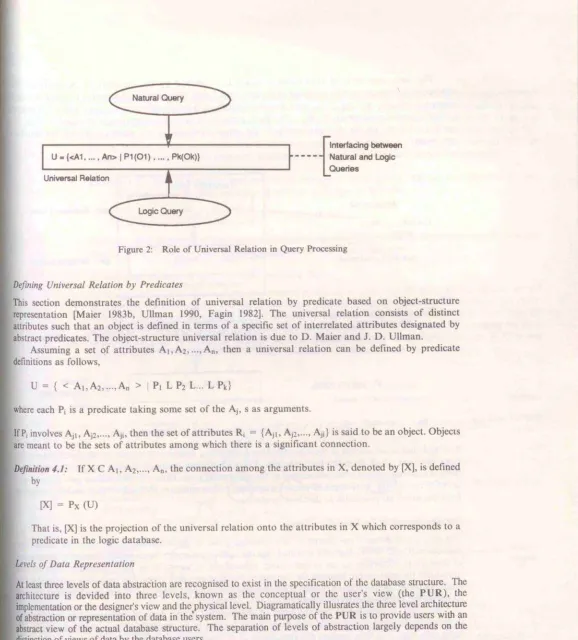
The Role of Predicate Universal Relation
U • {<A1, ...• An> I P1 (01) •..• , Pk(Ok)} - - - -
-
~nterfacing
Natural and Logic betweenL---~~---~ Queries
Universal Relation
Figure 2: Role of Universal Relation in Query Processing
Defining Universal Relation by Predicates
This section demonstrates the definition of universal relation by predicate based on object-structure
representation [Maier 1983b, Ullman 1990, Fagin 1982]. The universal relation consists of distinct
attributes such that an object is defined in terms of a specific set of interrelated attributes designated by
abstract predicates. The object-structure universal relation is due to D. Maier and J. D. Ullman.
Assuming a set of attributes At, A2 , ... , An, then a universal relation can be defined by predicate
definitions as follows,
where each P; is a predicate taking some set of the Aj. s as arguments.
IfP; involves Ajt, Aj2 , ••. , Aj;, then the set of attributes R;
=
{Ajt, Aj2 , ••• , Aj;} is said to be an object. Objectsare meant to be the sets of attributes among which there is a significant connection.
Definition 4.1: If XC A1, A2, ... , An, the connection among the attributes in X, denoted by [X], is defined
by
[X] = Px (U)
That is, [X] is the projection of the universal relation onto the attributes in X which corresponds to a
predicate in the logic database.
Levels of Data Representation
At least three levels of data abstrachon are recognised to exist in the specification of the database structure. The
architecture is devided into three levels, known as the conceptual or the user's view (the PUR), the
implementation or the designer's view and the physical level. Diagramatically illusrates the three level architecture
of abstraction or representation of data in the system. The main purpose of the PUR is to provide users with an
abstract view of the actual database structure. The separation of levels of abstraction largely depends on the
distinction of views of data by the database users.
This paper will focus on the conceptual level of data abstraction, and how the conceptual view is
mapped to the logical or implementation view of the data model. Data model is a representation of data
and its interrelationships which describes ideas of the real world [Brodie 1984, Codd 1990a]. Physical level is
below the implementation level which describes how data are actually stored in the physical storage devices
and access techniques.
The conceptual level of abstraction is meant to be viewed by the end-users of the database. The conceptual schema is the data structure at the conceptual level. The conceptual structure consists of a set of
distinct attributes, A1, A2, ••. , An, such that each attribute is as signed to at least one abstract·predicate
(called universal predicates), P1, P2, .•• , Pk. Each predicate designate a relationship of object relating to a
specific attribute set which corresponds to the actual predicate in the database (called the database
predicates).
Conceptual Level
Attrubute se:_t
---f-r..-<Af, ... ,
An> U=
{<A1, ... , An> IP1(01), ... , Pk(Ok)}
Universal predicates
LOB = {P1', P2', ... , Pk'}
Database predicate schemes
Storage structures
P1 (01) , ... , Pk(Ok)
Universal Relation
Implementation Level
Physical Level
- ~ End-user's View
- ~ Designer's VIew
- - . . Designer's View
System - - . . Programmer's
L---~ ~ew
Figure 3: Levels of Abstraction Viewed by Database Users
The implementation scheme of the logic database is the actual database structures. At this level, there exists
rules and facts which form the base relations. For each distinct predicate symbol that exist at this level, there is a corresponding predicate scheme at the conceptual level. Thus it form a unique pair of
database-universal predicates. Both types of predicate schemes posses common properties which enable a mapping
fram the universal predicates to database predicates.
Domains Viewed as Declared Data Types
The concept of domain has played a very important role in the relational model since the mo<Iel was
introduced [Codd 1990a]. It is well accepted that the domain concept is fundamental. Similarly, the concept
of domain is important as an interpretation mechanism of formulas in logic database. This section introduces the relationship between the concept of domains and data types. The main idea is to enable the
reader to realise the connection between domains and abstract data types (ADT) and how they may be used
to define the predicate universal relation.
An ADT is intended to capture some of the meaning of the data. If, however, two semantically distinguishable types of real-world objects or events happen to be represented by values of the same basic data type, it is thus requires the assignment of distinct attribute names to these types.
Example 4.1:
let us consider the following predicates,
customer(adam,IO) to mean 'adam is a customer with age of 10', and weight(adam,IO) to mean 'adam has weight 10 stones'.
From the above, the second argument of predicate 'customer' shows the domain of ages of a persons which is represented by integer values (such as 10, 11, 13, etc.), while the second argument of predicate 'weight' shows the domain of weight of persons which is represented by integer values (such as 10, 13, 14, etc.) as well. Clearly, these two sets of values have semantically different interpretations or meanings, though they are·represented by the same basic data types. From the above example, we could thus design an ADT for the second arguments of the predicate 'customer' and 'weight' as 'age' and 'weight' respectively.
Example 4.2: Let the predicate 'customer' is represented by customer(Al, A2) in a logic database L, then,
mathematically, we may define the domain of ADT 'age' as follows,
age = (c I c (E Dom(A2) L customer (At. A2) <E L)
Similarly, every argument of the predicates defined in the database are treated in the same manner. We have demonstrated the relationship between domains and ADTs in a database.
Relationships Between Models, Domains and Data Types
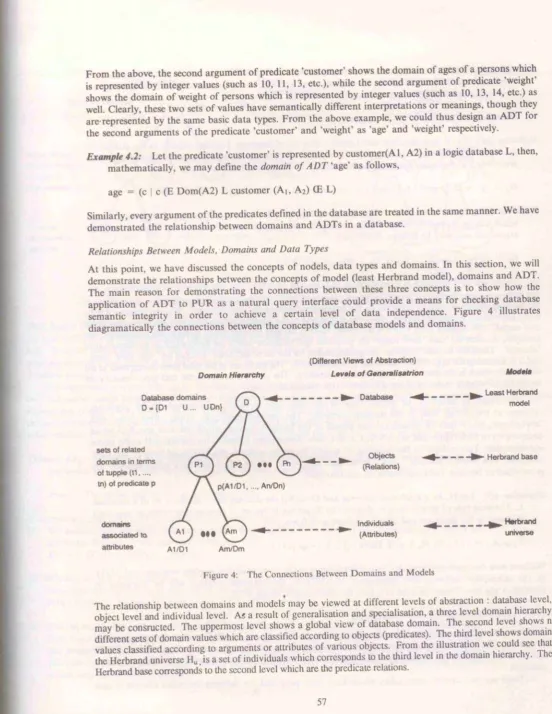
At this point, we have discussed the concepts of nodels, data types and domains. In this section, we will demonstrate the relationships between the concepts of model (least Herbrand model), domains and ADT. The main reason for demonstrating the connections between these three concepts is to show how the application of ADT to PUR as a natural query interface could provide a means for checking database semantic integrity in order to achieve a certain level of data independence. Figure 4 illustrates diagramatically the connections between the concepts of database models and domains.
Database domains
D·{D1 U ... UDn)
sets of related domains in terms ol tupple (11 •... , tn) of predicate p
domains
associated to
attributes A1/D1 Am/Dm
(Different Views of Abstraction)
bve/s of Gene,./lutrion
~--
...
(Relations) ObjectsIndividuals (Attributes)
..._ _____ ... Least Herbrand
model
. . . . _ - - - _... Herbrand base
... - - - - _.,. Herbrand
universe
Figure 4: The Connections Between Domains and Models
•
Dejiltitio11 4.2: Let Hu be a Herbrand universe, p(a) be a predicate in a database Land ML be the least Herbrand model of the database. The domain of an attribute Ai (which correspond to a term. Ti) is a non-empty fmite set of constants and may be defined as follows,
Dejillition 4.3: Let L be a database and Dom(L) be a set of database domains relative to the attributtes
Al, .... An. The Herbrand Universe Hu of Lis the set of all pound terms which can be formed out of the
constants and functions appearing in L and may be defined as follows,
Hu
=
{a I a <E Dom(L) L Dom(L)=
{Dom(Al) U ... U Dom(An)}}Definition 4.4: Let L be a database. The Herbrand base of a database Hb, is the set of all ground atoms
which can be formed by using predicates from L with ground terms from the Herbrand universe as arguments and may be defined as follows,
Hb
=
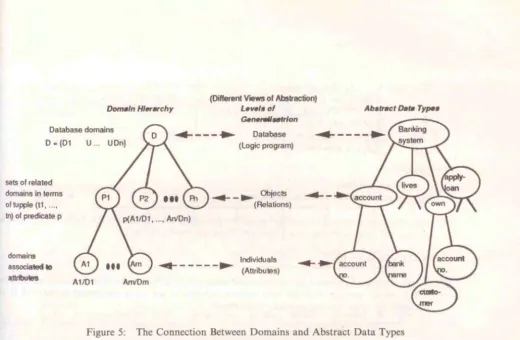
'{p(tt, .... tm) I (tt,··· tm) <E Hu L p((t~, ... tm)) <E L}Let us now see how domains is associated to the concept of ADT. For the purpose of explamation, an Let us now see how domains is associated to the concept of ADT. For the purpose of explaination, an example of the banking system is used to demonstrate the connection between the two concepts. We can observe that by using generalisation method [Brodie 1984), the abstraction of the banking system may be viewed as a hierarchic data model. The attribute level which is the lowest level in the data type hierarchy refers to the individuals. For example, 'account no.' and 'bank name' are attributes specialisation which are generalised to an object called 'account'. Thus, the'account' becomes the generalisation for the set of attributes 'account no.' and 'bank name', and it is located at the upper level, the object or relation level. The attributes at the third level corresponds to the individuals which is the third level in the domain hierarchy. The attribute names in the data type hierarchy are meant for referencing to the set of domain values in the domain hierarchy.
T~e object or entity at the second level in the data type hierarchy corresponds to the predicate relations at the second level in the domain hierarchy. The abstract predicates 'count' 'lives' 'own' and 'apply-loan', which may be viewed as subschemas of the banking system, which Ink at a specified set of components in each tupple and say whether or not these components reflect to the current real wor1d under consideration. This reflects to the meaning of atomic formulas which is the Herbrand base of the logic database. The objects 'account' 'own', 'lives' and 'apply-loan' as we see in the data type hierarchy are generalised to become 'banking-system' at the first level.
Definition 4.5: Let Hu be a Herbrand universe and Dom(Ai) the domain of an attribute Ai of a database
L. The data type of an attribute Ai denoted by Type(A,), is the set of permissable values or constants
declared in the database and may be defined as follows,
Type(Ai) = {a I a <E Hu L a <E Dom(Ai) L L I= MLP(a) }
We have now demonstrated how the relationships between the three concepts; models, domains and ADTs. In the subsequent sections, the application of ADTs to the universal relation will be discussed by demonstrating how it may be used as a too\ for construction of the PUR.
The Predicate Universal Relation Assumptions
At this point, we have understand the role of data types. In this section, we will formalise on the application of types on the new version of universal relation assumptions, called predicate universal relation (PUR) assumptions, which is aim at achieving its objective as an interface in natural query processing of a logic database.
There are two known approaches which have been proposed for defining universal relation [Fagin
Dom•ln Hler.,chy
Database domains
D • {01 U ... UDn}
sets of related domains in tenns oftupple (11, ... ,
In) of predicate p
domains associated to allribum
A1/D1 Am/Om
(Different Views of Abstraction)
L•v•l•of G.MNII•trlon
Database (logic program)
~-~Objects
~-(Relations)
Individuals (Attributes)
Ab•trect D•t• TYF»•
Figure 5: The Connection Between Domains and Abstract Data Types
1982, Maier 1983b, Ullman 1989, Maier 1984]. For our purpose, the object-structure approach seems to be the most suitable representation since this particular approach posseses common charateristics of predicate logic. In order to suit the role of the universal relationas an interface to logic query, some of the assump-tions are reviewed and taylored accordingly to suit its purpose, objectives and the environment of the logic database system.
An important property relating to the object-structure approach is that definition by predicates about the 'real world' could be expressed with the assumption that the universal relation satisfies the (full) join dependency [Fagin 1982, Maier 1983b]. Given a collection of predicates {pt, p2, ... , Pm) each of which is defined over a subset of the attributes in some universal set U, we may say relation rover relation scheme U is the relation defined by Pt, p2, ... , Pm if r consists of exactly those tupples that satisfy all these predicates. Theorem 4.1: A relation rover attributes Pt U ... U Pk can be the relation defined by some values of the
~redicates Pt , ... , Pk if and only if r satisfies the join dependency, JD > < (P~. ... , Pk) Proof" The proof can be found in [Fagin 1982].
The predicate universal relation assumptions assume that:
(I) We assume that the join dependency is full, meaning that the unions of all its objects is the set of all attributes defined by the universal relation,
JD > < (Pt(Ot),P2(02), ... ,Pk(Ok))
(2) We assume that every attributes set Oi
=
(At, ... , Am) belonging to a predicate symbol Pi, tbere exist a data type corresponding to each Ai, which may be defined as follows,Pi(Oi) = (At, ... ,Am)IAt ffi Type (At)L.. .. LAm ffi Type (Am)}
(3) For the set of object relationships (defined by predicates) 5
=
{Pt (Ot), P2(02), ... , Pk(O•.J}, where each Pi(O < i £ k) is a predicate relation scheme, each Oi(O < i £ k)} is an object which is characterised bythe properties of a set of typed attributes (At (E Type(At) L. .. L Am ffi Type(Am)), and there exists a full join dependency such that defined in (1), then there exists a predicate universal relation scheme which may be defined as follows,
U {AI,A2,···,An CE UaiPI(OI) L. .. L Pk(Ok) CE sig(L) L Oi C Ua
L Pi(Oi) = {(AI, ... ,Am)JAI) CE Type (A1) L...L An CE Type(An)} L JD > < (P1 (01 ), P2(02), ... , Pk(Ok))
L Pi(Oi)7rPk(Ok), ... , Pk(Ok)
L ((A1, .. ,Am) q = Type (AI) x ... ,x Type (Am)) L q is a subsitution)}
where,
L = a logic database.
Ua = a set of distinct universal attributes.
(4) Each object is composed of a defined set of components (a set of attributes) Oi, defined by an abstract predicate P, may be viewed as a projection of the universal relation U,
(5) A logic database L, is based on a closed-world assumptions (CW A) and a domain-closure assumptions
(DCA) which assumes that the only existing individuals are those mentioned or defined in the database. In terms of logic, this may be expressed as,
(Vx)(x = c1 Vx = C2 V ... Vx = Cn)
where c1, c2, ... , Cn are all constants occurring in the database.
(6) A logic database *, is based on a normal logic program P, which consists of a finite set of normal
clauses, C1, C2, ... , Ck. and each clause has the form H
·
-al
,
B2, ... , Bn (1 £ n)where H and Bi are of predicate structures (consisting no functors, i.e. datalog). Each predicate
structure is of the form p(t1, t2, ... , tn) where p is a predicate symbol and t1, t2, .... , tn are terms
(7) The (valid) natural queries of the logic database are those that corresponds to the existing attributes
and predicates defined in the database, no new attributes with the exception of synonyms. No
predicates and rule heads are generated except those defined in the database.
QUERY LANGUAGE
Logic·offers a uniform paradigm for software technology, i.e. one formalism which serves for constructing
and manipulating programmes, databases and software tools. The only drawback is that it requires the user to know the structure of the database. This definitely cause a burden to the naive users. We therefore attempt to introduce a query language which hide the user from the database structure based on PUR called natural query language.
Natural Query
Natural query is a query to the logic database based on PUR scheme as an interface. The form of queries in
the PUR environment is based on QUEL.like notation [Maier 1983, Ullman 1989], with the exception that
it contains no range-statements. This is because all the tupple variables would range over the universal relation. The format of queries that is used in this project is as follows:
RETRIEVE (attribute set)
WHERE (condition set)
Comparative Operator
@]
Natural Query
~
--rr-f
RETRIEVEAttribute Ust
1:8]
Search ConditionSimple Search Condition
Boolean Search Condition
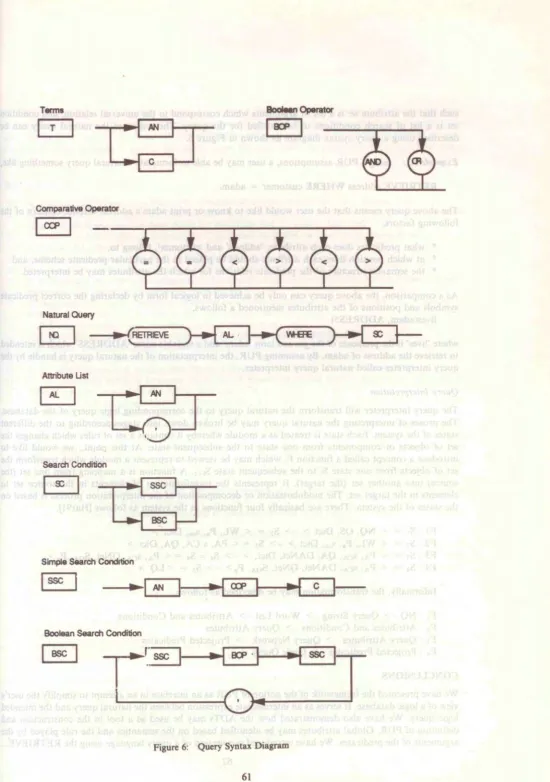
such that the attribute se: is a list or arguments which correspond to the universal relation, and condition set is a list of search conditions to be satisfied for the query. The syntax of the natural query can be described using a query syntax diagram as shown in Figure 6.
Extunple 5.1: using a PUR assumptions, a user may be able to formulate a natural query something like,
RETRIEVE address WHERE customer
=
adam.The above query means that the user would like to know or print adam's address without concern of the following factors,
• what predicates does each attribute. 'address' and 'customer', belong to,
• at which position does each attribute should be placed in the particular predicate scheme, and • the semantic structure of the predicate relations for which the attributes may be interpreted.
As a comparison, the above query can only be achieved in logical form by declaring the correct predicate symbols and positions of the attributes mentioned a follows,
lives(adam, ADDRESS)
where 'lives' is the predicate of the ground term 'adam' and a variable name 'ADDRESS' which is intended to retrieve the address of adam. By assuming PUR, the interpretation of the natural query is handle by the query interpreter called natural query interpreter.
Query Interpretation
The query interpreter will transform the natural query to the corresponding logic query of the database. The proses of interpreting the natural query may be broken down into stages according to the different states of the system. Each state is treated as a module whereby it contains a set of rules which changes the set of objects or components from one state to the subsequent state. At this point, we would like to introduce a concept called a function F, which may be viewed to represent a module which transform the set of objects from one state Si to the subsequent state Si+l· A function is a mapping from one set (the source) into another set (the target). It represents the transformation of elements in the source set to elements in the target set. The modularisation or decomposition of the interpretation process is based on the states of the system. There are basically four functions in the system as follows [Har9l ],
Fl: S, F2:
s
2
F3 :s3
F4 : S4
=
< NQ, QS, Diet > - > S2
=
< WL, P., Sa, Diet > < WL, P., Sea, Diet > - > S3=
< PA, s CA, QA, Diet >< PA, SCA, QA, DANet, Diet, > - > S4 = S4 = < PA, SCA, QNet, 8QA, P,>
< PA,SCA,DANet,QNet,SQA,P,> - > Ss
=
<LQ >Informally, the transformation may be described as follows,
•
F 1 : NQ - > Query String - > Word List - > Attributes and Conditions
F2 :Attributes and Conditions- > Query Attributes
F3 : Query Attributes- > Query Network- > Projected Predicates F 4 : Projected Predicates - > Logic Query
CONCLUSIONS
We have presented the framework of the notion of PUR as an interface in an attempt to simplify the user's view of a logic database. It serves as an intermediate expression between the natural query and the intended logic query. We have also demonstrated how the ADTs may be used as a tool in the construction and definition of PUR. Global attributes may be identified based on the semantics and the role played by the arguments of the predicates. We have introduced our version of a query language using the RETRIEVE ...
WHEPE ... statement and the syntax diagram is presented. This form of query syntax, would ease the users to formulate a query simply by providing the attribute names and the search condition without having to state the prdicate names. We believed that the PUR approach to the natural query processing of logic databases could provide a means for naive users [Ennals 1984] in using the logic database more comfortably.
REFERENCES
I. A. Barr and E.A. Fiegenbaum (Eds.), The Handbook of Artificial Intelligence, Vol.2, Pitman, 1982.
2. A. Motro and Q. Yuan, Querying Database Knowledge, Proceedings of the /990 ACM SIGMOD International
Conference on Management of Data, SIGMOD RECORD, Vol. 19, Issue 2, June 1990.
3. A. Mycroft and R. O'Keefe, A Polymorphic Type System for Prolog, In Logic Programming Workshop, 1983.
4. A. Thayse (Ed.), From Modal Logic to Deductive Databases, John Wiley and Sons, 1989. 5. A. Thayse, From Standard Logic to Logic Programming, John Wiley & Sons, 1988.
6. B. E. Jacobs, Applied Database Logic: Fundamental Database Issues, Vol.l, Prentice-Halls, 1985.
7. B. S. Harihodin, Natural Query Interpretation Based on Predicate Universal Relation Scheme, Technical Report,
Department of Computing, University of Bradford, 1991.
8. C. Beeri and H.F. Korth, Compatible Attributes in a Universal Relation, Proceedings of ACM Symposium on Principle of Database Systems, March 1982, Los Angeles, California, 1982.
9. C. J. Date, An Introduction to Database System, Addison-Wesley 1981.,
10. C. J. Date, Relational Database (selected writings), Addison-Wesley Publishing, 1986. II. C.J. Hogger, Essentilas of Logic Programming, Oxford University Press, New York, 1990.
12. C. L. Chang and R. Char .. Tong, Symbolic Logic and Mechanical Theorem Proving, Academic: Press, 1973. 13. D. C. Tsichritzis and F.H. Lochovosky, Database Management, Academic Press, N. Jersey, 1977.
14. D. D. Chamberlin and F. B Raymond, SEQUEL: A Structured English Query Language, ACM-SIGMOD,
1974, Workshop-Proceeding, Ann Arbor, Michigan, 1974.
15. D. Jacobs, Type Declarations as Subtypes Consraints in Logic Programming, Proceedings of ACM SIGPLAN'.90
Conference on Programming Languages, Design and Implementations, Jun 1990.
16. D. Kroenke, Database Processing: Fundamentals, Design and Implementation, Science Research Institute,
Sydney, 1883.
17. D. L. Pamas, J. E. Shore and D. Weiss, Abstract Types defined as Classes of Variables, Proceedings of the Conference on Data Abstraction, Defmition and Structure, SIGMOD F.D.T., Vo1.8, No.2, 1976.
18. D. L. Pamas, On the Criteria to be Used in Decomposition Systems into Modules, Communication of the ACM,
Vol. 15, No. 12, Dec. 1972.
19. D. Maier, J.D. Ullman and M.Y. Vardi, On the Foundations of the Universal Relations, ACM Transaction on Database System, Vol. 9, No.2, June 84.
20. D. Maier, Maximal Objects and the Semantics of Universal Relation Databases, ACM Transaction on Database Systems, Vol.8, No.I, 1983.
21. D. Maier, The Theory of Relational Databases, Computer Science Press,l983.
22. D. Stemple, T. Sheard and R. Bunker, Abstract Data Types in Databases : Specification, Manipulation and Access, In Object-Oriented Database Systems (S.B. Zdonik and D. Maier, Eds.), Morgan Kaufmann Pub!., 1990.
23. E. F. Codd, Domains as Extended Data Types, In The Relational Mode/for Database Management: Version 2,
Addison-Wesley,1990.
24. E. F. Codd, The Relational Model of Database Management, Version 2, Addison-Wesley Pub!., 1990.
25. E. Yardeni and E. Shapiro, A Type System for Logic ProgrJUDS, In Concurrent Prolog, Vol. 2, M.I:T. Press (E. Shapiro, Ed.), 1987.
26. E. Yardeni and E. Shapiro, A Type Systems for Logic Programs, Journal of Logic Programming, Vol. 10, No.2, 1991, 1991.
27. G. Dayantis, Types, Modularisation and Abstraction in Logic Programming, In Proceedings of /st. International Workshop on Algebraic and Logic Programming (J.Grabowski, P. Lescanne and W. Wechter, Eds.), Gaussig, GDR, 1988.
28. G. Smolka, Logic Programming with Polymorphically Oeder-Sorted Types, In Proceedings of 1st. International
Workshop on Algebraic and Logic Programming (J.Grabowski, P. Lescanne and W. Wechter, Eds.), Gaussig,
GDR, 1988.
29. H. F. Korth and A. Silberschatz, Database System Concepts, MacGraw Hill, 1991. [Kow79] R. Kowalski, Logic for Problem Solving, North-Holland, 1979.
Universal Relation Assumptions, ACM Transactions on Database Systems, Vol.9, No.3, Sept 1984.
31. H. Gallaire, J. Minker and J.M. Nicolas, An Overview and an Introduction to Logic and Databases, In Logic and Databases (H. Gallaire and J. Minker, Eds.), Plenum Press, 1977.
32. H. W. Beck and 5. Navathe, Integrating Natural Language, Query Processing and Semantic Data Models,
COMCON 5PRING 90-PROC IEEE CONFERENCE, 1990.
33. J. Bishop, Data Abstraction in Programming Languages, Addison-Wesley Pub!., 1986.
34. J.D. Ullman and C Zaniolo, Deductive Databases: Achievements and Future Directions, S/GMOD RECORD, Vol.l9, No.4, December 1990.
35. J.D. Ullman, Principles of Database and Knowledge-Based Systems, Vol. l and Vol.2, Computer Science Press, 1989.
36. J. D. Ullman, Principles of Database Systems, Computer Science Press, 1983.
37. J.D. Ullman, The U. R. Strikes Back, Proceedings of ACM Symposium on Principle of Database Systems, Los Angeles, California, March 1982.
38. R. Kowalski, Logic for Problem Solving, North-Holland, 1979. 39. J. J. MArtin, Data Types and Data Structures, Prentice-Halls, 1986.
40. J. Martin, Introduction to Database Organisation, Prentice-Halls, 1978.
41. J. V. Guttag, E. Horowitz and D. R. Musser, The Design of Data Type Specifications, Proceedings Conference on Software Engineering, 1976.
42. J. V. Guttag, The Specification and Application to Programming of Abstract Data Types, Computer Systems Research Report, CSRG-59, Univ. of Toronto, Dept. of Comp. Science, 1975. .
43. J. W. Lloyd, An Introduction to Deductive Database Systems, Australian Computer Journal, Vol. 15, No.2, May 1983.
44. J. W. Lloyd, Foundation of Logic Programming, Springer-Veriag, 1984.
45. J. W. Schmidt, Type Concepts for Database Definition, In Databases: Improving Usability and Responsiveness (Shneiderrnan, Ed.), Academic Press, 1978.
46. L. I. Brady, A Universal Relation Assumption Based on Entities and Relationships, In Entity-Relationship Approach (P.P. Chen, Ed.), IEEE CS Press/North Holland, 1985.
47. M. Cogolla, A Note on The Translation ofSQL to Tupple Calculus, SIGMOD RECORD, Vo/19, No.1, ACM Press, March 1990.
48. M. H. Emden and R. Kowaiski, The Semantics of Predicate Logic as Programming Languages, Journal of ACM, Vol.23, No.4, 1976.
49. M. L. Brodie and 5. N. Zilles (Eds), Proceedings of the Workshop on Data Abstraction, Databases and Conceptual Modelling, ACM, Jun 23-26, Pingree Park, Colorado, 1980.
50. M. L. Brodie, On The Development of Data Models, In On Conceptual Modelling: Perspective from Artificial Intelligence, Databases and Programming Languages, Springer-Verlag, 1984.
51. M. L. Brodie, The Application of Data Types to Database Semantic Integrity, Information Systems, Vol.5,
Pergamon Press, 1980.
52. P. Mishra, Towards a Theory of Types in Prolog, IEEE International Symposium on Logic Programming, 1984.
53. R. Dietrich and F. Hag!, A Polymorphic Type System with Subtypes for Prolog, Proceedings of the 2nd. European Symposium on Programming Languages, Nancy, France, 1988.
54. R. Ennals, J. Briggs and D. Brough, What the Naive User Wants From Prolog, In Implementations of Pro/og (J.
Cambell, Ed.), Ellis Horwood Ltd, 1984.
55. R. Fagin, A.O. Mendelzon and J.D. Ullman, A Simplified Universal Relation Assumptions and Its Properties,
ACM Transactions on Database Systems, Vol. 7, No.3, Sep. 1982.
56. R. Milner, A Theory of Type Poiymorphism in ProgrammiQg, Journal of Computer Science, Vol. 17, No.3, 1978. 57. S. A. Naqvi,l986. A Brief Survey of Logic and Database System, In On Knowledge Base Management Systems:
Integrating Artificial Intelligence and Database Technologies (M.L. Brodie and J. Mylopoulos, Eds.); Springer-Verlag, 1986.
58. S. M. Kuck and Y. Sagiv, A Universal Relation Database System Implemented via The Network Model,
Proceedings ACM Symposium on Principle of Database Systems, Los Angeles, March 1982.
59. U. Nilsson and J. Matuszynski, Logic, Programming and Prolog, John Wiley and Sons, 1990.
60. W. F. Clocksin and C.S Mellish, Programming in Prolog, Springer-Verlag, 1984.
61. W. Kent, Consequences of Assuming Universal Relation, ACM Transaction on Database System, Vol.6, No.4, Dec. 1981.
62. Y. Deville, 1990. Logic Programming: Systematic Programme Development, Addison-Wesley, 1990.