Homeomorphism between Sphere and Cube
Amidora Idris1,*, Tahir Ahmad2, Normah Maan1
1
Fuzzy Research Group, Department of Mathematics, Faculty of Science, Universiti Teknologi Malaysia, 81310 Skudai, Johor, Malaysia
2
Ibnu Sina Institute for Fundamental Science Studies, Universiti Teknologi Malaysia, 81310 Skudai, Johor, Malaysia * Author to whom correspondence should be addressed. E-mail: [email protected]
Received: 31 October 2008
ABSTRACT
In this paper, we present the construction of homeomorphism from unit sphere; S2 to unit cube; C3. On route, we
produced an explicit mapping between the two topological spaces where proving by construction is mainly adopted in this work.
| Homeomorphism | Homeomorphic | Continuously deformed |
1. Introduction
Sphere and cube are two different geometrical objects. Even though a sphere and a cube have a different shape, topologically there is no difference between them [1]. In that case, we can say that the surface of a sphere is a topologically equivalent to the surface of a cube. Two structures are topologically equivalent if and only if one shape can be continuously deformed to the other shape such as bending, stretching or squeezing without being severed, tearing or gluing [2]. In other words, there exists homeomorphism that is an open continuous bijection mapping between sphere and cube.
We consider two surfaces in space: a sphere and a cube. We can see that the sphere can be continuously deformed into the cube without tearing or collapsing them [3]. Many literature [3], [4], [5], [6], [7] mentioned that it is not hard to convince that a sphere can be deformed into a cube. However not all of them come up with an explicit mapping for a homeomorphism between them. Even though J.M. Lee in [3] posted the mapping from a sphere to a cube, he left out most of the essentials proofs to be homeomorphics.
Therefore, in this paper we construct the homeomorphism between unit sphere, S2 and unit cube, C3. This paper is organized into five sections. In the next section, we define C3 and prove that it is a topological space. The proof for S2 was left out because Tahir in [8] had proved that it is a topological space. In section 3, we construct and define the mapping explicitly from S2 to C3 and built up several related lemmas. Section 4, we prove the homeomorphism between them by showing openness, bijective and continuity of the mapping. Finally, we draw some conclusions in the last section of this paper.
A
rt
ic
le
J
ournal of
F
undamental
S
ciences
Available online at
2. C3 as a topological space
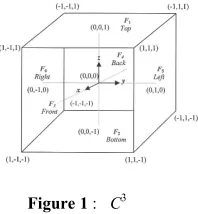
Before we prove that C3 is a topological space, we defined the cube C3 as follows. We denote C3as a surface
of the unit cube
[
−1,1 \]
3(
−1,1)
3 bounded by six square faces centered at the origin in three-dimension (Figure 1).
Figure 1 : C3
Next, we show that C3 is a topological space as follows. We define the open set V on C3 as V =θ∩C3 where θ is an open set in R3. Suppose
τ
C3 is a collection of all open sets of C3 .
First, we need to show that ∅∈
τ
C3 and C3∈
3
C
τ
. We know that ∅ is a subset of any set [9] and it is open[10]. Therefore ∅is an open set for C3. Thus, ∅∈
τ
C3. We also know that R3
is open and C3 is a subset of R3.
Thus R3∩ C3 = C3 is an open set for C3. Therefore, C3∈ 3
C
τ
.Next, we show that i C3 i I
V τ
∈
∈
U
where Vi = θi∩ C3, θi is an open set in R3. Notice thati i I
V
∈
U
= V1∪V2∪V3∪V4∪ ∪... Vi−1∪ ∪Vi ...= (θ1∩ C
3
)
∪
(θ2∩C3
)
∪
(θ3∩C3
)
∪
(θ4∩C3 )
∪
…∪
(θi-1∩C3)∪
(θi∩C3)∪
…= [(θ1
∪
θ2∪
θ3∪
θ4∪
…∪
θi-1∪
θi∪
…)] ∩C3
= 3
i i I
C
θ
∈
∩
U
.Since i i I
θ
∈
U
is open in R3, thus i i IV
∈
U
= i 3i I
C
θ
∈
∩
U
is open in C 3. Therefore, i 3 C i I
V τ
∈
∈
U
.Lastly, we show that 3 n
i C
i I
V τ
=
∈
I
. Notice thatn
i i I
V
=
I
= V1∩V2∩V3∩V4∩… ∩Vn-1∩Vn= (θ1∩C
3
) ∩ (θ2∩C
3
) ∩ (θ3∩C
3
) ∩ (θ4∩C
3 ) ∩… ∩ (θn-1∩C3) ∩ (θn∩C3)
= [(θ1∩θ2∩θ3∩θ4∩…∩θn-1∩θn)] ∩C
3
= 3 1
n
i i
C
θ
=
∩
Since 1
n
i i
θ
=
I
is open in R 3, thus
n
i i I
V
=
I
= 31
n
i i
C
θ
=
∩
I
is open in C 3. Therefore, 3 n
i C
i I
V τ
=
∈
I
. Hence,τ
C3 is indeeda topology on C3 and thus (C3, 3
C
τ
) is a topological space.In the next section, the construction of mapping between unit sphere, S2 to unit cube, C3 will be given.
3. Mapping from S2toC3
In this section, we define the mapping from S2 to C3 as follows:
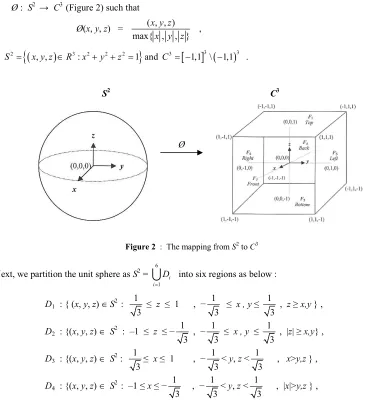
Ø : S2 → C3 (Figure 2) such that
Ø(x, y, z) = ( , , ) max{ , , }
x y z
x y z , (1)
where 2
{
(
)
3 2 2 2}
, , : 1
S = x y z ∈R x +y +z = and 3
[
]
3(
)
3 1,1 \ 1,1C = − − . (2)
S2 C3
Figure 2 : The mapping from S2 to C3
Next, we partition the unit sphere as S2 = 6
1
i i
D
=
U
into six regions as below :D1 :{ (x, y, z) ∈S2 : 1
3 ≤ z ≤ 1 , − 1
3 ≤ x , y ≤ 1
3 , z ≥ x,y } ,
D2 : {(x, y, z) ∈ S2 : –1 ≤ z ≤ − 1
3 , − 1
3 ≤ x , y ≤ 1
3 , |z| ≥ x,y} ,
D3 : {(x, y, z) ∈ S 2
: 1
3≤ x ≤ 1 , − 1
3< y, z < 1
3 , x>y,z } ,
D4 :{(x, y, z) ∈ S 2
: –1 ≤ x ≤ − 1 3 , −
1
3< y, z < 1
D5 :{(x, y, z) ∈S 2
: 1
3≤ y ≤ 1 , − 1
3≤ x ≤ 1
3 , − 1
3 < z < 1
3 , y≥ x, y>z} ,
D6 : {(x, y, z)∈S 2
: –1 ≤ y ≤ − 1 3, −
1 3≤ x ≤
1 3,−
1 3< z <
1
3, |y|≥ x, |y|>z}.
On the other hand, we partition the unit cube as C3 =
6
1
i i
F
=
U
(Figure 1) whereF1 : { (x, y, z) ∈ C 3
: z = 1 , 1− ≤x y, ≤1 } ,
F2 : { (x, y, z) ∈ C3 : z = –1 , 1− ≤x y, ≤1 } ,
F3 : { (x, y, z) ∈ C 3
: x = 1 , 1− <y z, <1 } ,
F4 : { (x, y, z) ∈ C 3
: x = –1 , 1− <y z, <1 } ,
F5 : { (x, y, z) ∈ C 3
: y = 1 , − ≤ ≤1 x 1 , − < <1 z 1 } ,
F6 : { (x, y, z) ∈ C 3
: y = –1 , − ≤ ≤1 x 1 , − < <1 z 1 } .
So, the mapping can be redefined as :
Ø : 6
1
i i
D
=
U
= S2 → 61
i i
F
=
U
= C3 .Then, we build the following lemmas in order to prove that S2 is homeomorphic to C3.
Lemma 3.1 If x, y ∈ [–a,a] and z∈ [a,1] for 0 ≤ a ≤ 1
3, then max{|x|, |y|, |z|}= z . Proof :
Consider S = { (x, y, z) : x, y∈ [–a,a] and z∈ [a,1] for 0 ≤ a ≤ 1 3 } . Therefore max{|x|} = max{|y|} = a and min{|z|} = a .
Observed that,
max{|x|, |y|, |z|} ≥ max{|x|} = a and max{|x|, |y|, |z|} ≥ max{|y|} = a .
But then,
max{|x|, |y|, |z|} ≥ max{|z|} ≥ min {|z|} = a = max{|x|} = max{|y|} .
Then, if (xo, yo, zo) ∈S, max{|xo|, |yo|, |zo|} = zo since zo > 0 , so |zo| ≥ min{|z|},
∀
z∈ [a,1].Lemma 3.2 If
D1 : { (x, y, z) ∈ S 2
: 1
3 ≤ z ≤ 1 , − 1
3 ≤ x , y ≤ 1
3, z ≥ x,y } , F1 : { (x, y, z) ∈ C3 : z = 1 , –1 ≤ x , y ≤ 1 } and there exists a mapping
Ø : D1 → F1
∋
Ø(x, y, z) =( , , ) max{ , , }
x y z
Proof :
We will prove that Ø(D1) = F1by showing that Ø(D1) ⊆ F1 and F1 ⊆ Ø(D1), where Ø(x, y, z) = (x’, y’, z’) ∈F1
for (x, y, z)
∈
D1 .(i) Ø(D1) ⊆ F1
We choose a∈Ø(D1), therefore a =
( , , ) max{ , , }
x y z
x y z for some (x, y, z) ∈D1 .
By Lemma 3.1, we have max{|x|, |y|, |z|} = z .
Therefore a = ( , , )x y z
z = , ,1 x y z z
, z≠0. Then, we need to show
1 x y, 1 z z
− ≤ ≤ .
But,
1 1
3 3
1 1
3
x z −
≤ ≤
⇒
1 1 3x z
− ≤ ≤ .
Similarly,
1 1
3 3
1 1
3
y z −
≤ ≤
⇒
1 1 3y z
− ≤ ≤ .
Thus a∈F1.
(ii) F1⊆ Ø(D1)
We choose b∈F1 . Therefore b = (x’, y’, 1)
∋
x’∈ [–1,1] and y’∈ [–1,1] .We need to show that b ∈Ø(D1) .
But then (x’, y’, 1) = ( ' , ' , )x z y z z
z for 1
1
3≤ ≤z , z≠0 and
1 1
' , ' 3 x z y z 3
− ≤ ≤
= ( ' , ' , ) max{ ' , ' , }
x z y z z x z y z z
= ( , , ) max{ , , }
x y z
x y z where x=x z' , y=y z'
= Ø(x, y, z) for 1 1 3≤ ≤z and
1 1
,
3 x y 3
− ≤ ≤
= Ø(D1) . Thus, b ∈Ø(D1) .
Since Ø(D1) ⊆ F1 and F1 ⊆ Ø(D1), clearly Ø(D1) = F1 .
Lemma 3.3 If x, y ∈ [–a,a] and z∈ [–1,–a] for 0 ≤ a ≤ 1
3, then max{|x|,|y|,|z|}=|z|.
Lemma 3.4 If
D2 : { (x, y, z) ∈ S2 : –1 ≤ z ≤ – 1
3 , – 1
3≤ x , y ≤ 1
3, |z| ≥ x,y } , F2 : { (x, y, z) ∈ C
3
: z = –1 , –1 ≤ x , y ≤ 1 } and there exists a mapping
Ø : D2 → F2
∋
Ø(x, y, z) =( , , ) max{ , , }
x y z
x y z , then Ø is onto.
Lemma 3.5 If y, z∈(–a,a) and x∈[a,1] for 0 ≤ a ≤
3
1
, then max{|x|,|y|,|z|}= x.
Lemma 3.6 If
D3 : { (x, y, z) ∈ S 2
: 1
3≤ x ≤ 1 , − 1
3< y, z < 1
3, x>y,z } , F3 : { (x, y, z) ∈ C
3
: x = 1 , –1 < y, z < 1 } and there exists a mapping
Ø : D3 → F3
∋
Ø(x, y, z) =( , , ) max{ , , }
x y z
x y z , then Ø is onto.
Lemma 3.7 If y, z∈(–a,a) and x∈[–1,–a] for 0 ≤a≤ 1
3, then max{|x|,|y|,|z|}= |x|.
Lemma 3.8 If
D4 : { (x, y, z) ∈ S2 : –1 ≤ x ≤ − 1
3, − 1
3< y, z < 1
3, |x|>y,z } , F4 : { (x, y, z) ∈ C
3
: x = –1 , –1 < y, z < 1 } and there exists a mapping
Ø : D4 → F4
∋
Ø(x, y, z) =( , , ) max{ , , }
x y z
x y z , then Ø is onto.
Lemma 3.9 If x∈[–a,a], z∈(–a,a) and y∈[a,1] for 0 ≤ a ≤ 1
3, then max{|x|,|y|,|z|}= y.
Lemma 3.10 Let
D5 : { (x, y, z) ∈S 2
: 1
3≤ y ≤ 1 , − 1
3 ≤ x ≤ 1
3, − 1
3 < z < 1
3, y≥x, y>z } , F5 : { (x, y, z) ∈ C3 : y = 1 , –1≤ x ≤ 1 , –1 < z < 1 } and there exists a mapping
Ø : D5 → F5
∋
Ø(x, y, z) =( , , ) max{ , , }
x y z
x y z , then Ø is onto.
Lemma 3.11 If x∈[–a,a], z∈(–a,a) and y∈[–1,–a] for 0 ≤ a ≤ 1
Lemma 3.12 If
D6 : { (x, y, z) ∈S 2
: –1 ≤ y ≤ − 1 3,−
1
3 ≤ x ≤ 1
3, − 1
3 < z < 1
3, y≥x, |y|>z } , F6 : { (x, y, z) ∈ C3 : y = –1 , –1≤ x ≤ 1 , –1 < z < 1 } and there exists a mapping
Ø : D6 → F6
∋
Ø(x, y, z) =( , , ) max{ , , }
x y z
x y z , then Ø is onto.
In this section, we have shown that Ø is a function from 6
1
i i
D
=
U
= S2 to 61
i i
F
=
U
= C3 and we are now ready toshow the homeomorphism between them in the following section.
4. Homeomorphism between S2 and C3
In this section, we will prove the equivalent structure of the sphere and cube (i.e. homeomorphism). In other words, S2
≅
C3. Before that, we present some general definitions and theorems which will be used along with the construction of this homeomorphism.Theorem 4.1 [11] If F = (f1, f2, …, fm) is a mapping from Rn to Rm , then
F*(Uj(p)) =
( )
(
( )
)
1m i
i
i j
f
p U F p x
=
∂ ∂
∑
, for 1 ≤ j ≤ n .Jacobian matrix of F at p is
( )
i
j
f p x
∂ ∂
, for 1 ≤ i ≤ m , 1 ≤ j ≤ n .
Theorem 4.2 [9] A map f : X →Y from topological space X to a topological space Y is continuous if and only if the inverse image f-1(U) of each open subset V of Y is open in X.
Definition 4.3 [9] A map f : X →Y between topological space is open if the image f(U) of each open subset U of X is open in Y and closed if the image f(E) of each closed subset E of X is closed in Y.
Definition 4.4 [12] A function f : X →Y between topological space is called a homeomorphism if f : X →Y is one-to-one and onto and both f and f-1 are continuous. The notation X
≅
Y means that X is homeomorphic to Y.Theorem 4.5 S2 is homeomorphic to C3
Proof :
Firstly, we define Ø : S2 → C3
∋
Ø(x, y, z) = ( , , ) max{ , , }x y z
x y z with
(
)
{
}
2 3 2 2 2
, , : 1
S = x y z ∈R x +y +z = and 3
[
]
3(
)
3 1,1 \ 1,1Assume
(
x y z1, 1, 1)
=(
x y z2, 2, 2)
. Therefore1 1 1
1 1 1
( , , ) max{ , , }
x y z
x y z =
2 2 2
2 2 2
( , , ) max{ , , }
x y z
x y z which implies
Ø
(
x y z1, 1, 1)
= Ø(
x y z2, 2, 2)
. Thus, Ø is a function from a topological space S2
to a topological space C3. In the
following proving, we will consider the function as Ø : 6 1 i i D =
U
= S2 → 6 1 i i F =U
= C3 .Next, we will show Ø is bijective. Pick a∈C3. Therefore
∃
(x, y, z) ∈S2∋
a = ( , , ) max{ , , }x y z x y z = Ø(x, y, z). Thus Ø is onto.
Now, we will use the same proving technique that had been done by Tahir [8], [13 ] to show that Ø is one to one. Let Ø = Ø* and
Ø(x, y, z) = ( , , ) max{ , , }
x y z x y z =
( , , )x y z
p = , , x y z p p p
= *, *, *
* * *
x y z
p p p
=
( *, *, *) * x y z
p =
( *, *, *) max{ * , * , *}
x y z
x y z = Ø(x*, y*, z*)
where p, p* ≠ 0 for (x, y, z), (x*, y*,z*)∈S 2
with corresponding p and p*. Since Ø(x, y, z) = Ø(x*, y*,z*), so Jacobian matrix Ø on (x, y, z) = Jacobian matrix Ø on (x*, y*,z*). Using Theorem 4.1, we get
x x x
x p y p z p
y y y
x p y p z p
z z z
x p y p z p
∂ ∂ ∂ ∂ ∂ ∂ ∂ ∂ ∂ ∂ ∂ ∂ ∂ ∂ ∂ ∂ ∂ ∂ = * * * * * * * * * * * * * * * * * * * * * * * * * * *
x x x
x p y p z p
y y y
x p y p z p
z z z
x p y p z p
∂ ∂ ∂ ∂ ∂ ∂ ∂ ∂ ∂ ∂ ∂ ∂ ∂ ∂ ∂ ∂ ∂ ∂
⇒
1 0 0 1 0 0 1 0 0 p p p = 1 0 0 * 1 0 0 * 1 0 0 * p p p (3)From (3), we have
1 1
*
* p p
p=p ⇒ = .
From the components of Jacobian matrix above, we can conclude that
1 1
*
* p p
p= p ⇒ = .
This implies x x*
p= p
⇒
x = x* ,*
y y
p= p
⇒
y = y* and*
z z
Thus, Ø is one-to-one. Since Ø is onto and one-to-one, therefore Ø is a bijection.
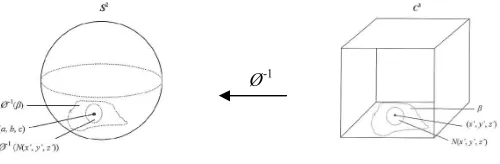
Next, we will show that Ø is continuous by using Theorem 4.2. According to this theorem, we need to show that Ø-1(β) is open in S2 for every open set β in C3. Pick (a, b, c) ∈ Ø-1(β) where β is an open set in C3. Consider
Ø-1(β) = { Ø-1(x’, y’, z’) : (x’, y’, z’) ∈β } .
Since Ø-1(β) is a bijection, there exists unique (x’, y’, z’) ∈ β such that Ø-1(x’, y’, z’) = (a, b, c). Since β is open, then N(x’, y’, z’)
⊂
β exists.Consider
Ø-1(N(x’, y’, z’)) = { Ø-1(x’*, y’*, z’*) : (x’*, y’*, z’*) ∈N(x’, y’, z’) }.
Clearly (a, b, c) = Ø-1(x’, y’, z’) ∈Ø-1(N(x’, y’, z’)). Then, pick any p
∈
Ø-1(N(x’, y’, z’). Since Ø-1 is a bijection, there exists unique (x’*, y’*, z’*) ∈N(x’, y’, z’) such that Ø-1(x’*, y’*, z’*) = p. Since N(x’, y’, z’)⊂
β, so (x’*, y’*, z’*)∈β. Thus, p = Ø-1(x’*, y’*, z’*) ∈ Ø-1(β) and this implies Ø-1(N(x’, y’, z’)⊂
Ø-1(β).Notice that
(a, b, c) ∈ Ø-1(N(x’, y’, z’)
⊂
Ø-1(β). Since (a, b, c)∈
Ø-1
(β) is arbitrary, therefore we can conclude that
(a, b, c) ∈ Ø-1(N(x’, y’, z’)
⊂
Ø-1(β) for every (a, b, c)∈Ø-1(β) for some corresponding (x’, y’, z’)∈β. Hence, Ø-1(β) is open. Since β is arbitrary, therefore we can conclude that Ø-1(β) is open in S2 for every open set β in C3. Thus, by Theorem 4.2, Ø is continuous (Figure 3).
Figure 3 : Ø is continuous
To show Ø-1 is continuous is equivalent as showing Ø is an open map. In order to prove that Ø is an open map, by using Definition 4.3 we need to show that Ø(A) is open in C3 for every open set A in S2. Pick
(a, b, c) ∈ Ø(A) such that A is an open set in S2. Consider
Ø(A) = { Ø(x, y, z) : (x, y, z)
∈
A } .Since Ø is a bijection, there exists unique (x, y, z)∈A such that Ø(x, y, z) = (a, b, c). Since A is open, then N(x, y, z)
⊂
A exists.Consider
Ø(N(x, y, z)) = { Ø(x’, y’, z’) : (x’, y’, z’) ∈N(x, y, z) }.
Clearly (a, b, c) = Ø(x, y, z) ∈Ø(N(x, y, z)). Then, pick any p
∈
Ø(N(x, y, z)). Since Ø is a bijection, there exists unique (x’, y’, z’) ∈N(x, y, z) such that Ø(x’, y’, z’) = p. Since N(x, y, z)⊂
A ,so (x’, y’, z’) ∈A. Thus,p = Ø(x’, y’, z’) ∈ Ø(A) and this implies Ø(N(x, y, z))
⊂
Ø(A) . Notice that(a, b, c) ∈Ø(N(x, y, z))
⊂
Ø(A).Since (a, b, c) ∈Ø(A) is arbitrary, therefore we can conclude that (a, b, c) ∈Ø(N(x, y, z))
⊂
Ø(A) for every (a, b, c) ∈Ø(A) for some corresponding (x, y, z) ∈A . Hence, Ø(A) is open. Since A is arbitrary, therefore we conclude that Ø(A) is open in C3 for every open set A in S2 . By using Definition 4.3, Ø is open. Therefore, Ø-1 is continuous.Finally, since Ø : S2 → C3
∋
Ø(x, y, z) = ( , , ) max{ , , }x y z
x y z with
{
(
)
}
2 3 2 2 2
, , : 1
S = x y z ∈R x +y +z = and
[
]
3(
)
33
1,1 \ 1,1
C = − − is onto, one-to-one, continuous as well as Ø-1 is continuous, Ø is a homeomorphism by
using definition 4.4. Since homeomorphism of S2 and C3 exists, S2 is homeomorphic to C3 and we write S2
≅
C3 (Figure 4).
Figure 4 : Homeomorphism of S2 and C3
5. Conclusion
In this paper, we have shown the construction of the homeomorphism between the unit sphere and the unit cube where they have an equivalent structure. It also preserves properties that spaces have. Results obtained from this research are very important in image processing and particularly Electroencephalography (EEG) signal for human brain.
6. Acknowledgement
The research is supported by Scientific Advancement Grant Allocation (SAGA) Vot No :73703. Amidora is sponsored by Universiti Teknologi Malaysia for her doctoral work. We would like also to thank the members of Fuzzy Research Group (FRG), Departments of Mathematics and Ibnu Sina Institute for Fundamental Science Studies for their assistance and cooperation.
7. References
[1] K.Lewin, Principles of Topological Psychology, McGraw-Hill Book Company Inc, New York, 1936. [2] A.W. Schurle, Topics in Topology, Elsevier North Holland Inc, New York, 1979.
[3] J.M. Lee, Introduction to Topological Manifolds, Springer-Verlag, New York, 2000. [4] N.P. Strickland, Lecture notes : Algebraic Topology, University of Sheffield, UK, 2007.
[5] E.Kasner and J.R. Newman, Mathematics and Imagination, Courier Dover Publications, New York, 2001. [6] C.Kosniowski, The Mathematical Gazette, 62(422) (1978) 233-245.
[7] W.P. Thurston, Three-Dimensional Geometry and Topology, Princeton University Press, USA, 1997. [8] Tahir Ahmad, The Riemann Surface: S2, Master Thesis, California State University,1989.
[9] M.Eisenberg, Topology, Holt, Rinehart and Winston Inc, New York, 1974. [10] I. Abdullah, Analisis Nyata, Dewan Bahasa dan Pustaka, Kuala Lumpur, 1995. [11] B.Oneill, Elementary Differential Geometry, Academic Press, London, 1966. [12] G.E. Bredon, Topology and Geometry, Springer-Verlag, New York, 1993. [13] Tahir Ahmad, Matematika, 9(1) (1993) 9-17.