ENHANCING PERFORMANCE AND EXPRESSIBILITY OF COMPLEX EVENT PROCESSING USING BINARY
TREE-BASED DIRECTED GRAPH
BABAK BEHRAVESH
EVENT PROCESSING USING BINARY TREE-BASED DIRECTED GRAPH
BABAK BEHRAVESH
A thesis submitted in fulfilment of the requirements for the award of the degree of
Doctor of Philosophy (Computer Science)
Faculty of Computing Universiti Teknologi Malaysia
To my wife, Khatereh Abron, for her support and kindness.
To my dears, mother Narges, brother Behzad, and late father andbrothers. To my kind supervisors, Professor Dr. Siti Mariyam Hj. Shamsuddin
and Dr.Alex Sim Tze Hiang.
In preparing this thesis, I was in contact with many researchers and academicians who have contributed towards my understanding and thoughts. In particular, I would like to thank to my internal supervisors, Professor Dr. Siti Mariyam Hj. Shamsuddin and Dr. Alex Sim Tze Hiang for their encouragement, guidance, critics and financial support. I would like to thank UTM Big Data Centre and Soft Computing Research Group (SCRG) for the inspiration in making this study a success, Prof.Samuel Madden and Dr.Yuan Mei from Massachusetts Institute of Technology for providing good comments on this work to carry out the experiments. Moreover, I would like to thank the authority of Universiti Teknologi Malaysia (UTM) for providing me with a good environment and facilities which I needed during the process.I would also like to thank the developers of the utmthesis LATEX project for making the thesis writing process easier for me, so I could focus on the content of the thesis, and not waste time with formatting issues. This work was partially supported by the Flagship project (RG QJ 130000.2428.02G38) and Applied Soft Computing- Big Data Research Centre.
ABSTRACT
ABSTRAK
TABLE OF CONTENTS
CHAPTER TITLE PAGE
DECLARATION ii
DEDICATION iii
ACKNOWLEDGEMENTS iv
ABSTRACT v
ABSTRAK vi
TABLE OF CONTENTS vii
LIST OF TABLES xii
LIST OF FIGURES xiii
LIST OF ABBREVIATIONS xv
LIST OF SYMBOLS xvi
1 INTRODUCTION 1
1.1 An Overview on Complex Event Processing
Systems 1
1.2 Problem Background 4
1.3 Problem Statement 9
1.4 Aim of the Reasearch 10
1.5 Objectives of the Research 13
1.6 Scope of the Study 14
1.7 Significance of Study 16
1.8 Organization of the Thesis 16
2 LITERATURE REVIEW 18
2.2 Event 20
2.2.1 Event Types 20
2.2.2 Features of Event 21
2.2.3 Event Sources 21
2.3 Continuous Queries 22
2.3.1 PATTERN Section 24
2.3.2 WHERE Clause 25
2.3.3 Time-Window 26
2.3.4 Aggregation 26
2.3.5 Strategies 27
2.4 Information Flow Processing 27
2.4.1 Publication/ Subscription Systems 29
2.4.2 Data Stream Management Systems 30
2.4.3 Complex Event Processing Systems 32
2.5 Data Cleansing Component 33
2.6 Inference component 33
2.7 Prediction Component 34
2.8 Event Matching Component 34
2.8.1 Methods and Models in Event-Matching 35
2.8.2 Join Operators 41
2.8.2.1 Sequence Operator in ZSTREAM 46 2.8.2.2 Negation Operator in ZSTREAM 52
2.8.2.3 Conjunction Operator 53
2.8.2.4 Disjunction in ZSTREAM 54
2.8.2.5 Kleene Operator in ZSTREAM 54
2.8.3 Plan Adaptation 56
2.9 Performance and Experssibility Measures 58
2.10 Datasets in Research Work 65
2.11 Discussion and Summary 66
3 RESEARCH METHODOLOGY 65
3.1 Introduction 68
3.2 Overview of the Event Machting Units in the
3.3 Defining a Continuous Query Language 76 3.4. Event Matching in the Proposed System 77
3.4.1 Creating a BTDG based on User-defined Query 77
3.4.2 Event Matching in the Proposed System 79 3.4.3 Plan Adaptation in the Proposed System 81 3.4 Transformation of a Query into a Binary
Tree-based Directed Graph 81
3.5 Non-kleene Operators 82
3.5.1 Sequence Operator 83
3.5.2 Negation Operator 83
3.5.3 Conjunction Operator 84
3.5.4 Disjunction Operator 84
3.6 Kleene Operators 85
3.6.1 Kleene Star Operator 85
3.6.2 Kleene Plus Operator 86
3.6.3 Kleene Num Operator 86
3.7 Reconstruction of Matching Plan with Respect to
Input Changes 87
3.8 Implementation 87
3.9 Datasets 90
3.10 Evaluation Metrics 93
3.11 Summary 95
4 NON-KLEENE JOIN OPERATORS ON
BINARYTREE-BASED DIRECTED GRAPH 93
4.1 Introduction 96
4.2 Language Specification 97
4.3 Transformation of a Query into a Binary
Tree-based Directed Graph 98
4.4 Sequence 101
4.5 Enhancement on Join Operators 108
4.6 Negation 113
4.7 Conjunction 117
4.8 Disjunction 124
4.9 Summary 129
5 HIGH PERFORMANCE AND EXPRESSIBLE
KLEENE OPERATOR 127
5.1 Introduction 130
5.1.1 Kleene operator in FAEM 131
5.1.2 Kleene Star and Plus 132
5.1.3 Kleene on Concurrent Join 137
5.1.4 Kleene Num 138
5.1.5 Combination Algorithm 141
5.2 Expressibility 144
5.2.1 Kleene operator in ZSTREAM 145
5.2.2 Kleene operator in SASE+ 146
5.2.1 Kleene Operator in FAEM 148
5.3 Performance 148
5.3.1 Order of Joins 149
5.3.2 Population of Events in Kleene 152
5.3.3 Selectivity of Events 154
5.3.4 Size of Time Window on Throughput and
Memory Consumption 155
5.3.5 Position of Kleene on Throughput and
Allocated Memory 157
5.4 Summary 158
6 FAST OPTIMAL PLAN ALGORITHM 156
6.1 Introduction 159
6.2 Plan Adaptation in FAEM 160
6.2.1 Limitations on Plan Adaptation 161 6.2.2 Fast Optimal Plan Algorithm (FOPA) to
Generate Tree-based Directed Graph 165
6.4 Changes on Rates of Events 176 6.5 The Associativity vs. Non-associativity 178
6.5.1 The Relationship between Associative
Operators 178
6.5.2 The Relationship between
Non-associative Operators 179
6.5.3 The Relationship between Associative and
Non-associative Operators 180
6.5.4 Applying Associativity in FAEM 181
6.6 Summary 182
7 CONCLUSIONS AND FUTURE WORK 180
7.1 Introduction 183
7.1.1 Research Summary 183
7.2 Research Contribution 189
7.3 Future Work 191
LIST OF TABLES
TABLE NO. TITLE PAGE
2.1 Two sample continuous queries 23
2.2 A brief review on characteristics of DBS and DSMS 30 2.3 Event matching models in information flow processing systems 36
2.4 Join operators in CEP 44
2.5 Plan adaptation in CEP systems 57
2.6 Performane in CEP systems 59
2.7 Expressibility in CEP systems 60
3.1 Event population in 1 million records in Yahoo! music dataset 90 3.2 List of queries and their descriptions that are used in this
research 91
4.1 Efficiency of Single vs. Batch method on removing out-of-range events with various event distribution 110 4.2 Applying two different sort methods on buffers for batch
removal vs. event removal on non-sorted buffers 111
4.3 Latency of ZSTREAM and FAEM 112
6.1 Consistancy in number of full match cases and diversity in number of comparisons on sequence operator 163 6.2 Inequality in number of composite events in right and left plans
onconjunction operator 164
6.3 Inconsistancy in number of composite events in right and left
LIST OF FIGURES
FIGURE NO. TITLE PAGE
1.1 A simplified event processing system 3
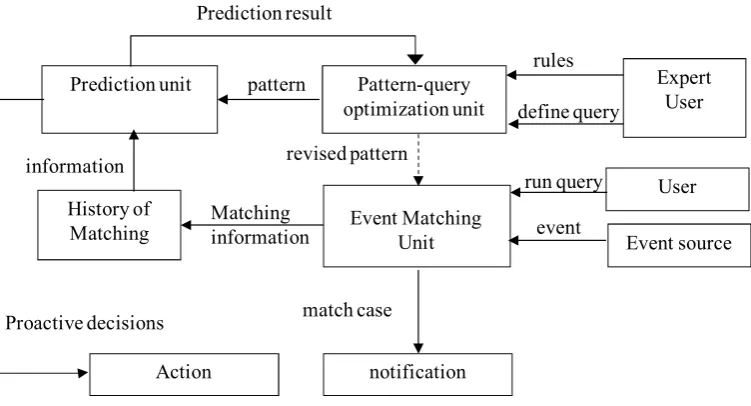
1.2 The proposed framework for event processing system 11
1.3 The flowchart of the proposed system 12
2.1 Categorization of components with focusing on objectives 28
2.2 FSM Model for Query 2 38
2.3 Tree model for Query 2 39
2.4 Delay in performing event matching (continued) 51
2.5 Sequence oprator in ZSTREAM 52
2.6 ZSTREAM model, specifications and shortcomings 64
3.1 Research Framework 69
3.2 Phases of the proposed event matching framework 74
3.3 Event matching on the proposed BTDG structure 80
3.4 Implementation diagram 88
4.1 Transforming Query 1 into a BTDG 100
2.2 Sequence operator on Query 2 104
4.3 Plans on BTDG with length of four 105
4.4 Throughput (a) and memory consumption (b) on t147073;
t56437; t189820; t531386 107
4.5 Negation operator on Query 2 116
4.6 Throughput on t147073! t56437; t189820 117
4.7 Conjunction operator on Query 5 120
5.1 kleene Plus in FAEM when kleene is on right buffer 136
5.3 Kleene Num in FAEM 140
5.4 shortcoming of Kleene + and * in ZSTREAM 146
5.5 Shortcoming of SASE(Agrawal and Diao, 2008) in sharing
buffer 147
5.6 Throughput(a) and memory consumption(b) of kleene on
various plans 150
5.7 Population of events on throughput(a) and memory
consumption(b) for various queries 153
5.8 Throughput (a) and memory consumption (b) of various rates of selectivity betweenfirst two event classes of the query 155 5.9 Size of time-window on throughput(a) and memory
consumption(b) for various queries 156
5.10 Position of kleene on throughput(a) and allocated memory(b). 157 6.1 Incosistency in reordering joins on Right and Left plans 161
6.2 Plans to apply priority on joins 169
6.3 Throughput(a) and memory consumption(b) on various
selectivity 172
6.4 Number of composite events in size of 2 and 3 on various
places for selectivity 173
6.5 throughput on adaptivity of FAEM, ZSTREAM, and fixed
left-plan 177
LIST OF ABBREVIATIONS
BTDG - Binary Tree-based Directed Graph CEP - Complex Event Processing DFA - Deterministic Finite Automaton DSMS - Data Stream Management System FAEM - Fast Adaptive Event Matching FOPA - Fast Optimal Plan Algorithm FSM - Finite State Machine
NFA - Non-deterministic Finite Automaton Pub/ Sub - Publication/ Subscription
LIST OF SYMBOLS
& - Conjunction operator
| - Disjunction operator
end_ts - End timestamp
e - Event
! - Negation operator
; - Sequence operator
start_ts - Start timestamp
- Threshold in plan adaptation
INTRODUCTION
1.1 An Overview on Complex Event Processing Systems
event processing system to monitor and take timely actions (de Fabritiis et al., 2008, Dinget al., 2011, Sokhaet al., 2013); similar demands exists on detection suspicious event patterns in computer networks(Huang et al., 2007) and event clouds (Suntinger, 2008, Widder et al., 2007). In energy consumption, smart energy grids needs to efficiently manage energy consumption through semantic web using event processing systems (Ciuciu, 2012, Mauri, 2008, Simmhan and Kumbhare, 2011). In stock market timely notification on large number of fluctuations in stock price needs monitoring for proper reaction using event processing systems (Bülow et al., 2014, Mangkorntong and Rabhi, 2007, Rozsnyaiet al., 2007). Crisis management systems needs to monitor environmental changes in form of a wide range of events and discover their correlation in order to take proactive timely decisions (Cugola and Margara, 2012, Itria et al., 2014). In companies, manufacturing needs concurrent monitoring of several processes, and reaction can be taken adaptively. Internet banking systems need to monitor transactions and check the received requests with banks in a real-time manner to avoid fraud or money laundry utilizing event processing systems. Regarding the demand in different areas and the complexity of relationship between events, complex event processing (CEP) systems is considered as an important area of information systems(LeHong and Fenn, 2012).
systems and allowed defining simple patterns to trigger event condition action rules. Since placing event processing on top of traditional systems was not efficient due to the need for real-time process, developing a middleware between application layer and network layer to perform CEP task started in mid 80's by Tibco (Guide, 2010, Palmer, 2013). According to (Luckham, 2008) CEP from late 90's to 2005 was only applicable for simple situations, from 2004 to 2012 was creepy CEP era, and then from 2010 to 2025 it is going to become a ubiquitous technology in event driven world.
In a simplified CEP system, Figure1.1, user defines query and sends it to an event matching unit where events from various event sources are received to discover their matching over the given pattern. The pattern matching process is visualized and evaluated based on mainly two modeling systems. Finite state machine also known as FSM-based (Agrawal and Diao, 2008, Cugola and Margara, 2012, Demers et al., 2007) and tree-based (Mei and Madden, 2009) are two event matching models for event processing which are widely used.
Figure 1.1 A simplified event processing system
to find if they can support a query. A query language that can support a wider range of operations is considered more expressible than others.
1.2 Problem Background
of event matching in CEP systems and does not propose a standard language for continuous query.
In order to improve performance and memory allocation for the process, these systems (Mei and Madden, 2009, Wuet al., 2006) also wait for a final event to start event matching. This may later have a converse effect on the process when there are many events waiting for evaluation and the final event is received late. The problem can be even worse when the size of time window is defined rather extended, rate of selectivity is low and a long queue of events are waiting for event matching.The large, extended, time window covers more number of events that are subjected for evaluation. In addition, the process is performed like breadth first algorithm so, it needs much time to produce the final match cases. This strategy in some scenarios causes a large lag time. On the other hand, the strategy to wait for final event instance that are seen in (Agrawal and Diao, 2008, Mei and Madden, 2009) may not be efficient in proactive decision making, where the system needs to notify a potential threat or opportunity before arriving the final event.
In event processing, events have a life cycle based on time-window of a pattern query. Earliest allowed time of considering an event is calculated by subtraction of now, current time, from the length of time window. So, events with the time stamp less than earliest allowed time are discarded. Provided information in above, ZSTREAM(Mei and Madden, 2009) starts event matching as arriving a new instance of final event, say e_f. The problem arises when many event instances are stashed in the system while still waiting for e_f. As soon as arriving the e_f the process starts where many comparisons between events are required and events are composed if they meet conditions. These processes take time so that some events that were valid by the time of detecting e_f are now invalid. In this case ZSTREAM results some false negatives.
Aggregation is performed based on grouping events. The aggregation is performed based on Kleene operator. Kleene can be either (+, *, num), where + represents one or more instances, * zero or more instances, and num is for a certain number of event instances. In ZSTREAM (Mei and Madden, 2009), two simple event classes confine a kleene event class, by put it in the middle, to make limitation on it. Then grouping is applied on the middle when criteria from left and right is applied. After the process a composite event is generated. The problem arise when another event class is joint with the kleene ternary and invalidates one of the kleene event items in composite event. In this case, if condition is not satisfied the composite event is remove. This create false negatives for Kleene operation. This point is extensively described in chapter 2.
Similarly, in SASE+ grouping is applied based on grouping on kleene buffer, while the condition from previous events in are not taken into account. In addition, in(Agrawal and Diao, 2008) through sharing results which can reduce memory allocation and CPU time because it prevents repetitive event matching task for other event instances in the same computation state no matter the history of event. However, this point can be violated because criteria on data values of events may cause failure as the process continues. The anti-thesis on the issue is presented in chapter 2. Sharing results based on a single hierarchical is a good solution to reduce burden of event matching as addressed in(Stakhanovaet al., 2009), while in contrast to this study, their method did not address how to manage time-window, and how to use the structure for prediction of next possible event.
enhanced system can be employed for high performance event matching; then contribute to high performance distributed CEP systems.
One of the positive points of ZSTREAM that highlights this work from the other CEP systems is the ability of ZSTREAM to reorder the priority of applying join operators based on a cost model. Reordering of join operators based on cost of operators and population of events, help their system to adapt with the changes and be able to switch to an efficient order of applying join operators (also called plan adaptation). If the cost of event matching passes a certain threshold, ZSTREAM attempts to calcualte cost of alternative plans and switch to a plan with the minimal cost. The time complexity of plan adaptation algorithm in ZSTREAM is addressed as O(n3). Their algorithm creates a powerset of event classes with timecomplexity of O(n2) and then in each round the algorithm performs a linear search to find the pair of event classes with the minimal cost. They addressed the overall time complexity of their plan adaptation algorithm is O(n3).
The expressibility of the event matching determines the range of queries a query language supports. The limitations in defining queries is because of adjacency of join operators with different natures in a single query. For example, A in Sequence join with B and B is in a conjunction join with C. This research discovers the origin of this limit, and overcomes the issue by developing a new set of join operators. This research separates operators as Non-kleene algorithms that are binary operators while kleene operators are unary operators. Previous research work support binary operators without covering the expressibility of the queries, however, this research highlights the shortcoming of their system (Mei and Madden, 2009) in supporting both kleene and non-kleene operators on a query with respect to expressibility as well as performance. This research presents more than 10 queries that are not supported by previous studies due to the limitation in expressibility.
The evaluation of event matching mostly concentrated on enhancement in order to improve performance of pattern matching, and expressibility of the query language to cover a wide range of queries.
1.3 Problem Statement
Regarding the limitations of the previous studies on events processing that addressed in problem background, current study focuses on gaps related to performance measures including throughput, end-to-end latency and size of allocated memory through developing enhanced algorithms on a flexible and robust structure, and expressibility of join algorithms to support various queries.Regarding these two measures problem statement is presented as:
a) How to design a unified structure to overcome the performance and expressibility shortcomings of previous systems?
1.4 Aim of the Reasearch
The aim of the research is to develop a fast adaptive event matching system (FAEM) through developing a new model, adaptive reordering joins and enhancing join algorithms to improve performance and expressibility measures of event matching.
Figure 1.2 The proposed framework for event processing system
The process starts when the expert user defines a query and send it to the system to check its validity as it is shown in Figure 1.3. If the query is valid then system transforms the query into a set of system objects (event buffers and cursors) to form a logical tree-based structure. However, the arrangement of the buffers and pointers is decided based on a cost operaotors and population of events in each buffer. After the construction of event matching plan, events are received from event sources.The system checks the events against the condition of each leaf buffer; if an event is match to a buffer then the event is inserted into the buffer and follows the cursor to check its sibling buffer to evaluate. If a pair of event fulfill the criteria then they are assembled and make a composite event. The composite event is inserted into their parent buffer. Then the evaluation continues with the parent buffer and its sibling.
Pattern-query optimization unit
Event Matching Unit
User revised pattern
run query
match case
notification
Event source Expert
User
event rules Prediction unit pattern
Prediction result
define query
History of Matching information
Matching information
Proactive decisions
Figure 1.3 The flowchart of the proposed system
Finally, if a composite event reached to the root of the tree, the system generates a notification. However, the system does not stop to receive and evalute events while stream of events enter to the system. The system also check if the plan is optimal based on a cost model. Switching to a plan with a lower cost improves the performance according to (Mei and Madden, 2009). In this case system attempt to reconstruct the matching plan.
Transforming the query to set of system objects
Expert user defines a query
Calculating the cost of various arrangements of system objects
Arranging system object on a BTDG based on the minimal cost (creating optimal matching plan)
Checking the validity of the query
Receiving stream of events Is it a
valid query?
Event matching on the arranged system objects
notification yes
no
Match case found? no
yes Current
plan is optimal? no
yes
1.5 Objectives of the Research
The main goal of the proposed framework by this study is to develop an expressible high performance event matching system. Therefore, according to background and problem statement, three main objectives of this research can be expressed as follows:
a) To develop a binary tree-based directed graph (BTDG) as a basis to define join operators' algorithms and to event matching and To creates a unified binary tree-based directed graph to transform user-defined query into BTDG. In BTDG event buffers are linked by join operators and criteria are placed on their respective buffers in order to improve performance and expressibility measures.
To design enhanced non-kleene join operator algorithms including sequence, negation, conjunction, and disjunction that improves throughput and end-to-end latency of the proposed CEP system.
To develop batch removal of out-of-range of time window events that helps to reduce number of comparisons, memory consumption, and excessive shifting of events in buffers.
To implement a time-window policy (actual time-window) on join algorithms to reduce latency gap which can improve performance of event matching process. This can be achieved through applying directed graph and modifying the join operators' algorithms.
To construct a directed graph to reduce latency gap so that when a new event comes event matching starts which helps reducing latency gap.
To develop two algorithms to support kleene operators 1) when the left event class is a kleene and the right event class is a non-kleene, and 2) when the left event class is a non-kleene and the right event class is a kleene. These twin algorithms improves expressibility of kleene operator in dealing with non-kleene operators. In addition, reordering joins can be performed in a good degree of flexibility. To propose a new combination algorithm for kneene num which is applied on top of hierarchy. The algorithm uses results of previous rounds and can improve performance of event matching.
c) To develop a fast optimal plan adaptation algorithm (FOPA) to reconstruct BTDG. This algorithm dynamically constructs and switches to the plan with a minimal cost through reordering join operators.
To develop fast optimal plan algorithm to switch to a query plan with a minimal cost to improve throughput of event matching; The proposed method adapts with respect to the cost model regarding, 1) population of events and, 2) cost of join operators.
To discover for the first time a property in join operators which influences results of event matching, associativity. In addition, an algorithm is designed to avoid generating inaccurate composite events as a result of considering this property.
To design plan adaptation algorithm in a low time complexity as O(n2) which performs better than its counterparts.
1.6 Scope of the Study
a) The proposed system is tested on two data sets, Yahoo! music in KDD Cup 2011(Dror et al., 2012)as a real-world dataset with more than 1,000,000 tuples and a synthesized stock market dataset.
b) Join operator algorithms including sequence, negation, conjunction, disjunction and kleene (*, +, and num) operators. In addition, event matching strategies at various levels of relaxation in accepting or rejecting events are covered.
c) Expressibility of query languages and their underlying algorithms are investigated. The expressibility factors that are considered in this research are, 1) adjacency of different types of join operators in a query, and 2) weather a query can support various sizes of event classes in its pattern.
d) Performance factors are considered that may cause 1) CPU-related (throughput and end-to-end latency) and 2) memory-related (size of allocated-memory) effects.
e) Some of the efficient techniques that were used ZSTREAM (Mei and Madden, 2009), SASE+ (Agrawal and Diao, 2008) and T-Rex (Cugola and Margara, 2010) for inquery transformation are investigated extensively.
f) Plan adaptation in reordering join operators in CEP systems is included.
1.7 Significance of Study
Regarding the demand for employing a high performance event processing systems in a wide range of applications, it is useful to enhance event matching process. On the other hand, improving the expressibility of queries can help to define wide range of queries.
The solution proposed in this study is in very bottom line of CEP system where many applications can employ it. Some of these applications are, traffic estimation and prediction in floating cars, decision making in stock markets, reducing catastrophe in critical management, traffic management in communication network, and real-time healthcare services.
1.8 Organization of the Thesis
In this thesis a new CEP system is developed which concentrates on enhancing expressibility and performance. The rest of this dissertation is organized as follows.
Chapter 3 covers the methods that is applied on this research. The method stems from scrutinized investigation on the literature. The steps of this research works are presented in few diagrams followed by detailed descriptions which includes the model to develop event matching, the algorithms to develop non-kleene and kleene join operators and plan adaptation algorithm. This chapter finally describes datasets and evaluation methods which are used in this research.
Chapter 4 presents the proposed structure to manage process through transformation of user-defined queries into binary tree-based directed graph. This structure is used as a basis to perform event marching for all of the join operator including kleene and kleene operators. This chapter also covers developing non-kleene operators including four enhanced algorithms for sequence, negation, conjunction and disjunction as event operators (join operators). The enhancement focuses on management of event buffers and sliding time window. It is shown that the enhancement on each operator improves performance of event matching.
Chapter 5 covers three kleene operators including kleene plus, star and num. We first discover the some shortcomings of kleene operators in FSM-based and tree-based systems which have not been addressed previously. Then, the steps for developing the algorithms are presented for kleene plus, star, and num. These algorithms are matched with the requirements of the proposed BTDG that is presented chapter 4. In addition, for kleene num a new combination algorithm is developed that tries to reuse results of previous combinations so that it can helps to improve throughput while maintains the accuracy of the process.
Adi, A. and O. Etzion. (2004). Amit – the situation manager. VLDB Journal. 13: 177-203.
Aggarwal, C.C., J. Han, J. Wang, and P.S. Yu. (2004). A framework for projected clustering of high dimensional data streams. Proceedings of the Thirtieth international conference on Very large data bases. VLDB Endowment: 31 August-3 September. Toronto, Canada. 852-863.
Agrawal, J. and Y. Diao. (2008). Efficient pattern matching over event streams. In Proceedings of ACM SIGMOD international conference on Management of data. Vancouver, BC, Canada: ACM. 2008. 147-160.
Arasu, A., S. Babu, and J. Widom. (2006). The CQL Continuous Query Language : Semantic Foundations and Query Execution . VLDB Journal. 121-142.
Babcock, B., S. Babu, and M. Datar. (2002). Models and issues in data stream systems. In Proceedings of the twenty-first ACM SIGMOD-SIGACT-SIGART symposium on Principles of database systems. ACM. 1- 16.
Babu, S. and J. Widom. (2001). Continuous queries over data streams. ACM Sigmod Record.30: 109-120.
Bai, Y. (2007). Data stream processing and query optimization techniques.ProQuest. Barga, R. and H. Caituiro-Monge. (2006). Event correlation and pattern detection in
CEDR. Current Trends in Database Technology–EDBT.2006: 919-930.
Brenna, L., A. Demers, and J. Gehrke. (2007). Cayuga: a high-performance event processing engine. Proceedings of ACM SIGMOD international conference on Management of data.1100-1102.
Cao, K., R. Li, and F. Wang. (2013). The Research on CEP Based on Query Rewriting for CPS. Internationa journal of modelling and optimization. 3(10): 509-514.
Cao, Z., Y. Diao, and P. Shenoy. (2009). Architectural considerations for distributed RFID tracking and monitoring. In Proceedings of the 5th ACM Workshop on Networking Meets Databases (NetDB). ACM: 14 October, Montana,USA.
Carmona, J., J. Cortadella, and M. Kishinevsky. (2008). A region-based algorithm for discovering Petri nets from event logs. Business Process Management. 358-373.
Chakravarthy, S., E. Anwar, L. Maugis, and D. Mishra. (1994). Design of sentinel: An object-oriented DBMS with event-based rules. Information and Software Technology.36(9): 555-568.
Chakravarthy, S. and Q.C. Jiang. (2009). Stream data processing: a quality of service perspective: modeling, scheduling, load shedding, and complex event processing. Processing.
Chakravarthy, S., V. Krishnaprasad, E. Anwar, and S.K. Kim. (1994). Composite events for active databases: Semantics, contexts and detection. Proceedings of the International Conference on Very Large Data Bases: Santiago, Chile. 606-617. Chandrasekaran, S. and M.J. Franklin. (2003). PSoup: a system for streaming queries
over streaming data. The VLDB Journal The International Journal on Very Large Data Bases.12: 140-156.
Chen, J., D.J. DeWitt, F. Tian, and Y. Wang. (2000). NiagaraCQ: A scalable continuous query system for internet databases. ACM SIGMOD Record.29: 379-390.
Chhillar, R.S. and B. Kochar. (2009). A New Efficient Approach for Effective Warehousing of RFID Data: Readers Load Sentient Scheme. American Journal of Scientific Research.3: 85-95.
Ciuciu, I.G., Robert Meersman, haram Dillon. (2012). Social network of smart-metered homes and SMEs for grid-based renewable energy exchange. in International Conference on Digital Ecosystems Technologies (DEST). 1-6. IEEE Cugola, G. and A. Margara. (2010). TESLA: a formally defined event specification
Cugola, G. and A. Margara. (2012). Complex event processing with T-REX. The Journal of Systems & Software.85: 1709-1728.
Cugola, G. and A. Margara. (2012). Processing flows of information: From data stream to complex event processing. V: 1-70. ACM
Dayal, U., B. Blaustein, A. BUchmann, and U. Chakravarthy. (1988). The HiPAC Project: Combining Active Databases and Timing Constraints*. In ACM SIGMOD.51-70.
de Fabritiis, C., R. Ragona, and G. Valenti. (2008). Traffic Estimation And Prediction Based On Real Time Floating Car Data. International IEEE Conference on Intelligent Transportation Systems. Ieee: Beijing. 197-203.
Demers, A., J. Gehrke, B. Panda, M. Riedewald, V. Sharma, W.M. White, and Others. (2007). Cayuga: A general purpose event monitoring system. Third Biennial Conference on Innovative Data Systems Research. CIDR: 7-10 January. Asilomar, CA, USA. 412-422.
Diao, Y., N. Immerman, D.G. (2007). Sase+, and An. agile language for kleene closure over event streams. In UMass, Technical Report.7: 1-14.
Ding, J.-X., H.-J. Huang, and Q. Tian. (2011). A traffic flow cellular automaton model to considering drivers' learning and forgetting behaviour. Chinese Physics B.20. 2. 028901.
Dong, L., D. Wang, and H. Sheng. (2006). Design of RFID Middleware Based on Complex Event Processing. 2006 IEEE Conference on Cybernetics and Intelligent Systems.1-6.
Drogba, G., N. Koenigstein, Y. Koren, and M. Weimer. (2011). The Yahoo! Music Dataset and KDD-Cup'11. in KDD Cup. 8-18.
Dror, G., N. Koenigstein, Y. Koren, and M. Weimer. (2012). Pattern recognition on Yahoo! Music Dataset. Proceedings of KDD Cup 2011 competition. 3-18.
Esparza, J. (1998). Decidability and complexity of Petri net problems—an introduction. Lectures on Petri Nets I: Basic Models.374-428.
Etzion, O. and P. Niblett. (2010). Event Processing in Action. Processing XML Streams with Deterministic Automata. Manning Publication Co.
Fodor, P., D. Anicic, and S. Rudolph. (2011). Results on out-of-order event processing. Practical Aspects of Declarative Languages. 220-234. Springer: Berlin Heidelberg
Forgy, C.L. (1982). Rete : A Fast Algorithm for the Many Pattern/Many Object Pattern Match Problem*. Artificial intelligence..19: 17-37.
Fu, T.-c., F.-l. Chung, R. Luk, and C.-m. Ng. (2007). Stock time series pattern matching: Template-based vs . rule-based approaches. Engineering Applications of Artificial Intelligence.20: 347-364.
Fülöp, L., G. Tóth, R. Rácz, and J. Pánczél. (2010). Survey on complex event processing and predictive analytics. In Proceedings of the Fifth Balkan
Conference in Informatics. 26-31.
Gatziu, S., A. Geppert, and K.R. Dittrich. (1995). The SAMOS Active DBMS Prototype. In SIGMOD conference.480-481.
Guido, A.S. (2010). Tibco Business Events Extreme Application Architect's Guide. Tibco technical report.
Gyllstrom, D., and J. Agrawal. (2008). On supporting kleene closure over event streams. In International Conference in Data Engineering (ICDE).10- 24.
Gyllstrom, D., Y. Diao, E. Wu, P. Stahlberg, and G. Anderson. (2007). SASE : Complex Event Processing over Streams. The Third Biennial Conference on Innovative Data Systems Research (CIDR). ACM: Asilomar, California, USA. 407-411.
Hassan, M.M., B. Song, and E.-N. Huh. (2009). A dynamic and fast event matching algorithm for a content-based publish/subscribe information dissemination system in Sensor-Grid.The Journal of Supercomputing. 330-365.
Hirte, S., Andreas Seifert, Stephan Baumann, Daniel Klan, K-U. Sattler. (2012). Data3-a kinect interface for olap using complex event processing. In International Conference on Data Engineering (ICDE),. 1297-1300. IEEE
Hoßbach, B., Bernhard Seeger. (2013). Anomaly management using complex event processing: extending data base technology paper. In Proceedings of the 16th International Conference on Extending Database Technology. 149-154. ACM. Huang, W., W. Tang, and C.F. Beedgen. (2007). Storing log data efficiently while
Itria, M.L., A. Daidone, and A. Ceccarelli. (2014). A Complex Event Processing Approach for Crisis-Management Systems. In Distributed Event Based Systems (DEBS). ACM Press: New York. 238-249.
J. Xie, J.Y., Y. Chen. (2008). A sampling-based approach to information recovery. Internationa Conference in Data Engineering (ICDE). 476- 485.
Jegadish. N, and Gehani, N.H. (1991). Ode as an active database: Constraints and triggers. In VLDB.327-336.
Jean-Claude Mamou, L.S.. (2004). Real time data integration services for health care information data integration. US20050228808 A1.
Jerzak, Z. and C. Fetzer. (2007). Prefix forwarding for publish/subscribe. Proceedings of inaugural international conference on Distributed event-based systems - DEBS '07. ACM Press: New York, New York, USA. 238-249.
Jin, C., J. Carbonell, and P. Hayes. (2004). ARGUS: Rete+ DBMS= Efficient Continuous Profile Matching on Large-Volume Data Streams. Foundations of Intelligent Systems. 142-151. Springer: Berlin Heidelberg.
K. Gatziu, S.D. (1994). Events in an active object-oriented database.
Krishnaprasad, V., S. Chakravarthy, and S. Kim. (1994). Composite Events for Active Databases: Contexts and Detection Semantics, Contexts and Detection. Proceedings of the 20th VLDB Conference, Santiago, Chile: Santiago, Chile. 606-617.
Lee, W.B., B.C.F. Cheung, and S.K. Kwok. (2009). Digital Manufacturing and RFID-Based Automation. Springer Handbook of Automation.859-879.
LeHong, H. and J. Fenn. Key Trends to Watch in Gartner 2012 Emerging
Technologies Hype Cycle. from:
http://www.forbes.com/sites/gartnergroup/2012/09/18/key-trends-to-watch-in-gartner-2012-emerging-technologies-hype-cycle-2/#67c5d9207f7c. 2012
Lemans, S.J.J., D. Fahland, and W.M.P. van der Aalst. (2014). Discovering block-structured process models from event logs containing infrequent behaviour. In Business Process Management Workshops. 66-78. Springer International Publishing
Liu, J., Q. Wu, and W. Liu. (2009). Temporal Restriction Query Optimization for Event Stream Processing. Advances in Web and Network Technologies, and Information Management.25-35.
Luckham, D. (2008). A Short History of Complex Event Processing 1 Part 2 : the rise of CEP.Technical Report. 1-8.
Luckham, D.C. (2001). The Power of Events: An Introduction to Complex Event Processing in Distributed Enterprise Systems.Addison-Wesley Professional. Mangkorntong, P. and F.A. Rabhi. (2007). A Domain-Driven Approach For
Detecting Event Patterns in E-Markets: A Case Study in Financial Market Surveillance. Web Information Systems Engineering–WISE.147-158.
Mauri, G., Diana Moneta, Paolo Gramatica. (2008). Automation systems to support smart energy behaviour of small customers. In SmartGrids for Distribution, CIRED Seminar. pp: 1-4.
Mei, Y. and S. Madden. Zstream: a cost-based query processor for adaptively detecting composite events. (2009). Proceedings of the 35th SIGMOD international conference on Management of data2009. Rhode Island, USA. 193-206. ACM.
Mendes, M.R.N., P. Bizarro, and P. Marques. (2009). A Performance Study of Event Processing Systems. Performance Evaluation and Benchmarking. pp: 221-236. Springer: Berlin Heidelberg.
Motwani, R., J. Widom, A. Arasu, B. Babcock, S. Babu, M. Datar, G. Manku, C. Olston, J. Rosenstein, and R. Varma. (2003). Query processing, approximation, and resource management in a data stream management system. Proc. First Biennial Conf. on Innovative Data Systems Research (CIDR).1-12.
Muthusamy, V., H. Liu, and H.-a. Jacobsen. (2010). Predictive publish/subscribe matching. Proceedings of the Fourth ACM International Conference on Distributed Event-Based Systems. ACM: Cambridge, UK. 14-25.
Nielsen, S., C. Chambers, and J. Farr. Systems and methods for complex event processing of vehicle information and image information relating to a vehicle. (2013). US Patent.243547564.
Owens, T.J. Survey of event processing. (2007). Journal of Air Force Research. 8(2): 24-33.
Palmer, M. (2013). Big Data Streaming Analytics and the New Physics of Fast Data. Tibco. from: http://www.tibco.com/blog/2014/07/22/big-data-streaming-analytics-and-the-new-physics-of-fast-data/.
Park, H.K. and W.S. Lee. (2008). Multiple continuous queries evaluation over data streams. Proceedings of the 8th conference on Applied computer scince. World Scientific and Engineering Academy and Society (WSEAS). Venice, Italy. 346-350.
Peng, S., Z. Li, Q. Li, Q. Chen, H. Liu, Y. Nie, and W. Pan. (2010). Efficient Multiple Objects-Oriented Event Detection Over RFID Data Streams. Web-Age Information Management.97-102.
Pongthawornkamol, T., Klara Nahrstedt, Guijun Wang. (2010). Probabilistic QoS modeling for reliability/timeliness prediction in distributed content-based publish/subscribe systems over best-effort networks. In Proceedings of the 7th international conference on Autonomic computing, pp. 185- 194.ACM.
Qin, X. and W. Lee. (2005). Attack plan recognition and prediction using causal networks.In 20th Annual Conference in Computer Security Applications.Tucson, US. 370-379.
Rao, J., S. Doraiswamy, H. Thakkar, and L.S. Colby. (2006). A deferred cleansing method for RFID data analytics. Proceedings of the 32nd international conference on Very large data bases.175- 186.
Ré, C., J. Letchner, M. Balazinksa, and D. Suciu. (2008). Event queries on correlated probabilistic streams.In proceedings of ACM SIGMOD international conference on Management of data. Vancouver, BC, Canada. 715-728. ACM
Rizou, S., F. Durr, and K. Rothermel. (2011), Fulfilling end-to-end latency constraints in large-scale streaming environments. In 30th International conference on Performance Computing and Communications Conference (IPCCC) Orlando. 1-8.
Rosenblum, D.S. and A.L. Wolf. (1997). A design framework for Internet-scale event observation and notification. ACM SIGSOFT Software Engineering Notes.
Rozsnyai, S., R. Vecera, J. Schiefer, and A. Schatten. (2007). Event Cloud -Searching for Correlated Business Events. The 9th IEEE International Conference on E-Commerce Technology, E-Commerce, and E-Services. 409-420. Schmidt, K.U., R. Stuhmer, and L. Stojanovic. (2008). Blending Complex Event
Processing with the RETE Algorithm. in 1st International workshop on Complex Event Processing for the Future Internet colocated with the Future Internet Symposium FIS2008. 1-10. ACM
Schultz-Møller, N.P., M. Migliavacca, and P. Pietzuch. (2009). Distributed complex event processing with query rewriting. in Proceedings of the Third ACM International Conference on Distributed Event-Based Systems - DEBS '09. Nashville, TN, USA: ACM Press. 4-5.
Shen, Z. and S. Tirthapura. (2006). Faster Event Forwarding in a Content-Based Publish-Subscribe System through Lookup ReuseEvent. Fifth IEEE International Symposium on Network Computing and Applications (NCA'06). 77-84. IEEE Simmhan, Y. and A. Kumbhare. (2011). An analysis of security and privacy issues in
smart grid software architectures on clouds. IEEE International Conference in Cloud Computing (CLOUD), 2011 4- 9 July. 582- 589. IEEE
Sokha, Y., K. Jeong, J. Lee, and W. Joe. (2013). A Complex Event Processing System Approach to Real Time Road Traffic Event Detection. Journal of Convergence Information Technology(JCIT).8: 142-148.
Srivastava, U. and J. Widom. (2004). Flexible time management in data stream systems. in Proceedings of the twenty-third ACM SIGMOD-SIGACT-SIGART symposium on Principles of database systems - PODS '04. New York, New York, USA: ACM Press. 263- 273.
Stakhanova, N., A. Ghorbani, and W. Bird. (2009). Graph Structures for event matching. US Patent: US.
Stipkovic, S., Ralf Bruns, Jurgen Dunkel. (2013). Pervasive Computing by Mobile Complex Event Processing. IEEE 10th International Conference in e-Business Engineering (ICEBE). 318-323. IEEE.
Stojanovic, N., Yongchun Xu, Aleksandar Stojadinovic, Ljiljana Stojanovic. (2014). Using mobile-based complex event processing to realize collaborative remote person monitoring. In Proceedings of the 8th ACM International Conference on Distributed Event-Based Systems. Oslo, Norway: ACM. 225-235.
Stonebraker, M., U. Çetintemel, and S. Zdonik. (2005). The 8 requirements of real-time stream processing. ACM SIGMOD Record.34(4): 42-47.
Suntinger, M., Hannes Obweger, Josef Schiefer, E. Groller. (2008). The event tunnel: Interactive visualization of complex event streams for business process pattern analysis. In Visualization Symposium, IEEE Pacific. Kyoto, Japan. 111- 118. IEEE
Tatbul, N. and S. Zdonik. (2006). Window-aware load shedding for aggregation queries over data streams. Proceedings of the 32nd international conference on Very large data bases. VLDB Endowment: Seol, Korea. 799-810.
Tran, T., C. Sutton, R. Cocci, Y. Nie, Y. Diao, and P. Shenoy. Probabilistic inference over rfid streams in mobile environments. (2009). In ICDE '09: Proceedings of the 2009 IEEE International Conference on Data Engineering. Shanghai, China. 1096-1107. IEEE
Turchin, Y., A. Gal, and S. Wasserkrug. (2009). Tuning complex event processing rules using the prediction-correction paradigm.In Proceedings of the Third ACM International Conference on Distributed Event-Based Systems. Nashville, TN, USA: ACM. 10-11.
van der Aalst, W.M.P. and B.F. van Dongen. (2013). Discovering Petri Nets from Event Logs. In Transactions on Petri Nets and Other Models of Concurrency VII. 372-422.
Viglas, S.D. and J.F. Naughton. (2002). Rate-based query optimization for streaming information sources. Proceedings of the 2002 ACM SIGMOD international conference on Management of data - SIGMOD '02.37- 48.
Walzer, K., T. Breddin, and M. Groch. (2008). Relative temporal constraints in the Rete algorithm for complex event detection. In Proceedings of the second international conference on Distributed event-based systems - DEBS '08. Rome, Italy. 147-155. ACM Press.
Wang, D. and E. Rundensteiner. (2013). Active complex event processing: applications in real-time health care. Proceedings of the VLDB Endowment. 1545-1548.
Wang, F., C. Zhou, and Y. Nie, Managing and Mining Sensor Data. Boston, MA: Springer US.
Wang, Y.M., L. Qiu, D. Achlioptas, G. Das, P. Larson, and H.J. Wang. (2007). Subscription partitioning and routing in content-based publish/subscribe systems. 16th International Symposium on DiStributed Computing (DISC’02).
Widder, A., R. Ammon, P. Schaeffer, and C. Wolff. (2007). Identification of suspicious, unknown event patterns in an event cloud. Proceedings of the 2007 inaugural international conference on Distributed event-based systems. ACM. 164-170.
Wu, E., Y. Diao, and S. Rizvi. (2006). High-performance complex event processing over streams. Proceedings of the 2006 ACM SIGMOD international conference on Management of data. ACM: Chicago, USA. 407-418.