M E T H O D
Open Access
The importance of study design for detecting
differentially abundant features in
high-throughput experiments
Huaien Luo
1†, Juntao Li
1†, Burton Kuan Hui Chia
1, Paul Robson
2and Niranjan Nagarajan
1*Abstract
High-throughput assays, such as RNA-seq, to detect differential abundance are widely used. Variable performance across statistical tests, normalizations, and conditions leads to resource wastage and reduced sensitivity. EDDA represents a first, general design tool for RNA-seq, Nanostring, and metagenomic analysis, that rationally selects tests, predicts performance, and plans experiments to minimize resource wastage. Case studies highlight EDDA’s ability to model single-cell RNA-seq, suggesting ways to reduce sequencing costs up to five-fold and improving metagenomic biomarker detection through improved test selection. EDDA’s novel mode-based normalization for detecting differential abundance improves robustness by 10% to 20% and precision by up to 140%.
Background
The availability of high-throughput approaches to do counting experiments (for example, by using DNA se-quencing) has enabled scientists in diverse fields (espe-cially in Biology) to simultaneously study a large set of entities (for example, genes or species) and quantify their relative abundance. These estimates are then com-pared across replicates and experimental conditions to identify entities whose abundance is significantly altered. One of the most common scenarios for such experi-ments is in study of gene expression levels, where se-quencing (with protocols such as SAGE [1], PET [2], and RNA-Seq [3]) and probe-based approaches [4] can be used to obtain a digital estimate of transcript abun-dance in order to identify genes whose expression is al-tered across biological conditions (for example, cancer versus normal [5]). Other popular settings where such differential abundance analysis is performed include the study of DNA-binding proteins and histone modifica-tions (for example, using ChIP-Seq [6,7]), RNA-binding proteins (for example, using RIP-Seq [8] and CLIP-Seq [9]), and the profiling of microbial communities (using 16S rRNA amplicon [10] and shotgun sequencing [11]).
Due to its generality, a range of software tools have been developed to do differential abundance tests (DATs), often with specific applications in mind, including popular programs such as edgeR [12], DEseq [6], Cuffdiff [13,14], Metastats [11], baySeq [15], and NOISeq [16]. The di-gital nature of associated data has allowed for several model-based approaches including the use of exact tests (for example, Fisher’s Exact Test [11]), Poisson [17], and Negative-Binomial [6,12] models as well as Bayesian [15] and Non-parametric [16] methods. Recent comparative evaluations of DATs in a few different application settings (for example, for RNA-Seq [6,16,18-21] and Metage-nomics [11]) have further suggested that there is notable variability in their performance, though a consensus on the right DATs to be used remains elusive. In addition, it is not clear, which (if any) of the DATs are broadly applic-able across experimental settings despite the generality of the statistical models employed. The interaction between modeling assumptions of a DAT and the application setting, as defined by both experimental choices (for example, number of sequencing reads to produce for RNA-seq) as well as intrinsic experimental characteris-tics (for example, number of genes in the organism of interest), could be complex and not predictable a priori. Correspondingly, only in very recent work, have experi-mental design issues been discussed in a limited setting, that is, using a t-test for RNA-seq analysis [22]. Also, as * Correspondence:[email protected]
†Equal contributors
1
Computational and Systems Biology, Genome Institute of Singapore, Singapore 138672, Singapore
Full list of author information is available at the end of the article
experimental conditions can vary significantly and along several dimensions (Table 1), a systematic assessment of DATs under all conditions is likely to be infeasible. As a result, the choice of DAT as well as decisions related to experimental design (for example, number of replicates and amount of sequencing) are still guided by rules of thumb and likely to be far from optimal.
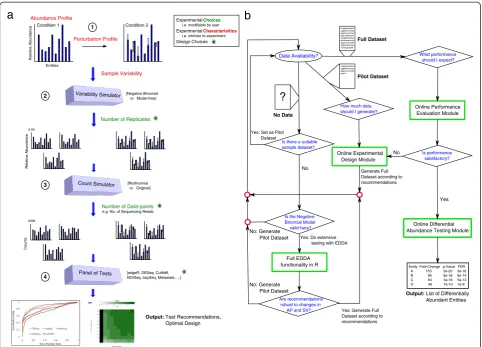
In this study, we establish the strong and pervasive im-pact of experimental design decisions on differential abundance analysis, with implications for study design in diverse disciplines. In particular, we identified data nor-malization as a source of performance variability and de-signed a robust alternative (mode normalization) that uniformly improves over existing approaches. We then propose a new paradigm for rational study design based on the ability to model counting experiments in a wide spectrum of applications (Figure 1). The resulting general-purpose tool called EDDA (for ‘Experimental Design in Differential Abundance analysis’), is the first program to enable researchers to design experiments for single-cell RNA-seq, NanoString assays, and Meta-genomic sequencing, and we highlight its use through case studies. EDDA provides researchers access to an array of popular DATs through an intuitive online inter-face [25] and answers questions such as‘How much se-quencing should I be doing?’,‘Does the study adequately capture biological variability?’, and‘Which test should I use to sensitively detect differential abundance in my application setting?’. To provide full access to its func-tionality, EDDA is also available as a user-friendly R package (on SourceForge [26] and Bioconductor [27]), and is easily extendable to new DATs and simulation models. The R package as well as the website provide different metrics to assess the performance of DATs
including the area under curve (AUC) of the receiver operating characteristic (ROC) curve, precision-recall curves, and actual versus estimated false discovery rate (FDR).
Results
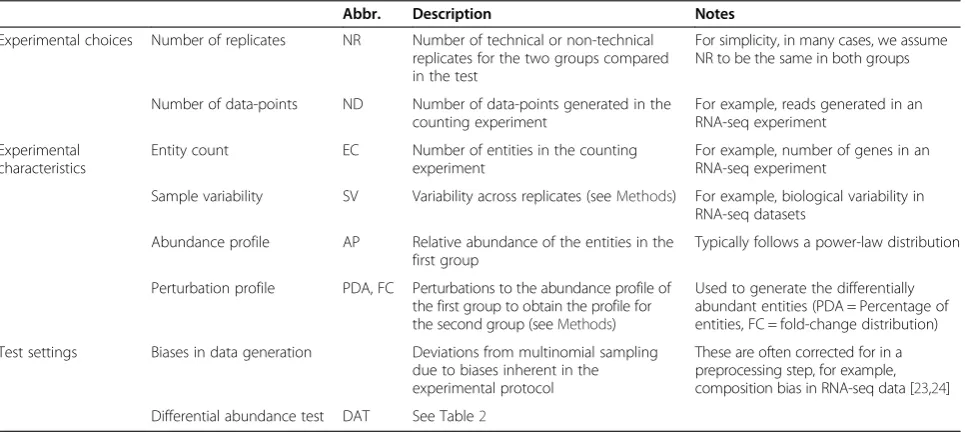
[image:2.595.58.541.517.733.2]In the following, we present and emphasize the under-appreciated impact of various experimental conditions (grouped into two categories: experimental choices and experimental characteristics, see Table 1) and various popular DATs (see Table 2) on the ability to detect dif-ferential abundance. Our results highlight the import-ance of careful experimental design and the interplay between experimental conditions and DATs in dictating the success of such experiments. We first establish that the impact of experimental choices on performance can be significant and in the next section explore their inter-action with various experimental characteristics. The re-sults presented here are based on synthetic datasets to allow controlled experiments and exploration of a wide-range of parameters, with no emphasis on a particular application. Note that these comparisons are not meant to serve as a benchmark (more sophisticated compari-sons and benchmarks can be found in other studies [6,11,16,18-21,28]) but instead to motivate the need for and the specific design decisions in EDDA. In the fol-lowing section, we discuss the validity of the modeling assumptions and parameter ranges that we investigated and used to guide the design of EDDA. We conclude by showcasing EDDA’s application in various settings. For ease of reference, a schematic overview of the simulation model in EDDA (Figure 1a) and a flowchart of how it can be used (Figure 1b) is provided in Figure 1 with de-tailed descriptions in the Methods section.
Table 1 Experimental conditions affecting differential abundance tests (DATs)
Abbr. Description Notes
Experimental choices Number of replicates NR Number of technical or non-technical replicates for the two groups compared in the test
For simplicity, in many cases, we assume NR to be the same in both groups
Number of data-points ND Number of data-points generated in the counting experiment
For example, reads generated in an RNA-seq experiment
Experimental characteristics
Entity count EC Number of entities in the counting experiment
For example, number of genes in an RNA-seq experiment
Sample variability SV Variability across replicates (seeMethods) For example, biological variability in RNA-seq datasets
Abundance profile AP Relative abundance of the entities in the first group
Typically follows a power-law distribution
Perturbation profile PDA, FC Perturbations to the abundance profile of the first group to obtain the profile for the second group (seeMethods)
Used to generate the differentially abundant entities (PDA = Percentage of entities, FC = fold-change distribution)
Test settings Biases in data generation Deviations from multinomial sampling due to biases inherent in the experimental protocol
These are often corrected for in a preprocessing step, for example, composition bias in RNA-seq data [23,24]
Impact of experimental choices on performance
While the availability of high-throughput technologies (such as massively parallel DNA sequencing) to do count-ing experiments has significantly increased the resolution of such experiments, the cost of the experiment is often
[image:3.595.57.540.88.435.2]still an important factor and the number of replicates and data-points that can be afforded may be less than optimal. Furthermore, in many settings the number of replicates or the number of data-points possible may be constrained due to technological limitations or uniqueness of samples
Table 2 Description of various software packages for conducting differential abundance tests
Name Statistical testing Normalization approach Target application areas
edgeR [12] Negative Binomial Model, Conditional Maximum Likelihood to estimate parameters, Exact Test
TMM, UQN SAGE [1], MPSS [29], PMAGE [30], miRAGE [31] and SACO [32] among others
DESeq [6] Negative Binomial Model, local regression to estimate parameters, Exact Test
Normalization by median RNA-seq [3], HITS-CLIP [9] and ChIP-seq [33] among others
baySeq [15] Negative Binomial Model, empirical Bayes to estimate parameters
RPM, TMM DNA-seq, RNA-seq [3] and SAGE [1] among others
NOISeq [16] Non-parametric approach RPM, RPKM, UQN ChIP-seq [33] and RNA-seq [3] among others
Cuffdiff [14] t-test RPM, RPKM, UQN RNA-seq [3]
Metastats [11] Non-parametrict-test, Fisher’s Exact Test for small counts
RPM Metagenomics
RPKM: Normalization by read count and gene length (RNA-seq) [3], RPM: Normalization by read count (RNA-seq), TMM: Trimmed Mean of M values [34], UQN: Upper Quartile Normalization [20].
Relative Abundance
Entities
Abundance Profile
Perturbation Profile
Variability Simulator Sample Variability
Number of Replicates
[Negative Binomial or Model-free]
Count Simulator [Multinomial or Original]
Number of Data-points
e.g. No. of Sequencing Reads
Counts
Panel of Tests [edgeR, DESeq, Cuffdiff, NOISeq, baySeq, Metastats, ...]
Characterisitics
Choices Experimental
i.e. modifiable by user i.e. intrinsic to experiment
Experimental
Design Choices
Output: Test Recommendations, Optimal Design
1
2
3
4
Condition 1 Condition 2
a
b
actgaagtcagtaa cggtattaatccagt gagatacacctcgc gcgcctattatcgat cgtcgtgcttgatgc gctatcgcgtacgtc aagacacatacgtt ttatgtcctgtaataa tcaaagggctgtttt
actgaagtcagtaa cggtattaatccagt gagatacacctcgc gcgcct
?
Data Availability? What performance
should I expect?
Full Dataset
Pilot Dataset
How much data should I generate?
Online Performance Evaluation Module
No Data
Is there a suitable sample dataset?
Yes: Set as Pilot Dataset
Online Experimental Design Module
Generate Full Dataset according to recommendations
Full EDDA functionality in R
Is the Negative Binomial Model valid here? No: Generate Pilot Dataset
No
Are recommendations robust to changes in AP and SV? No: Generate Pilot Dataset
Yes: Generate Full Dataset according to recommendations
Is performance satisfactory? No
Online Differential Abundance Testing Module
Yes
Output: List of Differentially Abundant Entities
Entity Fold-Change p-Value FDR A 153 3e-20 3e-16 B 96 6e-18 6e-14 C 64 5e-16 5e-12 D 48 7e-10 7e-8
Relative Abundance
0.05
2000
[image:3.595.58.541.580.715.2]Yes: Do extensive testing with EDDA
and conditions. In such settings, it would be ideal to understand and exploit the trade-off between the number of replicates and data-points needed (for example, by doing deeper RNA-seq for a few biological replicates) for such analysis. In the following, we investigate these di-mensions individually and in conjunction. For consistency and ease of comparison, we typically use AUC as the metric for performance (with precision-recall curves being provided in the supplement) to highlight variability across conditions. In practical applications, other metrics such as the true-positive rate and actual FDR while controlling for FDR (methods such as NOISeq would need alternative thresholds) may be more appropriate and are also sup-ported by EDDA.
Number of replicates
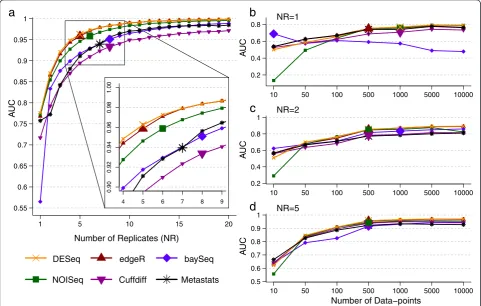
The performance of DATs (measured in terms of AUC) as a function of the number of replicates (NR) in the study is highly non-linear, with significant improvements obtainable until a saturation point (indicated by a larger marker size; Figure 2a). The saturation point is likely to be largely determined by the intrinsic variability of replicates
in an experiment. However, clear differences are also seen across DATs as seen in Figure 2a, where edgeR and DESeq achieved AUC greater than 0.95 with five replicates, while baySeq required eight replicates and has substantially lower AUC with one replicate. While all DATs seem to converge toward optimal performance (AUC =1) in this setting, the rate of convergence varies markedly (for ex-ample, note the curve for Cuffdiff). Note that the relative performance of DATs is influenced by the experimental setting, especially in conditions where the number of rep-licates available is small (as is typically the case), and thus the choice of DAT is strongly dependent on the desired precision/recall trade-off (Additional file 1: Figure S1).
Number of data-points
The number of data-points (ND) generated in an appli-cation setting is often set to be the maximum possible given the resources available. However, this may lead to misallocation of resources as suggested by Figure 2b, c, and d. In this setting, increasing the number of data-points continues to improve AUC over a wide range of values (for most DATs). At very high values AUC saturates, but not
1 5 10 15 20
0.55 0.6 0.65 0.7 0.75 0.8 0.85 0.9 0.95 1
Number of Replicates (NR)
AU
C
a
4 5 6 7 8 9
0.90
0.92
0.94
0.96
0.98
1.00
DESeq edgeR baySeq
NOISeq Cuffdiff Metastats
10 50 100 500 1000 5000 10000
0.2 0.4 0.6 0.8
b
AU
C
NR=1
10 50 100 500 1000 5000 10000
0.2 0.4 0.6 0.8 1
c
NR=2AU
C
10 50 100 500 1000 5000 10000
0.5 0.6 0.7 0.8 0.9 1
Number of Data−points
d
NR=5AU
[image:4.595.57.539.369.675.2]C
necessarily at 1 (Figures 1c and 2b). Oddly, for one of the DATs (baySeq), performance decreases with increase in ND - a feature that is nota priorievident from its specifi-cation (Figure 2b). However, with more replicates, much fewer data-points are needed to obtain high AUC values, suggesting that this is a better trade-off in this setting (Figure 2c, d; not necessarily the case in other settings, for example, when the number of replicates is already high or intrinsic variability across replicates is low). Note that if the number of data-points is limited by the application, then there is considerable variability in per-formance across DATs (Additional file 1: Figure S2) and some DATs may have consistently lower AUCs (Cuffdiff and Metastats, in this setting) with high ND as well. Thus, to meet experimental objectives, especially when high precision is desired, informed decisions on sta-tistical test and number of replicates to employ are nee-ded (as facilitated by experimental design tools such as EDDA).
Interaction of experimental characteristics and choices
It is important to note that experimental choices alone do not dictate the ability to detect signals of differential abundance and as we show here, the intrinsic character-istics of the experiment are also an important variable that need to be taken into account. This excludes the possibility of pre-computing recommendations for ex-perimental choices and DATs to use in various applica-tions and emphasizes the need for a general-purpose experimental design tool such as EDDA.
Entity count
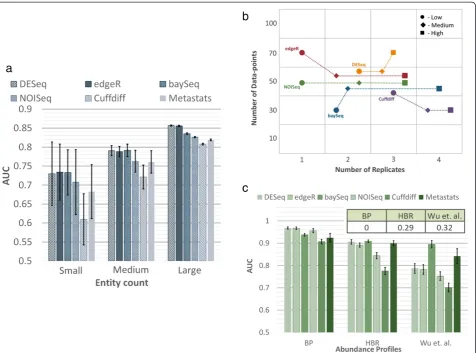
Intuitively, the impact of entity count (EC) being profiled is expected to be minimal and the a prioriassumption is that scaling the number of data-points as a function of the number of entities should lead to comparable perform-ance. Our results suggest that this is not quite true. As seen in Figure 3a, when the number of entities is low, there is not only greater variability in performance, but average AUC is also lower. Some statistical tests seem to be less appropriate when the number of entities is low (for example, Cuffdiff), while others exhibited greater robust-ness (edgeR and DESeq, followed by baySeq).
Sample variability
The intrinsic variability seen across replicates in an ap-plication setting dictates the trade-off between the num-ber of data-points and replicates needed in complex ways as shown in Figure 3b. While the specific patterns will depend on the application, even for a setting with large effect sizes as shown here, the specific trade-offs chosen by the various DATs vary (more sequencing for DESeq vs. more replicates for Cuffdiff ) and the cost-effectiveness of a method (=NR×NDneeded) can switch
with sample variability (SV) (for example, Cuffdiff goes from being the least to the most cost-effective when sam-ple variability increases; Figure 3b).
Abundance profile
The relative abundance of entities is often seen to follow a power law distribution (Additional file 1: Figure S3), but the precise shape can vary and together with the number of data-points generated, impact overall per-formance for an application. In particular, testing differ-ential abundance for rare entities (with low relative abundance) can be difficult and could explain the variabil-ity in performance seen in Figure 3c. While all methods have lower AUC for a rare-entity-enriched profile from
Wuet al.[35] (Additional file 1: Figure S3), some methods
seem to be more robust (for example, baySeq) or tuned to detect rare entities (for example, Metastats), while others experience a larger relative drop in performance (for ex-ample, Cuffdiff or NOISeq), suggesting that DAT choices need to take abundance profiles (APs) into account.
Perturbation profile
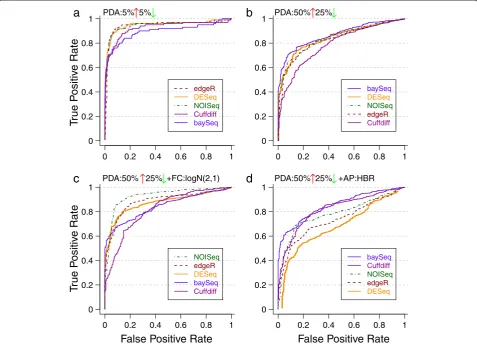
The effect of specific profiles of differential abundance on prediction performance is likely to be the least pre-dictable from first principles and this was also seen in our experiments (Figure 4). Altering the fraction of dif-ferentially abundant entities alone could reorder the per-formance of various statistical tests, as seen in Figure 4a and b, where baySeq went from being the worst per-former to the best perper-former. Furthermore, switching the distribution of fold-changes was also seen to affect results as seen in Figure 4b and c, with NOISeq now be-coming the best performing DAT. Other parameters such as the abundance profile also combine with the perturbation profile to influence relative performance as seen in Figure 4b and d, where DEseq went from being one of the best to being the worst performer. Overall, no single DAT was found to outperform others (Additional file 1: Figure S4), highlighting that specific experimental characteristics and choices need to be taken into account while choosing an appropriate DAT.
Modeling assumptions and normalization
(we refer to this as the Negative Binomial model), and bypassing the joint simulation of counts from a Multi-nomial distribution (referred to here as the Full model). For most current high-throughput experiments, as bio-logical variation is significant, the Full Model that incor-porates multinomial sampling of counts while modeling sample-to-sample variability as a negative binomial dis-tribution is appropriate. EDDA also includes an outlier simulation model that allows users to simulate more rea-listic datasets for some settings (for example, RNA-seq [28]; see Methods). In practice, both the Full and the Negative Binomial model elicit similar performance for most experimental settings and most DATs. However, for a few DATs (baySeq, NOISeq, and Cuffdiff) we ob-served deterioration in performance on the Full model when compared to a similar experiment using the Negative
Binomial model (Additional file 1: Figure S5) suggesting that the Full model is a better measure of performance of a DAT.
[image:6.595.62.539.88.441.2]that uses sub-sampling (and appropriate scaling where needed) of existing datasets to provide simulated datasets that match sample-to-sample variability in real datasets better (with the drawback that it relies on the availability of a dataset with many replicates; see Methods).
To evaluate the data generation models used in this study (either model-based or model-free), as well as es-tablish their suitability for the design of EDDA, we first investigated distributional properties of real and simu-lated datasets (Additional file 1: Figure S7). The results here indicate that while overall both simulation approa-ches (where applicable) provide good approximations and capture the general trend, the Model-Free approach more closely mimics true sample variability (Additional file 1: Figure S7). We next tested the suitability of an ap-proach where simulated datasets are generated to mimic an existing pilot dataset and employed to measure trends in performance. Our results confirmed that simulated
data generated by our simulation models enable reliable measurement of true performance for DATs (relative-error in AUC <6%) and monitoring of trends as a function of experimental choices and characteristics (Additional file 1: Figure S8). In addition, experimental recommen-dations from EDDA simulations were also found to match DAT recommendations based on benchmarking on real datasets [40] (Additional file 1: Figure S9), sug-gesting that EDDA can help avoid this step and still reli-ably guide experimental design.
In some experimental settings, variability in replicates can be extremely low and directly simulating from the Multinomial distribution (a special case of the Full model that we refer to as the Multinomial model; see Methods) is sufficient. In principal, with enough data-points, sta-tistical testing under the Multinomial model should be straightforward and we expect various DATs to perform well. The few exceptions that we noted, suggest that aspects
0 0.2 0.4 0.6 0.8 1 0
0.2 0.4 0.6 0.8 1
edgeR DESeq NOISeq Cuffdiff baySeq
0 0.2 0.4 0.6 0.8 1 0
0.2 0.4 0.6 0.8 1
baySeq DESeq NOISeq edgeR Cuffdiff
0 0.2 0.4 0.6 0.8 1 0
0.2 0.4 0.6 0.8 1
NOISeq edgeR DESeq baySeq Cuffdiff
0 0.2 0.4 0.6 0.8 1 0
0.2 0.4 0.6 0.8 1
False Positive Rate
False Positive Rate
T
rue P
ositiv
e Rate
T
rue P
ositiv
e Rate
b
a
d
c
baySeq Cuffdiff NOISeq edgeR DESeq
↑
↓
PDA:5% 5% PDA:50% 25%
↑
↓
↑
↓
[image:7.595.59.537.90.435.2]PDA:50% 25% +FC:logN(2,1) PDA:50% 25% +AP:HBR
↑
↓
Figure 4ROC plots under various perturbation profiles.Statistical tests in the legend are listed from best to worst (in terms of AUC values) for each setting. Note the striking reordering of test performance across subfigures with slight changes in experimental conditions. Simulations in
EDDA were done with(a)PDA =10%,(b)PDA = (50% UP, 25% DOWN),(c)PDA = (50% UP, 25% DOWN), FC = Log-normal (2, 1),(d)PDA = (50%
other than statistical testing, such as data normalization, may play a role in their reduced performance (Additional file 1: Figure S5).
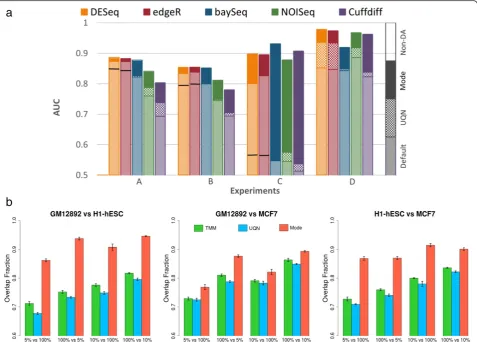
An investigation of different normalization approaches (Table 2) under the various experimental conditions ex-plored in this study suggests that their robustness can vary significantly as a function of the experimental setting. In particular, we observed a few settings under which many of the existing approaches performed sub-optimally (Figure 5a) and to address this we designed a new method (mode normalization) that analyzes the distri-bution of un-normalized fold-changes of entities using mode statistics to select a suitable normalization fac-tor (see Methods and Additional file 1: Figure S10). We
[image:8.595.60.538.272.614.2]compared mode normalization to the default normaliza-tion and a popular alternate (Upper-quartile Normaliza-tion), for each DAT and across all the conditions tested here, to find that the use of mode normalization uniformly improved performance (on average, AUC by 9% and preci-sion by 14% at 5% FDR). Also, in cases where the perform-ance of a few DATs dipped under the Multinomial model, mode normalization was able to rescue the AUC values (Additional file 1: Figure S5d). In addition, we identified several examples where mode normalization significantly improved AUC values for all the DATs tested (improving precision to detect differential abundance by up to 140% at 5% FDR), highlighting that proper data normalization is a key step in attaining experimental goals (Figure 5a). As
Figure 5Comparison of different data normalization approaches. (a)On simulated benchmark datasets using EDDA. Note that we used normalization by the sum of counts for all non-differentially-abundant entities (non-DA) as a measure of ideal performance here. In general, Upper-quartile Normalization (UQN) improved over the Default normalization (improvement shown by the checked box) but for cases where it did not we mark its performance with a solid line. Mode normalization always improved over the performance from UQN and the Default normalization for the DAT (improvement shown by the solid box). The parameters for the various experiments include for A: PDA = (26% UP, 10% DOWN), AP = Wuet al.; B: PDA = (35% UP, 15% DOWN); C: PDA = (40% DOWN), SM = Mutinomial; and D: the same as in Figure 4b. Unless stated otherwise, common parameters include NR =3, EC =1,000, FC = Log-normal (1.5, 1), ND =500 per entity, AP = HBR, SM = Full, and SV =0.5.(b)
depicted in Figure 5a, there are often cases where the default normalization of a DAT or a popular alternate (Upper-quartile Normalization) lead to reduced perform-ance while calling differentially abundant entities, while mode normalization consistently achieves optimal per-formance across DATs. Note that no normalization can be expected to work under all conditions and simulated data-sets generated by EDDA can also be valuable to compare and choose among alternative normalization techniques.
To further evaluate normalization methods on real datasets, we studied the consistency of differential abun-dance predictions (against predictions on the full data-set) upon down-sampling of data-points, using three deeply-sequenced RNA-seq datasets [40] (Figure 5b). These results highlight the robustness of mode normali-zation versus other popular approaches (UQN and TMM; Table 2). Mode normalization was found to improve ro-bustness by 10% to 20% across datasets and was the least affected by imbalances in sequencing depth across condi-tions (Figure 5b).
Applications of EDDA and mode normalization
The observed variability in the performance of DATs across experimental characteristics and choices, and the demonstration that data from many kinds of high-throughput experiments can be adequately modelled in
silico, motivated the use of a simulate-and-test paradigm
in EDDA to guide experimental design (see Figure 1a and Methods). EDDA allows users fine-scale control of all the variables discussed here (summarized in Table 1), but also provides the option to directly learn experi-mental parameters (and models for the model-free ap-proach) from pilot or publicly-available datasets. Some of the commonly expected modes of usage for EDDA are discussed in the Methods section ‘EDDA modules’ and illustrated in Figure 1b. Furthermore, to showcase the use of EDDA and mode normalization, we present results from EDDA analysis of several recently gener-ated datasets in three different experimental settings, each highlighting a different aspect of the utility of the package in a practical scenario.
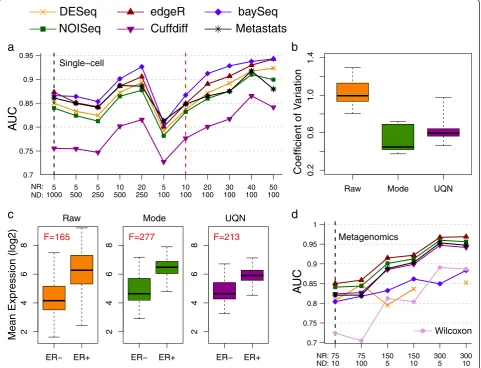
For the first case study, we analyzed data from a re-cent single-cell RNA-seq study of circulating tumor cells (CTCs) from melanoma patients [41]. The authors generated on average 1,000 data-points per entity (>20 million reads) and used a one-way ANOVA test (equiva-lent to at-test) to identify differentially abundant genes between CTCs and primary melanocytes. We reanalyzed the data using EDDA to simulate synthetic datasets that mimicked real data (with the Model-Free approach and a 96-cell dataset generated as a resource for this study) and used them to test a panel of DATs (see Methods). The availability of new micro-fluidics based systems to automate single-cell omics has highlighted the cost of
sequencing as the major bottleneck in studying a large number of cells. Strikingly, EDDA analysis revealed that this study could have been conducted with one-fifth of the sequencing that was done (by reducing sequencing depth to one-tenth and doubling the number of repli-cates) without affecting performance in terms of iden-tifying differentially abundant genes (Figure 6a). This was, however, only possible if the appropriate DAT was used (edgeR and BaySeq, in this case), with the choice of DAT playing a more significant role than the amount of sequencing done. Using BaySeq with on average 100 reads per gene (that is, 2 million reads per cell as op-posed to the 20 million reads used in this study) and in-creasing the number of replicates from five to 50 (and thus maintaining sequencing cost) would be expected to boost AUC from 0.86 (and 0.75 using thet-test) to 0.96 and sensitivity from 57% to 72% at 5% FDR, in this study (Figure 6a). Note that while practical considerations could limit the number of CTCs that can be captured and studied, this should not be an issue for other cell types in this study.
In the second case study, we analyzed data from an in-house project (manuscript in preparation) for the de-velopment of prognostic and predictive gene signatures in breast cancer on the NanoString nCounter platform (NanoString, WA, USA). The NanoString platform al-lows for the digital measurement of gene expression, si-milar to RNA-seq, but is typically used to profile a small, selected set of genes in a large number of samples (107 genes and 306 samples in this study), making data nor-malization a critical step for robust analysis. Using EDDA, we explored the impact of a range of normalization ap-proaches, including the one recommended in the Nano-String data analysis guide (NanoNano-String, WA, USA). As shown in Figure 6b, the coefficient of variation (COV) of a panel of six housekeeping genes(ACTG1,ACTB,EIF4G2,
GAPDH, RPLP0, and UBE2D4) is significantly lower, as
expected, when the data are properly normalized and, in particular, this is the case when using mode normalization which produces the lowest average COV across all the methods tested. We then investigated the effect of nor-malization on the power to discriminate between ER po-sitive and negative breast cancers using a panel of eight known ER signature genes [43]. Not surprisingly, the abil-ity to distinguish ER positive and negative breast cancers improves significantly with proper normalization with mode normalization providing the largest F-score (see Methods) among all the approaches tested (Figure 6c).
than 4 million microbial genes overall. Correspondingly, since on average approximately 20 million paired-end reads were generated per sample, the sequencing done here is expected to provide shallow coverage of the gene set, on average. The study involved a large number of cases (71) and controls (74) and the Wilcoxon test was used to identify differentially abundant genes in a case-control comparison. Another batch of 100 cases and controls was then used to validate biomarkers identified from the first batch. We used EDDA to generate virtual microbiome profiles and assessed the performance of the Wilcoxon test in this setting, in addition to the de-fault panel of DATs (Table 2). EDDA analysis revealed that the Wilcoxon test was likely to have been too con-servative in this setting and could have been improved upon using DATs like Metastats, which was designed for
Metagenomic data and edgeR, which is commonly used for RNA-seq analysis (Figure 6d). In addition, while in-creased coverage is likely to improve the ability to detect true differences in the microbiome, the gains are ex-pected to be relatively modest (for edgeR, approximatley 1% increase in AUC with 10-fold increase in sequencing; Figure 6d). Correspondingly, despite the shallow cover-age employed in this study, it is likely to have captured a significant fraction of the biomarkers that could have been determined with more sequencing. In contrast, in-creasing the number of replicates is likely to have mark-edly improved the ability to detect true differences in the microbiome, (with edgeR, approximately 7% increase in AUC by doubling the number of replicates Figure 6d). Keeping sequencing cost fixed and using 300 replicates and five reads per gene is thus expected to boost AUC
DESeq
edgeR
baySeq
NOISeq
Cuffdiff
Metastats
5 5 5 10 20 5 10 20 30 40 50
1000 500 250 500 250 100 100 100 100 100 100
0.7 0.75 0.8 0.85 0.9 0.95
Raw Mode UQN
0.2
0.6
1.0
1.4
ER− ER+
2468
ER− ER+
2468
ER− ER+
2468
75 75 150 150 300 300
10 100 5 10 5 10
0.7 0.75 0.8 0.85 0.9 0.95 1
Wilcoxon Single−cell
Metagenomics
Raw Mode UQN
NR: ND:
Mean Expression (log2)
F=165 F=277 F=213
NR: ND:
Coefficient of V
ar
iation
AU
C
AU
C
a
b
[image:10.595.58.540.91.459.2]c
d
Figure 6Case studies of EDDA usage. (a)Predicted performance of DATs as a function of replicates (NR) and sequencing depth (ND) for a single cell RNA-seq experiment (Ramskoldet al.[41]). Note that the vertical black dashed line indicates design choices in the original study.
(b)Coefficient of variation for a panel of housekeeping genes from a NanoString experiment under different normalization approaches.(c)
from 0.73 (using the Wilcoxon test) in the study to 0.97 (using edgeR; Figure 6d) and sensitivity from 32% to 86% at 5% FDR.
Based on this, we reanalyzed cases and controls from the first batch in this study to identify an additional 37,664 differentially abundant genes (17% increase) using edgeR, of which a greater fraction (27% increase over the original study) were also validated in the second batch of samples (Additional file 1: Table S2). The newly identified genes highlighted previously missing aspects of the role of the microbiome in Type 2 diabetes in-cluding the identification of 24 additional gene families enriched in differentially abundant genes (Additional file 1: Table S3). In particular, this analysis detected two bacterial genes identified as multiple sugar transport system substrate-binding proteins as being abundant in cases vs. controls (Additional file 1: Figure S11), as well as the enrichment of two new families for multiple sugar transport system permease proteins (K02025 and K02026). Strikingly, the newly detected genes also enabled construc-tion of an improved microbiome-based predictive model for Type 2 diabetes (AUC of 0.96 vs. 0.81 in the original study; see Methods and Additional file 1: Figure S11), based on the selection of 50 marker genes (see Methods and Additional file 1: Table S4), highlighting the disease-relevance for the additional biomarkers that we detect and that improved differential abundance analysis based on in-formed choices using EDDA can significantly impact major conclusions from a study.
Discussion and Conclusions
The case studies highlighted in the previous section are not unique in any way and point to a general trend in current design of high-throughput experiments, where commonly used rules of thumb lead to suboptimal designs and poor utilization of precious experimental resources. Considering that the market for sequencing based experi-ments alone is currently in the billions of dollars, savings in research budgets worldwide would be substantial with even a modest 10% improvement in study design. On the other end, with a fixed budget, optimizing study design can ensure that key insights are not missed. In particular, in many scenarios where either (a) effect sizes are small and fold-changes are marginal or (b) large effects on a few entities mask subtle effects on other entities or (c) the goal is to understand coordinated processes such as cel-lular pathways through enrichment analysis [44], loss in sensitivity or precision due to unguided experimental choices can be detrimental to the study. The use of a personalized-benchmarking tool such as EDDA pro-vides a measure of insurance against this.
With the recent, dramatic expansion in the number of high-throughput applications (largely based on DNA se-quencing) as well as end-users (often non-statisticians),
differential abundance testing is now frequently done by non-experts in settings different from the original benchmarks for a method. This can make it difficult to determine if a particular analysis was appropriate or lead to incorrect results. One possible approach that could account for this is to use multiple DATs to get a consen-sus set (also available as an option on the EDDA web-server) but this can result in overly conservative predic-tions. For example, in a recent analysis of RNA-seq data from two temporally-separated mouse brain samples using edgeR and DESeq (with default parameters), we found that the intersection of differentially expressed genes (at 10% FDR) contained less than 10% of the union. Breakdown of the results showed that while edgeR was primarily reporting upregulated genes (998 out of 1189), DESeq was largely reporting downregulated genes (875 out of 878), with no indication as to which analysis was more appropriate. EDDA simulations and analysis were then used to clarify that results from edgeR were more re-liable here (FPR of 3.8% vs. 9.2% at 10% FDR) and could be improved further using mode-normalization (FPR of 1.5%). Furthermore, the bias towards detecting up- or downregulated genes was intrinsic to the tests here (not affected by normalization as we originally suspected) and hence reporting the union of results was more appropri-ate. Examples such as this are not uncommon in the ana-lysis of high-throughput datasets and experimental design tools such as EDDA can help provide informed answers to researchers.
We hope the results in this study serve to further highlight the still under-appreciated importance of pro-per normalization for differential abundance analysis with high-throughput datasets [20,45,46]. Normalization based on mode statistics provides an intuitive alternative to existing approaches, exhibiting greater robustness to experimental conditions in general, >20% improved AUC performance in some conditions, as well as the ability to detect cases where proper normalization may not be feasible.
EDDA can thus serve as a basis for refining new statistical tests and clustering techniques for single-cell RNA-seq. Note that a common assumption in EDDA and most stat-istical testing packages is that deviations from the multi-nomial model due to experimental biases can be corrected for and hence these issues were ignored in this study [14,23]. However, we include an outlier simulation model that allows users to investigate the impact of potential out-liers in their data on various DATs that are more or less tuned to handle them [28].
EDDA was developed for count-based analysis, where its model-based simulations assume that counts from different entities are not correlated. In some applica-tions, such as transcript-level quantification using short-read RNA-sequencing, this assumption may not be valid due to technical reasons (for example, ambiguity in read mapping). Currently, this limitation can only be circum-vented by using the model-free approach in EDDA, based on sample data where entities are correlated (for ex-ample, by using transcript-level mapping for RNA-seq). Further work is needed to develop appropriate model-based approaches that adequately simulate technical ar-tefacts in count data and will necessarily have to be application-specific. Note that gene and exon-level quanti-fication are common applications of RNA-seq (as indi-cated by the majority of DATs being designed for this) and should benefit from model-based analysis in EDDA. Fur-thermore, with improvements in sequencing read length as well as adoption of third-generation sequencing tech-nologies, issues related to ambiguous read assignment are likely to affect a small fraction of reads. The use of EDDA’s model-based analysis is thus expected to become increas-ingly feasible in this burgeoning application area.
Recently, McMurdie et al. demonstrated the applic-ability of normalization/detection methods designed for RNA-seq data (edgeR/DESeq) for analyzing metage-nomic count data [47]. This study supports the under-lying basis of our work that methods for normalization and differential abundance testing should be broadly ap-plicable beyond the domains for which they were origin-ally proposed. Cross-fertilization of best practices from various application areas can improve the analysis of high-throughput count data and we hope that general platforms such as EDDA accelerate this process.
The basis for EDDA is a simple simulate-and-test pa-radigm as the diversity of statistical tests precludes more sophisticated approaches (for example, deriving closed-form or numerical bounds on expected perclosed-formance). Given the simplicity of this approach, it is even more surprising that the field has until now relied on rules of thumb. In light of this, the main contribution of this work should be seen as the demonstration that signifi-cant variability can be observed across all experimental dimensions and, therefore, lack of experimental design
tailored to a particular application setting can lead to substantial wastage of resources and/or loss of detec-tion power. We hope that the availability of EDDA through an intuitive, easy-to-use, point-and-click web-based interface will thus encourage a wide-spectrum of researchers to employ experimental design in their studies.
Methods
Single-cell library preparation and sequencing
ATCC® CCL-243™cells (that is, K562 cells) were thawed and maintained following vendor’s instructions using IMDM medium (ATCC® 30-2005™) supplemented with 10% FBS (GIBCO® 16000-077™). The cells were fed every 2 to 3 days by dilution and maintained between 2 × 10 [5] and 1 × 10 [6] cells/mL in 10 to 15 mL cultures kept in T25 flasks placed horizontally in an incubator set at 37°C and 5% CO2. Cells were slowly frozen 2 days after feeding at a concentration of 4 million cells per mL in 100μL aliquots of complete medium supplemented with 5% DMSO (ATCC® 4X). The cryo-vials containing the frozen aliquots were kept in the vapor phase of liquid ni-trogen until ready to use. On the day of the C1™ experi-ment, a 900 μL aliquot of frozen complete medium was thawed and brought to room temperature. The cryo-vial was retrieved from the cryo-storage unit and placed in direct contact with dry ice until the last minute. As soon as the cryo-vial was taken out of dry ice, the cells were thawed as quickly as possible at a temperature close to 37°C (in about 30 s).
The room temperature complete medium was slowly added to the thawed cells directly in the cryo-tube and mixed by pipetting four to five times with a 1,000 μL pipette tip. This cell suspension was mixed with C1™cell
suspension reagent at the recommended ratio of 3:2 im-mediately before loading 5 μL of this final mix on the C1™IFC. The C1 Single-Cell Auto Prep System (Fluidigm)
was used to capture individual cells and to perform cell lysis and cDNA amplification following the chip manufac-turer’s protocol for single-cell mRNA-seq (PN 100-5950). Briefly, chemistry provided by the SMARTer Ultra Low RNA Kit (Clontech) was used for reverse transcription and subsequent amplification of polyadenylated tran-scripts using the C1™script 1772×/1773×. After harvest of the amplified cDNA from the chip, 96-way bar-coded Illumina sequencing libraries were prepared by tagmen-tation with the Nextera XT kit (Illumina) following the manufacturer’s protocol with modifications stated in Fluidigm’s PN 100-5950 protocol. The 96 pooled librar-ies were 51-base single-end sequenced over three lanes of a Hi-Seq 2000.
Simulation of count data in EDDA
Abundance profile (AP)
When provided with sample data, EDDA uses the entity count and the sample abundance profile from the data (when multiple samples are provided, the counts are ag-gregated to get an average frequency profile) to do si-mulations. Users can also explicitly provide a profile or choose from among pre-defined profiles including BP (for BaySeq Profile; the profile used in simulations by Hardcastle et al. [15]), HBR (a profile derived from a ‘human brain reference’ dataset [49]) and the profile from Wu et al. [35]. In order to simulate with entity counts that differ from the original profile, EDDA allows users to sample entities (without replacement for sub-sampling and with replacement for over-sub-sampling) from the middle 80% (entities are ordered by relative abun-dance), top 10%, and bottom 10% independently. This procedure is designed to maintain the dynamic range of the original profile. In addition, to avoid working with entities with very low counts, EDDA allows users to fil-ter out those with counts below a minimum threshold for all replicates (default of 10).
Perturbation profile
If EDDA is provided with sample data under two con-ditions then the profile of differential abundance seen there is assigned to genes by keeping the relationship of mean expression and fold change. Specifically, EDDA applies a DAT (DESeq and FDR cutoff of 5% by default, after mode normalization) to the sample data to identify differentially abundant entities and their corresponding fold-changes (fi¼x2i=xi1 where x1i and x2i are the mean
relative abundance of entity i under the first and second condition, respectively). Given d differentially abundant entities, with fold-changes f1 to fd, a set of d entities
from the first condition are perturbed by these fold-changes to obtain the abundance profile for the second condition (that is, x2
i ¼√fjx1i and x1i ¼ x1i=√fj) while
retaining the correspondence between mean expression level and fold-change. In addition, to account for un-detected entities an additional fraction of entities is ran-domly selected (from those that fail the FDR cutoff and with fold-change >1.5) and their observed fold-changes used to perturb abundance profiles as before. The frac-tion of entities was determined to ensure that the overall count matched the expected number of differentially abundant entities in the dataset (estimated from the ex-pected number of true positives at each gene’s FDR level). In the absence of sample data, EDDA also allows users to specifically set the percentage of entities with increased and decreased entity counts (PDA), ranges for the fold-changes (FC) and the distribution to sample fold-fold-changes from (for example, Log-normal, Normal, or Uniform).
Simulation model (SM)
The default model for simulations in EDDA is the Full model where the mean abundance for each entity (under each condition) and the dispersion value provided (SV) is used to compute means for the replicates using a Negative Binomial distribution (this is done emulating the procedure in baySeq [15] where each entity has a dispersion sampled from a gamma distribution). When sample data are available, EDDA estimates dispersion values by using the procedure in DESeq (alternately, edgeR) to fit the empirical distribution. Entity abundan-ces for each replicate are then normalized to get a fre-quency vector (that sums to 1) to simulate count data from a Multinomial distribution (where the total count is sampled from Uniform(0.9 ×ND, 1.1 ×ND) andNDis the number of data-points specified by the user). EDDA also allows users a simpler Negative Binomial model (NB) where the counts are directly obtained from the Negative Binomial sampling described above and a Multinomial model where the abundance profile (nor-malized to 1) is used to directly simulate from the Multi-nomial distribution. EDDA also supports an outlier simulation model (turned off by default) as these are fre-quently encountered in real applications (for example, in RNA-seq data [28]). Specifically, to generate outlier data-points as in Love et al. [28], a random subset of genes (upto x% as specified by the user; default 15%) is selected and counts for them scaled up or down in a randomly chosen sample, by a user-specified factor (100 by default). In addition, the presence of outliers in sample data can allow users to simulate more realistic datasets using the Model-Free aproach as detailed below.
Model-free approach
approach, EDDA also provides users the option to con-vert counts back to a relative abundance profile for multinomial sampling of counts with a desired number of data-points.
Mode normalization
In principle, the ideal normalization factor for detecting differential abundance would be based on counts for an entity that is not differentially abundant (or the sum of counts for all such entities, see Figure 5). The idea be-hind mode-normalization is to identify such entities under the assumption that non-differentially-abundant entities will tend to have similar un-normalized fold changes (UFCs, computed as ratio of average counts across conditions). In methods such as DESeq, a related idea is implemented using a quantity called the size-factor (= ratio of observed count to a pseudo-reference sample computed by taking the geometric mean across samples) and by taking the median (or upper-quartile) size factor under the assumption that it would typically come from a non-differentially-abundant entity.
Mode normalization in EDDA is based on calculating UFCs for all entities and determining the approximate modes for their empirical distribution (Additional file 1: Figure S10). Specifically, we used a kernel density esti-mation approach [50] to smooth the empirical distribu-tion and to compute local maxima for it. In cases where the number of maxima is not as expected (that is, 3, cor-responding to entities with decreased, unchanged and increased relative abundance), the bandwidth for smoo-thing was decreased as needed (starting from 0.5, in steps of 0.02, till the number of maxima is as close to 3 as possible). If the final smoothed distribution was uni-or tri-modal then the mode in the middle (presumably composed of non-differentially-abundant entities) was chosen and the normalization factor was calculated from the geometric mean of 10 entity counts around the mode. For bimodal distributions, selecting the correct mode is potentially error-prone and we flag this to the user, picking the mode with the narrowest peak (as given by the width of the peak at half the maximum value) and calculating the normalization factor as before.
Parameter/DAT settings and EDDA extensions
EDDA is designed to be a general-purpose experimental design tool (that is easily extendable due to its implemen-tation in R) and correspondingly it provides significant flexibility in user settings. In addition, we investigated the question of which parameter values are typically seen in common applications (for example, RNA-seq, Nanostring analysis and Metagenomics) and used these to guide the evaluations presented in this study as detailed below.
For RNA-seq experiments, ECs in the range 1,000 (mi-crobial genomes) to 30,000 (mammalian genomes) are
common with NR and ND in the range (1, 10) and (10, 10,000) per entity, respectively. For Nanostring and Metagenomic experiments (species profile), EC can be significantly lower (in the range (10, 1,000)) as well as significantly higher (>1 million for Metagenomic gene profile). For the RNA-seq datasets analyzed in this study, SV was found to be in the range (0.1, 0.9) (Additional file 1: Table S1) though much higher variability was seen in Metagenomic data (>5). Abundance profiles are best learnt from pilot data but in their absence, the sample profiles provided with EDDA should serve as a useful range of proxies. For RNA-seq experiments, PDA values in the range (5%, 30%) can be expected while Nanostring and Metagenomic experiments can have even higher percentages. Fold change distributions were typically ob-served to be well-approximated by a Log-normal model (Log-normal(μ, σ)) but other models are also feasible in EDDA (for example, Normal(μ,σ) and Uniform(a, b)).
For DATs such as DESeq, edgeR, baySeq, NOISeq, and Metastats that are implemented in R, EDDA is set to call corresponding R functions, running them with default parameters and normalization options unless otherwise specified. The results in this study were obtained with the following versions of the various packages: DESeq (v1.7.6), edgeR (v2.4.6), baySeq (v1.8.3), NOISeq (version as of 20 April 2011), Metastats (version as of 14 April 2009), and R (v2.14.0). For Cuffdiff, the relevant C++ code was extracted from Cufflinks (v2.1.1) and incorpo-rated into EDDA as a pre-compiled dynamically-linked library using Rcpp [45,51].
In its current form, EDDA installs the DATs listed in Table 2 by default. In addition, EDDA is designed to support the easy integration of new DATs and a step-by-step guide to do so (with the Wilcoxon test used here as an example) is provided as part of the package (see Additional file 2: Text). EDDA is also designed to be extendable in terms of simulation models and a guide for this is also provided in the installation package (see Additional file 2: Text).
EDDA modules
For expert users the full functionality of EDDA and mode normalization is available in a package written in the statistical computing language R that can be freely downloaded from public websites such as SourceForge and Bioconductor. In addition, to enable easy access for those who are unfamiliar with the R environment, we designed web-based modules that encapsulate typical use cases for EDDA [25] (also see Figure 1a) including modules for:
results across DATs, compute the intersection and union of these results, and correspondingly select a more robust or comprehensive set of calls for downstream analysis. The assumption here is that a user has already generated all their data and would like a limited comparison of results from various DATs.
b) Performance Evaluation: The purpose of this module is to allow users to evaluate the relative performance of various DATs based on the characteristics of their experimental setting. A salient feature of this module is that users can adjust the stringency thresholds for the DATs and immediately assess the impact on performance, without re-running the DATs. The expected use case for this module is when users have pilot data and would like to do a systematic evaluation of the DATs.
c) Experimental Design: This module allows users to specify desired performance targets and the range of experimental choices that are feasible, to identify combinations that can meet the targets as well as the appropriate DATs that can be used to achieve them. Ideally, users in the planning stages of an experiment would use this module to optimize their experimental design.
Note that the experimental design module is arguably the most sophisticated and valuable among the three modules and encapsulates the main intended function for EDDA.
Preprocessing of RNA-seq datasets
Count data for RNA-seq datasets in ENCODE (for GM12892 NR =3, MCF7 NR =3, and h1-hESC NR =4) were obtained directly from [52]. Count data for Pickrell
et al. [53] (NR =69) were obtained from [54]. Reads
from each library of the K562 single cell RNA-seq data-set were mapped uniquely and independently using TopHat [55] (version 2.0.7) against the human reference genome (hg19). Raw counts for each gene were then extracted using Human Gencode 19 annotations and htseq-count [56].
Single-cell RNA-seq and metagenomic analysis
RNA-seq count data from single-cell experiments in Ramskoldet al.[41] were obtained from Additional file 1: Table S4 in the manuscript (15,000 genes and 10 sam-ples–six putative circulating tumor cells and four from the melanoma cell line SKMEL5; RPKM values were converted back to raw counts). Metagenomic count data from the study by Qin et al. [42] were obtained from [57] (1.14 million genes and 145 samples). The fit of the metagenomic count data to the Negative Binomial dis-tribution was assessed using a Kolmogorov-Smirnov
test, where <0.1% of the genes failed the test at aPvalue threshold of 0.01. Characteristics of both datasets were learned by EDDA and used to generate simulated data-sets (Model-Free for single-cell and with the Full Model for metagenomic data).
To build a predictive model for type 2 diabetes from the data in Qin et al. [42], we followed the procedure described there to identify 50 marker genes from the top 1,000 differentially abundant genes (based on edgeR P
values) by employing the maximum relevance minimum redundancy (mRMR) feature selection framework [58]. The identified marker genes were combined into a‘T2D index’ (= mean abundance of positive markers - mean abundance of negative markers) for each sample, which was then used to rank samples and compute ROC curves as in the original study.
Nanostring analysis
Nanostring count data were obtained from an in-house preliminary study of prognostic and predictive gene sig-natures for breast cancer (manuscript in preparation). Briefly, expression levels of 107 genes of interest from 369 patients in different stages of breast cancer and with known estrogen receptor (ER) alpha status and clinical outcomes were quantified using the NanoString nCoun-ter System (NanoString, WA, USA). The raw data were normalized by different generally applicable methods (for example, median normalization as implemented in DESeq, mode normalization from the EDDA package, and UQN as implemented in edgeR; see Table 2) as well as the recommended standard from the NanoString data analysis guide (normalized by positive and negative con-trols, followed by global normalization). Note that as this dataset has multiple categories we extended the standard two-condition version of mode-normalization by ran-domly labelling samples as controls or cases to identify the top 10 genes that are consistently chosen. In order to measure the impact of normalization on the ability to separate patients based on their ER status a standard F-score was calculated, as the ratio of between-group vari-ance to within-group varivari-ance of mean counts for the eight ER signature genes (formally F‐score =FBetween/
FWithin, whereFBetween= |X1|(E(X1) -E(X))2+ |X2|(E(X2) -E(X))2 and FWithin= (|X1|Var(X1) + |X2|Var(X2))/(|X1| + | X2| - 2) andX=X1∪X2, for mean countsX1andX2in
the two groups).
Availability
Additional files
Additional file 1:Supplementary Figures and Tables.
Additional file 2:Supplementary Text.
Competing interests
The authors declare that they have no competing interests.
Authors’contributions
NN and CKHB initiated the project. LH and CKHB implemented EDDA with additional inputs from LJ. LH designed and implemented mode-normalization with inputs from NN. PR coordinated the single-cell RNA-seq data generation. LJ conducted the single-cell and metagenomic analysis. LH conducted the nanostring analysis. NN, LH, LJ, and CHKB wrote the manuscript with inputs from all authors. All authors read and approved the final manuscript.
Acknowledgements
We would like to thank Shyam Prabhakar, Swaine Chen, Denis Bertrand, Sun Miao, Li Yi, and Chng Kern Rei for providing valuable feedback on drafts of the manuscript; Christopher Wong for sharing the Nanostring dataset with us; and Lili Sun, Naveen Ramalingam, and Jay West for technical assistance in generating the single-cell RNA-seq dataset.
Funding
This work was done as part of the IMaGIN platform (project No. 102 101 0025), supported by a grant from the Science and Engineering Research Council as well as IAF grants IAF311009 and IAF111091 from the Agency for Science, Technology and Research (A*STAR), Singapore.
Author details
1
Computational and Systems Biology, Genome Institute of Singapore, Singapore 138672, Singapore.2Stem-cell and Developmental Biology,
Genome Institute of Singapore, Singapore 138672, Singapore.
Received: 12 September 2014 Accepted: 3 November 2014
References
1. Velculescu VE, Zhang L, Vogelstein B, Kinzler KW:Serial analysis of gene expression.Science1995,270:484–487.
2. Ng P, Wei CL, Sung WK, Chiu KP, Lipovich L, Ang CC, Gupta S, Shahab A, Ridwan A, Wong CH, Liu ET, Ruan Y:Gene identification signature (GIS) analysis for transcriptome characterization and genome annotation.
Nat Methods2005,2:105–111.
3. Mortazavi A, Williams BA, McCue K, Schaeffer L, Wold B:Mapping and quantifying mammalian transcriptomes by RNA-Seq.Nat Methods2008,
5:621–628.
4. Geiss GK, Bumgarner RE, Birditt B, Dahl T, Dowidar N, Dunaway DL, Fell HP, Ferree S, George RD, Grogan T, James JJ, Maysuria M, Mitton JD, Oliveri P, Osborn JL, Peng T, Ratcliffe AL, Webster PJ, Davidson EH, Hood L, Dimitrov K:Direct multiplexed measurement of gene expression with color-coded probe pairs.Nat Biotechnol2008,26:317–325.
5. Meyerson M, Gabriel S, Getz G:Advances in understanding cancer genomes through second-generation sequencing.Nat Rev Genet2010,
11:685–696.
6. Anders S, Huber W:Differential expression analysis for sequence count data.Genome Biol2010,11:R106.
7. Zhang Y, Liu T, Meyer CA, Eeckhoute J, Johnson DS, Bernstein BE, Nusbaum C, Myers RM, Brown M, Li W, Liu XS:Model-based analysis of ChIP-Seq (MACS).Genome Biol2008,9:R137.
8. Zhao J, Ohsumi TK, Kung JT, Ogawa Y, Grau DJ, Sarma K, Song JJ, Kingston RE, Borowsky M, Lee JT:Genome-wide identification of polycomb-associated RNAs by RIP-seq.Mol Cell2010,40:939–953. 9. Licatalosi DD, Mele A, Fak JJ, Ule J, Kayikci M, Chi SW, Clark TA,
Schweitzer AC, Blume JE, Wang X, Darnell JC, Darnell RB:HITS-CLIP yields genome-wide insights into brain alternative RNA processing.Nature
2008,456:464–469.
10. Ong SH, Kukkillaya VU, Wilm A, Lay C, Ho EX, Low L, Hibberd ML, Nagarajan N:Species identification and profiling of complex microbial communities
using shotgun Illumina sequencing of 16S rRNA amplicon sequences.
PLoS One2013,8:e60811.
11. White JR, Nagarajan N, Pop M:Statistical methods for detecting differentially abundant features in clinical metagenomic samples.
PLoS Comput Biol2009,5:e1000352.
12. Robinson MD, McCarthy DJ, Smyth GK:edgeR: a Bioconductor package for differential expression analysis of digital gene expression data.
Bioinformatics2010,26:139–140.
13. Trapnell C, Williams BA, Pertea G, Mortazavi A, Kwan G, van Baren MJ, Salzburg SL, Wold BJ, Pachter L:Transcript assembly and quantification by RNA-Seq reveals unannotated transcripts and isoform switching during cell differentiation.Nat Biotechnol2010,28:511–515.
14. Trapnell C, Hendrickson DG, Sauvageau M, Goff L, Rinn JL, Pachter L:
Differential analysis of gene regulation at transcript resolution with RNA-seq.Nat Biotechnol2013,31:46–53.
15. Hardcastle TJ, Kelly KA:baySeq: empirical Bayesian methods for identifying differential expression in sequence count data.BMC
Bioinformatics2010,11:422.
16. Tarazona S, Garcia-Alcalde F, Dopazo J, Ferrer A, Conesa A:Differential expression in RNA-seq: a matter of depth.Genome Res2011,21:2213–2223. 17. Wang L, Feng Z, Wang X, Wang X, Zhang X:DEGseq: an R package for
identifying differentially expressed genes from RNA-seq data.
Bioinformatics2010,26:136–138.
18. Nookaew I, Papini M, Pornputtapong N, Scalcinati G, Fagerberg L, Uhlen M, Nielsen J:A comprehensive comparison of RNA-Seq-based transcriptome analysis from reads to differential gene expression and cross-comparison with microarrays: a case study in Saccharomyces cerevisiae.Nucleic Acids Res2012,40:10084–10097.
19. Soneson C, Delorenzi M:A comparison of methods for differential expression analysis of RNA-seq data.BMC Bioinformatics2013,14:91. 20. Bullard JH, Purdom E, Hansen KD, Dudoit S:Evaluation of statistical
methods for normalization and differential expression in mRNA-Seq experiments.BMC Bioinformatics2010,11:94.
21. Seyednasrollah F, Laiho A, Elo LL:Comparison of software packages for detecting differential expression in RNA-seq studies.Brief Bioinform, doi:10.1093/bib/bbt086.
22. Busby MA, Stewart C, Miller CA, Grzeda KR, Marth GT:Scotty: a web tool for designing RNA-Seq experiments to measure differential gene expression.
Bioinformatics2013,29:656–657.
23. Jones DC, Ruzzo WL, Peng X, Katze MG:A new approach to bias correction in RNA-Seq.Bioinformatics2012,28:921–928.
24. Roberts A, Trapnell C, Donaghey J, Rinn JL, Pachter L:Improving RNA-Seq expression estimates by correcting for fragment bias.Genome Biol2011,
12:R22.
25. EDDA web-based modules[http://edda.gis.a-star.edu.sg] 26. EDDA on SourceForge[https://sourceforge.net/projects/eddanorm/] 27. EDDA on Bioconductor[http://www.bioconductor.org/packages/devel/
bioc/html/EDDA.html]
28. Love MI, Huber W, Anders S:Moderated estimation of fold change and dispersion for RNA-Seq data with DESeq2.bioRxiv, doi:10.1101/002832. 29. Brenner S, Johnson M, Bridgham J, Golda G, Lloyd DH, Johnson D, Luo S,
McCurdy S, Foy M, Ewan M, Roth R, George D, Eletr S, Albrecht G, Vermaas E, Williams SR, Moon K, Burcham T, Pallas M, DuBridge RB, Kirchner J, Fearon K, Mao J, Corcoran K:Gene expression analysis by massively parallel signature sequencing (MPSS) on microbead arrays.Nat Biotechnol2000,
18:630–634.
30. Kim JB, Porreca GJ, Song L, Greenway SC, Gorham JM, Church GM, Seidman CE, Seidman JG:Polony multiplex analysis of gene expression (PMAGE) in mouse hypertrophic cardiomyopathy.Science
2007,316:1481–1484.
31. Cummins JM, He Y, Leary RJ, Pagliarini R, Diaz LA Jr, Sjoblom T, Barad O, Bentwich Z, Szafranska AE, Labourier E, Raymond CK, Roberts BS, Juhl H, Kinzler KW, Vogelstein B, Velculescu VE:The colorectal microRNAome.
Proc Natl Acad Sci U S A2006,103:3687–3692.
32. Impey S, McCorkle SR, Cha-Molstad H, Dwyer JM, Yochum GS, Boss JM, McWeeney S, Dunn JJ, Mandel G, Goodman RH:Defining the CREB regulon: a genome-wide analysis of transcription factor regulatory regions.Cell2004,119:1041–1054.
using chromatin immunoprecipitation and massively parallel sequencing.Nat Methods2007,4:651–657.
34. Robinson MD, Oshlack A:A scaling normalization method for differential expression analysis of RNA-seq data.Genome Biol2010,11:R25. 35. Wu JQ, Wang X, Beveridge NJ, Tooney PA, Scott RJ, Carr VJ, Cairns MJ:
Transcriptome sequencing revealed significant alteration of cortical promoter usage and splicing in schizophrenia.PLoS One2012,
7:e36351.
36. Robinson MD, Smyth GK:Small-sample estimation of negative binomial dispersion, with applications to SAGE data.Biostatistics2008,
9:321–332.
37. Lu J, Tomfohr JK, Kepler TB:Identifying differential expression in multiple SAGE libraries: an overdispersed log-linear model approach.BMC
Bioinformatics2005,6:165.
38. Brennecke P, Anders S, Kim JK, Kolodziejczyk AA, Zhang X, Proserpio V, Baying B, Benes V, Teichmann SA, Marioni JC, Heisler MG:Accounting for technical noise in single-cell RNA-seq experiments.Nat Methods2013,
10:1093–1095.
39. Deng Q, Ramskold D, Reinius B, Sandberg R:Single-cell RNA-seq reveals dynamic, random monoallelic gene expression in mammalian cells.
Science2014,343:193–196.
40. Rapaport F, Khanin R, Liang Y, Pirun M, Krek A, Zumbo P, Mason CE, Socci ND, Betel D:Comprehensive evaluation of differential gene expression analysis methods for RNA-seq data.Genome Biol2013,
14:R95.
41. Ramskold D, Luo S, Wang YC, Li R, Deng Q, Faridani OR, Daniels GA, Khrebtukova I, Loring JF, Laurent LC, Schroth GP, Sandberg R:Full-length mRNA-Seq from single-cell levels of RNA and individual circulating tumor cells.Nat Biotechnol2012,30:777–782.
42. Qin J, Li Y, Cai Z, Li S, Zhu J, Zhang F, Liang S, Zhang W, Guan Y, Shen D, Peng Y, Zhang D, Jie Z, Wu W, Qin Y, Xue W, Li J, Han L, Lu D, Wu P, Dai Y, Sun X, Li Z, Tang A, Zhong S, Li X, Chen W, Xu R, Wang M, Feng Q,et al:A metagenome-wide association study of gut microbiota in type 2 dia-betes.Nature2012,490:55–60.
43. Yu K, Ganesan K, Miller LD, Tan P:A modular analysis of breast cancer reveals a novel low-grade molecular signature in estrogen receptor-positive tumors.Clin Cancer Res2006,12:3288–3296.
44. Subramanian A, Tamayo P, Mootha VK, Mukherjee S, Ebert BL, Gillette MA, Paulovich A, Pomeroy SL, Golub TR, Lander ES, Mesirov JP:Gene set enrichment analysis: a knowledge-based approach for interpreting genome-wide expression profiles.Proc Natl Acad Sci U S A2005,
102:15545–15550.
45. Garmire LX, Subramaniam S:Evaluation of normalization methods in mammalian microRNA-Seq data.RNA2012,18:1279–1288.
46. Dillies MA, Rau A, Aubert J, Hennequet-Antier C, Jeanmougin M, Servant N, Keime C, Marot G, Castel D, Estelle J, Guernec G, Jagla B, Jouneau L, Laloe D, Le Gall C, Schaeffer B, Le Crom S, Guedj M, Jaffrezic F, French StatOmique Consortium:A comprehensive evaluation of normalization methods for Illumina high-throughput RNA sequencing data analysis.Brief Bioinform
2013,14:671–683.
47. McMurdie PJ, Holmes S:Waste not, want not: why rarefying microbiome data is inadmissible.PLoS Comput Biol2014,10:e1003531.
48. K562 Single-cell RNA-seq data[http://www.ncbi.nlm.nih.gov/ bioproject/238846]
49. Au KF, Jiang H, Lin L, Xing Y, Wong WH:Detection of splice junctions from paired-end RNA-seq data by SpliceMap.Nucleic Acids Res2010,
38:4570–4578.
50. Rosenblatt M:Remarks on some nonparametric estimates of a density function.Ann Math Stat1956,27:832–837.
51. Rcpp Package[http://cran.r-project.org/web/packages/Rcpp/index.html] 52. SeqQC website[http://bitbucket.org/soccin/seqc]
53. Pickrell JK, Marioni JC, Pai AA, Degner JF, Engelhardt BE, Nkadori E, Veyrieras JB, Stephens M, Gilad Y, Pritchard JK:Understanding mechanisms underlying human gene expression variation with RNA sequencing.
Nature2010,464:768–772.
54. ReCount website[http://bowtie-bio.sourceforge.net/recount/] 55. Kim D, Pertea G, Trapnell C, Pimentel H, Kelley R, Salzberg SL:TopHat2:
accurate alignment of transcriptomes in the presence of insertions, deletions and gene fusions.Genome Biol2013,14:R36.
56. HTSeq website[http://www-huber.embl.de/users/anders/HTSeq/doc/ overview.html]
57. GigaDB website[www.gigadb.org]
58. Peng H, Long F, Ding C:Feature selection based on mutual information: criteria of max-dependency, max-relevance, and min-redundancy.
IEEE Trans Pattern Anal Mach Intell2005,27:1226–1238.
doi:10.1186/s13059-014-0527-7
Cite this article as:Luoet al.:The importance of study design for detecting differentially abundant features in high-throughput experiments.Genome Biology201415:527.
Submit your next manuscript to BioMed Central and take full advantage of:
• Convenient online submission
• Thorough peer review
• No space constraints or color figure charges
• Immediate publication on acceptance
• Inclusion in PubMed, CAS, Scopus and Google Scholar
• Research which is freely available for redistribution