Debiasing the hidden curriculum
Academic equality among medical specialties
Wayne Woloschuk
PhDBruce Wright
MDKevin McLaughlin
MB ChB PhDAbstract
Objective To compare the academic performance of students who entered family medicine residency programs with that of students who entered other disciplines and discern whether or not family physicians are as academically talented as their colleagues in other specialties.
Design Retrospective quantitative study.
Setting University of Calgary in Alberta.
Participants Three graduating classes of students (2004 to 2006) from the University of Calgary medical school.
Main outcome measures Student performance on various undergraduate certifying examinations in years 1, 2, and 3, along with third-year in-training evaluation reports and total score on the Medical Council of Canada
Qualifying Examination Part I.
Results Complete data were available for 99% of graduates (N = 295). In the analysis, residency program (family medicine [n = 96] versus non–family medicine [n = 199]) served as the independent variable. Using a 1-way multivariate ANOVA (analysis of variance), no significant difference among any of the mean performance scores was observed (F5289 = 1.73, P > .05).
Students who entered family medicine were also well represented within the top 10 rankings of the various performance measures.
Conclusion The academic performance of students who pursued careers in family medicine did not differ from that of students who chose other specialties. Unfounded negativity toward family medicine has important societal implications, especially at a time when the gap between the number of family physicians and patients seeking primary care services appears to be widening.
This article has been peer reviewed.
Can Fam Physician 2011;57:e26-30
Research
|
Web exclusive
EDITOR’S KEY POINTS
• Medical school education comprises not only a formally offered curriculum, but also a “hidden curriculum”—a set of peer and educator influences that function within the organizational and cultural structure of the institution.
• That family medicine is perceived nega
-tively as a career option in this hidden curriculum dissuades some students from considering the discipline and lends cre
-dence to the notion that family physicians are less academically competent than their peers in other specialties.
• This study compared the academic performances of medical students entering family medicine resident programs with those entering other specialty programs and showed that there were no differences between the 2 groups, revealing that the negativity directed toward the academic performance of those pursuing family medicine is not based in fact.
• The negative perceptions of family medi
Démythifier le curriculum caché
Mêmes compétences académiques pour les diverses spécialités médicales
Wayne Woloschuk
PhDBruce Wright
MDKevin McLaughlin
MB ChB PhDRésumé
Objectif Comparer le rendement académique des étudiants en médecine qui entraient dans le programme de résidence en médecine familiale à celles des étudiants qui entraient dans les programmes d’autres spécialités et déterminer si les médecins de famille étaient aussi talentueux sur le plan académique que leur confrères des autres spécialités.
Type d’étude Étude rétrospective quantitative.
Contexte L’université de Calgary, en Alberta.
Participants Trois classes d’étudiants finissants (2004 à 2006) de la faculté de médecine de l’université de Calgary.
Principaux paramètres à l’étude Rendement des étudiants à divers examens de certification des années 1, 2 et 3 du premier cycle, rapports d’évaluation des stages de troisième année et score total à la partie I de l’examen de certification du Conseil médical du Canada.
Résultats Des données complètes étaient disponibles pour 99 % des diplômés (n = 295). Dans l’analyse, les programmes de résidence (médecine familiale [n = 96] versus autres programmes [n = 199]) représentaient les variables indépendantes. Une ANOVA (analyse de variance) unidirectionnelle à variables multiples n’a trouvé aucune différence significative pour l’un ou l’autre des scores obtenus (F5289 = 1,73, P > ,05). En outre, les étudiants qui entraient en médecine familiale étaient bien représentés parmi les 10 meilleurs résultats de plusieurs des mesures de rendement.
Conclusion Les étudiants qui avaient opté pour une carrière en médecine familiale avaient un rendement académique semblable à celui des étudiants qui avaient choisi d’autres spécialités. Une attitude négative injustifiée à égard de la médecine familiale a d’importantes répercussions sociétales, particulièrement à un moment où l’écart semble s’élargir entre le nombre de médecins de famille et le nombre de patients qui recherchent des services de première ligne.
Cet article a fait l’objet d’une révision par des pairs.
Can Fam Physician 2011;57:e26-30
POINTS DE REPèRE Du RéDacTEuR
• La formation dans les facultés de médecine comprend non seulement un curriculum formel, mais aussi un « cur
-riculum caché », c.-à-d. un ensemble d’influences qui agissent au sein de la structure organisationnelle et culturelle de l’institution.
• Le fait que la médecine familiale soit perçue comme une option de carrière moins attrayante à cause de ce curricu
-lum caché dissuade certains étudiants d’envisager cette discipline et renforce l’idée que les médecins de famille sont moins compétents sur le plan aca
-démique que leurs confrères des autres spécialités.
• Cette étude a comparé le rendement académique des étudiants en médecine qui entraient dans le programme de résidence en médecine familiale à celui des étudiants qui entraient dans les pro
-grammes d’autres spécialités et a montré qu’il n’y avait pas de différence entre les 2 groupes, ce qui prouve que la percep
-tion négative à l’égard du rendement de ceux qui optent pour la médecine familiale n’est pas réellement fondée.
• La perception négative de la mé
-decine familiale a des conséquences sociétales importantes au Canada, où on observe un écart de plus en plus grand entre le nombre de personnes qui ont besoin d’un médecin de famille et la proportion des diplômés des facultés de médecine qui optent pour une carri
-ère en médecine familiale; des mesures énergiques devraient être prises au sein des milieux culturels et formatifs des facultés de médecine pour que dispara
Research
|
Debiasing the hidden curriculum
T
he insufficient supply of family physicians or gen-eral practitioners in Canada is a national concern. In recent years, fewer medical students have entered family medicine residency programs, and negative com-ments directed toward primary care have been identi-fied as a factor that dissuade students from considering the discipline as a career option.1 Lack of respect forCanadian family physicians by colleagues from other disciplines has also been reported.2 Not all negativity,
however, is delivered by physicians—both residents and students have also been participants in the “bashing.”3
Why is family medicine perceived so negatively?
According to Hafferty,4 much of what is learned in
medical school can be found within the hidden cur-riculum, which he defines as “a set of influences that function at the level of organizational structure and cul-ture.”4 Negative comments degrading the discipline of
family medicine are elements of the hidden curriculum that are not only powerful5,6 but also counterproductive
to the efforts of medical schools and government bod-ies who are trying to bridge the primary care gap. By evading the scrutiny of the curriculum committee and accreditation body, this curricular agenda, which need not be evidence-based, provides an opportunity for the unfiltered biases of staff and students to be dissemi-nated. Consequently, the hidden curriculum might exert a pernicious influence on the career choices of medi-cal graduates and might even become self-fulfilling if students choose a career that they believe is congruent with their academic performance.
Research suggests that negative comments toward the family medicine discipline become more frequent as stu-dents approach graduation7 and, for some students, can
be instrumental in their career decisions.8 Negative
com-ments frequently heard about family medicine imply that the content of the discipline is too vast to master compe-tently and that family physicians are not as smart as phy-sicians in other disciplines.9 A popular belief perpetuated
by some faculty is that the top medical students should forego careers in family medicine to pursue subspecialty training.7,10 Nearly 20 years ago, Markert suggested that
students selecting family medicine residency training had lower grade point averages (GPAs) and National Board of Medical Examiners certification scores compared with students selecting subspecialty training.8 Although these
findings were largely countered by others,11,12 the
percep-tion that family medicine trainees are less academically talented than their peers seems to have lingered.
Differences in both postgraduate training and the health care system in the United States suggest that previous research findings might not extrapolate to the Canadian context. There are no Canadian data to sug-gest that medical students who choose family medicine as a career differ academically from their peers, although students do report this perception.10 The purpose of our
study was to compare the academic performance of medical students who chose family medicine as a career with the academic performance of their classmates who trained in other disciplines.
METhODS
We gathered data on the undergraduate academic per-formances of students from the University of Calgary in Alberta from 3 consecutive graduating medical classes (2004 to 2006) who entered the Canadian Resident Matching Service (CaRMS) match. Certifying examina-tion results of the various system courses were used to calculate GPAs for students’ first and second years in the program. A clerkship GPA was also calculated based on the written examination scores of each of the 7 mandatory rotations, which include anesthesia, family medicine, internal medicine, obstetrics and gynecology, pediatrics, psychiatry, and surgery. A mean in-training evaluation report score was calculated based on clinical performance in each of the mandatory rotations. We also recorded each student’s performance on the Medical Council of Canada Qualifying Examination (MCCQE) Part I and career choice as reported by CaRMS. The Conjoint Health Research Ethics Board at the University of Calgary granted ethical approval for this study.
We divided our graduates into 2 groups: those who entered a family medicine residency training program and those who entered any other residency training program. Career choice served as the independent vari-able, while the various performance measures served as dependent variables in the analysis. Using a 1-way mul-tivariate ANOVA (analysis of variance), we compared the GPAs obtained in each year of the 3-year program, performance on clerkship in-training evaluation reports, and MCCQE Part I scores.
RESuLTS
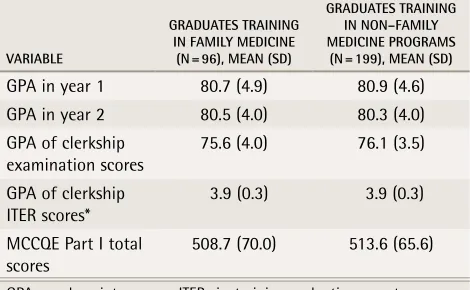
Complete data were available for 295 (99.0%) of the 298 graduates who entered the CaRMS match. Ninety-six (32.5%) graduates entered training in family medicine and 199 (67.5%) entered training programs in other dis-ciplines. The percentage of graduates from each class who entered family medicine training programs ranged from 29.9% (class of 2004) to 36.2% (class of 2006). Of the 295 participants, 164 (55.6%) were female. We found no significant difference in performance in undergrad-uate training measures or the MCCQE Part I scores between students who entered family medicine and those who entered other training programs (F5289 = 1.73,
measures to see how many students who entered family medicine residency programs ranked in the top 10 spots. We found that 4 students who entered family medicine were in the top 10 for the MCCQE Part I scores; with regard to the various undergraduate outcome measures, top 10 positions were occupied by 3 to 5 students who entered family medicine training programs.
DIScuSSION
Over a 3-year period, medical school graduates from the University of Calgary pursuing family medicine train-ing had academic performances comparable to those of their peers on measures taken between year 1 of undergraduate training and the licensing examination (ie, the MCCQE Part I), which is written at the time of graduation. Furthermore, these students were well rep-resented among the top 10 performers on the various performance measures. Given that one-third of students in this study entered family medicine training programs, one would expect a similar proportion of students pur-suing family medicine to rank in the top 10 positions of the various outcome measures. Results showed that these students occupied 30% to 50% of the top 10 posi-tions when each outcome measure was ranked, thereby meeting or exceeding this expectation. It is certainly reassuring to find that the specialty with the broadest scope of clinical practice is not a home for the least suc-cessful academic performers.
Our results are consistent with those of other studies that examined the academic performances of primary care and non–primary care physicians and students who
entered any of 8 specialty groupings, including family practice.11,12 Our study of a 3-year cohort did not have a
sufficient number of students to allow comparison of the academic performances of students among the different specialties. Grouping all of the non–family medicine stu-dents together might have masked potential differences in performance across specialties and is worthy of fur-ther investigation. Examining the performances of stu-dents who entered family medicine and those training in other fields during residency is also recommended.
Why all the unfounded negativity directed toward family medicine? We propose that this negativity is largely due to personal opinion that is voiced within the safety of the hidden curriculum. People are a primary source of hidden messages,5 and faculty who speak
poorly of other disciplines might be oblivious to the influ-ence such behaviour can have on students.13 The extent
to which these individuals, unintentionally or otherwise, stoke the fires of the hidden curriculum is unclear. Our study was not designed to address this important issue, but our results suggest that this topic warrants further study. Hojat et al12 found that, as students, primary care
physicians displayed less interest in research than their non–primary care peers. Investigating whether participa-tion in scholarly activities such as research or teaching affects other specialists’ perception of family medicine might help to understand the negativity.
The negative perceptions of family medicine as a career have important societal consequences. In Canada there has been a relentless increase in the number of individuals who are unable to secure a family doctor, while the proportion of medical school graduates select-ing family medicine as a career remains low, resultselect-ing in a primary care gap. Despite some recent gains in the proportion of graduates selecting family medicine, medi-cal schools need to do more to facilitate this upward trend. Clearly, this is a complex problem without a sim-ple solution.
Limitations
These data reflect the performances of students from a single medical school; it is not known whether these findings are representative of students from other medi-cal schools across Canada. In the United States, stu-dents might take other routes into primary care practice such that these findings might not apply. Also, this study did not investigate opinions or attitudes, mean-ing the extent to which participants within the local educational environment denigrated family medicine is unknown. Furthermore, we did not have data to deter-mine whether students who entered family medicine did so as their first choice of career or as an alternative. Consequently, we do not know if the academic perfor-mances of students in these 2 groups differ and whether this affected the findings.
Table 1.
Mean performance scores of graduates
(N = 295) who entered family medicine residency
versus those who entered non–family medicine
residency programs:
None of the differences between
groups was statistically significant.
VARiABLe
GRADuATes TRAiNiNG iN FAMiLy MeDiCiNe
(N = 96), MeAN (sD)
GRADuATes TRAiNiNG iN NoN–FAMiLy MeDiCiNe PRoGRAMs
(N = 199), MeAN (sD)
GPA in year 1 80.7 (4.9) 80.9 (4.6)
GPA in year 2 80.5 (4.0) 80.3 (4.0)
GPA of clerkship examination scores
75.6 (4.0) 76.1 (3.5)
GPA of clerkship ITER scores*
3.9 (0.3) 3.9 (0.3)
MCCQE Part I total scores
508.7 (70.0) 513.6 (65.6)
Research
|
Debiasing the hidden curriculum
Conclusion
“Bad-mouthing” appears to be part of the medical educa-tion environment,1 and reducing the prevailing
negativ-ity might contribute to an increased number of students willing to consider careers in primary care.3 In order to
debias the learning environment in which our students are immersed, medical schools need to be proactive14
by promoting a nonjudgmental setting for learning.3
Raising the consciousness of those who participate in the learning environment about this issue and promot-ing medicine as an interdisciplinary profession are sensi-ble strategies that have been advanced.3 Most important,
the profile of family medicine within the medical school environment should be enhanced in as many ways as possible.2 To best serve society, our ultimate goal should
be to remove the unjustified stigma placed upon family medicine by the medical training environment.
Dr Woloschuk is Director of Program Evaluation in the Faculty of Medicine at the University of Calgary in Alberta. Dr Wright is Associate Dean of Undergraduate Medical Education in the Faculty of Medicine at the University of Calgary. Dr McLaughlin is Assistant Dean of Undergraduate Medical Education in the Faculty of Medicine at the University of Calgary.
Contributors
Dr Woloschuk conceived the study, assisted with data collection and analysis, prepared the initial draft of the manuscript, and approved the final version. Dr Wright contributed to the study design and data collection, revised the manu-script for intellectual content, and approved the final version. Dr McLaughlin
assisted with the data analysis and data interpretation, revised the manuscript for intellectual content, and approved the final version.
Competing interests
None declared
Correspondence
Dr Wayne Woloschuk, Department of Undergraduate Medical Education, Faculty of Medicine, University of Calgary, 3330 Hospital Dr NW, Calgary, AB T2N 4N1; e-mail [email protected]
references
1. Hunt DD, Scott C, Zhong S, Goldstein E. Frequency and effect of negative comments (“badmouthing”) on medical students’ career choices. Acad Med
1996;71(6):665-9.
2. Manca D, Varnhagen S, Brett-MacLean P, Allan GM, Szafran O. RESPECT from specialists. Concerns of family physicians. Can Fam Physician
2008;54:1434-5.e1-5. Available from: www.cfp.ca/cgi/reprint/54/10/1434. Accessed 2010 Dec 7.
3. Holmes D, Tumiel-Berhalter LM, Zayas LE, Watkins R. “Bashing” of medi-cal specialties: students’ experiences and recommendations. Fam Med
2008;40(6):400-6.
4. Hafferty FW. Beyond curriculum reform: confronting medicine’s hidden cur-riculum. Acad Med 1998;73(4):403-7.
5. Anderson DJ. The hidden curriculum. AJR Am J Roentgenol 1992;159(1):21-2. 6. Mattsson B, Freeman GK, Coles CR, Schmedlin J. General practice in the
undergraduate curriculum: 20 interviews with Southampton final-year stu-dents. Med Educ 1991;25(2):144-50.
7. Hearst N, Shore WB, Hudes ES, French L. Family practice bashing as per-ceived by students at a university medical center. Fam Med 1995;27(6):366-70. 8. Markert RJ. Why medical students change to and from primary care as a
career choice. Fam Med 1991;23(5):347-50.
9. Campos-Outcalt D, Senf J, Kutob R. Comments heard by US medical students about family practice. Fam Med 2003;35(8):573-8.
10. Scott I, Wright B, Brenneis F, Brett-MacLean P, McCaffrey L. Why would I choose a career in family medicine? Reflections of medical students at 3 uni-versities. Can Fam Physician 2007;53:1956-7.e1-8. Available from: www.cfp. ca/cgi/reprint/53/11/1956. Accessed 2010 Dec 7.
11. Xu G, Veloski JJ, Hojat M. Changing interest in family medicine and students’ academic performance. Acad Med 1993;68(10 Suppl):S52-4.
12. Hojat M, Gonnella JS, Erdmann JB, Veloski JJ, Xu G. Primary care and non-primary care physicians: a longitudinal study of their similarities, differences, and correlates before, during, and after medical school. Acad Med 1995;70(1 Suppl):S17-28.
13. Kamien BA, Bassiri M, Kamien M. Doctors badmouthing each other. Does it affect medical students’ career choices? Aust Fam Physician 1999;28(6):576-9. 14. Peach HG. Badmouthing between disciplines. Aust Fam Physician