A Forward-Secure Public-Key Encryption Scheme
Ran Canetti∗ Shai Halevi∗ Jonathan Katz†
December 23, 2003
Abstract
Cryptographic computations are often carried out on insecure devices for which the threat of key exposure represents a serious and realistic concern. In an effort to mitigate the damage caused by exposure of secret keys stored on such devices, the paradigm of forward security was introduced. In a forward-secure scheme, secret keys are updated at regular periods of time; exposure of the secret key corresponding to a given time period does not enable an adversary to “break” the scheme (in the appropriate sense) for any prior time period. A number of constructions of forward-secure digital signature schemes, key-exchange protocols, and symmetric-key schemes are known.
We present the first non-trivial constructions of (non-interactive) forward-secure public-key encryption schemes. Our main construction achieves security against chosen-plaintext attacks under the decisional bilinear Diffie-Hellman assumption in the standard model. This scheme is practical, and all parameters grow at most logarithmically with the total number of time periods. We also give a slightly more efficient scheme in the random oracle model. Both our schemes can be extended to achieve security against chosen-ciphertext attacks and to support an unbounded number of time periods.
Toward our goal, we introduce the notion of binary tree encryption and show how to con-struct a binary tree encryption scheme in the standard model. This new primitive may be of independent interest. In particular, we use it to construct the first known example of a (hierar-chical) identity-based encryption scheme that is secure in the standard model. (Here, however, the notion of security we achieve is slightly weaker than what is achieved in some previous constructions in the random oracle model.)
Key words: Bilinear Diffie-Hellman, Encryption, Binary-tree encryption, Identity-based encryp-tion, Forward security, Key exposure.
∗IBM T.J. Watson Research Center, NY, USA.{
canetti,shaih}@watson.ibm.com.
†Dept. of Computer Science, University of Maryland, College Park, MD. Portions of this work were done while at
Contents
1 Introduction 2
1.1 Our Contributions . . . 2 1.2 Organization . . . 4
2 Binary Tree Encryption 4
2.1 The Bilinear Diffie-Hellman Assumption . . . 6 2.2 A BTE Scheme Based on the BDH Assumption . . . 7
3 Forward-Secure Public-Key Encryption 12
3.1 Definitions . . . 12 3.2 Forward-Secure PKE Schemes with Linear Complexity . . . 14 3.3 A Construction with Logarithmic Complexity . . . 14
A Basing HIBE on BTE 18
A.1 Definitions . . . 19 A.2 From BTE to HIBE . . . 20
1
Introduction
Exposure of secret keys can be a devastating attack on a cryptosystem since such an attack typically implies that all security guarantees are lost. Indeed, standard notions of security offer no protection whatsoever once the secret key of the system has been compromised. With the threat of key exposure becoming more acute as cryptographic computations are performed more frequently on poorly protected devices (smart-cards, mobile phones, even PCs), new techniques are needed to deal with this concern.
A variety of methods have been introduced in an attempt to deal with this threat (including secret sharing [36], threshold cryptography [14], and proactive cryptography [33]). One promising approach — which we focus on here — is to construct forward secure cryptosystems. This notion was first proposed in the context of key-exchange protocols by G¨unther [22] and Diffie, et al. [15]: a forward-secure key-exchange protocol guarantees that exposure of long-term secret information does not compromise the security of previously-generated session keys. We remark that a forward-secure key-exchange protocol naturally gives rise to a forward-forward-secureinteractive encryption scheme in which the sender and receiver generate a shared key which is used to encrypt a single message and is then promptly erased.
Subsequently, Anderson [3] suggested forward security for the more challenging non-interactive setting. The lifetime of the system is divided intoN intervals (or time periods) labeled 0, . . . , N−1. The receiver initially stores secret key SK0 and this secret key “evolves” with time. Namely, at
the beginning of time period i, the receiver applies some function to the “previous” key SKi−1 to
derive the “current” keySKi; keySKi−1is thenerasedandSKi is used for all secret cryptographic operations during period i. The public (encryption) key remains fixed throughout the lifetime of the scheme; this is crucial for making such a scheme viable. A forward-secure encryption scheme guarantees that even if an adversary learns SKi (for some i), messages encrypted during all time periods prior to i remain secret (a formal definition is given in Section 3). Note that since the adversary obtains all secrets existing at timei, the model inherently cannot protect the secrecy of messages encrypted at timeiand at all subsequent time periods.
A number of constructions of forward-secure signature/identification schemes are known [6, 29, 1, 25, 31, 28], and forward security for non-interactive, symmetric-key encryption has also been studied [7]. The existence of non-trivial, forward-secure public-key encryption (PKE) schemes, however, has been open since the question was first posed by Anderson [3]. Forward-secure PKE has the obvious practical advantage that a compromise of the system does not compromise the secrecy of previously-encrypted information; it is thus appropriate for devices operating in insecure environments. Furthermore, using such a scheme enables some measure of security againstadaptive adversaries who may choose which parties to corrupt based on information learned in the course of a given protocol; we comment further on this below.
1.1 Our Contributions
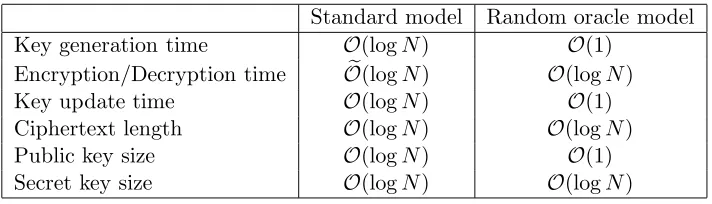
Forward secure encryption. We define a rigorous notion of security for forward-secure public-key encryption and give efficient constructions of schemes satisfying this notion. We prove semantic security of our main scheme in the standard model based on the decisional version of the bilinear Diffie-Hellman (BDH) assumption (cf. [26, 10]). All salient parameters of this scheme are logarith-mic inN, the total number of time periods.
Standard model Random oracle model Key generation time O(logN) O(1)
Encryption/Decryption time Oe(logN) O(logN)
Key update time O(logN) O(1)
Ciphertext length O(logN) O(logN)
Public key size O(logN) O(1)
Secret key size O(logN) O(logN)
Table 1: Summary of dependencies on the total number of time periodsN.
the random oracle model1 under thecomputational BDH assumption (which is presumably weaker
than the decisional BDH assumption). The parameters of our schemes are summarized in Table 1. Both schemes are roughly as efficient as log2N invocations of the Boneh-Franklin identity-based encryption scheme [10] and may therefore be practical for reasonable values ofN.
At a high level, our construction shares similarities with previous tree-based, forward-secure signature schemes (e.g., those of [6, 1, 31]). Here, however, we associate time periods with all the nodes of the tree (in a pre-order traversal) instead of associating time periods with the leaves only; this improves the efficiency of our key-generation and key-update algorithms. We note that this tree traversal technique can also be used to improve the efficiency of these algorithms in the tree-based signature schemes mentioned above, fromO(logN) to O(1).
We also note a number of extensions of our schemes. Using the techniques of Malkin, et al. [31], our schemes can be adapted to support an unbounded number of time periods (i.e., the number of time periods need not be known when the public key is generated and published). This has the added advantage that the efficiency and security of these schemes depend only on the number of time periods elapsed thus far. We also sketch two ways to extend our schemes to achieve security against adaptive chosen-ciphertext attacks [34, 8]. In the standard model, we note that the techniques of Sahai [35] using NIZK proofs (and based on earlier work of Naor and Yung [32]) extend to our setting; interestingly, we show also that general NIZK proofs may be implemented based on the BDH assumption alone (so that we do not require the additional assumption of trapdoor permutations). In the random oracle model, we modify the Fujisaki-Okamoto transformation [18] for our purposes and thereby obtain a secure scheme.
Binary-tree encryption and identity-based encryption. Our constructions are based on the hierarchical identity-based encryption (HIBE) scheme of Gentry and Silverberg [19] which, in turn, is based on the identity-based encryption scheme of Boneh and Franklin [10]. As a first step toward our construction, we define a relaxed variant of HIBE which we call binary tree encryption (BTE). We then show how to modify the Gentry-Silverberg construction to yield a BTE scheme which can be proven secure in the standard model for trees of polynomial depth. (In contrast, the main construction of Gentry and Silverberg is proven secure in the random oracle model, and only for trees of constant depth.) Finally, we construct a forward-secure encryption scheme from any BTE scheme.
We believe the BTE primitive is interesting in its own right. As an example, we show in Appendix A how a full-blown HIBE scheme may be based on any BTE scheme. Combined with
1
our construction of BTE, the resulting scheme is the first known example of an identity-based encryption scheme with a proof of security in the standard model (albeit with respect to a slightly weaker notion of security than that considered by Boneh-Franklin and Gentry-Silverberg).
Remark: forward security vs. adaptive security. A related notion of security for encryption schemes is adaptive security; namely, security against adversaries that choose whom to corrupt in an adaptive way, depending on the information gathered so far (see, e.g., [4, 11]). Although both adaptive security and forward security are concerned with protecting against break-ins that happen during the lifetime of the system, the two notions are incomparable. Clearly, adaptive security does not imply forward security since it only protects the secrecy of messages as long as both the sender and the receiver remain uncorrupted. As soon as a party becomes corrupted, all the messages sent and received by that party may be exposed. On the other hand, one might attempt to use a forward-secure encryption scheme to achieve adaptive security by having the receiver update its secret key after each ciphertext it receives.2 However, this approach does not provide adaptive security against a strong adversary who may see a ciphertext in transmission and then corrupt the receiver before the ciphertext is delivered (and, consequently, before the receiver has a chance to update its secret key). We remark that the last problem is avoided if one makes the non-standard assumption of atomic message delivery so that messages are sent and received in one step and parties cannot be corrupted while messages are in transit.
1.2 Organization
In Section 2 we define BTE and provide a construction which is provably secure under the decisional BDH assumption (described in Section 2.1) in the standard model. In this section we also show a more efficient construction based on the computational BDH assumption in the random oracle model, and discuss some extensions of our schemes (as mentioned above). In Section 3, we formally define forward-security for public-key encryption and show how a forward-secure PKE scheme can be constructed from any BTE scheme. Combining these results, we obtain a forward-secure PKE scheme with the advertised parameters.
2
Binary Tree Encryption
This section defines the notion of binary tree encryption (BTE), and presents a BTE scheme based on the bilinear Diffie-Hellman assumption. As discussed in the introduction, BTE is a relaxed version of hierarchical identity-based encryption (HIBE) [24, 19]. In addition to being an essential step in our construction of forward-secure encryption, we believe BTE is independently interesting: in particular, we show in Appendix A how to implement a full-blown HIBE from BTE; since we describe a BTE whose security can be proven in the standard model, this implies a secure HIBE in the standard model (albeit, with a weaker notion of security than that considered in [19]).
As in HIBE, in BTE we have a “master” public key P K associated with a tree; each node in this tree has a corresponding secret key. To encrypt a message destined for some node, one uses both P K and the name of the target node. The resulting ciphertext can then be decrypted using the secret key of the target node. Moreover, as in HIBE the secret key of any node can be used to derive the secret keys for the children of that node. The only difference between HIBE and BTE is that in the latter we insist on abinary tree, where the children of a nodeware labeledw0 andw1.
2
(Recall that in HIBE the tree can have arbitrary degree, and a child of node v can be labeled v.s
for any arbitrary string s.) A functional definition follows.
Definition 1 A (public-key) binary tree encryption (BTE) scheme is a 4-tuple of ppt algorithms (Gen,Der,Enc,Dec) such that:
• The key generation algorithm Gen takes as input a security parameter 1k and a value ` for the depth of the tree. It returns a master public keyP K and an initial (root) secret keySKε. (We assume that the values of k and `are implicit inP K and all node secret keys.)
• The key derivation algorithm Dertakes as input P K, the name of a node w ∈ {0,1}<`, and its secret key SKw. It returns secret keysSKw0, SKw1 for the two children of w.
• The encryption algorithm Enc takes as input P K, the name of a node w ∈ {0,1}≤`, and a message M. It returns a ciphertext C.
• Thedecryption algorithm Dectakes as inputP K, the name of a nodew∈ {0,1}≤`, its secret keySKw, and a ciphertext C. It returns a message M.
We make the standard correctness requirement: namely, for any (P K, SKε) output by Gen(1k, `), any nodew∈ {0,1}≤` and secret keySKw correctly generated for this node, and any messageM, we have M =Dec(P K, w, SKw,Enc(P K, w, M)).
The security notion that we present here for BTE requires the attacker to commit to the node to be attackedin advance(i.e., before seeing the public key); we call this attack scenario a selective-node (SN) attack (cf. “selective forgery” of signatures [23]). While this definition is weaker than the corresponding definition for HIBE achieved by [19], it suffices for constructing a forward-secure PKE scheme from any BTE scheme (cf. Section 3) in the standard model.
Definition 2 A BTE scheme issecure against selective-node, chosen-plaintext attacks (SN-CPA) if for all polynomially-bounded functions`(·), the advantage of anypptadversaryAin the following game is negligible in the security parameter:3
1. A(1k, `(k)) outputs a namew∗∈ {0,1}≤`(k) of a node.
2. AlgorithmGen(1k, `(k)) outputs (P K, SK
ε). In addition, algorithmDer(· · ·) is run to generate the secret keys of all the nodes on the path from the root to w∗ (we denote this path by P), and also the secret keys for the two children of w∗ (if |w∗|< `). The adversary is given P K
and the secret keys{SKw}for all nodes w of the following form:
– w=w0b, wherew0bis a prefix ofw∗ and b∈ {0,1} (i.e., wis a sibling of some node in P);
– w=w∗0 orw=w∗1 (i.e.,w is a child ofw∗; this is only when |w∗|< `).
(Note that this allows the adversary to computeSKw0 for any node w0 ∈ {0,1}≤`(k) that is
not a prefix ofw∗.)
3. The adversary generates a request challenge(M0, M1). A random bit b is selected and the
adversary is givenC∗ =Enc(P K, w∗, Mb).
At the end of the game the adversary outputs b0 ∈ {0,1}; it succeeds if b0 = b. The adversary’s advantage is the absolute value of the difference between its success probability and 1/2.
Security against chosen-ciphertext attacks is defined as the obvious extension of the above.
Definition 3A BTE scheme issecure against selective-node, chosen-ciphertext attacks(SN-CCA) if for all polynomially-bounded functions`(·), the advantage of anypptadversaryAin the following game is negligible in the security parameter:
1. A(1k, `(k)) outputs a namew∗∈ {0,1}≤`(k) of a node.
2. Algorithm Gen(1k, `(k)) outputs (P K, SK
ε). The adversary is given P K and node secret keys as in Definition 2.
3. The adversary may query a decryption oracle Dec∗(·,·). On query Dec∗(w, C) with w ∈ {0,1}≤`(k), a key SKw is derived from SKε (if one was not derived previously) and the adversary is givenM =Dec(P K, w, SKw, C).
4. The adversary generates a request challenge(M0, M1). A random bit b is selected and the
adversary is givenC∗ =Enc(P K, w∗, Mb).
5. The adversary may continue to queryDec∗(·,·), except that it may not query Dec∗(w∗, C∗) (but it may queryDec∗(w, C∗) withw6=w∗).
At the end of the game the adversary outputs b0 ∈ {0,1}; it succeeds if b0 = b. The adversary’s advantage is the absolute value of the difference between its success probability and 1/2.
2.1 The Bilinear Diffie-Hellman Assumption
The security of our BTE scheme is based on the difficulty of the bilinear Diffie-Hellman (BDH) problem as formalized by Boneh and Franklin [10] (see also [26]). The computational version of this assumption has been used for a number of cryptographic constructions; furthermore, the decisional version of the assumption (called the BDDH assumption in [10]) is also believed to hold. We review the relevant definitions as they appear in [10, 19]. Let 1 and 2 be two cyclic groups of prime
order q, where 1 is represented additively and 2 is represented multiplicatively. We assume a
map ˆe: 1 × 1 → 2 for which the following hold:
1. The map ˆeisbilinear: for allP0, P1 ∈ 1 and allα, β∈ qwe have ˆe(αP0, βP1) = ˆe(P0, P1) αβ.
2. There is an efficient algorithm to compute ˆe(P0, P1) for any P0, P1 ∈ 1.
A BDH parameter generator IG is a randomized, polynomial-time algorithm that takes a se-curity parameter 1k and outputs the description of two groups 1, 2 and a map ˆe satisfying the
above conditions. We define the computational BDH problem with respect to IG as the following: given ( 1, 2,eˆ) output by IG along with random P, αP, βP, γP ∈ 1, compute ˆe(P, P)αβγ. We
say that IG satisfies the computational BDH assumption if the following probability is negligible (ink) for all pptalgorithms A:
Pr
( 1, 2,eˆ)← IG(1k);P ← 1;α, β, γ ← q: A( 1, 2,ˆe, P, αP, βP, γP) = ˆe(P, P)αβγ
The decisional BDH problem is to distinguish between tuples of the form (P, αP, βP, γP, αβγP) and (P, αP, βP, γP, µP) for randomP, α, β, γ, µ. Formally, we sayIG satisfies the decisional BDH assumption if the following probability is negligible (in k) for allppt algorithms A:
Pr
( 1, 2,eˆ)← IG(1k);P ← 1;α, β, γ,← q: A( 1, 2,e, P, αP, βP, γP, αβγPˆ ) = 1
−Pr
( 1, 2,eˆ)← IG(1k);P ← 1;α, β, γ, µ← q: A( 1, 2,e, P, αP, βP, γP, µPˆ ) = 1
.
The decisional BDH assumption immediately implies that it is computationally infeasible to dis-tinguish between tuples of the form (P, αP, βP, γP,eˆ(P, P)αβγ) and (P, αP, βP, γP, r) for random
P ∈ 1, α, β, γ ∈ q, and r∈ 2.
BDH parameter generators believed to satisfy the above assumptions can be constructed from Weil and Tate pairings associated with super-singular elliptic curves or Abelian varieties. As our results do not depend on any specific instantiation, we refer the interested reader to [10] for details.
2.2 A BTE Scheme Based on the BDH Assumption
Our main result of this section is the following:
Theorem 1 Under the decisional BDH assumption, there exists a BTE scheme that is secure in the sense of SN-CPA.
We describe such a scheme now. The starting point for our construction is the HIBE scheme of Gentry and Silverberg [19]. Unlike their scheme, our scheme will be proven secure in the standard model and for trees of polynomial depth. (It is immediate that the scheme of [19] may be used to implement a secure BTE in the random oracle model for trees of constant depth.) The HIBE of Gentry and Silverberg (as well as the IBE scheme of Boneh and Franklin [10]) uses random oracles in three ways: to derive random elements from identities, to efficiently achieve semantic security based on the computational BDH assumption, and to obtain chosen-ciphertext security. The latter two uses of the random oracle can easily be avoided if one is willing forgo chosen-ciphertext security and to use the decisional BDH assumption. More interestingly, we show below that the random oracle mapping identities to group elements can be replaced by an O(`)-wise independent hash function (recall from Definition 2 that `is the depth of the tree). Additionally, a proof of security may be obtained even for trees of polynomial depth.
Notation and conventions. In the description below we let ` denote the depth of the tree. The i-bit prefix of a string w1w2. . . wt is denoted byw|i. Namely, w|i =w1. . . wi. In our scheme, we use a (2`+ 1)-wise independent family H of functions H : {0,1}≤` →
1 for which, given
elements x1, . . . , xk ∈ {0,1}≤` and g1, . . . , gk ∈ 1 (with k ≤ 2`+ 1), it is possible to efficiently
sample a random H ∈ H satisfying H(xi) = gi for i = 1, . . . , k. One possible instantiation is to let H={Hh0,...,h2`(x)}h0,...,h2`∈ 1, where Hh0,...,h2`(x)
def
= h0+ ˜xh1+· · ·+ ˜x2`h2` and ˜x represents some fixed one-to-one encoding of x ∈ {0,1}≤` as an element in
q (this requires that 2
`+1 ≤ q;
alternately, we can include in the public key a universal one-way hash function mapping {0,1}≤` to q). We let εdenote the empty string. Finally, IG is a BDH parameter generator believed to
satisfy the decisional BDH assumption.
Gen(1k, `) does the following:
2. Select a random generatorP ∈ 1 and a randomα∈ q. SetQ=αP.
3. Choose a random functionH ∈ H (note: `is implicit inH).
4. The public key isP K = ( 1, 2,e, P, Q, `, Hˆ ). The root secret key isSKε =αH(ε).
In general, forw=w1. . . wt, the secret key of nodewwill consist of t+ 1 group elements; these are denoted by SKw = (Rw|1, Rw|2, . . . , Rw|t−1, Rw, Sw) (for the special case of w = ε we simply have SKε=Sε=αH(ε)). With this in mind, we now describe the key derivation algorithm.
Der(P K, w, SKw) does the following:
1. Letw=w1. . . wt. ParseSKw as (Rw|1, Rw|2, . . . , Rw|t−1, Rw, Sw).
2. Choose random ρw0, ρw1 ∈ q. Set Rw0 =ρw0P, Rw1 =ρw1P, Sw0 =Sw+ρw0H(w0), and Sw1 =Sw+ρw1H(w1).
3. OutputSKw0= (Rw|1, . . . , Rw, Rw0, Sw0) and SKw1 = (Rw|1, . . . , Rw, Rw1, Sw1).
Slightly better efficiency is possible — without affecting the security of the scheme — by setting
ρw0 = ρw1. Doing so will also result in a slightly shorter secret key when this scheme is used to
construct a forward-secure PKE scheme in the following section.
Enc(P K, w, M) (whereM ∈ 2) does the following:
1. Letw=w1. . . wt. Select randomγ ∈ q.
2. OutputC= (γP, γH(w|1), γH(w|2), . . . , γH(w), M·d), whered= ˆe(Q, H(ε))γ.
Dec(P K, w, SKw, C) does the following:
1. Letw=w1· · ·wt, parseSKw as (Rw|1, . . . , Rw, Sw), and parseC as (U0, U1, . . . , Ut, V).
2. OutputM =V /d, where
d= Qt eˆ(U0, Sw) i=1 eˆ(Rw|i, Ui)
.
We verify that decryption succeeds. When encrypting, we haved= ˆe(Q, H(ε))γ = ˆe(P, H(ε))αγ. When decrypting, we haveU0=γP, andUi=γH(w|i) for 1≤i≤t (wheret=|w|). Hence,
d = Qt eˆ(U0, Sw) i=1 ˆe(Rw|i, Ui)
= ˆe γP, αH(ε) + Pt
i=1 ρw|iH(w|i)
Qt
i=1 e ρˆ w|iP, γH(w|i)
= ˆe(P, H(ε)) αγ·Qt
i=1 ˆe(P, H(w|i))γρw|i
Qt
i=1 ˆe(P, H(w|i))γρw|i
= ˆe(P, H(ε))γα
and thus decryption recoversM. Theorem 1 is established by the following proposition.
Proof Let `(·) be some function which is polynomially-bounded; in what follows, we simply write ` instead of `(k). Assume a ppt adversary A attacking the above scheme in the SN-CPA attack scenario, and denote the probability that A succeeds by PrA[Succ]. We construct a new adversaryB which attempts to solve the decisional BDH problem with respect to IG. Relating the advantage of B to the advantage of A gives the desired result. In the description below we denote byw|i the sibling of w|i; namely,w|i consists of the (i−1)-bit prefix ofwfollowed by the negation of theith bit ofw. (Thus,w|
i andw|i agree on their firsti−1 bits and differ only in their last bit.) The new adversary B is given the output ( 1, 2,eˆ) of IG(1k) and also (P, Q = αP, Iε = βP, U0 =γP, V0 =µP); the goal of B (informally) is to determine whether µ=αβγ or not. For
that purpose, B attempts to simulate an instance of the encryption scheme for A as follows: B
initiates a run of A, and A commits to the target node w∗ =w∗
1w∗2. . . w∗t (with t≤ `). Now, for 1≤i≤t, B choosesχi, λi, and ϕi at random from q. If t < `, then for b∈ {0,1} it also chooses λbt+1 and ϕbt+1 at random from q. Then B randomly chooses a hash function H : {0,1}
≤` →
1
from the family Hsubject to the following constraints:
1. H(ε) =Iε.
2. H(w∗|
i) =χiP for 1≤i≤t.
3. H(w∗|i) =λiP −ϕi1Iε for 1≤i≤t.
4. Ift < `, then also H(w∗0) =λ0
t+1P −ϕ01 t+1
Iε and H(w∗1) =λ1t+1P − ϕ11 t+1
Iε.
Note that since there are at most 2`+1 constraints,Bcan choose such a (random)H∈ Hefficiently. Furthermore, becauseHis a (2`+1)-independent family of functions, this choice ofHis distributed identically to H in the real experiment. B sets P K = ( 1, 2,e, P, Q, `, Hˆ ) and gives P K to A.
Next, B generates secret keys for siblings of the nodes on the path from the root tow∗, as well as for the children ofw∗(in caset < `). Recall that from these secret keysAcan derive appropriate secret keys for any node w in the tree such that w is not a prefix ofw∗. To generate these secret keys,B chooses (for 1≤i≤t)Rw∗|
i ∈ 1 at random and furthermore sets Rw∗|i =ϕiQ. Next, for all 1≤i≤t, B sets
Sw∗|
i =λiϕiQ+ i−1
X
j=1
χiRw∗|
j.
(For i= 1 the upper limit of the summation is less than the lower limit; by convention, we let the sum in this case be 0.) Additionally, ift < `thenB additionally sets (forb∈ {0,1})Rw∗b =ϕbt+1Q
and Sw∗b =λbt+1ϕbt+1Q+Ptj=1χiRw∗|
j. Note that, having done so, B can now provide A with all relevant secret keys.
We now verify that these keys have the correct distribution. For 1≤i≤tletρw∗|i ∈ qbe such
that Rw∗|
i =ρw∗|iP with an analogous definition forρw∗|i; note that ρw∗|i = ϕiα. Clearly, these ρ-values are all independently and uniformly distributed in q. Furthermore, in a real execution of
the SN-CPA experiment we would have Sw =αH(ε) +Pj|w=1| ρw|jH(w|j) for any w. For w =w ∗|
i this means
Sw∗|
i = αIε+
i−1
X
j=1
ρw∗|
jH(w ∗|
j)
+ρw∗|
iH(w ∗|
i)
= αIε+
i−1
X
j=1
ρw∗|
jχjP
+ϕiα(λiP − 1
= λiϕiQ+ i−1
X
j=1
χjRw∗|
j
The analysis for the nodesw∗0 andw∗1 (in case t < `) is exactly analogous.
Continuing its execution of A (after having provided the appropriate secret keys), B responds to the querychallenge(M0, M1) by choosing a random bit band returning
C = (U0, χ1U0, . . . , χtU0, eˆ(P, V0)·Mb) = (γP, χ1γP, . . . , χtγP, eˆ(P, µP)·Mb) = (γP, γH(w∗|1), . . . , γH(w∗), eˆ(P, P)µ·Mb).
Finally, if Aoutputsb0=bthenB outputs “1”; otherwise, B outputs “0”.
Recalling that Q = αP and H(ε) = Iε = βP, we can re-write the last component of C as (ˆe(Q, H(ε))γ)µ/αβγ·Mb. Thus, ifµ=αβγ thenC is indeed a (random) valid encryption ofMb and the probability thatBoutputs 1 is exactly PrA[Succ]. On the other hand, whenµis random the last element ofC is uniformly distributed in 2, independent ofb, and thereforeC is independent of b.
In this case, then, B outputs 1 with probability at most 1/2. The advantage of B is therefore at least|PrA[Succ]−1/2|; since the advantage ofBis negligible (by assumption onIG), the advantage of Amust be negligible as well. This concludes the proofs of Proposition 1 and Theorem 1.
Scheme parameters. In the construction above, a secret key of nodewat leveltconsists oft+ 1 elements of 1. However, we may notice that all elements of the secret key except forRw and Sw already appear in the secret key of the parent of w. Thus, the secret keys of all the nodes on the path from the root to w can be stored using only O(t) group elements (we make use of this fact when constructing our forward-secure PKE in the following section).
The key-generation algorithm requires time linear in ` (the depth of the tree), where this complexity is due to selection of the hash function H. The key-derivation algorithm requires a constant number of operations in 1 and two applications of the hash functionH; a single evaluation
of H requiresO(`) time when H is anO(`)-degree polynomial as suggested above. Encryption for a node at level t requires t applications of H, t+ 1 multiplications in 1, one application of ˆe,
and one multiplication and one exponentiation in 2. (Note that one can evaluate H on tdistinct
points (for t≤`) in time O(`log2`) — rather than the na¨ıveO(t`) — whenH is a 2`+ 1-degree polynomial [2, Section 8.5].) Decryption by a node at level trequires t+ 1 evaluations of ˆe along witht operations in 2.
Applications to HIBE. One can construct a full-blown HIBE scheme from any BTE scheme simply by encoding in binary all the identities in the system using collision-resistant hashing at every level of the hierarchy. (The security obtained, however, is weaker than that guaranteed by [19].) See Appendix A for details.
Construction in the random oracle model. The scheme above remains secure if the hash functionH is replaced with a cryptographic hash function modeled as a random oracle. (A proof of security is immediate since a random oracle, in particular, acts as a (2`+ 1)-wise independent hash function for any polynomial function`.) InstantiatingH in this way improves several of the scheme parameters: the public-key size, key-generation time, and key-update time are now independent of `, and encryption now takes timeO(`) (as opposed to ˜O(`)).
Once we are working in the random oracle model, the scheme may be further modified so that its security is based on the computational BDH assumption rather than the decisional version4:
4
simply replace the component M ·eˆ(Q, H(ε))r of the ciphertext by M ⊕H0(ˆe(Q, H(ε))r), where
H0 :
2 → {0,1}n is modeled as an independent random oracle.
Achieving chosen-ciphertext security. We sketch how our schemes may be modified so as to achieve security in the sense of SN-CCA. In the standard model, we may extend to our setting the techniques of Sahai [35] based on earlier work of Naor and Yung [32] (see also [30]); namely, we use simulation-sound NIZK proofs to achieve chosen-ciphertext security. In more detail (we assume the reader is familiar with [35, 30]), we construct a BTE scheme secure in the sense of SN-CCA as follows: The public key consists of a randomly-generated stringrfor a simulation-sound NIZK proof system, as well as two independently-generated public keysP K1, P K2 for a BTE scheme secure in
the sense of SN-CPA. The root secret key is the secret key SKε corresponding to P K1, and key
derivation is done in the obvious way. To encrypt message M for node w, the sender computes
C1←Enc(P K1, w, M),C2 ←Enc(P K2, w, M), and a simulation-sound NIZK proof of consistencyπ
using string r (explained in more detail below); the output ciphertext is C =hw, C1, C2, πi. The
proof π guarantees that (w, C1, C2, P K1, P K2) is in the languageL defined by:
L={(w, C1, C2, P K1, P K2) | ∃M s.t. C1 =Enc(P K1, w, M) and C2=Enc(P K2, w, M)};
that is,C1 andC2 are both encryptions of the same message M for the specified nodew. Node w
with secret key SKw decrypts ciphertext hw0, C1, C2, πi by first checking whether w0 =? w and
whether π is an accepting proof (with respect to r) of the statement (w0, C1, C2, P K1, P K2) ∈L.
If so, the output isDec(P K1, w, SKw, C1); otherwise, the output is⊥. We omit the tedious details
(which follow [35, 30]) that this scheme is indeed secure in the sense of SN-CCA.
It is known that simulation-sound NIZK (admitting efficient provers) may be based on the assumption of trapdoor permutations [35, 17]. We observe, additionally, that simulation-sound NIZK in the common reference string model5 may also be based on the (seemingly incomparable) decisional BDH assumption. To see this, note that Sahai’s construction [35] of simulation-sound NIZK may be based on any (standard) NIZK proof system. These, in turn, may be constructed using the “hidden-bits paradigm” set forth in [17] (see also [20, Section 4.10.2]). Our key observation (see Appendix B) is that this “hidden-bits paradigm” (which is usually achieved using trapdoor permutations) may be implemented usingpublicly-verifiable trapdoor predicates — a generalization of trapdoor permutations considered previously [16] and formally introduced here. We furthermore show in Appendix B how the decisional BDH assumption naturally gives rise to a publicly-verifiable trapdoor predicate. Combining these results yields the following theorem:
Theorem 2 Under the decisional BDH assumption, there exists a BTE scheme that is secure in the sense of SN-CCA.
In the random oracle model, we can achieve a more efficient scheme by applying, e.g., a secure variant of the Fujisaki-Okamoto transformation [18] (note that the Fujisaki-Okamoto transforma-tion only applies to standard PKE and must be appropriately modified for the case of BTE). We propose the following scheme: Let (Enc0,Dec0) represent any symmetric-key encryption scheme se-cure in the sense of IND-P0-C2 (cf. [27]), let Enc denote (the encryption algorithm for) a BTE scheme secure in the sense of SN-CPA which encrypts messages at least as long as the security
5In the common reference string model — to be distinguished from the common random string model — the reference stringrmay be chosen from an arbitrary, poly-time computable distribution (and not necessarily a uniform
one). Since the stringr included with the public key is generated by the recipient (and not by some third party),
parameter, and letH andGdenote independent random oracles which are also independent of any random oracles used by EncorEnc0. Consider then the following BTE schemeEnc00:
Enc00(P K, w, M) =hEnc(P K, w, σ;H(w, σ, M)),Enc0G(σ)(M)i,
where σ is a randomly-chosen value and the notation Enc(·,·,·;r) denotes that random coins r
are used when performing the stated encryption. Key generation and key derivation are done in the obvious way. A node w with secret key SKw decrypts ciphertext hC1, C2i by computing
σ =Dec(P K, w, SKw, C1) andM =Dec0G(σ)(C2). IfC1 =? Enc(P K, w, σ;H(w, σ, M)), the output
isM; otherwise, the output is⊥. Security of this modified scheme is given by the following theorem, whose proof exactly follows that of [18]:
Theorem 3 If Enc is a BTE scheme secure in the sense of SN-CPA, and Enc0 is a symmetric-key encryption scheme secure in the sense of IND-P0-C2, then the above construction yields a BTE scheme secure in the sense of SN-CCA in the random oracle model.
3
Forward-Secure Public-Key Encryption
In this section, we provide a definition of security for forward-secure public-key encryption and mention two “trivial” forward-secure schemes whose complexity is linear in the total number of time periods. As our main result — which is an immediate application of the BTE primitive discussed in the previous section — we then describe a construction of a forward-secure scheme all of whose parameters grow at most logarithmically with the total number of time periods.
3.1 Definitions
We first provide a syntactic definition of key-evolving public-key encryption schemes, and then define what it means for such a scheme to achieve forward security. The former is a straightforward adaptation of the notion of key-evolving signature schemes [6]; the latter, however, is new and requires some care.
Definition 4 A (public-key) key-evolving encryption (ke-PKE) scheme is a 4-tuple of ppt algo-rithms (Gen,Upd,Enc,Dec) such that:
• Thekey generation algorithm Gentakes as input a security parameter 1kand the total number of time periodsN. It returns a public key P K and an initial secret key SK0.
• Thekey update algorithm Updtakes as inputP K, an indexi < N of the current time period, and the associated secret key SKi. It returns the secret key SKi+1 for the following time
period.
• The encryption algorithm Enc takes as input P K, an index i≤ N of a time period, and a message M. It returns a ciphertext C.
• Thedecryption algorithm Dectakes as inputP K, an indexi≤N of the current time period, the associated secret key SKi, and a ciphertext C. It returns a message M.
We make the standard correctness requirement: namely, for any (P K, SK0) output byGen(1k, N),
Our definitions of forward-secure public-key encryption generalize the standard notions of se-curity for PKE, similar to the way in which the definitions of [6] generalize the standard notion of security for signature schemes.
Definition 5 A ke-PKE scheme is forward-secure against chosen plaintext attacks (fs-CPA) if for all polynomially-bounded functionsN(·), the advantage of anypptadversary in the following game is negligible in the security parameter:
Setup: Gen(1k, N(k)) outputs (P K, SK0). The adversary is given P K.
Attack: The adversary issues one breakin(i) query and one challenge(j, M0, M1) query, in either
order, subject to 0≤j < i < N. These queries are answered as follows:
• On query breakin(i), key SKi is computed via Upd(P K, i−1,· · ·Upd(P K,0, SK0)· · ·). This
key is then given to the adversary.
• On query challenge(j, M0, M1), a random bit b is selected and the adversary is given C∗ =
Enc(P K, j, Mb).
Guess: The adversary outputs a guessb0∈ {0,1}; it succeeds ifb0=b. The adversary’sadvantage is the absolute value of the difference between its success probability and 1/2.
We give an analogous definition incorporating chosen-ciphertext attacks by the adversary.
Definition 6A ke-PKE scheme isforward-secure against chosen-ciphertext attacks (fs-CCA) if for all polynomially-bounded functionsN(·), the advantage of anypptadversary in the following game is negligible in the security parameter:
Setup: Gen(1k, N) outputs (P K, SK
0). The adversary is given P K.
Attack: The adversary issues one breakin(i) query, one challenge(j, M0, M1) query, and multiple
Dec(k, C) queries, in any order, subject to 0 ≤ j < i < N and 0 ≤ k < N. These queries are answered as follows:
• Thebreakin and challenge queries are answered as in Definition 3.1.
• On query Dec∗(k, C), the appropriate key SKk is first derived using SK0 and P K. Then,
the adversary is given the outputDec(P K, k, SKk, C). If the adversary has already received responseC∗from querychallenge(j, M0, M1), then queryDec∗(j, C∗) is disallowed (but queries
Dec(k, C∗), with k6=j, are allowed).
Guess: The adversary outputs a guessb0∈ {0,1}; it succeeds ifb0=b. The adversary’sadvantage is the absolute value of the difference between its success probability and 1/2.
Remark 1: On the order of the breakin/challenge queries. The definitions above allow the adversary to make thebreakin and thechallenge queries in either order. Without loss of generality, however, we may assume the adversary makes thebreakinquery first. (Specifically, given an adversaryA that querieschallenge(j, M0, M1) before its breakinquery, it is easy to construct an
adversaryB that queriesbreakin(j+ 1) followed by this same challenge query and can then answer any subsequentbreakin queries of A; this B will achieve the same advantage as A.)
to the need to guess the location of the eventualchallengequery in advance. SinceN is polynomial ink, this reduction in security is tolerable. Still, it is better to avoid it.
Remark 2: Relaxing chosen-ciphertext security. Note that Definition 6 allows the ad-versary to make decryption queries for various time periods in arbitrary order (not necessarily chronological). Furthermore, the adversary is allowed to obtain the decryption of the challenge ciphertext C∗, as long as the decryption is for a different time period than the one in which the ciphertext was generated. This extra power given to the adversary results in a definition that is probably stronger than what is needed in most settings, and can potentially be relaxed and still pro-vide adequate security. Still, we present this notion since it is the strongest natural interpretation of the CCA paradigm and the CCA-secure variants of our scheme achieve it.
3.2 Forward-Secure PKE Schemes with Linear Complexity
For completeness, we discuss some simple approaches to forward-secure PKE yielding schemes with linear complexity in at least some parameters. One trivial solution is to generate N independent public-/private- key pairs {(ski, pki)} and to set P K = (pk0, . . . , pkN−1). In this scheme, the key
SKifor time periodiwill simply consist of (ski, . . . , skN−1). Algorithms for encryption, decryption,
and key update are immediate. The drawback of this trivial solution is an N-fold increase in the sizes of the public and secret keys, as well as in the key-generation time. Anderson [3] noted that an improved solution can be built from an identity-based encryption scheme. Here, the public key is the “master public key” of the identity-based scheme, and SKi is computed as the “personal secret key” of a user with identityi(the scheme is otherwise identical to the above). This solution achieves O(1) public key size, but still hasO(N) secret-key size and key-generation time.
In fact, one can improve this last solution somewhat: instead of a large secret key, it is enough if the user keeps a large non-secret file containing one record per period. The record for period i
contains the secret keySKi encrypted under the public key for time periodi−1. At the beginning of period i, the user obtains record i, uses key SKi−1 to recover SKi, and then erases SKi−1.
This solution achieves essentially the same efficiency as the “simple forward-secure signatures” of Krawczyk [29] (and in particular requiresO(N) non-secret storage and key-generation time).
3.3 A Construction with Logarithmic Complexity
We now construct an encryption scheme secure in the sense of fs-CPA (resp. fs-CCA) from any BTE scheme secure in the sense of SN-CPA (resp. SN-CCA). Our construction is straightforward and is easily seen to be secure given the machinery we have developed for BTE schemes in the previous section.
At a high level, the construction proceeds as follows: To obtain a forward-secure scheme with
N = 2`+1−1 time periods (labeled 0 throughN −1), simply use a BTE of depth` and associate the time periods with all nodes of the tree according to a pre-order traversal. (Let wi denote the node associated with periodi. In a pre-order traversal, w0 =εand if wi is an internal node then
the secret keys for wi+1 and its sibling (i.e., the two children of wi) are derived; otherwise, the secret key for node wi+1 is already stored as part of the secret key. In either case, the key for
nodewi is then deleted. Note that this maintains the property thatSKi+1 contains the secret key
forwi+1 as well as those for all right siblings of the nodes on the path from the root towi+1. Also, at miost lkeys are kept at any point in time.
Our method of associating time periods with nodes of a binary tree is reminiscent of previous tree-based forward-secure signature schemes [6, 1, 31]. However, we associate time periods withall nodes of a binary tree rather than with the leaves only (as was done in prior work); this results in efficiency improvement fromO(logN) to O(1) in the key-generation and key-update times. We remark that our tree-traversal method can also be applied to the signature schemes of [6, 1, 31] with similar efficiency gain.
More formally, given a BTE scheme (Gen, Der, Enc, Dec), we may construct a ke-PKE scheme (Gen0, Upd, Enc0,Dec0) as follows.
• Algorithm Gen0(1k, N) runs Gen(1k, `), where N ≤ 2`+1−1, and obtains P K, SKε. It then outputsP K0 = (P K, N), andSK0
0 =SKε.
• Algorithm Upd(P K, i, SKi0) has SKi0 organized as a stack of node keys, with the secret keySKwi on top. We first pop this key off the stack. Ifwiis a leaf node, the next key on top of the stack isSKwi+1. Ifwi is an internal node, compute (SKwi0, SKwi1)←Der(P K, wi, SKwi) and pushSKwi1 and then SKwi0 onto the stack. The new key on top of the stack isSKwi0 (and indeed wi+1 =wi0). In either case, node key SK
wi is then erased.
• AlgorithmEnc0(P K0, i, M) runsEnc(P K, wi, M). Note thatwi is publicly computable giveni
and N.
• Algorithm Dec0(P K0, i, SKi0, M) runs Dec(P K, wi, SKwi, M). Note that SKwi is always stored as part ofSK0
i.
Theorem 4 If BTE scheme(Gen,Der,Enc,Dec)is secure in the sense of SN-CPA (resp. SN-CCA) then ke-PKE scheme (Gen0,Upd,Enc0,Dec0) is secure in the sense of fs-CPA (resp. fs-CCA)
Proof The proof proceeds via straightforward reduction. Assume we have an adversaryA0 with advantage ε(k) in an fs-CPA (resp. fs-CCA) attack against (Gen0,Upd,Enc0,Dec0). We construct an adversaryA that obtains advantage ε(k)/N in the corresponding attack against the underlying BTE scheme (Gen,Der,Enc,Dec). SinceN is polynomial in the security parameterk, the theorem follows. We now define adversaryA:
1. A chooses uniformly at random a time period i∗ ∈[0, N) and outputs wi∗
. Next, A obtains the public key P K and the appropriate secret keys for the BTE scheme.
2. A runsA0 with public key (P K, N).
3. When A0 queries breakin(j) (recall from Remark 1 that without loss of generality A0 makes itsbreakinquery before itschallenge query), if j≤i∗ thenA outputs a random bit and halts. Otherwise,Acomputes the appropriate secret keySKj0 and gives this toA0. (Observe thatA
can efficiently compute SKj0 forj > i∗ from the secret keys it has been given.)
4. When A0 queries challenge(i, M0, M1), if i 6= i∗ then A outputs a random bit and halts.
5. If decryption queries are allowed, note that A can respond to queries Dec0∗(k, C) of A0 by simply queryingDec∗(wk, C) and returning the result to A0.
6. WhenA0 outputsb0, Aoutputsb0 and halts.
It is straightforward to see that wheni∗ =ithe copy ofA0 running within Ahas exactly the same view as in a real fs-CPA (resp. fs-CCA) interaction. Since A guesses i∗ =i with probability 1/N, we have that A correctly predicts the bit bwith advantage ε(k)/N.
Analysis of complexity parameters. Each of the four operations (key generation, key update, encryption, and decryption) requires at most one operation of the underlying BTE scheme. We have also noted in the previous section how the secret keys corresponding to any time period can be stored using only O(logN) group elements (rather than the na¨ıve O(log2N)). This justifies the claims given in Table 1 (for schemes achieving security in the sense of fs-CPA), and yields the following corollary.
Corollary 1 Under the decisional BDH assumption, there exists a ke-PKE scheme that is secure in the sense of fs-CPA. Furthermore, all parameters of this scheme are polylogarithmic in the total number of time periods.
Supporting an unbounded number of time periods. In our description above, we have assumed that the number of time periods N is known at the time of key generation. However, it is easy to modify our scheme to support an “unbounded” (i.e., arbitrary polynomial) number of time periods by using a BTE scheme with depth ` = ω(logk). Following [31], we can further improve this scheme so that its efficiency depends only logarithmically on the number of time periods elapsed thus far (a simple pre-order traversal using a tree of depth ω(logk) results in a scheme with superlogarithmic dependence onN for anyN =poly(k)).
Acknowledgments
The third author is very grateful to Craig Gentry for helpful discussions regarding [19] and for providing him with a preliminary version of that work.
References
[1] M. Abdalla and L. Reyzin. A new forward-secure digital signature scheme. Asiacrypt 2000, LNCS vol. 1976, pp. 116–129, Springer-Verlag, 2000.
[2] A. Aho, J. Hopcroft, and J. Ullman. The Design and Analysis of Computer Algorithms. Addison-Wesley, 1975.
[3] R. Anderson. Two remarks on public key cryptology. Invited Lecture, ACM-CCS ’97.
http://www.cl.cam.ac.uk/ftp/users/rja14/forwardsecure.pdf.
[4] D. Beaver and S. Haber. Cryptographic protocols provably secure against dynamic adversaries. InEurocrypt ’92, LNCS vol. 658, pp. 307–323, Springer-Verlag, 1992.
[6] M. Bellare and S. K. Miner. A forward-secure digital signature scheme. Crypto ’99, LNCS vol. 1666, pp. 431–448, Springer-Verlag, 1999.
[7] M. Bellare and B. Yee. Forward security in private-key cryptography. CT-RSA 2003, LNCS vol. 2612, pp. 1–18, Springer-Verlag, 2003.
[8] M. Bellare, A. Desai, D. Pointcheval, and P. Rogaway. Relations among notions of security for public-key encryption schemes. Crypto ’98, LNCS vol. 1462, pp. 26–45, Springer-Verlag, 1998.
[9] M. Bellare and M. Yung. Certifying permutations: non-interactive zero-knowledge based on any trapdoor permutation.J. Cryptology 9(3): 149–166 (1996).
[10] D. Boneh and M. Franklin. Identity based encryption from the Weil pairing. Crypto 2001, LNCS vol. 2139, pp. 213–229, Springer-Verlag, 2001. Full version to appear in SIAM J. Computing and available at http://eprint.iacr.org/2001/090.
[11] R. Canetti, U. Feige, O. Goldreich, and M. Naor. Adaptively secure computation. STOC ’96, pp. 639–648, ACM, 1996. Also MIT-LCS-TR #682, 1996.
[12] I.B. Damg˚ard. Collision free hash functions and public-key signature schemes. Eurocrypt ’87, LNCS vol. 304, pp. 203–216, Springer-Verlag, 1987.
[13] I.B. Damg˚ard and J.B. Nielsen. Improved non-committing encryption schemes based on a general complexity assumption. Crypto ’00, LNCS vol. 1880, pp. 432–450, Springer-Verlag, 2000.
[14] Y. Desmedt and Y. Frankel. Threshold cryptosystems.Crypto ’89, LNCS vol. 435, pp. 307–315, Springer-Verlag, 1989.
[15] W. Diffie, P. C. Van-Oorschot, and M. J. Weiner. Authentication and authenticated key exchanges. Designs, Codes, and Cryptography 2:107–125, 1992.
[16] Y. Dodis, J. Katz, S. Xu, and M. Yung. Strong key-insulated signature schemes. PKC ’03, LNCS vol. 2567, pp. 130–144, Springer-Verlag, 2003.
[17] U. Feige, D. Lapidot, and A. Shamir. Multiple non-interactive zero-knowledge proofs under general assumptions. SIAM J. Computing 29(1): 1–28 (1999).
[18] E. Fujisaki and T. Okamoto. Secure integration of asymmetric and symmetric encryption schemes. Crypto ’99, LNCS 1666, pp. 537–554, Springer-Verlag, 1999.
[19] C. Gentry and A. Silverberg. Hierarchical identity-based cryptography. Asiacrypt 2002, LNCS vol. 2501, pp. 548–566, Springer-Verlag, 2002.
[20] O. Goldreich. Foundations of Cryptography, vol. 1: Basic Tools. Cambridge University Press, 2001.
[21] O. Goldreich. Foundation of Cryptography, vol. 2. Available on-line from
http://www.wisdom.weizmann.ac.il/~oded/foc-vol2.html.
[23] S. Goldwasser, S. Micali, and R. Rivest. A digital signature scheme secure against adaptive chosen-message attacks. SIAM J. Computing, 17(2):281–308, April 1988.
[24] J. Horwitz and B. Lynn. Toward hierarchical identity-based encryption.Eurocrypt 2002, LNCS vol. 2332, pp. 466–481, Springer-Verlag, 2002.
[25] G. Itkis and L. Reyzin. Forward-secure signatures with optimal signing and verifying. Crypto 2001, LNCS vol. 2139, pp. 499–514, Springer-Verlag, 2001.
[26] A. Joux and K. Nguyen. Separating decision Diffie-Hellman from Diffie-Hellman in cryptographic groups. Manuscript, January 2001. Available at
http://eprint.iacr.org/2001/003/.
[27] J. Katz and M. Yung. Complete characterization of security notions for probabilistic private-key encryption. STOC 2000, ACM, 2000.
[28] A. Kozlov and L. Reyzin. Forward-secure signatures with fast key update. Security in Com-munication Networks, LNCS vol. 2576, pp. 247–262, Springer-Verlag, 2002.
[29] H. Krawczyk. Simple forward-secure signatures from any signature scheme. ACM-CCS 2000, pp. 108–115, ACM, 2000.
[30] Y. Lindell. A simpler construction of CCA2-secure public-key encryption under general as-sumptions. Eurocrypt 2003, LNCS vol. 2656, pp. 241–254, Springer-Verlag, 2003.
[31] T. Malkin, D. Micciancio, and S. K. Miner. Efficient generic forward-secure signatures with an unbounded number of time periods. Eurocrypt 2002, LNCS vol. 2332, pp. 400–417, Springer-Verlag, 2002.
[32] M. Naor and M. Yung, Public key cryptosystems provably secure against chosen ciphertext attacks, STOC ’90, pp. 427–437, ACM, 1990.
[33] R. Ostrovsky and M. Yung. How to withstand mobile virus attacks. PODC ’91, pp. 51–59, ACM, 1991.
[34] C. Rackoff and D. Simon. Non-interactive zero-knowledge proof of knowledge and chosen ciphertext attack. Crypto ’91, LNCS vol. 576, pp. 433–444, Springer-Verlag, 1991.
[35] A. Sahai. Non-malleable non-interactive zero-knowledge and adaptive chosen-ciphertext secu-rity. FOCS ’99, pp. 543–553, IEEE, 1999.
[36] A. Shamir. How to share a secret. Comm. of the ACM22(11):612–613, 1979.
A
Basing HIBE on BTE
Here we show how one can construct a full-blown hierarchical identity-based encryption scheme (HIBE) from any binary-tree encryption scheme (BTE). The construction is straightforward: we encode all the identities in binary using a collision-resistant hash function; this maps “ID-vectors” to fixed-length strings. In this way, any “ID-vector” is mapped to a node in the complete binary tree of the underlying BTE scheme. Below, we define the HIBE functionality similarly to [24, 19],6
6
introduce the notions of SN-security for HIBE, and then show that the above obvious construction indeed transforms any SN-secure BTE to a SN-secure HIBE.
A.1 Definitions
In all the definitions below, an ID-vector v is a vector of strings; i.e., v ∈ ({0,1}∗)∗. The empty vector is denoted (). Ifv= (v1, . . . , v`) is an ID-vector andv`+1 is any string, then byv.r we mean
the ID-vector (v1, . . . , v`, v`+1). For two ID-vectors u= (u1, . . . , u`1) and v = (v1, . . . , v`2), we say thatu is a prefix of v if`1≤`2 and ui =vi fori≤`1.
Definition 7A hierarchical identity-based encryption (HIBE) scheme is a 4-tuple of pptalgorithms (Gen,Ext,Enc,Dec) such that:
• Thekey generation algorithm Gentakes as input a security parameter 1k and a value`for the depth of the tree. It returns a master public key P K and an initial (root) secret key SK(). (This algorithm is called Setup in [24] and Root-setup in [19].) We assume that the values of k and `are implicit inP K and all node secret keys.
• Thekey extraction algorithm Exttakes the public key P K, an ID-vector v∈({0,1}∗)<` and its associated secret keySKv, and a string r. It returns the secret keySKv.r, associated with the ID-vector v.r. (This algorithm is called KeyGeni in [24] and Extraction in [19].)
• The encryption algorithm Enc takes a public key P K, an ID-vector v ∈ ({0,1}∗)≤`, and a message M. It returns a ciphertext C.
• The decryption algorithm Dec takes as input a public key P K, an ID-vector v∈({0,1}∗)≤` and its associated secret keySKv, and a ciphertext C. It returns a messageM.
We make the standard correctness requirement: namely, for any (P K, SK()) output by Gen(1k, `),
any ID-vector v ∈({0,1}∗)≤` and secret key SKv correctly generated for this ID-vector, and any message M, we have M =Dec(P K, v, SKv,Enc(P K, v, M)).
The notion of SN-security is a relaxation of the usual notion of security for HIBE schemes, requiring that the attacker commit to the ID-vector to be attacked before it sees the public key (similar to the SN-security notion of BTE scheme). A difference here is that one cannot give the adversary the secret keys of “all the siblings on the path to the target ID-vector” since there are too many of those. Instead, we allow the attacker to request the secret key corresponding to any ID-vector, except for prefixes of the target ID-vector.
Definition 8A HIBE scheme issecure against selective-node, chosen-plaintext attacks (SN-CPA) if for all polynomially-bounded functions`(·), the advantage of anypptadversaryAin the following game is negligible in the security parameter:
1. The adversary A(1k, `(k)) outputs an ID-vectorv∗ ∈({0,1}∗)≤`(k).
2. AlgorithmGen(1k, `(k)) outputs (P K, SK
()). The adversary is given P K.
3. The adversary may adaptively ask for the secret key(s) corresponding to any ID-vector(s) v, as long as v is not a prefix of the target ID-vector v∗. The adversary is given the secret keySKv correctly generated forv using the Ext algorithm.7
7If theExtalgorithm is randomized, then we assume that all these queries are answered consistently. For example, if the adversary first asks for the secret key ofv.s and then the secret key of v, then the randomness in generating
4. The adversary generates a request challenge(M0, M1). A random bit b is selected and the
adversary is givenC∗ =Enc(P K, v∗, M b).
5. The adversary can keep asking for secret keys as above, even after seeingC∗.
At the end of the game the adversary outputs b0 ∈ {0,1}; it succeeds if b0 = b. The adversary’s advantage is the absolute value of the difference between its success probability and 1/2.
A definition of security against chosen-ciphertext attacks is an obvious extension of the above.
Definition 9A HIBE scheme issecure against selective-node, chosen-ciphertext attacks (SN-CCA) if for all polynomially-bounded functions`(·), the advantage of anypptadversaryAin the following game is negligible in the security parameter:
1. The adversary A(1k, `(k)) outputs an ID-vectorv∗ ∈({0,1}∗)≤`(k).
2. AlgorithmGen(1k, `(k)) outputs (P K, SK()). The adversary is given P K.
3. The adversary may ask for the secret key corresponding to any ID-vector v, as long as v is not a prefix of the target ID-vector v∗. Such query is answered with the secret key SKv, correctly generated forv using the Extalgorithm.
The adversary may also query a decryption oracle Dec∗(·,·). On query Dec∗(v, C) with
v ∈ ({0,1}∗)≤`(k), a key SKv is derived from SK() (if one was not derived previously) and
the adversary is givenM =Dec(P K, v, SKv, C).
4. The adversary generates a request challenge(M0, M1). A random bit b is selected and the
adversary is givenC∗ =Enc(P K, v∗, M b).
5. The adversary can keep asking for secret keys as above, and may also continue to query
Dec∗(·,·), except that it may not query Dec∗(v∗, C∗) (but it can query Dec∗(v, C∗) with
v6=v∗).
At the end of the game the adversary outputs b0 ∈ {0,1}; it succeeds if b0 = b. The adversary’s advantage is the absolute value of the difference between its success probability and 1/2.
A.2 From BTE to HIBE
We now show a simple transformation which converts an SN-secure BTE scheme to an SN-secure HIBE scheme. In this transformation we use collision-resistant hashing to map an ID-vector with a bounded number of entries to a bounded-length string. Namely, we apply the hash function separately to each entry in the vector, thus obtaining a string whose length depends only on the number of entries in the input ID-vector (and not the length of these entries).
Collision-resistant hashing. Recall that a collision-resistant hash function [12] consists of two algorithms: the seed-generation algorithmsGenthat (given the security parameter) picks a seed for the function, and a hashing algorithmHash that given a seed and an arbitrary-length input string, produces the fixed-length output. The function has the property that for any seed generated by
sGen(1k), the output length of the hashing algorithm is always equal to k. The collision-resistance property asserts that any poly-time adversary that is given a random seeds(generated bysGen(1k)), can only find stringsr1 6=r2 such thatHash(s, r1) =Hash(s, r2) with probability negligible ink.
The construction. Our construction proceeds by identifying the ID-vector v∈({0,1}∗)≤` with the node w=H(s, v) in a binary tree of depth k`; then, to encrypt a message destined for userv, the message is encrypted for node w using some underlying BTE scheme. In more detail, given a collision intractable hash function (sGen,Hash) and a BTE scheme (Gen, Der, Enc, Dec), we may construct a HIBE scheme (Gen0, Ext, Enc0, Dec0) as follows.
• AlgorithmGen0(1k, `) runsGen(1k, k`) (for a binary tree of depthk`), and obtains (P K, SK ε). It also runsGen(1k) and gets the seeds. The public key of the HIBE is set toP K0 = (s, P K) and the root secret key isSK()0 =SKε.
• Algorithm Ext(P K0, v, SK0
v, r) sets w =Hash(s, v) and w0 =w01. . . w0k =Hash(s, r). (Recall that the secret key SKv0 is nothing more than the secret key SKw for the BTE scheme.) For i= 1..k, algorithm Extuses the algorithm Derto derive the BTE secret key SKw w0
1..w0i from the BTE secret key SKw w0
1..w0i−1. The HIBE secret key is then set to SK 0
v.r=SKww0.
• AlgorithmEnc0(P K0, v, M) runs Enc(P K, w, M), wherew=Hash(s, v).
• AlgorithmDec0(P K0, v, SKv0, M) runsDec(P K, w, SKw, M), where w=Hash(s, v).
Theorem 5 If (sGen,Hash) is a collision-resistant hash function and (Gen, Der, Enc, Dec) is a BTE scheme secure in the sense of SN-CPA (resp. SN-CCA), then (Gen0, Ext, Enc0, Dec0) is a HIBE scheme secure in the sense of SN-CPA (resp. SN-CCA).
Proof The proof is immediate. Given an adversary A that attacks the HIBE scheme (in either the CPA or CCA scenario), we build an adversaryB that attacks the underlying BTE scheme (in the same scenario). The adversaryB implements forAa HIBE scheme just as above, choosing the seeds for the hash function according tosGen(1k).
When A commits to its target ID-vector v∗, the adversary B can commit to its target node
w∗ =Hash(s, v∗). Then B can use its own queries to the BTE scheme to answer all of the queries thatA makes to the HIBE scheme, with only two exceptions. One exception is when Aasks for a secret keySKv0, corresponding to ID-vectorv, such that vis not a prefix of the target ID-vectorv∗, butw=Hash(s, v) is a prefix of the target node w∗ =Hash(s, v∗). The other exception (that can only occur in the CCA scenario) is whenA asks a decryption queryDec∗(v, C∗) wherev6=v∗ but
Hash(s, v) =Hash(s, v∗). It is easy to see that any of these exceptions imply finding collisions in the hash function. Hence, the probability of either of them occurring is negligible, and therefore B’s advantage is only negligibly smaller than the advantage of A.
It is not hard to see that the collision-resistant hash function in the above construction may be replaced by a universal one-way hash function; this is so because the definition above requires the adversary to commit to the “challenge” ID-vector in advance. Since a universal one-way hash function may be constructed from any one-way function (and thus, in particular, from any BTE scheme), we obtain the following result:
Theorem 6 Assuming the existence of a BTE scheme secure in the sense of SN-CPA (resp., SN-CCA), there exists a HIBE scheme secure in the sense ofSN-CPA (resp., SN-CCA).
B
Basing NIZK on Publicly-Verifiable Trapdoor Predicates
sampleable and that the permutation is efficiently computable by the (weaker) requirements that it is possible to efficiently sample uniform pairs (x, π(x)) and that given a pair (x, y) it is possible to efficiently determine whether or noty =π(x). Then, we argue that the publicly-verifiable trapdoor predicate which arises naturally from the computational BDH assumption is sufficient for NIZKin the context of CCA2-secure encryption (see discussion below).
The formal definition we give here is patterned after the definition of trapdoor permutations [20, Definition 2.4.5]. Below we let ¯I ⊆ {0,1}∗ be an index set and denote ¯Ik def= ¯I ∩ {0,1}k. For each index i∈I¯we associate a domain Di and a predicatefi : Di×Di → {0,1}. (Informally, fi tells us whether or not the pair (x, y) is of the form (x, π(x)).)
Definition 10 Let F ={fi : i∈ I¯} be a collections of functions fi : Di×Di → {0,1} such that for all i ∈ I¯and y ∈ Di, there is a unique x for which fi(x, y) = 1. Collection F is a
publicly-verifiable trapdoor predicateif there exist four pptalgorithms I, D, F, F−1 such that:
• Index and trapdoor selection: For all k we haveI(1k)∈I¯k× {0,1}∗.
• Uniform sampling of valid predicates: For all i∈I¯we have
– If (x, y)←D(i) then fi(x, y) = 1.
– For all ˜y∈Di, Pr[(x, y)←D(i) :y = ˜y] = 1/|Di|.
• Efficient predicate evaluation: For all i∈I¯and all (x, y)∈Di×Di, F(i, x, y) =fi(x, y).
• Hard to find a valid “match”: For allpptalgorithmsA the following probability is negligible ink:
Pr[(i, td)←I(1k); (x, y)←D(i) :A(i, y) =x].
• Finding a valid “match” with trapdoor: For all k, any pair (i, t) output by I(1k), and any
y∈Di we havefi(F−1(t, y), y) = 1.
It is not hard to see that a BDH parameter generator IG satisfying the computational BDH assumption (cf. Section 2.1) gives rise to a publicly-verifiable trapdoor predicate. Informally, this predicate arises because the computational Diffie-Hellman problem in 1 is “hard” while the
de-cisional Diffie-Hellman problem in 1 is “easy” (cf. [26]). Specifically, making the index a pair of
random elementsP, Q, we can define the predicate asfP,Q(R1, R2) = 1 iff logP R2 = logQR1. Now,
verifying the equality is just an instance of the decisional Diffie-Hellman problem, while computing
R2 from P, Q, and R1 requires solving the computational Diffie-Hellman problem. On the other
hand, knowing the trapdoor (i.e., logPQ) makes this last problem easy. In more detail:
• I(1k) runs IG(1k) to obtain (
1, 2,ˆe). Then, it chooses random P ∈ 1 and random
α ∈ q (recall that q is the order of 1, 2). It sets Q = αP and outputs the index i =
( 1, 2,e, P, Qˆ ) and the trapdoorα.
• D(i) chooses randomβ ∈ q and outputs (βQ, βP).
• F(i, R1, R2) (with R1, R2 ∈ 1) outputs 1 iff ˆe(P, R1) = ˆe(Q, R2).
• F−1(α, R
It is not difficult to see (e.g., [20, Section 4.10.2]) that publicly-verifiable trapdoor predicates satisfying some additional assumptions are sufficient to implement the “hidden-bits paradigm” and hence are sufficient for general NIZK. These additional assumptions, informally, relate to:
1. The ability to efficiently recognize elements of the index set I, or to prove that a given i is indeed in I (cf. [9]).
2. The existence of a sampling algorithm D0 which, on inputi∈I and random coinsω, outputs a uniformly-distributed element y ∈ Di and furthermore has the following property: for all
pptalgorithms A the following is negligible ink:
Pr[(i, td)←I(1k);ω ← {0,1}∗;y←D0(i;ω);x←A(i, y, ω) :fi(x, y) = 1].
(Note thatA is given the random coins ofD0. See [21, Appendix C.1] for discussion.)
Although these assumptions seem plausible for BDH parameter generators used in practice, we do not require these assumptions for our desired application to CCA2 security. In particular, since the receiver — and not a third party — establishes the “common reference string”, a number of simplifications are possible. Namely, the receiver simply generates parameters ( 1, 2,e, Pˆ )
(note that, in our case, these parameters may simply be those used by the underlying encryption scheme itself) and publishes a sufficiently-long sequence R1, . . . , R` of randomly-generated values in 1 which will serve as the common reference string. When proving a statement, a sender chooses
randomα ∈ q, computesQ=αP, and sendsQ(thereby defining an indexifor a publicly verifiable