Security notions for disk encryption
Kristian Gjøsteen
April 18, 2005
Abstract
We define security goals and attack models for disk encryption, and prove several relationships between the resulting security notions, and some general results about disk encryption. We give concrete construc-tions for every security notion along with security proofs. Finally, we briefly discuss the security of some implementations and standards for disk encryption.
1
Introduction
It is quite common for confidential and important data to be written to some storage medium (laptop computers, memory sticks, optical or magnetic media, etc.), but where the physical integrity of the storage medium cannot be guar-anteed. Conventional file encryption programs are ineffective in this situation, since the creation of temporary files, as well as working copies leave traces on the physical disk.
One popular solution is disk encryption, where data is encrypted before it is written to the storage medium. This is an attractive solution, because it is potentially very easy to use (it can be almost transparent to the user).
We shall consider four different attack scenarios for disk encryption.
Theft The simplest situation is when the storage medium is stolen, where the goal will be confidentiality. The thief should not be able to read the confidential information stored.
Passive monitoring There are situations where the adversary is able to mon-itor the data being read and written to and from the storage medium, but he is not able to modify the data. One somewhat far-fetched example could be electromagnetic radiation leaking from the cables between the user device and the storage medium. A more plausible example is a stor-age device connected to a network, where the attacker can read network traffic, but is unable or unwilling to modify traffic. A third example is read-only storage media used for transport.
subsequently recovered. Obviously, confidentiality remains a goal, but in addition, the storage medium may have been tampered with. We need to be confident in its integrity.
Active attack The most difficult situation is when the adversary has surrep-titious read and write access to the storage medium while it is in use (or between sessions). The most extreme example is out-sourced storage accessed via a network, where the adversary either controls the network, or is in complete control of the storage medium (we could say that the adversary is the storage medium).
We define precisely what a disk encryptor is in Section 2. In Section 3 we define attack models and security goals (combinations of which form security notions). In Section 4 we discuss relationships between various security notions, and in Section 5 we give two general results about what is required to reach various security notions.
In Section 6, we give several constructions for disk encryptors, meeting every interesting security notion discussed in Section 3. In Section 7 we look briefly at two practical implementations of disk encryptors, as well as the work of a standards group.
2
Disk encryptor
encryptor Disk
key
User Storagemedium
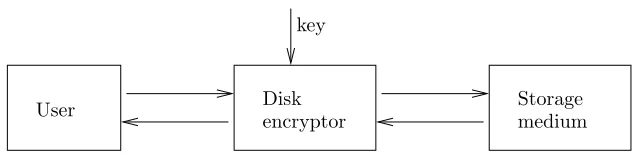
Figure 1: Disk encryptor model
Storage medium We first define what a sector-based storage medium is. Let
Sbe a set of possible sector values (typicallyS ={0,1}lfor somel). Astorage
medium for n sectors is an interactive deterministic algorithm. It accepts as input write or read requests, and keeps a list of pairs from{0,1, . . . , n−1} ×S. The list is initially empty.
The write request is a pair (i, s)∈ {0,1, . . . , n−1} ×S(“storesat indexi”). The storage medium stores the pair (i, s) in a list, discarding any previously stored pair (i, s0), and replies with the special symbol>.
Let x= (x1, x2, . . . , xr) ∈ Sr, and let I be a subset of {0,1, . . . , n−1} of
cardinalityr. Order the elements ofIand denote thejth element byij. Reading
(writing)xaccording toI means to read (write)xj from (to) sector ij.
Disk encryptor Adisk encryptor DEforN plaintext sectors with values in
S is an interactive algorithm, accepting input from a user and giving input to a storage medium1(see Figure 1).
The disk encryptor accepts as its first input a key from a setKand possibly a state. As part of its initialization, it may issue read and write requests to the storage medium. After initialization, the disk encryptor accepts as input read and write requests.
The disk encryptor may keep a state between read and write requests. We shall assume that this state is publicly known at all times, but that no adversary may modify it. A disk encryptor that does not keep a state isstateless.
The write request is a pair (i, s)∈ {0,1, . . . , N−1} ×S. The processing of the write request is probabilistic, and may result in read requests as well as write requests to the storage medium. All the read requests must be completed before any write request occurs. After all the read requests are complete, but before the first write request has been issued, the disk encryptor may stop processing and reply with the special symbol⊥(signifying encryption error). Otherwise, the disk encryptor issues its write requests to the storage medium and replies with the special symbol>(signifying no error) when processing is complete.
The read request is a number i∈ {0,1, . . . , N−1}. The processing of the read request is deterministic, and will only result in read requests to the storage medium. When the processing is complete, the disk encryptor replies either with a sector value fromS, or with the special symbol⊥, signaling decryption error. The disk encryptor’s state should not change as a result of a read request. We require that the indexes of the read and write requests issued to the storage medium should only depend on the index of the input request, not on the key or state.
The disk encryptor must guarantee that, in normal operation, if (i, s) was the last write request issued fori, then the read request iwill return s. If no write request (i, s0) for anys0 has been issued, the disk encryptor may respond arbitrarily to the read requesti.
To provide secure storage ofN sectors with values fromS, the disk encryptor requiresn≥N sectors of storage medium. The ration/Nis theexpansion ratio
of the disk encryptor.
We impose one more requirement on a disk encryptor: Any read and write request to the storage medium should result in at most a constant times logN
reads and writes to the storage medium.
The sectors read and written through the user interface of a disk encryptor are theplaintext sectors. The sectors on the storage medium are theciphertext sectors.
1It is possible (and desirable) to allow the disk encryptor and the storage medium to have
3
Security goals and attack models
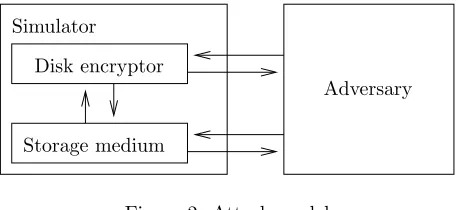
As usual, we model an attack as a game played between an adversary and a simulator. At the start of the game, the simulator initializes a disk encryptor instance with a randomly chosen key. The adversary is given access to the disk encryptor and the storage medium through the simulator.
Adversary Disk encryptor
Storage medium Simulator
Figure 2: Attack model
In practice, much of the information written to the disk encryptor will either be influenced, known or guessable by the adversary. This means that we should allow the adversary to write arbitrary data of his choice to the disk encryptor. The adversary should have read access to any data written by himself (when relevant). The intuition is that most users would not hesitate in giving the adversary access to data supplied by the adversary.
The simulator must of course bar read access to any data it has written to the disk encryptor, to keep the games from becoming trivial.
The four scenarios in the introduction give us the following attack models2,
which describe the attack conditions.
Single chosen plaintext attack (SCPA) The adversary is given write ac-cess to the disk encryptor. When he is finished writing, he is given read access to the storage medium for the duration of the game. (This corre-sponds to the theft scenario.)
Chosen plaintext attack (CPA) The adversary is given read and write ac-cess to the disk encryptor. Everything read from and written to the storage medium is simultaneously copied to the adversary. (This corresponds to the passive monitoring scenario.)
Single chosen ciphertext attack (SCCA) The adversary is given write ac-cess to the disk encryptor. When he is finished writing, he is given read and write access to the storage medium. When he is finished with the storage medium, he is given read access to the disk encryptor. (This corresponds to the theft with recovery scenario.)
2Technically, many more attack models are possible, but we consider only those that seem
Chosen ciphertext attack (CCA) The adversary is given read and write access to the disk encryptor, and the simulator uses the adversary as storage medium. (This corresponds to the active attack scenario.)
SCPA is the weakest attack, SCCA and CPA are not comparable, and CCA is the strongest attack.
We shall now describe a series of security goals for disk encryption. Throughout, we consider a disk encryptorDEprovidingN plaintext sectors with values from a setS.
The classic security goal is confidentiality. Following the standard notion of semantic security, an adversary that has partial information about the plain-text sectors must not be able to deduce anything new by studying the storage medium.
Definition. An adversary Aagainst semantic security works as follows: First the adversary specifies a probability spaceX overSr, an index setI⊆ {0,1, . . . ,
N−1} of cardinalityr, and a functionf :Sr→ {0,1} such that Pr[f(x) = 0|
x←r X] = Pr[f(x) = 1|x←r X] = 1/2. The simulator samplesxfrom X and writesxto the disk encryptor according toI. The adversary then outputs a bit
b∈ {0,1}.
LetE be the event thatf(x) =b. The adversary’s advantage is
AdvDE,A IND,·=|Pr[E]−1/2|.
Another important security goal is that of non-malleability, where the adver-sary should not be able to change the ciphertext sectors to cause any meaningful change in the plaintext sectors.
Definition. An adversaryAagainstnon-malleabilityworks as follows: First the adversary specifies a probability spaceXoverSr, and an index setI⊆ {0,1, . . . ,
N−1}of cardinalityr. The simulator samplesx= (x1, x2, . . . , xr) fromX and
writesxto the disk encryptor according to I.
The simulator will deny any read requests from the sectors inI. The adver-sary may choose to write to any sector inI(though he must refrain from writing to at least one sector). When theith sector inI is written to, we remove its index fromI, decreaser by one, and replaceX by the conditional probability space where theith coordinate is fixed to the valuexi.
When the adversary terminates, he outputs a relation R on Sr×Sr. The
simulator reads x0 = (x0
1, x02, . . . , x0r) from the disk encryptor according to I.
Now we replaceX with the conditional probability space where theith coordi-nate is fixed to the valuexi ifxi=x0i, and samplex00 fromX.
LetE0be the event that there was no decryption error when readingx0, and
x R x0. LetE1 be the event that there was no decryption error when reading
x0, and x00R x0. The adversary’s advantage is
AdvDE,A NM,·=1
Remark. The adversary is assumed to output a description of the probability spaceX such that the simulator can sample fromXand the possible conditional probability spaces.
Remark. If the adversary cannot change the ciphertext sectors, it is clear that
x=x00, and the adversary has zero advantage. Therefore, non-malleability is only relevant for the chosen ciphertext attacks.
In public key cryptography, the adversary is free to construct ciphertexts using the public key. In this way, adversaries can defeat non-malleability without ever tampering with a ciphertext.
For private key cryptography, the standard definition [7] allows ciphertexts output by an encryption oracle in the final answer. This mirrors the public key case.
For disk encryption, the equivalent notion would be to allow the adversary to write to the sectors inIwithout changing the probability spaceX. We disallow this, thereby separating the goals of indistinguishability and non-malleability.
Remark. We note that an adversary that can replace a sector value with ran-dom data has no advantage against non-malleability. This may be a problem for certain applications, and users should be aware of this property.
The following two goals are slightly different. The first (weaker) goal says that the adversary should not be able to cause the encrypted data to change in any way (even randomly). The second (stronger) goal says that any change the adversary makes to the storage medium will result in a decryption error.
Definition. An adversaryA against plaintext integrity works as follows: The simulator keeps a private copy of anything written to the disk encryptor. When data is read from the disk encryptor, it is compared with the private copy.
Let E be the event that data successfully read from the disk encryptor is different from the private copy. The adversary’s advantage is
AdvDE,A PTXT,·= Pr[E].
Definition. An adversaryAagainstciphertext integrity works as follows: The simulator keeps a private copy of anything the disk encryptor writes to the storage medium. Whenever the disk encryptor reads from the storage medium, it is compared with the private copy.
LetEbe the event that something the disk encryptor reads from the storage medium is different from the private copy, but the disk encryptor does not signal an error. The adversary’s advantage is
AdvDE,A CTXT,·= Pr[E].
4
Relationships
We first establish certain relationships between the security notions. None are surprising, but some of them are useful.
It is clear that any adversary against non-malleability must be a successful adversary against plaintext integrity. It is also trivial to show that any adversary against plaintext integrity is also an adversary against ciphertext integrity, but the converse is not true.
Theorem 1. Let DE be a disk encryptor. There exists a disk encryptor DE0
and a single chosen ciphertext adversary A against ciphertext integrity such that AdvDEA 0,CTXT,SCCA = 1. Further, for any adversary A0 against plaintext
integrity for DE0, there exists an adversary A00 against plaintext integrity for
DE such that
AdvDE,A00 PTXT,·= Adv
DE0,PTXT,·
A0 .
Auses trivial time, andA00 requires as much time asA0.
Proof. DE0 uses one extra sector of storage space. Whenever it receives a write request, it gives the write request to DE. If that write returns >, then DE0 writes a random value to the extra sector. Whenever it receives a read request, it reads the extra sector, then passes the read request toDE.
It is clear that any adversary that changes the extra sector in an arbitrary fashion, and then reads any sector from the disk encryptor, will win the cipher-text integrity game.
The extra sector can clearly be simulated by any adversary, so any adversary against plaintext integrity forDE0 can be used against DEas well.
The following theorem says that plaintext integrity does not imply semantic security.
Theorem 2. Let DE be a disk encryptor. There exists a disk encryptor DE0
and a single chosen plaintext adversary A against semantic security for DE0
with AdvDEA 0,IND,SCPA = 1/2. Further, for any adversaryA0 against plaintext
integrity for DE0, there exists an adversary A00 against plaintext integrity for
DE such that
AdvDE,A00 PTXT,·= Adv
DE0,PTXT,·
A0 .
Auses trivial time, andA00 has essentially the same time requirements asA0.
Proof. IfDE providesN plaintext sectors usingnciphertext sectors,DE0 will provideN plaintext sectors using n+N ciphertext sectors.
The idea is thatDE0keeps an unencrypted copy of the plaintext in the extra
N sectors. When reading, this unencrypted copy is ignored. The adversary against semantic security is then clear.
The most interesting result in this section is the following: Semantic security against (single) chosen ciphertext attacks follows from semantic security against (single) chosen plaintext attacks and ciphertext integrity against (single) chosen ciphertext attacks.
Theorem 3. Let DE be a disk encryptor, and let A be a (single) chosen ci-phertext adversary against semantic security. Then there exists a (single) cho-sen ciphertext adversaryA0 against ciphertext integrity, and a (single) chosen
plaintext adversaryA00 against semantic security such that
AdvDE,A IND,(S)CCA≤AdvDE,A0 CTXT,(S)CCA+ Adv
DE,IND,(S)CPA
A00 .
A0 andA00 has the same time requirements asA, except for a trivial amount of
processing for every disk encryptor read and write.
Proof. We only consider the chosen ciphertext attack. The adversaries derived from the single chosen ciphertext adversary are similar, and we leave them to the reader.
Consider first the chosen ciphertext attack game between the adversary and a simulator. LetE be the event that the bit output by the adversary is correct in this game.
Now we change the game as follows: A copy of anything the disk encryptor writes to the storage medium is kept. If the result of any read request made by the disk encryptor differs from this copy, the disk encryptor’s output for the operation is ignored and⊥is returned. LetE0 be the event that the bit output by the adversary is correct in this modified game.
We have that
AdvDE,A IND,CCA=|Pr[E]−1/2| ≤ |Pr[E]−Pr[E0]|+|Pr[E0]−1/2|.
As usual in game hopping, we want to bound|Pr[E]−Pr[E0]|and|Pr[E0]−1/2|. The two games proceed identically until⊥is returned in the modified game, but not in the original game. Let F be the event that this happens. Now we observe thatF is the event that leads to success against chosen ciphertext attack.
The adversaryA0 is then simplyA, augmented with parts simulating the at-tack against semantic security. The advantage ofA0against ciphertext integrity is Pr[F], and as usual we have that
|Pr[E]−Pr[E0]| ≤Pr[F] = AdvDE,A0 CTXT,CCA.
The chosen plaintext adversary A00 encapsulates A. It keeps a copy of the storage medium state. Whenever a read or write request for the storage medium is copied toA00,A00fakes a corresponding read or write request forA.
A00 providesA with the same environment as in the modified game. Hence
A’s success probability in the modified game is equal to the success probability ofA00. Therefore,
|Pr[E0]−1/2|= AdvDE,A00 IND,CPA.
This concludes the proof.
5
General results
If no redundancy is added to the stored data, the best security that can be achieved is semantic security and non-malleability against a single chosen ci-phertext attack.
Theorem 4. Suppose a disk encryptorDE has expansion ratio1. Then there exists a chosen plaintext adversary against semantic security, a chosen cipher-text adversary against non-malleability, and a single chosen ciphercipher-text adversary against plaintext integrity, all with advantage at least 1/2 and trivial time re-quirements.
Proof. First, we note that any disk encryptor with expansion ratio 1 must be de-terministic, and no matter what the storage medium contains, no read operation will result in a decryption error.
The chosen plaintext adversary against semantic security simply picks two distinct values x(0) and x(1) from SN, and writes x(0) to the disk encryptor.
It makes a copy of the storage medium state. Then it outputs the probability spaceX overSN such that Pr[x=x(0)|x r
←X] = Pr[x=x(1)|x←r X] = 1/2 andf(x(b)) =bforb∈ {0,1}.
After the simulator has written x(b) to the disk encryptor, the adversary
compares the contents of the storage medium with its copy. If it matches, 0 is output, otherwise 1 is output. This adversary has advantage 1/2.
The adversary against non-malleability writes bothx(0)andx(1) to the disk
encryptor, saving the storage medium states. It then outputs the probability spaceX. When the simulator writesx(b)to the disk encryptor, it replaces the
storage medium contents with the one corresponding tox(1−b), and outputs the
relationR= ((x(0), x(1)),(x(1), x(0))). This adversary has advantage 1/2.
Finally, the adversary against plaintext integrity writes arbitrary data to the disk encryptor. Then it makes some arbitrary change to the storage medium, and reads back from the disk encryptor. This adversary has advantage 1.
The next result shows that to achieve security against chosen ciphertext attacks, the disk encryptor must keep a state. The attack uses what is commonly known as rollback or replay attacks.
Theorem 5. Let DE be a stateless disk encryptor. Then a chosen ciphertext adversaryAagainst semantic security exists such that
AdvDE,A IND,CCA= 1/2.
Proof. The idea is that since the disk encryptor is stateless, if a state for the storage medium results in a valid read once, that state will always result in a valid read.
The adversary plays the role of the storage medium for the simulator. He chooses (arbitrarily) two different valuesx(0) andx(1) fromS, and outputs the
probability spaceX onS satisfying Pr[X =x(0)] = Pr[X =x(1)] = 1/2, the set I={0}, and a functionf :S→ {0,1} such thatf(x(j)) =j.
The simulator samplesband writesx(b)to the disk encryptor. At this point,
reading from the disk encryptor will returnx(b).
The adversary now saves the storage medium state. Then he writes x(0) to
the disk encryptor. Since he has written to this sector, the simulator will allow him to read it again. The adversary restores the saved storage medium state, and readsx(b) from the disk encryptor. The adversary now knowsb.
6
Concrete constructions
We give several constructions for meeting the various security notions described in Section 3.
Letl andm be integers larger than zero. Throughout this section, the set of sector valuesS will be the set of bit strings of length lm, S ={0,1}lm. N
will denote the number of plaintext sectors provided by the disk encryptor, and
n will be the number of ciphertext sectors required. Let l0 = dlog2me and l1=dlog2Ne.
When convenient, we shall consider integers as bit strings, and vice versa, in the usual manner.
6.1
Building blocks
We are interested in indistinguishable subsets of function families. So let ¯F be a function family, and letF be a subset of ¯F. Adistinguisher A forF plays the following game with a simulator: First, the simulator samples a function either fromF or from ¯F. Ais allowed to query the function (and its inverse, if relevant) at up toqpoints. ThenAoutputs 0 or 1.
LetE be the event that A outputs 0 when the simulator sampled from ¯F, or 1 when the simulator sampled fromF. ThenA’s distinguishing advantage is
AdvF,qA =|Pr[E]−1/2|.
Pseudo-random function families Let Map(S, S0) denote the set of all functions from the set S to the set S0. We are interested in finding subsets of Map(S, S0) where the functions are easy to evaluate, but it difficult it is to distinguish random elements of the subset from random elements of Map(S, S0).
Definition. LetS,S0andKbe sets. Apseudo-random function family (PRF) Φ from S to S0 indexed by K is a subset Φ = {f
Map(S, S0), along with a deterministic algorithm that on input of k ∈K and
s∈S computesfk(s).
We denote an adversary’s distinguishing advantage by AdvPRFA ,Φ,q.
Typical examples of interesting pseudo-random function families are message authentication codes, such as HMAC [1] and OMAC [5].
Block ciphers Let Perm(S) denote the set of all permutations on the set S. We are interested in finding subsets of Perm(S) where the permutations are easy to evaluate, but it is difficult to distinguish random elements of the subset from random elements of Perm(S).
Definition. LetS andKbe sets. Apseudo-random permutation family (PRP)
ΠonS indexed byKis a subset Π ={fk |k∈K} of Perm(S), along with two
deterministic algorithms that on input ofk∈Kands∈S computes fk(s) and
fk−1(s), respectively.
We denote an adversary’s distinguishing advantage by AdvPRPA ,Π,q.
Typical examples of interesting pseudo-random permutation families are block ciphers, such as AES [2].
We note that any pseudo-random permutation family Π on S can be used as a pseudo-random function family from S to S, and it is easy to show that for any PRF-distinguisherA, there exists a PRP-distinguisherA0 such that
AdvPRFA ,Π,q≤AdvPRPA0 ,Π,q+q
2/|S|.
Tweakable block ciphers Let S and T be sets. A tweakable permutation onS tweaked byT is a functionf :T→Perm(S). When convenient, we abuse notation and denote the action off(t) onsbyf(t, s), consideringf as a function
f :T×S→S. Let PermT(S) denote the set of tweakable permutations onS.
Definition. LetS,T andKbe sets. A tweakable pseudo-random permutation family Π˜ on S indexed by K and tweaked by T is a subset ˜Π ={fk | k ∈K}
of PermT(S), along with two deterministic algorithms that on input ofk∈K,
t∈T ands∈S computes (fk(t))(s) and (fk(t)−1)(s), respectively.
We denote an adversary’s distinguishing advantage by AdvTPRPA ,Π˜,q.
We refer to [3, 8] for further background on tweakable permutations and concrete constructions. We restrict ourselves to noting that there are practical constructions based on block ciphers.
6.2
Semantic security against single chosen plaintext
at-tack
Our first construction is also our simplest construction. It is based on the well-known counter mode construction. Let Φ be a pseudo-random function family from{0,1}l to{0,1}l indexed byK.
Define the function r : Map({0,1}l,{0,1}l)× {0,1,2, . . . , N −1} → S to
be function that takes (f, i) to the concatenation of the value off(i2l0+j) for
0≤j < m, that is,
(f, i)7→f(i2l0+ 0)||f(i2l0+ 1)||. . .||f(i2l0+m−1).
(Remember thatm≤2l0.)
The disk encryptor DE1(Φ) takes keys from K, and n =N. Suppose the disk encryptor is initialized with the keyk∈K. Given the write request (i, s), the disk encryptor issues the write request (i, s⊕r(fk, i)) to the storage medium.
Given the read requesti, the disk encryptor readss0 from theith sector of the storage medium and outputss0⊕r(f
k, i).
Theorem 6. Let DE1(Φ) be as above, providingN sectors of storage, and let
Abe a single chosen plaintext adversary against semantic security. Then there exists a distinguisherA0 forΦsuch that
AdvPRFA0 ,Φ,N m=
1 2Adv
DE,IND,SCPA
A .
Proof. We play two games. In the first game, we samplefk from Φ and run the
disk encryptor as specified above. Then we simulate a single chosen plaintext attack onDE1 forA. LetE be the event that the bit output byA is correct.
In the second game, we samplef from Map({0,1}l,{0,1}l) and use it instead
offk in the disk encryptor. Then we simulate a single chosen plaintext attack
onDE1forA, exactly as in the first game. IfE0 is the event that the bit output byA is correct, we must have that Pr[E0] = 1/2.
LetA0 be the distinguisher that computes the functionrby requesting func-tion values for the pointsi2l0+j, 0≤j < m. Then it simulates a single chosen
plaintext attack onDE1 forA. IfAguesses correctly, the simulator outputs 0, otherwise 1.
If the functionA0 tries to distinguish was sampled from Φ, everything pro-ceeds as in the first game. The probability thatA0 correctly answers 0 is Pr[E]. Otherwise, everything proceeds as in the second game, and the probability that
A0 correctly answers 1 is Pr[E0] = 1/2. We get that
AdvPRFA0 ,Φ,N m=|Pr[E]/2 + Pr[E
0]/2−1/2|
= 1
2|Pr[E]−1/2|= 1 2Adv
DE,IND,SCPA
A ,
which concludes the proof.
The next construction is based on Cipher Block Chaining mode. CBC mode requires an initialization vector, and using the sector index does not provide security. But if we run the sector index through the block cipher and use that as an initialization vector, we should get security.
Let Π be a pseudo-random permutation family on{0,1}l indexed byK.
The disk encryptor DE2(Π) takes keys fromK, and n=N. Let DE2(Π) be initialized with the keyk∈K. Given the write request (i, s), the valuesis split into blockss1, . . . , sm∈ {0,1}l. The IV is derived as c0 =fk(i). Thenci
is computed asfk(ci−1⊕si), and the write request (i, c1||c2||. . .||cm) is issued
to the storage medium.
While we believe this construction to be secure (when a secure block cipher is used), it has only disadvantages over counter mode. We leave the read operation and the security proof to the interested reader.
6.3
Non-malleability against single chosen ciphertext
at-tack
This construction uses a tweakable permutation on the sector level to encrypt the data. Note that the permutation has to be tweakable, otherwise the usual attacks on ECB mode apply. (See also Section 7.2.)
Let K be a set and T ={0,1, . . . , N −1}. Let ˜Π be a tweakable pseudo-random permutation family onS indexed byK and tweakable byT.
The disk encryptor DE3( ˜Π) takes keys from K, and n=N. Let DE3( ˜Π) be initialized with the key k∈K. Given the write request (i, s), it issues the write request (i, fk(i, s)) to the storage medium. Given the read requesti, it
passes it on to the storage medium and gets a values0. It then returns the value
fk(i)−1(s).
Theorem 7. Let DE3( ˜Π) be as above, and let A be a single chosen cipher-text adversary against semantic security (non-malleability). Then there exists a distinguisherA0 forΠ˜ such that
AdvTPRPA0 ,Π˜,N =
1 2Adv
DE3( ˜Π),IND,SCCA
A (
1 2Adv
DE3( ˜Π),NM,SCCA
A ).
Proof. We play two games. The first game is the unmodified attack game. In the second game, instead of samplingfk from ˜Π, we samplef from PermT(S)
and use it instead offk.
In the second game, two different sectors are encrypted with independent permutations, and any change in the storage medium will induce a random change in the corresponding plaintext sector.
Therefore, the adversary cannot have any advantage against semantic secu-rity or non-malleability for the second game. The theorem follows.
6.4
Ciphertext integrity against single chosen ciphertext
attack
The following construction provides ciphertext integrity using a pseudo-random function family. To provide semantic security against single chosen plaintext attacks, this disk encryptor should be combined with DE1. By Theorem 3, the combination will have semantic security and non-malleability against single chosen ciphertext attack.
Let T ={0,1, . . . , N −1}, and let Φ be a pseudo-random function family fromT×S to{0,1}lindexed byK.
The disk encryptor DE4(Φ) takes keys from K, andn= 2N. LetDE4(Φ) be initialized with the key k∈K. Given the write request (i, s), it issues the write requests (2i, s) and (2i+ 1, fk(i, s)) to the storage medium (the bit string
fk(i, s) is padded with zeros to get a string of lengthml). Given the read request
i, it issues the read requests 2iand 2i+ 1 to the storage medium, getting values
s0 ands00. Ifs00=f
k(i, s) (including zero padding),s0 is output, otherwise⊥.
Theorem 8. Let DE4(Φ) be as above, and let Abe a single chosen ciphertext adversary against ciphertext integrity. Then there exists a distinguisherA0 for Φsuch that
AdvDE4(Φ),CTXT,SCCA
A ≤Adv
PRF,Φ,N A0 +
N
2l.
Proof. Again, we play two games: One where a function is sampled from Φ, and one where it is sampled from Map(T×S,{0,1}l).
To succeed in the latter game, the adversary A has to find a value s, an indexi, as well as the function valuefk(i, s). Whenfk is replaced by a random
function, then for any s0 ∈ S we have that f(i, s) = s0 with probability 2−l.
It has at mostN chances of getting at least one sector right, giving a success probability of at mostN/2l. This concludes the proof.
We note that the zero padding is rather wasteful, but it is required for technical reasons. However, the storage medium can easily arrange to store several checksums in one physical sector, giving an expansion rate of (m+1)/m. We also note that it is easy to construct Φ using HMAC [1] or OMAC [5].
6.5
Semantic security against chosen plaintext attack
The following construction provides semantic security against a chosen plaintext attack using a pseudo-random function family. It is based on counter mode, but each sector is given its own initialization vector.
Let Φ be a pseudo-random function family from{0,1}lto{0,1}lindexed by
K. Letr: Map({0,1}l,{0,1}l)× {0,1}l−l0 →S be the function defined by
(f, t)7→f(t2l0+ 0)||f(t2l0+ 1)||. . .||f(t2l0+m−1).
(Remember thatm≤2l0.)
j from{0,1}l−l0, then issues the write requests (2i, j) (wherej is padded with
zeros) and (2i+ 1, s⊕r(fk, j)).
Given the read request i, the disk encryptor issues the read requests 2i
and 2i+ 1 to the storage medium, getting values s0 and s00. It then outputs
s00⊕r(f
k, s0) (where the zero padding ins0 is ignored).
Theorem 9. LetDE5(Φ)be as above, and letAbe a chosen plaintext adversary against semantic security that writes at most q sectors to the disk encryptor. Then there exists a distinguisherA0 forΦsuch that such that
AdvDE5(Φ),IND,CPA
A ≤Adv
PRF,Φ,qm A0 +q
2/2l−l0.
Proof. As usual, we play two games: One where a function is sampled from Φ, and one where it is sampled from Map({0,1}l,{0,1}l).
In the latter game, unless the same j is sampled for two different write operations, the adversary has no advantage. The probability that one j is sampled at least twice is at mostq2/2l−l0, which concludes the proof.
We note that a similar technique can be used for CBC-mode with no im-mediate advantage. It could also be used with a tweakable block cipher, again with no immediate advantage.
We also note that the storage medium could arrange to store several initial values in one physical sector, reducing the expansion rate to (m+ 1)/m.
6.6
Ciphertext integrity against chosen ciphertext attack
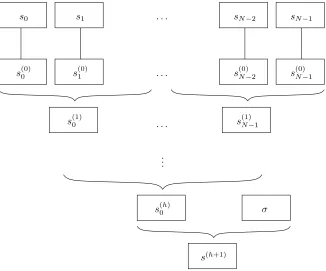
By Theorem 5, a disk encryptor must keep a state to achieve security against chosen ciphertext attack. Our goal is to keep the state as small and simple as possible. The idea is to use anm-ary tree of checksums (see Figure 3). The root of the tree is authenticated using the state, and the state changes with every write.
LetT be the set{0,1, . . . ,2l−1}, and let Φ be a pseudo-random family of
functions fromT×S to {0,1}l indexed byK.
Set N1 = N, and define the sequence Nj by Nj = dNj−1/me. Let h be the smallest integer such that Nh = 1. Setn1 =N, n2 = 2N, and define the
sequencenj bynj−1+Nj−1. For an integeri, we letij=bi/mj−1c.
The disk encryptor DE6(Φ) takes keys from K, and n = nh+1+ 1. Let DE6(Φ) be initialized with the keyk. It sets the stateσto the integer 1.
Denote the value of the sector nj+t, 0≤t < Nj, by s
(j)
t , and the sector
nh+1=nh+1 bys(h+1). The initialization process first zeross(1)i for alli. Then
it computes the correct checksumss(ijj)for alliand 1< j≤husing
s(ijj)=fk(j2l1+ij, s(mij−j1)+0||s (j−1)
mij+1||. . .||s (j−1)
max{mij+m−1,Nj}). (1)
Note that in the concatenation, the zero padding of eachs(tj) is discarded.
Fi-nally, it computess(h+1)using
s(1)0
sN−2 sN−1
s(1)N−1
s(0)N−2 s(0)N−1
s(h+1)
s(0h) σ
s0 s1
s(0)1 s(0)0
.. .
. . .
. . . . . .
Then the disk encryptor issues the writes (nj+ij, s
(j)
ij ) for all 0 ≤ i < N,
1≤j≤h, and finally the write (nh+1, s(h+1)).
Let the write request be (i, s). The disk encryptor readss(tj) from the index
nj+t, for ij+1m≤ t <max{ij+1m+m−1, Nj}, 1 ≤j ≤h. Then it reads
s(h+1) from the indexn
h+1.
It verifies that any zero padding remains zero, that for all 1 < j ≤ h, (1) holds, and that (2) holds. If any verification fails, ⊥is output and processing terminated.
If all of these checks are correct, the disk encryptor changess(1)i to befk(i, s),
updates everys(ijj)for 1< j≤haccording to (1), increasesσby 1, and updates
s(h+1) according to (2).
Then it issues the write requests (i, s), (nj +ij, si(jj)) for 1 ≤ j ≤ h, and
(nh, s(h+1)), and outputs>.
Given the read requesti, the disk encryptor readss(tj)from indexnj+t, for
ij+1m≤t <max{ij+1m+m−1, Nj}, 1≤j≤h. Then it readssi from index
iands(h+1)from indexn
h+1.
Now the disk encryptor verifies thats(1)i =fk(i, si), that any zero padding
remains zero, that the s(ijj) satisfy (1) for 1 < j ≤h, and that s(h+1) satisfies
(2). If any verification fails,⊥is output, otherwisesi is output.
Theorem 10. Let DE6(Φ) be as above, and let A be a chosen ciphertext ad-versary against ciphertext integrity that writes and reads at most q sectors to the disk encryptor. Then there exists a distinguisher A0 forΦ such that
AdvDE6(Φ),CTXT,CCA
A ≤Adv
PRF,Φ,qmh A0 +hq
2/2l+q/2l.
Proof. As usual, we play two games: One where a function is sampled from Φ, and one where it is sampled from Map(T×S,{0,1}l). The first game proceeds
exactly as in a real attack.
In the second game, we note that the value of every checksum sector is written using different values from T. So all checksums will be independent. Also, the master checksum denoted bys(h+1)will never be written twice using
the same value fromT.
Every time the adversary attempts a read after making a change to the checksum tree such thats(0h) changes, the probability that the read succeeds is 1/2l.
The only way the adversary can change the checksum tree without s(0h)
changing, is by finding a checksum collision. This means that the adversary’s advantage in the second game is at mostq2/2l+q/2l. The theorem follows.
If this construction is used in conjunction with the one from Section 6.5, we get semantic security and non-malleability against chosen ciphertext attacks by Theorem 3.
We also note that it is easy to replace the state σ with something that is easier for a user to remember (or write down), such as a date.
As an example, we compute the numbers for providing one gigabyte of stor-age (or 233 bits of storage), using 512 byte sectors (212 bits). Let l = 7 and
m= 25. We get thatn1= 221,n2= 216,n3= 211,n4= 26,n5= 2 andn6= 1.
The expansion rate is roughly 1.03. Every read operation requires 8 reads from the storage medium, and every write operations requires 7 reads and 8 writes. Caching can potentially reduce the number of physical reads and writes.
7
Existing implementations and standards
The following presentation includes three concrete examples of implementations or standards, and briefly investigates what security level they reach. It is inter-esting to compare these systems with the constructions in Section 6.
7.1
LoopAES
LoopAES [9] is a disk encryptor for Linux-based computer operating systems. Its stated aim is to provide confidentiality, but not integrity. It encrypts sectors using a block cipher in CBC mode, and has three modes of operation, one using a single key and two different modes using multiple keys.
The documentation is somewhat unclear, but one multiple-key mode appar-ently uses a pseudo-random function family to derive the initialization vector from the sector index. This may provide semantic security against single chosen plaintext attacks.
The (possibly deprecated) single key mode uses the sector index as initial-ization vector for CBC mode, which is insecure.
7.2
Security in Storage Working Group (SISWG)
We quote from the purpose of the Security in Storage Working Group [4]:
This standard provides a standard architecture for media security and enabling components. Present non-standard, insecure encrypted storage methodologies are augmented, and users will be able to cre-ate higher-assurance, standard, interoperable solutions.
7.3
FreeBSD’s GDBE
The disk encryptor called GEOM Based Disk Encryption (GDBE) [6] is part of the computer operating system FreeBSD.
The main idea is that every sector is encrypted using a block cipher in CBC mode. A constant initialization vector is used together with a one-time key. The one-time key is encrypted and written to a different sector using a block cipher in CBC mode. The key for this encryption is derived from a master key, sector index and a salt using a pseudo-random function family.
The system seems likely to provide security against chosen plaintext attacks, but it does not make any attempt to protect against chosen ciphertext attacks. The author’s distrust of standard cryptographic algorithms leads him to use the block cipher in a way that puts a great stress on the key scheduling algorithm, which is somewhat unfortunate.
8
Concluding remarks
One common feature of most disk encryption implementations (SISWG’s stan-dards work and FreeBSD’s GDBE being notable exceptions) is that the docu-mentation says very little about the cryptographic reasoning behind the system, and there is little in the way of useful security analysis. This paper provides a set of formal security notions as well as constructions, which should provide a sound basis for evaluating disk encryption systems.
While the SISWG does an excellent job, providing solutions that are as good as possible under the circumstances, we believe that the restrictions they have imposed on themselves makes it impossible to reach certain worthwhile security notions.
This paper attempts to define all useful security notions for disk encryption, and determining what is required to achieve those notions. Ideally, users of disk encryption should first consider their threat model, and then choose a suitable solution. If the available solutions turn out to have unacceptable costs, the users can make an informed choice about what to do. Having different solutions standardized should make this task simpler.
Also, certain applications are less demanding than some of the solutions considered by SISWG. One example is encryption of swap space. If the disk encryptor is initialized with a random key when the system starts, all that is required to protect the swap space is semantic security against single chosen plaintext attacks. Using FreeBSD’s GDBE or SISWG’s tweakable block ciphers is simply overkill.
References
[2] FIPS 197. Advanced Encryption Standard. Federal Information Processing Standards Publication. National Technical Information Service, Springfield, Virginia, November 2001.
[3] Shai Halevi and Phillip Rogaway. A tweakable enciphering mode. In Dan Boneh, editor,Proceedings of CRYPTO 2003, volume 2729 ofLNCS, pages 482–499. Springer-Verlag, 2003.
[4] J. Hughes. Chair of the IEEE security in storage working group, 2004. http://www.siswg.org/.
[5] Tetsu Iwata and Kaoru Kurosawa. OMAC: One-key CBC MAC. In Thomas Johansson, editor, Fast Software Encryption, volume 2887 ofLNCS, pages 129–153. Springer-Verlag, 2003.
[6] Poul-Henning Kamp. GBDE – GEOM based disk encryption. BSDCON ’03, 2003. http://phk.freebsd.dk/pubs/bsdcon-03.gbde.paper.pdf.
[7] J. Katz and M. Yung. Complete characterization of security notions for prob-abilistic private-key encryption. InProceedings of the 32nd Annual Sympo-sium on Theory of Computing, pages 245–254. ACM, 2000.
[8] Moses Liskov, Ronald L. Rivest, and David Wagner. Tweakable block ci-phers. In Moti Yung, editor,Proceedings of CRYPTO 2002, volume 2442 of
LNCS, pages 31–46. Springer-Verlag, 2002.