
A Block-Cipher Mode of Operation for Parallelizable Message Authentication
J. Black∗ P. Rogaway †
February 15, 2002
Appears in Advances in Cryptology – Eurocrypt ’02, Lecture Notes in Computer Science, Vol. ????, L. Knudsen, ed., Springer-Verlag. This is the full version.
Abstract
We define and analyze a simple and fully parallelizable block-cipher mode of operation for message authentication. Parallelizability does not come at the expense of serial efficiency: in a conventional, serial environment, the algorithm’s speed is within a few percent of the (inherently sequential) CBC MAC. The new mode, PMAC, is deterministic, resembles a standard mode of operation (and not a Carter-Wegman MAC), works for strings of any bit length, employs a single block-cipher key, and uses just max{1, |M|/n}block-cipher calls to MAC a stringM ∈ {0,1}∗ using ann-bit block cipher. We prove PMAC secure, quantifying an adversary’s forgery probability in terms of the quality of the block cipher as a pseudorandom permutation.
Key words: block-cipher modes, message authentication codes, modes of operation, provable security.
1
Introduction
Background. Many popular message authentication codes (MACs), like the CBC MAC [17]
and HMAC [1], are inherently sequential: one cannot process the i-th message block until all previous message blocks have been processed. This serial bottleneck becomes increasingly an issue as commodity processors offer up more and more parallelism, and as increases in network speeds outpace increases in the speed of cryptographic hardware. By now there would seem to be a significant interest in having a parallelizable MAC which performs well in both hardware and software, built from a block cipher like AES.
There are several approaches to the design of such an MAC. One is to generically construct a more parallelizable MAC from an arbitrary one. For example, one could begin with breaking the message M[1]· · ·M[2m] into M = M[1]M[3]· · ·M[2m−1] and M =M[2]M[4]· · ·M[2m] then separately MAC each half. But such an approach requires one to anticipate the maximal amount of parallelism one aims to extract. In the current work we are instead interested infully parallelizable
MACs: the amount of parallelism that can be extracted is effectively unbounded.
One idea for making a fully parallelizable MAC is to use the Carter-Wegman paradigm [13, 23], as in [12, 16, 19], making sure to select a universal hash-function family that is fully parallelizable. In fact, most universal hash functions that have been suggestedare fully parallelizable. This approach is elegant and can lead to a nice MAC, but constructions for fast universal hash-functions have
∗ Department of Computer Science/171, University of Nevada, Reno, Nevada, 89557, USA. E-mail:
[email protected] WWW:www.cs.unr.edu/~jrb/
† Department of Computer Science, University of California, Davis, California, 95616, USA. E-mail:
proven to be quite complex to specify or to implement well [7, 9], and may be biased either towards hardware or towards software. Twenty years after the paradigm was introduced, we still do not know of a single Carter-Wegman MAC that actually gets used. So the current work goes back to giving a conventional mode, but one designed, this time around, for serialand parallel efficiency.
The XOR MAC. Bellare, Gu´erin and Rogaway introduced a parallelizable MAC with their
XOR MACs [3]. The messageM is divided into pieces M[1]· · ·M[] of length less than the block-size; for concreteness, think of eachM[i] as having 64 bits when the blocksize isn= 128 bits. Each piece M[i] is preceded by [i], the number iencoded as a 64-bit number, and to each [i]M[i] one applies the block cipher E, keyed by the MAC key K. One more block is enciphered, it having a first bit of 1 and then a counter or random value in the remaining n−1 bits. The MAC is that counter or random value together with the XOR of all + 1 ciphertext blocks. Thus the MAC uses + 1≈2m+ 1 block-cipher invocations to authenticate a message ofm blocks of nbits; one has paid for parallelizability at a cost of about a factor of two in serial speed. Further disadvan-tages include the need for randomness or state (conventional MACs are deterministic) and in the increased length of the MAC (because of the counter or random value that has to be included).
PMAC. Unlike the XOR MAC, our new algorithm, PMAC, doesn’t waste any block-cipher
invo-cations because of block-indices (nor for a counter or random values). Also, in the spirit of [11], we optimally deal with short final blocks; we correctly MAC messages of arbitrary and varying bit lengths. The result is that PMAC makes do with just |M|/n block-cipher calls to MAC a non-empty message M using an n-bit block cipher. PMAC is deterministic, freeing the user from having to provide a counter or random value, and making the MAC shorter. Overhead beyond the block-cipher calls has been aggressively optimized, so a serial implementation of PMAC runs just a few percent slower than the CBC MAC.
Besides the efficiency measures already mentioned, PMAC uses very little key-setup: one block-cipher call. (A few shifts and conditional xors are also used.) The PMAC key is a single key for the underlying blocks cipher; in particular, we forgo the need for key-separation techniques. Avoiding multiple block-cipher keys saves time because many block ciphers have significant key-setup costs. Being so stingy with keys and block-cipher invocations takes significant care; note that even the traditional CBC MAC uses between one and four additional block-cipher calls, as well as additional key material, once it has been enriched to take care of messages of arbitrary lengths [6, 11, 17, 21]. Of course avoiding this overhead doesn’t matter much on long messages, but it is significant on short ones. And in many environments, short messages are common.
We prove PMAC secure, in the sense of reduction-based cryptography. Specifically, we prove that PMAC approximates a random function (and is therefore a good MAC) as long as the under-lying block cipher approximates a random permutation. The actual results are quantitative; the security analysis is in the concrete-security paradigm.
PMAC was proposed in response to NIST’s call for contributions for a first modes-of-operation workshop. Earlier versions of this writeup were submitted to NIST and posted to their website (Oct 2000, Apr 2001).
Additional related work. Building on [3], Gligor and Donescu describe a MAC they call
PMAC was also influenced by the variant of the XOR MAC due to Bernstein [8]. His algorithm is deterministic, and the way that the XOR MAC was made deterministic in [8] is similar to the way that PMAC has been made deterministic. Finally, there is also some similarity in appearance between PMAC and Jutla’s IAPM encryption mode [18].
2
Mathematical Preliminaries
Notation. Ifi≥1 is an integer thenntz(i) is the number of trailing 0-bits in the binary
represen-tation of i. So, for example, ntz(7) = 0 and ntz(8) = 3. If A∈ {0,1}∗ is a string then|A| denotes its length in bits while An = max{1, |A|/n} denotes its length in n-bit blocks (where the
empty string counts as one block). IfA=an−1· · ·a1a0 ∈ {0,1}n is a string (eachai ∈ {0,1}) then str2num(A) is the numberni=0−12iai. IfA, B ∈ {0,1}∗ are equal-length strings than A⊕B is their bitwise xor. IfA∈ {0,1}∗ and |A|< nthenpadn(A) is the stringA10n−|A|−1. IfA∈ {0,1}n then padn(A) =A. Withnunderstood we writepad(A) forpadn(A). IfA=an−1an−2· · ·a1a0 ∈ {0,1}n
then A<<1 = an−2an−3· · ·a1a00 is the n-bit string which is the left shift of A by 1 bit while
A>>1 = 0an−1an−2. . . a2a1 is the n-bit string which is the right shift of A by one bit. In
pseu-docode we write “Partition M into M[1]· · ·M[m]” as shorthand for “Let m = Mn and let M[1], . . . , M[m] be strings such that M[1]· · ·M[m] =M and |M[i]|=nfor 1≤i < m.”
The field with 2n points. The field with 2n points is denoted GF(2n). We interchangeably
think of a pointain GF(2n) in any of the following ways: (1) as an abstract point in the field; (2) as ann-bit string an−1. . . a1a0 ∈ {0,1}n; (3) as a formal polynomiala(x) =an−1xn−1+· · ·+a1x+a0 with binary coefficients; (4) as a nonnegative integer between 0 and 2n −1, where a ∈ {0,1}n corresponds tostr2num(a). We writea(x) instead ofaif we wish to emphasize that we are thinking ofaas a polynomial. To add two points in GF(2n), take their bitwise xor. We denote this operation by a⊕b. To multiply two points, fix some irreducible polynomial p(x) having binary coefficients and degree n. To be concrete, choose the lexicographically first polynomial among the irreducible degree npolynomials having a minimum number of coefficients. To multiply points a, b∈GF(2n), which we denote a·b, regardaand b as polynomialsa(x) =an−1xn−1+· · ·+a1x+a0 andb(x) =
bn−1xn−1+· · ·+b1x+b0, form their productc(x) where one adds and multiplies coefficients in GF(2), and take the remainder when dividingc(x) by p(x). Note that it is particularly easy to multiply a point a∈ {0,1}n by x. We illustrate the method for n= 128, wherep(x) =x128+x7+x2+x+ 1. Then multiplying a=an−1· · ·a1a0 by xyields
a·x=
a<<1 iffirstbit(a) = 0
(a<<1)⊕012010000111 iffirstbit(a) = 1 (1)
It is similarly easy to divide aby x(meaning to multiplyaby the multiplicative inverse of x). To illustrate, assume thatn= 128. Then
a·x−1 =
a>>1 iflastbit(a) = 0
(a>>1)⊕101201000011 iflastbit(a) = 1 (2)
If L ∈ {0,1}n and i≥ −1, we write L(i) to mean L·xi. To computeL(−1), L(0), . . . , L(µ), whereµis small, setL(0) =Land then, fori∈[1..µ], use Equation (1) to computeL(i) =L(i−1)·x
from L(i−1); and use Equation (2) to computeL(−1) fromL.
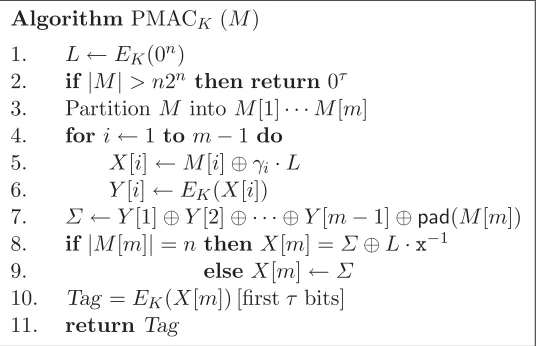
Algorithm PMACK (M)
1. L←EK(0n)
2. if |M|> n2n then return0τ 3. Partition M intoM[1]· · ·M[m] 4. for i←1 tom−1 do
5. X[i]←M[i]⊕γi·L
6. Y[i]←EK(X[i])
7. Σ ←Y[1]⊕Y[2]⊕ · · · ⊕Y[m−1]⊕pad(M[m]) 8. if |M[m]|=nthenX[m] =Σ⊕L·x−1
9. elseX[m]←Σ 10. Tag =EK(X[m]) [firstτ bits] 11. return Tag
Figure 1: Definition of PMAC. The message to MAC isM and the key isK. The algorithm depends on a block cipherE: K × {0,1}n → {0,1}n and a numberτ ∈[1..n]. Constantsγ1, γ2, . . ., the meaning of the multiplication operator, and the meaning ofpad() are all defined in the text.
Gray codes. For any ≥ 1, a Gray code is an ordering γ = γ0 γ1 . . . γ
2−1 of {0,1} such
that successive points differ (in the Hamming sense) by just one bit. For na fixed number, PMAC makes use of the “canonical” Gray code γ =γn constructed by γ1 = 0 1 while, for >0,
γ+1= 0γ
0 0γ1 · · · 0γ2−2 0γ2−1 1γ2−1 1γ2−2 · · · 1γ1 1γ0.
It is easy to see thatγ is a Gray code. What is more, for 1≤i≤2n−1,γi =γi−1⊕(0n−11<<ntz(i)). This makes it easy to compute successive points. Note that γ1, γ2, . . . , γ2n−1 are distinct, different from 0, and γi ≤2i.
Let L ∈ {0,1}n and consider the problem of successively forming the strings γ1 ·L, γ2 ·L,
γ3·L, . . ., γm·L. Of course γ1·L= 1·L=L. Now, for i≥2, assume one has already produced
γi−1·L. Since γi = γi−1 ⊕(0n−11<<ntz(i)) we know that γi·L = (γi−1⊕(0n−11<<ntz(i)))·L=
(γi−1·L)⊕(0n−11<<ntz(i))·L= (γi−1·L)⊕(L·xntz(i)) = (γi−1·L)⊕L(ntz(i)). That is, theith
word in the sequenceγ1·L, γ2·L, γ3·L, . . . is obtained by xoring the previous word withL(ntz(i)).
3
Definition of PMAC
PMAC depends on two parameters: a block cipher and a tag length. The block cipher is a function
E: K × {0,1}n → {0,1}n, for some number n, where each E(K,·) = EK(·) is a permutation on
{0,1}n. Here K is the set of possible keys and nis the block length. The tag length is an integer
τ ∈[1..n]. By trivial means the adversary will be able to forge a valid ciphertext with probability 2−τ. With E: K × {0,1}n → {0,1}n and τ ∈ [1..n], we let PMAC[E, τ] denote PMAC using block cipher E and tag length τ. We simplify to PMAC-E when τ is irrelevant. PMAC[E, τ] is a function taking a key K ∈ K and a message M ∈ {0,1}∗ and returning a string in {0,1}τ. The function is defined in Figure 1 and illustrated in Figure 2. We comment that line 2 of Figure 1 is simply to ensure that PMAC is well-defined even for the highly unrealistic case that|M|> n2n(by which time our security result becomes vacuous anyway). Alternatively, one may consider PMAC’s message space to be strings of length at mostn2n rather than strings of arbitrary length.
τ r r r r r r r r r h h h h h h h ? ? ? - ? ? ? ? ? ? ? ? -? -? -- ?
-M[m]
EK
γ2·L M[2]
EK
γm−1·L pad
EK EK
γ1·L M[1]
first τ bits
Y[1]
X[1]
Y[2]
X[2]
M[m−1]
X[m−1]
Y[m−1]
Tag
Σ
0n if |M[m]|< n
L·x−1 if |M[m]|=n
Figure 2: Illustration of PMAC. Message M is written as M = M[1]· · ·M[m], where m = max{1, |M|/n}and|M[1]|=|M[2]|=· · ·=|M[m−1]|=n. ValueL=EK(0n) is derived fromK. The meaning of theγi·Lvalues is described in the text.
key K is provided to both the party that generates MACs and the party that verifies them. Key setup: Both the party that generates the MACs and the party that verifies the MACs do any key setup useful for applying the block-cipher in its forward direction. LetL←EK(0n). Letm∗ bound
the maximum number of n-bit blocks for any message which will be MACed. Let µ← log2m∗. LetL(0)←L. Fori∈[1..µ], compute L(i)←L(i−1)·xby Equation (1), using a shift and a con-ditional xor. ComputeL(−1)←L·x−1 by Equation (2), using a shift and a conditional xor. Save the values L(−1), L(0), L(1), L(2), . . . , L(µ) in a table. (Alternatively, defer computing some or all of theseL(i) values until the value is actually needed.) MAC generation: Letm← |M|/n. If m = 0 then let m ← 1. Let M[1], . . . , M[m] be strings such that M[1]· · ·M[m] = M and
|M[i]| = n for i ∈ [1..m −1]. Let Offset ← 0n. Let Σ ← 0n. For i ← 1 to m−1, do the following: let Offset ← Offset⊕L(ntz(i)); let Y[i] ← EK(M[i]⊕Offset); let Σ ← Σ⊕Y[i]. Let Σ←Σ⊕pad(M[m]). If|M[m]|< nthen letY[m]←EK(Σ) else letY[m]←EK(Σ⊕L(−1)). Let
Tag be the first τ bits of Y[m]. Return Tag as the computed MAC. MAC verification: Given (M,Tag), do the following: Generate the MACTag for the message M using the MAC generation procedure just described. If Tag =Tag then regard the message M as authentic. If Tag =Tag
4
Comments
As we shall soon prove, PMAC is more than a good MAC: it is good as a pseudorandom function (PRF) having variable-input-length and fixed-output-length. As long as the underlying block ci-pherE is secure, no reasonable adversary will be able to distinguish PMACK(·), for a random and hidden key K, from a random function ρ from {0,1}∗ to{0,1}τ. It is a well-known observation, dating to the introduction of PRFs [15], that a good PRF is necessarily a good MAC.
Conceptually, the key is (K, L). But instead of regarding this as the key (and possibly definingK and L from an underlying key), the value L is defined from K and then K is still used as a key. Normally such “lazy key-derivation” would get one into trouble, in proofs if nothing else. For PMAC we prove that this form of lazy key-derivation works fine.
Any string M ∈ {0,1}∗ can be MACed, and messages which are not a multiple of the block length are handled without the need for obligatory padding, which would increase the number of block-cipher calls.
MAC generation is “on line,” meaning that one does not need to know the length of the message M in advance. Instead, the message can be MACed as one goes along, continuing until there is an indication that the message is now complete. The work of Petrank and Rackoff brought out the importance of this property [21].
In contrast to a scheme based on mod parithmetic (for a primep) or mod 2n arithmetic, there is almost no endian-favoritism implicit in the definition of PMAC. (The exception is that the left shift used for forming L(i+ 1) from L(i) is more convenient under a big-endian convention, as is the right shift used for formingL(−1) =L·x−1 from L.)
If τ =n (or one retains a constant amount of extra information) PMAC is incremental in the sense of [15] with respect to operations
append(M, x) = Mx,
truncate(M,∆) = M[first|M| −∆ bits],for|M| ≥∆,and
replace(M, i, x) = M[firsti−1 bits]xM[last|M| −i− |x|+ 1 bits],for|M| ≥i+|x| −1.
For each operation it is easy to see how to update the MAC of M in time proportional to|x|, ∆, or|x|, respectively.
PMAC is parsimonious, as defined in [5]. Partition M intoM[1]· · ·M[m] and assume|M| ≥n and τ = n. For i ∈ [1..m] such that |M[i]| = n, there is a simple algorithm to recover M[i] from K, M =M[1]· · ·M[i−1]M[i+ 1]· · ·M[m], and Tag = PMACK(M). As shown in [5], a
parsimonious PRF can be combined with a parsimonious encryption scheme (eg., CTR mode) to yield a length-preserving pseudorandom permutation (a “variable-input-length block cipher”) that acts on messages of any number of bits greater than or equal to n.
5
Theorems
Security definitions. We first recall the needed definitions. A block cipher is a functionE: K × {0,1}n→ {0,1}nwhereKis a finite set and eachEK(·) =E(K,·) is a permutation on{0,1}n. Let
Perm(n) denote the set of all permutations on {0,1}n. This set can be regarded as a block cipher by imagining that each permutation is named by a unique element of K. LetA be an adversary (a probabilistic algorithm) with access to an oracle, and suppose thatAalways outputs a bit. Define
The above is the probability that adversaryAoutputs 1 when given an oracle forEK(·), minus the
probability thatAoutputs 1 when given an oracle for π(·), where K is selected at random from K and π is selected at random from Perm(n). Similarly, a function family from n-bits to n-bits is a map F: K × {0,1}n → {0,1}n where K is a finite set. We write FK(·) for F(K,·). Let Rand(n)
denote the set of all functions from{0,1}nto{0,1}n. This set can be regarded as a function family as above. Define
AdvprfF (A) = Pr[K ← KR : AFK(·)= 1]−Pr[ρ←R Rand(n) : Aρ(·)= 1]
Finally, a function family from {0,1}∗ to {0,1}τ is a map f: K × {0,1}∗ → {0,1}τ where K is a set with an associated distribution. We writefK(·) forf(K,·). Let Rand(∗, τ) denote the set of all functions from{0,1}∗to{0,1}τ. This set is given a probability measure by asserting that a random elementρof Rand(∗, τ) associates to each stringx∈ {0,1}∗ a random stringρ(x)∈ {0,1}τ. Define
Advprff (A) = Pr[K← KR : AfK(·)= 1]−Pr[g←R Rand(∗, τ) : Ag(·)= 1]
Main result. We now give an information-theoretic bound on the security of our construction.
Theorem 1 [Security of PMAC] Fix n, τ ≥ 1. Let A be an adversary with an oracle. Suppose that Aasks its oracle q queries, these having aggregate length of σ blocks. Let σ¯=σ+ 1. Then
AdvprfPMAC[Perm(n),τ](A) ≤ σ¯
2
2n−1
In the theorem statement and from now on, the aggregate length of messages M1, . . . , Mq asked by Ais the numberσ =qr=1Mrn.
From the theorem above it is standard to pass to a complexity-theoretic analog. Fix parameters
n, τ ≥ 1 and block cipher E: K × {0,1}n→ {0,1}n. Let A be an adversary with an oracle and suppose that A asks queries having aggregate length ofσ blocks. Let ¯σ=σ+ 1. Then there is an adversary B for attacking E that achieves advantage AdvprpE (B) ≥AdvprfPMAC[E,τ](A)−¯σ2/2n−1. AdversaryB asks at most ¯σ oracle queries and has a running time equal to A’s running time plus the time to computeE on ¯σ points, plus additional time ofcnσ¯ for a constantc that depends only on details of the model of computation.
It is a standard result that being secure in the sense of a PRF implies an inability to forge with good probability. See [4, 15].
Structure of the proof. The proof combines two lemmas. The first, the structure lemma,
measures the pseudorandomness of PMAC using two functions: the M-collision probability, de-noted Mcolln(·), and the MM-collision probability, denoted MMcolln(·,·). The second lemma, the
collision-bounding lemma, upperbounds Mcolln(m) and MMcolln(m,m¯).
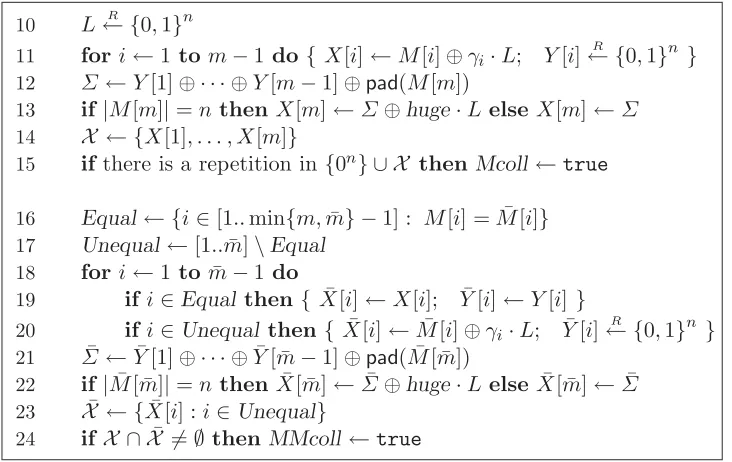
We begin by defining Mcolln(·) and MMcolln(·,·). Fix n and choose M and ¯M, partitioning
them into M[1]· · ·M[m] and ¯M[1]· · ·M¯[ ¯m]. Consider the experiment of Figure 3. When M is a string, let Mcolln(M) denote the probability that Mcoll gets set to true in line 15 when the program of Figure 3 is run on M. When m is a number, Mcolln(m) is the maximum value of
Mcolln(M) over all strings M such that Mn = m. Similarly, when M and ¯M are strings, let MMcolln(M,M¯) denote the probability thatMMcollgets set totruewhen the program of Figure 3 is run on strings M,M¯. When m and ¯m are numbers, let MMcolln(m,m¯) denote the maximum
10 L← {R 0,1}n
11 fori←1tom−1do { X[i]←M[i]⊕γi·L; Y[i]← {R 0,1}n } 12 Σ←Y[1]⊕ · · · ⊕Y[m−1]⊕pad(M[m])
13 if|M[m]|=nthenX[m]←Σ⊕huge·LelseX[m]←Σ
14 X ← {X[1], . . . , X[m]}
15 ifthere is a repetition in {0n} ∪ X then Mcoll←true
16 Equal← {i∈[1..min{m,m¯} −1] : M[i] = ¯M[i]}
17 Unequal←[1..m¯]\Equal
18 fori←1to m¯ −1 do
19 ifi∈Equalthen { X¯[i]←X[i]; Y¯[i]←Y[i]}
20 ifi∈Unequal then{ X¯[i]←M¯[i]⊕γi·L; Y¯[i]← {R 0,1}n } 21 Σ¯ ←Y¯[1]⊕ · · · ⊕Y¯[ ¯m−1]⊕pad( ¯M[ ¯m])
22 if|M¯[ ¯m]|=nthenX¯[ ¯m]←Σ¯⊕huge·Lelse X¯[ ¯m]←Σ¯
23 X ← {¯ X¯[i] :i∈Unequal}
24 ifX ∩X ¯ =∅then MMcoll←true
Figure 3: Defining the collision probabilities. Functions Mcolln(·) and MMcolln(·,·) are defined using this game. In lines 14 and 23,X and ¯X are understood to be multisets. The union in line 15 is a multiset union. Recall thathuge is a synonym forx−1.
Lemma 1 [Structure lemma] Fix n, τ ≥ 1. Let A be an adversary that asks q queries, these having an aggregate length of σ blocks. Then
AdvprfPMAC[Perm(n),τ](A) ≤
max
m1,...,mq σ=
mi mi≥1
1≤r≤q
Mcolln(mr) +
1≤r<s≤q
MMcolln(mr, ms) +
(σ+ 1)2 2n+1
The proof of this lemma is in Appendix A.
Explanation. Informally, Mcolln(m) measures the probability of running into trouble when the
adversary asks a single question M having block length m. Trouble means a collision among the values X[0], X[1], . . . , X[m], where X[0] = 0n and each X[i] is the block-cipher input associated to message block i. Informally, MMcolln(m,m¯) measures the probability of running into trouble
across two messages,M and ¯M, having lengthsmand ¯m. This time trouble means a “non-trivial” collision. That is, consider them+ ¯m+1 points at which the block cipher is applied in processingM and ¯M. There are m points X[1], . . . , X[m], another ¯m points ¯X[1], . . . ,X¯[ ¯m], and then there is the point 0n(the block cipher was applied at this point to defineL). Some pairs of these m+ ¯m+ 1 points could coincide for a “trivial” reason: namely, we know thatX[i] = ¯X[i] ifi < mand i <m¯ and M[i] = ¯M[i]. We say that there is a nontrivial collision between M and ¯M if some other
X[i] and ¯X[j] happened to coincide. Note that M-collisions include collisions with 0n, while MM-collisions do not. Also, MM-MM-collisions do not include MM-collisions within a single message (or MM-collisions with 0n) because both of these possibilities are taken care of by way of M-collisions.
ways. First, it allows one to excise adaptivity as a concern. Dealing with adaptivity is a major complicating factor in proofs of this type. Second, it allows one to concentrate on what happens to single messages and to a fixed pair of messages. It is easier to think about what happens with one or two messages than what is happening with all q of them.
Bounding the collision probabilities. The following lemma indicates that the two types of
collisions we have defined rarely occur. The proof shall be given shortly.
Lemma 2 [Collision-bounding lemma] Let Mcolln(·) and MMcolln(·,·) denote the M-collision
probability and the MM-collision probability. Then
Mcolln(m) ≤ m
+ 1 2
· 1
2n and MMcolln(m,m¯) ≤
mm¯ 2n
Concluding the theorem. Pseudorandomness of PMAC, Theorem 1, follows by combining
Lemmas 1 and 2. Namely,
AdvprfPMAC[Perm(n),τ]
≤ max
m1,...,mq σ=
mi mi≥1
1≤r≤q
Mcolln(mr) +
1≤r<s≤q
MMcolln(mr, ms) +
(σ+ 1)2 2n+1
≤ mmax
1,...,mq
σ=
mi mi≥1
1≤r≤q
Mcolln(mr)
+ max
m1,...,mq σ=
mi mi≥0
1≤r<s≤q
MMcolln(mr, ms) +
(σ+ 1)2 2n+1
≤ max
m1,...,mq σ=
mi mi≥0
1≤r≤q m
r+ 1
2 · 1 2n
+ mmax
1,...,mq
σ=
mi mi≥0
1≤r<s≤q mrms
2n
+
(σ+ 1)2 2n+1
≤ (σ+ 1)2
2n +
(σ2/2) 2n +
(σ+ 1)2
2n+1 (3)
≤ 2 (σ+ 1)2
2n
where (3) follows because the first sum is maximized with a single message of length σ, while the second sum is maximized by q messages of length σ/q. (These claims can be justified using the method of Lagrange multipliers.) This completes the proof of Theorem 1.
Proof of Lemma 2. We now bound Mcolln(m) and MMcolln(m,m¯). To begin, let Unequal =
Unequal\ {X¯[ ¯m]} (multiset difference: remove one copy of ¯X[ ¯m]) and define
D4 ={X¯[j] : j∈Unequal} D5 ={X¯[ ¯m]}
We first show that for any two pointsX[i] andX[j] in the multiset D1∪D2∪D3, wherei < j and
X[0] = 0n, the probability that these two points collide is at most 2−n. The inequality
Mcolln(m) ≤
m
+ 1 2
· 1
2n
follows because there are m+ 1 points in D1 ∪D2∪D3. Afterwards, we show that for any point
X[i] inD2∪D3 and any point in ¯X[j] inD4∪D5, the probability that they collide is at most 2−n. The inequality
MMcolln(m,m¯) ≤ mm¯
2n follows because |D2∪D3| · |D4∪D5| ≤mm¯.
To show Mcolln(m)≤m2+1·21n consider the following four cases:
Case(D1, D2): Pr[0n =X[i]] = Pr[M[i]⊕γi·L= 0n] = Pr[L=γi−1·M[i]] = 2−n. We have used
that γi is nonzero and we are working in a field. (We will continue to use this without mention.)
Case(D1, D3): If|M[m]|< nandm≥2 thenΣis a randomn-bit string and so Pr[0n =X[m]] =
Pr[0n=Σ] = Pr[0n=Y[1]⊕ · · ·Y[m−1]⊕pad(M[m])] = 2−n. If|M[m]|=nandm≥2 thenΣ is a randomn-bit string that is independent ofLand so Pr[0n=X[m]] = Pr[0n=Σ⊕huge·L] = 2−n. If|M[m]|< nand m= 1 then Pr[0n=X[1]] = Pr[0n=pad(M[m])] = 0. If|M[m]|=nandm= 1 then Pr[0n=X[1]] = Pr[0n =pad(M[m])⊕huge·L] = 2−n.
Case(D2, D2): For i, j∈[1..m−1],i < j, Pr[X[i] =X[j]] = Pr[M[i]⊕γi·L=M[j]⊕γj·L] =
Pr[M[i]⊕M[j] = (γi⊕γj)·L] = 2−n because γi = γj for i=j. (Here one assumes that j < 2n because the lemma gives a non-result anyway if j were larger.)
Case (D2, D3): Assume that m ≥ 2, for otherwise there is nothing to show. Suppose first
that |M[m]| < n. Then Pr[X[i] = X[m]] = Pr[M[i]⊕γi ·L = Σ]. The value Σ is uniformly random and independent of L, so this probability is 2−n. Suppose next that |M[m]| =n. Then Pr[X[i] =X[m]] = Pr[M[i]⊕γi·L=Σ⊕huge·L] = Pr[M[i]⊕Σ = (γi⊕huge)·L]. This value is
2−n sinceγi =huge. Here we are assuming thati <2n−1, which is without loss of generality since a larger value ofi, and therefore m, would give a non-result in the theorem statement.
Moving on, to show that MMcolln(m,m¯)≤ m2nm¯ we verify the following four cases:
Case(D2, D4): Leti∈[1..m−1] andj∈Unequaland consider Pr[X[i] = ¯X[j]] = Pr[M[i]⊕γi·L=
¯
M[j]⊕γj·L] = Pr[M[i]⊕M¯[j] = (γi⊕γj)·L. Ifi=j thenγi=γj and this probability is 2−n. If
i=j then the probability is 0 since, necessarily, M[i]= ¯M[j].
Case(D2, D5): Suppose that|M¯[ ¯m]|< n. Then Pr[X[i] = ¯X[ ¯m]] = Pr[M[i]⊕γi·L= ¯Σ] = 2−n
because ¯Σ is independent of L. Suppose that |M¯[ ¯m]| = n. Then Pr[X[i] = ¯X[ ¯m]] = Pr[M[i]⊕
γi·L= ¯Σ⊕huge·L] = Pr[M[i]⊕Σ¯ = (γi⊕huge)·L] = 2−n because ¯Σ is independent of L and γi =huge.
Case (D3, D4): Suppose that |M[m]|< n. Then Pr[X[m] = ¯X[j]] = Pr[Σ = ¯M[j]⊕γj·L] = 2−n
becauseΣ is independent of L. Suppose that |M[m]|=n. Then Pr[X[m] = ¯X[j]] = Pr[Σ⊕huge·
L= ¯M[j]⊕γj·L] = Pr[Σ⊕M¯[j] = (γj ⊕huge)·L] = 2−n because γj =huge.
Case (D3, D5): Suppose that |M[m]|< n and |M¯[ ¯m]|< n. If m > m¯ then Pr[X[m] = ¯X[ ¯m]] =
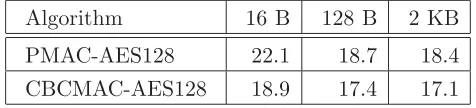
Algorithm 16 B 128 B 2 KB
PMAC-AES128 22.1 18.7 18.4 CBCMAC-AES128 18.9 17.4 17.1
Figure 4: Performance results. Numbers are in cycles per byte (cpb) on a Pentium 3, for three message lengths, the code written in assembly.
used in the definition of ¯Σ. If m < m¯ then Pr[X[m] = ¯X[ ¯m]] = Pr[Σ = ¯Σ] = 2−n because of the contribution of ¯Y[ ¯m−1] in ¯Σ—a random variable that is not used in the definition of Σ. If
m = ¯m and there is ani < m such that M[i]= ¯M[i] then Pr[X[m] = ¯X[ ¯m]] = Pr[Σ = ¯Σ] = 2−n because of the contribution of ¯Y[i] in ¯Σ—a random variable that is not used in the definition ofΣ. Ifm= ¯m and for every i < mwe have thatM[i] = ¯M[i], then, necessarily, M[m]= ¯M[m]. In this case Pr[Σ= ¯Σ] = 0, as the two checksums differ by the nonzero valuepad(M[m])⊕pad( ¯M[m]).
Suppose that |M[m]| = n and |M¯[ ¯m]| = n. Then X[m] and ¯X[m] are offset by the same amount,huge·L, so this offset is irrelevant in computing Pr[X[m] = ¯X[ ¯m]. Proceed as above.
Suppose that |M[m]| < n and |M¯[ ¯m]| = n. Then Pr[X[m] = ¯X[m]] = Pr[Σ = ¯Σ⊕huge·
L] = 2−n since Σ and ¯Σ are independent of L. Similarly, if |M[m]| = n and |M¯[ ¯m]| < n, then Pr[X[m] = ¯X[m]] = 2−n. This completes the proof.
6
Performance
A colleague, Ted Krovetz, implemented PMAC-AES128 and compared its performance in an en-tirely sequential setting to that of CBCMAC-AES128. The latter refers to the “basic” CBC MAC; nothing is done to take care of length-variability or the possibility of strings which are not a multiple of the block length. The code was written in modestly-optimized assembly under Win-dows 2000 sp1 and Visual C++ 6.0 sp4. All data fit into L1 cache. Disregarding the one-block message in Figure 4 we see that, in a serial environment, PMAC-AES128 was about 8% slower than CBCMAC-AES128. A more aggressively optimized implementation of CBCMAC-AES128, due to Helger Lipmaa, achieves 15.5 cpb for 1 KByte message lengths [20]. Adding the same 8%, we expect that this code could be modified to compute PMAC at a rate of about 16.7 cpb. In general, differences in implementation quality would seem to be a more significant in determining implementation speed than the algorithmic difference between PMAC and the CBC MAC.
Though some or all of the L(i)-values are likely to be pre-computed, calculating all of these values “on the fly” is not expensive. Starting with 0n we form successive offsets by xoring the previous offset withL, 2·L,L, 4·L,L, 2·L,L, 8·L, and so forth, making the expected number of
a·x-operations to compute an offset at most∞i=1i/2i+1 = 1. For n= 128, each a·xinstruction requires a 128-bit shift and a conditional 32-bit xor.
Acknowledgments
This paper was written while Rogaway was on leave from UC Davis, visiting the Department of Computer Science, Faculty of Science, Chiang Mai University.
References
[1] M. Bellare, R. Canetti, and H. Krawczyk. Keying hash functions for message
au-thentication. Advances in Cryptology — CRYPTO ’96. Lecture Notes in Computer Science, vol. 1109, Springer-Verlag, pp. 1–15, 1996. Available at URLwww-cse.ucsd.edu/users/mihir
[2] M. Bellare, S. Goldwasser, and O. Goldreich. Incremental cryptography and
ap-plications to virus protection. Proceedings of the 27th Annual ACM Symposium on the Theory of Computing (STOC ’95). ACM Press, pp. 45–56, 1995. Available at URL
www.cs.ucdavis.edu/∼rogaway
[3] M. Bellare, R. Gu´erin and P. Rogaway.“XOR MACs: New methods for message
au-thentication using finite pseudorandom functions.”Advances in Cryptology — CRYPTO ’95. Lecture Notes in Computer Science, vol. 963, Springer-Verlag, pp. 15–28, 1995. Available at URLwww.cs.ucdavis.edu/∼rogaway
[4] M. Bellare,J. Kilian, andP. Rogaway. The security of the cipher block chaining message
authentication code.Journal of Computer and System Sciences, vol. 61, no. 3, Dec 2000. (Full version of paper fromAdvances in Cryptology — CRYPTO ’94. Lecture Notes in Computer Science, vol. 839, pp. 340–358, 1994.) Available at URLwww.cs.ucdavis.edu/∼rogaway
[5] M. BellareandP. Rogaway. Encode-then-encipher encryption: How to exploit nonces or
redundancy in plaintexts for efficient encryption.Advances in Cryptology — ASIACRYPT ’00. Lecture Notes in Computer Science, vol. 1976, Springer-Verlag, 2000. Available at URL
www.cs.ucdavis.edu/∼rogaway
[6] A. Berendschot, B. den Boer, J.P. Boly, A. Bosselaers, J. Brandt, D. Chaum, I. Damg˚ard, M. Dichtl, W. Fumy, M. van der Ham,C.J.A. Jansen,P. Landrock, B. Preneel, G. Roelofsen, P. de Rooij, and J. Vandewalle. Integrity primitives for
secure information systems, Final report of RACE integrity primitives evaluation (RIPE-RACE 1040). Lecture Notes in Computer Science, vol. 1007, Springer-Verlag, 1995.
[7] D. Bernstein. Floating-point arithmetic and message authentication. Unpublished
manuscript. Available at URL http://cr.yp.to/papers.html#hash127
[8] D. Bernstein. How to stretch random functions: the security of protected counter sums.
Journal of Cryptology, vol. 12, no. 3, pp. 185–192 (1999). Available at URLcr.yp.to/djb.html
[9] J. Black, S. Halevi, H. Krawczyk,T. Krovetz, and P. Rogaway. UMAC: Fast and
secure message authentication. Advances in Cryptology — CRYPTO ’99. Lecture Notes in Computer Science, Springer-Verlag, 1999. Available at URL www.cs.ucdavis.edu/∼rogaway
[10] J. Black and P. Rogaway. A block-cipher mode of operation for parallelizable message
authentication. Full version of this paper. Available at URLwww.cs.ucdavis.edu/∼rogaway
[11] J. Black and P. Rogaway. CBC MACs for arbitrary-length messages: The
three-key constructions. Full version of paper from Advances in Cryptology — CRYPTO ’00. Lecture Notes in Computer Science, vol. 1880, pp. 197–215, 2000. Available at URL
www.cs.ucdavis.edu/∼rogaway
[12] G. Brassard. On computationally secure authentication tags requiring short secret shared
[13] L. CarterandM. Wegman. Universal hash functions.J. of Computer and System Sciences.
vol. 18, pp. 143–154, 1979.
[14] V. Gligor and P. Donescu. Fast encryption and authentication: XCBC encryption and
XECB authentication modes.Fast Software Encryption, Lecture Notes in Computer Science, Springer-Verlag, April 2001. Available at URL www.eng.umd.edu/∼gligor
[15] O. Goldreich,S. Goldwasser, andS. Micali. How to construct random functions.
Jour-nal of the ACM, vol. 33, no. 4, pp. 210–217, 1986.
[16] S. Haleviand H. Krawczyk. MMH: Software message authentication in the Gbit/second
rates. Fast Software Encryption (FSE 4), Lecture Notes in Computer Science, vol. 1267, Springer-Verlag, pp. 172–189, 1997. Available at URLwww.research.ibm.com/people/s/shaih
[17] Iso/Iec 9797. Information technology – Security techniques – Data integrity mechanism using
a cryptographic check function employing a block cipher algorithm. International Organization for Standards (ISO), Geneva, Switzerland, 1994 (second edition).
[18] C. Jutla. Encryption modes with almost free message integrity. Advances in Cryptology —
EUROCRYPT 2001. Lecture Notes in Computer Science, vol. 2045, B. Pfitzmann, ed., Springer-Verlag, 2001.
[19] H. Krawczyk. LFSR-based hashing and authentication. Advances in Cryptology —
CRYPTO ’94. Lecture Notes in Computer Science, vol. 839, Springer-Verlag, pp 129–139, 1994.
[20] H. Lipmaa. Personal communication, July 2001. Further information available at www.tcs.hut.fi/∼helger
[21] E. Petrank and C. Rackoff. CBC MAC for real-time data sources.
Jour-nal of Cryptology, vol. 13, no. 3, pp. 315–338, Nov 2000. Available at URL
www.cs.technion.ac.il/∼erez/publications.html. Earlier version as 1997/010 in the Cryptology ePrint archive,eprint.iacr.org
[22] B. Preneel. Cryptographic primitives for information authentication — State of the art.
State of the Art in Applied Cryptography, COSIC ’97, LNCS 1528, B. Preneel and V. Rijmen, eds., Springer-Verlag, pp. 49–104, 1998.
[23] M. Wegman and L. Carter. New hash functions and their use in authentication and set
equality.J. of Comp. and System Sciences. vol. 22, pp. 265–279, 1981.
A
Proof of the Structure Lemma
Let A be an adversary that attacks PMAC[Perm(n), τ]. Since A is computationally unbounded, there is no loss of generality to assume thatAis deterministic. One can imagineAinteracting with a PMAC[Perm(n), τ] oracle as A playing a certain game, Game 1, as defined in Figure 5. This game perfectly simulates the behavior of PMAC[Perm(n), τ]. It does so in a somewhat unusual way, sometimes setting a flagbad totrue. We observe that if the flagbad isnot set totruein an execution of the game, then the value Tagr returned by the game at line 33 is a random one—the first τ bits of the string randomly selected at line 29. It follows that AdvPMAC[Perm(n),τ](A) is at
most the probability that bad gets set to true in Game 1. The rest of the proof is devoted to bounding this probability.
Initialization
10 L← {R 0,1}n; π(0n)←L
When A makes its r-th query, Mr =Mr[1]· · ·Mr[mr], wherer ∈[1..q] 20 fori←1 tomr−1do
21 Xr[i]←Mr[i]⊕γi·L
22 ifXr[i]∈Domain(π) thenYr[i]←π(Xr[i]) 23 elseYr[i]← {R 0,1}n
24 ifYr[i]∈Range(π) then{ bad←true; Yr[i]←R Range(π)} 25 π(Xr[i])←Yr[i]
26 Σr←Yr[1]⊕Yr[2]⊕ · · · ⊕Yr[mr−1]⊕pad(Mr[mr])
27 if|Mr[mr]|=n thenXr[mr]←Σr⊕huge·Lelse Xr[mr]←Σr 28 ifXr[mr]∈Domain(π) then{ bad←true; TAGr←R Range(π) } 29 elseTAGr← {R 0,1}n
30 if TAGr ∈Range(π) then {bad ←true; TAGr ←R Range(π) }
31 π(Xr[mr])←TAGr 32 Tagr ←TAGr [firstτ bits] 33 return Tagr
Figure 5: Game 1. This game accurately simulates PMAC[Perm(n), τ].
size of this set starts at 1 (after executing line 10) and grows one element at a time until, by the time just before the last addition of a point, it has sizeσ. Thus we have that
Pr
1 [bad gets set in lines 24 or 30 ] ≤
1 + 2 +. . .+σ 2n
≤ (σ+ 1)2
2n+1 (4)
Here the subscript of 1 in the probability reminds us that we are considering the behavior of Game 1. We can now modify Game 1 by changing the behavior when and only when bad is set, and adding as a compensating factor the bound given by Equation (4). In particular, we may simply omit lines 24 and 30, and the second statement in the compound statement of line 28 along with the followingelse. The modified game is rewritten in Figure 6. At this point we know that
AdvprfPMAC[Perm(n),τ](A) ≤ Pr
2 [bad gets set ] +
(σ+ 1)2
2n+1 (5)
Here the subscript of 2 in the probability reminds us that we are considering the behavior of Game 2. Notice in Game 2 that the value Tagr returned in response to a queryM is always a random
τ-bit string. But of course the game does more than just return these strings: it also chooses L at random, fills in π-values, and sets bad under certain conditions. We can defer doing all those things, and just return the random strings Tag1, . . . ,Tagq. This does not change the view of the adversary that interacts with the game, nor will it change the probability thatbad is set totrue. The modified game is called Game 3, and it is depicted in Figure 7.
We need to bound the probability that bad gets set to true in Game 3. This probability is over the random TAGr-values selected at line 10, the random value of L selected at line 20, and
Initialization
10 L← {R 0,1}n; π(0n)←L
When A makes its r-th query, Mr=Mr[1]· · ·Mr[mr], where r∈[1..q]
20 for i←1 tomr−1 do 21 Xr[i]←Mr[i]⊕γi·L
22 if Xr[i]∈Domain(π) thenYr[i]←π(Xr[i])
23 else {Yr[i]← {R 0,1}n; π(Xr[i])←Yr[i]} 24 Σr ←Yr[1]⊕Yr[2]⊕ · · · ⊕Yr[mr−1]⊕pad(Mr[mr])
25 if |Mr[mr]|=nthen Xr[mr]←Σr⊕huge·L elseXr[mr]←Σr 26 if Xr[mr]∈Domain(π) thenbad ←true
27 TAGr[mr]← {R 0,1}n 28 π(Xr[mr])←TAGr[mr] 29 Tagr←TAGr[firstτ bits]
30 return Tagr
Figure 6: Game 2. A simplification of Game 1. Bounding the probability thatbadgets set in this game, and then adding a correction factor, serves to boundAdvprfPMAC[Perm(n),τ].
When A makes its r-th query, Mr=Mr[1]· · ·Mr[mr], wherer ∈[1..q]
10 TAGr← {R 0,1}n
11 return TAGr[firstτ bits]
When A is done making its q queries 20 L← {R 0,1}n; π(0n)←L
21 forr ←1 toq do
22 fori←1 tomr−1 do 23 Xr[i]←Mr[i]⊕γi·L
24 ifXr[i]∈Domain(π) thenYr[i]←π(Xr[i]) 25 else{ Yr[i]← {R 0,1}n; π(Xr[i])←Yr[i]} 26 Σr←Yr[1]⊕Yr[2]⊕ · · · ⊕Yr[mr−1]⊕pad(Mr[mr])
27 if|Mr[mr]|=n thenXr[mr]←Σr⊕huge·LelseXr[mr]←Σr 28 ifXr[mr]∈Domain(π) thenbad←true
29 π(Xr[mr])←TAGr
10 L← {R 0,1}n; π(0n)←L
11 forr ←1 toq do
12 fori←1 tomr−1 do 13 Xr[i]←Mr[i]⊕γi·L
14 ifXr[i]∈Domain(π) thenYr[i]←π(Xr[i]) 15 else{ Yr[i]← {R 0,1}n; π(Xr[i])←Yr[i]} 16 Σr←Yr[1]⊕Yr[2]⊕ · · · ⊕Yr[mr−1]⊕pad(Mr[mr])
17 if|Mr[mr]|=n thenXr[mr]←Σr⊕huge·LelseXr[mr]←Σr 18 ifXr[mr]∈Domain(π) thenbad←true
19 π(Xr[mr])←TAGr
Figure 8: Game 4[C]. This game depends on constants C which specify: q, TAG1, . . . ,TAGq ∈ {0,1}n, andM1=M1[1]· · ·M1[m1], . . . , Mq=Mq[1]· · ·Mq[mq].
10 L← {R 0,1}n; π(0n)←L
11 forr ←1 toq do
12 for i←1 tomr−1 do
13 Xr[i]←Mr[i]⊕γi·L; Yr[i]← {R 0,1}n
14 if Mr[i] =Ms[i] for somes < r andi < ms thenYr[i]←π(Xs[i])
15 else if Xr[i]∈Domain(π) thenbad ←true
16 π(Xr[i])←Yr[i]
17 Σr ←Yr[1]⊕Yr[2]⊕ · · · ⊕Yr[mr−1]⊕pad(Mr[mr])
18 if |Mr[mr]|=nthenXr[mr]←Σr⊕huge·L elseXr[mr]←Σr 19 if Xr[mr]∈Domain(π) thenbad ←true
20 π(Xr[mr])←0n
Figure 9: Game 5[C]. This game sets bad at least as often as Game 4[C] does. It is this game that is related back to the one that defines the collision probabilities Mcolln and MMcolln.
bad will rarely be set. In fact, we show something stronger: that even if one arbitrarily fixes the values ofTAG1, . . . ,TAGq∈ {0,1}n(and takes the probability over just the remaining values), still
the probability that bad will be set to true is small. Since the oracle responses have now been fixed, and since the adversary itself is deterministic, the queries M1, . . . , Mq that the adversary will generate have likewise been fixed. Interaction and the adversary itself are essentially gone at this point, replaced by universal quantification. The new game is show in Figure 8. It depends on constants C= (q, TAG1, . . . ,TAGq, M1, . . . , Mq). At this point in the proof we have that
AdvprfPMAC[Perm(n),τ](A)≤
max
C {Pr[bad gets set to truein game 4[C]}+
(σ+ 1)2
2n+1 (6)
where, if A is limited to q queries of aggregate length σ, then C specifies q, strings M1, . . . , Mq of
aggregate block length σ, andTAG1, . . . ,TAGq ∈ {0,1}n.
The next step is to modify Game 4 so that the new game, Game 5, sets bad every time that Game 4 does, plus some additional times. Look at line 14 in Game 4. The value Xr[i] could have
j = i, or Xr[i] =Xr[j] for some j < i. If Xr[i] was in the domain of π for a non-trivial reason,
we effectively give up, settingbad totrue. Thus in Game 5, line 15, we set bad ifXr[i] is already in the domain of π and it is not due to the trivial cause (which is tested for in line 14). We also modify the last line, settingXr[mr] to some particular value, say 0n, instead of toTAGr. The only
significance of this assignment was to make π defined at the point Xr[mr]; the particular value associated to this point is not used unlessbad has already been set totrue.
The coins used in Game 5 are L and Y1 = Y1[1]· · ·Y1[m1], . . ., Yq = Yq[1]· · ·Yq[mq], where Ys[i] are either random coins or are a synonym Yu[i] where u is the least number such that u < s and i < mu and Ms[i] = Mu[i] (whenever such a u exists). Run Game 5 on M1, . . . , Mq and the
indicated vector of coins. Suppose that bad gets set to true on this execution. Let s∈ [1..q] be the particular value ofrwhen badfirst got set totrue. We differentiate the following possibilities: Case 1. When bad was first set totrue, this happened because Xs[i] = 0n for some s, or this
happened because Xs[i] =Xs[j] for somej ∈[1..i−1].
Case 2. Whenbadgot set totruethis happened becauseXs[i] =Xu[j] for someu∈[1..s−1] (and if i=j thenMs[i]=Mu[j]).
In the first case, if we had run game 5 using coins L and Ys, dropping line 14 and restricting the execution of line 12 to r = s, then bad still would have been set to true. This exactly coincides with the game that defines Mcolln(Ms). Thus the probability that case 1 occurs for Ms, is at most Mcolln(Ms), and, by the sum bound, the probability that case 1 occurs is at most
1≤r≤qMcolln(mr).
In the second case, if we had run game 5 using coins L, Ys and Yu, restricting the
execu-tion of line 12 to r ∈ {s, u}, then bad still would have been set to true. This exactly coin-cides with the game that defines Mcolln(Ms, Mu). Thus the probability that case 2 occurs for Ms, Mu, is at most MMcolln(Ms, Mu), and the probability that case 2 occurs due to (Ms, Mu) is
at most MMcolln(Ms, Mu) and, by the sum bound, the probability of an MM collision is at most
![Figure 2:Illustration of PMAC. Message M is written as M= M[1] · · · M[m], where m =max{1, ⌈|M|/n⌉} and |M[1]| = |M[2]| = · · · = |M[m − 1]| = n](https://thumb-us.123doks.com/thumbv2/123dok_us/1838158.1238027/5.612.140.476.63.427/figure-illustration-pmac-message-m-written-max-m.webp)
![Figure 5: Game 1. This game accurately simulates PMAC[Perm(n), τ].](https://thumb-us.123doks.com/thumbv2/123dok_us/1838158.1238027/14.612.117.496.70.333/figure-game-game-accurately-simulates-pmac-perm-t.webp)
![Figure 6: Game 2. A simplification of Game 1. Bounding the probability that bad gets set in this game,and then adding a correction factor, serves to bound AdvprfPMAC[Perm(n),τ].](https://thumb-us.123doks.com/thumbv2/123dok_us/1838158.1238027/15.612.116.495.432.653/figure-simplication-bounding-probability-correction-factor-serves-advprfpmac.webp)
![Figure 8: Game 4[C]. This game depends on constants C which specify: q, TAG1, . . . , TAGq ∈ {0, 1}n,and M1 = M1[1] · · · M1[m1],](https://thumb-us.123doks.com/thumbv2/123dok_us/1838158.1238027/16.612.109.504.263.425/figure-game-game-depends-constants-specify-tag-tagq.webp)
