by Mark Zegarelli
Logic
FOR
Logic For Dummies®
Published by
Wiley Publishing, Inc.
111 River St.
Hoboken, NJ 07030-5774
www.wiley.com
Copyright © 2007 by Wiley Publishing, Inc., Indianapolis, Indiana Published simultaneously in Canada
No part of this publication may be reproduced, stored in a retrieval system, or transmitted in any form or by any means, electronic, mechanical, photocopying, recording, scanning, or otherwise, except as per-mitted under Sections 107 or 108 of the 1976 United States Copyright Act, without either the prior written permission of the Publisher, or authorization through payment of the appropriate per-copy fee to the Copyright Clearance Center, 222 Rosewood Drive, Danvers, MA 01923, 978-750-8400, fax 978-646-8600. Requests to the Publisher for permission should be addressed to the Legal Department, Wiley Publishing, Inc., 10475 Crosspoint Blvd., Indianapolis, IN 46256, 317-572-3447, fax 317-572-4355, or online at
http://www.wiley.com/go/permissions.
Trademarks: Wiley, the Wiley Publishing logo, For Dummies, the Dummies Man logo, A Reference for the Rest of Us!, The Dummies Way, Dummies Daily, The Fun and Easy Way, Dummies.com and related trade dress are trademarks or registered trademarks of John Wiley & Sons, Inc. and/or its affiliates in the United States and other countries, and may not be used without written permission. All other trademarks are the property of their respective owners. Wiley Publishing, Inc., is not associated with any product or vendor mentioned in this book.
LIMIT OF LIABILITY/DISCLAIMER OF WARRANTY: THE PUBLISHER AND THE AUTHOR MAKE NO REP-RESENTATIONS OR WARRANTIES WITH RESPECT TO THE ACCURACY OR COMPLETENESS OF THE CONTENTS OF THIS WORK AND SPECIFICALLY DISCLAIM ALL WARRANTIES, INCLUDING WITHOUT LIMITATION WARRANTIES OF FITNESS FOR A PARTICULAR PURPOSE. NO WARRANTY MAY BE CREATED OR EXTENDED BY SALES OR PROMOTIONAL MATERIALS. THE ADVICE AND STRATEGIES CONTAINED HEREIN MAY NOT BE SUITABLE FOR EVERY SITUATION. THIS WORK IS SOLD WITH THE UNDER-STANDING THAT THE PUBLISHER IS NOT ENGAGED IN RENDERING LEGAL, ACCOUNTING, OR OTHER PROFESSIONAL SERVICES. IF PROFESSIONAL ASSISTANCE IS REQUIRED, THE SERVICES OF A COM-PETENT PROFESSIONAL PERSON SHOULD BE SOUGHT. NEITHER THE PUBLISHER NOR THE AUTHOR SHALL BE LIABLE FOR DAMAGES ARISING HEREFROM. THE FACT THAT AN ORGANIZATION OR WEBSITE IS REFERRED TO IN THIS WORK AS A CITATION AND/OR A POTENTIAL SOURCE OF FURTHER INFORMATION DOES NOT MEAN THAT THE AUTHOR OR THE PUBLISHER ENDORSES THE INFORMA-TION THE ORGANIZAINFORMA-TION OR WEBSITE MAY PROVIDE OR RECOMMENDAINFORMA-TIONS IT MAY MAKE. FURTHER, READERS SHOULD BE AWARE THAT INTERNET WEBSITES LISTED IN THIS WORK MAY HAVE CHANGED OR DISAPPEARED BETWEEN WHEN THIS WORK WAS WRITTEN AND WHEN IT IS READ.
For general information on our other products and services, please contact our Customer Care Department within the U.S. at 800-762-2974, outside the U.S. at 317-572-3993, or fax 317-572-4002. For technical support, please visit www.wiley.com/techsupport.
Wiley also publishes its books in a variety of electronic formats. Some content that appears in print may not be available in electronic books.
Library of Congress Control Number: 2006934804 ISBN-13: 978-0-471-79941-2
ISBN-10: 0-471-79941-6
Manufactured in the United States of America 10 9 8 7 6 5 4 3 2 1
About the Author
Mark Zegarelliis a professional writer with degrees in both English and Math from Rutgers University. He has earned his living for many years writing vast quantities of logic puzzles, a hefty chunk of software documentation, and the occasional book or film review. Along the way, he’s also paid a few bills doing housecleaning, decorative painting, and (for ten hours) retail sales. He likes writing best, though.
Dedication
This is for Mark Dembrowski, with love for his unfailing support, encourage-ment, and wisdom.
Author’s Acknowledgments
Writers don’t write, they rewrite — and rewriting sure is easier with a team of first-rate editors to help. Many thanks to Kathy Cox, Mike Baker, Darren Meiss, Elizabeth Rea, and Jessica Smith of Wiley Publications for their eagle-eyed guidance. You made this book possible.
I would like to thank Professor Kenneth Wolfe of St. John’s University, Professor Darko Sarenac of Stanford University, and Professor David Nacin of William Paterson University for their invaluable technical reviewing, and to Professor Edward Haertel of Stanford University for his encouragement and assistance. You made this book better.
Publisher’s Acknowledgments
We’re proud of this book; please send us your comments through our Dummies online registration form located at www.dummies.com/register/.
Some of the people who helped bring this book to market include the following:
Acquisitions, Editorial, and Media Development
Project Editors: Mike Baker, Darren Meiss
Acquisitions Editor: Lindsay Lefevere
Copy Editors: Jessica Smith, Elizabeth Rea
Editorial Program Coordinator: Hanna K. Scott
Technical Editor: Kenneth Wolfe
Editorial Managers: Carmen Krikorian
Media Development Manager:Laura VanWinkle
Editorial Assistant:Erin Calligan
Cartoons: Rich Tennant (www.the5thwave.com)
Composition Services
Project Coordinator: Jennifer Theriot
Layout and Graphics:Claudia Bell, Peter Gaunt, Brooke Graczyk, Denny Hager, Stephanie D. Jumper, Heather Ryan
Anniversary Logo Design:Richard Pacifico
Proofreaders: John Greenough, Joanne Keaton
Indexer: Valene Hayes Perry
Publishing and Editorial for Consumer Dummies
Diane Graves Steele, Vice President and Publisher, Consumer Dummies
Joyce Pepple, Acquisitions Director, Consumer Dummies
Kristin A. Cocks, Product Development Director, Consumer Dummies
Michael Spring, Vice President and Publisher, Travel
Kelly Regan,Editorial Director, Travel
Publishing for Technology Dummies
Andy Cummings,Vice President and Publisher, Dummies Technology/General User
Composition Services
Gerry Fahey,Vice President of Production Services
Contents at a Glance
Introduction ...1
Part I: Overview of Logic...7
Chapter 1: What Is This Thing Called Logic? ...9
Chapter 2: Logical Developments from Aristotle to the Computer ...19
Chapter 3: Just for the Sake of Argument...33
Part II: Formal Sentential Logic (SL) ...49
Chapter 4: Formal Affairs ...51
Chapter 5: The Value of Evaluation ...73
Chapter 6: Turning the Tables: Evaluating Statements with Truth Tables ...85
Chapter 7: Taking the Easy Way Out: Creating Quick Tables...107
Chapter 8: Truth Grows on Trees...125
Part III: Proofs, Syntax, and Semantics in SL...145
Chapter 9: What Have You Got to Prove?...147
Chapter 10: Equal Opportunities: Putting Equivalence Rules to Work ...161
Chapter 11: Big Assumptions with Conditional and Indirect Proofs ...175
Chapter 12: Putting It All Together: Strategic Moves to Polish Off Any Proof...187
Chapter 13: One for All and All for One ...205
Chapter 14: Syntactical Maneuvers and Semantic Considerations ...213
Part IV: Quantifier Logic (QL) ...223
Chapter 15: Expressing Quantity with Quality: Introducing Quantifier Logic ...225
Chapter 16: QL Translations ...239
Chapter 17: Proving Arguments with QL ...251
Chapter 18: Good Relations and Positive Identities ...275
Chapter 19: Planting a Quantity of Trees ...287
Part V: Modern Developments in Logic ...299
Chapter 20: Computer Logic ...301
Chapter 21: Sporting Propositions: Non-Classical Logic...309
Part VI: The Part of Tens ...333
Chapter 23: Ten Quotes about Logic ...335
Chapter 24: Ten Big Names in Logic ...337
Chapter 25: Ten Tips for Passing a Logic Exam...341
Table of Contents
Introduction...1
About This Book...1
Conventions Used in This Book ...2
What You’re Not to Read ...3
Foolish Assumptions ...3
How This Book Is Organized...3
Part I: Overview of Logic ...4
Part II: Formal Sentential Logic (SL) ...4
Part III: Proofs, Syntax, and Semantics in SL...4
Part IV: Quantifier Logic (QL) ...5
Part V: Modern Developments in Logic...5
Part VI: The Part of Tens ...5
Icons Used in This Book...6
Where to Go from Here...6
Part I: Overview of Logic ...7
Chapter 1: What Is This Thing Called Logic? . . . .9
Getting a Logical Perspective ...9
Bridging the gap from here to there...10
Understanding cause and effect ...10
Everything and more ...12
Existence itself ...12
A few logical words ...13
Building Logical Arguments ...13
Generating premises ...13
Bridging the gap with intermediate steps ...14
Forming a conclusion...14
Deciding whether the argument is valid...15
Understanding enthymemes ...15
Making Logical Conclusions Simple with the Laws of Thought ...15
The law of identity ...16
The law of the excluded middle ...16
The law of non-contradiction...16
Combining Logic and Math ...17
Math is good for understanding logic...17
Chapter 2: Logical Developments from Aristotle to the Computer . . .19
Classical Logic — from Aristotle to the Enlightenment ...20
Aristotle invents syllogistic logic ...20
Euclid’s axioms and theorems ...23
Chrysippus and the Stoics ...24
Logic takes a vacation ...24
Modern Logic — the 17th, 18th, and 19th Centuries...25
Leibniz and the Renaissance...25
Working up to formal logic ...26
Logic in the 20th Century and Beyond...29
Non-classical logic...30
Gödel’s proof...30
The age of computers ...31
Searching for the final frontier...32
Chapter 3: Just for the Sake of Argument . . . .33
Defining Logic ...33
Examining argument structure ...34
Looking for validation...36
Studying Examples of Arguments ...37
Ice cream Sunday ...37
Fifi’s lament ...38
Escape from New York ...38
The case of the disgruntled employee ...39
What Logic Isn’t...39
Thinking versus logic...40
Reality — what a concept!...41
The sound of soundness ...42
Deduction and induction...43
Rhetorical questions ...44
Whose Logic Is It, Anyway?...46
Pick a number (math) ...46
Fly me to the moon (science) ...47
Switch on or off (computer science) ...47
Tell it to the judge (law) ...48
Find the meaning of life (philosophy) ...48
Part II: Formal Sentential Logic (SL) ...49
Chapter 4: Formal Affairs . . . .51
Observing the Formalities of Sentential Logic ...51
Statement constants ...52
Statement variables ...52
Truth value ...53
The Five SL Operators ...53
Feeling negative ...54
Displaying a show of ands...55
Logic For Dummies
Digging for or ...57
Getting iffy ...59
Getting even iffier ...61
How SL Is Like Simple Arithmetic ...63
The ins and outs of values ...63
There’s no substitute for substitution...64
Parenthetical guidance suggested ...65
Lost in Translation ...65
The easy way — translating from SL to English ...66
The not-so-easy way — translating from English to SL ...68
Chapter 5: The Value of Evaluation . . . .73
Value Is the Bottom Line ...74
Getting started with SL evaluation...75
Stacking up another method...76
Making a Statement...77
Identifying sub-statements...78
Scoping out a statement ...79
The main attraction: Finding main operators...80
Eight Forms of SL Statements...82
Evaluation Revisited ...83
Chapter 6: Turning the Tables: Evaluating
Statements with Truth Tables . . . .85
Putting It All on the Table: The Joy of Brute Force ...86
Baby’s First Truth Table ...87
Setting up a truth table ...87
Filling in a truth table...89
Reading a truth table ...92
Putting Truth Tables to Work ...93
Taking on tautologies and contradictions...93
Judging semantic equivalence ...94
Staying consistent ...96
Arguing with validity...98
Putting the Pieces Together...100
Connecting tautologies and contradictions...101
Linking semantic equivalence with tautology ...102
Linking inconsistency with contradiction...103
Linking validity with contradiction ...105
Chapter 7: Taking the Easy Way Out: Creating Quick Tables . . . .107
Dumping the Truth Table for a New Friend: The Quick Table...108
Outlining the Quick Table Process...109
Making a strategic assumption...110
Filling in a quick table ...110
Reading a quick table...111
Disproving the assumption ...112
xi
Planning Your Strategy ...113
Tautology...113
Contradiction ...114
Contingent statement ...114
Semantic equivalence and inequivalence ...114
Consistency and inconsistency ...115
Validity and invalidity ...115
Working Smarter (Not Harder) with Quick Tables...116
Recognizing the six easiest types of statements to work with...117
Working with the four not-so-easy statement types ...119
Coping with the six difficult statement types ...122
Chapter 8: Truth Grows on Trees . . . .125
Understanding How Truth Trees Work...125
Decomposing SL statements...126
Solving problems with truth trees...128
Showing Consistency or Inconsistency...128
Testing for Validity or Invalidity...131
Separating Tautologies, Contradictions, and Contingent Statements...134
Tautologies ...134
Contradictions ...137
Contingent Statements ...140
Checking for Semantic Equivalence or Inequivalence ...140
Part III: Proofs, Syntax, and Semantics in SL ...145
Chapter 9: What Have You Got to Prove? . . . .147
Bridging the Premise-Conclusion Divide...148
Using Eight Implication Rules in SL ...149
The →rules: Modus Ponens and Modus Tollens ...150
The & rules: Conjunction and Simplification ...153
The 0rules: Addition and Disjunctive Syllogism ...155
The Double →Rules: Hypothetical Syllogism and Constructive Dilemma ...158
Chapter 10: Equal Opportunities: Putting
Equivalence Rules to Work . . . .161
Distinguishing Implications and Equivalences...162
Thinking of equivalences as ambidextrous ...162
Applying equivalences to part of the whole ...162
Discovering the Ten Valid Equivalences ...163
Double Negation (DN)...163
Contraposition (Contra) ...164
Logic For Dummies
Implication (Impl)...165
Exportation (Exp)...166
Commutation (Comm) ...167
Association (Assoc) ...168
Distribution (Dist) ...169
DeMorgan’s Theorem (DeM)...170
Tautology (Taut) ...172
Equivalence (Equiv) ...172
Chapter 11: Big Assumptions with Conditional
and Indirect Proofs . . . .175
Conditioning Your Premises with Conditional Proof...176
Understanding conditional proof ...177
Tweaking the conclusion...178
Stacking assumptions ...180
Thinking Indirectly: Proving Arguments with Indirect Proof...181
Introducing indirect proof...182
Proving short conclusions ...183
Combining Conditional and Indirect Proofs ...184
Chapter 12: Putting It All Together: Strategic
Moves to Polish Off Any Proof . . . .187
Easy Proofs: Taking a Gut Approach...188
Look at the problem...188
Jot down the easy stuff...189
Know when to move on ...190
Moderate Proofs: Knowing When to Use Conditional Proof...191
The three friendly forms: x →y, x 0y, and ~(x & y) ...191
The two slightly-less-friendly forms: x ↔y and ~(x ↔y)...193
The three unfriendly forms: x & y, ~(x 0y), and ~(x →y)...194
Difficult Proofs: Knowing What to Do When the Going Gets Tough ...195
Choose carefully between direct and indirect proof ...195
Work backwards from the conclusion ...196
Go deeper into SL statements...198
Break down long premises ...202
Make a shrewd assumption ...204
Chapter 13: One for All and All for One . . . .205
Making Do with the Five SL Operators ...206
Downsizing — A True Story...208
The tyranny of power ...208
The blow of insurrection ...209
The horns of dilemma...209
The (Sheffer’s) stroke of genius...210
The moral of the story...212
xiii
Chapter 14: Syntactical Maneuvers
and Semantic Considerations . . . .213
Are You WFF Us or Against Us? ...214
Understanding WFFs (with a few strings attached)...215
Relaxing the rules ...216
Separating WFFs from non-WFFs ...216
Comparing SL to Boolean Algebra ...217
Reading the signs ...218
Doing the math ...220
Understanding rings and things ...221
Exploring syntax and semantics in Boolean algebra ...221
Part IV: Quantifier Logic (QL)...223
Chapter 15: Expressing Quantity with Quality:
Introducing Quantifier Logic . . . .225
Taking a Quick Look at Quantifier Logic ...226
Using individual constants and property constants...226
Incorporating the SL operators ...229
Understanding individual variables ...230
Expressing Quantity with Two New Operators ...231
Understanding the universal quantifier ...231
Expressing existence...232
Creating context with the domain of discourse ...233
Picking out Statements and Statement Forms...235
Determining the scope of a quantifier ...236
Discovering bound variables and free variables ...236
Knowing the difference between statements and statement forms ...237
Chapter 16: QL Translations . . . .239
Translating the Four Basic Forms of Categorical Statements ...239
“All” and “some” ...240
“Not all” and “no” ...242
Discovering Alternative Translations of Basic Forms ...244
Translating “all” with 7...245
Translating “some” with 6...245
Translating “not all” with 7...246
Translating “no” with 6...246
Identifying Statements in Disguise...247
Recognizing “all” statements ...247
Recognizing “some” statements ...248
Recognizing “not all” statements ...248
Recognizing “no” statements ...249
Logic For Dummies
Chapter 17: Proving Arguments with QL . . . .251
Applying SL Rules in QL ...252
Comparing similar SL and QL statements...252
Transferring the eight implication rules from SL into QL ...253
Employing the ten SL equivalence rules in QL ...255
Transforming Statements with Quantifier Negation (QN) ...256
Introducing QN ...256
Using QN in proofs ...257
Exploring the Four Quantifier Rules ...259
Easy rule #1: Universal Instantiation (UI) ...260
Easy rule #2: Existential Generalization (EG) ...262
Not-so-easy rule #1: Existential Instantiation (EI) ...265
Not-so-easy rule #2: Universal Generalization (UG)...270
Chapter 18: Good Relations and Positive Identities . . . .275
Relating to Relations...276
Defining and using relations ...276
Connecting relational expressions...277
Making use of quantifiers with relations ...278
Working with multiple quantifiers...279
Writing proofs with relations ...280
Identifying with Identities ...283
Understanding identities ...284
Writing proofs with identities ...285
Chapter 19: Planting a Quantity of Trees . . . .287
Applying Your Truth Tree Knowledge to QL ...287
Using the decomposition rules from SL ...287
Adding UI, EI, and QN...289
Using UI more than once ...291
Non-Terminating Trees ...295
Part V: Modern Developments in Logic ...299
Chapter 20: Computer Logic . . . .301
The Early Versions of Computers ...302
Babbage designs the first computers ...302
Turing and his UTM...302
The Modern Age of Computers ...304
Hardware and logic gates ...305
Software and computer languages ...307
xv
Chapter 21: Sporting Propositions: Non-Classical Logic . . . .309
Opening up to the Possibility ...310
Three-valued logic...310
Multi-valued logic ...311
Fuzzy logic...313
Getting into a New Modality ...315
Taking Logic to a Higher Order ...317
Moving Beyond Consistency ...318
Making a Quantum Leap...320
Introducing quantum logic...320
Playing the shell game ...321
Chapter 22: Paradox and Axiomatic Systems . . . .323
Grounding Logic in Set Theory ...323
Setting things up...324
Trouble in paradox: Recognizing the problem with set theory ...325
Developing a solution in the Principia Mathematica...326
Discovering the Axiomatic System for SL ...327
Proving Consistency and Completeness...328
Consistency and completeness of SL and QL ...329
Formalizing logic and mathematics with the Hilbert Program...329
Gödel’s Incompleteness Theorem...330
The importance of Gödel’s theorem ...331
How he did it ...331
Pondering the Meaning of It All...332
Part VI: The Part of Tens ...333
Chapter 23: Ten Quotes about Logic . . . .335
Chapter 24: Ten Big Names in Logic . . . .337
Aristotle (384–322 BC)...337
Gottfried Leibniz (1646–1716) ...337
George Boole (1815–1864)...338
Lewis Carroll (1832–1898) ...338
Georg Cantor (1845–1918)...338
Gottlob Frege (1848–1925) ...339
Bertrand Russell (1872–1970)...339
David Hilbert (1862–1943)...339
Kurt Gödel (1906–1978)...340
Alan Turing (1912–1954)...340
Logic For Dummies
Chapter 25: Ten Tips for Passing a Logic Exam . . . .341
Breathe ...341
Start by Glancing over the Whole Exam...341
Warm up with an Easy Problem First ...342
Fill in Truth Tables Column by Column...342
If You Get Stuck, Jot Down Everything ...342
If You REALLY Get Stuck, Move On ...342
If Time Is Short, Finish the Tedious Stuff ...343
Check Your Work...343
Admit Your Mistakes...343
Stay Until the Bitter End...344
Index...345
xvii
Logic For Dummies
Introduction
Y
ou use logic every day — and I bet you didn’t even realize it. Forinstance, consider these examples of times when you might use logic:
Planning an evening out with a friend
Asking your boss for a day off or for a raise
Picking out a shirt to buy among several that you like
Explaining to your kids why homework comes before TV
At all of these times, you use logic to clarify your thinking and get other people to see things from your perspective.
Even if you don’t always act on it, logic is natural — at least to humans. And logic is one of the big reasons why humans have lasted so long on a planet filled with lots of other creatures that are bigger, faster, more numerous, and more ferocious.
And because logic is already a part of your life, after you notice it, you’ll see it
working (or notworking) everywhere you look.
This book is designed to show you how logic arises naturally in daily life. Once you see that, you can refine certain types of thinking down to their essence. Logic gives you the tools for working with what you already know (the premises) to get you to the next step (the conclusion). Logic is also great for helping you spot the flaws in arguments — unsoundness, hidden assump-tions, or just plain unclear thinking.
About This Book
Logic has been around a long time — almost 2,400 years and counting! So, with so many people (past and present) thinking and writing about logic, you may find it difficult to know where to begin. But, never fear, I wrote this book with you in mind.
Logic For Dummiesis for anybody who wants to know about logic — what it is, where it came from, why it was invented, and even where it may be going. If you’re taking a course in logic, you’ll find the ideas that you’re studying explained clearly, with lots of examples of the types of problems your profes-sor will ask you to do. In this book, I give you an overview of logic in its many forms and provide you with a solid base of knowledge to build upon.
Logic is one of the few areas of study taught in two different college depart-ments: math and philosophy. The reason that logic can fit into two seemingly different categories is historical: Logic was founded by Aristotle and devel-oped by philosophers for centuries. But, about 150 years ago, mathemati-cians found that logic was an indispensable tool for grounding their work as it became more and more abstract.
One of the most important results of this overlap is formal logic, which takes ideas from philosophical logic and applies them in a mathematical frame-work. Formal logic is usually taught in philosophy departments as a purely computational (that is, mathematical) pursuit.
When writing this book, I tried to balance both of these aspects of logic. Generally speaking, the book begins where logic began — with philosophy — and ends where it has been taken — in mathematics.
Conventions Used in This Book
To help you navigate through this book, we use the following conventions:
Italicsare used for emphasis and to highlight new words and terms defined in the text. They’re also used for variables in equations.
Boldfacedtext indicates keywords in bulleted lists and also true (T) and
false (F) values in equations and tables. It’s also used for the 18 rules of
inference in SL and the 5 rules of inference in QL.
Sidebars are shaded gray boxes that contain text that’s interesting to
know but not critical to your understanding of the chapter or topic.
Twelve-point boldfaced text (
T
andF
) text is used in running examplesof truth tables and quick tables to indicate information that’s just been added. It’s used in completed truth tables and quick tables to indicate the truth value of the entire statement.
Parentheses are used throughout statements, instead of a combination
of parentheses, brackets, and braces. Here’s an example:
~((P0Q) →~R)
What You’re Not to Read
I would be thrilled if you sat down and read this book from cover to cover, but let’s face it: No one has that kind of time these days. How much of this book you read depends on how much logic you already know and how thor-oughly you want to get into it.
Do, however, feel free to skip anything marked with a Technical Stuff icon. This info, although interesting, is usually pretty techie and very skippable. You can also bypass any sidebars you see. These little asides often provide some offbeat or historical info, but they aren’t essential to the other material in the chapter.
Foolish Assumptions
Here are a few things we’ve assumed about you:
You want to find out more about logic, whether you’re taking a course or
just curious.
You can distinguish between true and false statements about commonly
known facts, such as “George Washington was the first president,” and “The Statue of Liberty is in Tallahassee.”
You understand simple math equations.
You can grasp really simple algebra, such as solving for xin the equation
7 – x= 5
How This Book Is Organized
This book is separated into six parts. Even though each part builds on the information from earlier parts, the book is still arranged in a modular way. So, feel free to skip around as you like. For example, when I discuss a new topic that depends on more basic material, I refer you to the chapter where I intro-duced those basics. If, for right now, you only need info on a certain topic, check out the index or the table of contents — they’ll for sure point you in the right direction.
3
Here’s a thumbnail sketch of what the book covers:
Part I: Overview of Logic
What is logic? What does it mean to think logically, or for that matter illogi-cally, and how can you tell? Part I answers these questions (and more!). The chapters in this part discuss the structure of a logical argument, explain what premises and conclusions are, and track the development of logic in its many forms, from the Greeks all the way to the Vulcans.
Part II: Formal Sentential Logic (SL)
Part II is your introduction to formal logic. Formal logic, also called symbolic logic, uses its own set of symbols to take the place of sentences in a natural language such as English. The great advantage of formal logic is that it’s an easy and clear way to express logical statements that would be long and com-plicated in English (or Swahili).
You discover sentential logic (SL for short) and the five logical operators that make up this form. I also show how to translate back and forth between English and SL. Finally, I help you understand how to evaluate a statement to decide whether it’s true or false using three simple tools: truth tables, quick tables, and truth trees.
Part III: Proofs, Syntax, and
Semantics in SL
Just like any logic geek, I’m sure you’re dying to know how to write proofs in SL — yeah, those pesky formal arguments that link a set of premises to a conclusion using the rules of inference. Well, you’re in luck. In this part, you discover the ins and outs of proof writing. You also find out how to write con-ditional and indirect proofs, and how to attack proofs as efficiently as possi-ble using a variety of proof strategies.
You also begin looking at SL from a wider perspective, examining it on the levels of both syntax and semantics.
You find out how to tell a statement from a string of symbols that just looks like a statement. I also discuss how the logical operators in SL allow you to build sentence functions that have one or more input values and an output value. From this perspective, you see how versatile SL is for expressing all possible sentence functions with a minimum of logical operators.
Part IV: Quantifier Logic (QL)
If you’re looking to discover all there is to know about quantifier logic (or QL, for short), look no further: This part serves as your one-stop shopping intro-duction. QL encompasses everything from SL, but extends it in several impor-tant ways.
In this part, I show you how QL allows you to capture more intricacies of a statement in English by breaking it down into smaller parts than would be possible in SL. I also introduce the two quantification operators, which make it possible to express a wider variety of statements. Finally, I show you how to take what you already know about proofs and truth trees and put it to work in QL.
Part V: Modern Developments in Logic
The power and subtlety of logic becomes apparent as you examine the advances in this field over the last century. In this part, you see how logic made the 19th century dream of the computer a reality. I discuss how varia-tions of post-classical logic, rooted in seemingly illogical assumpvaria-tions, can be consistent and useful for describing real-world events.I also show you how paradoxes fundamentally challenged logic at its very core. Paradoxes forced mathematicians to remove all ambiguities from logic by casting it in terms of axiom systems. Ultimately, paradoxes inspired one mathematician to harness paradox itself as a way to prove that logic has its limitations.
Part VI: The Part of Tens
Every For Dummiesbook contains a Part of Tens. Just for fun, this part of the
book includes a few top-ten lists on a variety of topics: cool quotes, famous logicians, and pointers for passing exams.
5
Icons Used in This Book
Throughout this book, you’ll find four icons that highlight different types of information:
I use this icon to point out the key ideas that you need to know. Make sure you understand the information in these paragraphs before reading on!
This icon highlights helpful hints that show you the easy way to get things done. Try them out, especially if you’re enrolled in a logic course.
Don’t skip these icons! They show you common errors that you want to avoid. The paragraphs that don this important icon help you recognize where these little traps are hiding so that you don’t take a wrong step and fall in.
This icon alerts you to interesting, but unnecessary, trivia that you can read or skip over as you like.
Where to Go from Here
If you have some background in logic and you already have a handle on the Part I stuff, feel free to jump forward where the action is. Each part builds on the previous parts, so if you can read Part III with no problem, you probably don’t need to concentrate on Parts I and II (unless of course you just want a little review).
If you’re taking a logic course, you may want to read Parts III and IV carefully — you may even try to reproduce the proofs in those chapters with the book closed. Better to find out what you don’t know while you’re studying than while you’re sweating out an exam!
If you’re not taking a logic course — complete with a professor, exams, and a final grade — and you just want to discover the basics of logic, you may want to skip or simply skim the nitty-gritty examples of proofs in Parts III and IV. You’ll still get a good sense of what logic is all about, but without the heavy lifting.
If you forge ahead to Parts IV and V, you’re probably ready to tackle some fairly advanced ideas. If you’re itching to get to some meaty logic, check out Chapter 22. This chapter on logical paradoxes has some really cool stuff to take your thinking to warp speed. Bon voyage!
Part I
In this part . . .
S
o, let me guess, you just started your first logic classand you’re scrambling around trying to discover the ins and outs of logic as quickly as possible because you have your first test in 48 hours. Or, maybe you’re not scrambling at all and you’re just looking for some insight to boost your understanding. Either way, you’ve come to the right place.
Chapter 1
What Is This Thing Called Logic?
In This Chapter
Seeing the world from a logical point of view
Using logic to build valid arguments
Applying the laws of thought
Understanding the connection between math and logic
Y
ou and I live in an illogical world. If you doubt this fact, just flip on theevening news. Or really listen to the guy sitting at the next barstool. Or, better yet, spend the weekend with your in-laws.
With so many people thinking and acting illogically, why should you be any different? Wouldn’t it be more sensible just to be as illogical as the rest of the human race?
Well, okay, being illogical on purpose is probably not the best idea. For one thing, how can it possibly be sensible to be illogical? For another, if you’ve picked this book up in the first place, you’re probably not built to be illogical. Let’s face it — some folks thrive on chaos (or claim to), while others don’t.
In this chapter, I introduce you to the basics of logic and how it applies to your life. I tell you a few words and ideas that are key to logic. And, I touch very briefly on the connections between logic and math.
Getting a Logical Perspective
Whether you know it or not, you already understand a lot about logic. In fact, you already have a built-in logic detector. Don’t believe me? Take this quick test to see whether you’re logical:
Q:How many pancakes does it take to shingle a doghouse?
If the answer here seems illogical to you, that’s a good sign that you’re at least on your way to being logical. Why? Simply because if you can spot something that’s illogical, you must have a decent sense of what actually is logical.
In this section, I start with what you alreadyunderstand about logic (though
you may not be aware of it), and build towards a foundation that will help you in your study of logic.
Bridging the gap from here to there
Most children are innately curious. They always want to know why
every-thing is the way it is. And for every becausethey receive, they have one more
why. For example, consider these common kid questions:
Why does the sun rise in the morning?
Why do I have to go to school?
Why does the car start when you turn the key?
Why do people break the law when they know they could go to jail?
When you think about it, there’s a great mystery here: Even when the world doesn’t make sense, why does it feel like it should?
Kids sense from an early age that even though they don’t understand some-thing, the answer must be somewhere. And they think, “If I’m here and the answer is there, what do I have to do to get there?” (Often, their answer is to bug their parents with more questions.)
Getting from here to there — from ignorance to understanding — is one of the main reasons logic came into existence. Logic grew out of an innate human need to make sense of the world and, as much as possible, gain some control over it.
Understanding cause and effect
One way to understand the world is to notice the connection between cause and effect.
As you grow from a child to an adult, you begin to piece together how one event causes another. Typically, these connections between cause and effect
can be placed in an if-statement.For example, consider these if-statements:
IfI let my favorite ball roll under the couch, thenI can’t reach it.
IfI do all of my homework before Dad comes home, thenhe’ll play catch
with me before dinner.
IfI practice on my own this summer, thenin the fall the coach will pick me
for the football team.
IfI keep asking her out really nicely and with confidence, theneventually
she will say yes.
Understanding how if-statements work is an important aspect of logic.
Breaking down if-statements
Every if-statement is made up of the following two smaller statements called sub-statements: The antecedent,which follows the word if,and the consequent, which follows the word then. For example, consider this if-statement:
If it is 5 p.m., thenit’s time to go home.
In this statement, the antecedent is the sub-statement
It is 5 p.m.
The consequent is the sub-statement
It’s time to go home
Notice that these sub-statements stand as complete statements in their own right.
Stringing if-statements together
In many cases, the consequent of one if-statement becomes the antecedent of another. When this happens, you get a string of consequences, which the
Greeks called a sorites(pronounced sore-it-tease). For example:
In this case, you can link these if-statements together to form a new if-statement:
If it’s 5 p.m., then I need to call my husband to make reservations at the restaurant.
If it’s 5 p.m., then it’s time to go home.
If it’s almost time for dinner, then I need to call my husband to make reservations at the restaurant.
If it’s time to go home, then it’s almost time for dinner.
Thickening the plot
With more life experience, you may find that the connections between cause and effect become more and more sophisticated:
IfI let my favorite ball roll under the couch, thenI can’t reach it, unless I
scream so loud that Grandma gets it for me, though ifI do that more than
once, thenshe gets annoyed and puts me back in my highchair.
IfI practice on my own this summer butnot so hard that I blow my knees
out, thenin the fall the coach will pick me for the football team only ifhe
has a position open, but ifI do notpractice, then the coach will notpick me.
Everything and more
As you begin to understand the world, you begin to make more general state-ments about it. For example:
All horses are friendly.
All boys are silly.
Every teacher at that school is out to get me.
Every time the phone rings, it’s for my sister.
Words like alland everyallow you to categorize things into sets(groups of
objects) and subsets(groups within groups). For example, when you say “All
horses are friendly,” you mean that the set of all horses is contained within the set of all friendly things.
Existence itself
You also discover the world by figuring out what existsand doesn’t exist.
For example:
Some of my teachers are nice.
There is at least one girl in school who likes me.
No one in the chess club can beat me.
There is no such thing as a Martian.
Words like some, there is,and there existsshow an overlapping of sets called
an intersection.For example, when you say, “Some of my teachers are nice,”
you mean that there’s an intersection between the set of your teachers and the set of nice things.
Similarly, words like no, there is no,and noneshow that there’s no intersec-tion between sets. For example, when you say “No one in the chess club can beat me,” you mean that there’s no intersection between the set of all the chess club members and the set of all the chess players who can beat you.
A few logical words
As you can see, certain words show up a lot as you begin to make logical con-nections. Some of these common words are:
if . . . then and but or
not unless though every
all every each there is
there exists some there is no none
Taking a closer look at words like these is an important job of logic because when you do this, you begin to see how these words allow you to divide the world in different ways (and therefore understand it better).
Building Logical Arguments
When people say “Let’s be logical” about a given situation or problem, they usually mean “Let’s follow these steps:”
1. Figure out what we know to be true.
2. Spend some time thinking about it.
3. Find the best course of action.
In logical terms, this three-step process involves building a logical argument. An argument contains a set of premises at the beginning and a conclusion at the end. In many cases, the premises and the conclusion will be linked by a series of intermediate steps. In the following sections, I discuss them in the order that you’re likely to encounter them.
Generating premises
The premisesare the facts of the matter: The statements that you know
(or strongly believe) to be true. In many situations, writing down a set of premises is a great first step to problem solving.
13
For example, suppose you’re a school board member trying to decide whether to endorse the construction of a new school that would open in September. Everyone is very excited about the project, but you make some phone calls and piece together your facts, or premises.
Premises:
The funds for the project won’t be available until March.
The construction company won’t begin work until they receive payment.
The entire project will take at least eight months to complete.
So far, you only have a set of premises. But when you put them together, you’re closer to the final product — your logical argument. In the next sec-tion, I show you how to combine the premises together.
Bridging the gap with intermediate steps
Sometimes an argument is just a set of premises followed by a conclusion. Inmany cases, however, an argument also includes intermediate stepsthat show
how the premises lead incrementally to that conclusion.
Using the school construction example from the previous section, you may want to spell things out like this:
According to the premises, we won’t be able to pay the construction com-pany until March, so they won’t be done until at least eight months later, which is November. But, school begins in September. Therefore. . .
The word therefore indicates a conclusion and is the beginning of the final step, which I discuss in the next section.
Forming a conclusion
The conclusionis the outcome of your argument. If you’ve written the
inter-mediate steps in a clear progression, the conclusion should be fairly obvious. For the school construction example I’ve been using, here it is:
Conclusion:
The building won’t be complete before school begins.
If the conclusion isn’t obvious or doesn’t make sense, something may be wrong with your argument. In some cases, an argument may not be valid. In others, you may have missing premises that you’ll need to add.
Deciding whether the argument is valid
After you’ve built an argument, you need to be able to decide whether it’s valid,which is to say it’s a good argument.To test an argument’s validity, assume that all of the premises are true and then see whether the conclusion follows automatically from them. If the conclusion automatically follows, you know it’s a valid argument. If not, the argument is invalid.
Understanding enthymemes
The school construction example argument may seem valid, but you also may have a few doubts. For example, if another source of funding became available, the construction company may start earlier and perhaps finish by September. Thus, the argument has a hidden premise called an enthymeme
(pronounced en-thim-eem),as follows:
There is no other source of funds for the project.
Logical arguments about real-world situations (in contrast to mathematical or scientific arguments) almost always have enthymemes. So, the clearer you become about the enthymemes hidden in an argument, the better chance you have of making sure your argument is valid.
Uncovering hidden premises in real-world arguments is more related to rhetoric, which is the study of how to make cogent and convincing arguments. I touch upon both rhetoric and other details about the structure of logical arguments in Chapter 3.
Making Logical Conclusions Simple
with the Laws of Thought
As a basis for understanding logic, philosopher Bertrand Russell set down three laws of thought. These laws all have their basis in ideas dating back to Aristotle, who founded classical logic more than 2,300 years ago. (See Chapter 2 for more on the history of logic.)
All three laws are really basic and easy to understand. But, the important thing to note is that these laws allow you to make logical conclusions about statements even if you aren’t familiar with the real-world circumstances that they’re discussing.
15
The law of identity
The law of identity states that every individual thing is identical to itself.
For example:
Susan Sarandon is Susan Sarandon.
My cat, Ian, is my cat, Ian
The Washington Monument is the Washington Monument.
Without any information about the world, you can see from logic alone that all of these statements are true. The law of identity tells you that any
state-ment of the form “Xis X,” must be true. In other words, everything in the
uni-verse is the same as itself. In Chapter 19, you’ll see how this law is explicitly applied to logic.
The law of the excluded middle
The law of the excluded middlestates that every statement is either true or
false.
For example, consider these two statements:
My name is Mark.
My name is Algernon.
Again, without any information about the world, you know logically that each of these statements is either true or false. By the law of the excluded middle, no third option is possible — in other words, statements can’t be partially true or false. Rather, in logic, every statement is either completely true or completely false.
As it happens, I’m content that the first statement is true and relieved that the second is false.
The law of non-contradiction
The law of non-contradictionstates that given a statement and its opposite,
one is true and the other is false.
For example:
My name is Algernon.
My name is not Algernon.
Even if you didn’t know my name, you could be sure from logic alone that one of these statements is true and the other is false. In other words, because of the law of contradiction, my name can’t both be and not be Algernon.
Combining Logic and Math
Throughout this book, many times I prove my points with examples that use math. (Don’t worry — there’s nothing here that you didn’t learn in fifth grade or before.) Math and logic go great together for two reasons, which I explain in the following sections.
Math is good for understanding logic
Throughout this book, as I’m explaining logic to you, I sometimes need exam-ples that are clearly true or false to prove my points. As it turns out, math examples are great for this purpose because, in math, a statement is always either true or false, with no gray area between.
On the other hand, sometimes random facts about the world may be more subjective, or up for debate. For example, consider these two statements:
George Washington was a great president.
Huckleberry Finn is a lousy book.
Most people would probably agree in this case that the first statement is true and the second is false, but it’s definitely up for debate. But, now look at these two statements:
The number 7 is less than the number 8.
Five is an even number.
Clearly, there’s no disputing that the first statement is true and that the second is false.
17
Logic is good for understanding math
As I discuss earlier in this chapter, the laws of thought on which logic is based, such as the law of the excluded middle, depend on black-and-white thinking. And, well, nothing is more black and white than math. Even though you may find areas such as history, literature, politics, and the arts to be more fun, they contain many more shades of gray.Math is built on logic as a house is built on a foundation. If you’re interested in the connection between math and logic, check out Chapter 22, which
focuses on how math starts with obvious facts called axiomsand then uses
logic to form interesting and complex conclusions called theorems.
Chapter 2
Logical Developments from
Aristotle to the Computer
In This Chapter
Understanding the roots of logic
Discovering classical and modern logic
Looking at 20th century logic
W
hen you think about how illogicalhumans can be, it’s surprising todiscover how much logic has developed over the years. Here’s just a partial list of some varieties of logic that are floating around out there in the big world of premises and conclusions:
Boolean logic Modern logic Quantifier logic
Classical logic Multi-valued logic Quantum logic
Formal logic Non-classical logic Sentential logic
Fuzzy logic Predicate logic Syllogistic logic
Informal logic Propositional logic Symbolic logic
As your eyes scan all of these varieties of logic, you may feel a sudden urge to embrace your humanity fully and leave logic to the Vulcans. The good news, as you’ll soon discover, is that a lot of these varieties are quite similar. After you’re familiar with a few of them, the rest become much easier to understand.
Classical Logic — from Aristotle
to the Enlightenment
The ancient Greeks had a hand in discovering just about everything, and logic is no exception. For example, Thales and Pythagoras applied logical argument to mathematics. Socrates and Plato applied similar types of reason-ing to philosophical questions. But, the true founder of classical logic was Aristotle.
When I talk about classical logicin this section, I’m referring to the historical
period in which logic was developed, in contrast with modern logic, which I discuss later in the chapter. But, classical logic can also mean the most standard type of logic (which most of this book is about) in contrast with non-classical logic(which I discuss in Chapter 21). I try to keep you clear as I go along.
Aristotle invents syllogistic logic
Before Aristotle (384–322 BC), logical argument was applied intuitively where appropriate in math, science, and philosophy. For example, given that all numbers are either even or odd, if you could show that a certain number wasn’t even, you knew, then, that it must be odd. The Greeks excelled at this divide-and-conquer approach. They regularly used logic as a tool to examine the world.
Aristotle, however, was the first to recognize that the tool itself could be examined and developed. In six writings on logic — later assembled as a
single work called Organon,which means tool— he analyzed how a logical
argument functions. Aristotle hoped that logic, under his new formulation, would serve as a tool of thought that would help philosophers understand the world better.
Aristotle considered the goal of philosophy to be scientific knowledge, and saw the structure of scientific knowledge as logical. Using geometry as his model, he saw that science consisted of proofs, proofs of syllogisms, syllo-gisms of statements, and statements of terms. So, in the Organon, he worked from the bottom upwards: The first book, the Categories, deals with terms; the second, On Interpretation, with statements; the third, Prior Analytics, with syllogisms; and the fourth, Posterior Analytics, with proofs.
Prior Analytics, the third book in the Organonseries, delves directly into what Aristotle called syllogisms, which are argument structures that, by their very design, appear to be indisputably valid.
The idea behind the syllogism was simple — so simple, in fact, that it had been taken for granted by philosophers and mathematicians until Aristotle
noticed it. In a syllogism, the premises and conclusions fit together in such a way that, once you accept the premises as true, you must accept that the conclusion is true as well — regardless of the content of the actual argument being made.
For example, here’s Aristotle’s most famous syllogism:
Premises:
All men are mortal.
Socrates is a man.
Conclusion:
Socrates is mortal.
The following argument is similar in form to the first. And it’s the form of the argument, not the content, that makes it indisputable. Once you accept the premises as true, the conclusion follows as equally true.
Premises:
All clowns are scary.
Bobo is a clown.
Conclusion: Bobo is scary.
Categorizing categorical statements
Much of Aristotle’s attention focused on understanding what he called cate-gorical statements. Catecate-gorical statements are simply statements that talk about whole categories of objects or people. Furniture, chairs, birds, trees,
red things, Meg Ryan movies, and cities that begin with the letter Tare all
examples of categories.
In keeping with the law of the excluded middle (which I discuss in Chapter 1), everything is either in a particular category or not in it. For example, a red chair is in the category of furniture, chairs, and red things, but not in the cat-egory of birds, trees, Meg Ryan movies, or cities that begin with the letter T.
Aristotle broke categorical statements down into the following two types :
Universal statements:These are statements that tell you something about an entire category. Here’s an example of a universal statement:
All dogs are loyal.
21
This statement relates two categories and tells you that everything in the category of dogs is also in the category of loyal things. You can con-sider this a universal statement because it tells you that loyalty is a uni-versal quality of dogs.
Particular statements:These are statements that tell you about the exis-tence of at least one example within a category. Here’s an example of a particular statement:
Some bears are dangerous.
This statement tells you that at least one item in the category of bears is also in the category of dangerous things. This statement is considered a particular statement because it tells you that at least one particular bear is dangerous.
Understanding the square of oppositions
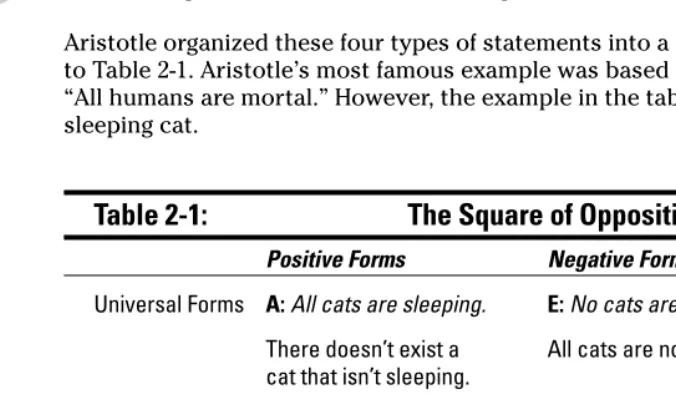
The square of oppositions— a tool Aristotle developed for studying
categori-cal statements — organizes the four basic forms of categoricategori-cal statements that appear frequently in syllogisms. These four forms are based on the posi-tive and negaposi-tive forms of universal and particular statements.
Aristotle organized these four types of statements into a simple chart similar to Table 2-1. Aristotle’s most famous example was based on the statement “All humans are mortal.” However, the example in the table is inspired by my sleeping cat.
Table 2-1:
The Square of Oppositions
Positive Forms Negative Forms
Universal Forms A:All cats are sleeping. E:No cats are sleeping.
There doesn’t exist a All cats are not sleeping. cat that isn’t sleeping.
No cats are not sleeping. There isn’t a cat that is sleeping.
Every cat is sleeping. There doesn’t exist a sleeping cat.
Particular Forms I:Some cats are sleeping. O:Not all cats are sleeping.
Not all cats are not sleeping. Some cats are not sleeping.
At least one cat is sleeping. There is at least one cat that isn’t sleeping.
There exists a sleeping cat. Not every cat is sleeping.
As you can see from the table, each type of statement expresses a different relationship between the category of cats and the category of sleeping things. In English, you can express each type of statement in a variety of ways. I’ve listed a few of these in the table, but many more are possible in each case.
Aristotle noticed relationships among all of these types of statements. The most important of these relationships is the contradictory relationship between those statements that are diagonal from each other. With contradic-tory pairs, one statement is true and the other false.
For example, look at the Aand O statements in Table 2-1. Clearly, if every cat
in the world is sleeping at the moment, then Ais true and Ois false;
other-wise, the situation is reversed. Similarly, look at the Eand I statements. If
every cat in the world is awake, then Eis true and Iis false; otherwise, the
situation is reversed.
If you’re wondering, the letters for the positive forms Aand Iare reputed to
come from the Latin word AffIrmo, which means “I affirm.” Similarly, the
let-ters for the negative forms Eand Oare said to come from the Latin word
nEgO, which means “I deny.” The source of these designations is unclear, but
you can rule out Aristotle, who spoke Greek, not Latin.
Euclid’s axioms and theorems
Although Euclid (c. 325–265 BC) wasn’t strictly a logician, his contributions to logic were undeniable.
Euclid is best known for his work in geometry, which is still called Euclidean geometryin his honor. His greatest achievement here was his logical
organiza-tion of geometric principles into axiomsand theorems.
Euclid began with five axioms (also called postulates) — true statements that he believed were simple and self-evident. From these axioms, he used logic to
prove theorems— true statements that were more complex and not
immedi-ately obvious. In this way, he succeeded in proving the vast body of geometry logically followed from the five axioms alone. Mathematicians still use this logical organization of statements into axioms and theorems. For more on this topic, see Chapter 22.
Euclid also used a logical method called indirect proof. In this method, you assume the opposite of what you want to prove and then show that this assumption leads to a conclusion that’s obviously incorrect.
23
For example, a detective in a murder mystery might reason: “If the butler committed the murder, then he must have been in the house between 7 p.m. and 8 p.m. But, witnesses saw him in the city twenty miles away during those hours, so he couldn’t have also been in the house. Therefore, the butler didn’t commit the murder.”
Indirect proof is also called proof by contradiction and reductio ad absurdum, which is Latin for reduced to an absurdity. Flip to Chapter 11 for more about how to use indirect proof.
Chrysippus and the Stoics
While Aristotle’s successors developed his work on the syllogistic logic of categorical statements, another Greek school of philosophy, the Stoics, took a different approach. They focused on conditional statements, which are
state-ments that take the form if . . . then. . . .For example:
Ifclouds are gathering in the west, thenit will rain.
Most notable among these logicians was Chrysippus (279–206 BC). He examined arguments using statements that were in this if . . . then . . . form. For example:
Premises:
If clouds are gathering in the west, then it will rain.
Clouds are gathering in the west.
Conclusion: It will rain.
Certainly, there are connections between the Aristotelian and the Stoic approaches. Both focused on sets of premises containing statements that, when true, tended to fit together in a way that forced the conclusion to be true as well. But friction between the two schools of thought caused logic to develop in two separate strands for over a century, though over time these merged into a unified discipline.
Logic takes a vacation
After the Greeks, logic went on a very long vacation, with a few sporadic revivals.
Throughout the Roman Empire and Medieval Europe for over a thousand years, logic was often disregarded. Aristotle’s writing on logic was occasion-ally translated with some commentary by the translator. However, very few people wrote original treatises on logic.
During the first millennium AD, more work on logic was done in the Arab world. Both Christian and Muslim philosophers in Baghdad continued to translate and comment upon Aristotle. Avicenna (980–1037) broke from this practice, studying logical concepts that involve time, such as always, sometimes, and never.
The 12th century saw a renewed interest in logic, especially logical fallacies, which are flaws in arguments. Some of this work, which was begun with Aristotle in his Sophistic Refutations, was used by theologians during this time of ever-widening Catholic influence in Europe. Throughout the next few cen-turies, philosophers continued to study questions of language and argument as they related to logic.
Additionally, as one of the seven liberal arts, logic was also central to the cur-riculum of the universities developing at this time. (I’m sure you are dying to know that the other six liberal arts were: grammar, rhetoric, arithmetic, geometry, astronomy, and music.)
Modern Logic — the 17
th
, 18
th
,
and 19
th
Centuries
In Europe, as the Age of Faith gradually gave way to the Age of Reason in the 16th and 17th centuries, thinkers became optimistic about finding answers to questions about the nature of the universe.
Even though scientists (such as Isaac Newton) and philosophers (such as René Descartes) continued to believe in God, they looked beyond church teachings to provide answers as to how God’s universe operated. Instead, they found that many of the mysteries of the world — such as the fall of an apple or the motion of the moon in space — could be explained mechanisti-cally and predicted using mathematics. With this surge in scientific thought, logic rose to preeminence as a fundamental tool of reason.
Leibniz and the Renaissance
Gottfried Leibniz (1646–1716) was the greatest logician of the Renaissance in Europe. Like Aristotle, Leibniz saw the potential for logic to become an indis-pensable tool for understanding the world. He was the first logician to take
25
Aristotle’s work a significant step farther by turning logical statements into symbols that could then be manipulated like numbers and equations. The result was the first crude attempt at symbolic logic.
In this way, Leibniz hoped logic would transform philosophy, politics, and even religion into pure calculation, providing a reliable method to answer all of life’s mysteries with objectivity. In a famous quote from The Art of
Discovery (1685), he says:
The only way to rectify our reasonings is to make them as tangible as those of the Mathematicians, so that we can find our error at a glance, and when there are disputes among persons, we can simply say: “Let us calculate, without further ado, to see who is right.”
Unfortunately, his dream of transforming all areas of life into calculation was not pursued by the generation that followed him. His ideas were so far ahead of their time that they were not recognized as important. After his death, Leibniz’s writings on logic as symbolic calculation gathered dust for almost 200 years. By the time they were rediscovered, logicians had already caught up with these ideas and surpassed them. As a result, Leibniz was not nearly as influential as he might have been during this crucial phase in the develop-ment of logic.
Working up to formal logic
For the most part, logic was studied informally— that is, without the use of
symbols in place of words — into the beginning of 19th century. Beginning with Leibniz, mathematicians and philosophers up to this time had impro-vised a wide variety of notations for common logical concepts. These sys-tems, however, generally lacked any method for full-scale computation and calculation.
By the end of the 19th century, however, mathematicians had developed formal logic— also called symbolic logic— in which computable symbols stand for words and statements. Three key contributors to formal logic were George Boole, Georg Cantor, and Gottlob Frege.
Boolean algebra
Named for its inventor, George Boole (1815–1864), Boolean algebra is the first fully fleshed-out system that handles logic as calculation. For this reason, it’s considered the precursor to formal logic.
Boolean algebra is similar to standard arithmetic in that it uses both numeri-cal values and the familiar operations for addition and multiplication. Unlike arithmetic, however, only two numbers are used: 0 and 1, which signify false and true, respectively.
For example:
Let A= Thomas Jefferson wrote the Declaration of Independence.
Let B= Paris Hilton wrote the U.S. Constitution.
Because the first statement is true and the second is false (thank goodness!), you can say:
A= 1 and B= 0
In Boolean algebra, addition is interpreted as or, so the statement
Thomas Jefferson wrote the Declaration of Independence orParis Hilton
wrote the U.S. Constitution
is translated as
A+ B= 1 + 0 = 1
Because the Boolean equation evaluates to 1, the statement is true. Similarly, multiplication is interpreted as and, so the statement
Thomas Jefferson wrote the Declaration of Independence andParis Hilton
wrote the U.S. Constitution
is translated as
A×B= 1 ×0 = 0
In this case, the Boolean equation evaluates to 0, so the statement is false.
As you can see, the calculation of values is remarkably similar to arithmetic. But the meaning behind the numbers is pure logic.
Check out Chapter 14 for more on Boolean algebra.
Cantor’s set theory
Set theory,pioneered by Georg Cantor in the 1870s, was another foreshadow-ing of formal logic, but with far wider influence and usefulness than Boolean algebra.
Loosely defined, asetis just a collection of things, which may or may not
have something in common. Here are a few examples:
{1, 2, 3, 4, 5, 6}
{Batman, Wonder Woman, Spiderman}
{Africa, Kelly Clarkson, November, Snoopy}
27
This simple construction is tremendously effective for characterizing impor-tant core ideas of logic. For example, consider this statement:
All U.S. states that contain the letter zbegin with the letter A.
This statement can be verified by identifying the sets of all states that contain
the letter zand begin with the letter A.Here are the two sets:
Set 1:{Arizona} Set 2:{Alabama, Alaska, Arizona, Arkansas} As you can see, every member of the first set is also a member of the second
set. Thus, the first set is a subsetof the second set, so the original statement
is true.
Despite its apparent simplicity — or, rather, because of it — set theory would soon become the foundation of logic and, ultimately, of formal mathematics itself.
Frege’s formal logic
Gottlob Frege (1848–1925) invented the first real system of formal logic. The system he invented is really one logical system embedded within another.
The smaller system, sentential logic— also known as propositional logic— uses
letters to stand for simple statements, which are then linked together using symbols for five key concepts: not, and, or, if, and if and only if. For example:
Let E= Evelyn is at the movies.
Let P= Peter is at home.
These definitions allow you to take these two statements:
Evelyn is at the movies andPeter is at home.
IfEvelyn is at the movies, thenPeter is notat home.
and turn them into symbols as follows:
E& P
E→~P
In the first statement, the symbol & means and. In the second, the symbol →
means if. . .then,and the symbol ~ means not.
I discuss sentential logic in more detail in Parts II and III.
The larger system, quantifier logic— also known as predicate logic— includes
all of the rules from sentential logic, but expands upon them. Quantifier logic uses different letters to stand for the subject and the predicate of a simple statement. For example:
Let e= Evelyn
Let p= Peter
Let Mx= x is at the movies
Let Hx= xis at home
These definitions allow you to represent these two statements:
Evelyn is at the movies andPeter is at home
IfEvelyn is at the movies, thenPeter is notat home
as
Me& Hp
Me→~Hp
Quantifier logic also includes two additional symbols for alland some, which