Volume 2006, Article ID 59809, Pages1–12 DOI 10.1155/ASP/2006/59809
DNA Microarray Data Analysis: A Novel
Biclustering Algorithm Approach
Alain B. Tchagang1and Ahmed H. Tewfik2
1Department of Biomedical Engineering, Institute of Technology, University of Minnesota, 312 Church Street SE, Minneapolis, MN 55455, USA
2Department of Electrical and Computer Engineering, Institute of Technology, University of Minnesota, 200 Union Street SE, Minneapolis, MN 55455, USA
Received 15 May 2005; Revised 5 October 2005; Accepted 1 December 2005
Biclustering algorithms refer to a distinct class of clustering algorithms that perform simultaneous row-column clustering. Biclus-tering problems arise in DNA microarray data analysis, collaborative filBiclus-tering, market research, information retrieval, text mining, electoral trends, exchange analysis, and so forth. When dealing with DNA microarray experimental data for example, the goal of biclustering algorithms is to find submatrices, that is, subgroups of genes and subgroups of conditions, where the genes exhibit highly correlated activities for every condition. In this study, we develop novel biclustering algorithms using basic linear algebra and arithmetic tools. The proposed biclustering algorithms can be used to search for all biclusters with constant values, biclusters with constant values on rows, biclusters with constant values on columns, and biclusters with coherent values from a set of data in a timely manner and without solving any optimization problem. We also show how one of the proposed biclustering algorithms can be adapted to identify biclusters with coherent evolution. The algorithms developed in this study discover all valid biclusters of each type, while almost all previous biclustering approaches will miss some.
Copyright © 2006 Hindawi Publishing Corporation. All rights reserved.
1. INTRODUCTION
One of the major goals of gene expression data analysis is to uncover genetic pathways, that is, chains of genetic interac-tions. For example, a researcher may be interested in identi-fying the genes that contribute to a disease. This task is dif-ficult because subgroups of genes display similar activation patternsonlyunder certain experimental conditions. Genes that are coregulated or coexpressed under a subset of condi-tions will behave differently under other conditions. Finding genetic pathways may therefore benefit from identifying clus-ters of genes that are coexpressed under subsets of conditions as opposed to all conditions.
Gene expression data is typically arranged in a data ma-trix, with rows corresponding to genes and columns corre-sponding to experimental conditions. Conditions can be dif-ferent environmental conditions or different time points cor-responding to one or more environmental conditions. The (n,m)th entry of the gene expression matrix represents the expression level of the gene corresponding to rownunder the specific condition corresponding to columnm. The nu-merical value of the entry is usually the logarithm of the rela-tive amount of the mRNA of the gene under the specific con-dition. By simultaneously clustering the rows and columns
of the gene expression matrix, one can identify candidate subsets of conditions that may be associated with cellular processes that exhibit themselves only or identify subsets of genes that potentially play a role in a given biological process. Biological analysis and experimentation could then confirm the biological significance of the candidate subsets.
Furthermore, when a clustering algorithm is applied to the rows of the gene expression matrix, it assigns each gene to a single cluster. Biclustering techniques on the other hand identify clusters that are not mutually exclusive or exhaus-tive. A gene may belong to no cluster, one or more clusters.
Cheng and Church compute the residue of each element of a submatrix of the gene expression matrix by subtract-ing from that element the means of all elements in its cor-responding row and column and by adding a constant equal to the overall mean of all elements in the matrix. They define a bicluster to be a submatrix formed with a subset of rows and columns of the gene expression matrix with a low mean-squared residue score and used a greedy approach to find bi-clusters. After that, many other approaches were proposed in the literature [3–9]. For example, Tanay et al. [3] mapped expression data onto bipartite graphs and used probabilistic graph techniques to find biclusters. Getz et al. [4] devised a coupled two-way iterative clustering algorithm to identify biclusters. Lazzeroni and Owen [5] introduced the notion of a plaid model, which describes the input matrix as a linear function of variables corresponding to its biclusters. Ben-Dor et al. [6] defined a bicluster as an order-preserving subma-trix, or equivalently, a group of genes whose expression levels induce some linear order across a subset of the conditions. Yang et al. [9] used tree traversal with two-way pruning of maximum coherent sets for each pair of genes and each pair of conditions, see [10] for many other approaches.
Most of these previous techniques search for one or two types of biclusters among four that have been identified in the literature [10]: biclusters with constant values, biclusters with constant values on rows or columns, biclusters with co-herent values, and biclusters with coco-herent evolution. Most previous techniques are also greedy and will miss meaningful biclusters. Many of these pioneering approaches used a cost function to define biclusters. In many cases, the cost function will measure the square deviation from the sum of the mean value of expression levels in the entire bicluster, and the mean values of expression levels along each row and column in the bicluster.
Our objective here is to develop a biclustering algorithm that is able to discoverallbiclusters in a given data set of any type defined by the user in a timely manner. The proposed biclustering algorithm approach is different from previous ones in several ways. Firstly, the proposed approach can be used to find the exact number of all valid perfect biclusters in each type and identify all of them in a timely manner. Sec-ondly, the proposed approach uses basic linear algebra and arithmetic tools and avoids the need for heuristic cost func-tions of prior approaches that can miss some pertinent bi-clusters. More specifically, our approach relies on the manip-ulation of elementary binary matrices with entries equal to “0” or “1.” Finally, our approach allows the user to view bi-clusters under any specific experimental condition.
Observe also that our procedures will produce more bi-clusters than most of the other biclustering approaches since they identify all biclusters of a given type. As mentioned above, this reduces the probability of missing a bicluster of potentially significant biological value. On the other hand,
this also increases the number of biclusters that a biologist needs to further examine. So far, we have not identified an effective criterion for ranking biclusters according to their potential biological significance.
The rest of this paper is organized as follows. After a quick description of the gene expression matrix in Section 2, we develop the proposed biclustering algorithm inSection 3. In Section 4, we show some simulation results and we compare the proposed biclustering algorithm with previous ones.
2. GENE EXPRESSION MATRIX
A DNA microarray data can be represented as anN×M ma-trixAwhose rows represent the genes, columns represent the experimental conditions, and real-number entriesanm rep-resent the expression level of gene nunder conditionmas illustrated in
A= ⎡ ⎢ ⎢ ⎢ ⎢ ⎢ ⎢ ⎢ ⎢ ⎢ ⎢ ⎣
a11 a12 · · · a1M a21 a22 · · · a2M
..
. ... ... ... an1 an2 · · · anM
..
. ... ... ... aN1 aN2 · · · aNM
⎤ ⎥ ⎥ ⎥ ⎥ ⎥ ⎥ ⎥ ⎥ ⎥ ⎥ ⎦
. (1)
We can also partition the matrixAinto rows, or into columns as illustrated by
A=R1 R2 · · · Rn · · · RN T
,
A=C1 C2 · · · Cm · · · CM .
(2)
In (2),
Rn=
an1 an2 · · · anm · · · anM ,
Cm=
a1m a2m · · · anm · · · aNm T
,
(3)
where 1 ≤ n ≤ N and 1 ≤ m ≤ M. The row vectorRn corresponds to the expression levels of thenth gene under Mconditions. The column vectorCmcorresponds to the ex-pression levels of theNgenes under themth condition. From (1), we can also define two additional vectors: the row vec-tor Conditions(1×M) and the column vector Genes(1×N). They are both label vectors and they are defined to keep track of every condition and gene:
conditions
=Condition 1· · ·Conditionm· · ·ConditionM , genes
=Gene 1 Gene 2 Gene 3· · ·Genen· · ·GeneN T. (4)
3. THE PROPOSED BICLUSTERING ALGORITHM
we describe below, the gene expression matrix is written as the sum of the product of each of its distinct elements with an elementary matrix. Each elementary matrix is binary, that is, its elements are either “1” or “0.” By performing elementary row or the column operations on the elementary matrices, it becomes easy to identify all perfect biclusters in a timely manner.
3.1. Data conditioning
The first part of the proposed biclustering algorithm consists of performing the data conditioning due to the fact that we are not only working with noisy data, but also DNA experi-mental data contains missing values.
Many techniques to recover missing values have been de-veloped in the literature, for example, [11,12]. Since the re-covery of missing values is not our main focus in this study, we have used the zero method, that is, replacing each missing value by zero.
Several techniques have been proposed in the literature, to deal with noise, including many data quantization tech-niques. In this study, we have used the following approach. First, we identify the numberLof distinct valuesαlthat exist in the gene expression matrixA. We assume that the values αl are rank-ordered according to their magnitudes, that is, αl< αl+1. Next, we redefineαlusing
αl= bl+bl−1
2 , (5)
where
bl=b0+le, withl=1toL,
e=bL−b0
L , b0=min
anm
, bL=max
anm
.
(6)
The interval [b0 bL] is then divided intoLequal intervals:
b0 bL
=b0b1
U· · ·Ubl−1 bl
U· · ·UbL−1bL
. (7)
Finally, a new data matrix is obtained by quantizing each ex-pression valueanmusingAlgorithm 1. Specifically, ifanmfalls in the interval [bl−1 bl[, then it is quantized to the centroid αlof that interval.
One advantage of using this quantization approach is that it does operate on all the data of the matrix. Therefore the biclusters that are present in the original set of data are not likely to be destroyed. All it does is reducing the num-ber of original biclusters and increasing their size by merging some of them together. This happens because this first global manipulation reduces the effect of noise in the entries of the gene expression matrix and the set of data becomes more uniform. We have also found this quantization approach to be useful in extending our basic biclustering approaches to deal with the coherent evolution case, as we will explain be-low.
Input A = microarray data
Output A = quantized microarray data Begin,
Compute:L,bL,b0,e,bl,αl Forl=1toL
Forn=1toN
Form=1toM Ifanm[bl−1bl[
anm=αl elseif anm==bL anm=αL End
End End End End Begin
Algorithm1: Data quantization procedure.
Note that one can also choose to perform the same ma-nipulation described above gene by gene, that is, by perform-ing the same manipulation on each row of the gene expres-sion matrix separately. One can also use any other quantiza-tion method, such as [13].
Finally, note that it is important in practice to assess the effects of the quantization step on the biclusters that are iden-tified by the procedures that we discuss below. This can be done by performing a simple sensitivity analysis in which the parametere is perturbed about its selected value. It is enough to consider one or two values forebelow and above its selected numerical value as determined above. Only bi-clusters that continue to be identified by the algorithms as eis varied should be retained for further examination. Note that the number of genes in these biclusters may also change. The user therefore needs to determine a rule for dealing with genes that may be dropped from the biclusters asechanges. The most conservative approach would be to retain only the genes that remain in the biclusters for all values ofearound its selected value.
3.2. Gene expression matrix decomposition
The second part of the proposed biclustering algorithm con-sists of writing matrixAas the sum of the products of each of its distinct elements with a corresponding elementary ma-trix. It is the first important step of the proposed biclustering algorithm because after the gene expression matrix is written as mentioned above, obtaining perfect biclusters is straight-forward. This is due to the fact that the elementary matrices consist of “0’s” and “1’s.”
Given thatAis made up ofLdistinct values,Acan be expressed using
A= l=L
l=1
From (8), we observe that theAl’s are binary matrices as mentioned earlier. We can also partition the matricesAlas rows or columns as illustrated by (9) and (10), respectively:
Al=
rl
1 r2l · · · rnl · · · rNl T
, (9)
Al=
cl1 cl2 · · · clm · · · clM T
. (10)
In (9) and (10), respectively, the row vectorsrl
n are binary 1×M vectors and the column vectorscl
m are binaryN×1 vectors. The row vectorrl
ncorresponds to thenth row of the elementary matrix that is associated to thelth distinct ele-ment of the gene expression matrix. The column vectorcl
m corresponds to themth column of the elementary matrix that is associated to thelth distinct element of the gene expression matrix. From (2)–(10), we can derive the following relations:
Rn= l=L
l=1
αlrnl, Cm= l=L
l=1
αlclm, l=L
l=1
Al=ones(N,M),
l=L
l=1
rnl =ones(1,M), l=L
l=1
clm=ones(N, 1),
(11)
where
α1< α2< α3<≤←−≤←−≤←−< αl←−1
< αl<≤←−≤←−≤←−< αL←−1< αL.
(12)
Here, ones(K,L) denotes a K×L matrix of ones. Finally, note that since we are dealing with binary numbers, the num-ber of distinct combinations that the row vectorrl
ncan take is less than or equal to 2M −1 and the number of distinct combinations that the column vectorcl
mcan take is less than or equal to 2N−1.
Decomposing the gene expression matrix as shown above has many advantages. Firstly, as mentioned earlier, all subse-quent algorithms operate on binary data. Thus we gain in terms of computational complexity and memory resources. Secondly, it allows the user to get more local information about the gene expression matrix in a simple way. For exam-ple, the ones in the binary row vectorrl
nshow the positions (i.e., the conditions) at which thenth gene has the same ex-pression valueαl(which corresponds to thelth distinct ele-ment of the gene expression matrix) and its zeros show the position at which the samenth gene is not expressed atαl. On the other hand, the ones in the binary column vector cl
m show subgroups of genes that have the same expression valueαl(which corresponds to thelth distinct element of the gene expression matrix) under the samemth condition, and its zeros show the subgroup of genes that are not expressed at the same valueαlunder the samemth condition. Also, if one is given two genes with two different binary row vectors rl
nandrkl associated with the same expression valueαl, one can identify the position at which both genes are expressed simultaneously atαlby computing the elementwise product ofrl
nandrkl. The result will be a binary row vector with its ones showing the positions at which both genes are expressed
simultaneously atαl. As will become clear below, this obser-vation plays a critical role in the elaboration of the proposed biclustering algorithm. Finally, observe that the decomposi-tion is also a powerful gene expression visualizadecomposi-tion tool.
3.3. Biclusters identification
The third part of the proposed algorithm consists of identify-ing the four types of biclusters from the gene expression ma-trix. Firstly, we develop three simple algorithms that can be used to extract all biclusters with constant values, biclusters with constant values on columns, and biclusters with con-stant values on rows. Secondly, we show how one of these algorithms can be modified to extract biclusters with coher-ent values. Finally, we describe how the modified algorithm, when coupled with tuning parametere(e=(bL−b0)/L)
de-fined above, can predict biclusters with coherent evolution from a set of data.
3.3.1. Biclusters with constant values
In a DNA microarray experimental data, a perfect bicluster with constant values is any submatrix B = [ai j] ofAwith dimensionI×Jwhose elements are constant:
B=ai j
=μ·ones(I,J), (13)
where 1≤i≤I and 1≤ j≤J. Such matrices reveal groups of genes with constant expression levels within a sub-group of conditions or vice versa.
From the gene expression matrix decomposition per-formed above, such matrices can be obtained by analyzing each elementary matrixAlseparately to obtain subgroups of genes that have constant expression levelαlunder different conditions. Such matrices will therefore correspond to sub-group of matrices of each elementary matrix whose elements are only the binary number “1.” To identify such matrices, we proceed by identifying the set of distinct rows of each el-ementary matrix that are nonzeros. The sum of the cardi-nalities of the sets of distinct rows of each of the elementary matricesAl will also be equivalent to the exact number of biclusters with constant values that can be found in a set of data.
In other words, sinceAlis a binary matrix, and since the number of genesNis always greater than the number of con-ditionsM, the number of biclusters (Nb) with constant values in a DNA microarray experimental data can be defined using
Nb= l=L
l=1
Pl, (14)
wherePlis the number of distinct nonzeros rowsrilof each elementary matrixAl. Now note that each distinct nonzeros rowrl
iof each elementary matrixAlconstitutes the principal row element of theith biclusterBl
iof the elementary matrix Alconsidered. Therefore, in order for any other rowrnlof the elementary matrixAlto belong to theith bicluster, (15) has to be true:
Input: A = quantized microarray data Output:Bl
i=biclusters with constant values Begin,
Compute:Pl,ril,rnl Forl=1toL
Fori=1toPl Bl
i=[]; Forn=1toN
Ifrl
i·∗rnl ==ril Bl
i=
Bl i;
Genes(n)αlril
End End
End End;Bl
i=
[0 Conditions];Bl i
;
End Begin
Algorithm2: Algorithm for finding biclusters with constant val-ues.
where 1≤i≤Pl, 1 ≤ n ≤ N, 1 ≤ l ≤ L, and “·∗” de-notes the elementwise product of the two given row vectors. Algorithm 2is then used to extract biclusters that have con-stant expression levelαl.
3.3.2. Biclusters with constant values on columns
A perfect bicluster with constant values on a column is any submatrixB = [ai j] ofAwith dimensionI×J which has one of the following forms:
B=ai j
= ⎧ ⎨ ⎩
μ+βj
, additive model,
μβj
, multiplicative model. (16)
The general form can be represented using
B= ⎡ ⎢ ⎣
· · · · μ1 μ2 · · · μJ · · · · ⎤ ⎥
⎦. (17)
We observe that ifβj =0 in the additive model orβj =1 in the multiplicative model, we haveai j=μ. Thus some perfect biclusters with constant values are also subclasses of biclus-ters with constant values on columns.
In a DNA microarray experimental data, biclusters with constant values on columns identify subgroups of conditions within which a subgroup of genes present similar expression values assuming that the expression values may differ from condition to condition.
UnlikeAlgorithm 2which dealt with the elementary ma-tricesAlone at a time, identification of biclusters with con-stant values on columns must examine all elementary ma-trices at the same time. It proceeds by identifying the exact number of distinct columns of the entire elementary matri-ces. The number found corresponds to the exact number of biclusters with constant values on columns that can be found in a set of data. Each distinct column also defines the mem-bership in a bicluster as shown below.
Input:A=quantized microarray data
Output:Bj=biclusters with constant values on columns Begin,
Compute:Pc,cj,cml Forj=1toPc
Bj=[]; Forl=1toL
Form=1toM
Ifcj·∗cml ==cj Bj=
Bj
Conditions(m);αlcj
End End
End;Bj=
[0 Genes]Bj
;
End End Begin
Algorithm3: Algorithm for finding biclusters with constant values on columns.
From the gene expression matrix decomposition per-formed above, the number of biclusters (Nb) with constant values on columns is given by
Nb=Pc, (18)
wherePcis the number of distinct nonzeros columnscjof the entire elementary matricesAl. Once more, each distinct col-umncj of the entire elementary matricesAlconstitutes the principal column element of thejth biclustersBj. Therefore, in order for any other columncl
mof any elementary matrix Alto belong to thejth bicluster, (19) has to be verified:
cj·∗clm=cj, (19) where 1≤j ≤Pc, 1≤m≤M, and 1≤l≤L.Algorithm 3 is then used to extract biclusters that have constant values on columns.
3.3.3. Biclusters with constant values on rows
A perfect bicluster with constant values on rows is any sub-matrixB=[ai j] ofAwith dimensionI×Jwhich has one of the following forms:
B=ai j
= ⎧ ⎨ ⎩
μ+αi
, additive model,
μαi
, multiplicative model. (20)
The general form of such biclusters can be represented using
B= ⎡ ⎢ ⎢ ⎢ ⎣
· · · μ1 · · ·
· · · μ2 · · ·
· · · · · · · μI · · · ⎤ ⎥ ⎥ ⎥
⎦. (21)
Input:A=quantized microarray data
Output:Bi=biclusters with constant values on rows Begin,
Compute:Pr,ri,rln Fori=1toPr
Bi=[]; Forl=1toL
Forn=1toN
Ifri·∗rnl ==ri Bi=
Bi;
Genes(n)αlri
End End End;Bi=
[0 Conditions];Bi
;
End End Begin
Algorithm4: Algorithm for finding biclusters with constant values on rows.
In a DNA microarray experimental data, biclusters with constant values on rows represent subgroups of genes with similar expression level across a subgroup of conditions, al-lowing the expression levels to differ from gene to gene.
Identification of such biclusters uses the same methodol-ogy as inAlgorithm 3.Algorithm 4operates on the rows of all the elementary matrices at the same time. It proceeds by identifying the exact number of distinct rows of the entire elementary matrices. Once more, the number found corre-sponds to the exact number of biclusters with constant values on rows that can be found in a set of data. Each distinct row also defines the membership in a bicluster as shown below.
From the gene expression matrix decomposition per-formed above, the number of biclusters (Nb) with constant values on rows is given by
Nb=Pr, (22)
wherePris the number of distinct nonzeros rowsriof the en-tire elementary matricesAl. Each distinct rowriof the entire elementary matricesAlconstitutes the principal row element of theith biclusterBi. Therefore, in order for any other row rl
nto belong to theith bicluster, (23) has to be verified:
ri·∗rnl =ri, (23) where 1 ≤i ≤Pr, 1≤n≤N, and 1≤l≤L.Algorithm 4 is then used to extract biclusters that have constant value on rows.
3.3.4. Biclusters with coherent values
A perfect bicluster with coherent values is any submatrix B = [ai j] ofAwith dimensionI×J which has one of the following forms:
B=ai j
= ⎧ ⎨ ⎩
μ+αi+βj
, additive model,
μαiβj
, multiplicative model. (24)
In this study, we will only deal with the additive model. From the above definition, we observe that the types of biclusters defined previously are particular cases of bicluster with co-herent values.
(i) Ifαi=βj =0, thenai j=μand the bicluster has con-stant values.
(ii) Ifαi=0, thenai j =μ+βjand the bicluster has con-stant values on columns.
(iii) Ifβj =0, thenai j =μ+αiand the bicluster has con-stant values on rows.
In a DNA microarray experimental data, biclusters with coherent values represent subgroups of genes and subgroups of conditions with coherent values on both rows and col-umns.
Note that a bicluster B with coherent values can be viewed as the sum of three matrices:B1with constant values,
B2with constant values on rows, andB3with constant values
on columns, that is,B=[μ+αi+βj]=[μ] + [αi] + [βj], with B1=[μ],B2=[αi] andB3=[βj]. Therefore, to obtain per-fect biclusters with coherent values from a DNA microarray experimental data, one of the following three approaches can be used.
Approach 1
The gene expression matrixAis first written as the sum of three matricesZ1,Z2, andZ3, whereZ1is a matrix with
con-stant values on rows, Z2 a matrix with constant values on
columns, andZ3 = A−(Z1+Z2). Next, useAlgorithm 2
to extract all perfect biclusters with constant values fromZ3.
Finally, add to each entry of each of these biclusters the cor-responding entry in (Z1+Z2) to obtain the biclusters with
coherent values inA.
Approach 2
The gene expression matrixAis first written as the sum of three matricesZ1,Z2, andZ3, whereZ1is a matrix with
con-stant values,Z2 a matrix with constant values on rows, and
Z3=A−(Z1+Z2). Next, useAlgorithm 3to extract all perfect
biclusters with constant values on columns fromZ3. Finally,
add to each entry of each of these biclusters the correspond-ing entry in (Z1+Z2) to obtain the biclusters with coherent
values inA.
Approach 3
The gene expression matrixAis first written as the sum of three matricesZ1,Z2, andZ3, whereZ1is a matrix with
con-stant values,Z2 a matrix with constant values on columns,
andZ3 = A−(Z1+Z2). Next, useAlgorithm 4to extract
all perfect biclusters with constant values on rows fromZ3.
Finally, add to each entry of each of these biclusters the cor-responding entry in (Z1+Z2) to obtain the biclusters with
coherent values inA.
is not arbitrary. It must be constructed using each row of the gene expression matrixAthat is also part of the bicluster with coherent values as explained below.
Property 1. LetXbe a matrix that contains a bicluster with coherent values embedded within its structure. Subtract fromXa matrixYthat has constant values on columns, and is constructed using a row of Xthat is also part of the bi-cluster with coherent values. The resulting matrixZcontains a bicluster with constant values on rows embedded within its structure. Furthermore, the location of the bicluster with constant values inZcorresponds to that of the bicluster with coherent values inA.
Proof. Without loss of generality, consider a matrix X that includes a bicluster with coherent values embedded in it:
X= ⎡ ⎢ ⎢ ⎢ ⎣
a α1+β2 f α1+β4 α1+β5
b e g j k
c α3+β2 h α3+β4 α3+β5
d α4+β2 i α4+β4 α4+β5
⎤ ⎥ ⎥ ⎥
⎦. (25)
The bicluster with coherent valuesB =(αi+βj) embedded within the structure ofXis
B= ⎡ ⎢ ⎢ ⎢ ⎣
·· α1+β2 ·· α1+β4 α1+β5
·· ·· ·· ·· ·· ·· α3+β2 ·· α3+β4 α3+β5
·· α4+β2 ·· α4+β4 α4+β5
⎤ ⎥ ⎥ ⎥
⎦. (26)
Thus we can construct the matrixYthat has constant values on columns using either the first, the third, or the fourth row ofX. Let us use the first row ofX. Therefore, we have
Y= ⎡ ⎢ ⎢ ⎢ ⎣
a α1+β2 f α1+β4 α1+β5
a α1+β2 f α1+β4 α1+β5
a α1+β2 f α1+β4 α1+β5
a α1+β2 f α1+β4 α1+β5
⎤ ⎥ ⎥ ⎥
⎦. (27)
By computingZ=X−Y, we have
Z= ⎡ ⎢ ⎢ ⎢ ⎣
0 0 0 0 0
b−a e−α1−β2 g−f j−α1−β4 k−α1−β5
c−a α3−α1 h−f α3−α1 α3−α1
d−a α4−α1 i−f α4−α1 α4−α1
⎤ ⎥ ⎥ ⎥
⎦.
(28)
Observe that Z has a bicluster Bcwith constant values on rows embedded within its structure. Furthermore, the loca-tion ofBccorresponds to that of the bicluster with coherent values inX:
Bc= ⎡ ⎢ ⎢ ⎢ ⎣
·· 0 ·· 0 0 ·· ·· ·· ·· ·· ·· α3−α1 ·· α3−α1 α3−α1
·· α4−α1 ·· α4−α1 α4−α1
⎤ ⎥ ⎥ ⎥
⎦. (29)
In [14], we provide a development of all of the other ap-proaches.
Since we do not have any knowledge about the rows of the gene expression matrix A, the intuitive approach is to use an iterative multistep approach. Specifically, we itera-tively construct the matrixZ1+Z2with constant values on
columns using each row ofA. After each iteration, we com-puteZ3 =A−(Z1+Z2) and useAlgorithm 4to extract all
perfect biclusters with constant values on rows fromZ3.
Fi-nally, we add to each entry of each of these biclusters the cor-responding entry in (Z1+Z2) to obtain the biclusters with
coherent values inA.
From the proof of the above property, we observe that there are many ways to construct the matrixZ1+Z2with
con-stant values on columns and obtain the same bicluster with coherent values. Therefore, to avoid redundancy and gain in computational time, we need a strategy that prevents the al-gorithm from identifying a bicluster more than once. The strategy should take into account the fact that a row of the gene expression matrix can be part of more than one biclus-ter with coherent values. Such strategy is still under investi-gation.
3.3.5. Biclusters with coherent evolution
The last type of biclusters addressed in this study is the set of biclusters that exhibit coherent evolution. Identifying such biclusters can be helpful in the sense that in some applica-tions, one might be interested in looking for subgroups of genes that are upregulated or downregulated across a sub-group of conditions without taking into account their actual expression values.
To extract such biclusters from a DNA microarray exper-imental data, we use the following approach. First, we tune parametere(e=(bL−b0)/L) defined inSection 3.1. Second,
we use the definition of perfect biclusters with coherent val-ues to obtain biclusters with coherent valval-ues from the new set of data. The location of the perfect biclusters obtained from the new set of data corresponds to that of potential biclusters with coherent evolution in the original set of data. Finally, we use a merit function to validate all resulting potential biclus-ters as we explain below.
By tuning parameteredefined inSection 3.1, we decrease the numberLof distinct values contained in the original set of data. Thus the resulting new set of data is more uniform than the original one. By applying the algorithm that extracts biclusters with coherent values to the new set of data, we ob-tain perfect biclusters with coherent values. A few examples are shown and discussed below inSection 4.2. After tuning, extraction, and matching of the set of perfect biclusters ob-tained from the new set of data with their equivalent in the original set of data, we obtain subgroups of genes with ex-pression levels that evolve coherently or stay constant across a subgroup of conditions regardless of their expression values. In some cases, we get biclusters with 1 or 2 imperfections. By imperfection we mean a gene with expression levels that do not evolve coherently with those of all other genes for a few conditions.
coherent evolution. Specifically, we adopt the mean-squared residue functionHdefined by
H(I,J)=| 1 I||J|
i∈I,j∈J rai j
2
. (30)
In (30),r(ai j)=ai j−aiJ−aI j+aIJis the residue function,
aiJ= 1 |J|
j∈J
ai j (31)
is the mean of theith row in the bicluster,
aI j = 1 |I|
i∈I
ai j (32)
is the mean of thejth column in the bicluster, and
aIJ= 1 |I||J|
i∈I,j∈J
ai j (33)
is the mean of all the elements of the bicluster.
The residue of perfect biclusters is zero, so is their mean-squared residue. In order to validate a bicluster, we define a thresholdδand all qualified biclusters must verify:
H(I,J)< δ. (34)
3.3.6. Complexity analysis
We can easily estimate the complexity of the proposed ap-proach. Recall thatNis the number of rows of the gene ex-pression matrixA,Mis the number of columns inA, andL is the number of distinct values inA.
Algorithm 1, which is used for data quantization, re-quires about (N×M×L) operations. One has to note that this step is optional. After data quantization, we perform the matrix decomposition that requires about (N×M×L) op-erations.Algorithm 2which is used to extract biclusters with constant values usesO((N×M+N+K+K×M)×L×Nb) op-erations because we performN×Mbinary multiplications, Ncomparisons, andKassignmentsL×Nbtimes. Here,Nbis the number of biclusters andK is the number of times (15) is verified. It can be similarly verified that the complexities of Algorithms3and4are, respectively,O((N×M+M+K1+
K1×N)×L×Nb) andO((N×M+N+K2+K2×M)×L×Nb), whereK1andK2are the number of times (19) and (23) are
verified.
From the above observations, the complete biclustering approach has complexity ofO(N×M×L×Nb). Therefore, The proposed biclustering algorithm is less complex than the FLOC algorithm proposed by Yang et al. which has complex-ityO((N+M)2×K×P), wherePis the desired number of
biclusters andKis the number of iteration till the end. FLOC was shown by Yang et al. to be less complex than the Cheng-Church algorithm [9].
4. RESULTS
Let us conclude by discussing some of the results that we have obtained. As in [13], we have implemented the proposed bi-clustering algorithm in Matlab and tested it on the yeast gene microarray data that can be found at [15]. The data consists of 2884 genes and 17 conditions. We have obtained the fol-lowing first results. Initially, the data containedL=206 dis-tinct values.
4.1. First set of results
In the first set of results that we report here, we set bL = max[anm]=595,b0 =min[anm]=0, thuse=2.8883 and bl=b0+le=2.8883l, with 1≤l≤L. After data
condition-ing, we obtainedL = 111 new distinct values. Then from our simulation, we obtained Nb = 10225 biclusters with constant values,Nb = 3391 biclusters with constant values on rows, and Nb = 836 biclusters with constant values on columns. Because of the large number of biclusters found, we will present here a few illustrative results that will help the reader to grasp the magnitude of the problem and the nature of the results produced by the algorithm.Figure 1shows an example of perfect biclusters with constant values, perfect bi-clusters with constant values on rows, and perfect bibi-clusters with constant values on columns obtained.Figure 2shows an example of perfect biclusters with coherent values obtained.
4.2. Second set of results
In the second set of results that we report, we explore the ef-fect of two parameters: parameterethat defines the number of distinct values of the data set and thresholdδthat qualifies the biclusters obtained.
For the thresholdδ, we simply compare the residue of the biclusters obtained with the average residue of the Cheng-Church algorithm (204.293), and the average residue of the biclustering algorithm defined by Yang et al. (187.543) [9].
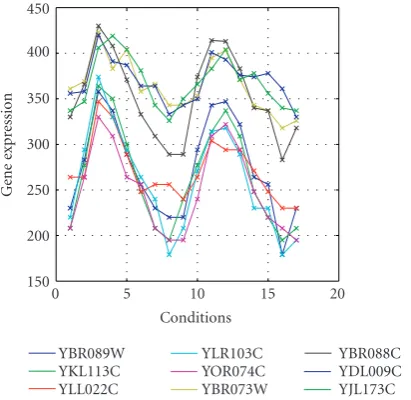
To explore the effect ofe, we successively tuned its value from 2.8883 as initially defined to about 40. It is obvious that by increasing the value ofe, the size of the biclusters obtained will increase and the probability of having the biclusters af-fected by imperfection will also increase.Figure 3shows an example of biclusters with coherent evolution obtained with-out any imperfection. Thus, there is no need to use the merit function for validation.Figure 4shows an example of perfect biclusters with coherent values obtained in the new data set aftere is tuned up.Figure 5shows the equivalent bicluster with the original data set. We observe a few imperfections, and thus need to use the merit function for validation.
2 4 6 8 10 12 14 16 Conditions
68 68.2 68.4 68.6 68.8 69 69.2 69.4 69.6 69.8 70
Gene
ex
pr
ession
YDL210W YEL052W
YER084W
(a)
0 5 10 15 20
Conditions 0
20 40 60 80 100 120
Gene
ex
pr
ession
YAL065C YAR002C-A YBR028C YBR090C
YBR124W YDL216C YDR314C YHR079C-A
YIR042C YJL147C YNL034W YKR104W (b)
0 5 10 15
Conditions 10
5 0 5 10 15
Gene
ex
pr
ession
YAL065C YAR002C-A
YBR090C YER179W
YHR079C-A YNL034W (c)
Figure1: Example of bicluster (a) with constant values; (b) with constant values on rows; and (c) with constant values on columns.
threshold valueδ. We discuss the biological significance of the biclusters that the procedure identified in the next sub-section.
Note that the data conditioning and decomposition steps of our procedure took approximately 250 seconds to process the yeast data found at [15]. It took less than 10 seconds to identify a bicluster. Thus its running time is better than that of [2], which reportedly takes 300–400 seconds to find a sin-gle bicluster, and is comparable to that of [16].
4.3. Biological significance
Since our ultimate goal is to be able to uncover genetic path-ways from the set of biclusters that our methods produce, we need to investigate the biological significance of these
biclus-ters. Ideally, the investigation would also yield a criterion for ranking biclusters according to their biological significance. As mentioned earlier, we have not succeeded so far in iden-tifying such a criterion. We will therefore limit ourselves in this subsection to a discussion of the biological significance of the 258 biclusters mentioned inSection 4.2. The analysis of these biclusters is representative of what we have seen so far. It also illustrates the complexity of the additional inves-tigations that must be performed on the biclusters once they have been identified.
6 8 10 12 14 16 18 Conditions
50 100 150 200 250 300 350 400
Gene
ex
pr
ession
YAL010C YDR150W YLR138W YKL173W YBR220C
YEL015W YCR041W YAR061W YBR032W YCR063W
YDL034W YDL247W YMR117C
Figure2: Example of bicluster with coherent values.
2 4 6 8 10 12 14 16 18
Conditions 350
400 450 500 550 600
Gene
ex
pr
ession
YAL003W YAL038W YAR009C YBL072C YBL092W
YBR048W YBR084C-A YBR181C YBR189W YDL082W
YDL130W YDR025W YDR050C YDR450W
Figure3: Example of bicluster with coherent evolutions obtained from the new data set aftereis tuned up.
calledFunCat, the functional classification catalog. More in-formation can be found in [19].
Table 1 provides a preliminary biological significance analysis of the 258 biclusters inSection 4.2. The second row ofTable 1lists how many biclusters were found. Rows three through five show how many biclusters belong to one of 4 mutually exclusive categories. The third row shows how many of those biclusters contained genes that were all anno-tated under the same function. An example of a bicluster in this grouping would be three genes that all produce proteins
0 5 10 15 20
Conditions 200
250 300 350 400 450
Gene
ex
pr
ession
YBR089W YKL113C YLL022C
YLR103C YOR074C YBR073W
YBR088C YDL009C YJL173C
Figure4: Example of perfect biclusters with coherent values ob-tained from the new data set aftereis tuned up.
0 5 10 15 20
Conditions 150
200 250 300 350 400 450
Gene
ex
pr
ession
YBR089W YKL113C YLL022C
YLR103C YOR074C YBR073W
YBR088C YDL009C YJL173C
Figure5: Equivalent of the perfect biclusters with coherent values shown inFigure 4in the real data set with few imperfection. The lines represent different genes.
whose main purpose is metabolism. The fourth row displays how many of the biclusters picked up only genes that were unclassified. The fifth row lists the number of biclusters that contained genes annotated to the same function as well as unclassified genes.
Table1: Biological analysis of the 258 biclusters with coherent evolutions.
Number of conditions 13 14 15 16 17
Number of biclusters with coherent values 148 69 35 5 1
Number of functionally defined biclusters 3 (2.0%) 1 (1.4%) 0 0 0
Biclusters composed entirely of unclassified genes 35 (23.6%) 12 (17.4%) 16 (45.8%) 0 1
Biclusters with unclassified genes and genes of one function 50 (33.8%) 37 (53.6%) 13 (37.1%) 4 (80%) 0
Biclusters with genes of mixed annotation 60 (40.6%) 19 (27.6%) 6 (17.1%) 1 (20%) 0
“mixed” data. The appearance of such biclusters led us to pose several questions that we are attempting to answer in collaboration with researchers in the biological sciences. The genes in these mixed biclusters showed patterns of coherent evolution but did not fall necessarily in the same functional category.
The presence of these biclusters may be indicative of the fact that coregulated genes do not necessarily belong to the same functional category. On the other hand, it may indicate that these genes have other unknown functions or functions that were not captured in the annotation we used. It is also possible that the expression levels of certain genes that be-long to a given functional category affect those of some other genes that belong to a different functional category.
Many of the mixed biclusters are of biological interest be-cause they contain genes that either belong to a single func-tional category or are unclassified. Current investigations are attempting to determine whether the unclassified genes in these biclusters do actually belong to the same functional cat-egory as the others. With colleagues, we are examining the lit-erature to identify the theorized functions of many of the un-classified genes that appear in mixed biclusters or biclusters with unclassified genes. We are also studying alternative gene annotation sources, such as GO-slim [20], to answer some of the questions that we posed here.
5. CONCLUSION
In this study, we developed an efficient biclustering algo-rithm that can be used to extract from a set of data biclusters with constant values, constant values on rows, constant val-ues on columns, and coherent valval-ues. We also described an approach for finding biclusters with coherent evolutions, this approach combines the algorithm that finds biclusters with coherent values with adaptive gene expression level quanti-zation procedure. Since completing this work, we have also developed an alternative fast and direct approach for finding all biclusters with coherent evolutions [21] with no imperfec-tion. In contrast to prior work, our procedure is able to find all biclusters with constant values, constant values on rows, constant values on columns, and coherent values. Further-more, it has similar or lower complexity than that of prior work.
REFERENCES
[1] J. A. Hartigan, “Direct clustering of a data matrix,”Journal of the American Statistical Association, vol. 67, no. 337, pp. 123– 129, 1972.
[2] Y. Cheng and G. M. Church, “Biclustering of expression data,” inProceedings of the 8th International Conference on Intelligent Systems for Molecular Biology (ISMB ’00), pp. 93–103, La Jolla, Calif, USA, August 2000.
[3] A. Tanay, R. Sharan, and R. Shamir, “Discovering statistically significant biclusters in gene expression data,”Bioinformatics, vol. 18, supplement 1, pp. S136–S144, 2002.
[4] G. Getz, E. Levine, and E. Domany, “Coupled two-way clus-tering analysis of gene microarray data,” Proceedings of the National Academy of Sciences of the United States of America, vol. 97, no. 22, pp. 12079–12084, 2000.
[5] L. Lazzeroni and A. Owen, “Plaid models for gene expression data,”Statistica Sinica, vol. 12, no. 1, pp. 61–86, 2002. [6] A. Ben-Dor, B. Chor, R. Karp, and Z. Yakhini, “Discovering
local structure in gene expression data: the order-preserving submatrix problem,” inProceedings of the 6th Annual Interna-tional Conference on ComputaInterna-tional Biology (RECOMB ’02), pp. 49–57, Washington, DC, USA, April 2002.
[7] R. Sharan, A. Maron-Katz, and R. Shamir, “CLICK and EX-PANDER: a system for clustering and visualizing gene expres-sion data,”Bioinformatics, vol. 19, no. 14, pp. 1787–1799, 2003. [8] Y. Kluger, R. Basri, J. T. Chang, and M. Gerstein, “Spectral bi-clustering of microarray data: cobi-clustering genes and condi-tions,”Genome Research, vol. 13, no. 4, pp. 703–716, 2003. [9] J. Yang, H. Wang, W. Wang, and P. S. Yu, “Enhanced
bicluster-ing on expression data,” inProceedings of 3rd IEEE Symposium on Bioinformatics and Bioengineering (BIBE ’03), pp. 321–327, Bethesda, Md, USA, March 2003.
[10] S. C. Madeira and A. L. Oliveira, “Biclustering algorithms for biological data analysis: a survey,”IEEE Transactions on Com-putational Biology and Bioinformatics, vol. 1, no. 1, pp. 24–45, 2004.
[11] O. Alter, P. O. Brown, and D. Botstein, “Processing and model-ing genome-wide expression data usmodel-ing smodel-ingular value decom-position,” inMicroarrays: Optical Technologies and Informatics, vol. 4266 ofProceedings of SPIE, pp. 171–186, San Jose, Calif, USA, January 2001.
[12] O. Troyanskaya, M. Cantor, G. Sherlock, et al., “Missing value estimation methods for DNA microarrays,” Bioinformatics, vol. 17, no. 6, pp. 520–525, 2001.
[13] A. H. Tewfik and A. B. Tchagang, “Biclustering of DNA mi-croarray data with early pruning,” inProceedings of IEEE Inter-national Conference on Acoustics, Speech, and Signal Processing (ICASSP ’05), Philadelphia, Pa, USA, March 2005.
[14] A. B. Tchagang and A. H. Tewfik, “Robust biclustering algo-rithm: ROBA,” Tech. Rep., University of Minnesota, 2005. [15] S. Tavazoie, J. Hughes, M. Campbell, R. Cho, and G. Church,
Yeast micro data set, http://arep.med.harvard.edu/bicluster-ing.
[17] U. G¨uldener, M. M¨unsterk¨otter, G. Kastenm¨uller, et al., “CYGD: the comprehensive yeast genome database,”Nucleic Acids Research, vol. 33, Database issue, pp. D364–D368, 2005. [18] Munich Information Center for Protein Sequences (MIPS) and GSF-National Research Center for Environment and Health, “Comprehensive Yeast Genome Database,” 2002. (vis-ited July 21, 2005),http://mips.gsf.de/genre/proj/yeast/. [19] A. Ruepp, A. Zollner, D. Maier, et al., “The FunCat, a
func-tional annotation scheme for systematic classification of pro-teins from whole genomes,”Nucleic Acids Research, vol. 32, no. 18, pp. 5539–5545, 2004.
[20] R. Balakrishnan, K. R. Christie, M. C. Costanzo, et al., “Sac-charomyces Genome Database,”http://www.yeastgenome.org. [21] A. H. Tewfik, A. B. Tchagang, and L. Vertatschitsch, “Parallel identification of gene biclusters with coherent evolution,” to appear inIEEE Transactions on Signal Processing, Special issue on Genomics Signal Processing.
Alain B. Tchagang received the B.S. de-gree and the M.S. dede-gree in physics from the University of Yaound´e I, Cameroon, in 1996 and 1997, a “Diplome d’Ingenieur de Conception de Genie Electrique” from the “ ´Ecole Nationale Superieure Polytech-nique” of Cameroon in 2000, the M.S. de-gree in electrical engineering from the Uni-versity of Minnesota, USA, in October 2004. He is currently a Ph.D. student in the
De-partment of Biomedical Engineering at the University of Min-nesota. He is also a Research Assistant in the Multiscale Multi-rate Signal Processing Lab at the University of Minnesota. His re-search interests include (A) application of digital signal process-ing and digital control systems design to biomedical engineer-ing (bioelectricity, biomechanics, biological transport processes, and medical imaging; (B) mathematical modeling and analysis of biological systems and data (genomics, proteomics, DNA mi-croarray, gene expression, gene regulatory networks, and compu-tational biology.) He did work as an Electrical Engineer Intern at http://www.cenco.usduring Spring 2004, Summer 2004, Fall 2004.
Ahmed H. Tewfik received his B.S. de-gree from Cairo University, Cairo, Egypt, in 1982, and his M.S., E.E., and Sc.D. degrees from the Massachusetts Institute of Tech-nology, Cambridge, Mass, in 1984, 1985, and 1987, respectively. He is the E. F. John-son Professor of electronic communications with the Department of Electrical Engineer-ing at the University of Minnesota. His cur-rent research interests are in genomics and