1754
A Multi-Attention based Neural Network with External Knowledge for
Story Ending Predicting Task
Qian Li1, Ziwei Li1, Jin-Mao Wei1, Yanhui Gu2, Adam Jatowt3, Zhenglu Yang1 CCCE, Nankai University,China1
School of CS and Technology, Nanjing Normal University, China2 Graduate School of Informatics, Kyoto University, Japan3
{liqian515,lzw nku}@mail.nankai.edu.cn, [email protected], [email protected], [email protected],
Abstract
Enabling a mechanism to understand a temporal story and predict its ending is an interesting issue that has attracted considerable attention, as in case of the ROC Story Cloze Task (SCT). In this paper, we develop a multi-attention based neural network (MANN) with well-designed optimizations, like Highway Network, and concatenated features with embedding representations into the hierarchical neural network model. Considering the particulars of the specific task, we thoughtfully extend MANN with external knowledge resources, exceeding state-of-the-art results obviously. Furthermore, we develop a thorough understanding of our model through a careful hand analysis on a subset of the stories. We identify what traits of MANN contribute to its outperformance and how external knowledge is obtained in such an ending prediction task.
1 Introduction
The prediction on story endings is an important and interesting application because it is involved with several essential issues, such as textual semantic understanding, logical reasoning and natural text gen-eration. Most previous studies on the subject of common sense story understanding mainly focus on generating guesses for a missing event, such as matching explicit information in a given context (Cham-bers and Jurafsky, 2008), paying attention to specific types of common sense knowledge, like event schema (Chambers and Jurafsky, 2009), or concentrating on unsupervised learning (Chambers and Ju-rafsky, 2008). Although numerous studies have addressed the issue, training machines to be able to understand underlying narrative structures is still a challenging task. Previous research is limited at the shallow technique requirement of evaluation and noisy knowledge resources.
To facilitate the evaluation and benchmark the problem in the literature, the Story Cloze Task (SCT) has been introduced to predict what should be the “right” ending to a story (Mostafazadeh et al., 2016), which consists of daily events. The common strategies utilized to perform the task can be classified into two kinds of approaches: (1) traditional machine learning techniques with optimal feature engineering; and (2) deep learning-based models with effective strategies (Cai et al., 2017). The task is published with an unlabeled training set that consists of one-correct-ending stories, which is a notable impediment for further research. Some studies investigated fake ending generation, which obtained far more satisfying results. Most supervised learning approaches are trained from the finite evaluation set, ignoring the sheer volume of training corpus.
Understanding daily stories requires not only common sense experience sharing, but also a thorough understanding of text learned from common sense knowledge resources. We propose an effective multi-attention based neural network (MANN) and broaden our model with external knowledge. The model is superior in three aspects: (i) it adds features of sentences as embedding representations; (ii) it features a self-matched attention mechanism that functions through one sentence of the story, while interaction attention functions across the story plot and ending option to obtain word-level interaction; and (iii) it involves external knowledge to augment text coherence understanding.
The proposed model is comprehensively evaluated by comparing it with state-of-the-art approaches. Results show that the performance of the MANN strategy is superior to that of its competitors by up to 7% in terms of accuracy.
Furthermore, we conduct ablation experiments to illustrate the effect of each component in the MANN framework. Through elaborate evaluation, we demonstrate the superiorities and different characteristics of the components in the proposed model and the beneficial effect of the external knowledge utilized.
The contributions of this work are as follows:
• We build a MANN with deliberately devised structures, consisting of components that were not previously applied in this task, such as synthesis embeddings, multiple attentions and Highway, to characterize the semantic coherence of temporal stories from SCT.
• Unlike previous work on generating fake options or that trained only on the labeled set, we extend our model by regarding the unannotated corpus as proportions of external knowledge to enrich insufficient information to remedy the issue of limited resources.
• We conduct comprehensive analysis by manually labeling a subset of 300 stories to further study how our method performs in the story ending prediction task. We demonstrate that the proposed model outperforms the state-of-the-art methods by up to 7%. We will provide the full list of these annotated samples for further research.
2 Related Work
The issue of story ending prediction is related to several other research topics, such as reading compre-hension and common sense learning, which will be briefly surveyed as follows.
Reading comprehensionis the ability to read and understand text, and it has attracted much attention in natural language processing (NLP) to evaluate the level a machine can reach in understanding text. Two popular forms of evaluation tasks exist in this field: cloze-style query and text-span matching. Cloze-style query, such as SQuAD published by Stanford University, focuses on predicting existing text from the original corpus when given a relevant context. Text-span matching is different from selecting a possible word from the provided text to replenish the blank areas, such as CNN/DailyMail by Hermann and Hinton. Existing tasks are constructed with fragments, whereas examples from SCT are complete and independent stories that has short and meaningful sentence. SCT is also different in that it requires the prediction of development of a story, which is not provided in the given hypothesis. This novel task calls for stronger relation extraction and external inferential capability to identify the correct ending. Our model paid attention on through structure and proved to be effective during experiments.
Common sense learning is a challenging aspect in NLP. The limitation of other rich knowledge structures is that they mostly either focus on shallower representations, such as semantic roles like PropBank (Palmer et al., 2005), or pay attention to specific types of knowledge, i.e., unsupervised co-reference in the text (Chambers and Jurafsky, 2009) and event temporal relation (Modi and Titov, 2014). Learning from structural event knowledge is proposed to enrich this field, including narrative schema (Chambers and Jurafsky, 2009) and event frames (Sha et al., 2016). Unlike the above tasks, SCT (Mostafazadeh et al., 2016) provides large-scale supervised training stories of temporal and causal relations, ensuring a high-quality evaluation for common sense knowledge understanding of mecha-nisms.
However, the published ROCStories could not be used directly in supervised learning. Considering the use of the training set without negative endings, researchers proposed strategies to generate incorrect options. A conditional generative adversarial network has been proposed, achieving a moderate result with an accuracy of 60.9% (Wang et al., 2017). Roemmele (Roemmele et al., 2017) designed four generative models for fake options, namely, random, backward, nearest-ending and language model. The best result is produced from samples of all four types of endings (67.2%).
Figure 1: Architecture of our model.1
Task, which achieved a score of 75.2% by associating writing style features in endings and training a linear regression. HCM (Chaturvedi et al., 2017) trained a joint model with feature engineering to obtain representations of event sequence, sentiment, and topic from validation set and a hidden variable approach as a voter, thereby obtaining 77.6%. The previous NN-based models did not perform well. Cai (Cai et al., 2017) constructed a model with hierarchical long short-term memory network (LSTM) to encode plot and an ending2sentence attention, then concatenated the two representations through feed-forward network and outputting the final prediction, obtaining 74.7% accuracy. We pursue the same strategy to construct our principal model MANN and see opportunity to utilize external knowledge in the technique of combining semantic sequence information.
3 Proposed Model
This study aims to deduce the right ending given its previous context in the story. Formally, the story ending prediction task is defined as follows: given the storyhP, Ei, whereP=hs1, . . . , sniis a story plot,
and the ending optionsE=he1, . . . , eki, the task is to select an appropriate endingei (1≤i≤ k)from E. We address the task as a regression problem, mapping the right ending as 1 and the wrong ending as 0. We identify the highest-scored option as the answer. We first introduce the MANN model, followed with the extension of the model; this extension is constructed to learn from external knowledge. The whole model is shown in Fig.1.
3.1 Multi-attention Neural Network Model
The proposed MANN model consists of four layers. The embedding layer maps each word to a high-dimension vector representation. Then, the encoding layer encodes the representation of the context, and the feature amalgamation layer extracts features from the interaction between plot and the ending. Finally, the output layer provides the probability of the right ending.
Embedding Layer:We concatenate five representations: (i) word embedding; (ii) character feature; (iii) part-of-speech (POS) tagging; (iv) sentiment polarity of a word; and (v) negation.
Word embedding is conducted by converting a token to a high-dimensional vector space, and we obtain a fixed word embedding of each word by using pre-trained vocabulary. The character feature is obtained by mapping each word to a high-dimensional vector space to better handle out-of-vocab or rare words. We abstract character-level representations for tokens through a one-dimension convolutional neural network(CNN). The vectors embedded from characters have the same size as the input channel size of the CNN. By max-pooling the outputs of the CNN over the entire width, we obtain fixed-size vectors for words. By utilizing pre-processing tools, we tackle the last three aspects of a word as one-hot representations, while we collect the POS tagging feature with a natural language toolkit, sentiment polarity of a word with a look-up from pre-trained sentiment lexica, and negation with a corpus of
negation words (i.e., “not”, “neither”, “nor” and “n’t”). The concatenation of the five representations of a word is then passed through a two-layer Highway Network (Srivastava et al., 2015) to fuse the information of features, which is processed as follows:
trans=ReLU(wtx+bt) (1)
gate=σ(wgx+bg) (2)
H(x) =gate∗trans+x(1−gate) (3)
wherewg, wt∈RD×Dandbt, bg ∈RD,Dis the dimension of input.
Encoding Layer:The encoding layer encodes the sequence and semantic abstraction of a single sentence and then compromises them, which are from an identical plot to obtain a fusion premise.
Sentence encoding constructs an LSTM in both directions on top of the embeddings provided by the previous layer and concatenate the outputs of forward and backward LSTMs, to learn high-level abstractions from time-sequence features of the context. We obtainslj,(j=1,...,n) = [−−−−→LST M;←−−−−LST M] where ;represents the concatenation between two directional LSTM thus slj ∈ RT×2d denotes each
sentence in plot andeli ∈RG×2ddenotes the ending.
The new representations are passed into self-matched attention to model the temporal interactions between words. Taking vectorV as example, self-matched attentionVe =att(V)is defined as follows:
Mij =WT[Vi;Vj;Vi◦Vj] (4)
ai =sof tmax(Mi) (5)
e
Vi =
X
j
aijVj (6)
whereWT ∈R6dis a weight matrix and◦is element-wise multiplication. The higher-level semantics
can directly tackled from encoded sequences through the attention mechanism.
Plot encodingcompounds the interacted representation of sentences from the same story context. We studied several commonly used implementations for sentence combination, such as LSTM, summation, weighted summation, and concatenation operations. We find simple concatenation useful. The encod-ings of the story plot is concatenated asPˆ = [att(sl1);· · ·;att(sln)],Pˆ ∈RnT×2d, while the ending is
simply represented aseˆ=att(eli),eˆ∈RG×2d.
Feature Amalgamation Layer:We focus on characterizing diverse interaction information among rep-resentations of the plot and the ending, thus extracting feature from them. This layer is inspired by the IIN model (Gong et al., 2018). We combine the plot vectors and ending representations to create a word-by-word interaction attention tensor, in which each channel represents the interaction of the word in one dimension. We tried processing, such asFij = ˆPi◦ˆej,Fij = ˆPi+ ˆej andFij =|Pˆi−eˆj|and
found that the most effective one isFij = ˆPi◦ˆej, where we definei∈[1, . . . , nT],j∈[1, . . . , G],◦is
element-wise multiplication andF ∈RnT×G×2d.
Then, we adapt a feature extractor on F to extract semantic features from word-by-word inter-action.Unlike extractors (i.e., VGG and ResNets (He et al., 2016)), DenseNet (Huang et al., 2017) strengthens feature propagation and reduces information disappearance through time because of the structure of pre-activation.
Output Layer: A multi-feedforward neural layer is used. We apply threetanhlayers to calculate a score for prediction support.
3.2 Extension of MANN
External knowledge is mostly used to enrich word implication, thereby ensuring that semantic infor-mation can be extracted. To address the combination of external knowledge and the neural network model, Chen (Chen et al., 2017) added extra relation informations of word pair into the encoder. Other researchers studied embedding representations (Bordes et al., 2013) to learn complex reasoning capac-ities. Considering specific ending-prediction task, we aim to further derive coherence among sentences from stories. Directly working on the large-scale ROCStories is not easy due to its deficiency of negative samples. We use SemLM (Peng and Roth, 2016) to model the distribution over a meaningful sequence chain, with ROCStories regarded as portion of our extra resources while the other are from news data.
SemLM is a language model that first uses FrameNet to split sentences by semantic sequence, and then represents these pieces of sequence with semantic frames and discourse markers from an extended vocabulary. The abstraction of a sentence is[f1, dis1, f2,· · · , o]wherefi denotes semantic frames,disi
denotes discourse markers and o denotes period symbol. The SemLM is trained with a log-bilinear model (Mnih and Hinton, 2007) on ROC corpus and news data, and obtains the probability of two words appearing simultaneously in a sentence. The log-bilinear model computes the sequence probability of the next wordwi given the previous words (context), which is defined as follows:
p(wi|c(wi)) =
exp(v(wi)Tu(c(wi)) +b(wi))
P
w∈V exp(v(w)Tu(c(wi)) +b(w))
(7)
We definev(w)as the target vector,v0(w)as the context vector, andb(w)as a bias of a token. Here,
V is the vocabulary, u(c(wi)) = Pct∈c(wi)qt ◦ v 0(c
t), ◦ is element-wise multiplication and qi is a
model parameter that depends on the position of a token in the context. The final sequence probability is
Qk
i=1p(wi|c(wi)).
The trained language model is then used to calculate the conditional probability of semantic frames from each option when given the same hypothesis, inspired by HCM (Chaturvedi et al., 2017). For each endingeiwith frames represented asfeiandhf1, f2,· · · , fTi, T ≥nindicating semantic frames evoked in the story plot, the following features are captured considering the sequence of frames in corresponding story plot:P(fei|fT),P(fei|fT, fT−1),. . .,P(fei|fT, fT−1,· · · , f1).
Finally we learn the semantic sequence feature of plot-ending pairs which represents the interaction information between the plot and the ending of stories, extending the study on external knowledge. We fuse it with features extracted from DenseNet in the feature amalgamation layer through concatenation.
4 Experiments
4.1 Data
As described in (Mostafazadeh et al., 2016), SCT was constructed based on ROCStories. The ROC corpus consists of 100,000 five-sentence cases, each of which was written as a logically meaningful story. After eliminating original endings, writers develop both a “right” ending and a “wrong” ending for the context of examples which are randomly chosen from the corpus. The published SCT is constructed with ROCStories as a large training set, an evaluation set, and a test set, which have the same structure and a size of 1,871.
We evaluate our model by using the benchmark SCT (Mostafazadeh et al., 2016). Notably, the training set contains sentence articles with one correct ending, while the evaluation set consists of four-sentence stories with two ending options.
4.2 Training details
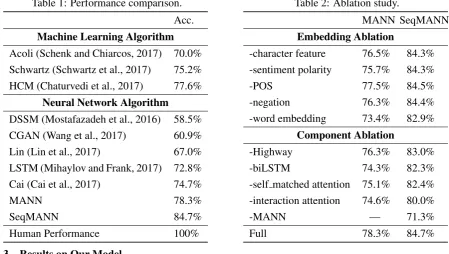
Table 1: Performance comparison.
Acc.
Machine Learning Algorithm
Acoli (Schenk and Chiarcos, 2017) 70.0%
Schwartz (Schwartz et al., 2017) 75.2% HCM (Chaturvedi et al., 2017) 77.6%
Neural Network Algorithm
DSSM (Mostafazadeh et al., 2016) 58.5% CGAN (Wang et al., 2017) 60.9%
Lin (Lin et al., 2017) 67.0% LSTM (Mihaylov and Frank, 2017) 72.8% Cai (Cai et al., 2017) 74.7%
MANN 78.3%
SeqMANN 84.7%
Human Performance 100%
Table 2: Ablation study.
MANN SeqMANN
Embedding Ablation
-character feature 76.5% 84.3%
-sentiment polarity 75.7% 84.3%
-POS 77.5% 84.5%
-negation 76.3% 84.4%
-word embedding 73.4% 82.9%
Component Ablation
-Highway 76.3% 83.0% -biLSTM 74.3% 82.3% -self matched attention 75.1% 82.4%
-interaction attention 74.6% 80.0%
-MANN — 71.3%
Full 78.3% 84.7%
4.3 Results on Our Model
We compare our model with some distinctive methods and approaches that rank high in LSDSem 2017 Shared Task (Mostafazadeh et al., 2017) in Tabel 1. Cai (Cai et al., 2017) is state-of-the-art model in NN-methods while HCM (Chaturvedi et al., 2017) is state-of-the-art model in all published NN-methods. Under the condition in which external resources are not used, MANN outperforms Cai by 3% and even performs better than the highest-level method. Benefiting from external knowledge, SeqMANN achieves a 6.4% improvement over MANN. Nevertheless, the superiority of SeqMANN does not rely on only the external resources utilized, but the correlated effect between MANN and the external resources, as we can see that after removing MANN from SeqMANN (as shown in Table 2 and will described in Section 4.4), the remaining external resources based model only obtained 71.3%1.
4.4 Ablation Study
We conduct an ablation study on the proposed model to evaluate the effectiveness of each feature and component involved. Results are shown in Table 2.
Embedding Ablation: All embedding features contribute to MANN. However, the influence is not as crucial in SeqMANN. We conjecture that contextual information in the embedding process partly overlaps with the features in external knowledge.
Component Ablation: We respectively remove each component to study their contribution. For interac-tion atteninterac-tion ablainterac-tion, we replace it with flattening between plot and ending representainterac-tions, followed by removing DenseNet and replacing a three-layertanhoperation as feature extractor. For MANN ablation, we only retain the extraction of external knowledge and the output layer (we model SemanticSequence by the same way as MANN ablation processing in Section 5).
5 Data Analysis
To further analyze the model, we seek to determine the abilities required to predict the right ending, and which aspects of questions among the specific dataset are solved by our model. We sample 300 examples from the validation set randomly and annotate them manually from two cognitive chunks, namely, by labeling samples with the difficulty degree in human-understandable rationale for prediction and by tagging samples according to the linguistic phenomena they contain.
Table 3: Some examples from each human-understandable difficulty labeling category.
Category Story plot Ending options
Relevant Word
Kyle invited everyone he works with bowling one night. Most people could not go but Matt and John showed up. Matt had never been bowling before so they had to show him how to. After a few games, Matt picked up how to play better.
e1: Now Matt and Kyle can go bowling more then. e2: Kyle took the children shopping for a gift for their mother.
Compatible Sentence
It was the last day of our vacation.We were eating lunch on the patio of the hotel. We laughed and smiled because it was a great vacation.Then we packed our bags and drove to the airport.
e1: We want to revisit someday.e2: We all vowed to never go back again.
Plot-level Paraphras-ing
Rory was allergic to gluten and strawberries.One day she sat down to eat lunch at school.She opened her lunch box, and stared at a sandwich with strawberries.Her new step mom had packed her lunch for the first time.
e1: Rory had to buy a school lunch that day.e2: Rory ate the sandwich.
Ambiguous Inference
Tina always wore a red bikini when she went to the beach. She was known for it and everyone expected to see her in one. One day she met her friends in a blue bikini and surprised them. They could not understand why she would wear something dif-ferent.
e1: They liked the new bikini though.
e2: Tina’s friends knew how unpre-dictable she was.
5.1 Human-understandable Difficulty Labeling
We classify the 300 samples into the following categories (as shown in Table 3, where the right ending ise1and the wrong ending ise2):
Relevant Word. The verbs and noun phases ine1 are more relevant to the plot than those ine2. This category includes examples that are thought to be correctly predicted at the word level.
Compatible Sentence. We could derive the correct answer by understanding a single sentence in the hypothesis, which means that the answer is similar to some sentence in an earlier context.
Plot-level Paraphrasing.It requires a full understanding of multiple sentences to infer the answer. Ambiguous Inference. It includes examples in which we think both endings are logically reasonable for the story, while the correct one is more answerable. This category consists of poorly designed cases, which we consider miscarriage examples in this task.
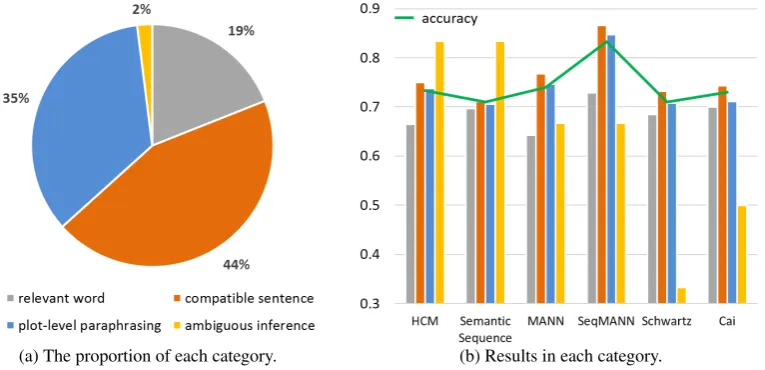
[image:7.595.110.493.411.596.2](a) The proportion of each category. (b) Results in each category.
Figure 2: Results of human understandable difficulty labeling.
Fig.2a shows the proportion of each category. The second and third cases have the highest proportion, followed by the first and the least “Ambiguous Inference” cases. We observe that deeper information processing, which means sentence understanding (for “Compatible Sentence” case) and plot-level un-derstanding (for “Plot-level Paraphrases” case), is crucial to good performance in this task. The low proportion of “Ambiguous Inference” shows the satisfactory quality of this task.
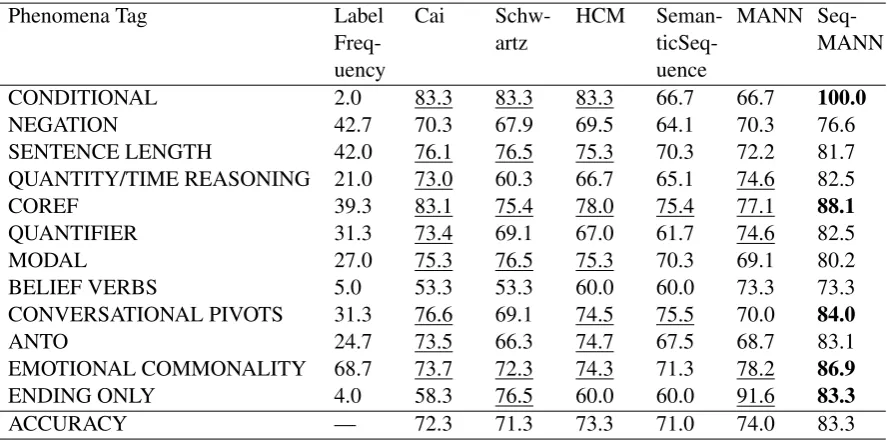
out-Table 4: Linguistic phenomena tagging results. Phenomena Tag Label
Freq-uency
Cai Schw-artz
HCM Seman- ticSeq-uence
MANN Seq-MANN
CONDITIONAL 2.0 83.3 83.3 83.3 66.7 66.7 100.0 NEGATION 42.7 70.3 67.9 69.5 64.1 70.3 76.6 SENTENCE LENGTH 42.0 76.1 76.5 75.3 70.3 72.2 81.7 QUANTITY/TIME REASONING 21.0 73.0 60.3 66.7 65.1 74.6 82.5 COREF 39.3 83.1 75.4 78.0 75.4 77.1 88.1 QUANTIFIER 31.3 73.4 69.1 67.0 61.7 74.6 82.5 MODAL 27.0 75.3 76.5 75.3 70.3 69.1 80.2 BELIEF VERBS 5.0 53.3 53.3 60.0 60.0 73.3 73.3 CONVERSATIONAL PIVOTS 31.3 76.6 69.1 74.5 75.5 70.0 84.0 ANTO 24.7 73.5 66.3 74.7 67.5 68.7 83.1 EMOTIONAL COMMONALITY 68.7 73.7 72.3 74.3 71.3 78.2 86.9 ENDING ONLY 4.0 58.3 76.5 60.0 60.0 91.6 83.3 ACCURACY — 72.3 71.3 73.3 71.0 74.0 83.3 perform other methods on this task. (iii) The model is a stable one with external knowledge resources, thus still maintaining high accuracy under decreasing training data.
5.2 Linguistic Phenomena Tagging
To obtain an idea of the linguistic phenomena in SCT and to conduct a detailed analysis of the semantical performance of these models, imitating MultiNLI (Williams et al., 2018), we design a set of annotation tags to label the subset as follows:
CONDITIONAL:Whether the example contains the word “if”.
NEGATION:Whether the example contains negation words, e.g., not, none, neither. SENTENCE LENGTH:Whether the right ending is longer than the other endings.
QUANTITY/TIME REASONING:Whether understanding the ending options contains quantity or time reasoning that needs to be explained from the plot.
COREF:Whether ending options contain referring expressions.
QUANTIFIER:Whether the example contains quantifier words, e.g., more, most, enough. MODAL:Whether the example contains modal verbs.
BELIEF VERBS:Whether the example contains belief verbs such as think, believe and doubt. CONVERSATIONAL PIVOTS: Whether the example contains discourse cohesion, e.g., but, yet, however, though, while.
ANTO:Whether the example contains an antonym pair.
EMOTIONAL COMMONALITY:Whether the sentiment throughout the plot is consistent with that through the right ending.
ENDING ONLY:Whether the ending options contradict themselves.
Results are shown in Table 4, and we observe the following: (i) The poor performances on SENTENCE LENGTH indicates that such feature, which is regarded as valuable bias (Cai et al., 2017; Schwartz et al., 2017), does not have an influential contribution to our model. (ii) Examples with ENDING ONLY tag shows that our attention components recognize not only paraphrases in relation among sentences but also the intra-semantic implications of each sentence. (iii) The model outperforms in terms of EMOTIONAL COMMONALITY, which shows effects of adding sentiment polarity in embedding representation.
6 Conclusion
[image:8.595.78.522.76.297.2]Acknowledgements
This work was supported in part by the National Natural Science Foundation of China under Grant No.U1636116, 11431006, 61772288, the Research Fund for International Young Scientists under Grant No. 61650110510 and 61750110530, and the Ministry of education of Humanities and Social Science project under grant 16YJC790123.
References
Antoine Bordes, Nicolas Usunier, Alberto Garcia-Duran, Jason Weston, and Oksana Yakhnenko. 2013. Translat-ing embeddTranslat-ings for modelTranslat-ing multi-relational data. InNIPS, pages 2787–2795.
Zheng Cai, Lifu Tu, and Kevin Gimpel. 2017. Pay attention to the ending: Strong neural baselines for the roc story cloze task. InACL, pages 616–622.
Nathanael Chambers and Dan Jurafsky. 2008. Unsupervised learning of narrative event chains. InACL, pages
789–797.
Nathanael Chambers and Dan Jurafsky. 2009. Unsupervised learning of narrative schemas and their participants. InACL and AFNLP, pages 602–610.
Snigdha Chaturvedi, Haoruo Peng, and Dan Roth. 2017. Story comprehension for predicting what happens next. InEMNLP, pages 1603–1614.
Qian Chen, Xiaodan Zhu, Zhen-Hua Ling, and Diana Inkpen. 2017. Natural language inference with external
knowledge. arXiv preprint arXiv:1711.04289.
Yichen Gong, Heng Luo, and Jian Zhang. 2018. Natural language inference over interaction space. InICLR.
Kaiming He, Xiangyu Zhang, Shaoqing Ren, and Jian Sun. 2016. Deep residual learning for image recognition.
InCVPR, pages 770–778.
Gao Huang, Zhuang Liu, Kilian Q Weinberger, and Laurens van der Maaten. 2017. Densely connected
convolu-tional networks. InCVPR, pages 4700–4708.
Hongyu Lin, Le Sun, and Xianpei Han. 2017. Reasoning with heterogeneous knowledge for commonsense
machine comprehension. InEMNLP, pages 2032–2043.
Todor Mihaylov and Anette Frank. 2017. Story cloze ending selection baselines and data examination. In
LSD-Sem, pages 87–92.
Andriy Mnih and Geoffrey Hinton. 2007. Three new graphical models for statistical language modelling. In
ICML, pages 641–648.
Ashutosh Modi and Ivan Titov. 2014. Inducing neural models of script knowledge. InCoNLL, pages 49–57.
Nasrin Mostafazadeh, Nathanael Chambers, Xiaodong He, Devi Parikh, Dhruv Batra, Lucy Vanderwende, Push-meet Kohli, and James Allen. 2016. A corpus and evaluation framework for deeper understanding of common-sense stories. InNAACL, pages 839–849.
Nasrin Mostafazadeh, Michael Roth, Annie Louis, Nathanael Chambers, and James Allen. 2017. Lsdsem 2017 shared task: The story cloze test. InLSDSem, pages 46–51.
Martha Palmer, Daniel Gildea, and Paul Kingsbury. 2005. The proposition bank: An annotated corpus of semantic roles. Computational linguistics, 31(1):71–106.
Haoruo Peng and Dan Roth. 2016. Two discourse driven language models for semantics. InACL, pages 290–300.
Jeffrey Pennington, Richard Socher, and Christopher Manning. 2014. Glove: Global vectors for word
representa-tion. InEMNLP, pages 1532–1543.
Melissa Roemmele, Sosuke Kobayashi, Naoya Inoue, and Andrew M Gordon. 2017. An rnn-based binary classi-fier for the story cloze test. InLSDSem, pages 74–80.
Niko Schenk and Christian Chiarcos. 2017. Resource-lean modeling of coherence in commonsense stories. In
LSDSem, pages 68–73.
Roy Schwartz, Maarten Sap, Ioannis Konstas, Leila Zilles, Yejin Choi, and Noah A Smith. 2017. The effect of different writing tasks on linguistic style: A case study of the roc story cloze task. InCoNLL, pages 15–25. Lei Sha, Sujian Li, Baobao Chang, and Zhifang Sui. 2016. Joint learning templates and slots for event schema
induction. InNAACL-HLT, pages 428–434.
Rupesh K Srivastava, Klaus Greff, and J¨urgen Schmidhuber. 2015. Training very deep networks. InNIPS, pages
2377–2385.
Bingning Wang, Kang Liu, and Jun Zhao. 2017. Conditional generative adversarial networks for commonsense
machine comprehension. InIJCAI, pages 4123–4129.
Adina Williams, Nikita Nangia, and Samuel R Bowman. 2018. A broad-coverage challenge corpus for sentence