Mapping Collocational Properties into Machine Learning Features
J a n y c e M . W i e b e t a n d K e n n e t h J . M c K e e v e r t a n d R e b e c c a F . B r u c e $D e p a r t m e n t of C o m p u t e r Science a n d t h e C o m p u t i n g Research L a b o r a t o r y New Mexico S t a t e University
Las Cruces, NM 88003
e-mail: wiebe, [email protected] S D e p a r t m e n t of C o m p u t e r Science University of N o r t h Carolina at Asheville
Asheville, NC 28804-3299 e-mail: [email protected]
A b s t r a c t
This paper investigates interactions between collocational properties and methods for orga- nizing them into features for machine learn- ing. In experiments performing an event cat- egorization task, Wiebe et al. (1997a) found that different organizations are best for dif- ferent properties. This paper presents a sta- tistical analysis of the results across different machine learning algorithms. In the experi- ments, the relationship between property and organization was strikingly consistent across al- gorithms. This prompted further analysis of this relationship, and an investigation of cri- teria for recognizing beneficial ways to include collocational properties in machine learning ex- periments. While many types of collocational properties and methods of organizing them into features have been used in NLP, systematic in- vestigations of their interaction are rare. 1 I n t r o d u c t i o n
Properties can be m a p p e d to features in a machine learning algorithm in different ways, potentially yielding different results (see, e.g., Hu and Kibler 1996 and Pagallo and Haussler 1990). This paper investigates interactions be- tween collocational properties and methods for organizing them into features. Collocations, conceived broadly as words meeting certain con- straints that are correlated with the targeted classification, are used in a wide range of NLP applications, from word-sense disambiguation to discourse processing. They must be selected and represented in s o m e way. Thus, this work is widely applicable to experimental design in NLP.
In experiments performing an event catego- rization task, Wiebe et al. (1997a) co-varied four types of organization and three types of collocational property. They found that differ- ent organizations are best for different proper- ties, and that the best results are obtained with the most constrained properties and an orga- nization that is not common in NLP (but see Goldberg 1995 and Cohen 1996). However, they experimented with only one machine learning algorithm, and did not offer any insight into the results.
This paper presents a statistical analysis of the results across different machine learning al- gorithms. In the experiments, the relationship between property and organization is strikingly consistent across algorithms. This prompted further analysis of this relationship, and a study of criteria for recognizing beneficial ways to in- clude collocations in machine learning experi- ments. While many types of collocational prop- erties and methods for representing t h e m as fea- tures have been used in NLP, systematic inves- tigations of their interaction are rare.
2 T h e E v e n t C a t e g o r i z a t i o n T a s k This work is part of a larger project on pro- cessing newspaper articles to support automatic segmentation and summarization. A funda- mental component of reporting is evidentiality (Chafe 1986, van Dijk 1988): What source does the reporter give for his information? Is the in- formation being presented as fact, opinion, or speculation? Our end application is a segmen- tation of the text into factual and non-factual segments, to include in a document profile for summarization and retrieval. A prerequisite to answering such questions is recognizing where in the text speech events and private states (belief, opinions, perception) are presented. That is the problem addressed here.
Specifically, the main state or event of each sentence is classified into one of the following event categories:
1. ps: clauses about private states. "Philip Morris hopes that by taking its Bill. of Rights theme to the airwaves it will reach the broadest possible audience."
2. se.ds: clauses presenting speech events in the form of direct speech. "I'm hopeful that we'll have further discussions," Mr. Hahn said.
3. se.ms: speech-event clauses that are mix- tures of direct and indirect speech. "The company s£id the fastener business 'has been under severe cost pressures for some time.' "
4. se.o: clauses presenting speech events in the form of indirect speech, together with clauses about speech events that do not fall in the other speech-event categories. "Stelco Inc. said it plans to shut down three Toronto-area plants."
5. ps [ event: private state and either a speech event or other action. "They were at odds over the price."
6. other: clauses that are not included in any of the other categories. "The-fasteners, nuts and bolts, are sold to the North Amer- ican auto market."
Speech events and private states are very :fre- quent in newspaper articles: 48% of the sen- tences in our corpus. Note that the speech
event category is broken into subcategories, co~:- responding to different styles. The styles vary in the amount of paraphrase they admit, which in turn strongly affects how the sentence can be integrated into the surrounding discourse. We anticipate these distinctions to be important for future discourse segmentation tasks.
This event categorization task is very chal- lenging. The language used for speech events and private states is rich and varied. Metaphor and idiom are widely used (Barnden 1992) and there is a great deal of syntactic and part of speech variation. The classification is also highly context dependent. For example, a word like agree may simply refer to a belief, as in He agrees that interest rates may go down, but may also refer to a specific speech event, as in She said they should begin, and he agreed. For an- other example, many words normally associated with non-verbal actions may refer directly to speech events, if they appear in a strong speech context: e.g., attack, estimate, explore, guide, analyze, rise above, measure, etc.
We developed detailed coding instructions for manual annotation of the data, and performed an inter-coder reliability study, including two expert and one naive annotator. The results of the study, which will be reported elsewhere, are very good. The coding instructions, the anno- tations of the data, and the results of the study will be made available on the project web site.
The event categorization task is a challeng- ing test for the issues concerning collocations addressed in this paper. However, it is impor- tant to note that these issues are relevant for any NLP task for which collocational informa- tion may be useful, including wordsense disam- biguation.
3 C o l l o c a t i o n a l P r o p e r t i e s
We need to untie the notion of collocation from wordsense disambiguation, and consider collocations to be words that co-occur (more t h a n chance) with whatever classes are being targeted (such as the event categories presented above). Viewed in this way, collocations are also important for m a n y event categorization and discourse processing tasks. Examples are open- class words that suggest dialog acts; words t h a t help disambiguate cue words (e.g., is now be- ing used temporally, or as a discourse marker? (Hirschberg & Litman 1993)); and words t h a t suggest states versus events (Siegel 1997).
The work reported here is relevant when there are m a n ) potential collocations to choose from, and we are automatically sifting through the various possibilities for good ones. For word- sense disambiguation, many different words co- occur in the corpus with the target word; we want to choose a subset that are good indica- tors of the sense of the target word. For di- alog act recognition, we could search through the adjectives in the corpus, for example, for some that suggest a rejection dialog act (e.g., busy, occupied, committed, tied up, ...) in the scheduling domain (Wiebe et. al 1997b)). For disambiguating the cue phrase now, we could search for words that prefer the temporal ver- sus the discourse interpretation (perhaps tem- poral adverbs and verbs with temporal aspects of their meaning). For event categorization, we could sift through the main verbs to find those that are good indicators of speech, for example (say, demand, attack, concede,...).
To aid discussion, we use the following for- mal definitions. A collocational property is a set of constraints, P I Pp. In wordsense disam- biguation, for example, we might have an adja- cent collocational property, defined by four con- straints:
P1 = being one word left of target word, P2 = being two words left of target word, P3 = being one word right of target word, P4 = being two words right of target word.
words. Finally, a collocation word is a poten- tial collocation word that is j u d g e d to be cor- related with the classification, according to a metric such as conditional probability, an infor- mation theoretic criterion, or a goodness-of-fit test.
We allow properties to be divided into sub- properties. T h a t is, the set of constraints defining a property are divided into subsets, S 1 . . . S s . In our example, if s = 1, there is just one undivided property, defined by the set (P1, P~, P3, P4}. If s = p = 4, t h e n there are four subproperties, each defined by one of the constraints. Or, there might be two subproper- ties, 81 = (P1, P2}, corresponding to adjacent words on the left, and $2 = (Pa, P4), corre- sponding to adjacent words on the right. Be- cause these definitions cover m a n y variations in a uniform framework, they facilitate compara- tive evaluation of systems implementing differ- ent schemes.
The experiments performed here use colloca- tional properties defined in Wiebe et al. 1997a to perform the event categorization task de- scribed in section 2. For this and o t h e r appli- cations in which event type is important, such as many information extraction, text catego- rization, and discourse processing tasks, highly definitive properties, i.e., properties that pin- point only the more relevant parts of the sen- tence, can lead to better performance. We de- fine such a highly definitive collocational prop- erty. Specifically, it is defined by a set of syn- tactic patterns that are regular expressions com- posed of parts of speech and root forms of words. The property is referred to as the SP colloca- tional property; it yields the best overall results on our event categorization task, as shown later in table 1. A partial description of the SP prop- erty is the following (where N P a p p r o x approx- imates a noun phrase):
baseAdjPat = {a ] a is in the p a t t e r n
(main_verb adv* a), where the main verb is copular}. E.g., "She is/seems happy"
A potential collocation word is a word that sat- isfies one of the constraints. Continuing the ex- ample, all of the words that appear in the cor- pus one or two words to the left or right of the target word are potential adjacent collocation
Our SP property is organized into two subprop- erties (i.e., s is 2). Recall that a subproperty is defined by a set of constraints. Our first SP subproperty is defined by baseAdjPat and Com- plexAdjPat. The potential collocation words corresponding to this subproperty are all adjec- tives that are used in either pattern in the cor- pus, and the actual collocation words are words chosen from this set. Our second SP subprop- erty is defined by two verb patterns not shown above. Given a clause, our system can apply the syntactic patterns fully automatically, us- ing regular expression matching techniques.
The other collocational property,
CO, was de-
fined to contrast with the SP property because it is not highly definitive. That is, it is defined by very loose constraints that do not inw~lve syntactic patterns. The two CO constraints we use are simply adjective and verb, so that the potential collocation words are all the adjec- tives and verbs appearing in the corpus (ignor- ing where they appear in the sentence). In our experiments, each of these constraints is treated as a subproperty (so, again, s is 2).
4 S e l e c t i n g C o l l o c a t i o n s a n d R e p r e s e n t i n g t h e m as F e a t u r e s The context of this work is automatic classifica- tion. Suppose there is a training sample, where each tagged sentence is represented by a vector
(F1,...,Fn_l,C).
TheFi's
are input features and C is the targeted classification. Our task is to induce a classifier that will predict the value of C given an untagged sentence represented by theFi's.
This section addresses selecting collo- cations and representing them as such features. 4.1 S e l e c t i n g C o l l o c a t i o n sFollowing are two methods for selecting collo- cation words of a given collocational property (Wiebe et al. 1997a). Assume there are c classes,
C1 ... Cc,
and s subproperties,$1 ... Ss.
4.1.1 P e r - C l a s s M e t h o d
In the
per-class
method (also used by Ng and Lee 1996), a set of words,WordsCiSj,
is se- lected for each combination of Class Ci and sub- propertySj.
They are selected to be words that, when they satisfy a constraint in Sj, are corre- lated with classCi.
Specifically:WordsCiS) =
{ W [P(Cilw
satisfies a constraint inSj)
> k}.We use k = 0.5. We experimented with some
other values of k and other criteria, but did not find any that consistently yield better results. A more thorough investigation is planned. 4.1.2 O v e r - R a n g e M e t h o d
In the
over-range
method, a set of words,l¥ordsSj,
is selected for each subpropertySj,
such that, when they satisfy a constraint in
Sj,
they are correlated with the classification vari- able across the range of its values.
Specifically, the model of independence be- tween each word w (when satisfying a constraint in
Sj) and the classification variable is assessed,
using the likelihood ratio statistic, G 2 (Bishop et al. 1975). Those with the top N 6 2 val- ues, i.e., for which independence is a poor fit, are chosen 1. For the purposes of comparison, we limit the number of words to the maximum number of features permitted by one of the ML packages, 20 for ORe and 19 for ORb (ORe and ORb are defined below.)4.2 O r g a n i z a t i o n s
Finally, the collocation words must be organized into features. Following are two organizations for each selection method (Wiebe et al. 1997a). 4.2.1 O v e r - R a n g e B i n a r y ( O R b )
This organization is commonly used in NLP, for example by Gale et al. 1992. A binary feature is defined for each word in each set
WordsSj,
l < j < s .
4.2.2 O v e r - R a n g e E n u m e r a t e d ( O R e ) This organization is used by, for example, Ng & Lee 1996. One feature is defined per subprop- erty Sj. It has I
WordsSj
I + l values, one value for each word inIVordsSj,
corresponding to the presence of that word. Each feature also has a value for the absence of any word inWordsSj.
E.g., for both CO and SP collocations, there is one feature for adjectives and one for verbs. The adjective feature has a value for each se- lected adjective, and a value for none of them occurring. (The verb feature is analogous.) 4.2.3 P e r - C l a s s B i n a r y ( P C b )
There is one binary feature for each class Ci, whose value is 1 if any member of any of the sets
4.2.4 P e r - C l a s s E n u m e r a t e d ( P C e ) For each subproperty
Sj,
a feature is defined with c + 1 values as follows. There is one value for each classCi,
corresponding to the presence of a word inWordsCiSj.
Each feature also has a value for the absence of any of those words. E.g., for both CO and SP collocations, there is one feature for adjectives and one for verbs. The adjective feature has one value for each class, corresponding to the presence of any of the ad- jectives chosen for that class; there is also a value for the absence of any of them. (The verb feature is analogous.)Note that, in the over-range organizations, in- creasing the number of words increases the com- plexity of the event space, in ORe by increas- ing the number of feature values and in ORb by increasing the number of features. These in- creases in complexity can worsen accuracy and computation time (Goldberg 1995, Bruce e t a l . 1996, Cohen 1996). The per-class organizations allow the number of collocation words to be increased without a corresponding increase in complexity.
5 T h e M a c h i n e L e a r n i n g A l g o r i t h m s The algorithms included in this study are rep- resentative of the major types suggested by Michie et al. (1994) of the StatLog project comparing machine learning algorithms. (1) PEBLS, a K-Nearest Neighbor algorithm (Cost and Salzberg 1993); (2) C4.5, a decision tree al- gorithm (Quinlan 1994); (3) Ripper, an induc- tive rule based classifier (Cohen 1996); (4) the Naive Bayes classifier; and (5), a probabilistic model search procedure (Bruce & Wiebe 1994) using the public domain software CoCo (Bads- berg 1995). Linear discriminant classifiers are omitted because they are not appropriate for categorical data. Neural network classifiers are omitted as well.
6 R e s u l t s
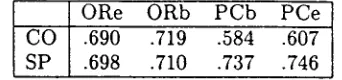
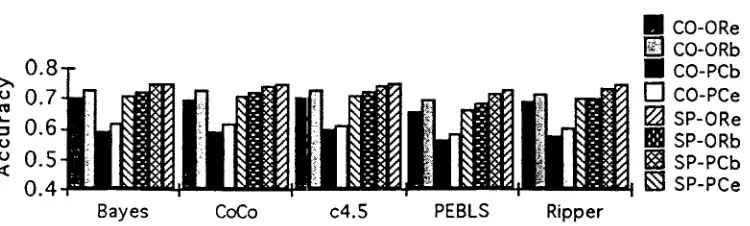
Figure 1 presents the accuracy o f ~ a c h of the machine learning algorithms on each combina- tion of collocational property and feature or- ganization. Table 1 shows the mean accuracy across algorithms. In addition to collocational features, all experiments included seven other
(automatically determined) features, such as position in the paragraph. Two main modi-
ORe ORb P C b PCe CO .690 .719 .584 .607 SP .698 .710 .737 .746 Table 1: Mean Accuracy Across Algorithms
fications of Wiebe et al. (1997a) were made to facilitate the comparisons at issue here. First, nouns were originally included in the CO but not the SP collocational property. Here, they are not included in either. Second, a weakness in the method for selecting the collocation sets is changed so that, for each collocational property, the words in the sets
WordsCiSj are
identical for both per-class experiments.The data consists of 2,544 main clauses from the Wall Street Journal Treebank corpus (Mar- cus et al., 1993). 2 There are six classes, and the lower bound for the classification p r o b l e m - - t h e frequency in the data set of the most frequent class--is 52%.
10-fold cross-validation was performed. All experiments were independent, so that, for each fold, the collocations were determined and rule induction or model search, etc., was performed anew on the training set.
We performed an analysis of variance to de- tect significant differences in accuracy consider- ing algorithm, collocational property, and fea- ture organization. When there are, we per- formed post-hoc analyses (using Tukey's HSD, to control for multiple comparison error rates (SAS Institute 1989)) to identify the differences.
The algorithms differ in accuracy, i.e., the analysis shows there is a significant main effect of algorithm on accuracy (p < 0.0001). Post- hoc analysis shows that there is only one signif- icant difference: the lower performance of PE- BLS relative to the others.
[image:5.596.311.482.140.180.2]u 0.7" t~
0.6-
U
0.5-
0 . 4 , I ; , ; ;
Bayes CoCo c4.5 PEBLS Ripper
[ ] CO-ORe [ ] CO-ORb [ ] CO-PCb [ ] CO-PCe [ ] SP-ORe
[]
SP-ORb [ ] SP-PCb [ ] SP-PCeFigure 1: Accuracy of Machine Learning Algorithms (means across folds)
erty and organization, on the other (p > 0.996). T h a t is, the relative effects of property and organization on accuracy do not significantly change from one algorithm to another.
No a t t e m p t was made to tune the algorithms for performance (e.g., varying the number of neighbors in the PEBLS experiments). Thus, we do not take the results to be indicative of the quality of the algorithms. Rather, the consistent pattern off results indicates that per-class orga- nization is beneficial or not depending mainly on the collocational property.
Further analysis, controlling for differences across algorithms, reveals a highly significant interaction ( P < 0.0001) between collocational property and feature organization. Post-hoc comparisons show that the best per-class exper- iment, SP-PCe, is significantly better than any over-range experiment, but is not significantly better than the other syntactic pattern/per- class experiment, SP-PCb. In fact, we experi- mented (using the CoCo search algorithm) with per-class variations not presented in Wiebe et al. (1997a), specifically with different sets of subproperties (e.g., PCe with s = 1). There is no statistically significant difference among any of the syntactic pattern/per-class experiments. In contrast, the co-occurrence/per-class ex- periments (CO-PCe and CO-PCb) are signifi- cantly worse than all the other experiments.
Among the four over-range experiments, the only significant difference is between CO-ORb and CO-ORe. As seen in table 2, a large number of per-class collocation words appear only once (a consequence of the basic conditional proba- bility test we use). We reran the per-class ex- periments (10-fold cross validation using CoCo search), excluding collocation words that ap-
pear only once in the training set. There were miniscule increases in the SP results (less t h a n 0.3%). For the CO collocations, the P C b ex- periment increased by 3.15% and the PCe by less than 1%. With these new results, the per- class/co-occurrence results are still much worse than all the other experiments.
7 A n a l y s i s
In the previous section, we established that there is a highly significant interaction in the experiments between collocational property and feature organization, and that the p a t t e r n of this interaction is extremely consistent across the algorithms. In this section, the properties and organizations are analyzed in order to gain insight into the pattern of results and develop some diagnostics for recognizing when the per- class organizations may be beneficial. We con- sider a number of factors, including conflicting class indicators, entropy, conditional probabil- ity, and event space complexity.
As table 2 illustrates, the SP collocations are of much lower frequency, since they are more constrained. Specifically, table 2 shows the number of occurrences in one training set of the collocation words selected per-class.
[image:6.596.142.517.101.214.2]"Frequency: > 50 41-50 31-40 2 1 - 3 0 1 1 - 2 0 6-10 3-5 2 1
CO 3 5 6 25 57 130 396 213 1293
SP 3 0 0 2 15 50 91 96 409
Table 2: Frequency of Collocation Words Selected with the Per-Class Method
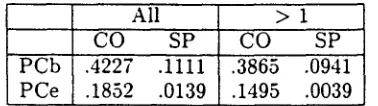
Table 3 shows that the CO collocations often conflict, while the SP collocations rarely do. This is true whether or not the collocations ap- pearing only once are included (shown on the left versus the right side of the table).
PCb PCe
All > 1 CO SP" CO SP .4227 . 1 1 1 1 .3865 . 0 9 4 1 .1852 .0139 .1495 .0039 Table 3: Percentage of Sentences with Conflict- ing Collocations
7.2 M e a s u r e s o f F e a t u r e Q u a l i t y
We argue that, for the per-class organizations to be beneficial, the individual collocation words must strongly select a single majority class. Suppose that two words wl and w2 in the set
W o r d s C c 4 S s : select different classes as the sec- ond most probable class, with, say, conditional probabilities of .24 and .22, respectively. In- formation concerning the second most probable class is lost under the per-class grouping, even though the words are associated with another class over 20% of the time. If the conditional probability of the most strongly associated class were higher for both words, the frequency of the secondary association would be reduced, result- ing in fewer erroneous classifications.
Two measures that can be used to assess how strongly collocation words select single majority classes are entropy and conditional probability of class given feature.
Quality of low frequency collocations is diffi- cult to measure. For example, entropy tends to be unreliable for low frequency features. There- fore, table 4 shows statistics calculated for the more frequent words selected in common un-
CO SP
Conditional Probability .6494 .7967
Entropy .9362 .5541
Table 4: Means for Collocations in Common with Frequency > 10
der the SP and CO constraints in the training set of one fold of a per-class experiment. The 17 selected words all occur at least 10 times under each constraint in the training set used. Since an identical set of words is measured un- der both kinds of collocational property, the re- sults strongly reflect the quality of the proper- ties.
The entropy of the conditional distribution of the class C given value f of feature F is:
H ~ - ~ p(c [ F = f ) × l o g ( p ( c I F = f ) ) ce{c~ ... co}
The first line of table 4 shows shows that, on average, the SP collocation words are more strongly indicative of a single class. The sec- ond line shows that, on average, SP collocations have much lower entropy than the others. 7.3 T h e P o t e n t i a l o f P e r - C l a s s
O r g a n i z a t i o n s : m o r e i n f o r m a t i o n w i t h o u t a d d e d c o m p l e x i t y
As shown above in tables 2, 3, and 4, collocation words of the more constrained SP property are of lower frequency and higher quality than the CO collocations. Because the SP collocations are low frequency, using them requires including a larger number of collocations words.
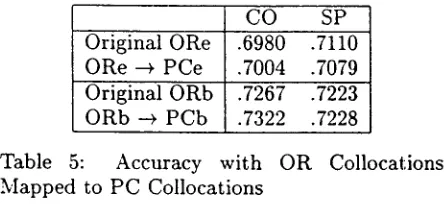
[image:7.596.97.461.115.159.2] [image:7.596.300.499.218.270.2] [image:7.596.66.255.301.354.2]were included in the original ORe experiment and organized them as P C e and similarly for ORb and PCb, and reran the experiments (10- fold cross validation using CoCo search). When the features are so transformed, the accuracy is virtually unchanged, as shown in table 5.
CO SP
Original ORe .6980 .7110 ORe ~ PCe .7004 .7079 Original ORb .7267 .7223 ORb ---> P C b .7322 .7228
Table 5: Accuracy with OR Collocations Mapped to P C Collocations
The results suggest that simply applying the per-class organizations to existing collocations will not result in significant improvement. The improvement we see when moving from the over-range to the per-class organizations of the SP collocations is largely due to inclusion of ad- ditional high quality collocations; the PC or- ganizations allow them to be included without adding complexity.
Various methods have been proposed for re- ducing the complex feature space associated with large numbers of low frequency properties. For example, one can ignore infrequent collo- cations entirely (e.g., Ng & Lee), consider only the single best property (e.g., Yarowsky 1993), or ignore negative evidence, i.e., the absence of a property (e.g., Hearst 1992). Another is to retain the high quality collocations, group- ing them per-class. Cohen (1996) and Goldberg (1995) propose similar methods for text catego- rization tasks, although they do not address the comparative issues investigated here.
8 C o n c l u s i o n s
We performed extensive experimentation inves- tigating the interactions among collocational property, feature organization, and machine learning algorithm. We found a highly signifi- cant interaction between collocational property and feature organization, which is extremely consistent across the machine learning algo- rithms experimented with. The results obtained with the per-class organization and the highly
definitive collocations (i.e., the SP collzcations) are significantly better than any experiment us- ing either" the lower quality collocations or the over-range organization.
T h e per-class organizations allow us to take advantage of the lower frequency, higher qual- ity collocations; with the over-range organiza- tions, the results are no better than with the lower quality ones. Our analysis shows, how- ever, that merely using a per-class organization with high-quality collocations is not sufficient to realize the potential benefits: a larger n u m b e r of collocations are needed for increased results. Very importantly, using the per-class orga- nizations with the lower quality collocations proved costly--the results decreased by over 10%. Choices must be made in how colloca- tions are selected and organized in any event. A main lesson from these experiments is that in- appropriate organizations must be avoided for the particular type of property at hand.
In continuing work, we are investigating in- teractions with additional experimental param- eters. The goals of this paper were to investi- gate issues relevant for many NLP applications in a uniform framework, and to shed some light on interactions between collocational properties and how they are represented as features in ma- chine learning algorithms.
9 A c k n o w l e d g e m e n t s
This research was supported in part by the Office of Naval Research under grant number N00014-95-1-0776. We thank Julie Maples for her work developing the annotation instructions and manually a n n o t a t i n g the data, and Lei Duan for his work implementing the original ex- periments.
10 R e f e r e n c e s
[image:8.596.94.317.206.308.2]Bruce, R. and Wiebe, J. 1994. Word-Sense Disambiguation Using Decomposable Models. Proc. 32nd Annual Meeting of the Assoc. for Comp. Linguistics (ACL-94), pp. 139-146.
Chafe, Wallace. 1986 Evidentiality in En- glish Conversation and Academic Writing. I n : Chafe, Wallace and Nichols, Johanna, Eds.,
Ev-
identiality: The Linguistic Coding of Epistemol-
ogy.
Ablex, ~Norwood, N J: 261-272.Cohen, W. 1996. Learning Trees and Rules with Set-Valued Features. Proc. AAAI-96, pp. 709-- 717.
. ~ . - C o s t , S. and Salzberg, S. 1993. A Weighted Nearest Neighbor Algorithm for Learning with Symbolic Features,
Machine Learning 10
(1): 57-78.van Dijk, T.A. (1988).
News as Discourse.
(Hillsdale, N J: Lawrence Erlbaum).
Gale, W.; Church, K.; and Yarowsky, D. 1992. A Method for Disambiguating Word Senses in a Large Corpus. AT&T Bell Laboratories Sta- tistical Research Report No. 104.
Goldberg, J. H. 1995. CDM: An Approach to Learning in Text Categorization. Proc. IEEE International Conference on Tools with AI, pp. 258-265.
Hearst, M. (1992). Automatic acquisition of hyponyms from large text corpora. Proc. COLING-92.
Hirschberg, J. and Litman, D. (1993). Em- pirical studies on the disambiguation of cue phrases.
Computational Linguistics 19,
3, 501- 530.Hu, Y.J. and Kibler, D. 1996. Generation of At- tributes for Learning Algorithms. Proc. AAAI- 96, pp. 806-811.
Marcus, M.; Santorini, B.; and Marcinkiewicz, M. 1993. Building a Large Annotated Corpus of English: The Penn Treebank.
Computational
Linguistics I9
(2): 313-330.Michie, D.; Spiegelhalter, D.J.;, and Taylor, C.C. 1994.
Machine Learning, Neural and Sta-
tistical Classification
(NY: Ellis Horwood).Ng, H., and Lee, H. 1996. Integrating Multi- ple Knowledge Sources to Disambiguate Word Senses: An Exemplar-Based Approach. Proc. ACL-96, pp. 40--47.
Pagallo, G. and Haussler, D. 1990. Boolean Fea- ture Discovery in Empirical Learning.
Machine
Learning, 5:
71-99.Quinian, J. R. 1994.
C4.5: Programs for Ma-
chine Learning
(San Mateo: Morgan Kaufman).SAS Institute Inc. 1989.
SAS/STAT User's
Guide, Version 6, Fourth Edition, Volume 2.
Cary, NC: SAS Institute Inc).
Siegel, E. (1997). Learning methods for combin- ing linguistic indicators to classify verbs. Proc. 2nd Conference on Empirical Methods in Natu- ral Language Processing (EMNLP-2), pp. 156- 162.
Wiebe, J.; Bruce, R.; and Duan, L. 1997a. Probabilistic Event Categorization. Proc. Con- ference on Recent Advances in Natural Lan- guage Processing (RANLP-97), pp. 163-170. European Commission, DG XIII.
Wiebe, Janyc%. O'Hara, Tom, McKeever, Kenneth, and OhrstrSm-Sandgren, Thorsten. 1997b. A n empirical approach to temporal ref-
erence resolution. In Proc. 2nd Conference on