Exploiting Salient Patterns for Question Detection and Question
Retrieval in Community-based Question Answering
Kai Wang
Department of Computer Science School of Computing National University of Singapore
Tat-Seng Chua
Department of Computer Science School of Computing National University of Singapore
Abstract
Question detection serves great purposes in the cQA question retrieval task. While detecting questions in standard language data corpus is relatively easy, it becomes a great challenge for online content. On-line questions are usually long and infor-mal, and standard features such as ques-tion mark or 5W1H words are likely to be absent. In this paper, we explore ques-tion characteristics in cQA services, and propose an automated approach to detect question sentences based on lexical and syntactic features. Our model is capable of handling informal online languages. The empirical evaluation results further demonstrate that our model significantly outperforms traditional methods in de-tecting online question sentences, and it considerably boosts the question retrieval performance in cQA.
1 Introduction
Community-based Question Answering services (cQA) such as Yahoo! Answers have emerged as popular means of information exchange on the web. They not only connect a network of people to freely ask and answer questions, but also allow information seekers to search for relevant histori-cal questions in the cQA archive (Agichtein et al., 2008; Xue et al., 2008; Wang et al., 2009).
Many research works have been proposed to find similar questions in cQA. The state-of-the-art retrieval models include the vector space model (Duan et al., 2008), language model (Duan et al., 2008; Jeon et al., 2005), Okapi model (Jeon et al., 2005), translation model (Jeon et al., 2005;
Rie-zler et al., 2007; Xue et al., 2008), and syntac-tic tree matching model(Wang et al., 2009). Al-though experimental studies in these works show that the proposed models are capable of improv-ing question retrieval, they did not give clear ex-planation on which portion of the question that the user query is actually matched against. A question thread from cQA usually comprises sev-eral sub-questions conveying different informa-tion needs, and it is highly desirable to identify individual sub-questions and match each of them to the user query. Getting sub-questions clearly identified not only helps the retrieval system to match user query to the most desirable content but also improves the retrieval efficiency.
However, the detection of sub-question is non-trivial. Question sentences in cQA are usually mixed with various description sentences, and they usually employ informal languages, where standard features such as question mark or ut-terance are likely to be absent. As such, simple heuristics using question mark or 5W1H words (who, what, where, why, how) may become in-adequate. The demand of special techniques in detecting question sentences online arises due to three particular reasons. First, the question mark could be missing at the end of a question1, or might be used in cases other than questions such as “Really bad toothache?”. Second, some ques-tions such as “I’d like to know the expense of re-moving wisdom teeth” are expressed in a declar-ative form, which neither contains 5W1H words nor is neccessarily ended with “?”. Third, some question-like sentences do not carry any actual in-formation need, such as “Please help me?”. Fig-ure 1 illustrates an example of a question thread
1
S1: What do you guys do when you find that the 'plastic protection seal' is missing or disturbed.
S2: Throw it out, buy a new one.. or just use it anyways? S3: Is it really possible or likely that the item you purchased was
tampered with??
S4: The box was in a plastic wrap but the item itself inside did not having the protection seal (box says it should) so I couldn't have inspected it before I bought it. S5: Please suggest?… thanks!
Figure 1: An example of a question thread ex-tracted from Yahoo! Answers
from Yahoo! Answers, where sub-questions S1 and S2 are posted in non-standard forms, and S5 is merely a question-like simple sentence. To the best of our knowledge, none of the existing ques-tion retrieval systems are equipped with a com-prehensive question detector module to handle various question forms online, and limited effort has been devoted to this direction.
In this paper, we extensively explore character-istics of questions in cQA, and propose a fully automated approach to detecting question sen-tences. In particular, we complement lexical pat-terns with syntactic patpat-terns, and use them as fea-tures to train a classification model that is capable of handling informal online languages. To save human annotations, we further propose to employ one-class SVM algorithm for model learning, in which only positive examples are used as opposed to requiring both positive and negative examples. The rest of the paper is organized as follows: Section 2 presents the lexical and syntactic pat-terns as used for question detection. Section 3 describes the learning algorithm for the classifi-cation model. Section 4 shows our experimental results. Section 5 reviews some related work and Section 6 concludes this paper.
2 Pattern Mining for Question Detection
As has been discussed, human generated content on the Web are usually not well formatted, and naive methods such as the use of question mark and 5W1H words are not adequate to correctly detect or capture all online questions. Methods based on hand-crafted rules also fail to cope with various question forms as randomly appeared on the Web. To overcome the shortcomings of these traditional methods, we propose to extract a set of salient patterns from online questions and use
them as features to detect question sentences. In this study, we mainly focus on two kinds of patterns – sequential pattern at the lexical level and syntactic shallow pattern at the syntac-tic level. Sequential patterns have been well dis-cussed in many literature, including the identifi-cation of comparative sentences (Jindal and Liu, 2006), the detection of erroneous sentences (Sun et al., 2007) and question sentences (Cong et al., 2008) etc. However, works on syntactic patterns have only been partially explored (Zaki and Ag-garwal, 2003; Sun et al., 2007; Wang et al., 2009). Grounded on these previous works, we next ex-plain our mining approach of the sequential and syntactic shallow patterns.
2.1 Sequential Pattern Mining
Sequential Pattern is also referred to as Labeled Sequential Pattern (LSP) in the literature. It is in the form of S⇒C, where S is a sequence
{t1, . . . , tn}, andC is the class label that the
se-quenceS is classified to. In the problem of ques-tion detecques-tion, a sequence is defined to be a se-ries of tokens from questions, and the class labels
are{Q, N Q}, which stand for question and
non-question respectively.
The purpose of sequential pattern mining is to extract a set of frequent subsequence of words that are indicative of questions. For example, the word subsequence “anyone know what . . .
to” could be a good indication to characterize the question sentence “anyone know what I can do to make me less tired.”. Note that the mined sequen-tial tokens need not to be contiguous as appeared in the original text.
1. Maximum Pattern Length: It limits the maxi-mum number of tokens in a mined sequence. 2. Maximum Token Distance: The two adjacent
tokens tn and tn+1 in the pattern need to be
within a threshold window in the original text. 3. Minimum Support: The minimum percentage
of sentences inQcontaining the patternp. 4. Minimum Confidence: The probability of a
patternp⇒Qbeing true in the whole database.
To overcome the word sparseness problem, we generalize each sentence by applying the Part-of-Speech (POS) tags to all tokens except some in-dicative keywords such as 5W1H words, modal words, stopwords etc. For instance, the question sentence “How can I quickly tell if my wisdom teeth are coming” is converted to “How can I RB VBP if my NN NNS VBP VBG”, on top of which the pattern mining is conducted. To further cap-ture online language patterns, we mine a set of frequent tokens that are unique to cQA such as “any1”, “im” and “whats”, and keep them from being generalized. The reason to hold back this set of tokens is twofold. First, conventional POS taggers are trained from standard English corpus, and they could mis-tag these non-standard words. Second, the special online tokens are analogue to standard stopwords, and having them properly ex-cluded could help reflect the online users’ textual questioning patterns.
It is expected that the converted patterns pre-serve the most representative features of online questions. Each discovered pattern makes up a binary feature for the classification model that we will introduce in Section 3.
2.2 Syntactic Shallow Pattern Mining
The sequential patterns represent features at the lexical level, but we found that lexical patterns might not always be adequate to categorize ques-tions. For example, the pattern{when, do}could presume the non-question “Levator scapulae is used when you do the traps workout” to be a ques-tion, whereas the question “know someone with an eating disorder?” could be overlooked due to the lack of indicative lexical patterns.
These limitations, however, could be allevi-ated by syntactic features. The syntactic pattern (SBAR(WHADVP(WRB))(S(NP)(VP))) extracted
S
NP VP
NN VBP NP
Anyone try NP
weight NNS
watchers
S
NP VP
NN VBP NP
Someone need DT
a NNP
diet NN
motivator ?
.
? .
Anyone try weight watchers? Someone need a diet motivator?
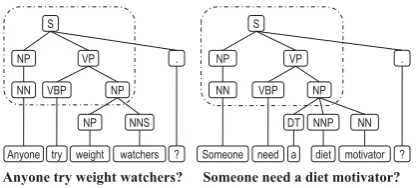
Figure 2: An example of common syntactic pat-terns observed in two different question sentences
from the former example has the order of NP and VP being switched, which could indicate the sentence to be a non-question, whereas the pattern (VP(VB)(NP(NP)(PP))) may be evidence that the latter example is indeed a question, because this pattern is commonly witnessed in the archived questions. Figure 2 shows an ex-ample that two questions bear very different wordings but share the same questioning pat-tern (S(NP(NN))(VP(VPB)(NP))) at the syntactic level. In view of the above, we argue that pat-terns at the syntactic level could complement lex-ical patterns in identifying question sentences.
To our knowledge, the mining of salient pat-terns at the syntactic level was limited to a few tasks. Zaki and Aggarwal (2003) employed tree patterns to classify XML data, Sun et al. (2007) extracted all frequent sub-tree structures for erro-neous sentences detection, and Wang et al. (2009) decomposed the parsing tree into fragments and used them to match similar questions. Our work differs from these previous works in that: (1) we also utilize syntactic patterns for the question de-tection; and (2) we do not blindly extract all pos-sible sub-tree structures, but focus only on certain portions of the parsing tree for better pattern rep-resentation and extraction efficiency.
Given a syntactic tree T, we define syntac-tic pattern as a part of sub-structures of T such that the production rule for each non-leaf node in the patterns is intact. For example, the pattern (S(NP(NN))(VP(VPB)(NP))) in Figure 2 is con-sidered to be a valid syntactic pattern, whereas (S(NP(NN))(VP(VPB))) is not, since the produc-tion rule VP→VPB·NP is not strictly complied.
SBARQ
WHADVP SQ
WRB MD NP ADVP VP
Q: How can I quickly tell if my wisdom teeth are coming?
SQ
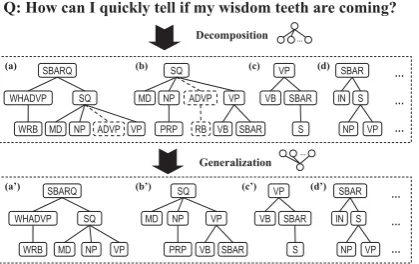
Figure 3: Illustration of syntactic pattern extrac-tion and generalizaextrac-tion process
It is believed that the syntax structure will become too specific if it is extended to a deeper level or too general if the depth is too shallow, neither of which produces good representative patterns. We therefore set the depthDof each syntactic pattern to be within a reasonable range (2≤D≤4). Sec-ond, we prune away all leaf nodes as well as the production rules at the POS tag level. We believe that nodes at the bottom levels do not carry much useful structural information favored by question detector. For example, the simple grammar rule NP→DT·NN does not give any insight to use-ful question structures. Third, we relax the def-inition of syntactic pattern by allowing the re-moval of some nodes denoting modifiers, prepo-sition phrases, conjunctions etc. The reason is that these nodes are not essential in representing the syntactic patterns and are better excluded for generalization purpose. Figure 3 gives an illus-tration of the process for pattern extraction and generalization. In this example, several syntac-tic patterns are generated from the question sen-tence “How can I quickly tell if my wisdom teeth are coming?”, and the tree patterns (a) and (b) are generalized into (a’) and (b’), in which the redun-dant branch (ADVP(RB)) that represents the ad-verb “quickly” is detached.
Contents on the Web are prone to noise, and most off-the-shelf parsers are not well-trained to parse online questions. For example, the parsing tree of the question “whats the matter with it?” will be very different from that of the question “what is the matter with it?”. It would certainly be nice to know that “whats” is a widely used short form of the phrase “what is” on the Web,
but we are lack of this kind of thesaurus. Nev-ertheless, we argue that the parsing errors would not hurt the question detector performance much as long as the mining database is large enough. The reason is that if certain irregular forms fre-quently occur on the Web, there will be statisti-cal evidences that the syntactic patterns derived from it, though not desired, will commonly occur as well. In other words, we take the wrong pat-terns and utilize them to detect questions in the irregular forms. Our approach differs from other systems in that we do not intentionally try to rec-tify the grammatical errors, but leave the errors as they are and use the statistical based approach to capture those informal patterns.
The pattern extraction process is outlined in Al-gorithm 1. The overall mining strategy is analo-gous to the mining of sequential patterns, where support and confidence measures are taken into account to control the significance of the mined patterns. All mined syntactic patterns together with the lexical patterns will be used as features for learning the classification model.
Algorithm 1 ExtractPattern(S, D)
Input: A set of syntactic trees for sentences (S); the depth range (D)
Output: A set of sub-tree patterns extracted fromS
1: P atterns={}
2: for all Syntactic treeT ∈Sdo
3: Nodes←Top-down level order traversal ofT 4: for all noden∈N odesdo
5: Extract subtreeprooted under noden, with depth within the rangeD
6: p←generalize(p)
7: P atterns.add(p)
8: end for
9: end for
10: return P atterns
3 Learning the Classification Model
The input to a SVM binary classifier normally consists of both positive and negative examples. While it is easy to discover certain patterns from questions, it is unnatural to identify character-istics for non-questions, as they usually do not share such common lexical and syntactic patterns. The lack of good negative examples leads tra-ditional SVM to perform poorly. To adapt the imbalanced input data, we proposed to employ a one-class SVM method (Manevitz and Yousef, 2002) for learning. The basic idea of one-class SVM is to transform features from only positive examples via a kernel to a hyper-plane and treats the origin as the only member of the second class. It uses relaxation parameters to separate the posi-tive examples from the origin, and finally applies the standard two-class SVM techniques to learn a decision boundary. As a result, anything out-side the boundary are conout-sidered to be outliers (i.e. non-questions in this problem).
More formally, given n training samples
x1, . . . , xnof one class, the hyperplane separating
them from the origin is constructed by solving
min1
2w
2+ 1
νn
n
i=1
ξi−ρ (1)
subject to: w·Φ(xi)≥ρ−ξi, whereΦis a
ker-nel function, ξi is the slack variable, andν is the
parameter controlling the upper bound percentage of outliers. Ifwandρsolve this problem, the de-cision functionf(x) =sign(w·Φ(x)−ρ) will be positive for most examplesxi in the training set.
Supervised learning methods usually require training data to be manually annotated. To save labeling efforts, we take a shortcut by treating all sentences ending with question marks as an initial positive examples. This assumption is acceptable, as Cong et al. (2008) reported that the rule-based method using only question mark achieves a very high precision of over 97% in detecting questions. It in turn indicates that questions ending with “?” are highly reliable to be real questions.
However, the initial training data still contain many sentences ending with “?” but are not true questions. These possible outliers will shift the decision boundary away from the optimal one, and we need to remove them from the training dataset for better classification. Many prepro-cessing strategies are available for training data
Good positive examples (true questions) Bad positive examples (non-questions)
Origin
(i) (ii) (iii)
Iterations for training data refinement (i)
Decision Boundary
Iterations
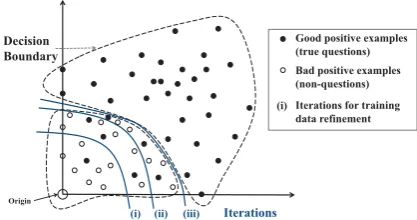
Figure 4: Illustration of one-class SVM classifi-cation with training data refinement (conceptual only). Three iterations (i) (ii) (iii) are presented.
refinement, including bootstrapping, condensing, and editing etc. In this work, we employ a SVM-based data editing and classification method pro-posed by Song et al. (2008), which iteratively sets a small value to the parameterν of the one-class SVM so as to continuously refine the decision boundary. The algorithm could be better visual-ized with Figure 4. In each iteration, a new de-cision boundary will be determined based on the existing set of data points, and a portion of pos-sible outliers will be removed from the training set. It is expected that the learned hyperplane will eventually be very close to the optimal one.
We use the freely available software LIBSVM2 to conduct the one-class SVM training and test-ing. A linear kernel is used, as it is shown to be superior in our experiments. In each refinement iteration, the parameter ν is conservatively set to 0.02. The number of iteration is dynamically de-termined according to the algorithm depicted in (Song et al., 2008). Other parameters are all set to default. The refined decision boundary from the training dataset will be applied to classify ques-tions from non-quesques-tions. The question detector model learned will serve as a component for the cQA question retrieval system in our experiments.
4 Experiments
In this section, we present empirical evaluation results to assess the effectiveness of our ques-tion detecques-tion model. In particular, we first ex-amine the effects of the number of patterns on question detection performance. We further con-duct experiments to show that our question
de-2
# of Lexical Confidence # of Syntactic Confidence
Patterns 60% 65% 70% 75% 80% Patterns 60% 65% 70% 75% 80%
Support
0.40% 1685 1639 1609 1585 1545
Support
0.03% 916 758 638 530 453
0.45% 1375 1338 1314 1294 1277 0.04% 707 580 488 402 341
0.50% 1184 1151 1130 1113 1110 0.05% 546 450 375 308 261
0.55% 1037 1007 989 975 964 0.06% 468 379 314 260 218
Table 1: Number of lexical and syntactic patterns mined over different support and confidence values
Lexical Patterns
Confidence
Syntactic Patterns
Confidence
65% 70% 75% 60% 65% 70%
P R F1 P R F1 P R F1 P R F1 P R F1 P R F1
Support
0.40% 85.7 90.7 88.1 86.9 88.6 87.7 87.8 86.6 87.2
Support
0.03% 80.4 83.3 81.9 85.1 77.5 81.1 90.7 70.2 79.1 0.45% 86.6 90.2 88.4 88.9 88.5 88.7 89.6 86.7 88.2 0.04% 79.0 86.1 82.4 90.1 78.2 83.7 90.8 70.8 79.6 0.50% 88.5 91.6 88.4 86.4 89.0 87.7 86.2 87.9 87.0 0.05% 80.3 82.5 81.4 88.8 78.4 83.3 89.9 69.0 78.1 0.55% 86.5 89.9 88.1 88.1 87.5 87.8 88.0 89.2 88.6 0.06% 83.0 83.2 83.1 88.5 77.2 82.4 86.7 75.8 80.9
Table 2: Question detection performance over different sets of lexical patterns and syntactic patterns
tection model combining both lexical and syntac-tic features outperforms traditional rule-based or lexical-based methods. We finally demonstrate that our question detection model gives additional performance boosting to question matching.
4.1 Performance Variation over Different Pattern Sets
The performance of the question detection model can be sensitive to the number of features used for learning. To find the optimal number of features used for model training, we examine the perfor-mance variation over different amount of lexical and syntactic patterns undertaken for training.
Dataset: We collected a total of around 800k
question threads from Yahoo! Answers Health-care domain. From the collected data, we gener-ated the following three datasets:
- Pattern Mining Set: Comprising around 350k sentences from 60k question threads, where those ending with “?” are treated as questions and others as non-questions.
- Training Set: Positive examples comprising around 130k sentences ending with “?” from another 60k question threads for the one-class SVM learning algorithm.
- Testing Set: Two annotators are asked to tag randomly picked sentences from the remaining set. A total of 2,004 question sentences and 2,039 non-question sentences are annotated.
Methods & Results: We use different
combi-nations of support and confidence values to gen-erate different set of patterns. The support value ranges from 0.40% to 0.55% for lexical patterns
with a step size of 0.05%, and ranges from 0.03% to 0.06% for syntactic patterns with a step size of 0.01%. The confidence value for both patterns ranges from 60% to 80% with a step size of 5%. These value ranges are empirically determined. Table 1 presents the number of lexical and syn-tactic patterns mined against different support and confidence value combinations.
For each set of lexical or syntactic patterns mined, we use them as features for model train-ing. We convert the training sentences into a set of feature vectors and employ the one-class SVM algorithm to train a classifier. The classifier will then be applied to predict the question sentences in the testing set. To evaluate each question de-tection model, we employ Precision (P), Recall (R), andF1 as performance metrics, and Table 2
presents the results3.
We observe from Table 2 that given a fixed sup-port level, the precision generally increases with the confidence level for both lexical and syntactic patterns, but the recall drops. The lexical feature set comprising 1,314 sequential patterns as gen-erated with {sup=0.45%, conf=70%} gives the bestF1 score of 88.7%, and the syntactic feature
set comprising 580 syntactic patterns generated from{sup=0.04%, conf=65%} gives the bestF1
score of 83.7%. It is noted that the sequential patterns give relatively high recall while the syn-tactic patterns give relatively high precision. Our reading is that the sequential patterns are capable of capturing most questions, but it may also give wrong predictions to non-questions such as
“Lev-3
ator scapulae is used when you do the traps work-out” that bears the sequential pattern{when, do}. On the other hand, the syntactic patterns could give reliable predictions, but its coverage could suffer due to the limited number of syntactic pat-terns. We conjecture that a combination of both features could further improve the performance.
4.2 Performance Comparison with
Traditional Question Detection Methods
We next conduct experiments to compare the per-formance of our question detection model to tra-ditional rule-based or lexical-based methods.
Methods & Results: We set up five different
systems for meaningful comparisons:
1. 5W1H (baseline1): a rule-based method using 5W1H to determine a question sentence. 2. Question Mark (baseline2): a method using the
question mark “?” to judge a question.
3. SeqPattern: Using only the set of 1,314 se-quential patterns as features.
4. SynPattern: Using only the set of 580 syntactic patterns as features.
5. SeqPattern+SynPattern: Merging both lexical and syntactic patterns and use them as a set of features for question detection.
We again employ Precision (P), Recall (R), and F1 as performance metrics to evaluate each
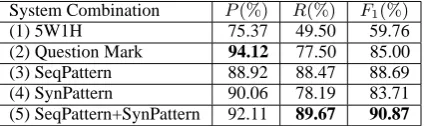
question detection system, and tabulate the com-parison results in Table 3. From the Table, we observe that 5W1H performs poorly in both preci-sion and recall, and question mark based method gives relatively low recall although the precision is the highest amongst all the methods evaluated. This is in line with the results as observed in (Cong et al., 2008). SeqPattern outperforms the two baseline systems in both R and F1 scores,
and its combination with SynPattern augments the performance in both precision and recall by a lot. It also achieves statistically significant im-proved results (t-test, p-value<0.05) as compared to other four systems. These results are consistent with our intuition that syntactic patterns can lever-age sequential patterns in improving the question detection performance.
It is noted that SeqPattern+SynPattern exhibits the highest recall (R) amongst all the systems. The significance test further suggests that many
System Combination P(%) R(%) F1(%)
(1) 5W1H 75.37 49.50 59.76
(2) Question Mark 94.12 77.50 85.00
(3) SeqPattern 88.92 88.47 88.69
(4) SynPattern 90.06 78.19 83.71
(5) SeqPattern+SynPattern 92.11 89.67 90.87
Table 3: Performance comparisons for question detection on different system combinations
question sentences miss-detected by 5W1H or Question Mark method could be properly cap-tured by our model. This improvement is mean-ingful, as the question coverage is also an im-portant factor in the cQA question retrieval task, where high recall implies that more similar ques-tions could be matched and returned, hence im-proving the question retrieval performance.
4.3 Performance Evaluation on Question Retrieval with Question Detection Model
To further demonstrate that our question detection model can improve question retrieval, we incor-porate it into different question retrieval systems.
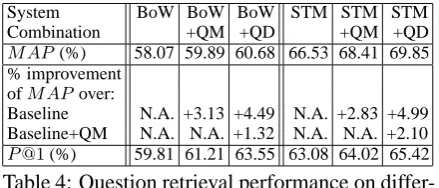
Methods: We select a simple bag-of-word
(BoW) system retrieving questions at the lexical level, and a syntactic tree matching (STM) model matching questions at the syntactic level (Wang et al., 2009) as two baselines. For each baseline, we further set up two different combinations:
- Baseline+QM: Using question mark to detect question sentences, and perform question re-trieval on top of the detected questions. - Baseline+QD: Using our proposed model to
detect question sentences, and perform ques-tion retrieval on top of the detected quesques-tions. This gives rise to additional 4 different system combinations for comparison.
Dataset: We divide the dataset from Yahoo!
“irrel-System BoW BoW BoW STM STM STM
Combination +QM +QD +QM +QD
M AP (%) 58.07 59.89 60.68 66.53 68.41 69.85
% improvement ofM APover:
Baseline N.A. +3.13 +4.49 N.A. +2.83 +4.99
Baseline+QM N.A. N.A. +1.32 N.A. N.A. +2.10
P@1(%) 59.81 61.21 63.55 63.08 64.02 65.42
Table 4: Question retrieval performance on differ-ent system combinations measured by MAP and P@1 (Baseline is either BoW or STM)
evant” without telling them which system the re-sult is generated from. By eliminating some query questions that have no relevant matches, the final testing set contains 214 query questions.
Metrics & Results: We evaluate the question
retrieval performance using two metrics: Mean Average Precision (MAP) and Top One Precision (P@1). The results are presented in Table 4.
We can see from Table 4 that STM outper-forms BoW. Applying QM or QD over BoW and STM boosts the system performance in terms of both MAP and P@1. They also achieve statis-tical significance as judged by paired t-test (p-value<0.05). More specifically, the MAP on QM coupled systems improves by 3.13% and 2.83% respectively over BoW and STM. This is evidence that having question sentences clearly identified could help to retrieve relevant ques-tions more precisely, as without question detec-tion, the user query is likely to be matched to ir-relevant description sentences. Our question de-tection model (QD) further improves the MAP by 1.32% and 2.1% respectively over BoW+QM and STM+QM, and it also yields better top one precision by correctly retrieving questions at the first position on 136 and 140 questions respec-tively, out of a total of 214 questions. These im-provements are in line with our expectation that our model incorporating salient features at both the lexical and syntactic levels is comprehensive enough to capture various forms of questions on-line, and hence improve the performance of ques-tion matching.
5 Related Work
Research on detecting question sentences can generally be classified into two categories. The first category simply employs rule-based methods such as question mark, 5W1H words, or
hand-crafted regular expressions to detect questions. As discussed, these conventional methods are not adequate to cope with online questions.
The second category uses machine learning ap-proaches to detect question sentences. Shrestha and McKeown (2004) proposed a supervised rule induction method to detect interrogative questions in email conversations based on part-of-speech features. Yeh and Yuan (2003) used a statistical approach to extract a set of question-related words and derived some syntax and semantic rules to detect mandarin question sentences. Cong et al. (2008) extracted labeled sequential patterns and used them as features to learn a classifier for ques-tion detecques-tion in online forums.
Question pattern mining is also closely related to the learning of answer patterns. Work on an-swer patterns includes the web based pattern min-ing (Zhang and Lee, 2002; Du et al., 2005) and a combination of syntactic and semantic elements (Soubbotin and Soubbotin, 2002) etc.
In contrast to previous work, we do not only fo-cus on standard language corpus, but extensively explore characteristics of online questions. Our approach exploits salient question patterns at both the lexical and syntactic levels for question detec-tion. In particular, we employ the one-class SVM algorithm such that the learning process is weakly supervised and no human annotation is involved.
6 Conclusion
This paper proposed a new approach to detecting question sentences in cQA. We mined both lexical and syntactic question patterns, and used them as features to build classification models. The min-ing and leanmin-ing process is fully automated and re-quires no human intervention. Empirical evalua-tion on the cQA archive demonstrated the effec-tiveness of our model as well as its usefulness in improving question retrieval performance.
References
Agichtein, Eugene, Carlos Castillo, Debora Donato, Aristides Gionis, and Gilad Mishne. 2008. Find-ing high-quality content in social media. In WSDM, pages 183–194.
Cong, Gao, Long Wang, Chin-Yew Lin, Young-In Song, and Yueheng Sun. 2008. Finding question-answer pairs from online forums. In SIGIR, pages 467–474.
Du, Yongping, Helen Meng, Xuanjing Huang, and Lide Wu. 2005. The use of metadata, web-derived answer patterns and passage context to improve reading comprehension performance. In HLT, pages 604–611.
Duan, Huizhong, Yunbo Cao, Chin-Yew Lin, and Yong Yu. 2008. Searching questions by identify-ing question topic and question focus. In HLT-ACL, pages 156–164.
Jeon, Jiwoon, W. Bruce Croft, and Joon Ho Lee. 2005. Finding similar questions in large question and an-swer archives. In CIKM, pages 84–90.
Jindal, Nitin and Bing Liu. 2006. Identifying compar-ative sentences in text documents. In SIGIR, pages 244–251.
Manevitz, Larry M. and Malik Yousef. 2002. One-class svms for document One-classification. J. Mach. Learn. Res., 2:139–154.
Pei, Jian, Jiawei Han, Behzad Mortazavi-asl, Helen Pinto, Qiming Chen, Umeshwar Dayal, and Mei chun Hsu. 2001. Prefixspan: Mining sequen-tial patterns efficiently by prefix-projected pattern growth. In ICDE, pages 215–224.
Riezler, Stefan, Alexander Vasserman, Ioannis Tsochantaridis, Vibhu Mittal, and Yi Liu. 2007. Statistical machine translation for query expansion in answer retrieval. In ACL, pages 464–471.
Shrestha, Lokesh and Kathleen McKeown. 2004. De-tection of question-answer pairs in email conversa-tions. In COLING, page 889.
Song, Xiaomu, Guoliang Fan, and M. Rao. 2008. Svm-based data editing for enhanced one-class classification of remotely sensed imagery. Geo-science and Remote Sensing Letters, IEEE, 5(2):189–193.
Soubbotin, Martin M. and Sergei M. Soubbotin. 2002. Use of patterns for detection of likely answer strings: A systematic approach. In TREC.
Sun, Guihua, Gao Cong, Xiaohua Liu, Chin-Yew Lin, and Ming Zhou. 2007. Mining sequential patterns and tree patterns to detect erroneous sentences. In AAAI, pages 925–930.
Wang, Kai, Zhaoyan Ming, and Tat-Seng Chua. 2009. A syntactic tree matching approach to finding sim-ilar questions in community-based qa services. In SIGIR, pages 187–194.
Xue, Xiaobing, Jiwoon Jeon, and W. Bruce Croft. 2008. Retrieval models for question and answer archives. In SIGIR, pages 475–482.
Yeh, Ping-Jer and Shyan-Ming Yuan. 2003. Mandarin question sentence detection: A preliminary study. In EPIA, pages 466–478.
Zaki, Mohammed J. and Charu C. Aggarwal. 2003. Xrules: an effective structural classifier for xml data. In KDD, pages 316–325.