E v a l u a t i o n of a P r a c t i c a l Interlingua
for Task-Oriented D i a l o g u e
Lori Levin, Donna Gates, Alon Lavie, Fabio Pianesi,
Dorcas Wallace, Taro Watanabe, Monika Woszczyna
L a n g u a g e T e c h n o l o g i e s I n s t i t u t e , C a r n e g i e M e l l o n U n i v e r s i t y a n d I R S T I T C , T r e n t o , I t a l y
I n t e r n e t : l s l © c s , cmu. e d u
Abstract
IF (Interchange Format), the interlingua used by the C-STAR consortium, is a speech-act based in- terlingua for task-oriented dialogue. IF was de- signed as a practical interlingua that could strike a balance between expressivity and simplicity. If it is too simple, components of meaning will be lost and coverage of unseen data will be low. On the other hand, if it is too complex, it cannot be used with a high degree of consistency by collab- orators on different continents. In this paper, we suggest methods for evaluating the coverage of IF and the consistency with which it was used in the C-STAR consortium.
Introduction
IF (Interchange Format) is an interlingua used by the C-STAR consortium 1 for task-oriented dia- logues. Because it is used in five different coun- tries for six different languages, it had to achieve a careful balance between being expressive ehough and being simple enough to be used consistently. If it was not expressive enough, components of meaning would be lost and coverage of unseen data would be low. On the other hand, if was not sim- ple enough, different system developers would use it inconsistently and the wrong meanings would be translated. IF is described in our previous papers ([PT98, LGLW98, LLW+]).
For this paper, we have proposed methods for evaluating the coverage of IF and the degree to which it can be used consistently across C-STAR sites. Coverage was measured by having human IF specialists annotate unseen data. Consistency was measured by two means. The first was inter-coder agreement among IF specialists at Carnegie Mel- lonUniversity and ITC-irst (Centre per la ricerca
lhttp://www.c-star.org
scientifica e tecnologica). The second, less direct method, was a cross-site end-to-end evaluation of English-to-Italian translation where the English- to-IF analysis grammars were written at CMU and IF-to-Italian generation was developed at IRST. If the English and Italian grammar writers did not agree on the meaning of the IF, wrong transla- tions will be produced. In this way, the cross-site evaluation can be an indirect indicator of whether the CMU and IRST IF specialists agreed on the meaning of IF representations. For comparison, we also present within-site end-to-end evaluations of English-to-German, English-to-Japanese, and English-to-IF-to-English, where all of the analysis and generation grammars were written at CMU.
T h e I n t e r c h a n g e F o r m a t
Because we are working with task-oriented dia- logues, adequate rendering of the speech act in the target language often overshadows the need for lit- eral translation of the words. IF is therefore based on domain actions (DAs), which consist of on speech acts plus domain-specific concepts. An ex-
ample of a DA is
give-information+price+room
(giving information about the price of a room). DAs are composed from 45 general speech acts
(e.g., acknowledge, g i v e - i n f o r m a t i o n ,
accept)
and about 96 domain-specific concepts (e.g, p r i c e , temporal, room, f l i g h t , a v a i l a b i l i t y ) . In addition to the DA, IF representations can con- tain arguments such as room-type, d e s t i n a t i o n , and p r i c e . There are about 119 argument types.
In the following example, the DA consists
of a speaker tag (a: for agent), the speech-
P e r c e n t
Cumulatlve Percent Count Coverage
15.7 15,7 652 19.8 4.1 172 28.3 3.4 143 26.0 2.7 113 28.0 2.0 85 30.1 2.0 85 31,9 1.9 78 33.7 1.8 75 35.5 1.8 73 37.2 1.7 70 3 8 . 8 1.6 6 6 40.3 l . S 64 41.7 1,4 60 43.2 1.4 60
4 4 . 5 1.3 5 6
45.8 1.3 52 46.9 1.2 48 48.0 1.1 46
4 9 . 1 1.1 44
50.1 1.0 42
NA*
;:;
244
DA
acknowledge
a f f i r m
thank introduce-self give-lnformation+prtce
g r e e t i n g
give-lnfor marion+tern poral give-lnformatlon+numeral
give-in f o r m a t i o n + p r i c e + r o o m r e q u e s t - i n for m a t i o n + p a y m e n t g i v e - i n f o r m a t i o n + p a y m e n t g i v e - i n f o r m + f e a t u r e s + r o o m give-in f o r m -t- a v a i l a b i l i t y + r o o m
accept
give-information+personal-data req-act +reserv+ feat ures+room
req- verif-give-inforra + n u m e r a l o f f e r + h e l p
apologize
request-inform+personal-data
no-tag
Figure 1: Coverage of Top20 DAs and No-tag in development data
sented with the complex argument p r i c e = which has its own arguments q u a n t i t y = , currency= and p e r - u n i t = . This IF representation is neutral be- tween sentences that have different verbs, sub- jects, and objects such as A double room costs 150 dollars a night, The price o f a double room is 150
dollars a night, and A double room i s 150 dollars
a night. ~
AGENT: ''a double room costs $150 a night.'' a:give-information+price+room
( r o o m - t y p e = d o u b l e ,
price=(quantity=lSO, currency=dollar, per-unit=night)
C o v e r a g e a n d D i s t r i b u t i o n o f
D i a l o g u e A c t s
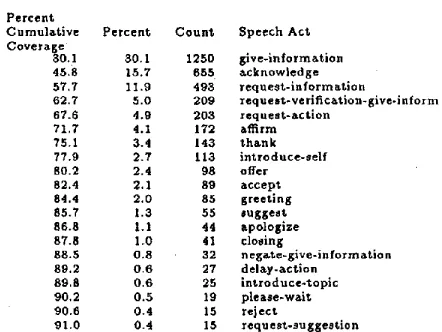
In this section, we address the coverage of IF for task-oriented dialogues about travel planning. We want to know whether a very simple interlingua like IF can have good coverage. We are using a rather subjective measure of coverage: IF experts hand-tagged unseen data with IF representations and counted the percentage of utterances to which no IF could be assigned. (When they tagged the unseen data, they were not told that the IF was being tested for coverage. The tagging was done for system development purposes.) Our end-to- end evaluation described in the following sections can be taken as a less subjective measure of cov-
2When we add anaphora resolution, we will need to know whether a verb (cost) or a noun (price) was used. This will be an issue our new project, NESPOLEI
(http://nespole. itc. it/).
Percent
Cumulative Percent Count Speech Act Coverage
30.1 80.1 1250 glve-lnformation
45,8 15.7 655 acknowledge
57,7 11.9 498 r e q u e s t - l n f o r m a t i o n
62,7 5,0 209 r e q u e s t - v e r i f i c a t i o n - g i v e - i n f o r m 87.6 4.9 203 request-actlon
71.7 4.1 172 affirm
7 5 , 1 3 . 4 1 4 3 thank
77,9 2.7 113 introduce-self
80.2 2.4 98 offer
82,4 2.1 89 accept
8 4 . 4 2 . 0 8 5 greeting
85.7 1.3 55 suggest
66.8 I . I 44 apologize
87.8 1.0 41 closing
88.5 0.8 32 negate.give-information
89.2 0.6 27 d e l a y - a c t i o n 89,8 0.6 25 introduce-topic
90,2 0.5 19 please-wait
9 0 . 6 0 . 4 15 reject
[image:2.612.328.549.63.229.2]91.0 0.4 15 request-suggestlon
Figure 2: data
Coverage of speech-acts in development
erage. However, the score of an end-to-end evalu- ation encompasses grammar coverage problems as well as IF coverage problems.
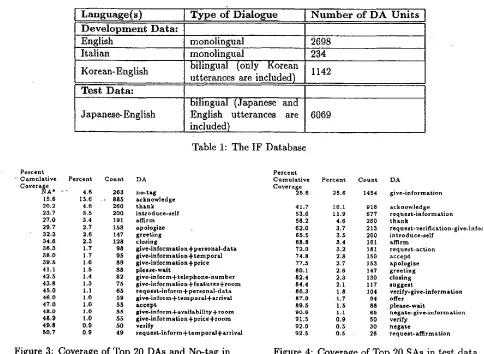
The development portion of the coverage ex- periment proceeded as follows. Over a period of two years, a database of travel planning dialogues was collected by C-STAR partners in the U.S., Italy, and Korea. The dialogues were role-playing dialogues between a person pretending to be a traveller and a person pretending to be a travel agent. For the English and Italian dialogues, the traveller and agent were talking face-to-face in the same language - - both speaking English or both speaking Italian. The Korean dialogues were also role playing dialogues, but one participant was speaking Korean and the other was speaking En- glish. From these dialogues, only the Korean ut- terances are included in the database. Each utter- ance in the database is annotated with an English translation and an IF representation. Table 1 sum- marizes the amount of data in each language. The English, Italian, and Korean data was used for IF development.
[image:2.612.78.298.65.245.2]L a n g u a g e ( s ) T y p e o f D i a l o g u e N u m b e r o f D A U n i t s D ' e v e l o p m e n t D a t a :
English Italian
Korean-English
Test Data:
Japanese-English
monolingual monolingual
biiingual (only 'Korean utterances are included)
bilingual (Japanese and English utterances are included)
Table 1: The IF Database 2698
1142
6069
Percent
' C u m u l a t i v e Percent Count DA C o v e r ~ , - - = - " 4.6 263 no-tag
15.6 15.6 • - 885 acknowledge 2 0 . 2 4,6 2 6 0 t h a n k 23.7 3.5 200 i n t r o d u c e - s e l f 27.0 3.4 191 affirm 29.7 2.7 153 apologize 32.3 2.6 147 g r e e t i n g 34.6 2.3 128 closing
36.3 1.7 98 g i v e - i n f o r m a t i o n + p e r s o n a l - d a t a 38.0 1.7 95 g l v e - i n f o r m a t i o n + t em poraI
3 9 . 5 1.6 89 give-in f o r m a t i o n + price 41.1 1.5 88 please-wait
42.5 1.4 82 give-inform+telephone-number 43.8 1.3 75 g i v e - i n f o r m a t i o n + f e a t u r e s + r o o m 45.0 I . I 65 r e q u e s t - i n f o r m + p e r s o n a l - d a t a 46.0 1.0 59 give-in for m ÷ t e m p oral-.{- arrival 47.0 1.0 55 accept
48.0 l.O 5 5 give-infor m + a v a i l a b i l i t y + r o o m 48.9 1.0 55 g i v e - i n f o r m a t i o n + p r i c e - b r o o m 49.8 0.9 50 verify
50.7 0.9 49 r e q u e s t - i n form + t e m p o r a l + a r r i v a l
Figure 3: Coverage of Top 20 DAs and No-tag in test data
P e r c e n t C u m u l a t i v e C o v e r a g e
2 5 . 6
P e r c e n t C o u n t DA
25.6 1454 g i v e - i n f o r m a t i o n
41.7 16.1 916 a c k n o w l e d g e
5 3 . 6 11.9 677 r e q u e s t - i n f o r m a t i o n
5 8 . 2 4.6 260 t h a n k
62,0 3.7 213 request-verification-give-inform 65.5 3.5 200 introduce-self
6 8 . 8 3.4 191 a f f i r m 7 2 . 0 3.2 181 r e q u e s t - a c t i o n
74.8 2.8 159 accept 77.5 2.7 153 apologize
80.1 2.6 147 g r e e t i n g 82.4 2.3 130 c l o s i n g 84.4 2.1 117 suggest
86.3 1.8 104 v e r l f y - g i v e - i n f o r m a t i o n 87.9 1.7 94 offer
89.5 1.5 88 please-wait
90.6 I . I 65 negate-glve-lnformation
91.5 0.9 50 verify 92.0 0.5 30 n e g a t e
92.5 0.5 . 26 r e q u e s t - a f f i r m a t l o n
Figure 4: Coverage of Top 20 SAs in test data
second column shows the percent of the develop- ment data covered by each DA or speech act. The third column shows the number of times each DA or speech act occurs in the development data.
The evaluation portion of the coverage ex- periment was carried out on 124 dialogues (6069 dialogue act units) that were collected at ATR,
Japan. One participant in each dialogue was
speaking Japanese and the other was speaking En- glish. Both Japanese and English utterances are included in the data. The 124 Japanese-English dialogues were not examined closely by system de- velopers during IF development. After the IF de- sign was finalized and frozen in Summer 1999, the Japanese-English data was tagged with IFs. No further IF development took place at this point except that values for arguments were added. For
example,
Miyako
could be added as a hotel name,but no new speech acts, concepts, or argument types could be added. Sentences were tagged as n o - t a g if the IF did not cover them.
Figures 3 and 4 show the cumulative cover-
age of the top twenty DAs and speech acts in the Japanese-English data, including the percent of n o - t a g sentences.
Notice that the percentage of n o - t a g was lower in our test data than in our development data. This is because the role playing instructions for the test data were more restrictive than the role playing instructions for the development data. Figures 1 and 3 show that slightly more of the test data is covered by slightly fewer DAs.
Cross-Site Reliability of IF
Representations
In this section we attempt to measure how reliably IF is used by researchers at different sites. Recall that one of the design criteria of IF was consis- tency of use by researchers who are separated by oceans. This criterion limits the complexity of IF. Two measures of consistency are used - inter-coder agreement and a cross-site end-to-end evaluation.
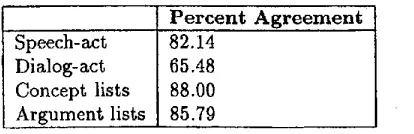
I n t e r - C o d e r A g r e e m e n t : Inter-coder agree-
[image:3.612.88.572.60.414.2] [image:3.612.94.352.68.398.2]P e r c e n t A g r e e m e n t Speech-act 82.14
Dialog-act 65.48 Concept lists 88.00 Argument lists I 85.79
Table 2: Inter-coder Agreement between CMU and IRST
C-STAR partners. We used 84 DA units from the Japanese-English data described above. The 84 DA units consisted of some coherent dialogue fragments and and some isolated sentences. The data was coded at CMU and at IRST. We counted agreement on ~he components of the IF separately. Table 2 shows agreement on speech acts, dialogue acts (speech act plus concepts), concepts, and ar- guments. The results are reported in Table 2 in terms of percent agreement. Further work might include some other calculation of agreement such as Kappa or precision and recall of the coders against each other. Figure 5 shows a fragment of a dialogue coded by CMU and IRST. The coders disagreed on the IF middle sentence, I'd like a twin room please. One coded it as an acceptance of a twin room, the other coded it as a preference for a twin room.
C r o s s - S i t e E v a l u a t i o n : As an approximate and indirect measure of consistency, we have compared intra-site end-to-end evaluation with cross-site end-to-end evaluation. An end-to-end evaluation includes an analyzer, which maps the source lan- guage input into IF and a generator, which maps IF into target language sentences. The intra-site evaluation was carried out on English-German, English-Japanese, and English-IF-English trans- lation. The English analyzer and the German, Japanese, a n d English generators were all writ- ten at CMU by IF experts who worked closely with each other. The cross-site evaluation was car- ried out on English-Italian translation, involving an English analyzer written at CMU and an Ital- ian generator written at IRST. The IF experts at CMU and IRST were in occasional contact with each other by email, and met in person two or three times between 1997 and 1999.
A number of factors contribute to the success of an inter-site evaluation, just one of which is that the sites used IF consistently with each other. An- other factor is that the two sites used similar de- velopment data and have approximately the same coverage. If the inter-site evaluation results are about as good as the intra-site results, we can con-
clude that all factors are handled acceptably, in- cluding consistency of IF usage. If the inter-site results are worse than the intra-site results, con- sistency of IF use or some other factor may be to blame. Before conducting this evaluation, we already knew that there was some degree of cross- site consistency in IF usage because we conducted successful inter-continental demos with speech translation and video conferencing in Summer 1999. (The demos and some of the press coverage are reported on the C-STAR web site.) The de- mos included dialogues in English-Italian, English- German, English-Japanese, English-Korean, and English-French. At a later date, an Italian-Korean demo was produced with no additional work, thus illustrating the well-cited advantage of an inter- lingual approach in a multi-lingual situation. The end-to-end evaluation reported here goes beyond the demo situation to include data that was un- seen by system developers.
Evaluation Data: The Summer 1999 intra-site evaluation was conducted on about 130 utterances from a CMU user study. The traveller was played by a second time user - - someone who had partici- pated in one previous user study, but had no other experience with our MT system. The travel agent was played by a system developer. Both people were speaking English, but they were in different rooms, and their utterances were paraphrased us- ing IF. The end-to-end procedure was that (1) an English utterance was spoken and decoded by the JANUS speech recognizer, (2) the output of the rec- ognizer was parsed into an IF representation, and (3) a different English utterance (supposedly with the same meaning) was generated from the IF rep- resentation. The speakers had no other means of communication with each other.
In order to evaluate English-German and English-Japanese translation, the IFs of the 130 test sentences were fed into German and Japanese generation components at CMU. The data used in the evaluation was unseen by system developers at the time of the evaluation. For English-Italian translation, the IF representations produced by the English analysis component were sent to IRST to be generated in Italian.
[image:4.612.73.280.67.134.2]We have singles, and t,ins and also Japanese rooms available on the eleventh. CMU a:give-information+availability+room
(room-type=(single ~ twin ~ japanese_style), time=mdll) IRST a:give-in2ormation+availability+room
(room-type=(single ~ twin & japanese_style), time=mdll)
I'd like a twin room, please.
CMU c:accept+features+room (room-typeffitwin)
IBST c:give-information+preference+features+room (room-type=twin)
A twin room is fourteen thousand yen. CMU a:give-information+price+room
(room-type=twin, price=(currency=yen, quantity=f4000)) IRST a:give-in.formation+price+room
(room-type=twin, price=(currency=yen, quantity=f4000))
Figure 5: Examples of IF coding from CMU and IRST
. o
Method
1 Recosnition only
2 Transcription
3 Recosnition
4 Transcription
5 Recognition
6 Transcription
7 Recognition
8 Transcription
9 Recognition
10 Transcription
11 Recognition
I OutPut Language II OK+Perfect Perfect Grader I No. of Graders
En$1ish English. En$1ish J a p a n e s e Japanese G e r m a n G e r m a n
German German
Italian Italian
78 % 62 % C M U 3
74 % 54 % C M U 3
59 ~ 42 % C M U 3
777 % 59 % C M U 2
62 % 4,5 % C M U 2
70 %- ... s9 % CMU "
58 % 34 % C M U 2
67 ~ 43 % I R S T 2
59 % 36 % I R S T 2
73 % 5 1 % I R S T ... 6
6 1 % 42 % I R S T 6
Figure 6: Translation Grades for English to English, Japanese, German, and Italian
score of perfect is assigned if, in addition to the previous criteria, the translation is fluent in the target language. A score of bad is assigned if the target language sentence is incomprehensible or some element of meaning has been added, deleted, or changed. The evaluation procedure is described in detail in [GLL+96]. In Figure 6, a c c e p t a b l e is the sum of p e r f e c t and ok scores, s
Figure 6 shows the results of the intra-site and inter-site evaluations. The first row grades the speech recognition o u t p u t against a human- produced transcript of what was said. This gives us a ceiling for how well we could do if trans- lation were perfect, given speech recognition er- rors. Rows 2 through 7 show the results of the intra-site evaluation. All analyzers and genera- tors were written at CMU, and the results were graded by CMU researchers. (The German re- sults are a lower than the English and Japanese results because a shorter time was spent on gram- mar development.) Rows 8 and 9 report on CMU's intra~site evaluation of English-German transla~
Sin another paper ([LBL+00]), we describe a task- based evaluation which focuses on success of commu- nicative goals and how long it takes to achieve them.
tion (the same system as in Rows 6 and 7), but the results were graded by researchers at IRST. Comparing Rows 6 and 7 with Rows 8 and 9, we can check t h a t CMU and IRST graders were us- ing roughly the same grading criteria: a difference of up to ten percent among graders is normal in our experience. Rows 10 and 11 show the results of the inter-site English-Italian evaluation. The CMU English analyzer produced IF representa- tions which were sent to IRST and were fed into IRST's Italian generator. The results were graded by IRST researchers.
Conclusions drawn from the inter-site evaluation:
Since the inter-site evaluation results are compa- rable to the intra-site results, we conclude that re- searchers at I R S T and CMU are using IF at least as consistently as researchers within CMU.
F u t u r e P l a n s
[image:5.612.86.526.62.375.2] [image:5.612.91.515.228.368.2]in a more traditional frame-based interlingua fo- cusing on lexical meaning and grammatical fea- tures of the sentences. We are working on disam- biguating literal from task-oriented meanings in
context. For example
That's great
could be an ac-ceptance (like
I'll take it)
(task oriented) or couldjust express appreciation. Sentences may also con-
tain a combination of task oriented (e.g.,
Can you
tell me)
and descriptive(how long the castle has
been standing)
components.[GLL+96]
[LBL+O0]
[LGLW98]
R e f e r e n c e s
Donna Gates, A. Lavie, L. Levin, A. Waibel, M. Gavald~, L. Mayfield, M:-Woszczyna, and P. Zhan. End-to- End Evaluation in JANUS: A Speech-
to-Speech Translation System. In
Pro-
ceedings of ECAI-96,
Budapest, Hun- gary, 1996.Lori Levin, Boris Bartlog, Ari-
adna Font Llitjos, Donna Gates, Alon Lavie, Dorcas Wallace, Taro Watan- abe, and Monika Woszczyna. Lessons Learned from a Task-Based Evaluation
of Speech-to-Speech MT. In
Proceed-
ings of LREC 2000,
Athens, Greece, June to appear, 2000.Lori Levin, D. Gates, A. Lavie, and A. Waibel. An Interlingua Based on Domain Actions for Machine Transla- tion of Task-Oriented Dialogues. In
Proceedings of the International Con-
ference on Spoken Language Process-
ing (ICSLP'98),
Sydney, Australia, 1998.[LLW +]
[PT98]
Lori Levin, A. Lavie, M. Woszczyna, D. Gates, M. Gavald~, D. Koll, and A. Waibel. The Janus-III Translation
System.
Machine Translation.
To ap-pear.
Fabio Pianesi and Lucia Tovena. Us- ing the Interchange Format for Encod-
ing Spoken Dialogue. In