Generic Sentence Fusion is an Ill-Defined Summarization Task
Hal Daum´e III and Daniel MarcuInformation Sciences Institute University of Southern California
4676 Admiralty Way, Suite 1001 Marina del Rey, CA 90292
{hdaume,marcu}@isi.edu
Abstract
We report on a series of human evaluations of the task of sentence fusion. In this task, a human is given two sentences and asked to produce a single coherent sentence that contains only the important information from the original two. Thus, this is a highly constrained summarization task. Our inves-tigations show that even at this restricted level, there is no measurable agreement between humans re-garding what information should be considered im-portant. We further investigate the ability of sepa-rate evaluators to assess summaries, and find simi-larly disturbing lack of agreement.
1 Introduction and Motivation
The practices of automatic summarization vary widely across many dimensions, including source length, summary length, style, source, topic, lan-guage, and structure. Most typical are summaries of a single news document down to a headline or short summary, or of a collection of news docu-ments down to a headline or short summary (Hahn and Harman, 2002). A few researchers have focused on other aspects of summarization, including sin-gle sentence (Knight and Marcu, 2002), paragraph or short document (Daum´e III and Marcu, 2002), query-focused (Berger and Mittal, 2000), or speech (Hori et al., 2003).
The techniques relevant to, and the challenges faced in each of these tasks can be quite different. Nevertheless, they all rely on one critical assump-tion: there exists a notion of (relative) importance between pieces of information in a document (or ut-terance), regardless of whether we can detect this or not. Indeed, recent research has looked at this question in detail, and can be rather cleanly divided into two partitions. The first partition aims to de-velop manual evaluation criteria for determining the quality of a summary, and is typified by the exten-sive research done in single-document summariza-tion by Halteren and Teufel (2003) and by the evalu-ation strategy proposed by Nenkova and Passonneau
(2004). The other half aims to develop automatic evaluation criteria to imitate the manual evaluation methods (or at least to complement them). Work in this area includes that of Lin and Hovy (2003) and Pastra and Saggion (2003), both of whom inspect the use of Bleu-like metrics (Papineni et al., 2002) in summarization.
The results of these investigations have been mixed. In the DUC competitions (Hahn and Har-man, 2002), when manual evaluation has been em-ployed, it has been commonly observed that human-written summaries grossly outscore any machine-produced summary. All machine-produced sum-maries tend to show little (statistically significant) difference from one another. Moreover, a baseline system that simply takes the first sentences of a doc-ument performs just as well or better than intelli-gently crafted systems when summarizing news sto-ries. Additionally, studies of vast numbers of sum-maries of the same document (Halteren and Teufel, 2003) have shown that there is little agreement among different humans as to what information be-longs in a single document summary. This has been leveraged by Nenkova and Passonneau (2004) to produce a manual scoring method for summaries, though the fact that humans show so little agree-ment in this task is somewhat disheartening. All of these evaluations rely strongly on the issue of mul-tiple references, in order to achieve consensus.
sim-Connecting Point has become the single largest Mac retailer after tripling it ’s Macintosh sales since January 1989 .
[image:2.595.63.500.72.118.2]Connecting Point Systems tripled it ’s sales of Apple Macintosh systems since last January . It is now the single largest seller of Macintosh .
Figure 1: Examplehdocument,abstractialignment.
ply to the vast space of possible choices a summa-rizer could make, and see the disagreement simply as par for the course.
2 Our Study
In this paper, we report on a study of the perfor-mance of humans producing summaries. We con-cern ourselves with the task of sentence fusion. In this task, we assume that two sentences are provided and that the summarizer must produce as output a single sentence that contains the important informa-tion contained in the input sentences (we will de-scribe later how we obtain such data). We would like to show that this task is well-defined: if we show many humans the same two sentences, they will produce similar summaries. Of course we do not penalize one human for using different words than another.
The sentence fusion task is interesting after per-forming sentence extraction, the extracted sen-tences often contain superfluous information. It has been further observed that simply compress-ing sentences individually and concatenatcompress-ing the re-sults leads to suboptimal summaries (Daum´e III and Marcu, 2002). The use of sentence fusion in multi-document summarization has been extensively ex-plored by Barzilay in her thesis (Barzilay, 2003; Barzilay et al., 1999), though in the multi-document setting, one has redundancy to fall back on. Addi-tionally, the sentence fusion task is sufficiently con-strained that it makes possible more complex and linguistically motivated manipulations than are rea-sonable for full document or multi-document sum-maries (and for which simple extraction techniques are unlikely to suffice).
3 Data Collection
Our data comes from a collection of computer prod-uct reviews from the Ziff-Davis corporation. This corpus consists of roughly seven thousand docu-ments paired with human written abstracts. The av-erage document was1080words in length, with an
abstract of length136words, a compression rate of
roughly87.5%.
3.1 Examples Based on Alignments
For 50 of these hdocument,abstracti pairs, we
have human-created word-for-word and phrase-for-phrase alignments. An example alignment is shown in Figure 1. Moreover, using a generalization of a hidden Markov model, we are able to create (in an unsupervised fashion) similar alignments for all of the documents (Daum´e III and Marcu, 2004). This system achieves a precision, recall and f-score of
0.528,0.668and0.590, respectively (which is a
sig-nificant increase in performance (f = 0.407) over
the IBM models or the Cut & Paste method (Jing, 2002)).
Based on these alignments (be they manually cre-ated or automatically crecre-ated), we are able to look for examples of sentence fusions within the data. In particular, we search for sentences in the ab-stracts which are aligned to exactly two document sentences, for which at least80% of the summary
sentence is aligned and for which at least 20% of
the words in the summary sentence come from each of the two document sentences.
This leaves us with pairs that consist of two doc-ument sentences and one abstract sentence, exactly the sort of data we are looking to use. We randomly select25such pairs from the data collected from the
human-aligned portion of the corpus and 25 pairs
from the automatically aligned portion, giving us50
pairs in all.
3.2 Examples Based on Elicitation
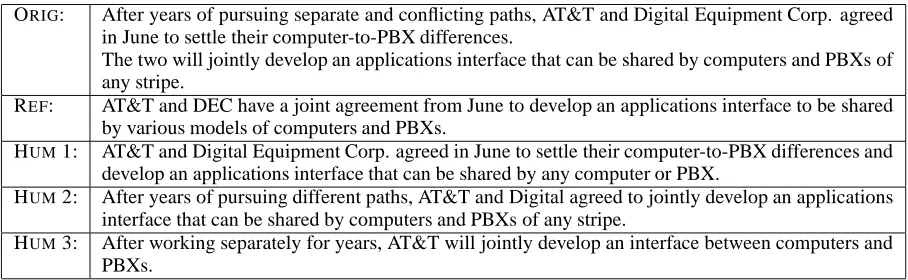
In addition to collecting data from the Ziff-Davis corpus, we also elicited data from human subjects with a variety of different backgrounds (though all were familiar with computers and technology). These people were presented with the pairs of docu-ment sentences and, independently of the rest of the document, asked to produce a single summary sen-tence that contained the “important” information. Their summary was to be about half the length of the original (this is what was observed in the pairs extracted from the corpus) They were given no ad-ditional specific instructions.
ORIG: After years of pursuing separate and conflicting paths, AT&T and Digital Equipment Corp. agreed in June to settle their computer-to-PBX differences.
The two will jointly develop an applications interface that can be shared by computers and PBXs of any stripe.
REF: AT&T and DEC have a joint agreement from June to develop an applications interface to be shared by various models of computers and PBXs.
HUM1: AT&T and Digital Equipment Corp. agreed in June to settle their computer-to-PBX differences and develop an applications interface that can be shared by any computer or PBX.
HUM2: After years of pursuing different paths, AT&T and Digital agreed to jointly develop an applications interface that can be shared by computers and PBXs of any stripe.
[image:3.595.72.526.70.210.2]HUM3: After working separately for years, AT&T will jointly develop an interface between computers and PBXs.
Table 1: Example of elicited data.
document sentences, the “reference” summary (i.e., the one that came from the original abstract), and the responses of three of the eight human subjects are shown (the first is the most “cut and paste,” the second is typical of the “middle set” and the last is unusually abstractive).
3.3 Baseline Summaries
In addition to the human elicited data, we gener-ate three baseline summaries. The first baseline, LONGER, simply selects the longer of the two sen-tences as the summary (typically the sensen-tences are roughly the same length; thus this is nearly random). The second baseline, DROPSTOPfirst catenates the sentences (in random order), then removes punctu-ation and stop words, finally cutting off at the50%
mark. The third baseline, COMP is the document compression system developed by Daum´e III and Marcu (2002), which compresses documents by cut-ting out constituents in a combined syntax and dis-course tree.
4 Evaluation of Summaries
We perform three types of manual evaluation on the summaries from the previous section. In the first, the ranked evaluation, we present evaluators with original two document sentences; they also see a list of hypothesis summaries and are asked to rank them relative to one another. In the second evalu-ation, the absolute evaluevalu-ation, evaluators are pre-sented with the reference summary and a hypothe-sis and are asked to produce an absolute score for the hypothesis. In the third, the factoid evaluation, we manually inspect the information content of each hypothesis.
4.1 Ranked Evaluation
In the ranked evaluation, human evaluators are pre-sented with the original two document sentences. They also see a list of 12 hypothesis summaries:
the reference summary, the eight summaries elicited
from human subjects, and the three baseline sum-maries. They are asked to produce a ranking of the
12summaries based both on their faithfulness to the
original document sentences and on their grammat-icality. They were allowed to assign the same score to two systems if they felt neither was any better (or worse) than the other. They ranked the systems from
1(best) to12(worst), though typically enough
sys-tems performed “equally well” that a rank of12was
not assigned. Three humans performed this evalua-tion.
4.2 Absolute Evaluation
In the absolute evaluation, human evaluators are shown the reference summary and a single hypoth-esis summary. In order to partially assuage the is-sue of humans doing little more than string match-ing (Coughlin, 2001), the reference and hypothe-sis were shown on separate pages and humans were asked not to go “back” during the evaluation. Due to time constraints, only three systems were evaluated in this manner, one of the humans (the human out-put was selected so that it was neither too cut-and-paste nor too generative), the LONGER and COMP systems. Three humans performed this task (each shown a single different system output for each ref-erence summary) and scored outputs on a scale from
1(best) to5(worst). They were told to deduct points
for any information contained in the reference not contained in the hypothesis, any information con-tained in the hypothesis not concon-tained in the refer-ence, and ungrammaticality.
4.3 Factoid Evaluation
REF LONGER COMP HUM1 HUM2 HUM3 Factoid
F F F F F CP has taken leadership
F F leadership by volume
doug kass is analysis at dataquest inc dq is a market research co
dq is in san jose
kass said CP has taken leadership
F F F F F analysts say
F F F F F F CP has a wide variety of stores
F F F F F F CP endorsed apple’s earned investment program F F F F CP has become the low-price leader
[image:4.595.78.520.72.209.2]F F F F CP hasn’t sacrificed technical support
Table 2: Factoid-based evaluation scheme for the sentence pair “Connecting Point has taken leadership by volume, volume, volume,” said Doug Kass, an analyst at Dataquest Inc., a market research company in San Jose. Analysts and observers say Connecting Point’s wide variety of stores and endorsement of Apple’s earned investment program have helped it become the low-price leader without sacrificing technical support.”
We assume that we are given the original pair of sentences from the document and the hypothesis summaries for many systems (in our experiments, we used the original reference summary, the outputs of three representative humans, and the LONGER and COMPbaselines). Given this data, we first seg-ment the original pair of sentences into “factoids” in the style of Halteren and Teufel (2003). Then, for each hypothesis summary and each factoid, we in-dicate whether the summary contained that factoid.
Grammaticality of summary hypotheses enters into the calculation of the factoid agreement num-bers. A system only gets credit for a factoid if its summary contains that factoid in a sufficiently grammatical form that the following test could be passed: given any reasonable question one could pose about this factoid, and given the hypothesis summary, could one answer the question correctly. An example is shown in Table 2.
Based on this information, it is possible to se-lect one or more of the outputs as the “gold stan-dard” and compare the rest in the pyramid scor-ing scheme described by Nenkova and Passonneau (2004). If only one output is used as the gold stan-dard, then it is sufficient to compute precision and recall against that gold standard, and then use these numbers to compute an F-score, which essentially measures agreement between the chosen gold stan-dard and another hypothesis. In the remainder of this analysis, when we report an F-score over the factoid, this is calculated when the REFsummary is taken as the standard.
5 Evaluation Results
The fundamental question we would like to answer is whether humans agree in terms of what informa-tion should be preserved in a summary. Given our data, there are two ways of looking at this. First:
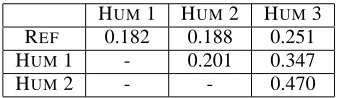
[image:4.595.336.506.277.326.2]HUM1 HUM2 HUM3 REF 0.182 0.188 0.251 HUM1 - 0.201 0.347 HUM2 - - 0.470
Table 3: Agreement (kappa) scores for different combinations of systems and humans
do the humans from whom we elicited data select the same information as the reference? Second: do these humans agree with each other. Both of these questions can be answered by looking at the results of the factoid evaluation.
For any set of columns in the factoid evaluation, we can compute the agreement based on the kappa statistic (Krippendorff, 1980). Researchers have ob-served that kappa scores over 0.8 indicate strong
agreement, while scores between 0.6 and 0.8
indi-cate reasonable agreement. Kappa values below0.6
indicate little to no agreement. The kappa values for various combinations of columns are shown in Table 3.
As we can see from this table, there is essen-tially no agreement found anywhere. The maximum agreement is between HUMAN2 and HUMAN3, but even a kappa value of0.470is regarded as virtually
no agreement. Furthermore, the kappa values com-paring the human outputs to the reference outputs is even lower, attaining a maximum of 0.251; again,
no agreement. One is forced to conclude that in the task of generic sentence fusion, people will not pro-duce a summary containing the same information as the original reference sentence, and will not pro-duce summaries that contain the same information as another person in the same situation.
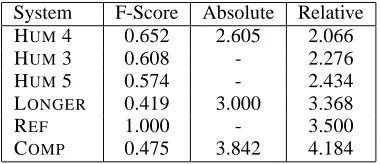
sum-System F-Score Absolute Relative HUM4 0.652 2.605 2.066 HUM3 0.608 - 2.276 HUM5 0.574 - 2.434
LONGER 0.419 3.000 3.368
REF 1.000 - 3.500 COMP 0.475 3.842 4.184
Table 4: Factoid F-score, absolute score and relative ranking for6outputs
maries, they will be able to distinguish one as some-how better than another. Answering this question is the aim of the other two evaluations.
[image:5.595.83.273.71.153.2]First, we consider the absolute rankings. Recall that in this evaluation, humans are presented with the reference summary as the gold standard sum-mary. Since, in addition to grammaticality, this is supposed to measure the correctness of information preservation, it is reasonable to compare these num-bers to the F-scores that can be computed based on the factoid evaluation. These results are shown in Table 4. For the first column (F-Score), higher num-bers are better; for the second and third columns, lower scores are better. We can see that the evalua-tion prefers the human output to the outputs of either of the systems. However, the factoid scoring prefers the COMPmodel to the LONGERmodel, though the Absolute scoring rates them in the opposite direc-tion.
As we can see from the Relative column in Ta-ble 4, human elicited summaries are consistently preferred to any of the others. This is good news: even if people cannot agree on what information should go into a summary, they at least prefer hu-man written summaries to others. After the hu-man elicited summaries, there is a relatively large jump to the LONGER baseline, which is unfortu-nately preferred to the REFERENCEsummary. After the reference summary, there are two large jumps, first to the document compression model and then to the DROPSTOP baseline. However, when com-paring the relative scores to the F-Score, we see that, again, the factoid metric prefers the COMPmodel to the LONGER model, but this is not reflected in the relative scoring metric.
6 Analysis of Results
There are two conclusions that can be drawn from these data. The first, related specifically to the kappa statistic over the factoids as depicted in Ta-ble 3, is that even in this modest task of compress-ing two sentences into one, the task is ill-defined. The second, related to the two other evaluations, is that while humans seem able to agree on the
rela-tive quality of sentence fusions, judgments elicited by direct comparison do not reflect whether systems are correctly able to select content.
6.1 Disagreement of Importance
As indicated in Section 5, when humans are given the task of compressing two sentences into one, there is no measurable agreement between any two as to what information should be retained.
The first thing worth noting is that there is mod-erately more agreement between two elicited, non-expert data points than between the elicited data and the original reference. This can be attributed either to the lack of context available to the non-experts, or to their respective lack of expertise. Regardless, the level of agreement between such non-expert hu-mans is so low that this matters little. Furthermore, from an automatic sentence fusion perspective, a computer program is much more like a non-expert human with no context than an expert with an entire document to borrow from.
It might be argued that looking at only two sen-tences does not provide sufficient context for hu-mans to be able to judge relative importance. This argument is supported by the fact that, upon mov-ing to multi-document summarization, there is (rel-atively) more agreement between humans regarding what pieces of information should be kept. In or-der to make the transition from two-sentence fusion to multi-document summarization, one essentially needs to make two inductive steps: the first from two sentences, to three and so on up to a full sin-gle document; the second from a sinsin-gle document to multiple documents.
that there would be even less agreement on what makes a good summary1.
6.2 Human Perception of Quality
We have presented two sets of results regarding hu-man perception of the quality of summaries. In the first (see Table 4), humans are presented with the REFsummary and then with either a human-elicited summary, a summary that is simply the longer of the two sentences (recall that they do not see the origi-nal two sentences, so they have no way of knowing how this summary was created) and the output of the COMPsystem. If one accepts that the F-Score over factoids is a high-quality measure of summary quality, then there should be strong correlation be-tween this F-Score and the absolute scoring of the system outputs. This is not observed. In fact, the F-Score strongly prefers the COMPsystem over the LONGER system, while human scoring prefers the LONGERsystem.
Since the humans performing this evaluation were told explicitly to count off for missing infor-mation, extraneous information or lack of grammat-icality, the only reasonable explanation for this dis-crepancy is that the evaluators were sufficiently put off by the grammatical errors made by the COMP system that they penalized it heavily. Grammatical-ity does enter into the factoids evaluation, though perhaps not as strongly.
In the relative ranking evaluation (see Table 4), there are two disturbing observations we can make. First, as in the absolute scoring, the factoid evalua-tion prefers the COMPsystem to the LONGER sys-tem, but the relative ranking puts them in the other order. Second, the LONGER baseline outperforms the reference summary.
As before, we can explain this first discrepancy by the issue of grammaticality. This is especially important in this case: since the evaluators are not given a reference summary that explicitly tells them what information is important and what information is not, they are required to make this decision on their own. As we have observed, this act is very imprecise, and it is likely the people performing the evaluation have recognized this. Since there is no longer a clear cut distinction between important and unimportant information, and since they are re-quired to make a decision, they have no choice but to fall back on grammaticality as the primary moti-vating factor for their decisions.
1Summarizing a set of unrelated documents may be an
un-realistic and unimportant task; nevertheless, it is interesting to consider such a task in order to better understand why humans agree more readily in multi-document summarization than in single document summarization or in sentence fusion.
The second discrepancy is particularly disturb-ing. Before discussing its possible causes, we briefly consider the implications of this finding. In order to build an automatic sentence fusion sys-tem, one would like to be able to automatically col-lect training data. Our method for doing so is by constructing word-for-word and phrase-for-phrase alignments between documents and abstracts and leveraging these alignments to select such pairs. In theory, one could extract many thousands of such examples from the plethora of existing docu-ment/summary pairs available. Unfortunately, this result tells us that even if we are able to build a system that perfectly mimics these collected data, a simple baseline will be preferred by humans in an evaluation.
One might wish to attribute this discrepancy to er-rors made by the largely imperfect automatic align-ments. However, we have calculated the results sep-arately for pairs derived from human alignments and from automatic alignments, and observe no differ-ences.
This leaves two remaining factors to explain this difference. First, the original summary is created by a trained human professional, who is very famil-iar with the domain (while our elicited data comes from technologically proficient adults, the topics discussed in the data are typically about technical systems from the late eighties, topics our summa-rizers know very little about). Second, the original summarizers had the rest of the document available when creating these fusions. Though without per-forming relevant experiments, it is impossible to say what the results would be.
7 Summary and Conclusions
We have performed an analysis of agreement be-tween humans in the highly constrained task of fus-ing two sentences together. This task has appli-cations in summarization, question answering and pure natural language generation. We have shown that this task is not well defined, when viewed in isolation. Furthermore, we have shown that us-ing automatically extracted data for trainus-ing cannot lead to systems that outperform a simple baseline of choosing the longer of the two sentences..
These results are disheartening, though by per-forming such experiments a priori, we are able to better judge which courses of research are and are not worth pursuing. Questions regarding the agree-ment between people in the area of single docu-ment summarization and multi-docudocu-ment summa-rization have already been raised and are currently only partially answered (Halteren and Teufel, 2003; Nenkova and Passonneau, 2004; Marcu and Ger-ber, 2001). We have shown that even in this con-strained domain, it is very unlikely that any signif-icant agreement will be found, without specifically guiding the summarizers, either by a query, a user model, or some other external knowledge. We have argued that it is likely that this lack of agreement will not be subverted by adding more sentences, though this should be confirmed experimentally.
The issues of multiple references and of adding context (essentially by allowing the summarizers to see the document from which these two sentences were extracted) has not been addressed in this work; either might serve to increase agreement. However, one of the goals of this methodology for ically extracting pairs of sentences from automat-ically aligned corpora is to be able to get data on which to train and test a system without having hu-mans write it. To require one to elicit multiple ref-erences to obtain any agreement obviates this goal (moreover, that agreement between humans and the original summary sentence is even lower than be-tween a pair of humans makes this practice ques-tionable). Regarding context, it is reasonable to hy-pothesize (though this would need to be verified) that the addition of context would result in higher kappa scores. Unfortunately, if a human is given access to this information, it would only be fair to give a system access to the same information. This means that we would no longer be able to view generic sentence fusion as an isolated task, making fusion-specific research advances very difficult.
8 Acknowledgements
We wish to thank Kevin Knight, Eduard Hovy, Jerry Hobbs and the anonymous reviewers for their help-ful and insighthelp-ful comments. This work was par-tially supported by DARPA-ITO grant N66001-00-1-9814, NSF grant IIS-0097846, and a USC Dean Fellowship to Hal Daum´e III.
References
R. Barzilay, K. McKeown, and M. Elhadad. 1999. Information fusion in the context of multi-document summarization. In Proceedings of ACL.
R. Barzilay. 2003. Information Fusion for Mut-lidocument Summarization: Paraphrasing and Generation. Ph.D. thesis, Columbia University. A. Berger and V. Mittal. 2000. Query-relevant
sum-marization using FAQs. In Proceedings of ACL. D. Coughlin. 2001. Correlating automated and
hu-man assessments of machine translation quality. In Proceedings of MT Summit IX.
H. Daum´e III and D. Marcu. 2002. A noisy-channel model for document compression. In Proceed-ings of ACL.
H. Daum´e III and D. Marcu. 2004. A phrase-based HMM approach to document/abstract alignment. In preparation.
U. Hahn and D. Harman, editors. 2002. Second Document Understanding Conference (DUC-2002).
H. Halteren and S. Teufel. 2003. Examining the consensus between human summaries: Initial ex-periments with factoid analysis. In HLT-NAACL DUC Workshop.
C. Hori, S. Furui, R. Malkin, H. Yu, and A. Waibel. 2003. A statistical approach to automatic speech summarization. Journal on Applied Signal Pro-cessing, 3:128–139.
H. Jing. 2002. Using hidden Markov modeling to decompose human-written summaries. Compu-tational Linguistics, 28(4):527 – 544, December. K. Knight and D. Marcu. 2002. Summarization beyond sentence extraction: A probabilistic ap-proach to sentence compression. Artificial Intel-ligence.
K. Krippendorff. 1980. Content analysis: An Intro-duction to its Methodology. Sage Publications, CA.
C.Y. Lin and E. Hovy. 2003. Automatic evaluation of summaries using n-gram co-occurrence statis-tics. In Proceedings of HLT-NAACL.
perfor-mance by sentence compression - a pilot study. In Proceedings of IRAL Workshop.
I. Mani and M. Maybury, editors. 1999. Ad-vances in Automatic Text Summarization. The MIT Press, Cambridge, MA.
D. Marcu and L. Gerber. 2001. An inquiry into the nature of multidocument abstracts, extracts, and their evaluation. In NAACL Summarization Workshop.
A. Nenkova and R. Passonneau. 2004. Evaluating content selection in summarization: The pyramid method. In Proceedings of HLT-NAACL.
K. Papineni, S. Roukos, T. Ward, and W.J. Zhu. 2002. Bleu: a method for automatic evaluation of machine translation. In Proceedings of ACL. K. Pastra and H. Saggion. 2003. Colouring