CUSTOMIZING AND EVALUATING A MULTILINGUAL DISCOURSE MODULE
Chinatsu Aone
S y s t e m R e s e a r c h a n d A p p l i c a t i o n s C o r p o r a t i o n ( S R A ) 2 0 0 0 1 5 t h S t r e e t N o r t h
A r l i n g t o n , V A 2 2 2 0 1 e m a i h a o n e c @ s r a . c o m
ABSTRACT
In this papeh we first describe how we have custom- ized our data-driven multilingu~fl discourse module within our text understanding system lor dill'erent lm~guages and for a particular NLP application by utilizing hierm'chic~dly organized discourse KB's. Then, we report qum~titalive and qmditative findings from ewduating the system both with and without discourse processing, ~md discuss how resolving certain kinds of mmphora affects system perh)r- l n a n c e .
1 I N T R O D U C T I O N
Although previous discourse rese,'uch (cf Hobbs [7], Webber 191, Grosz mid Sidner 16/, etc.) made significant contributions at a theorelic~d level, the effectiveness of discourse processing in NLP systems h~s not been studied so Ira' at a practical level (of. Walker [8]). In systems used in NLP applications such us the Message Underst,'ulding Conferences (of. 14, 5 I), discourse processing is often not a sep~u'ate module hut is pmt mid proeel of "template gener- ation." Thus, the eflbct of different types of discourse pro- cessing on a pm'liculm" task has not been shown either.
In addition, both at Iheoretical and practical levels, few seem to have considered designing discourse processing in a way that is customizable for multiple languages and domains. However, since discourse phenomena differ mnong Imlguages mid even among domains within the same language, it ix desirable that discourse processing be custonfizahle and its result ewduable.
In this paper, we descril)e how we have customized our multilingual discourse module wilhin our tcxl understand- ing system for a pm'ticulm" I~mk (i.e. data exla'action in the joint venture domain) in two different lmlguagcs (i.e. English mid Japanese), mid report the cwduation rcsul|s.
2 DISCOURSE MODULE
ARCHITECTURE
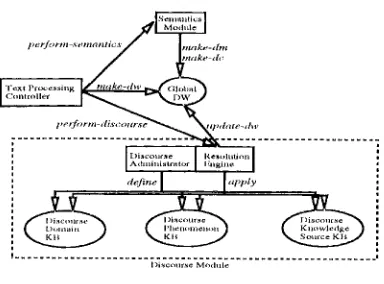
In Aone ~ultl McKee [2], we have described our new language- and domain-independent discourse module within our text underslanding system. In addition to being lmlguage- mid domain-independent, the module is ewdu- able m~d mfinable to different applications and domains. The discourse mchitecture is motiwtted by our need to port our text uuderstmlding system to diflcrent languages (e.g. English, Japanese, Spanish) mid to different dom~dns (of. Aone et al. [1]). The discourse mtxlule is strictly dam- ~hiven so that mmphora resolution h)r different lmlguages
mid domains can be achieved sunply by selecling neces- sary dala. It consists of one discourse processor (the Reso- lution Engine) and three discourse knowledge bases (the Discourse Phenomenon KB, the Discourse Knowledge Source KB, the Discourse Domain KB). The Discourse AdminisUator ix a developmenl-time tool for defitfiug the three discourse KB's. The m'chitecture is shown in Figure
I.
peFfortll-At~tllatlliC,g
deft,,, I [ "q'~':Y
I)iscc,urs¢ M~chlle
Figure 1. Discourse Architecture
2.1 I)iscourse Knowledge Bases
The Discourse Knowledge Source KB houses small well-delined mmphora resolution strategies. Each knowl- edge source (KS) is an object in the hierarchically orga- nized KB, and infl)rmation can be inherited from more general to more specific KS's. This KB consists of three kinds of KS's: generators, [liters and orderers. A g e n e r a t o r
is uscd to generate possible anlecedent hypotheses fi'om a certain region of text. A f i l t e r is used to eliminate impossi- ble hypotheses, while an ot~lerer is used to rmlk possible hyl)othescs in a preference order if there is more than one.
Most of the KS's are language-independen! (e.g. all the generalors and the semanlic tilters). Even when they are language-specilic, a sub-KS can inherit information from its superclass KS's while defining specific data lee:ally. For ex,'unple, the Semantic-Gender-Filter KS 1 deliues only funclional definition of this KS, while its sub-KS's for English ~md Japanese each specify ]~mguage-specific data ~md inherit the stone funclioual definilion from their pro'on! KS.
1. Seluanlic-Gender-Filter filters out an antecedent hypothesis whose semantic gende1 is not consistent with the restriction imposed by the syntaclic gender of ~l p I ' O I I O H I | ,
[image:1.612.315.507.262.404.2]The Discourse Phenomenon KB contains hierarchi- cally organized discourse phenomenon objects (e.g. Nmne-Anaphora, DeIinite-NP) each of which specifies a definition of the discourse phenomenon and a set of KS's (i.e. generators, tilters, and orderers) to apply to resolve this particular discourse phenomenon. Because the dis- course KS's are independent of discourse phenomena, the stone discourse KS cm~ be shared by different discourse phenomena in different languages ,and domains. For exam- pie, KS's such as Sem,-mtic-Type-Filter and Recency- Orderer are used by most discourse phenomena in multiple languages.
Finally, the Discourse Domain KB contains discourse domain objects each of which defines a set of discourse phenomena to hmldle in a particular domain. Since texts in different domains exhibit different sets of discourse phe- nomena, and since dilt'erent applications even within the same domain may not have to handle the same set of dis- course phenomena, the discourse domain KB is a way to
customize ,and constrain the workload of tile discourse
module.
These three hierarchically organized discourse KB's make it possible to share some of the discourse KB's while also being able to add language- mid domain-specitic dis- course data.
2.2 Resolution Engine
The Resolution Engine is the run-time processing module which finds tile best ,antecedent hypothesis tot a given ~maphor by using the discourse KB's described above. First, it determines from the Discourse Dom~fin KB which discourse phenomena to handle giveu a particular language eald domain. Then, it uses the Discourse Phe- nomenon KB to classify ml auaphor as one of the dis- course phenomena and to decide which KS's to apply to it. Next, the Engine applies appropriate generator KS's to get ,'m initial set of antecedent hypotheses, mid then applies fil- ter KS's to remove inconsistent hypotheses. When there is more than one hypothesis left, orderer KS's specified in the Discourse Phenomenon KB are invoked to rank the hypotheses.
3 CUSTOMIZING DISCOURSE KB'S
We have customized our discourse KB's to perform a data extraction t,'~sk in the joint venture domain. Our text understanding system takes English mid Japanese newspa- per articles about joint ventures as input (cf. Figure 2), and outputs database templates (eL Figure 3). The system has to extract from the ,articles infonnation regm'ding which organizations participate iu a joint venture (including a new joint venture compmly if any), what the purpose of tile joint venture is (e.g. selling coal), who tim people m'e that are associated with these organizations, etc. We made a task-oriented decision that handling organization mm-
phora, both definite NPs (e.g. "the company") and name
anaphora (e.g. "Toyota" for "Toyota Motors Corp."), is a
top priority initially in order to improve performance.
Thus, we created in the Discourse Domain KB a discourse domain object called JV-Data-Extraction which specifies that two discourse phenomenon objects from the Dis- course Phenomenon KB, namely mune anaphora (DP- Nmne) mid definite NP anaphora for orgmlizations (DP- DNP-Orgmlization), should be handled ill this application domain.
NEW YORK -- A joint veature to export c o n from tile United States has been l b n n e d between M&M Ferrous America Ltd. here and Crown Coal & Coke Co., Pittsburgh.
Coal obtained by Crown lroln v,'u-ious domes- tic mines will be marketed oflMlore by M&M, a lrading colnp~my formed six years ago by former PhilippiBrothers Inc. employees. Crown, which formerly had its own mines, heretofore marketed coati from v,'uious sources to domestic steehnak- ers only, according to Eric S. Katzenstein, M & M vice president.
((omitted))
Eastern European countries such as Rommlia are likely mm'kets, he said.
Figure 2. All Exmnple o1' Input Text
<TIE UP REI, ATIONSHII'-2975348 1> := TIlL U P S TAT[ IS: EXISTING
ENTITY: <ENTITY-2975348-1> <F, NTITY-2975348-2> ACTIVITY: <ACTIVITY-2975348-1>
<ENTITY-2975348-1 > :=
NAME: M&M Ferrous America I,TD AMASES: "M&M"
I,OCATION: New York (CITY 4) New York (PROVINCE 1) United States (COUNTI),Y)
TYPE: COMPANY
PERSON: <PERSON-2975348-1>
<ENTITY-2975348-2> := NAME: Crown C~al & Coke CO A/JASI~ : "(?rowll"
I,OCAT[ON: Pittsburgh (CITY 4) Pem~sylwtnia (IqU)VINCF, 1) United States (COUNTRY)
TYPE: COMPANY
<INDUSTRY-2975348-1> := IN D[ ISTRY-TYPE: S ALES
PRODUCT/SERVICE: (50 "Crown's coal")
<ACTIVITY-2975348-1 > :=
[NDUSTRY: <INDUSTRY-2975348 1>
ACTIVITY-SIT|';: (Romania (COUNTRY) <ENTITY-2975348- 1>)
<PERSON-297534g- 1 > := NAME: Eric S. Katzenstein
PERSON'S ENTITY: <I.;NTITY-2975348- I > POSITION: SREXEC
Figure 3. An Exmnple o f a u Output Template
3.1 Name Anaphora
Type-Filter, and Recency-Orderer. Tiffs generator gener- ates all the possible antecedenl hypotheses up to the cur- rent sentence. The Semantic-Type-Filter then checks if rice semantic type of a m p h o r is consistent with that of an ;mte- cedent [iypothesis. When there is more than one hypothe- sis left, the Recency-Orderer orders the hypotheses according to their proximity to the ataphot.
In addition to the three lmcguage-independent KS's, each h'mguage uses a language-specific lilter. For English, a filter named Englis[i-N,'une-Filter, which matches an anaphor (e.g.
"Crown")
with a subsequence of a~ mtte- cedent n a n e string (e.g. "Crown Coal & Coke CO"), is currently employed. For Japatese, mt additional sittgle fil- ler called Japanese-N,'une-Filter covers seemingly vast wu'iatious of Japanese company crane anaphora 2. This KS matches an attuphor with any conthiualion of characters in an ~mtecedenl as long as the character order is preserved (e.g. " a b e " can be an anaphor of "abede"). One exceplion is lhal a~ mtaphor c~m have an extra word "s[ia" at the end that is not a part of flte fnll company mune or a compmty acronym (e.g. "Westinghouse (WH)" can be refen'cd to auapltoric~dly by "Weslinghouse-sha" or " W H - s h a " ) .3.2 Definite N P
Attother discourse phenomctton which is handled lor this lask ix definite NPs relerriug Io organizations such as "the venture," "the West Germ+m electronics concern," etc., where the words "venture" and "cottcern" in these cotttexts point to subcltksses of I/to semanlic concept l+or an org~utization. Although Japanese does not have a delinite article, in writlen Japmlese the word " d o u " (literally meaning "lice s a n e " ) prefixed to certain nout~s performs approximately the s a n e function ~Ls English tlelinite a'tiele " t h e " . Both English and Japatese currently share the s a n e three KS's (i.e. Current-Text-Generatoc', Semantic- Type-Filter, Recency-Orderer) lot delinite NP resolution.
Additionally, English uses Syntactic-Number-Filter, which checks if the syntaclic nnmber of the anaphor is consistent with that of ~m anlecedent hypolhesis. Although Japalese does not exhibit syntactic number distinction, a "don" phr~Lse can only refer semmttic~dly Io a single entity. 3 Thus, Japanese uses Semanlic-Amount-Eilter, which exchtdes semantically plural entities (e.g. a con- joined NP, ~m NP with a plural qnmttifier) as possible aate- cedents for a "dou" phrase.
4 E V A L U A T I O N R E S U I : I ' S
hi this section, we will report onr evahtalion results. We ran 100 Japanese and 100 English blind test joint vett-
2, For example:
~ [ ~ ( ~ H ~ f ~ ) , ~¢,~,~ ( ~ . , ~ 2 Z ~ ) , • .
3. A definite plural NP can be expressed in Japanese by a numeral or numerical quantilier plus a classifier, as in "ryousha" (file two companies) and "san-sha" (the three companies).
lure ,'uticlcs through our text uuderslmlding system with and without the discourse module turned on, and scored the resnlls using an automalic scoring prognam. The scor- ing program uses a scoring metric from information retrieval, and reports recall and precision for each slot in the lemplates as well as a single combined score called F-
measure 4 for overall perforlnance (of.
1141).
It shouM be noted that this ewduation is a blackbox
ewduation of the syslem as used in a particular application task. Consequently, the results do not directly reflect the perfonn~mce of the discourse module itself• For cxanple, this task does not require all company name anaphora (i.e. aliases) to be reported, but only those which are involved in joint ventures. Also, the causes of task l~tilure or success are somelimes due to the lhilure or success of system mod- ules other ttum the discourse module. For instance, the pro- processing system does not always recognize company names which me potential autecedenls. On the other hard, the preprocessing module rather than the discourse module sometimes recognizes compaty acronyms as aliases. Thus, the resnlts of the hlackbox ev~dnation reflect more on how the discourse module helps the whole system per- Ibnn a p~uticular task.
4.1 Name A n a p h o r a
It is clem* that the perlbnmmce of name auaphora reso- htlion is directly linked to how well the system tills in the ALIASES slot in the output templates (of. Figure 3), The 100 Japanese texts required idenlifying a total of 127 com- pany name aliases. With the discourse module tnnted on, the recall of Ihc ALIASES slot increases by 38 poinls and the precision by 16 points. Though the set of KS's used for n a n e amphora was mostly satisihctory, we lound one problem paticular to this domain in tx~th l~mguages. Since the texts arc in the joint venture domain, it is often i[ie c~tse that the n a n e of a new joint venture company (e.g. "'Chrysler Japan") overlaps the n a n e s of its p~u'ent corn- panics (e.g. "Chrysler Corp."). Wlten the text nses a n a n e anaphor (e.g. "Chrysler"), it must refer to the pm+ent com- pany even when the joint venture company is mentioned most recently. We are plmming to add another orderer which preli~rs the pm'ent company when there is such a conllicl.
4.2 I)elinite N P
We hyt×)thesized that resolving delinitc NP's affects the extraclion of information about which company is per- forming which "economic activity" in a joint venture (e.g. Compaty A will nlanufaelufe ca's while Company B will mm'ket them), since snch information appem's later in a t
4. F-measure is calculated by:
( []7, + 1.0) x 1' x R
1~2 x f ' + R
where 1' is precision, R is recall, and [] is the relative importmtce given to recall over precision. In this case, ~= 1.0.
article after compmties involved ill It joint venture are "already introduced into the discourse (e.g. "Publishing rivals Time Inc. and New York Thnes Co. said they agreed ill principle to form ajointiy owned national magazine dis- tribution partnership... The joint venture will continue to market m a g ~ i n e s currently marketed by Tune Distribu- tion...").
Under the same test condition as above, the precision of the relevant slot (i.e. ACTIVITY-SITE slot ill Figure 3) increased by 5 points in JapaJmse when discourse process- ing was used. The recall was not affected much by the dis- course processing; it increased only by 1 point. In the English test, the changes in both precision and recall were negligible. One of the reasons for this less drastic incre~tse of this slot value is that the sentence expressing economic activities do not always use delinite NPs for the agents of such activities. Such agents can be expressed by name mlaphora or pronouns or, often in English, by implicit sub- jects of infinitives, as in "Siemens AG and GTE Corp. agreed to set up a new holding eomp~my in West Germany
to oversee their telecommunications joint venture...".
In addition, examination of the test results showed that when there are more than one antecedent hypothesis, topic marking (using particle " w a " ) plays a more significant role in determining the antecedent of a Japmmse "dou" definite NP th,'m recency. At the time of the testing, how- ever, we were not using topic marking infonnafion to pre- fer topicalized amecedent hypotheses. Another finding which is true of both Japanese and English is that definite NP ,'maphora resolution often requires pragmatic infercnc- ing ill order to obtain a fact which is not explicitly slated in the text. For ex,-unple, in order to resolve the definite NP in the senteuce "Chevron, an oil company, also said it acquired Rhonc-Poulenc's 30% interest in Petrosynthese S.A., boosting its holding in the French joint venture to 65%," the discourse module has to infer either that Petrosyuthese S.A. is a French comp~my (perhaps from the company designator?) or that acquiring someone's holding ill a company increases one's holding in that company. Wc are currently adding KS's which m~dce use of topic infor- mation and pragmatic inferencing, ,and also investigating which combinations of KS's will optimize discourse pcr- fo iTllallce.
Furthermore, we think that very little ch,-mge in recall is due to the fact that the system a~ssumed tile parent com- panies to be the value of ACTIVITY-SITE when it is undetermined. Thus, this detault value kept the recall of the system without discourse processing higher, mid them- fore the ACTIVITY-SITE slot was not as good an indica- tor of the discourse module performance as the ALIASES slot.
It is interesting to note that ml approach like Dagan ~u~(I Itai's [3], which uses statistical data on semantic selec- tional restriction that is automatically acquired from large corpora to resolve anaphora 5, tines not work well in this domain. This is because a typical text in this domain con- tains at least two lX)ssible antecedents (joint venture part-
ners m~d possibly a joint venture comp~my) of the s~une semm~tic type, munely organization, hn" a delinite NP ana- phora referring to organizations.
4.3 Overall P e r f o r m a n c e
Overall, discourse processing increased the system perh~rmance measured by tile combination of overall recall mid precision scores (i.e. F-measure) by 4 points in Japanese, mostly due to ~m overall increa.se in precision.
Interestingly, the discourse processing helped also in the identification of links between organizations mid people, ,'~s indicated by the PERSON slot of the <ENTITY> object ,'rod the PERSON'S ENTITY slot of tile <PERSON> object (cf. Figure 3). With the discourse processing lunged on, the recall of both PERSON and PERSON'S ENTITY slots incre~Lsed by 7 points, and the precision by 10 points and 12 points respectively.
We think that this is because when a person associated with an organization is mentioncd, the company mune or the person's naJne is often an anaphoric form as in "Carlos M. Herrera, president of Preferred," or "Katzenstein, a
former executive with Bomar Resources Inc.". In order to undersUmd the relation between ,'m organization and a per- son as in "Eric S. Katzenstein, M & M vice president" (cf. Figure 2), tile system has to recognize both the alfilialion link between the person and the comDmy hnplicit in tile appositive phrase, and the mmphoric link between Ihe objects under different aliases. Our discourse module takes care of both identifying appositive relations (e.g. Eric S. Katzenstein is vice presideu0 and resolving u~une anaphora (e.g. " M & M " refers to "M&M Ferrous America Ltd.").
5 CURRENT AND FUTURE WORK
In this paper, we have described our multilingual dis- course module mid ils customized discourse KB's, and reported the blackbox ewduation results when it was used in a data extraction task in the joint venture domain. Cur- rently we arc working on the following two research areas in order to improve anaphora resolution.First, we are experimenting with ways to automate Iraining of anaphora resolulion by applying machine learn- ing so that the discourse module can be castomized auto- maritally to a p~ticular hmguage, domain or application without extensive manual knowledge engineering. Ill order to obtain feedback liar training, we must be able to automate glassbox evaluation of discourse processing itself. For this, we have built Iwo tools: a discourse tag- ging tool and a discourse evaluation tool. The former has been used to tag texts with discourse relations, while tile latter lakes discourseqagged corpora as a key and the sys- tem output as results to be ev~duated.
Second, we are expanding the rm~ge of anaphoric phe- nomena which our discourse module can hmldle. They include overt pronouns in English mM Spanish, and zero pronouns in Japanese and Spmfish.
REFERENCES
I1] Chinalsu Aone, Hatte Blcjcr, Sharon Flank, Douglas McKee, and SmMy Shinn. The Murasaki Project: Multilingual Natural Language UnderslmMing. In Proceedings of the ARPA Human Language Technol- ogy Wvrkshop, 1993.
12] Chinatsu Aone and Dougl,~s McKce. Language-Inde- pendent Anaphora Resolution System lot Under- standing Multilingu~d "lbxls. In Proceedings of 31st Annual Meeting of the ACL, 1993.
1131
Ido Dagml ~md Alon llai. Aulomatic Acquisition of Constraints for Ihe Resolution of Anaphora Refer- ences and Synlactic Ambiguities. In Proceedings of the 13th International Cot!ference on Computational Linguistics, 1990.141
Delense Adwmced Resem'ch Projecks Agency. Pro- ceedings of t"ourth Message Understanding Confi~r- ettce (MUC-4). Morgml Kauflmmn Publishers, 1992.[51 Adwmced Resem'ch Pro}ecls Agency. Proceedings of Fourth Message Understanding Cot(erence (MUC- 5). Morg,'m Kaufinmm Publishers, 1993.
16]
Bm'bara Grosz and Candace L. Sidner. Attentions, hltenl.iol~s alld file Strtlcture of Discourse. Cotttpula- tional Linguistics, 12, 1986.171
Jen'y R. Hobbs. Pronoun Resolution. Technical Report 76-1, Depmlmenl of Computer Science, City College, City University of New York, 1976.[81 Marilyn A. Walkel; Evaluating Discourse Processing Algorithms. In Proceedings of 27th Annual Meeting of the ACL, 1989.
191 Bonnie Webber. A Formal Approach to Discourse Anaphora. Technical report, Bolt, Beranek, and New- mini, 1978.