Toward Memory--based Translation
S a t o s h i S A T O and Ma.koto N A G A O
D e p t . of Electrical E n g i n e e r i n g , K y o t o U n i v e r s i t y Y o s h i d a - h o n m a c h i , Sa.kyo, K.yoto, 606, Ja.pan
s a . t o @ k u e e . k y o t o - u . a c . j p
A b s t r a c t
An essential problem of example-based transla- tion is how to utilize more than one translation example for translating one source sentence.
This 1)aper proposes a method to solve this problem. We introduce tile representation, called .matching e,,z:pressio~z, which tel)resents the combination of fragments of translation ex- amples. The translation process consists of three steps: (.1) Make the source matching ex- pression from lhe source sentence. (2) TransDr the source matching expression into the target matching expression. (3) Construct the target sentence from the target matching expression.
This mechanism generates some candidates of translation. To select, the best translation out of them, we define the score of a translation.
1
I n t r o d u c t i o n
Use of extracted information fiom examples or example-based translation is becoming the new wave of machine translation. The ba.- sic idea. of example~based translation is very simple: translate a source sentence by imitat- ing the translation example of a similar sen- tence in the database. The idea first appeared in [Nagao 84], and some research has followed it [Sumita 88][Sato 89][Sadler 89a.][Sadler 89b]. But a great deal of effort is still needed to im- plemenl the idea.
In our previous work, we show how to select. the best target word in case-frame translation based on examples[Sato 89]. In this paper, we concentrate on two problems:
1. ltow to combine some fragments of trans- lation examph~s in order to translate one sentence?
2. tlow to select tile best tra.nslation out of
inany candidates?
We show partial solutions for them in MBT2. MBT2 is the second p r o t o t y p e system in our Memory-based Translation Project.. MBT2 ca.n do bi-directional m~nslation between an English word-dependency tree and a Japanese word- dependency tree. It is implemented in Sicstus Prolog.
2
N e e d
t o
C o m b i n e
F r a g -
m e nt s
The basic idea of example-based translation is very simple: translate a source sentence by im- itating the translation example of similar sen- t e n c e i n the database. But in many cases, it is necessary to imitate more than one translation example and combine some fragments of them. Let's consider the translation of the following sentence.
(1) He buys a book on international politics. If we know the following translation examt)le (2) and (3), we can translate sentence (1) into sentence (4) by imitating examples and colnbin- ing fragments of them.
(2) He buys a notebook.
K a t e ha nouto wo ka~.
(3) I read a boo]~ on international polilics. Watt, hi ha kokusaiseiji nit,suite l:akareta hon wo yomu.
(4) Kate ha kokusMseiji nitsuite kM~reta hon WO ka~ll.
It is easy for a human to do this, but not so for a machine. The ability to combine some fragments of translation examples is essential to example-based translation. A lack of this abil- ity restricts the power of example-based trans- lation. In this paper, we concentrate on the implementation of this ability on machine.
3
Matching Expression
To implenrent the ability to combine some frag- ments of t.ra.nslation example in order to trans- late one sentence, we must determine the fol- lowing:
® how to represent translation examples • what is a fragment
• how to r e p r e s e . t the combination of flag-
lnent.s
3.1 T r a n s l a t i o n D a t a b a s e
T h e translation database is the collection of translation examples. A t~anslation example consists of three parts:
• an English word-dependency tree ( E W D ) • a Japanese word-dependency tree ( J W D ) • correspondence links
For example, in Prolog,
ewd e ( [ e l , [ b u y , v ] ,
[e2,[he,pron]], [e3, [notebook,n],
[ e 4 , [ a , d e t ] ] ] ] ) . %% He buys a notebook. j w d _ e ( [ j I , [kau,v] ,
[ j 2 , [ h a , p ] ,
[j3,[kare,pron]]], [ j 4 , [ w o , p ] ,
[ j 5 , [nouto,n]]]]). %% Kare ha nouto wo kau. c l i n k s ( [ [ e l , j l ] , [ e 2 , j 3 ] , [ e 3 , j 5 ] ] ) .
%% el <-> jl, e2 <-> j3, e 3 <-> j5
Each number with prefix 'e' or 'j' in word- dependency trees represents the ID of the sub- tree. Each node in a tree contains a word (in root form) and its syntactic category. A corre- spondence link is represented as a pair of iDs.
3.2 T r a n s l a t i o n U n i t
A word-dependency (sub)tree which has a cor- respondence link is transhttable; e.g. e l , e2, e3, j l , j3, j5. A translatable tree in which some translatable subtrees are removed is also trans- lata.ble; e.g. e l - e 2 , e l - e 3 , e l - e 2 - e 3 , j l - j 3 , j l - j 5 , j l - j a - j S . Both of them are tra.nslat- M)le fragments. Sadler calls them
translation
w,,its[Sadler
89a,].3.3 M a t c h i n g E x p r e s s i o n
Next we will introduce the concept 'matching expression.' Matching expression(ME) is de- fined as the following:
<HE> : : = [<ID>I<ME-Commands>] < M E - C o m m a n d s > : : =
[]
or [<ME-Command> I <ME-Commands>] < M E - C o m m a n d > : :=
[d, < ID>] or [r,<ID>, <ME>]
or [a,<ID>,<ME>]
%% delete <ID> %% r e p l a c e <ID> %% with <ME> %% a d d <ME> a s a %% c h i l d o f r o o t %% n o d e o f <ID>
Every ID in an ME should be translatable. We assume the example in Section 3.1 and the following example.
ewd_e( fell, freud,v] , [el2, ['I ),prOn]] , [el3, [book,n] ,
[el4, [a,det] ] , [elb, Ion,p] ,
[el6, [politics,n] , felT, [international, adj]
] ] ] ] 1 ) .
Y,Y, I read a book on i n t e r n a t i o n a l %% politics.
jwd_e([jll, [yomu,v] , [j12, [ha,p] ,
[j13, [watashi,pron] ]] , [ j 1 4 , [wo,p] ,
[j15, [hon,n] , [ j 1 6 , [ t a , aux] ,
[j17, [reru,aux] , [j18, [kaku,v] ,
[j19, [nitsuite,p] , [j20, [kokusaiseij i,n]
1 ] ] 1 1 ] ] ] ) .
%% W a t a s h i h a k o k u s a i s e i j i n i t s u i . t e %% k a k a r e t a h o n wo yomu.
c l i n k s ( [ e l l , ] l l ] , [ e 1 2 , j 1 3 ] , [ e 1 3 , j 1 5 ] , [ e 1 6 , j 2 0 ] ] ) .
Under this assumption, the word-dependency tree (a) can be represented by the matching ex- pression (b).
( a ) [ [ b u y , v 1 , [ [ h e , p r o n ] ] , [[book,hi ,
[ [ a , d e t ] ] ,
[ Ion,p],
[[politics,n] ,
[ [international,adj]]] ] ] ] %% He buys a book on i n t e r n a t i o n a l Y,Y, politics.
( b ) [ e l , [ r , e 3 , [ e l 3 ] ] ]
Source WD (SWD)
#
Source ME (SME)
Target ME (TME)
g
~.,ompo~itiol~ ]
Target WD (TWD)
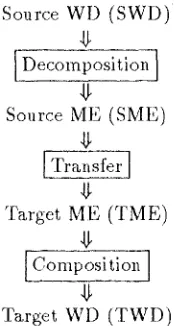
Figure 1: Flow of Translaton
T h e matching expression (b) consists of two transla,tion units: el-e3, e13. And it has the information to combine them.
4
Tl'anslation
via Matching
Expression
Figure 1 shows the flow of the translation pro- . cess. The translation process consists of three steps: decomposition, transfer, and composi- tion. This process generates all candidates of translation using Prolog's backtrack mecha- nism.
4.1
D e c o m p o s i t i o n
In decomposition, the system decomposes a
source word-dependency tree(SWD) into trans- lation units, and makes a source matching ex- pression(SME). For example, [image:3.596.131.218.71.234.2]SWD = [[buy,v], [ [he,pron] ] , [ [book,n] ,
[ [ a , d e t ] ] ,
[[on,p],
[ [politics ,n],
[ [international, adj] ] ] ] ] ]
SME = [ e l , [ r , e a , [ e l 3 ] ] ]
The main tasks in this step are to retrieve translation units and compare the source WD with retrieved translation units. To retrieve translation units quickly, we use some hashing techniques. There are two program to do the comparison task; one for English WDs and one for Japanese WDs. In comparison of Japanese WDs, the order of subtrees is not inlportant.
To reduce the search space and the num- ber of candidates, we define replaceablity be- tween syntactic categories. If two nodes are replaceable, system makes only ~ replace- c o m m a n d . As a result, the the system does not make some matching expressions; e.g.
[el, [d,e3] , [a,el, [e13]]]
4.2
T r a n s f e r
in the transfer step, the system replaces every ID in the source matching expression with its corresponding ID. For example,
SME = [el,[r,eS,[el3]]] TME = [j1,[r,jS,[j15]]]
4.3
C o m p o s i t i o n
in the composition step, the system composes the target word-dependency tree according to the target matching expression. For example.
TME = [ j l , [ r , j 5 , [ j l S ] ] ]
TWD = [[kau,v], [ [ha,p] ,
[ [kare,pron] ] ] ,
[[wo,p],
[ [hon ,n] , [[ta, aux],
[ [tern, aux],
[ [kaku, v] , [ [nitsuite,p] ,
[ [kokusaiseiji,n] ] ] ] ] ] ] ] ] ~,~. Kate ha kokusaiseiji nitsuite ~,~, kakareta hon wo kau.
This step divides into two sub-steps; the main composing step and validity checking. In the main composing step, there is no ambi- guity with one exception. Because an add- c o m m a n d [a,<ID>,<ME>] specifies only the parent node(<ID>) to add the tree(<ME>), there are some choices in composing English word- dependency trees. In this step, all possibilities are generated.
Validity of the composed word-dependency trees are checked using syntactic categories. Validity is checked in every parent-children unit. For example, in the above target word- dependency tree,
[v, [p,p] ] , [p, [ p r o m ], [p, [n] ],
In, [aux] ]
. . . .
z"
/ 7t2 L
1 " / ~
l
I
I
,
\ 7/5 71,7 .2
. . ~ ._.___-- r e s t r i c t e d e n v i o r n m e n t ~ / " '~" \
' n l l / m 2 ( = n 2 ) ", m l o
/ m,8 2
/ ,-
d
Translation Gx~mple Source (or Target) WD
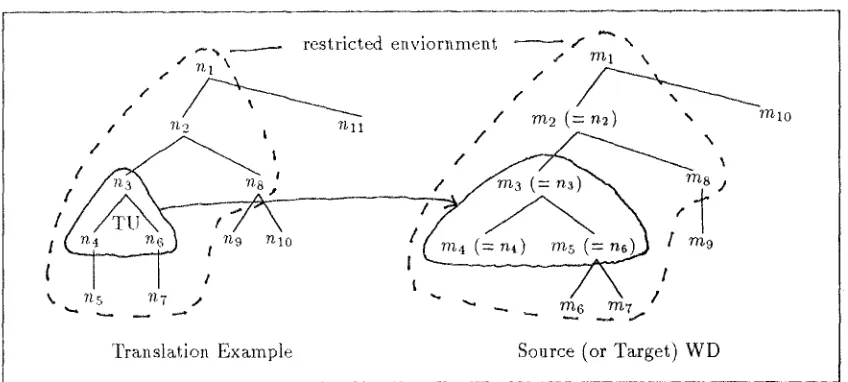
Figure 2: Restricted Environments of TU
5
S c o r e o f T r a n s l a t i o n
To select the best translation out of all can- didates generated by system, we introduce the score of a tra.nslM.ion. We define it based on the score of the matching expression, because the matching expression determines the translation outi)ut. The scores of.the source matching ex- pression and the target matching expression are calculated separately.
5.1 S c o r e o f T r a n s l a t i o n U n i t
First, we will define the score of a translation
unit. The score of a translation unit should
reflect the correctness of the translation unit. Which translation unit is better? Two main fac- t.ors are:
1. A larger translation unit is better.
2. A translation unit in a matching expression is a fragment of a source (or target) word- dependency tree, and also a fragment of a translation example. There are two envi- ronments of a translation unit; in a source (or target) tree and in a translation exam- ple. The more similar these two environ- meuts are, the better.
To calculate 1, we define the size of a trans- lation u n i t ( T U ).
size(TU)
= the number of nodes in TUTo calculate 2, we need a measure of simi- larity between two environments, i.e. external similarity. To estimate external similarity, we
introduce a unit called
restricted environment.
A restricted environment consists of the nodes one link outside of a TU normally. If corre- sponding nodes are same in two environments, those environments are extended one more link outside. Figure 2 illustrates restricted environ- ments of a TU. We estimate external similarity as the best matching of two restricted environ- ments. To find the best matching, we first deter- mine the correspondences between nodes in two restricted environments. Some nodes have sev- eral candidates of correspondence. For example, n7 corresponds with rn6 or m7. In this case, we select the most similar node. To do this, we assume t h a t similarity values between nodes (words) are defined as numeric values between 0 and 1 in a thesaurus. W h e n the best matching is found, we can calculate the matching point
between two environments,
mpoint(TU, WD).
m p o i n t ( T U , W D ) =
summation of similarity values between corre- sponding nodes in two restricted environments ~t the best matching
We use this value as a measure of similarity between two environments.
Finally, we define the score of a translation
unit,
seore(TU, WD).
score(TU, WD) =
size(TU) x (size(Tg) + mpoiut(TU, WD))
For example, we assume t h a t the following similarity vMues are defined in a thesaurus.
[image:4.596.88.512.63.254.2]s i m ( [ b o o k , n ] , [ n o t e b o o k , n ] , O . 8 ) . sire( [buy,v] , [read,v] ,0.5) . sire( [hon,n] , [nouto,n] ,0.8). s i m ( [ k a u , v ] , [ y o m u , v ] , O . 5 ) .
T h e n i.he scores of t r a n s l a t i o n units in the previous section are the followings.
j l - j 5 I[ '! [ 0.S
I J s___2_JLL
5.2 S c o r e o f M a t c h i n g E x p r e s s i o n ]?he score of a nlatching expression is defined as the following.
score.( .'tiE:. It'D) F~YUCME score(TU, WD)
s i z c ( W D ) 2
FOl; exaul ple,
[ j l , [ r , j S , [j15] ]
5 . 3 S c o r e o f T r a n s l a t i o n
Finally, we define the score of a t r a n s l a t i o n as
the following.
scur~:(SWD. S M E , T M E , T W D ) =
~,n i~( seo,'~( S M E . S WD), score( T ~ I E, T W D ) )
For example, the score of the t r a n s l a t i o n in
• the previous section is 0.6.I2.
6
E x a m p l e s
T h e English verb eat corresponds to two
J a p a n e s e verbs, tabcrv and okasu. For exam-
pie.
(4) The mall eats w.:getabtes.
Hito ha yasal wo taberu.
(5) Acid eats metal.
San ha kinzoku wo oka.qu.
Figure 3 shows t r a n s l a t i o n outl)uts based on e x a m p l e (,t) and (5) by M B T 2 . M B T 2 chooses
htberu for he cat.s t~ota, toes and okasu for sulfuric acid cals i r o n .
* * * T r & n s l a t i o n S o u r c e * * *
[image:5.596.90.242.155.224.2][ [ e a t , v] , [ the,pron] ] , [ [potato,n] ] ]
Y,Y, He eats p o t a t o e s . *** T r a n s l a t i o n R e s u l t s *** No. I (Score = 0.5889)
[ [taberu, v] ,
[ [ha,p],
[ [kare,pron] ] ] ,
[[wo,p],
[ [jagaimo,n] ] ] ]
No. 2 (Score = 0.4S56)
[ [okasu, v],
[ [ha, p],
[ [kare,pron] ] ] , [ [~o,p],
[[jagaimo,n]] ]]
*** T r a n s l a t i o n Source ***
[[eat,v] , [[acid,n] ,
[ [sulfuric,adj]] ] , [[iron,n]]]
%% S u l f u r i c acid eats iron. *** T r a n s l a t i o n R e s u l t s *** No. I (Score = 0.5500)
[ [okasu, v],
[ [ha, p] ,
[ [ryuusan,n] ] ] , [ [wo,p],
[ [ t e t s u , n ] ] ]]
No. 2 (Score = 0.4688)
[[taberu, v] ,
[ [ha, p],
[ [ryuusan,n]] ],
[[wo,p],
[[tetsu,n]] ]]
7
D i s c u s s i o n
Although M B T 2 is not a full realization of Na- gao's idea., it contains some merits from the orig- inal idea.
1. It is easy to modify the system.
The knowledge of the system is in the form of translation examl)les and thesauri. We can modify the system with addition of translation examples.
. It can do high quality translation.
The system sees as wide a scope as possible in a sentence and uses the largest transla- tion units. It produces high quality trans- lations.
. It can translate some metaphorical sen- tences.
In the system, semantic information is not used as constraints. As a result, the system can translate some metaphorical sentences.
Demerits or problems of the system are:
1. A great deal of computation is needed.
2. Can we make good thesauri?
The first l)roblem is not serious. Parallel compu- tation or some heuristics will overcome it. But the second problem is serious. We have to study how to construct large thesauri.
a c k n o w l e g m e n t s
The authors would like to thank Mort Webster for his proof reading.
R e f e r e n c e s
[Nagao 84] Makoto Nagao, A Framework of a Mechanical Translation between Japanese and English by Analogy Principle, in ARTI- FICIAL AND t I U M A N I N T E L M G E N C E (A. Elithorn and R. Banerji, editors), El- sevier Science Publishers, B.V, 198.t. [Sadler 89a] Victor Sadler, The Bilingual
Knowledge B a n k ( B K B ) , B S O / R e s e a r c h , 1989.
[Sadler 89b] Victor Sadler, Translating with a simulated Bilingual Knowledge Bank{ BKB), B S O / R e s e a r c h , 1989.
[Sato 89] Satoshi Sa.to and Makoto Nagao, Memory-based Translation, I P S J - W G , NL- 70-9, 1989. (in Japanese)
[Sumita 88] E. Sumita and Y. T s u t s u m i , A Translation Aid System Using Flexible Text Retrieval Based on Syntax-Matching, T R L Research Report, TR-87-1019, Tokyo Re- search Laboratory, IBM, 1988.
8
C o n c l u s i o n
This paper describes how to combine some translation units in order to translate one sen- tence and how to select tile best translation out of some candidates generated by system. To represent the combination of fragments, we in- troduce the representation called matching ex- pression. To select the best translation, we de- fine the score of translation based on the score of the matching expression.
This framework can be applied to not only the translation between word-dependency trees but also the translation between other d a t a struc- tures. We hope that generation can be imple- mented in same framework as the translation from a word-dependency tree to a list or string.