Transductive Pattern Learning for Information Extraction
Brian McLernon
Nicholas Kushmerick
School of Computer Science and Informatics
University College Dublin, Ireland
{
brian.mclernon,nick
}
@ucd.ie
Abstract
The requirement for large labelled training corpora is widely recognized as a key bot-tleneck in the use of learning algorithms for information extraction. We present TPLEX, a semi-supervised learning algorithm for in-formation extraction that can acquire extrac-tion patterns from a small amount of labelled text in conjunction with a large amount of un-labelled text. Compared to previous work, TPLEX has two novel features. First, the al-gorithm does not require redundancy in the fragments to be extracted, but only redundancy of the extraction patterns themselves. Second, most bootstrapping methods identify the high-est quality fragments in the unlabelled data and then assume that they are as reliable as man-ually labelled data in subsequent iterations. In contrast, TPLEX’s scoring mechanism pre-vents errors from snowballing by recording the reliability of fragments extracted from un-labelled data. Our experiments with several benchmarks demonstrate that TPLEX is usu-ally competitive with various fully-supervised algorithms when very little labelled training data is available.
1
Introduction
Information extraction is a form of shallow text anal-ysis that involves identifying domain-specific frag-ments within natural language text. Most recent re-search has focused on learning algorithms that auto-matically acquire extraction patterns from manually labelled training data (e.g., (Riloff, 1993; Califf and Mooney, 1999; Soderland, 1999; Freitag and Kushm-erick, 2000; Ciravegna, 2001; Finn and KushmKushm-erick, 2004)). This training data takes the form of the original text, annotated with the fragments to be extracted.
Due to the expense and tedious nature of this la-belling process, it is widely recognized that a key bot-tleneck in deploying such algorithms is the need to cre-ate a sufficiently large training corpus for each new do-main. In response to this challenge, many researchers have investigated semi-supervised learning algorithms that learn from a (relatively small) set of labelled texts
in conjunction with a (relatively large) set of unlabelled texts (e.g., (Riloff, 1996; Brin, 1998; Yangarber et al., 2002)).
In this paper, we present TPLEX, a semi-supervised algorithm for learning information extraction patterns. The key idea is to exploit the following recursive defini-tions: good patterns extract good fragments, and good fragments are extracted by good patterns. To opera-tionalize this recursive definition, we initialize the pat-tern and fragment scores with labelled data, and then iterate until the scores have converged.
Most prior semi-supervised approaches to informa-tion extracinforma-tion assume that fragments are essentially named entities, so that there will be many occurrences of any given fragment. For example, for the task of discovering diseases (“influenza”, “Ebola”, etc), prior algorithms assume that each disease will be mentioned many times, and that every occurrence of such a dis-ease in unlabelled text should be extracted. However, it may not be the case that fragments to be extracted occur more than once in the corpus, or that every oc-currence of a labelled fragment should be extracted. For example, in the well-known CMU Seminars cor-pus, any given person usually gives just one seminar, and a fragment such as “3pm” sometimes indicates the start time, other occurrences indicate the end time, and some occurrence should not be extracted at all. Rather than relying on redundancy of the fragments, TPLEX exploits redundancy of the learned extraction patterns.
TPLEXis a transductive algorithm (Vapnik, 1998), in that the goal is to perform extraction from a given un-labelled corpus, given a un-labelled corpus. This is in con-trast to the typical machine learning framework, where the goal is a set of extraction patterns (which can of course then be applied to new unlabelled text). As a side-effect, TPLEX does generate a set of extraction patterns which may be a useful in their own right, de-pending on the application.
al-gorithms (Sec. 4). We conclude with a summary of ob-servations made during the evaluation, and a discussion of future work (Sec. 5).
2
Related work
A review of machine learning for information extrac-tion is beyond the scope of this paper; see e.g. (Cardie, 1997; Kushmerick and Thomas, 2003).
A number of researchers have previously developed bootstrapping or semi-supervised approaches to infor-mation extraction, named entity recognition, and re-lated tasks (Riloff, 1996; Brin, 1998; Riloff and Jones, 1999; Agichtein et al., 2001; Yangarber et al., 2002; Stevenson and Greenwood, 2005; Etzioni et al., 2005). Several approaches for learning from both labeled and unlabeled data have been proposed (Yarowsky, 1995; Blum and Mitchell, 1998; Collins and Singer, 1999) where the unlabeled data is utilised to boost the performance of the algorithm. In (Collins and Singer, 1999) Collins and Singer show that unlabeled data can be used to reduce the level of supervision required for named entity classification. However, their approach is reliant on the presence of redundancy in the named entities to be identified.
TPLEXis most closely related to the NOMEN algo-rithm (Yangarber et al., 2002). NOMENhas a very sim-ple iterative structure: at each step, a very small num-ber of high-quality new fragments are extracted, which are treated in the next step as equivalent to seeds from the labeled documents. NOMENhas a number of pa-rameters which must be carefully tuned to ensure that it does not over-generalise. Erroneous additions to the set of trusted fragments can lead to a snowballing of errors.
Also, NOMEN uses a binary scoring mechanism, which works well in dense corpora with substantial re-dundancy. However, many information extraction tasks feature sparse corpora with little or no redundancy. We have extended NOMEN by allowing it to make finer-grained (as opposed to binary) scoring decisions at each iteration. Instead of definitively assigning a position to a given field, we calculate the likelihood that it belongs to the field over multiple iterations.
3
The T
PLEXalgorithm
The goal of the algorithm is to identify the members of the target fields within unlabelled texts by generaliz-ing from seed examples in labelled traingeneraliz-ing texts. We achieve this by generalizing boundary detecting pat-terns and scoring them with a recursive scoring func-tion.
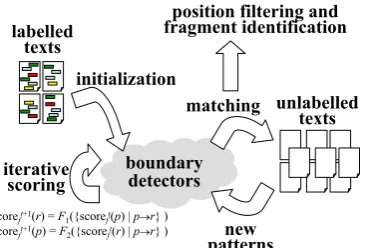
As shown in Fig. 1, TPLEXbootstraps the learning process from a seed set of labelled examples. The ex-amples are used to populate initial pattern sets for each target field, with patterns that match the start and end positions of the seed fragments. Each pattern is then generalised to produce more patterns, which are in turn
VFRUH
^VFRUH _o` VFRUH
^VFRUH _o`
Figure 1: An overview of TPLEX. A key idea of the al-gorithm is the following recursive scoring method: pat-tern scores are a function of the scores of the positions they extract, and position scores are a function of the scores of the patterns that extract them.
applied to the corpus in order to identify more base pat-terns. This process iterates until no more patterns can be learned.
TPLEXemploys a recursive scoring metric in which good patterns reinforce good positions, and good posi-tions reinforce good patterns. Specifically, we calculate confidence scores for positions and patterns. Our scor-ing mechanism calculates the score of a pattern as a function of the scores of the positions that it matches, and the score of a position as a function of the scores of the patterns that extract it.
TPLEXis a multi-field extraction algorithm in that it extracts multiple fields simultaneously. By doing this, information learned for one field can be used to con-strain patterns learned for others. Specifically, our scor-ing mechanism ensures that if a pattern scores highly for one field, its score for all other fields is reduced.
In the remainder of this section, we describe the al-gorithm by formalizing the space of learned patterns, and then describing TPLEX’s scoring mechanism. 3.1 Boundary detection patterns
TPLEXextracts fragments of text by identifying prob-able fragment start and end positions, which are then assembled into complete fragments. TPLEX’s patterns are therefore boundary detectors which identify one end of a fragment or the other. TPLEXlearns patterns to identify the start and end of target occurrences inde-pendently of each other. This strategy has previously been employed successfully (Freitag and Kushmerick, 2000; Ciravegna, 2001; Yangarber et al., 2002; Finn and Kushmerick, 2004).
[will be <punc>][<caps> <fname>]
would correctly find the start of a name in an utterance such as “will be: Dr Robert Boyle” and “will be, San-dra Frederick”, but it will fail to identify the start of the name in “will be Dr. Robert Boyle”. The boundary de-tectors that find the beginnings of fragments are called the pre-patterns, and the detectors that find the ends of fragments are called the post-patterns.
3.2 Pattern generation
As input, TPLEXrequires a set of tagged seed docu-ments for training, and an untagged corpus for learn-ing. The seed documents are used to initialize the pre-pattern and post-pattern sets for each of the target fields. Within the seed documents each occurrence of a fragment belonging to any of the target categories is surrounded by a set of special tags that denote the field to which it belongs.
The algorithm parses the seed documents and iden-tifies the tagged fragments in each document. It then generates patterns for the start and end positions of each fragment based on the surrounding tokens.
Each pattern varies in length from 2 tontokens. For a given pattern length `, the patterns can then over-lap the position by zero to ` tokens. For example, a pre-pattern of length four with an overlap of one will match the three tokens immediately preceeding the start position of a fragment, and the one token immedi-ately following that position. In this way, we generate Pn
i=2(i+ 1)patterns from each seed position. In our experiments, we set the maximum pattern length to be
n= 4.
TPLEXthen grows these initial sets for each field by generalizing the initial patterns generated for each seed position. We employ eight different generalization to-kens when generalizing the literal toto-kens of the initial patterns. The wildcard token<*> matches every lit-eral. The second type of generalization is <punc>, which matches punctuation such as commas and peri-ods. Similarly, the token<caps>matches literals with an initial capital letter,<num>matches a sequence of digits, <alpha num>matches a literal consisting of letters followed by digits, and<num alpha>matches a literal consisting of digits followed by letters. The fi-nal two generalisations are<fname>and<lname>, which match literals that appear in a list of first and last names (respectively) taken from US Census data.
All patterns are then applied to the entire corpus, in-cluding the seed documents. When a pattern matches a new position, the tokens at that position are converted into a maximally-specialized pattern, which is added to the pattern set. Patterns are repeatedly generalized un-til only one literal token remains. This whole process iterates until no new patterns are discovered. We do not generalize the new maximally-specialized patterns discovered in the unlabelled data. This ensures that all patterns are closely related to the seed data. (We exper-imented with generalizing patterns from the unlabelled
data, but this rapidly leads to overgeneralization.) The locations in the corpus where the patterns match are regarded as potential target positions. Pre-patterns indicate potential start positions for target fragments while post-patterns indicate end positions. When all of the patterns have been matched against the corpus, each field will have a corresponding set of potential start and end positions.
3.3 Notation & problem statement
Positions are denoted byr, and patterns are denoted by p. Formally, a pattern is equivalent to the set of positions that it extracts.The notationp→rindicates that patternpmatches positionr. Fields are denoted by
f, andFis the set of all fields.
The labelled training data consists of a set of po-sitions R = {. . . , r, . . .}, and a labelling function
T :R →F∪ {X}for each such position. T(r) =f
indicates that positionris labelled with fieldf in the training data. T(r) = X means thatris not labelled in the training data (i.e.ris a negative example for all fields).
The unlabelled test data consists of an additional set of positionsU.
Given this notation, the learning task can be stated concisely as follows: extend the domain of T to U, i.e. generalize fromT(r)forr∈R, toT(r)forr∈U. 3.4 Pattern and position scoring
When the patterns and positions for the fields have been identified we must score them. Below we will de-scribe in detail the recursive manner in which we define
scoref(r)in terms ofscoref(p), and vice versa. Given
that definition, we want to find fixed-point values for
scoref(p)andscoref(r). To achieve this, we initialize
the scores, and then iterate through the scoring process (i.e. calculate scores at stept+ 1from scores at stept). This process repeats until convergence.
Initialization. As the scores of the patterns and posi-tions of a field are recursively dependant, we must as-sign initial scores to one or the other. Initially the only elements that we can classify with certainty are the seed fragments. We initialise the scoring function by assign-ing scores to the positions for each of the fields. In this way it is then possible to score the patterns based on these initial scores.
From the labelled training data, we derive the prior probabilityπ(f)that a randomly selected position be-longs to fieldf ∈F:
π(f) =|{r∈R|T(r) =f}|/|R|.
Note that1 −P
fπ(f)is simply the prior
probabil-ity that a randomly selected position should not be ex-tracted at all; typically this value is close to 1.
posi-tionrin fieldf:
The first case handles positions in the unlabelled docu-ments; at this point we don’t know anything about them and so fall back to the prior probabilities. The second and third cases handle positions in the seed documents, for which we have complete information.
Iteration. After initializing the scores of the posi-tions, we begin the iterative process of scoring the patterns and the positions. To compute the score of a pattern p for field f we compute a positive score,
posf(p); a negative score, negf(p); and an unknown
score,unk(p).posf(p)can be thought of as a measure
of the benefit of ptof, whilenegf(p)measures the
harm ofptof, andunk(p)measures the uncertainty about the field with whichpis associated.
These quantities are defined as follows: posf(p)is
the average score for fieldf of positions extracted by
p. We first compute:
posf(p) =
constant to ensure thatP
fposf(p) = 1.
For each fieldf and patternp,negf(p)is the extent
to whichpextracts positions whose field is notf:
negf(p) = 1−posf(p).
Finally,unk(p)measures the degree to whichp ex-tract positions whose field is unknown:
unk(p) = 1 |{p→r}|
X
p→r
unk(r),
whereunk(r)measures the degree to which positionr
is unknown. To be completely ignorant of a position’s field is to fall back on the prior field probabilitiesπ(f). Therefore, we calculateunk(r)by computing the sum of squared differences betweenscoret
f(r)andπ(f):
The normalization constantZensures thatunk(r) = 0
for the positionrwhose scores are the most different from the priors—ie,ris the “least unknown” position.
For each fieldf and patternp,scoret
f(p)is defined
This definition penalizes patterns that are either in-accurate or have low coverage.
Finally, we complete the iterative step by calculating a revised score for each position:
scoret+1
scores to ensure that the scores of unlabelled positions never exceed the scores of labelled positions. The first case in the function for scoretf+1(r) handles positive
and negative seeds (i.e. positions in labelled texts), the second case is for unlabelled positions.
We iterate this procedure until the scores of the pat-terns and positions converge. Specifically, we stop when
3.5 Position filtering & fragment identification
Due to the nature of the pattern generation strategy, many more candidate positions will be identified than there are targets in the corpus. Before we can proceed with matching start and end positions to form frag-ments, we filter the positions to remove the weaker can-didates.
We rank all of positions for each field according to their score. We then select positions with a score above a threshold β as potential positions. In this way we reduce the number of candidate positions from tens of thousands to a few hundred.
The next step in the process is to identify complete fragments within the corpus by matching pre-positions with post-positions. To do this we compute the length probabilities for the fragments of fieldf based on the lengths of the seed fragments off. Suppose that posi-tionr1has been identified as a possible start for fieldf, and positionr2has been identified as a possible fieldf end, and letPf(`)be the fraction of fieldf seed
frag-ments with length`. Then the fragmente= (r1, r2)is assigned a score
scoref(e) = scoref(r1)·scoref(r2)·Pf(r2−r1+ 1).
Despite these measures, overlapping fragments still occur. Since the correct fragments can not overlap, we know that if two extracted fragments overlap, at least one must be wrong. We resolve overlapping fragments by calculating the set of non-overlapping fragments that maximises the total score while also accounting for the expected rate of occurrence of fragments from each field in a given document.
fragments. Letscore(G)be the chance thatGis the correct set of fragments forD. Assuming that the cor-rectness of the fragments can be determined indepen-dentlygiventhat the correct number of fragments have been identified for each field, thenscore(G)can be de-fined zero if∃(r1, r1),(s2, r2)∈ Gsuch that(s1, r1) overlaps(s2, r2), andscore(G) =Qfscore(Gf)
oth-erwise, where Gf ⊆ G is the fragments in G for
fieldf. The score ofGf ={e1, e2, . . .}is defined as
score(Gf) = Pr(|Gf|)·Qjscore(e
j), wherePr(|G f|)
is the fraction of training documents that have|Gf|
in-stances of fieldf.
It is infeasible to enumerate all subsetsG ⊆E, so we perform a heuristic search. The states in the search space are pairs of the form(G, P), whereGis a list of good fragments (i.e. fragments that have been ac-cepted), andP is a list ofpendingfragments (i.e. frag-ments that haven’t yet been accepted or rejected).
The search starts in the state({}, E), and states of the form(G,{})are terminal states. The children of state (G, P) are all ways to move a single fragment fromP toG. When forming a child’s pending set, the moved fragment along with all fragments that it over-laps are removed (meaning that the moved fragment is selected and all fragments with which it overlaps are rejected). More precisely, the children of state(G, P)
are:
(G0, P0)
e∈P∧G0=G∪{e} ∧
P0={e0∈P|e0doesn0t overlape}
.
The search proceeds as follows. We maintain a set
S of the bestK non-terminal states that are to be ex-panded, and the best terminal stateB encountered so far. Initially,Scontains just the initial state. Then, the children of each state inS are generated. If there are no such children, the search halts andBis returned as the best set of fragments. Otherwise,B is updated if appropriate, andSis set to the bestKof the new chil-dren. Note thatK =∞corresponds to an exhaustive search. In our experiments, we usedK= 5.
4
Experiments
To evaluate the performance of our algorithm we con-ducted experiments with four widely used corpora: the CMU seminar set, the Austin jobs set, the Reuters acquisition set [www.isi.edu/info-agents/RISE], and the MUC-7 named entity corpus[www.ldc.upenn.edu].
We randomly partitioned each of the datasets into two evenly sized subsets. We then used these as la-beled and unlala-beled sets. In each experiment the al-gorithm was presented with a document set comprised of the test set and a randomly selected percentage of the documents from the training set. For example, if an experiment involved providing the algorithm with a 5% seed set, then 5% of the documents in the training set (2.5% of the documents in the entire dataset) would be selected at random and used in conjunction with the documents in the test set.
For each training set size, we ran five iterations with a randomly selected subset of the documents used for training. Since we are mainly motivated by scenarios with very little training data, we varied the size of the training set from 1–10% (1–16% for MUC-7NE) of the available documents. Precision, recall and F1 were cal-culated using the BWI (Freitag and Kushmerick, 2000) scorer. We usedall occurrencesmode, which records a match in the case where we extract all of the valid fragments in a given document, but we get no credit for partially correct extractions.
We compared TPLEX to BWI (Freitag and Kushmerick, 2000), LP2 (Ciravegna, 2001), ELIE (Finn and Kushmerick, 2004), and an approach based on conditional random fields (Lafferty et al., 2001). The data for BWI was obtained using the TIES implementation [tcc.itc.it/research/textec/tools-resources/ties.html]. The data for the LP2learning curve was obtained from (Ciravegna, 2003). The results for ELIE were generated by the current implementation
[http://smi.ucd.ie/aidan/Software.html]. For the CRF re-sults, we used MALLET’s SimpleTagger (McCallum, 2002), with each token encoded with a set of binary features (one for each observed literal, as well as the eight token generalizations).
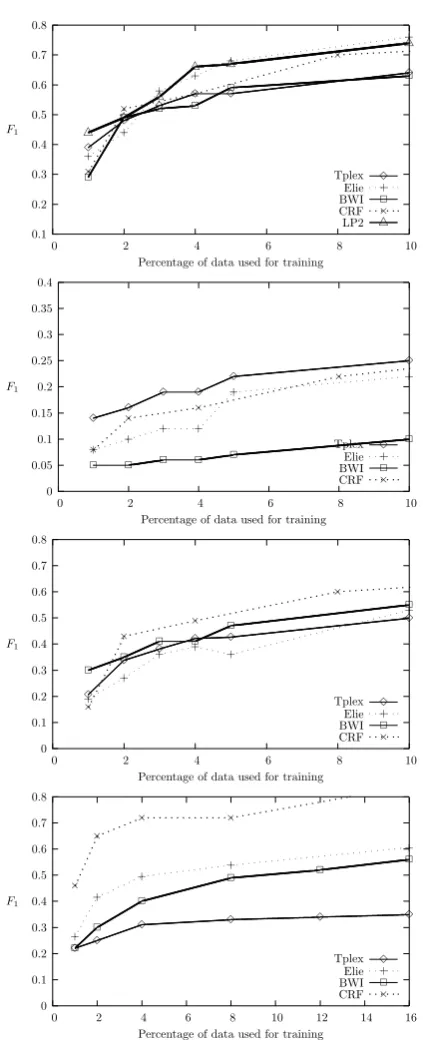
Our results in Fig. 2 indicate that in Acquisitions dataset, our algorithm substantially outperforms the competitors at all points on the learning curve. For the other datasets, the results are mixed. For SA and Jobs, TPLEXis the second best algorithm at the low end of the learning curve, and steadily loses ground as more labelled data is available. TPLEXis the least accurate algorithm for the MUC data. In Sec. 5, we discuss a variety of modifications to the TPLEX algorithm that we anticipate may improve its performance.
Finally, the graph in Fig. 3 compares TPLEXfor the SA dataset, in two configurations: with a combination of labelled and unlabelled documents as usual, and with only labelled documents. In both instances the algo-rithm was given the same seed and testing documents. In the first case the algorithm learned patterns using both the labeled and unlabeled documents. However, in the second case, only the labeled documents were used to generate the patterns. These data confirm that TPLEXis indeed able to improve performance from un-labelled data.
5
Discussion
0.1
Percentage of data used for training Tplex
Percentage of data used for training Tplex
Percentage of data used for training Tplex
Percentage of data used for training Tplex
Figure 2: F1 averaged across all fields, for the Seminar (top), Acquisitions (second), Jobs (third) and MUC-NE (bottom) corpora.
Conclusions. From our experiments we have ob-served that our algorithm is particularly competitive in scenarios where very little labelled training data is available. We contend that this is a result of our algo-rithm’s ability to use the unlabelled test data to validate the patterns learned from the training data.
We have also observed that the number of fields that are being extracted in the given domain affects the per-formance of our algorithm. TPLEXextracts all fields simultaneously and uses the scores from each of the
0
Percentage of data used for training Trained with unlabeled data
3
3 3
3 3 3
3
Trained with only labeled data
+ +
+
+ +
+
+
Figure 3: F1 averaged across all fields, for the Semi-nar dataset trained on only labeled data and trained on labeled and unlabeled data
patterns that extract a given position to determine the most likely field for that position. With more fields in the problem domain there is potentially more infor-mation on each of the candidate positions to constrain these decisions.
Future work. We are currently extending TPLEXin several directions. First, position filtering is currently performed as a distinct post-processing step. It would be more elegant (and perhaps more effective) to incor-porate the filtering heuristics directly into the position scoring mechanism. Second, so far we have focused on a BWI-like pattern language, but we speculate that richer patterns permitting (for example) optional or re-ordered tokens may well deliver substantial increases in accuracy.
We are also exploring ideas for semi-supervised learning from the machine learning community. Specifically, probabilistic finite-state methods such hidden Markov models and conditional random fields have been shown to be competitive with more tradi-tional pattern-based approaches to information extrac-tion (Fuchun and McCallum, 2004), and these methods can exploit the Expectation Maximization algorithm to learn from a mixture of labelled and unlabelled data (Lafferty et al., 2004). It remains to be seen whether this approach would be effective for information ex-traction.
Another possibility is to explore semi-supervised ex-tensions to boosting (d’Alch´e Buc et al., 2002). Boost-ing is a highly effective ensemble learnBoost-ing technique, and BWI uses boosting to tune the weights of the learned patterns, so if we generalize boosting to han-dle unlabelled data, then the learned weights may well be more effective than those calculated by TPLEX.
References
E. Agichtein, L. Gravano, J. Pavel, V. Sokolova, and A. Voskoboynik. 2001. Snowball: A prototype sys-tem for extracting relations from large text collec-tions. InProc. Int. Conf. Management of Data. A. Blum and T. Mitchell. 1998. Combining
la-beled and unlala-beled data with co-training. InProc. 11th Annual Conference on Computational Learning Theory, pages 92–100.
S. Brin. 1998. Extracting patterns and relations from the World Wide Web. InWebDB Workshop at the Int. Conf. Extending Database Technology.
M. E. Califf and R. Mooney. 1999. Relational learning of pattern-match rules for information extraction. In Proc. American Nat. Conf. Artificial Intelligence.
C. Cardie. 1997. Empirical methods in information extraction. AI Magazine, 18(4).
F. Ciravegna. 2001. Adaptive information extraction from text by rule induction and generalisation. In Proc. Int. J. Conf. Artificial Intelligence.
F. Ciravegna. 2003. LP2: Rule induction for infor-mation extraction using linguistic constraints. Tech-nical report, Department of Computer Science, Uni-versity of Sheffield.
M. Collins and Y. Singer. 1999. Unsupervised mod-els for named entity classification. In Proc. joint SIGDAT Conference on Empirical Methods in Nat-ural Language Processing and Very Large Corpora, pages 100–110.
F. d’Alch´e Buc, Y. Grandvalet, and C. Ambroise. 2002. Semi-supervised MarginBoost. InProc. Neural In-formation Processing Systems.
O. Etzioni, M. Cafarella, D. Downey, A. Popescu, T. Shaked, S. Soderland, D. Weld, and A. Yates. 2005. Unsupervised named-entity extraction from the Web: An experimental study. Artificial Intelli-gence. In press.
A. Finn and N. Kushmerick. 2004. Multi-level bound-ary classification for information extraction. In Proc. European Conf. Machine Learning.
D. Freitag and N . Kushmerick. 2000. Boosted wrap-per induction. InProc. American Nat. Conf. Artifi-cial Intelligence.
P. Fuchun and A. McCallum. 2004. Accurate infor-mation extraction from research papers using con-ditional random fields. InProc. Human Language Technology Conf.
N. Kushmerick and B. Thomas. 2003. Adaptive in-formation extraction: Core technologies for infor-mation agents. Lecture Notes in Computer Science, 2586.
J. Lafferty, A. McCallum, and F. Pereira. 2001. Con-ditional random fields: Probabilistic models for seg-menting and labeling sequence data. InProc. Int. Conf. Machine Learning.
J. Lafferty, X. Zhu, and Y. Liu. 2004. Kernel con-ditional random fields: Representation, clique se-lection, and semi-supervised learning. InProc. Int. Conf. Machine Learning.
A. McCallum. 2002. Mallet: A machine learning for language toolkit. http://mallet.cs.umass.edu. E. Riloff and R. Jones. 1999. Learning dictionaries for
information extraction by multi-level bootstrapping. InProc. American Nat. Conf. Artificial Intelligence. E. Riloff. 1993. Automatically constructing a dictio-nary for information extraction tasks. InProc. Amer-ican Nat. Conf. Artificial Intelligence.
E. Riloff. 1996. Automatically generating extraction patterns from untagged text. InProc. American Nat. Conf. Artificial Intelligence.
S. Soderland. 1999. Learning information extraction rules for semi-structured and free text. Machine Learning, 34(1-3):233–272.
M. Stevenson and M. Greenwood. 2005. Automatic learning of information extraction patterns. InProc. 19th Int. J. Conf. on Artificial Intelligence.
V. Vapnik. 1998. Statistical learning theory. Wiley. R. Yangarber, W. Lin, and R. Grishman. 2002.
Unsu-pervised learning of generalised names. InProc. Int. Conf. Computational Linguistics.