Phrase-based Parallel Fragments Extraction from Comparable Corpora
Xiaoyin Fu, Wei Wei, Shixiang Lu, Zhenbiao Chen and Bo Xu
Interactive Digital Media Technology Research Center, Institute of Automation, Chinese Academy of Sciences, Beijing, China
{xiaoyin.fu,wei.wei,shixiang.lu,zhenbiao.chen,xubo}@ia.ac.cn
Abstract
We present a phrase-based method to ex-tract parallel fragments from the compa-rable corpora. We do this by introducing a force decoder based on the hierarchical phrase-based (HPB) translation model to detect the alignments in comparable sen-tence pairs. This method enables us to ex-tract useful training data for statistical ma-chine translation (SMT) system. We eval-uate our method by fragment detection and large-scale translation tasks, which show that our method can effectively extract par-allel fragments and improve the perfor-mance of the state-of-the-art SMT system.
1 Introduction
Parallel corpora are valuable resources for train-ing a statistical translation system. In most cases, it has been an effective way to build state-of-the-art statistical models using a large scale of paral-lel corpora. However, the paralparal-lel corpora only exist in particular domains for a few number of language pairs, such as international conference recordings and legal texts. Since comparable cor-pora exist in large quantities with many languages, and the exploitation in them for extracting parallel data can be very useful for SMT system, the ac-quisition of parallel data from comparable corpora has caught much attention.
Various methods (Zhao and Vogel, 2002; Munteanu and Marcu, 2005; Abdul-Rauf and Schwenk, 2009; Smith et al., 2010) have been previously proposed to extract parallel data from comparable corpora at the sentence level. These methods share the same framework, which firstly identifies candidate document pairs and then ex-tracts parallel sentences from the obtained docu-ments. However, it is found that most of these sentences are comparable sentence pairs (Hong et
al., 2010), which embed non-parallel fragments or even lack translations. Consider the comparable sentence pair from Chinese to English in Figure 1. Methods for extracting parallel sentences will bring in noise when these bilingual sentences are retained. But discarding them is also not a wise choice, as there are still some useful parallel frag-ments as the underlines shown in the figure.
Figure 1: Example of comparable sentence pairs. The parallel fragments are marked by underlines.
In order to deal with this problem, further effort-s (Munteanu and Marcu, 2006; Quirk et al., 2007; Kumano et al., 2007; Lardilleux et al., 2012) were made to obtain parallel data at the fragment lev-el. The work of (Riesa and Marcu, 2012) detect-ed parallel fragments using the hierarchical align-ment model. However, this approach obtains frag-ments from parallel sentence pairs, which limits it-s application in comparable corpora. (Hewavitha-rana and Vogel, 2011) have explored several align-ment approaches to detect parallel fragalign-ments em-bedded in comparable sentences. However, these approaches extract fragments mainly using the lexical features and considering the words in par-allel fragments are independent, which make it d-ifficult to measure the alignments exactly.
In this paper, we present a phrase-based method, which considers both the lexical and phrasal features, to extract parallel fragments from comparable corpora. We introduce a force decoder based on the HPB translation model to detect par-allel fragments for each sentence pair. The re-sults show that our method can effectively extrac-t parallel fragmenextrac-ts from extrac-the comparable
ra and significantly improve the performance on Chinese-to-English translation tasks.
2 Parallel Fragments Extraction
2.1 HPB Translation Model
The HPB translation model (Chiang, 2005) has shown strong abilities in SMT for its capability in generalization. It is based on the weighted syn-chronous context-free grammar (SCFG). And the translation rule is represented as:
X→ hα, γ,∼i (1)
whereXis a non-terminal,αandγare source and target strings with terminals and non-terminals. ∼ describes a correspondence between the non-terminals inαandγ.
Two glue rules are added so that it prefers com-bining hierarchical phrases in a serial manner:
S→ hS1X2, S1X2i (2)
S → hX1, X1i (3)
2.2 Force Decoding based on HPB model
The force decoding can be seen as a bilingual pars-ing process that generates derivation trees from both sides of the sentence pair with an existing H-PB model.
Lete = eM1 andf= f1N be the source and tar-get sentences in comparable corpora. For each of the sentence pair e and f, the decoding process enumerates all of the possible bilingual derivation treesΦwith HPB rules from bottom to up. At each node in these derivation trees, the decoder gener-ates alignments by recursively combining phras-es generated from the current node’s children, and builds up larger and larger alignments. It should be noted that these nodes can be generated only if the alignments are exactly contained in both elements of the sentence pair. The derivation process works similarly to a CKY parser, moving bottom-up and generating larger constituents. However, the force decoder generates derivation trees for both of the bilingual sentences simultaneously and these trees do not have to span the entire sentences, especially in the non-parallel sentences, which is quite differ-ent with the CKY parser.
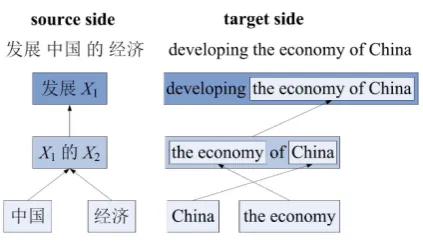
Still considering the comparable sentence pair in Figure1. Figure 2 gives an example of extract-ing one of the parallel fragments by force decod-ing with the followdecod-ing HPB rules:
X→ huÐX1, developingX1i
X→ hX1¥I, Chinai
X→ hX1²L, the economyi
X→ hX1 X2,X2ofX1i
Figure 2: Example of derivation trees in force decoding. To give better illustration, the non-terminal rules from parent nodes are combined with the rules from child nodes on the target side.
It can be seen that the bilingual derivation trees, which represent the source and target fragments, are generated simultaneously. At the first deriva-tion step, it is found that the Chinese words “¥ I” and “²L” from the source side can be trans-lated into English as “China” and “the economy”, which are exactly contained in the target sentence. Then we keep these words as the nodes in bilin-gual derivation trees, and continue to generate par-ent nodes by combining these child nodes bottom-up. The derivation process continues until there are no bilingual nodes that meet the words in both of bilingual sentences. At last, we will get the par-allel fragments “uÐ¥I ²L” and “devel-oping the economy of China” from the top of the derivation trees.
2.3 The Extension of HPB Rules
In our force decoding framework, there are some words that do not have translation rules, such as the out-of-vocabulary (OOV) words. This case could make up a large portion in the comparable corpora. To overcome this drawback, the HPB model has to be trained on a large scale of training data with a large vocabulary. Even so, there are still some of the words that may lack translations. We suppose these words can be translated into any of the sequential words in target sentences and add a special rule to our HPB model:
where i is the position of the word that do not have translation rules in source side,i0 andj0 are the start and end positions of the phrasal segment in target sentence. Here we restrict the length of the phrasal segment because larger segment tend to bring in noise in force decoding.
Moreover, in order to better evaluate the align-ments between the parallel fragalign-ments, we extend the original HPB rules inspired by the work of ( ˇCmejrek et al., 2009):
hX1, X1fi,hX1, f X1i,hX1e, X1i,
heX1, X1i
(5)
hX1X2, X2X1i (6)
in which rules (5) allow the HPB rules to insert and delete a single word, and rule (6) expands the stan-dard glue rules and enables the aligning phrasal segments swap their constituents.
2.4 The Verification of Parallel Fragments
For each bilingual sentence pair, we can generate various alignment derivation trees. The derivation trees from source side are isomorphic to the target side because of the characteristic of SCFG.
In order to better evaluate the alignment for the derivation trees, each HPB rule in force decoding is associated with a score that is computed via the following log linear formula:
w(X→ hα, γ,∼i) =Y
i
φi(f, e)λi (7)
whereφi(f, e) is a feature describing one partic-ular aspect of the rule associated with the source and target phrases(f, e), andλiis the correspond-ing weight of the feature. Following the stan-dard HPB model, features used in our force decod-ing are relative-frequency phrase translation prob-ability P(f|e) and its inverse P(e|f), lexically weighted phrase translation probability lex(f|e)
and its inverselex(e|f).
Moreover, we consider the score of the special rule is:
w(X→ hei, fi0,j0i) =ω×e−|j 0−i0|
(8)
in which,ωis the weight of the special rule. After generating the derivation trees, we recur-sively traverse these trees at each node top-down, and extract parallel fragments from both sides with the following constraints:
1) The node in the derivation tree has a score greater than a thresholdτ.
2) The node that represents the words from source side whose span is greater than 2.
The first constraint forces us to extract frag-ments with high alignment scores, as there are some alignment errors in HPB rules. And the second constraint makes us be more confident in the alignment scores over the larger fragments. The recursive traversal from derivation trees stops, once a fragment pair has been extracted.
For each sentence pair, different parallel frag-ments are extracted from derivation trees. Then we combine these fragments if there are overlaps in both source and target side. Otherwise, we keep these fragments as independent pairs.
3 Experiments
In our experiments, we compared our fragments extraction method with the PESA method ex-plored by (Hewavitharana and Vogel, 2011), which is based on the lexical features.
3.1 Data and Evaluation Setup
We used the parallel corpora fromLDC1to train
our HPB model in force decoding. The HPB mod-el was trained following (Chiang, 2007) with word alignment by running GIZA++ (Och and Ney, 2003). We downloaded comparable data from the online news sites: the BBC, and Xinhua News. The candidate sentence pairs (Raw) had been ex-tracted following the approach of (Munteanu and Marcu, 2005) as we only focused on the perfor-mance of parallel fragments extraction. The sizes of these corpora are listed in Table 1.
Data Sets #Sentences #Chinese #English
LDC 3.4M 64M 70M
Raw 2.6M 42M 49M
Table 1: Numbers of sentences and words for the parallel and comparable corpora.
We evaluated the quality of the extracted paral-lel fragments in two different ways:
Fragments Evaluation We obtained manual alignments for 600 sentence pairs and extracted parallel segments up to 10 words that are consis-tent with the annotated word alignment. We also removed the segments less than 3 words for the
1LDC2002E18, LDC2002T01, LDC2003E07,
constraint as described in Section 2. Then we test-ed the performance with the manual annotation.
Translation EvaluationWe evaluated the frag-ments on Chinese-to-English translation tasks. We used a HPB translation system with a 4-gram lan-guage model trained on about 4 billion words of English using SRI Language Toolkit (Stolcke, 2002). We tuned parameters of the SMT system using minimum error-rate training (Och, 2003) to maximize the BLEU-4 (Papineni et al., 2002) on NIST 2005, and evaluated on the standard test set-s, NIST 2006 and NIST 2008.
3.2 Experimental results
3.2.1 Performance on Fragments Extraction
We first compared the our method (HPB-FD) with PESA by fragments extraction. To give credit to our fragments extraction, we used partial matches to evaluate the performance of our extract method, following the way of (Hewavitharana and Vogel, 2011). The precision and recall were defined based on the tokens in the extracted target frag-ments that were also exists in the reference. And the F1 score was calculated in the standard way.
Exact P R F1
PESA 60.36 88.42 84.74 86.54 HPB-FD 74.12 94.36 88.90 91.55
Table 2: The results for fragments extraction with PESA and HPB-FD.
Table 2 gives the performance of PESA and our HPB-FD method. The results are presented as per-centages of: exact matches found (Exact), preci-sion (P), recall (R) and F1. It can be seen that our method can effectively extract parallel frag-ments from the comparable corpora. Comparing to PESA, our extraction method has higher scores in both Exact and F1 measure. This demonstrates that extracting fragments by our force decoding method can be more effectively to evaluate par-allel fragments in comparable corpora.
3.2.2 Performance on Machine Translation
We then evaluated the extracted parallel fragments with the HPB translation system. In the base-line system, translation model (LDC) was trained on the LDC corpora that had been cleaned and thought to be less noisy. In the contrast experi-ments, we trained three translation models. The first model (LDC+Raw) was trained on the LDC
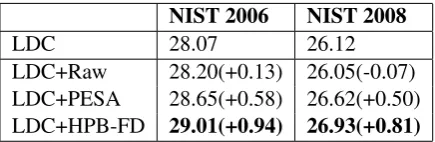
with the extracted comparable sentences. The sec-ond model (LDC+PESA) was trained on the LDC and fragments that were extracted by PESA. And the third (LDC+HPB-FD) was trained on LDC and fragments that were extracted by HPB-FD. Table 3 lists the BLEU scores obtained by different train-ing data.
NIST 2006 NIST 2008
LDC 28.07 26.12
LDC+Raw 28.20(+0.13) 26.05(-0.07) LDC+PESA 28.65(+0.58) 26.62(+0.50) LDC+HPB-FD 29.01(+0.94) 26.93(+0.81)
Table 3: The translation performance with differ-ent training data. BLEU score gains are significant withp <0.01.
Comparing to the baseline system, all the adding training data get stable improvements in translation performance except for the compara-ble sentences. It suggests that the simple incre-ment in training data does not always lead to bet-ter performance. The superiority of parallel cor-pora confirms that, the quality is more important than quantity in collecting training data. More-over, comparing to the parallel fragments extract-ed by PESA, our method get better translation re-sults in both translation tasks, which also suggest-s our method can effectively extract parallel frag-ments from comparable corpora for the SMT sys-tem.
4 Conclusions
Parallel data in the real world is increasing contin-ually. However, we cannot always get the trans-lation performance improved by simply enlarging our training data. The collection of parallel data is expensive, and to our best knowledge, there is not a unified method to detect parallel fragments automatically.
Acknowledgments
We thank the anonymous reviewers for their valu-able comments and suggestions. This work was supported by the National High Technology Re-search and Development Program (”863” Pro-gram) of China under Grant No.2011AA01A207 and also supported by the National Program on Key Basic Research Project (”973” Program) un-der Grant No.2013CB329302.
References
Sadaf Abdul-Rauf and Holger Schwenk. 2009. On the Use of Comparable Corpora to Improve SMT
per-formance. In Proceedings of the 12th Conference of
the European Chapter of the ACL, pages 16–23.
David Chiang. 2005. A Hierarchical Phrase-Based
Model for Statistical Machine Translation. In
Pro-ceedings of the 43rd Annual Meeting of the ACL, pages 263–270.
David Chiang. 2007. Hierarchical Phrase-based Trans-lation. Computational Linguistics, 33(2):201–228.
Martin ˇCmejrek, Bowen Zhou, Bing Xiang. 2009.
En-riching SCFG Rules Directly from Efficient
Bilin-gual Chart Parsing. In Proceedings of the
Interna-tional Workshop on Spoken language Transaltion, pages 136–143.
Sanjika Hewavitharana and Stephan Vogel. 2011. Ex-tracting parallel phrases from comparable data. In
Proceedings of the 4th Workshop on Building and Using Comparable Corpora: Comparable Corpora and the Web, pages 61–68.
Gumwon Hong, Chi-Ho Li, Ming Zhou and,
Hae-Chang Rim. 2010. An Empirical Study on
We-b Mining of Parallel Data. In Proceedings of the
23rd International Conference on Computational Linguistics, pages 474–482.
Tadashi Kumano, Hideki Tanaka and Takenobu
Toku-naga. 2007. Extracting Phrasal Alignments from
Comparable Corpora by Using Joint Probability
SMT Model. In Proceedings of the International
Conference on Theoretical and Methodological Is-sues in Machine Translation, pages 95–103.
Adrien Lardilleux, Franc¸ois Yvon and Yves Lepage. 2012. Hierarchical Sub-sentential Alignment with
Anymalign. In Proceedings of the 16th annual
meet-ing of the European Association for Machine Trans-lation, pages 279–286.
Dragos Stefan Munteanu and Daniel Marcu. 2006.
Extracting Parallel Sub-Sentential Fragments from Non-Parallel Corpora. In Proceedings of the 21st In-ternational Conference on Computational Linguis-tics and 44th Annual Meeting of the ACL, pages 81– 88.
Franz Josef Och. 2003. Minimum Error Rate Training
in Statistical Machine Translation. In Proceedings
of the 41st Annual Meeting of the ACL, pages 160– 167.
Franz Josef Och and Hermann Ney. 2003. A System-atic Comparison of Various Statistical Alignmen-t Models. Computational Linguistics, 29(1):19–51.
Kishore Papineni, Salim Roukos, Todd Ward and Wei-Jing Zhu. 2002. Bleu: a Method for Automatic E-valuation of Machine Translation. InProceedings of 40th Annual Meeting of the ACL, pages 311–318.
Chris Quirk, Raghavendra U. Udupa, and Arul Menezes. 2007. Generative Models of Noisy Trans-lations with Applications to Parallel Fragment Ex-traction. InProceedings of the Machine Translation Summit XI, pages 377–384.
Jason Riesa and Daniel Marcu. 2012. Automatic
Par-allel Fragment Extraction from Noisy Data. In
Pro-ceedings of the 2012 Conference of the North Amer-ican Chapter of the ACL: Human Language Tech-nologies, pages 538–542.
Jason R. Smith and Chris Quirk and Kristina Toutano-va. 2010. Extracting Parallel Sentences from Com-parable Corpora using Document Level Alignment. In Human Language Technologies: The 2010 Annu-al Conference of the North American Chapter of the
ACL, pages 403–411.
Dragos Stefan Munteanu and Daniel Marcu. 2005. Im-proving Machine Transaltion Performance by
Ex-ploiting Non-parallel Corpora. Computational
Lin-guistics, 31(4).
Andreas Stolcke. 2002. SRILM – An Extensible
Lan-guage Modeling Toolkit. InProceedings of
Interna-tional Conference on Spoken Language Processing, pages 901–904.