T ¨
uSBL: A Similarity-Based Chunk Parser
for Robust Syntactic Processing
Sandra K ¨ubler
Seminar f ¨ur SprachwissenschaftUniversity of T ¨ubingen Wilhelmstr. 113 D-72074 T ¨ubingen, Germany
[email protected]
Erhard W. Hinrichs
Seminar f ¨ur SprachwissenschaftUniversity of T ¨ubingen Wilhelmstr. 113 D-72074 T ¨ubingen, Germany
[email protected]
ABSTRACT
Chunk parsing has focused on the recognition of partial constituent structures at the level of individual chunks. Little attention has been paid to the question of how such partial analyses can be combined into larger structures for complete utterances.
The T¨uSBL parser extends current chunk parsing techniques by a tree-construction component that extends partial chunk parses to complete tree structures including recursive phrase structure as well as function-argument structure. T¨uSBL’s tree construction algo-rithm relies on techniques from memory-based learning that allow similarity-based classification of a given input structure relative to a pre-stored set of tree instances from a fully annotated treebank.
A quantitative evaluation of T¨uSBL has been conducted using a semi-automatically constructed treebank of German that consists of appr. 67,000 fully annotated sentences. The basic PARSEVAL measures were used although they were developed for parsers that have as their main goal a complete analysis that spans the entire in-put. This runs counter to the basic philosophy underlying T¨uSBL, which has as its main goal robustness of partially analyzed struc-tures.
Keywords
robust parsing, chunk parsing, similarity-based learning
1.
INTRODUCTION
Current research on natural language parsing tends to gravitate toward one of two extremes: robust, partial parsing with the goal of broad data coverage versus more traditional parsers that aim at complete analysis for a narrowly defined set of data. Chunk pars-ing [1, 2] offers a particularly promispars-ing and by now widely used example of the former kind. The main insight that underlies the chunk parsing strategy is to isolate the (finite-state) analysis of non-recursive, syntactic structure, i.e. chunks, from larger, recursive structures. This results in a highly-efficient parsing architecture that is realized as a cascade of finite-state transducers and that
pur-.
sues a longest-match, right-most pattern-matching strategy at each level of analysis.
Despite the popularity of the chunk parsing approach, there seem to be two apparent gaps in current research:
1. Chunk parsing research has focused on the recognition of partial constituent structures at the level of individual chunks. By comparison, little or no attention has been paid to the question of how such partial analyses can be combined into larger structures for complete utterances.
2. Relatively little has been reported on quantitative evaluations of chunk parsers that measure the correctness of the output structures obtained by a chunk parser.
The main goal of the present paper is help close those two re-search gaps.
2.
THE T ¨
USBL ARCHITECTURE
In order to ensure a robust and efficient architecture, T¨uSBL, a similarity-based chunk parser, is organized in a three-level archi-tecture, with the output of each level serving as input for the next higher level. The first level is part-of-speech (POS) tagging of the input string with the help of the bigram tagger LIKELY [10].1 The parts of speech serve as pre-terminal elements for the next step, i.e. the chunk analysis. Chunk parsing is carried out by an adapted version of Abney’s [2] scol parser, which is realized as a cascade of finite-state transducers. The chunks, which extend if possible to the simplex clause level, are then remodeled into complete trees in the tree construction level.
The tree construction is similar to the DOP approach [3, 4] in that it uses complete tree structures instead of rules. Contrary to Bod, we do not make use of probabilities and do not allow tree cuts, instead we only use the complete trees and minimal tree modifica-tions. Thus the number of possible combinations of partial trees is strictly controlled. The resulting parser is highly efficient (3770 English sentences took 106.5 seconds to parse on an Ultra Sparc 10).
3.
CHUNK PARSING AND TREE
CONSTRUC-TION
The division of labor between the chunking and tree construction modules can best be illustrated by an example.
1
0 1 2 3 4 5 6 7 8 9 10 11 12 13 500
501 502
503
504 505
506
507 508 509
510 511
512 513 514
515 516 517
dann ADV
w"urde VAFIN
ich PPER
vielleicht ADV
noch ADV
vorschlagen VVINF
Donnerstag NN
den ART
elften NN
und KON
Freitag NN
den ART
zw"olften ADJA
August NN
HD HD
HD
VXINF OV
HD HD
VXFIN HD
− HD
NX
HD APP
ADVX MOD
HD
NX ADVX ADVX
ON MOD MOD
HD ADJX
− − HD
NX
HD APP
NX
NX
− − −
NX OA
VF LK MF VC
NF SIMPX
[image:2.612.58.538.54.218.2]− − − − −
Figure 2: Sample tree construction output
Input:
dann w”urde ich vielleicht noch vorschlagen Donnerstag den elften und Freitag den zw”olften August
(then I would suggest maybe Thursday eleventh and Friday twelfth of August)
Chunk parser output:
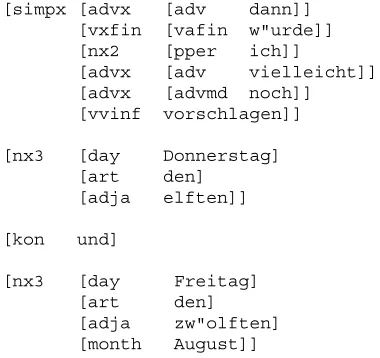
[simpx [advx [adv dann]]
[vxfin [vafin w"urde]]
[nx2 [pper ich]]
[advx [adv vielleicht]]
[advx [advmd noch]]
[vvinf vorschlagen]]
[nx3 [day Donnerstag]
[art den]
[adja elften]]
[kon und]
[nx3 [day Freitag]
[art den]
[adja zw"olften]
[image:2.612.53.243.340.519.2][month August]]
Figure 1: Chunk parser output
For complex sentences such as the German input dann w”urde
ich vielleicht noch vorschlagen Donnerstag den elften und Fre-itag den zw”olften August (then I would suggest maybe Thursday
eleventh and Friday twelfth of August), the chunker produces a structure in which some constituents remain unattached or partially annotated in keeping with the chunk-parsing strategy to factor out recursion and to resolve only unambigous attachments, as shown in Fig. 1.
In the case at hand, the subconstituents of the extraposed co-ordinated noun phrase are not attached to the simplex clause that ends with the non-finite verb that is typically in clause-final posi-tion in declarative main clauses of German. Moreover, each con-junct of the coordinated noun phrase forms a completely flat struc-ture. T¨uSBL’s tree construction module enriches the chunk output
as shown in Fig. 22. Here the internally recursive NP conjuncts have been coordinated and integrated correctly into the clause as a whole. In addition, function labels such as mod (for: modifier), hd (for: head), on (for: subject), oa (for: direct object), and ov (for: verbal object) have been added that encode the function-argument structure of the sentence.
4.
SIMILARITY-BASED TREE
CONSTRUC-TION
The tree construction algorithm is based on the machine learning paradigm of memory-based learning [12].3 Memory-based learn-ing assumes that the classification of a given input should be based on the similarity to previously seen instances of the same type that have been stored in memory. This paradigm is an instance of lazy
learning in the sense that these previously encountered instances
are stored “as is” and are crucially not abstracted over, as is typi-cally the case in rule-based systems or other learning approaches. Past applications of memory-based learning to NLP tasks consist of classification problems in which the set of classes to be learnt is simple in the sense that the class items do not have any internal structure and the number of distinct items is small.
The use of a memory-based approach for parsing implies that parsing needs to be redefined as a classification task. There are two fundamentally different, possible approaches: the one is to split parsing up into different subtasks, that is, one needs separate clas-sifiers for each functional category and for each level in a recur-sive structure. Since the classifiers for the functional categories as well as the individual decisions of the classifiers are independent, multiple or no candidates for a specific grammatical function or constituents with several possible functions may be found so that an additional classifier is needed for selecting the most appropriate assignment (cf. [6]).
The second approach, which we have chosen, is to regard the complete parse trees as classes so that the task is defined as the selection of the most similar tree from the instance base. Since in
2
All trees in this contribution follow the data format for trees de-fined by the NEGRA project of the Sonderforschungsbereich 378 at the University of the Saarland, Saarbr¨ucken. They were printed by the NEGRA annotation tool [5].
3
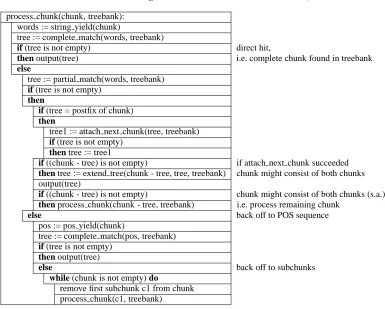
construct tree(chunk list, treebank):
while (chunk list is not empty) do
[image:3.612.53.438.115.424.2]remove first chunk from chunk list process chunk(chunk, treebank)
Figure 3: Pseudo-code for tree construction, main routine.
process chunk(chunk, treebank): words := string yield(chunk)
tree := complete match(words, treebank)
if (tree is not empty) direct hit,
then output(tree) i.e. complete chunk found in treebank
else
tree := partial match(words, treebank)
if (tree is not empty) then
if (tree = postfix of chunk) then
tree1 := attach next chunk(tree, treebank)
if (tree is not empty) then tree := tree1
if ((chunk - tree) is not empty) if attach next chunk succeeded
then tree := extend tree(chunk - tree, tree, treebank) chunk might consist of both chunks output(tree)
if ((chunk - tree) is not empty) chunk might consist of both chunks (s.a.)
then process chunk(chunk - tree, treebank) i.e. process remaining chunk
else back off to POS sequence
pos := pos yield(chunk)
tree := complete match(pos, treebank)
if (tree is not empty) then output(tree)
else back off to subchunks
while (chunk is not empty) do
remove first subchunk c1 from chunk process chunk(c1, treebank)
Figure 4: Pseudo-code for tree construction, subroutine process chunk.
this case, the internal structure of the item to be classified (i.e. the input sentence) and of the class item (i.e. the most similar tree in the instance base) need to be considered, the classification task is much more complex, and the standard memory-based approach needs to be adapted to the requirements of the parsing task.
The features T¨uSBL uses for classification are the sequence of words in the input sentence, their respective POS tags and (to a lesser degree) the labels in the chunk parse. Rather than choosing a bag-of-words approach, since word order is important for choosing the most similar tree, the algorithm needed to be modified in order to rely more on sequential information.
Another modification was necessitated by the need to generalize from the limited number of trees in the instance base. The classifi-cation is simple only in those cases where a direct hit is found, i.e. where a complete match of the input with a stored instance exists. In all other cases, the most similar tree from the instance base needs to be modified to match the chunked input.
If these strategies for matching complete trees fail, T¨uSBL at-tempts to match smaller subchunks in order to preserve the qual-ity of the annotations rather than attempt to pursue only complete parses.
The algorithm used for tree construction is presented in a slightly simplified form in Figs. 3-6. For readability’s sake, we assume here that chunks and complete trees share the same data structure
so that subroutines like string yield can operate on both of them indiscriminately.
The main routine construct tree in Fig. 3 separates the list of in-put chunks and passes each one to the subroutine process chunk in Fig. 4 where the chunk is then turned into one or more (partial) trees. process chunk first checks if a complete match with an in-stance from the inin-stance base is possible.4 If this is not the case, a partial match on the lexical level is attempted. If a partial tree is found, attach next chunk in Fig. 5 and extend tree in Fig. 6 are used to extend the tree by either attaching one more chunk or by re-sorting to a comparison of the missing parts of the chunk with tree extensions on the POS level. attach next chunk is necessary to en-sure that the best possible tree is found even in the rare case that the original segmentation into chunks contains mistakes. If no partial tree is found, the tree construction backs off to finding a complete match in the POS level or to starting the subroutine for processing a chunk recursively with all the subchunks of the present chunk.
The application of memory-based techniques is implemented in the two subroutines complete match and partial match. The pre-sentation of the two cases as two separate subroutines is for ex-pository purposes only. In the actual implementation, the search is carried out only once. The two subroutines exist because of
4
string yield returns the sequence of words included in the input
attach next chunk(tree, treebank): attempts to attach the next chunk to the tree take first chunk chunk2 from chunk list
words2 := string yield(tree, chunk2) tree2 := complete match(words2, treebank)
if (tree2 is not empty) then
remove chunk2 from chunk list return tree2
else return empty
Figure 5: Pseudo-code for tree construction, subroutine attach next chunk.
extend tree(rest chunk, tree, treebank): extends the tree on basis of POS comparison words := string yield(tree)
rest pos := pos yield(rest chunk)
tree2 := partial match(words + rest pos, treebank)
if ((tree2 is not empty) and (subtree(tree, tree2))) then return tree2
else return empty
Figure 6: Pseudo-code for tree construction, subroutine extend tree.
the postprocessing of the chosen tree which is necessary for par-tial matches and which also deviates from standard memory-based applications. Postprocessing mainly consists of shortening the tree from the instance base so that it covers only those parts of the chunk that could be matched. However, if the match is done on the lexical level, a correction of tagging errors is possible if there is enough ev-idence in the instance base. T¨uSBL currently uses an overlap
met-ric, the most basic metric for instances with symbolic features, as
its similarity metric. This overlap metric is based on either lexical or POS features. Instead of applying a more sophisticated metric like the weighted overlap metric, T¨uSBL uses a backing-off ap-proach that heavily favors similarity of the input with pre-stored instances on the basis of substring identity. Splitting up the classi-fication and adaptation process into different stages allows T¨uSBL to prefer analyses with a higher likelihood of being correct. This strategy enables corrections of tagging and segmentation errors that may occur in the chunked input.
4.1
Example
Input:
dann w”urde ich sagen ist das vereinbart
(then I would say this is arranged) Chunk parser output:
[simpx [advx [adv dann]]
[vxfin [vafin w"urde]]
[nx2 [pper ich]]
[vvinf sagen]]
[simpx [vafin ist]
[nx2 [pds das]]
[vvpp vereinbart]]
Figure 7: Chunk parser output
[image:4.612.333.537.296.350.2]For the input sentence dann w”urde ich sagen ist das vereinbart (then I would say this is arranged), the chunked output is shown in Fig. 7. The chunk parser correctly splits the input into two clauses
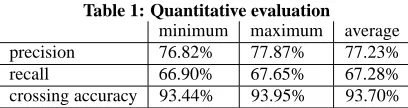
Table 1: Quantitative evaluation
minimum maximum average precision 76.82% 77.87% 77.23%
recall 66.90% 67.65% 67.28%
crossing accuracy 93.44% 93.95% 93.70%
dann w”urde ich sagen and ist das vereinbart. A look-up in the
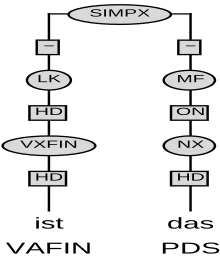
instance base finds a direct hit for the first clause. Therefore, the correct tree can be output directly. For the second clause, only a partial match on the level of words can be found. The system finds the tree for the subsequence of words ist das, as shown in Fig. 8. By backing off to a comparison on the POS level, it finds a tree for the sentence hatten die gesagt (they had said) with the same POS sequence and the same structure for the first two words. Thus the original tree that covers only two words is extended via the newly found tree. T¨uSBL’s output for the complete sentence is shown in Fig. 9.
5.
QUANTITATIVE EVALUATION
A quantitative evaluation of T¨uSBL has been conducted using a semi-automatically constructed treebank of German that consists of appr. 67,000 fully annotated sentences or sentence fragments.5
The evaluation consisted of a ten-fold cross-validation test, where the training data provide an instance base of already seen cases for T¨uSBL’s tree construction module.
The evaluation focused on three PARSEVAL measures: labeled precision, labeled recall and crossing accuracy, with the results shown in Table 1.
While these results do not reach the performance reported for other parsers (cf. [7], [8]), it is important to note that the task carried out here is more difficult in a number of respects:
1. The set of labels does not only include phrasal categories, but also functional labels marking grammatical relations such as subject, direct object, indirect object and modifier. Thus, the evaluation carried out here is not subject to the justified crit-icism levelled against the gold standards that are typically
5
0 1
500 501
502 503
504
ist
VAFIN
das
PDS
HD HD
VXFIN HD
NX ON
LK MF
SIMPX
[image:5.612.234.344.52.183.2]− −
Figure 8: A partial tree found be the system
0 1 2 3 4 5 6
500 501 502 503 504 505 506 507 508 510 509 511
513
514 515 516
dann
ADV
w"urde
VAFIN
ich
PPER
sagen
VVINF
ist
VAFIN
das
PDS
vereinbart
VVPP
HD HD HD HD HD HD
ADVX MOD
VXFIN HD
NX ON
VXFIN HD
VXINF OV
NX ON
VF LK MF VC
− − − −
SIMPX
HD VXINF
OV
LK MF VC
SIMPX
− − −
Figure 9: T ¨uSBL’s output for the complete sentence
in conjunction with the PARSEVAL measures, namely that the gold standards used typically do not include annotations of syntactic-semantic dependencies between bracketed con-stituents.
2. The German treebank consists of transliterated spontaneous speech data. The fragmentary and partially ill-formed na-ture of such spoken data makes them harder to analyze than written data such as the Penn treebank typically used as gold standard.
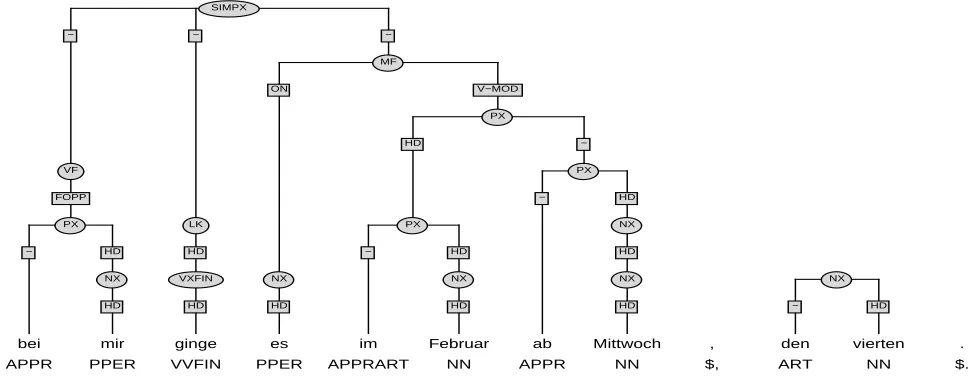
It should also be kept in mind that the basic PARSEVAL mea-sures were developed for parsers that have as their main goal a complete analysis that spans the entire input. This runs counter to the basic philosophy underlying an amended chunk parser such as T¨uSBL, which has as its main goal robustness of partially analyzed structures: Precision and recall measure the percentage of brackets, i.e. constituents with the same yield or bracketing scope, which are identical in the parse tree and the gold standard. If T¨uSBL finds only a partial grouping on one level, both measures consider this grouping wrong, as a consequence of the different bracket scopes. In most cases, the error ’percolates’ up to the highest level. Fig. 10 gives an example of a partially matched tree structure for the sentence “bei mir ginge es im Februar ab Mittwoch den vierten” (for me it would work in February after Wednesday the fourth). The only missing branch is the branch connecting the second noun phrase (NX) above “Mittwoch” to the NX “den vierten”. This re-sults in precision and recall values of 10 out of 15 because of the
altered bracketing scopes of the noun phrase, the two prepositional phrases (PX), the field level (MF) and the sentence level (SIMPX). In order to capture this specific aspect of the parser, a second evaluation was performed that focused on the quality of the struc-tures produced by the parser. This evaluation consisted of manually judging the T¨uSBL output and scoring the accuracy of the recog-nized constituents. The scoring was performed by the human an-notator who constructed the treebank and was thus in a privileged position to judge constituent accuracy with respect to the treebank annotation standards. This manual evaluation resulted in a score of 92.4% constituent accuracy; that is: of all constituents that were recognized by the parser, 92.4% were judged correct by the hu-man annotator. This seems to indicate that approximately 20% of the precision errors are due to partial constituents whose yield is shorter than in the corresponding gold standard. Such discrepan-cies typically arise when T¨uSBL outputs only partial trees. This occurs when no complete tree structures can be constructed that span the entire input.
6.
CONCLUSION AND FUTURE RESEARCH
In this paper we have described how the T¨uSBL parser extends current chunk parsing techniques by a tree-construction compo-nent that completes partial chunk parses to tree structures including function-argument structure. [image:5.612.152.442.220.383.2]0 1 2 3 4 5 6 7 8 9 10 11
500 501 502 503 504 505
506 507 508 509
510 511
512 513
514
bei APPR
mir PPER
ginge VVFIN
es PPER
im APPRART
Februar NN
ab APPR
Mittwoch NN
, $,
den ART
vierten NN
. $.
HD HD HD HD HD − HD
NX −
NX HD
VXFIN
HD −
NX HD
NX HD PX
FOPP −
NX HD
PX HD
PX −
NX ON
PX V−MOD
VF −
LK −
[image:6.612.52.540.54.249.2]MF − SIMPX
Figure 10: A partially grouped tree output of the T ¨USBL system
similarity metric. We anticipate that the results reported in Fig. 1 can be further improved by experimenting with more sophisticated similarity metrics. However, we will have to leave this matter to future research.6
7.
ACKNOWLEDGMENTS
The research reported here was funded both by the German Fed-eral Ministry of Education, Science, Research, and Technology (BMBF) in the framework of the VERBMOBIL Project under Grant 01 IV 101 N 0 and by the Deutsche Forschungsgemeinschaft (DFG) in the framework of the Sonderforschungsbereich 441.
8.
REFERENCES
[1] S. Abney. Parsing by chunks. In R. Berwick, S. Abney, and C. Tenney, editors, Principle-Based Parsing. Kluwer Academic Publishers, 1991.
[2] S. Abney. Partial parsing via finite-state cascades. In J. Carroll, editor, Workshop on Robust Parsing (ESSLLI ’96), 1996.
[3] R. Bod. Beyond Grammar: An Experience-Based Theory of
Language. CSLI Publications, Stanford, California, 1998.
[4] R. Bod. Parsing with the shortest derivation. In Proceedings
of COLING 2000, 2000.
[5] T. Brants and W. Skut. Automation of treebank annotation. In Proceedings of NeMLaP-3/CoNLL98, Sydney, Australia, 1998.
[6] S. Buchholz, J. Veenstra, and W. Daelemans. Cascaded grammatical relation assignment. In Proceedings of
EMNLP/VLC-99, University of Maryland, USA, June 21-22, 1999, pages 239 – 246, 1999.
[7] E. Charniak. Statistical parsing with a context-free grammar and word statistics. In Proceedings of the Fourteenth
National Conference on Artifical Intelligence, Menlo Park,
1997.
6
[9] reports that the gain ratio similarity metric has yielded excel-lent results for the NLP applications considered by these investiga-tors.
[8] M. Collins. Head-Driven Statistical Models for Natural
Language Parsing. PhD thesis, University of Pennsylvania,
1999.
[9] W. Daelemans, J. Zavrel, and A. van den Bosch. Forgetting exceptions is harmful in language learning. Machine
Learning: Special Issue on Natural Language Learning, 34,
1999.
[10] H. Feldweg. Stochastische Wortartendisambiguierung f¨ur das Deutsche: Untersuchungen mit dem robusten System LIKELY. Technical report, Universit¨at T¨ubingen, 1993. SfS-Report-08-93.
[11] A. Schiller, S. Teufel, and C. Thielen. Guidelines f¨ur das Tagging deutscher Textkorpora mit STTS. Technical report, Universit¨at Stuttgart and Universit¨at T¨ubingen, 1995. (URL: http://www.sfs.nphil.uni-tuebingen.de/Elwis/stts/stts.html). [12] C. Stanfill and D. Waltz. Towards memory-based reasoning.
Communications of the ACM, 29(12), 1986.
[13] R. Stegmann, H. Schulz, and E. W. Hinrichs. Stylebook for the German Treebank in VERBMOBIL. Technical Report 239, Verbmobil, 2000.
[14] J. Veenstra, A. van den Bosch, S. Buchholz, W. Daelemans, and J. Zavrel. Memory-based word sense disambiguation.
Computers and the Humanities, Special Issue on Senseval, Word Sense Disambiguations, 34, 2000.
[15] J. Zavrel, W. Daelemans, and J. Veenstra. Resolving PP attachment ambiguities with memory-based learning. In M. Ellison, editor, Proceedings of the Workshop on