IJEDR1603013
International Journal of Engineering Development and Research (www.ijedr.org)70
Wind analysis of multistoried structure with T shape
and L Shape geometry
Bhumika Pashine
1, V. D. Vaidya
2, Dr. D. P. Singh
31P.G. student, 2Assitant Professor, 3Principal and Professor 1Structural Engineering Department,
1 KDK College of Engineering, Nagpur, India
________________________________________________________________________________________________________
Abstract - Recently modern architecture means something abstract, irregular in geometry. Everyone wants to win the race
of designing aesthetically beautiful and complex structures and with issue of scarcity of land it is today’s necessity to go higher and higher vertical and construct high rise structures. But as we go higher wind excitation becomes one of the most precarious force acting on the surface of the structure and if the plan geometry is irregular it can induce torsion which can be life-threatening to the structure, so it is essential to analyze and understand such forces during designing. In this paper behavior of high rise building against the wind force having two irregular geometry, (T shape and L shape) is studied and analyzed for different heights. Both the geometries were investigated for 15, 25 and 30 storey and observed that all the parametric coefficient increase per unit length with increase in height. Also direction of wind plays very vital role in behavior of structure.
Index Terms - Wind pressure, High rise Structure, T shape geometry, L shape geometry, Torsion.
________________________________________________________________________________________________________
I.INTRODUCTION
In recent years every engineer, scientist and research scholars are working for triumphing something advance, new and more effective in their field than those before them. In such competitive world, structural engineers and architects are also experimenting with things which seemed unachievable in past, they plan structures which are better looking aesthetically and taller than already designed before, and in doing so they go for irregular plan geometry with more number of storey. But these irregular geometry in high-rise structures means they are more responsive to wind pressure and movement in the building due to wind excitation is responsible for torsional effect which is a result of imbalanced distribution of wind load on the surface of the structure. Thus it is very important for structural engineers to study wind loads and intensities in detail during designing of high-rise structure with irregular geometry. There are various codes available all over the world which helps to pick coefficient of wind pressure in that particular area. In India Code of practice for Design loads (other than earthquake) for buildings and structures” IS: 875 (Part-3) 1987) [12] is referred but remains salient on typical irregular plan of high rise building such as ‘T shape’ and ‘L shape’, hence there is a need of study in detail for such cases.
Ravinder Ahlawat and Ashok K. Ahuja, (2015) [1][2], studied in detail wind loads on ‘T’ plan shape and ‘Y’ plan shape tall buildings using wind tunnel test and found out that wind load flow is greatly affected by the neighboring structures. Md. Rashedul Kabir, Debasish Sen, Md. Mashfiqul Islam, (2015)[3], investigated response of multi-storey irregular and regular buildings of identical weight under static and dynamic loading and observed that, the response of any shape structure is almost matching if the total mass doesn’t vary too much. J. A. Amin and A. K. Ahuja (2008)[7] has done experimental study of wind pressures on irregular plan shape buildings and concluded that there is a huge variation in pressure along the width of different faces of structure as well as along the height. The magnitude and location of the measured peak pressure co-efficient vary noticeably with wind direction. It is also observed that change in the plan dimensions significantly affects the distributions of wind pressure on different faces of the structure.
The direction from which wind pressure is induced (along and across) plays a very important role especially for structure with irregular geometry as distribution of wind excitation on the surface of structure is responsible for torsional moment, hence more research should be done for better understandings the effect of wind on irregular geometry.
IJEDR1603013
International Journal of Engineering Development and Research (www.ijedr.org)71
II.PROBLEMSTATEMENTIn this paper attempt has be made to study behavior of high rise buildings with irregular geometry under wind pressure and to evaluate analytical techniques to compute dynamic response and present a detailed comparison between T and L shaped geometry with three different storey heights i.e. 15, 25, 30 storey.
Geometry of building:
Type of building : Commercial Plinth area : 900 m2.
Floor Height : 3.5m Depth of foundation : 2.0 m
Fig -2:T shaped plan (Model-T) and L shape plan (Model-L)
Wind Data:
As per IS 875-Part III
Basic Wind Speed of Nagpur: 44 m/s Terrain Category: III
Software Modeling:
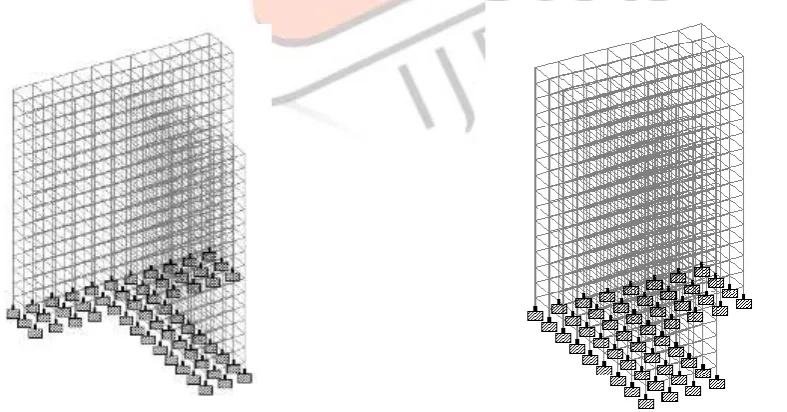
STAAD-Pro was used to perform computer modeling of the building with T shape and L shape plan geometry. R.C buildings are modeled as beam-column building composed of beams, columns for different storey as shown in Figure 3& 4. The columns are assumed to be fixed at their base. A detailed three-dimensional model is employed for wind analysis.
Fig -3:Typical 3-D model for T shaped geometry (Model-T) Fig -4:Typical 3-D model for L shaped geometry (Model-L)
III.RESULTANDDISCUSSION:
After performing analysis behavior of various parametric coefficients such as maximum displacement, storey drift, axial force, shear force, bending moment and torsional moment has been worked out. The variation in result of those parameters are
IJEDR1603013
International Journal of Engineering Development and Research (www.ijedr.org)72
compared in two categories as given below, (i) variation due to change in geometry (from chart 1 to 18), (ii) variation per unit length due to change in height (from chart 19 to 27).Variation In parameters Due To Change In Geometry: 15 Storey Building:
Chart -1: Variation in displacement for model T and L, Chart -2: Variation in Storey drift for model T and L, 15 storey along and across WL 15 storey along and across WL
Chart -3: Variation in Axial Force for model T and L, Chart -4: Variation in Bending moment for model T and L, 15 storey along and across WL 15 storey along and across WL
IJEDR1603013
International Journal of Engineering Development and Research (www.ijedr.org)73
25 Storey Building
Chart -7: Variation in Displacement for model T and L, Chart -8: Variation in Storey drift for model T and L 25 storey along and across WL 25 storey along and across WL
Chart -9: Variation in Axial force for model T and L, Chart -10: Variation in Bending moment for model T and L, 25 storey along and across WL 25 storey along and across WL
Chart -11: Variation in Shear force for model T and L, Chart -12: Variation in Torsional moment for model T and L, 25 storey along and across WL 25 storey along and across WL
IJEDR1603013
International Journal of Engineering Development and Research (www.ijedr.org)74
30 Storey Building
Chart -13: Variation in Displacement for model T and L, Chart -14: Variation in Storey drift for model T and L, 30 storey along and across WL 30 storey along and across WL
Chart -15: Variation in Axial force for model T and L, Chart -16: Variation in Bending moment for model T and L, 30 storey along and across WL 30 storey along and across WL
IJEDR1603013
International Journal of Engineering Development and Research (www.ijedr.org)75
From above charts 1 to 18 , it can be observed that the structure with T shaped geometry is more responsive to the wind pressure as compared to L shaped geometry. Also direction of wind plays a very vital role, as it can be seen that when wind load is across the T shape plan there is considerable increase in maximum displacement, storey drift and torsional moment. However there is no significant difference in values of parametric coefficient in L shaped building with reference to wind direction (along and across the length) as the length in both direction does not differ much for all heights.Variation In Per Unit Length for Different Parametric Coefficient Due To Change In Height
T Shaped Geometry
Chart -19: Variation in Displacement per unit length, Chart -20: Variation in Axial Force per unit length, model-T Vs No. of storey model-T Vs No. of storey
Chart -21: Variation in Shear Force per unit length, Chart -22: Variation in Bending Moment per unit length model-T Vs No. of storey model-T Vs No. of storey
IJEDR1603013
International Journal of Engineering Development and Research (www.ijedr.org)76
L Shaped Geometry
Chart -23: Variation in Displacement per unit length, Chart -24: Variation in Axial Force per unit length, model-L Vs No. of storey model-L Vs No. of storey
Chart -25: Variation in SF per unit length, Chart -26: Variation in BM per unit length, model-L Vs No. of storey model-L Vs No. of storey
IJEDR1603013
International Journal of Engineering Development and Research (www.ijedr.org)77
After studying above charts (chart 19 to 27) it can be seen that maximum displacement, torsional moment, , bending moment and axial force increases as per unit length with increase in number of storey for both T shaped and L shaped geometry. However shear force is almost constant per unit length with increase in height of building in case of T shaped plan wheras decreases in case of L shape structure.IV.CONCLUSIONS
The following conclusions are drawn from the study:
1. The geometry of building is one of the important governing factor during analysis of behavior high rise structure against wind load with reference to various parametric coefficients.
2. The structure with T shaped plan is more sensitive to the wind load as compared to L shaped plan and hence less cost effective and serviceable.
3. Consideration of the direction of wind pressure is very vital during design of high rise building with irregular geometry. 4. Torsional moment is one of the dominating factor and should be analyzed properly in case of irregular geometry which
increases per unit length with increase in height.
5. Shear force either decrease or remains approximately constant per unit length with increase in height.
REFERENCES
[1]. Ravinder Ahlawat and Ashok K. Ahuja, (2015), “Wind loads on ‘T’ plan shape tall buildings”. Journal of Academia and Industrial Research (JAIR) ISSN: 2278-5213 Volume 4, Issue 1.
[2]. Ravinder Ahlawat and Ashok K. Ahuja, (2015), “Wind loads on ‘Y’ plan shape tall building”. International Journal of Engineering and Applied Sciences (IJEAS) ISSN: 2394-3661, Volume-2, Issue-4.
[3]. Md. Rashedul Kabir, Debasish Sen, Md. Mashfiqul Islam, (2015), “Response of multi-storey regular and irregular buildings of identical weight under static and dynamic loading in context of Bangladesh”. International Journal Of Civil and Structural Engineering, ISSN 0976 – 4399, Volume 5, No 3
[4]. Jawad Ahmed, H S Vidyadhar,“Wind Analysis and Design of Multi Bay Multi Storey 3D RC Frame”, International Journal of Engineering Research & Technology (IJERT), ISSN: 2278-0181 Vol. 2 Issue 9, September – 2013.
[5]. Ming Gu, “Study on wind loads and responses of tall buildings and structures”The Seventh Asia-Pacific Conference on Wind Engineering, Nov. 2009,Taipei, Taiwan.
[6]. Hossein Moravej, Mahdi Hatami, Reza Naghshbandi, Yaser Mousavi Siamakani ,“Wind load analysis of buildings in hill-shape zone”, Int. Journal of Applied Sciences and Engineering Research, Vol. 4, Issue 1, 2015.
[7]. J. A. Amin and A. K. Ahuja (2008), “Experimental study of wind pressures on irregular plan shape buildings”. BBAA VI International Colloquium on: Bluff Bodies Aerodynamics & Applications Milano, Italy.
[8]. Indian standard code 875: part 2,3,5- 1987, “Code of practice for Design loads (other than earthquake) for buildings and structures.”