IJEDR1602282
International Journal of Engineering Development and Research (www.ijedr.org)1580
Resource Optimization in Road Construction Projects
K. Sri Bindu1, U. Jayasanthosh Kumar2
Asst. Professor, Research Scholar,
Department Of Civil engineering, Dhanekula institute of engineering and technology, Ganguru, Andhra Pradesh, India
________________________________________________________________________________________________________
Abstract - The Construction projects, especially the highway construction projects, use huge amount of resources on and off the field in various forms of resources viz., materials, plants, equipment and human resources along with money, time and space. The uniqueness of the projects makes the resource planning a tedious job as the efficiency of each resource depends upon a huge number of working condition factors. A detailed study of resource planning will help in better monitoring and overall controlling of the project. In highway projects, the same resource is often used for different activities and the productivity of that resource being different for different activities, it becomes inevitable to know the correct norms for correct estimation, planning and monitoring.
Keywords - construction, resources, monitoring, controlling, productivity, estimation.
________________________________________________________________________________________________________
I. INTRODUCTION
Construction activity is an integral part of a country’s infrastructure and industrial development which includes hospitals, schools, offices, houses and other buildings; urban infrastructure; highways, ports, railways, airports etc. Construction becomes the basic input for socio-economic development. Besides the construction industry generates employment and provides growth to other sectors through linkages. It is, therefore essential, that, this vital activity is nurtured for healthy growth of economy.
1.1 Indian Context
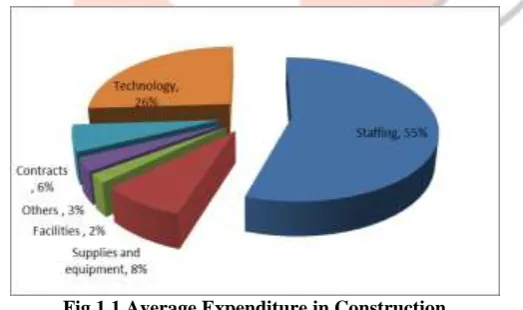
Construction is an important part of the industrial sector and one of the core sectors in India’s economy. It is estimated that construction spending is expected to increase to US$370 billion by the end of 2013, with residential totaling US$63 billion and non-residential registering US$307 billion. The construction sector has increased its share of India’s total employment from 2.8% in 1983 to 5.4% in 2003-04. The sector accounts for about 38% of gross investment and about 45% of total infrastructure cost. And the average expenditure involved in the construction was shown as a pie chart in the Fig 1.1.
Fig 1.1 Average Expenditure in Construction 1.2 Choice of Technology and Construction Method
Many of techniques and materials used for construction are essentially unchanged since the introduction of mechanization in the early part of twentieth century. For example at the time of highway construction at the beginning of the nineteenth century most of the highway project report stated that ―the work could not have been done any faster or more efficiently in our days, despite all technological and mechanical advances in the time, since the reason being that no present system could possibly carry the spoil material away any faster or more efficiently then the system employed. No motor trucks were in the digging of soil everything ran on the rails foe cutting and filling of soil at different chainage to reduce the wastage of human resources and achieve maximum productivity. And because of quantity of soil and rain, no other methods have work so well to achieve the desired output.
In contrast to this view of one large project, it may also point to the continuous change an Improvement occurring in traditional material and technique. This continuous improvement in techniques help to plan and distribute the resources as per the requirement and efficient distribution of all these resources helps in close monitoring and actual progress of the work which includes resources like man, material, machinery and money with respect to their productivity which is very crucial in scheduling. 1.3 Problem Identification
IJEDR1602282
International Journal of Engineering Development and Research (www.ijedr.org)1581
Considering the significance of this sector, it is necessary to identify the major issues affecting the efficiency of the sector and take corrective action. There is a need to enhance productivity through appropriate mechanization to meet physical targets. There is a clear case for encouraging mechanization to build up the sectors capacity to deliver the critical infrastructure needed for the economic development. Hence there is a need to utilize the resources effectively.Construction schedules generated by network scheduling techniques often need to be modified in order to reduce significant fluctuations in resource utilization levels over the project duration. The resource fluctuations are impractical, inefficient and costly to implement on construction sites, as they
Create difficulties in attracting and keeping top-quality workers if stable employment is not guaranteed; Require the hiring and releasing of workers on a short term basis.
In order to complete a project without any risks related to resources proper resource planning is essential. 1.4 Objectives
The main objectives of this work is to plan the main resources (i.e. the equipment, plants and manpower) deployed at a highway project by using Microsoft Soft Project Software.
To investigate issues pertaining in highway projects. Scheduling the activities in the project.
To plan resources by understanding productivity of each of the resource and its use for a particular activity using Microsoft project.
To optimize cost of the project by levelling the resources
Using MSP software resources are planned, scheduled, allocated and then crashed. 1.5 Scope of Study
In order to optimize the cost and duration in construction projects resource optimization is required. This may be used for the expansion of M.G Road from Patamata to Machilipatnam (NH-9).
II. METHODOLOGY AND CASE STUDY
This chapter explains about the methodology of the study and the details about the case study done. 3.1 Methodology
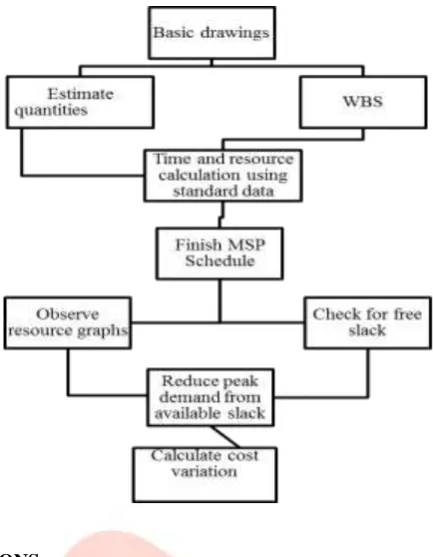
From the basic drawings quantities required for each activity are estimated and work break down structure is done. By using the standard data book, the resources and time required to complete the activity is calculated. Then the cost of the project is calculated and MSP schedule is prepared. Observe the resource graphs, check for free slack using Gantt chart. Reduce the resources having peak demand from the available slack by levelling. Calculate the cost variation in the project after and before reducing the peak demand.
Repeat the same process for three different cases. In Case-1 entire project was taken as a part
From chainage 22.260 km to 40.768 km In Case-2 the total project was divided into three stages
From chainage 22.260 km to 31.00 km From chainage 31.00 km to 40.768 km
In Case- 3 the total project was divided into three stages From chainage 22.260 km to 28.00 km
From chainage 28.00 km to 34.00 km From chainage 34.00 km to 40.768 km
IJEDR1602282
International Journal of Engineering Development and Research (www.ijedr.org)1582
IV. RESULTS AND DISCUSSIONSThe below tables are the result of our project similarly we have done for other two cases also.
4.1 Case-2
In CASE-2 the entire project is divided into 2 sections. The cost is calculated based on the resource allocations which are established from standard data book.
Table 4.1 Table showing the costs & duration before leveling of resources (Case-2)
S.NO. TASK NAME UNIT QUANTITY DURATION COST
1 From km 22.260-31.00(section-1)
2 Road works B/S
3 Possession &access of site
4 Clearing and grubbing Hec 3.93/- 4days 62297.2/-
5 Excavation Cum 17698.5/- 49days 1157481.9/-
6 Embankment Cum 10619.1/- 106days 1210577.4/-
7 GSB Cum 6992/- 23 days 14074896/-
8 Prime coat Sq.m 83030/- 24 days 2739990/-
9 Wet mix macadam Cum 7866/- 35 days 17556912/-
10 Tack coat Sq.m 79534/- 22 days 954408/-
11 Bituminous macadam Cum 3059/- 15 days 23168866/-
12 Semi-dense bituminous concrete Cum 1835.4/- 9 days 17399592/-
13 Earthen shoulders Cum 3933/- 39 days 1006848/-
14 From km 31.00-km 40.768 (section-2)
15 Road works B/S
16 Possession & access of site
17 Clearing and grubbing Hec 4.39/- 4 days 68686.6/-
18 Excavation Cum 19780.2/- 55 days 1293625/-
19 Embankment Cum 11868.12/- 118 days 1352965.6/-
20 Granular sub base Cum 7814.4/- 26 days 15730387/-
21 Prime coat Sq.m 92796/- 26 days 3062268/-
22 Wet mix macadam Cum 8791.2/- 39 days 19621958.4/-
23 Tack coat Sq.m 88888.8/- 25 days 1066665/-
24 Bituminous macadam Cum 3418.8/- 16 days 25887932/-
25 Semi-dense bituminous concrete Cum 2051.28/- 10 days 19445376/-
26 Earthen shoulders Cum 4395.6/- 43 days 1125273/-
The total cost of the project is Rs.16,79,87,005 and duration of the project is 688 days.
IJEDR1602282
International Journal of Engineering Development and Research (www.ijedr.org)1583
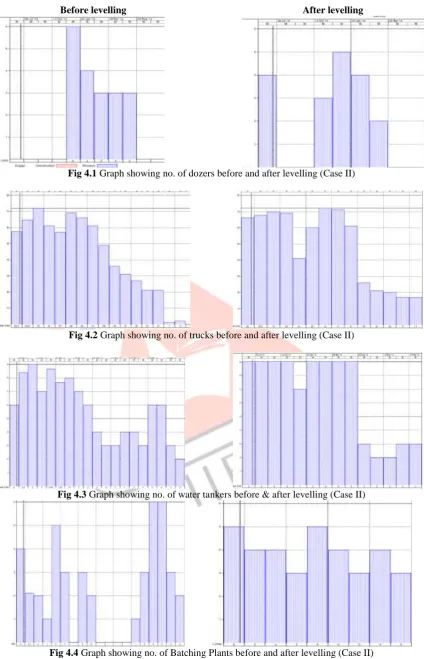
Before levelling After levelling
Fig 4.1 Graph showing no. of dozers before and after levelling (Case II)
Fig 4.2 Graph showing no. of trucks before and after levelling (Case II)
Fig 4.3 Graph showing no. of water tankers before & after levelling (Case II)
Fig 4.4 Graph showing no. of Batching Plants before and after levelling (Case II)
The total cost of the project is given by the formula
Total cost of project= (cost of project before levelling)-(total reduction in cost after levelling) The cost calculation after levelling the resources is shown in the following Table 4.2
IJEDR1602282
International Journal of Engineering Development and Research (www.ijedr.org)1584
Resource As perstandard
After levelling
Reduction
in resource Cost/hr
Cost/day for the levelled resource Use of resource in days Total reduction in cost
Trucks 2 1 1 250 500 10 5000
Water tanker 8 6 2 624 2496 15 37440
Batching plant 11 6 5 19120 19120 21 401520
Vibrators 6 4 2 2678.30 20890.74 8 167125.92
Dozer 2 1 1 2450 2450 8 19600
Excavator 1 0.5 0.5 1440 1440 6 8640
Mate 4 3 1 43.125 345 67 23115
Mazdoor skilled 20 15 5 44.625 1785 75 133875
Mazdoor unskilled 85 70 15 36.875 4425 10 44250
Wet mix plant 7 6 1 1646 10863.6 8 86908.8
Reduction in cost after levelling 927474.72
Total cost of project before levelling 167987005
cost of project after levelling the resources 167059530
In the above case total cost of the project before leveling is Rs 16,79,87,005 and after levelling the cost is reduced by Rs 9,27,474.72so the total cost comes down to Rs16,70,59,530
V. LITERATURE SURVEY
References are drawn from a variety of sources including published articles, non-referred reports. The estimation information exchanges website, Internet documents and also published conference reports.
VI. CONCLUSION
The objective of the project was to minimize time and cost by levelling the resources and this was done by taking three cases to compare the optimized results. In Case 1 the entire project was considered to be done in the same order of WBS without breaking it into parts and the cost incurred by the utilization of resources is calculated. In Case 2 the entire project was divided into two parts and the cost incurred by the utilization of resources is calculated. In Case 3 the entire project was divided into three parts and the cost incurred by the utilization of resources is calculated.
From the project carried out the following are the conclusions drawn:
‒ By scheduling the project in three different types, three different time schedules are obtained and the respective resource allocations are also achieved.
‒ From the resource allocations and the time schedule of the three cases the optimal resource utilization is identified by the cost comparison.
‒ By performing the resource levelling the cost of the project has been reduced by Rs 9,27,474.72
‒ From the above analysis conducted, the optimal solution is Case 2 with the reduction of cost to Rs 9,27,474.72 where the total cost is Rs 16, 70,59,530.3 which is the least cost of the three cases due to the reduction in duration.
REFERENCES
[1] B.Mulholland and J.Christian,(1999). “Risk Assessment in Construction Schedules.” J.Constr.Eng.Manage.,Vol 125, No.1, Jan/Feb,1999. ASCE(8-15)
[2] El-Rayes, Mosehli (1998) “Heuristic Solution for Resource Scheduling for Repetitive Construction Projects.”J. Management and Innovation for a Sustainable Built Environment,2011.
[3] Hoijat Adeli and Asim Karim. (1997). “Scheduling/Cost Optimization and Neural Dynamics Model For Construction.”
J.Constr.Eng.Mange., Vol.123, No.4, December,1997. ASCE (450-458)
[4] Jin-Lee Kim, Ralph D. Ellis Jr.(2008). “Permutation-Based Elitist Genetic Algorithm For Optimizaation of Large sized Resource constrained Project Scheduling.” J.Constr.Eng.Mange., Vol.134, No.11, November,2008. ASCE (904-913)
[5] K SwarnaKumari, J Vikranth (2012). “ A Study on resource planning in highway construction projects.” International Journal of Engineering Research and Applications (IJERA) ISSN: 2248-9622 Vol. 2, Issue4, July-August 2012, pp.1960-1967
[6] Kris G. Mattila (A.M.ASCE), and Amy Park (2003). “ Comparision of Linear Scheduling Model and Repetitive Scheduling Method.” J.Constr.Eng.Manage.,Vol 129, No.1, Feb 1, 2003. ASCE(56-64)
[7] Mostafa E. Shehata ,Khaled M. El-Gohary (2012) “Towards improving construction labor productivity and projects’ performance.” Alexandria Engineering Journal, Vol 50, February 2012.
[8] Project Management for Construction Fundamental Concepts for Owners, Engineers, Architects and Builders by Chris Hendrickson, Department of Civil and Environmental Engineering, Carnegie Mellon University, Pittsburgh, PA l52l3 [9] Peurifoy, R.L., Construction Planning, Equipment and Methods, 2nd edition McGraw-Hill, NewYork,1970.