Scholarship@Western
Scholarship@Western
Electronic Thesis and Dissertation Repository
7-7-2016 12:00 AM
Climbing Up Cloud Nine: Performance Enhancement Techniques
Climbing Up Cloud Nine: Performance Enhancement Techniques
for Cloud Computing Environments
for Cloud Computing Environments
Mohamed Abusharkh
The University of Western Ontario Supervisor
Abdallah Shami
The University of Western Ontario Joint Supervisor Abdelkader Ouda
The University of Western Ontario
Graduate Program in Electrical and Computer Engineering
A thesis submitted in partial fulfillment of the requirements for the degree in Doctor of Philosophy
© Mohamed Abusharkh 2016
Follow this and additional works at: https://ir.lib.uwo.ca/etd
Part of the Artificial Intelligence and Robotics Commons, Computer and Systems Architecture
Commons, Digital Communications and Networking Commons, Software Engineering Commons, and the Theory and Algorithms Commons
Recommended Citation Recommended Citation
Abusharkh, Mohamed, "Climbing Up Cloud Nine: Performance Enhancement Techniques for Cloud Computing Environments" (2016). Electronic Thesis and Dissertation Repository. 3881.
https://ir.lib.uwo.ca/etd/3881
This Dissertation/Thesis is brought to you for free and open access by Scholarship@Western. It has been accepted for inclusion in Electronic Thesis and Dissertation Repository by an authorized administrator of
Abstract
With the transformation of cloud computing technologies from an attractive trend to a business reality, the need is more pressing than ever for efficient cloud service manage-ment tools and techniques. As cloud technologies continue to mature, the service model, resource allocation methodologies, energy efficiency models and general service manage-ment schemes are not yet saturated. The burden of making this all tick perfectly falls on cloud providers. Surely, economy of scale revenues and leveraging existing infrastructure and giant workforce are there as positives, but it is far from straightforward operation from that point. Performance and service delivery will still depend on the providers’ algorithms and policies which affect all operational areas.
With that in mind, this thesis tackles a set of the more critical challenges faced by cloud providers with the purpose of enhancing cloud service performance and saving on providers’ cost. This is done by exploring innovative resource allocation techniques and developing novel tools and methodologies in the context of cloud resource management, power efficiency, high availability and solution evaluation.
variations of the problem is presented. Moreover, the challenge of evaluating cloud re-source management solutions performance in terms of high availability is addressed. An extensive framework is introduced to design high availability-aware cloud simulators and a prominent cloud simulator (GreenCloud) is extended to implement it. Finally, real cloud application scenarios evaluation is demonstrated using the new tool.
The primary argument made in this thesis is that the proposed resource allocation and simulation techniques can serve as basis for effective solutions that mitigate performance and cost challenges faced by cloud providers pertaining to resource utilization, energy effi-ciency, and client satisfaction.
Acknowledgements
As modest as this work is, it gives me a chance to thank Allah -glorified and exalted is He- for His countless blessings. I pray that I can serve Him, as He guides me to, and be a true follower of Prophet Mohammed Who taught us to strive for knowledge, peace and helping others.
I would like to express my unlimited gratitude to my supervisor Prof. Abdallah Shami. His continuing concern with the students’ futures and his amazing efforts to secure the best possible working environment are really commendable. In my case, his continuous guidance and accommodating patience throughout this journey made it a great experience and made this thesis possible. I am also very grateful to my co-supervisor Dr. Abdelkader Ouda for always granting me his confidence and continuous support in any way he could.
Many thanks go to Western and everybody at Western engineering. You are the un-sung heroes of this educational process. Special thanks to Chris Mariott, Stephanie Tigert, and Georgea Giakoumatos for their efforts and smiles. I am deeply blessed with and grate-ful to my beloved family. My brothers and sisters have been the best ever and have always been there for me. I would like to thank Ahmed, Ala’a, Wafa’a, Faten, Basma and my nephews and nieces. And a big thank you to Maha and Mona for their contribution. You guys are always in my heart. Special thanks to my father and mother in law, uncle Afdal and Aunt Hala for their continuous support and kindness and for always treating me like a son. My deep gratitude goes to my dear uncle Taysir and his family for making us feel at home in London . Special thanks to my cousin, Ayman Abu Sharkh. Ayman’s leadership talent is only matched by his kindness and true friendship.
Special thanks go to my friends and colleagues at Western. Your friendship and un-wavering support turned the nice moments into glorious memories and turned each tough moment into a push forward. Special thanks to this colorful road’s companion Mohamed Kalil for being a true friend and a relentless engineer’s engineer. Hassan Hawilo & Ma-nar Jammal, Karim Hammad, Peng Hao, Khaled Al Hazmi, Mohamed Hussein, Emad Aqili, Abdallah Mobyed, Maysam Mirahmdi, Dan Wallace, Oscar Fillio, Ahmed AlShaer, Ahmed Hamade, Nojan Madineh, Rejaul Choudry, Aidin Reyhani-Masouleh, Omar Sal-lam, Jay Nadeu, Ajmal Khan, Eric Southern, Siamack Gademi, Mohamed Noor, Khaled Abu Sharkh, Ahmed Abu sharkh, Fuad Shamieh, Wilson Higashino, Abdulfattah Noorwali, Anas Saci and all my friends and colleagues at Western; You have all contributed greatly to my life and to this work and I will always remember you fondly.
Many thanks to all the great teachers who taught me through the years; special thanks to Mr. Mohammed Ghoneim, Dr. Bader Al Bdaiwi, and Dr. Ziad Najem. I would like to specially thank my M.Sc. supervisor, Dr. Hazem Raafat, for his support. I would like to thank anyone who gave away the least bit of their time to contribute to this project.
Last but far from least, this work would not have been possible without the love and support of my amazing wife Doaa and lovely daughter Hana. I remember reading my first paper when Hana was just 2 weeks old when I started this program and now she is a little girl holding this thesis in her hands. You guys are a true blessing. May Allah grant us happiness in this life and the other and make our dreams true. Amen.
Table of Contents
Abstract . . . ii
Dedication . . . iv
Acknowledgements . . . v
Table of Contents . . . vii
List of Tables . . . xi
List of Figures . . . xiii
Acronyms . . . xv
1 Introduction . . . 1
1.1 Resource Allocation in a Network Based Cloud Computing Environment: Design Challenges . . . 3
1.1.1 A Comprehensive Solution for Network Processing RA . . . 4
1.1.2 External Challenges . . . 5
1.1.3 Internal challenges . . . 7
1.2 Thesis Outline and Contributions . . . 11
1.3 Contributions of the Thesis . . . 12
1.3.1 Contributions of Chapter 2 . . . 12
1.3.2 Contributions of Chapter 3 . . . 13
1.3.3 Contributions of Chapter 4 . . . 14
2.3 Model description . . . 23
2.4 Mathematical Formulation . . . 24
2.4.1 Notations . . . 25
2.4.2 Decision Variables . . . 26
2.4.3 Objective Function . . . 26
2.4.4 Constraints . . . 26
2.5 Heuristic solution . . . 28
2.5.1 Heuristic model . . . 28
2.5.2 Heuristic techniques for minimizing tardiness . . . 29
2.6 Suboptimal Solution . . . 36
2.6.1 Master Problem Formulation . . . 38
2.6.2 Subproblem . . . 38
2.7 Results . . . 39
2.7.1 Simulation Environment . . . 39
2.7.2 Heuristics . . . 39
2.7.3 Relaxed Solution Results . . . 40
2.7.4 Comparison with Previous Solutions . . . 46
2.8 Chapter Summary . . . 52
3 An Evergreen Cloud: Optimizing Energy Efficiency in Green Cloud Comput-ing Environments Based on Virtual Machine State Prediction . . . 53
3.1 Introduction . . . 53
3.2 Related work . . . 56
3.2.1 Server Consolidation . . . 56
3.2.2 Adaptive Allocation . . . 59
3.2.3 Other Efforts . . . 60
3.2.4 Contribution . . . 61
3.3 System Implementation Scenario . . . 62
3.4 System Model . . . 65
3.4.1 Notations . . . 65
3.4.2 Decision Variables . . . 66
3.4.3 Objective Function . . . 66
3.4.4 Constraints . . . 68
3.5 Consolidation-based energy efficiency . . . 68
3.5.1 VM Dynamic Idleness Prediction (DIP) . . . 69
3.5.2 Classification Parameters . . . 69
3.5.3 How DIP Works . . . 70
3.6 Non-Consolidation-based energy efficiency . . . 74
3.6.1 Live Migration: Why Not? . . . 74
3.6.2 Smart VM Overprovision(SVOP) . . . 74
3.7 Experimental Setup . . . 75
3.7.1 Data Set . . . 75
3.7.2 Classifier and Classification Tool . . . 77
3.7.3 Simulation Parameters . . . 80
3.8 Result Analysis . . . 81
3.8.1 Comparing Placement Methods . . . 81
3.8.2 Evaluated Methods (Energy Efficiency Solutions) . . . 81
3.8.3 Consolidation Frequency . . . 83
3.8.4 Permanent Vs. Temporary Switch Off . . . 83
3.8.5 DIP technique’s Impact on the Consolidation based Techniques . . 83
3.8.6 Smart VM Over Provision(SVOP) as a Method that is Not Depen-dent on Migration . . . 84
3.9 Chapter Summary . . . 85
4 Building a Cloud on Earth: A Study of Cloud Computing Data Center Simu-lators . . . 89
4.1 Introduction . . . 89
4.2 The Roles of a Cloud Simulator . . . 91
4.3 Comparisons methodology . . . 94
4.3.1 Cloud Simulator Design Decisions . . . 94
4.3.2 Cloud Simulator Ingredients . . . 94
4.4 Cloud Simulator Detailed review . . . 101
4.4.1 CloudSim . . . 101
4.4.2 NetworkCloudSim . . . 107
4.4.3 GreenCloud . . . 109
4.4.4 iCanCloud . . . 114
4.4.5 TeachCloud . . . 115
4.4.6 GroudSim . . . 116
4.4.7 CloudAnalyst . . . 117
4.4.8 CDOSim . . . 119
4.4.9 MDCSim . . . 119
4.4.10 GDCSim . . . 120
4.4.11 SPECI . . . 121
4.4.12 BigHouse . . . 122
4.5 Simulator Comparison . . . 123
4.5.1 Simulators with a Specific Purpose or Working on a Limited Scale . 124 4.5.2 Simulators Operating on a More General Scale . . . 124
4.5.3 When Do I Need a New Simulator? . . . 124
4.6.1 Lose the Grid Perspective . . . 130
4.6.2 More Work towards Realistic User Application Patterns . . . 131
4.6.3 Cloud Deployment and Pricing . . . 134
4.6.4 Deeper Look at Reliability and High Availability . . . 134
4.6.5 Widen your Horizons: Outside the Data Center . . . 135
4.6.6 Exploiting High Performance Computing features . . . 135
4.6.7 Modeling Cloud Storage . . . 136
4.6.8 Modeling Containers along with VMs . . . 137
4.7 Chapter Summary . . . 138
5 Simulating High Availability Scenarios in Cloud Data Centers : A Closer Look139 5.1 Introduction . . . 139
5.2 A framework to implement HA-awareness in cloud simulators . . . 142
5.3 Enhancing GreenCloud with HA features . . . 145
5.3.1 GreenCloud scheduling environment . . . 145
5.3.2 GreenCloud Scalability parameters . . . 148
5.3.3 HA enhancements made to GreenCloud . . . 149
5.3.4 Phased Communication application(PCA) Scenario . . . 149
5.4 Experimental Results . . . 153
5.5 Chapter Summary . . . 155
6 Conclusion . . . 157
6.1 Thesis Summary and Future Work . . . 158
6.1.1 Resource allocation in a network-aware cloud environment . . . 158
6.1.2 Energy efficiency resource allocation in cloud environments . . . . 159
6.1.3 Cloud simulators as a performance enhancement tools for cloud solutions . . . 160
References . . . 161
Curriculum Vitae . . . 173
List of Tables
2.1 A comparison of cloud resource allocation efforts . . . 21
2.2 An example of a set of Resource Allocation requests . . . 24
2.3 VM configuration for the 3 instance (VM) types used in the experiment as offered by Amazon EC2 [1]. . . 28
2.4 Experiment parameter configuration. . . 39
2.5 Optimal Vs. Relaxed solution values and execution times . . . 44
2.6 Execution times & average tardiness for connection requests for large scale problems when increasing the average connection duration to 100 Time units 45 2.7 Connection Requests Acceptance rate for different network loads using the Relxed solution . . . 46
3.1 A comparison of energy efficiency virtualization based efforts in cloud environments- Part1 . . . 63
3.2 A comparison of energy efficiency virtualization based efforts in cloud environments-Part 2 . . . 64
3.3 Energy Efficiency Problem - Major Parameters . . . 73
3.4 Classifier Prediction Precision Comparison . . . 78
3.5 Evaluated methods (Energy Efficiency Solutions) . . . 82
4.1 Simulator basic elements as an initial set of design decisions . . . 95
4.2 A summary of CLoudSim features . . . 105
4.3 CloudSim test parameters . . . 105
4.4 CloudSim Execution times for different load amounts . . . 106
4.5 CloudSim Execution times for different load types when for 10K hosts, 20K VMs,40K Cloudlets with 4 processors per hosts.(the changed param-eter in each line is put in bold). . . 106
4.6 A summary of NetworkCloudSim features . . . 109
4.7 Types of workloads/tasks at GreenCloud . . . 112
4.8 A summary of GreenCloud features . . . 113
4.9 A sample of GreenCloud execution times for different architectures with a data center load of 70 per cent . . . 113
4.10 CloudAnalyst test parameters . . . 118
5.1 tasks in GreenCloud- Defining attributes . . . 145 5.2 Simulation Parameters . . . 151 5.3 pca scenario simulation results- impact of increasing the arrival rate on
average service time . . . 154 5.4 PCA scenario simulation results-impact of the dequeuing rate on the
aver-age service time . . . 154 5.5 pca scenario simulation results-large data center . . . 154 5.6 sample research questions that can be investigated using the extended tools 155
List of Figures
1.1 Network-aware Resource Allocation: Design Challenges-External
Chal-lenges . . . 6
1.2 Network-aware Resource Allocation: Design Challenges-Internal Challenges 8 1.3 A sample network of private and public clouds connected through Internet or VPNs . . . 11
2.1 Cloud simulated environment and components . . . 17
2.2 An example of a cloud provider-client network : clients can connect from their private clouds, their headquarters or from a singular machine through the Internet. The provider data centers represent public clouds . . . 23
2.3 The allocation process using heuristic techniques . . . 29
2.4 Equal time distribution heuristic technique . . . 30
2.5 Node distance heuristic technique . . . 32
2.6 Function :fillNode . . . 33
2.7 Duration priority heuristic technique . . . 33
2.8 Greedy heuristic technique . . . 34
2.9 The suboptimal method step by step . . . 37
2.10 Request Blocking results for scheduling methods (allowed tardiness/request =1 time units . . . 41
2.11 Request Blocking results for scheduling methods (allowed tardiness/request =30000 time units . . . 42
2.12 Request average tardiness results for scheduling methods (allowed tardi-ness/request =25 time units . . . 43
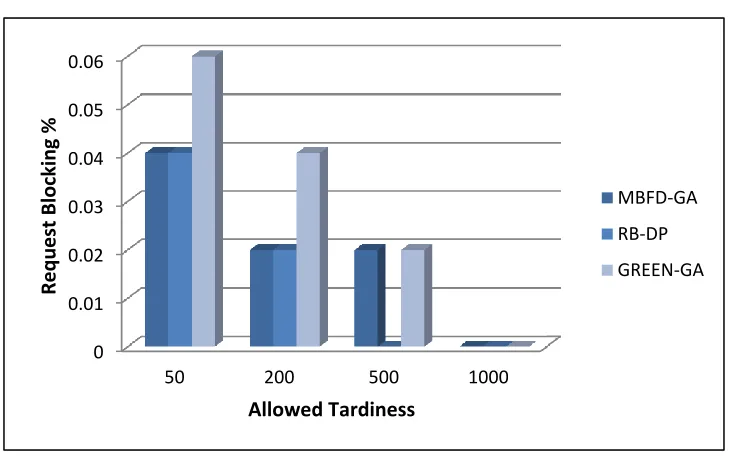
2.13 Request blocking percentage results for scheduling methods when allowed tardiness changes . . . 48
2.14 Request average tardiness results for scheduling methods when allowed tardiness changes . . . 48
2.15 Request blocking percentage results for scheduling methods with allowed tardiness=5 units(very low) . . . 49
2.16 Request blocking percentage results for scheduling methods while chang-ing allowed tardiness levels . . . 50
nique (DIP) . . . 73
3.4 Consolidation-based Energy efficiency flowchart . . . 76
3.5 Idle VMlist overbooking function . . . 77
3.6 VM prediction results using REPtree classifier ( the number of received requests on X-Axis vs. the number predicted requests on Y-axis) . . . 79
3.7 Comparing request acceptance rate for different placement methods . . . . 80
3.8 Request acceptance rate for different energy efficiency methods . . . 85
3.9 Power consumed per request for different energy efficiency methods . . . . 86
3.10 Power consumed per for different energy efficiency methods . . . 86
3.11 Number of migrations per VM for different energy efficiency methods . . . 87
3.12 Percentage of used servers for different energy efficiency methods . . . 87
4.1 The expected roles a cloud simulator may play . . . 92
4.2 Cloud simulator design framework . . . 95
4.3 Cloud simulated environment and components . . . 98
4.4 GreenCloud output . . . 114
4.5 Recommended Cloud Simulators depending on User Priorities . . . 130
5.1 GreenCloud output . . . 141
5.2 The enhanced task life cycle in GreenCloud . . . 146
5.3 GreenCloud task execution flowchart . . . 147
5.4 Sequence diagram of the PCA scenario-Register . . . 151
5.5 Sequence diagram of the PCA scenario-Audio-Video Call . . . 152
Acronyms
BW Bandwidth
CC Cloud Computing
CPU Central Processing Unit
DC Data center
DCN Data center networks
DIP Dynamic VM idleness prediction technique
DP Duration Priority Technique
DVFS Dynamic Voltage and Frequency Scaling
EC2 Amazon Elastic Compute Cloud
ED Equal Time Distribution Technique
FF First Fit
GA Greedy Algorithm
GUI Graphical User Interface
HA High availability , Highly available IaaS Infrastructure As a Service
MBFD Modified Best First Search
MIPs Million Instructions Per Second
NaaS Network As a Service
ND Node Distance Distribution Technique
OPL Optimization Programming Language- used in CPLEX
PaaS Platform As a Service
PCA Phased Communication Application
QoS Quality of Service
RA Resource Allocation
RB Resource Based Distribution Technique
SLA Service-Level Agreement
SVOP Smart Overprovision VM placement Technique
VM Virtual Machines
VPN Virtual Private Networks
Chapter 1
Introduction
The substantial weight cloud computing holds in the current information technology mar-ketplace nowadays makes it hard to remember that cloud computing started gaining this momentum in the not-so-distant past. In 2008, a figure as big as Oracle’s CEO Larry El-lison stated that: “The interesting thing about Cloud Computing is that we’ve redefined Cloud Computing to include everything that we already do...I don’t understand what we would do differently in the light of Cloud Computing other than change the wording of some of our ads”. This was “the” Larry Ellison, quoted in the Wall Street Journal, on September 26, 2008.[4].
Fast forward to today, and cloud computing is not the future but the present of com-puting. Cloud technology adoption rates show that clearly. 78% of U.S. small businesses will have fully adopted cloud computing by 20020, more than doubling the current 37% [5]. The percentage grows to 90% when looking at large businesses (larger than 1000 em-ployees) [6]. The U.S. Small and Medium Business (SMB) cloud computing and services market will grow from 43 billion dollars in 2015 to 55 billion dollars in 2016 [5]. This trend is consistent in Europe as well. The percentages of small, medium and large busi-nesses adopting cloud technologies in UK are 46, 63 and 82% respectively. In Germany, the percentages are 50, 65 and 86%.
advance. Virtualization comes as a layer of protection for the clients against implementa-tion complexities. Merging into the cloud is becoming a business reality for clients and for a good reason.
However, the burden of making this all tick perfectly falls on cloud providers. Surely, economy of scale revenues and leveraging existing infrastructure, giant workforces and expertise are there as positives, but it is far from straightforward operation from that point. As much as cloud computing as a paradigm redefines the service model and client priorities, it still requires a major shake up on the cloud provider side as well. Performance and service delivery will still depend on the providers’ policies and algorithms that affect all operational areas. This covers a wide spectrum of aspects ranging from security, application portability to communication efficiency and reaching energy efficiency and resource allocation in a data center.
Cloud data center resource allocation and management represents a critical area in need of continuous attention. Resource allocation has a direct impact on two sides that are at the core of why the cloud is financially effective: resource utilization and energy efficiency. Simply put, the better resource utilization is, the more client requests the data center (cloud) can serve and the better the performance can be. As for energy efficiency, it is a pressing issue for cloud providers. Power costs represent between 25% and 40% of the operational expenses of a data center [8]. The carbon footprint of a data center is a political and environmental pain point for cloud providers as well.
With that in mind, this thesis tackles a set of the more critical challenges faced by cloud providers with the purpose of enhancing cloud service performance and saving on providers’ cost. This is done by exploring innovative resource allocation techniques and developing novel tools and methodologies in the context of cloud resource management, power efficiency, high availability and solution evaluation.
This discussion aims at providing the reader with an elaborate context for this lively field. After that, the contributions of this thesis are stated chapter by chapter.
1.1
Resource Allocation in a Network Based Cloud
Computing Environment: Design Challenges
Several providers have cloud computing (CC) solutions available, where a pool of vir-tualized and dynamically scalable computing power, storage, platforms, and services are delivered on demand to clients over the Internet in a pay as you go manner. This is im-plemented using large data centers (DCs) where thousands of servers reside. Clients have the choice between using private clouds which are DCs specialized for the internal needs of a certain business organization and public clouds which are open over the Internet to the public for use. Services are offered under several deployment models including Infras-tructure as a Service (IaaS), Platform as a Service (PaaS), Software as a Service (SaaS) and Network as a Service (NaaS). Each provider offers a unique service portfolio with a range of options that include Virtual Machines (VMs) instance configuration, nature of network services, degree of control over the rented machine, supporting software/hardware security services, additional storage, etc. To move to the cloud, clients demand guarantees with regards to achieving the required improvements in scale, cost control and reliability of operations. Despite its importance, providing computation power alone is not sufficient as a competitive advantage. Other factors have gained more weight recently such as the networking solution offerings. The network performance and resource availability could be the tightest bottleneck for any cloud. This is seen as an opportunity for network service providers who are building their own clouds using distributed cloud architecture.
Here, there is a need for a comprehensive resource allocation (RA) and scheduling system for CC data center networks (DCNs). This system would handle all the resources in the cloud providers’ DCNs and would manage client requests, dictate RA, ensure sat-isfaction of network QoS conditions, and eliminate performance hiccups while minimiz-ing the service provider cost and controllminimiz-ing the level of consumed energy. The resource
translate directly to revenue. Second, it is a key point that will make or break potential clients’ decision to move fully to a particular cloud.
1.1.1
A Comprehensive Solution for Network Processing RA
own distributed DCs with a vision to enter the CC market. They envision replacing a large DC with multiple smaller DCs to be closer to the clients. This setup turns the network infrastructure into a distributed cloud. That in turn helps in controlling costs and increas-ing service differentiation. A cloud service provider caters network services to clients to support one of three functions:
1. Connecting the clients’ private cloud (or headquarters) to VMs the client reserved in the DCs; using Internet or VPNs as shown in Fig. 1.3.
2. Connecting the VMs on different public clouds to facilitate data exchange between two VMs reserved by the same client.
3. Connecting VMs on the same public cloud together
It is no use to the clients if their application is producing the results needed in the required time if these results cannot be delivered to them through a stable network con-nection. In [4], data transfer bottlenecks are stated as one of the main obstacles cloud client growth is facing. The authors show that when moving large amounts of data in a distributed DC environment, the network service performance will be a critical point for the whole process. In the example mentioned, the authors reached the conclusion that the data transmission tardiness can cause the client to prefer sending data disks with a courier (FedEx, for example).
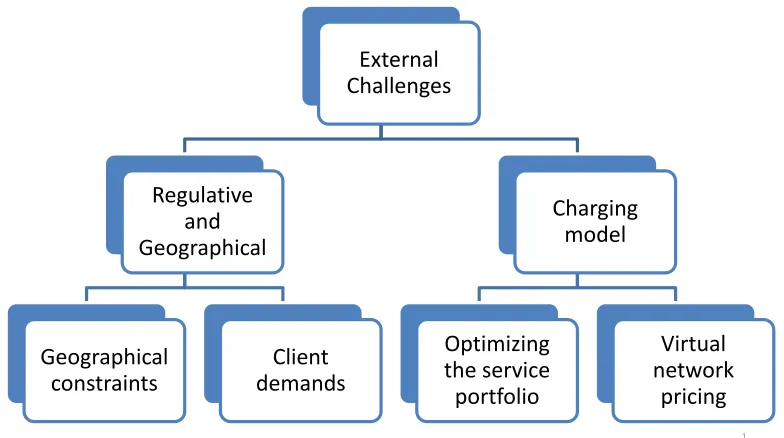
Targeting a network-aware RA system brings to the front multiple challenges that face the CC community. Addressing those issues would be of utmost importance to form a complete solution. These design challenges can be classified into external challenges which are enforced by factors outside the RA process and internal challenges that are related to the way the RA is done.
1.1.2
External Challenges
1.1.2.1 Regulative and Geographical Challenges:
1
Challenges
Regulative and Geographical
Geographical constraints
Client demands
Charging model
Optimizing the service portfolio
Virtual network
pricing
Figure 1.1: Network-aware Resource Allocation: Design Challenges-External Challenges
but it presents regulative and security challenges. An example would be the regulative obligation of complying with the U.S. Health Information Portability and Accountability Act (HIPAA) (the Health Information Protection Act (HIPA) in Canada). HIPAA does not apply directly to third party service providers, it is imperative that health care organizations require the third-party providers to sign contracts which require them to handle all patient data in adherence with HIPAA standards. This raises some constraints to handling and storing data:
1. Geographical constraints: HIPAA requires that patient data does not leave US soil. This constraint limits the choice of DCs to allocate a VM to and limits data move-ment maneuvers while trying to optimize performance. Additionally, when data is stored in the cloud, it is necessary to know the physical location of the data, the number of data copies, data modification details, or data deletion details.
3. Under HIPPA, patients have a right to access any information stored about them. A careful study of the locations of the patients and the usage distribution of these patients is crucial for the RA system. Considering this factor when placing the data would minimize the distance patient data will travel in the network. Making a decision where the data is located has a direct effect on minimizing the cost.
1.1.2.2 Charging Model Issues:
The resources management system should incorporate the clients charging model. For ex-ample, when using Amazon EC2, a client can pay for the instances completely on demand, reserve an instance for term contract or choose spot Instances that enable him to bid for unused Amazon EC2 capacity. Issues to be considered here include:
1. Finding the service portfolio offering that maximizes the revenue weight of excess resources in the DC. Examining the options available in the market, it is clear that cost is not calculated based on static consumptions.
2. Finding the best way to integrate the virtual network usage into the cost analy-sis. Challenges would arise because a virtual link length/distance (and in turn cost) varies from link to link. A virtual link could even change to use another physical path on the substrate network based on the methodology used.
1.1.3
Internal challenges
1.1.3.1 Data Locality
There is a need for systems to implement data locality features “the right way”. This means how to combine the management of compute (processing) and data (network) resources us-ing data locality features to minimize the amount of data movement and in turn improve application performance/scalability while meeting end users security concerns. It is impor-tant to schedule computational tasks close to the data, and to understand the cost of moving the work as opposed to moving the data.
To have a full view of how to use data locality these issues need to be considered: 1. A data aware-scheduler is critical in achieving good scalability and performance. A
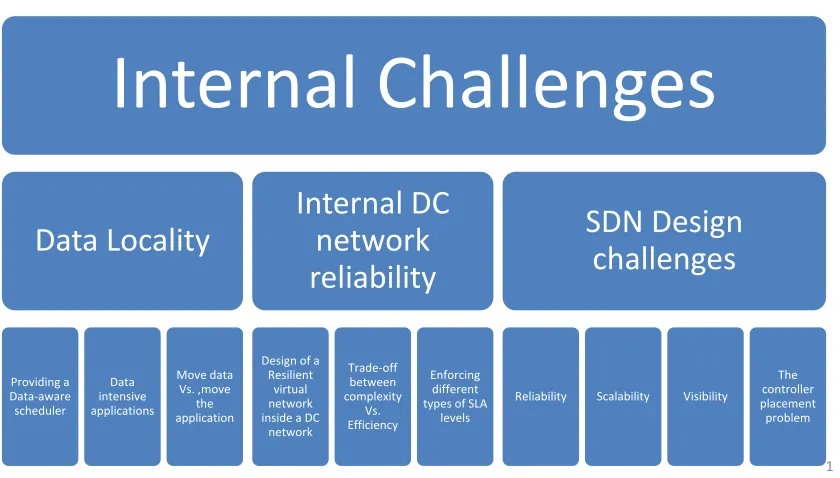
Internal Challenges
Data Locality
Providing a Data-aware scheduler Data intensive applications Move data Vs. ,move the applicationInternal DC
network
reliability
Design of a Resilient
virtual network inside a DC
network Trade-off between complexity Vs. Efficiency Enforcing different types of SLA
levels
SDN Design
challenges
Reliability Scalability Visibility
The controller placement problem
1 Figure 1.2: Network-aware Resource Allocation: Design Challenges-Internal Challenges
like: What information is needed by the scheduler when making a decision? What are the policies and decision criteria for moving data? What data integration policies should be enforced?
2. Analyzing the behaviour of data intensive applications is a very good starting point on the road to understanding data locality and data movement patterns. This is needed to determine data integration policies for specific data locality and move-ment patterns. This allows the study of meta-policies that switch data integration policies as patterns change.
3. Moving the application itself to servers in the data center where data is needed. Many factors have to be considered, such as:
• The availability of servers in the data center
• Policy/ algorithm specifications on when to move considering future demand might need data stored in the original location
1.1.3.2 Reliability of Network Resources Inside a DC
The DC internal network affects the performance deeply. The DC internal network design decisions affect performance and reliability of the DC resources. These decisions relate to factors like network topology, traffic routing, flow optimization, bandwidth allocation policies and network virtualization options.
1.1.3.3 SDN Design Challenges inside the DCs
SDN is a networking paradigm in which the forwarding behavior of a network el-ement is determined by a software control plane decoupled from the data plane. This paradigm can enable many advantages if it is coupled with an efficient RA model. SDN leads to many benefits such as increasing network and service customizability, supporting improved operations and increased performance. The software control plane can be imple-mented using a central network controller which can handle the task of RA in the DCN by directing all the client requests to it. This controller will execute the RA algorithms then send the allocation commands across the network. Since it is a relatively new paradigm, the community has to tackle the following SDN challenges:
1. Reliability - Using centralized SDN controller affects reliability. Although solutions like stand by controllers or using multiple controllers for the network are suggested, practical investigation is needed to reveal the problems and analyze the trade-offs of using such solutions.
2. Scalability - When the network scales up in the number of switches and the number of end hosts, the SDN controller becomes a key bottleneck. For example, [12] estimates that a large DC consisting of 2 million virtual machines may generate 20 million flows per second. The current controllers can support about105 flows per second in the optimal case [13]. Extensive scalability results in losing visibility of the network traffic, making troubleshooting nearly impossible.
3. Visibility - Prior to SDN, a network team could quickly spot, for example, that a backup was slowing the network. The solution would then be to simply reschedule it
from view by the UDP tunnels, which means that when traffic slows and users complain, pinpointing the problem area in the network is not possible. With the loss of visibility, troubleshooting is hindered, scalability is decreased and a delay in resolution could be quite detrimental to the business.
4. The controller’s placement problem influences every aspect of a decoupled control plane, from state distribution options to fault tolerance to performance metrics. This problem includes placement of controllers with respect to the available topology in the network and the number of needed controllers. The placement is related to certain metrics defined by clients like latency, increasing number of nodes, etc. According to [14], random placement for a small value of k medians will result in an average latency between 1.4x and 1.7x larger than that of the optimal placement. As a result, cloud clients will see network service specification as decisive factor in their choice to move to the cloud or to choose their cloud provider. Factors like bandwidth options, port speed, number of IP addresses, load balancing options and availability of VPN access should be considered by any comprehensive model.
1.1.3.4 Fault Tolerance and High availability
Fault tolerance requirements are essential to clients with large sets of data. A fault tolerance strategy affects how clients VMs are distributed across the fault domains. This distribution often contradicts performance. The challenge here is to find the fault domain definitions and VM distribution that complies with fault tolerance constraints without compromising the performance.
1.1.3.5 Portability and vendor lock in
Internet
User 1
User 4
User 3 User 2
Data Center 3
Data Center 2 Data Center 4
Data Center 1
VM VM
VM VM
VM VM VM
VM
Figure 1.3: A sample network of private and public clouds connected through Internet or VPNs
certain client leaves. Which RA adjustments are made and how? Here, designing efficient procedure is a big performance booster.
1.2
Thesis Outline and Contributions
1.3
Contributions of the Thesis
The major contributions of the thesis are summarized as follows.
1.3.1
Contributions of Chapter 2
This chapter aims to tackle the problem of allocating client VM reservation and connec-tion scheduling requests to corresponding data center resources while achieving the cloud provider’s objectives. This chapter’s main contributions include the following:
.
1. The resource allocation problem for cloud data centers is formulated in order to obtain the optimal solution. This formulation takes into consideration the computa-tional resource requirements at a practical granularity while considering the virtu-alization scenario common in the cloud. It also considers conditions posed by the connection requests (request lifetime/deadline, bandwidth requirements and rout-ing) at the same time. An important advantage of this approach over approaches used in previous efforts is considering both sets of resource requirements simulta-neously before making the scheduling decision. This formulation is looked at from the providers’ perspective and aims at maximizing performance.
3. Multiple heuristic methods are introduced to preform the two phases of the schedul-ing process. Three methods are tested for the VM reservation step. Two methods are tested for scheduling connections. The performance of these methods is investi-gated and then compared to some of the currently available methods.
4. A suboptimal method based on relaxing the optimal solution is introduced to solve the same problem for large scale cases. This method exploits the technique of de-composing the original problem into two separate sub-problems. The first one is re-ferred to as the master problem which performs the assignment of VMs to data cen-ter servers based on a novel VM-node relation function. The second one, cen-termed as the subproblem, performs the scheduling of connection requests assigned by master problem. This suboptimal method achieves better results than the heuristic methods while getting these results in more feasible time periods in contrast to the optimal formulation.
1.3.2
Contributions of Chapter 3
This chapter aims at offering a more complete solution for energy efficiency in cloud data centers. As seen in TABLE 3.1, each one of the solutions surveyed, despite covering a significant flavor of the problem, does not offer a comprehensive vision. To achieve an outstanding solution for such a layered problem, the following contributions are offered:
1. The problem is formulated as a mathematical optimization problem with the objec-tive of minimizing the energy consumption.
to dictate the overprovision of VMs by choosing the mostly idle VMS to be switched off and in turn minimize lost requests.
4. A data set published by of Google (data center traces [16]) is used to evaluate the two proposed methods. The performance of these methods is compared to common scheduling algorithms in terms of critical energy efficiency metrics including: en-ergy used per server, enen-ergy used per served request, service rate, and number of migrations performed.
1.3.3
Contributions of Chapter 4
This chapter strives to offer a timely and comprehensive view of the cloud simulators as of today. The contributions of this chapter can be summarized as follows.
1. This chapter examines the major cloud simulators available to researchers and in-dustry engineers and compares them in terms of the main simulated components, application model, network model, and architecture. This includes systematically covering general purpose simulators as well specialized simulators or limited scale simulators. A discussion of the merits of building a new simulator as opposed to extending an already existing one is presented.
2. The limitations found in each simulator are presented using an approach that depicts what it is and what it is not. The ground on which the current simulators stand is illustrated in terms of environment assumptions they were based on. This helps in the following step which is constructing a framework for the cloud simulator design process which would ideally cover the industry and research community needs. This cloud simulator design framework can serve as an elaborate design checklist for newly initiated projects.
and pricing, reliability and high availability, challenges originated outside the data center and Big data considerations among others.
1.3.4
Contributions of Chapter 5
Building on the discussion from Chapter 4, this chapter addresses the need for a cloud simu-lator that enables high availability(HA) algorithm testing in order to reach a HA scheduling technique that does not sacrifice other performance metrics. To the best of our knowledge, there is not a simulator that provides the detailed functionality that enables measuring HA metrics, testing HA algorithms and producing the results in a way that can serve academia and the industry. The aim of this chapter is to try and do just that.
1. A framework to amend cloud simulators with HA features is introduced. This framework would enhance the cloud simulator of choice with required features in order to turn it into an HA-aware simulator. The framework includes features related to component failure and recovery, synchronization and functional dependency as well as work flow features like dynamic scheduling of multi-phased tasks in addition to a higher granularity modeling of applications.
Chapter 2
Wind Driven Clouds: Optimal and Suboptimal
Resource Allocation Techniques in Cloud
Computing Data Centers
2.1
Introduction
The appeal of cloud computing for clients comes from the promise of transforming com-puting infrastructure into a commodity or a service that organizations can pay for exactly as much as they use. This idea is an IT corporation executive’s dream. As Gartner analyst Daryl Plummer puts it“Line-of-business leaders everywhere are bypassing IT departments to get applications from the cloud .. and paying for them like they would a magazine
sub-scription. And when the service is no longer required, they can cancel that subscription
with no equipment left unused in the corner” [18]. The idea that centralized computing over the network is the future, was clear to industry leaders as early as 1997. None other than Steve Jobs said:“I don’t need a hard disk in my computer if I can get to the server faster .. carrying around these non-connected computers is byzantine by comparison”[18]. This applies to organizations purchasing and planning large data centers as well.
However, performance remains the critical factor. If at any point doubts are cast over a provider’s ability to deliver the service according to the Service Level Agreements (SLAs) signed, clients will consider moving to other providers. They might even consider going back to the buy-and-maintain model. Providers are under constant pressure to improve
Figure 2.1: Cloud simulated environment and components
performance, offer more diverse resource deployment options, improve service usability, and enhance application portability. A main weapon here is an efficient resource allocation system. In the cloud scenario, clients are able to rent Virtual Machines (VMs) from cloud providers. Providers offer several deployment models where VM configuration differs in computing power, memory, storage capacity and platform to name a few factors. During the rental period, clients require network capabilities. Clients will exchange data between client headquarters (or private clouds) and VMs or between two client VMs. The task here is to schedule VM reservation requests and connection requests in the fastest possible way while using the data center resources optimally.
This task is getting even harder with the emergence of the big data concepts. IBM summarized big data challenges into 4 different dimensions referred to as the 4 Vs: Volume, Velocity, Variety, and Veracity [19]. With most companies owning at least 100 TB of data stored and with 18.6 billion network connections expected to exist in 2016 [19], resource allocation efficiency has never been so important.
resources. Such an efficient system would have a major financial impact as excess resources translate directly into revenues.
The following sections are organized as follows: a discussion of the related research efforts is introduced in Section 2.2 leading to this chapter’s contribution. Detailed model description is given in Section 2.3. Section 2.4 presents the mathematical formulation of the problem. The heuristic methods are presented in Section 2.5. The suboptimal solution is presented in Section 2.6. Results are shown and analyzed in 2.7. Finally, Section 2.8 concludes the chapter.
2.2
Related Work
Previous attempts were made to optimize a diverse set of cloud resources. In [20], Dastjerdi and Buyya propose a framework to simplify cloud service composition. Their proposed technique optimizes the service composition on the basis of deployment time, cost and re-liability preferred by users. The authors exploit a combination of evolutionary algorithms and fuzzy logic composition optimization with the objective of minimizing the effort of users while expressing their preferences. Despite including a wide range of user require-ments in the problem modeling and providing an optimization formulation along with a fuzzy logic heuristic, [4] tackles the problem from the user’s prospective rather than the provider’s. The main goal is to provide the best possible service composition which gives the problem a brokering direction instead of the focus on cloud data center performance. SLA conditions are considered an input guaranteed by the cloud provider regardless of how they are achieved.
Step 1 taking optimization and fairness into consideration. The model in [21] represents a problem of competition for resources in a cloud environment. Each system/node/machine represents a resource that has a corresponding cost and execution time for each task. More granularity is needed in terms of considering the multiple degrees of computational and net-work resources when scheduling. Memory, storage, computational powers and bandwidth (at least) should be considered separately in an ideal model. Moreover, network resource impact is not considered thoroughly in [5]. Also, no detailed discussion for Virtualization scenarios was given.
In [22], Beloglazovet al. define an architectural framework in addition to resource allocation principles for energy efficient cloud computing. They develop algorithms for energy efficient mapping of VMs to suitable physical nodes. They propose scheduling al-gorithms which take into account QoS expectations and power usage characteristics of data center resources. This includes, first, allocating VMs using modified best fit decreasing method and then optimizing the current VM allocation using VM migration. Considering challenges migration might cause in terms of performance hiccups caused by copying and moving delays and scheduling challenges along with provider vulnerability for SLA viola-tions, a solution that minimizes the need for VM migration is a preferable one. No deadline for tasks is considered.
Duanet al. [23] formulate the scheduling problem for large-scale parallel workflow applications in hybrid clouds as a sequential cooperative game. They propose a communi-cation and storage-aware multi-objective algorithm that optimizes execution time and eco-nomic cost while fulfilling network bandwidth and storage requirements constraints. Here, the computation time is modeled as a direct function of the computation site location and the task instead of using a unified unit for task size. Memory was not used as a resource. Task deadlines are not considered. The goal is to complete a set of tasks that represent a specific application. This model is closer to job execution on the grid rather than the model more common in the cloud which is reserving a VM with specific resource requirements and then running tasks on them. Moreover, the assumption presented is that data exchange requests can run concurrently with the computation without any dependency.
memory and storage) in addition to data exchange requirements (task size variable repre-senting the process files to be sent to the host the task scheduled on before execution, data sent to other servers during execution and output data sent after execution). There was no optimization model offered.
When looking at the solutions available in the literature, it is evident that each exper-iment focuses on a few aspects of the resource allocation challenges faced in the area. We try to summarize the different aspects in Table 2.1.
An ideal solution would combine the features/parameters in Table 2.1 to build a com-plete solution. This would include an optimization formulation that covers computational and network resources at a practical granularity level. Dealing with bandwidth as fixed commodity is not enough. Routing details of each request are required to reflect the hot spots in the network. That applies for computational resources as well. CPU, memory and storage requirements constitute a minimum of what should be considered. Moreover, A number of previous efforts concentrate on processing resources while some focus on net-working resources. The question arising here is: How can we process client VM reservation requests keeping in mind their data exchange needs? The common approach is to perform the VM placement and the connection scheduling separately or in two different consecutive steps. This jeopardizes the QoS conditions and forces the provider to take mitigation steps when the VM’s computational and network demands start colliding. These steps include either over provisioning as a precaution or VM migration and connection preemption af-ter issues like network bottlenecks start escalating. Minimizing VM migration incidents is a major performance goal. Off-line VM migration, however fast or efficient it may be, means there is a downtime for clients. This does not really comply with a demanding client environment where five 9’s availability (99.999% of the time availability) is becoming an expectation. As for online migration, it pauses a load with more copying/redundancy re-quired. These challenges associated with VM migration cause cloud computing solution architects to welcome any solution that does not include migration at all.
T able 2.1: A comparison of cloud resource allocation ef forts Feature/ Reference [4] [5] [6] [7] [8] Proposed solution Optimization model of fered Y es Y es No Y es No Y es Perspecti v e User/brok er Pro vider Pro vider Pro vider Pro vider Pro vider Computation re-sources VM types (generic) Computational node (no memory) CPU, Memory and Storage Computational node (no memory) CPU, Mem-ory and Stor -age
CPU, Mem- ory
and Storage Netw ork resources amounts of data Does not af fect ex ecu-tion time No BW & amounts of data BW , source & destination BW , source & destina-tion Scheduling considers both netw ork & com-putational resources No No No Y es No Y es Request deadline/ lifetime No Y es No No Y es Y es VM modeling VMs & VM
ap-pliances offered
location of the source/destination of the requested connection. This means the nodes/VMs that will (most probably) exchange data with the VM. As these closely tied VMs are sched-uled relatively near each other, network stress is minimized and the need to optimize the VM location is decreased dramatically.
In this work, we aim to tackle the problem of allocating client VM reservation and connection scheduling requests to corresponding data center resources while achieving the cloud provider’s objectives. Our main contributions include the following:
1- Formulate the resource allocation problem for cloud data centers in order to
ob-tain the optimal solution. This formulation takes into consideration the computational re-source requirements at a practical granularity while considering the virtualization scenario common in the cloud. It also considers conditions posed by the connection requests (re-quest lifetime/deadline, bandwidth requirements and routing)at the same time. An impor-tant advantage of this approach over approaches used in previous efforts is considering both sets of resource requirements simultaneously before making the scheduling decision. This formulation is taken from the providers’ perspective and aims at maximizing performance. 2- Make the formulation generic in a way that it does not restrict itself to the
lim-ited environment of one data center internal network. The connection requests received can come from one of many geographically distributed private or public clouds. Moreover, the scheduler is given the flexibility to place the VMs in any of the cloud provider’s data centers that are located in multiple cities. These data centers (clouds) represent the net-work communicating nodes. The complete problem is solved using IBM ILOG CPLEX optimization library[15].
3-Introduce multiple heuristic methods to preform the two phases of the scheduling process. Three methods are tested for the VM reservation step. Two methods are tested for scheduling connections. The performance of these methods is investigated and then compared to some of the currently available methods mentioned earlier.
Private Cloud 1
Private Cloud 2 Stand alone Client 1
Stand alone Client 2
Stand alone Client 3
VM-Node Connections
Public Cloud 1
Public Cloud 2
Public Cloud 3
Public Cloud 4
VM-VM Connections
Figure 2.2: An example of a cloud provider-client network : clients can connect from their private clouds, their headquarters or from a singular machine through the Internet. The
provider data centers represent public clouds
sub-problems. The first one is referred to as master problem which performs the assignment of VMs to data center servers based on a VM-node relation function. The second one, termed as subproblem, performs the scheduling of connection requests assigned by master problem. This suboptimal method achieves better results than the heuristic methods while getting these results in more feasible time periods in contrast to the optimal formulation.
2.3
Model description
C-2 Res VM2 High-Storage T=15 400 -
-C-1 Res VM3 Standard T=20 150 -
-C-2 Res VM4 High-Memory T=10 70 -
-C-1 Req con VM-VM T=15 10 VM1 VM3
C-1 Req con VM-C T=18 20 VM3 C1
C-2 Req con VM-VM T=25 8 VM4 VM2
C-2 Req con VM-C T=30 30 VM4 C2
require cloud hosting, they send requests to reserve a number of VMs. All of these VMs can be of the same type or of different types. Each cloud provider offers multiple types of VMs for their clients to choose from. These types vary in the specification of each computing resource like memory, CPU units and storage. We will use these three types of resources in our experiment. Consequently, each of the requested VMs is allocated on a server in one of the data centers. Also, the client sends a number of requests to reserve a connection. There are two types of connection requests: 1- A request to connect a VM to another VM where both VMs were previously allocated space on a server in one of the data centers (public clouds). 2- A request to connect a VM to a client node. Here, the VM located in a data center node connects to the client headquarters or private cloud. The cloud provider-client network is illustrated in Fig. 2.2 For every request, the client defines the source, the destination, the start time and the duration of the connection. Thus, an initial objective is to minimize the average tardiness of all connection requests. A sample of client requests is shown in Table 2.2. Requests labeled Res indicate a VM reservation. Requests labeled Req con indicate a connection request between a VM and a client node or between 2 VMs. An example of the VM configuration is shown in Table 2.3 [1].
2.4
Mathematical Formulation
connection requests while satisfying the requirements for virtual connection requests of different clients. This model is solved using IBM ILOG CPLEX software for a small set of requests.
2.4.1
Notations
Environment and network parameters are described below. A set of VMs and a set of servers are represented by V M and Q respectively. Mqm represents the amount of re-sources (e.g. memory) available on a server where q ∈ Q and m ∈ {memory(mem),
CP U unit(cu), storage(sg)} such that Mqm = 30 indicates that available memory on
tion request, i ∈ I. Xvq is a binary decision variable such that Xvq = 1 ifv ∈ V M is scheduled on serverq∈Q. Yipwis a binary decision variable such thatYipw = 1if request, i∈I scheduled on path,p∈P and wavelength,w∈λ
2.4.3
Objective Function
The problem is formulated as a mixed integer linear programming (MILP) problem. The objective of the MILP is minimizing the average tardiness of client connection requests to and from VMs. Tardiness here is calculated as the difference between the requested start time by the client (represented by ri) and the scheduled start time by the provider (represented byFi). The solver looks for the solution that satisfies clients in the best way while not harming other clients’ connections. The solution works under the assumption that all clients requests have the same weight/importance to the provider. The objective function of the problem is as follows:
M INX
i
(Fi−ri) i∈I, (2.1)
2.4.4
Constraints
The objective function is subjected to the following constraints:
X
q∈Q
Xvq = 1, v ∈V M, (2.2)
X
p∈P
X
w∈λ
Yipw = 1, i∈I, (2.3)
X
v∈V M
Yipw+ (Xsiq+Xdic −3bqcp)<= 2,
i∈I, q ∈Q, c∈Q, p∈P, w∈λ, (2.5)
P
p∈P
[(ti×alp×Yipw) + (h×alp×Yipw) + (h×alp×Yjpw)]
+Fi−Fj +h×Wij <= 3h, i, j ∈I, l ∈L, w ∈λ,
(2.6)
Wij +Wji = 1, i, j ∈I, (2.7)
Xvq, Yipw, Wij ∈ {0,1}, (2.8)
Fi−ri >= 0, i∈I, (2.9)
Fi−ri <=T ARD, i∈I, (2.10)
Fi, ri >= 0, i∈I. (2.11)
large (SXL) Large (MXL) Large (CXL)
Memory 15 GB 17 GB 7 GB
CPU (EC2 units) 8 6.5 20
Storage 1690 GB 490 GB 1690 GB
2.5
Heuristic solution
2.5.1
Heuristic model
The proposed model in this paper tackles the resource allocation challenges faced when provisioning computational resources (CPU, memory and storage) and network resources. A central controller manages these requests with the objective of minimizing average tardi-ness and request blocking. The solution aims at solving the provider’s cost challenges and the cloud applications performance issues.
For every request, the client defines the source, destination, start time and duration of the connection. Thus, this problem falls under the advance reservation category of prob-lems.
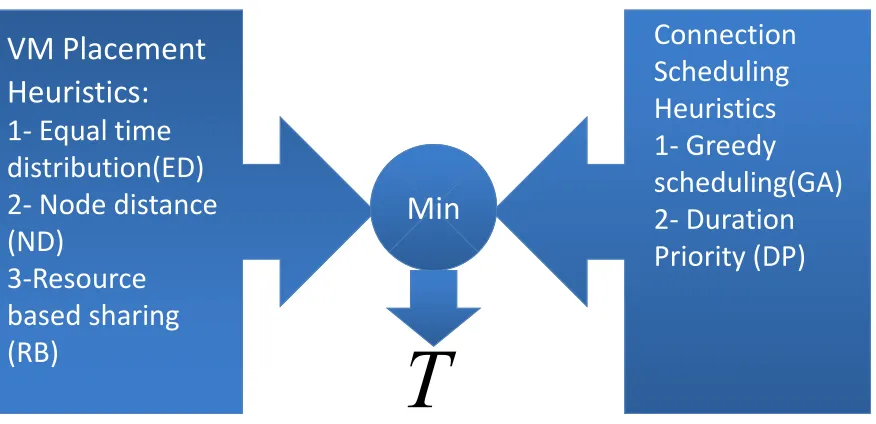
Minimize the total tardiness(incurred delay) for all requests
VM Placement
Heuristics:
1- Equal time
distribution(ED)
2- Node distance
(ND)
3-Resource
based sharing
(RB)
Min
Connection
Scheduling
Heuristics
1- Greedy
scheduling(GA)
2- Duration
Priority (DP)
T
1 Figure 2.3: The allocation process using heuristic techniques
2.5.2
Heuristic techniques for minimizing tardiness
The allocation process is divided into two consecutive steps as in 2.3.
1- Allocation of VMs on data center servers. Here, all the VM reservation requests are served based on server resource availability before any connection request is served.
2- Scheduling of connection requests on the available network paths. This happens after all VMs have been allocated resources and started operation on the servers.
For the first subproblem, three heuristic techniques were evaluated. For the second step (subproblem), two heuristic techniques were tested. For a complete experiment, one heuristic for each subproblem is used. These heuristics are divided as follows:
2.5.2.1 VM reservation heuristic techniques a) Equal Time Distribution Technique (ED):
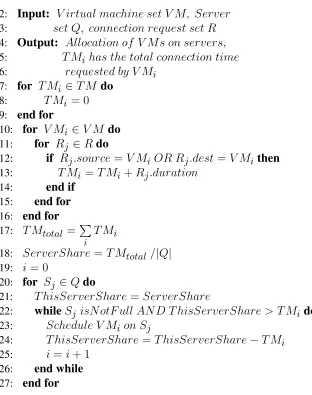
2: Input: V irtual machine set V M, Server
3: set Q, connection request set R
4: Output: Allocation of V M s on servers,
5: T Mi has the total connection time
6: requested by V Mi
7: for T Mi ∈T M do 8: T Mi = 0 9: end for
10: for V Mi ∈V M do 11: for Rj ∈Rdo
12: if Rj.source=V MiOR Rj.dest=V Mithen
13: T Mi =T Mi+Rj.duration
14: end if 15: end for 16: end for 17: T Mtotal =P
i
T Mi
18: ServerShare=T Mtotal/|Q|
19: i= 0
20: for Sj ∈Qdo
21: T hisServerShare=ServerShare
22: whileSj isN otF ull AN D T hisServerShare > T Mido
23: Schedule V Mion Sj
24: T hisServerShare=T hisServerShare−T Mi
25: i=i+ 1
26: end while 27: end for
the number of servers. This is based on the assumption that all servers have the same capacity (for computational and network resources). Then, for each server, VMs are allocated computation resources on the corresponding servers one by one. When the server is allocated a number of VMs that cover/consume the calculated server share, the next VM is allocated resources on the following server and the previous steps are repeated. The algorithm is described in pseudo code in Fig. 2.4. b) Node Distance Technique (ND):
First, the average distance between each two nodes is calculated. The two nodes furthest from each other (with maximum distance) are chosen. Then, the maximum number of VMs is allocated on the servers of these two nodes. Next, the remaining nodes are evaluated, the node with maximum average distance to the previous two nodes is chosen. The same process is repeated until all the VMS are scheduled. The algorithm is described in pseudo code in Fig. 2.5. fillNodehere is a function that basically tries to schedule as many VMs as possible on the called node until the node’s resource are exhausted.fillNodeis illustrated in Fig. 2.6
c) Resource Based Distribution Technique (RB):
In this heuristic, the choice of the server is based on the type of VM requested. As shown in Table III, three types of VMs are used in the experiment: i) High Memory Extra Large (MXL) has high memory configuration; ii) High CPU Extra Large (CXL) has a high computing power; iii) Standard Extra large (SXL) is more suited to typical applications or the ones that need a lot of storage space. Depending on the type of VM requested by the client, the heuristic picks the server with the highest amount of the available resources. The VM then is allocated resources on that server. This causes the distribution to be more balanced.
2.5.2.2 Connection reservation heuristic techniques a) Duration Priority Technique (DP):
2: Input: V irtual machine set V M, Server
3: set Q, N ode set N, P ath set P,
4: where Pijkis path k between nodes
5: i and j, N P is af ixed N umber of paths
6: between node i and node j
7: Output: Allocation of V M s on servers 8: for Ni ∈N do
9: for Nj ∈N do 10: A[i][j] = PN P
k Pijk.Length/N P
11: end for 12: end for
13: P ick 2nodes x, y with max A[x][y]
14: U ={x, y}
15: RemV M s =|V M|
16: RemV M s =f illN ode(x, RemV M s)
17: RemV M s =f illN ode(y, RemV M s)
18: whileU 6=N AN D RemV M s >0do
19: maxDist= 0
20: for Ni ∈N AN D Ni ∈/ U do
21: avgDist= 0
22: for Bj ∈U do
23: avgDist=avgDist+A[Bj][Ni]
24: end for
25: if avgDist > maxDistthen
26: maxDist=avgDist
27: N extN ode=Ni
28: end if 29: end for
30: RemV M s=f illN ode(N extN ode, RemV M s)
31: U =U ∪ {N extN ode}
32: end while
2: Function :fillNode
3: Input: V irtual machine set V M, N ode x,
4: RequestedV M s, server set Q
5: Output: servers in node x f illed with max
6: V M s possible
7: i=|V M| −RemV M s
8: for Sj ∈ Q and Sj residing in N ode xdo
9: whileSj isN otF ull AN D i <|V M|do
10: Schedule V Mion Sj
11: i=i+ 1
12: end while 13: end for
14: return i
Figure 2.6: Function :fillNode
2: Input: P ath set P where Pxyk is path k
3: between nodes x and y,
4: and connection request set R
5: T is the allowed tardines per request
6: Output: Scheduling of network connection
7: requests on network paths
8: Sort R in descending order based onRi.duration
9: for Ri ∈Rdo
10: for t =Ri.RST to Ri.RST +T do
11: P ick shortest path Pxyk where Ri.source=x and Ri.destination=y
12: if Pxyk isAvailable(t, Ri.duration)then
13: Schedule Ri on Pxykat time unit t
14: M ove to next request
15: end if 16: end for 17: end for
2: Input: P ath set P
3: where Pxyk is path k between nodes
4: x and y is Server set Q, connection
5: request set R, N P is N umber of paths
6: between node x and node y
7: T is the allowed tardines per request
8: Output: Scheduling of network connection
9: requests on network paths
10: Sort R in descending order based on Ri.RST
11: (requested start time)
12: for Ri ∈Rdo
13: for t =Ri.RST to Ri.RST +T do
14: x=Ri.source
15: y=Ri.destination
16: for k = 0to N P do
17: if PxykisAvailable(t, Ri.duration)then
18: Schedule Rion Pxyk at time unit t
19: M ove to next request
20: end if 21: end for 22: end for 23: end for
algorithm is described in pseudo code in Fig. 2.7. b) Greedy Algorithm (GA):
In this heuristic, scheduling is based on the connection Requested Start Time (RST). Connection requests with earlier RST are scheduled on the first path available re-gardless of the path length.The algorithm is described in pseudo code in Fig. 2.8.
2.5.2.3 Complexity analysis of the heuristic solutions
The resource allocation problem in a cloud data center is a variation of the well known knapsack problem. The knapsack problem has two forms. In the decision form which is considered less difficult as it is NP-Complete- the question is: Can an objective value of at least K be achieved without exceeding a specific weight W? The optimization form of the problem which is the form we try to solve in this thesis- tries to optimize the possible objective value. The optimization form is NP-Hard. This means it is at least as hard as all the NP problems. There is no current solution in polynomial time for this form.
This motivated the introduction of the heuristic algorithms. It might be of interest to the reader to visit the complexity of the introduced heuristic algorithms.
First, we revisit the variables covered in this analysis. VM represent the VM set, N represent the set of nodes, S is the set of servers, R is the set of connection requests, T is the allowed tardiness per request and D is the average duration of a connection. This analysis is offered with the sole purpose of being an approximation of the time complexity to show that these algorithms run within polynomial time and in turn- can be practically used by large scale cloud networks. Looking at the introduced algorithms one by one, we find that Equal time distribution has a complexity of O(|V M||R|+|S|). Node distance algorithms runs in O(|N3|+|S|+ |V|). Resource based distribution runs in O(|V||S|) which constitutes the quickest among the 3 VM placement algorithms we introduced. As for connection scheduling heuristics algorithms, Duration priority runs in O(|R|.lg|R|+
|R|.T.D) or O(|R|.(1 +lg|R|.+T.D). Finally, the greedy connection scheduling algorithm
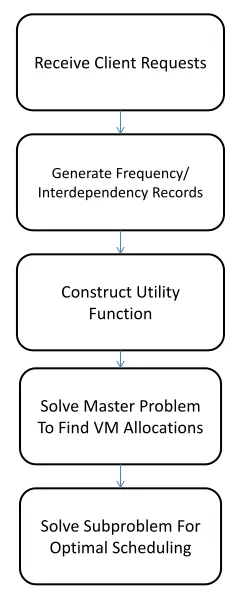
only feasible for small scale problems. Even when using a 5-node network with 4 servers and 7 links connecting them, the number of optimization variables can be as big as 5000 variables when scheduling 50 requests that belong to 5 VMs. On the other hand, heuristic methods achieve feasible solution in relatively quick times but the solution quality cannot be proven. This motivates us to move to the next step which is finding a method that achieves a suboptimal solution. The method introduced here is based on a decomposition technique. We illustrate the method in the Fig. 2.9 The steps go as follows:
1- In Step 1, a set of known connection requests are preprocessed to generate inter-dependency measurements. This is figured out by calculating the frequency of communi-cations between each two points in the network. To be more specific, the frequency of the connection requests between eachV MiandV Mj is calculated as well as the frequency of connection requests betweenV Miandnodek which represent a private cloud. This gives us an indication of which direction most of the VM’s connections go. This is closely cor-related with the dependencies this VM has and should ideally affect where it is scheduled. 2- In the second step, a utility function is constructed based on the connection fre-quency values generated in step 1. The utility function serves as the objective function of the master problem that allocates VMs on hosts.
3- Next, a master problem in which we handle the assignment of VMs to servers and connections to specific paths without scheduling them is generated. In other words, we solve for the decision variableXvq without considering any scheduling constraints. This produces a feasible assignment for VMs that aims at scheduling interdependent VMs close to each other.
tech-Receive Client Requests
Generate Frequency/ Interdependency Records
Construct Utility Function
Solve Master Problem To Find VM Allocations
Solve Subproblem For Optimal Scheduling
2.6.1
Master Problem Formulation
We first introduce Distance function. It represents the distance between two nodes mea-sured by the number of links in the shortest path between them. A frequency function based on connection duration is also added. This is a function where the connection duration is preferred as dominant factor. The frequency function is a value that will represent interde-pendency between two VMs or between a VM and a private cloud (client node). Another alternative here is depending on the number of connections requested between these two points rather than the total amount of connection time. Once we calculate the frequency function values, the utility function is constructed as:
M IN X
v∈V M
X
u∈V M
X
s∈Q
X
q∈Q
(F reqvu×Distancesq×Xvs×Xuq), (2.12)
Subject to
2.2,2.4. (2.13)
The master problem finds the VM allocation that maximizes the value of point to point interdependency.