Torque Calculation in Interior Permanent Magnet Synchronous
Machine Using Improved Lumped Parameter Models
Hooshang Mirahki* and Mehdi Moallem
Abstract—In this paper, we present improved Lumped-Parameter Models for simulation of a Interior
Permanent Magnet Synchronous (IPMS) machine to calculate PM flux linkage, and Q and D-axis inductances which can be used for torque calculation. These improved models include all details of flux barriers and air bridges of rotor and also the effect of saturation in central posts and stator core. To validate the accuracy of these models, results are compared with the Finite Element Method results for a presented IPMS machine.
1. INTRODUCTION
Due to their high efficiency, power density, power factor and torque density, Interior Permanent Magnet Synchronous (IPMS) machines are increasingly being used in various applications, such as variable speed drives, electrical vehicles, and other industrial drives [1, 2]. Compared with Surface Permanent Magnet (SPM) machines, IPMS machines have robust rotor construction, high reluctance torque, and high demagnetization withstand. Also they are suitable for electric vehicles application which requires a wide constant power operating speed range [1, 3].
Since Finite Element Analysis (FEA) is highly time consuming for machine design and optimization process [3], researchers have always looked for analytical methods that can be used for the purpose of machine optimization. The existing methods such as Laplacian or quasi-Poissonian methods solve the field equations for surface permanent magnet machine [4] or inset permanent magnet machine directly and use the conformal mapping for taking the effects of slots into consideration [4, 5]. Anyhow, because of the leakage flux, saturation in different parts and the complicated structure of IPMS machine, it is not possible to use these analytical methods for the modeling and optimization of IPMS machine [6, 7]. The Magnetic Equivalent Circuits (MEC) method used for calculation of no-load and full-load field in inductions [8], switched reluctance [9], salient-pole synchronous [10], SPM [11] and IPMS machines [7] is not an appropriate approach for optimization purposes due to its complexity and modeling efforts. The saturating Lumped Parameter Model (LPM) is one of the most efficient methods for optimization of IPMS machines especially in high-load conditions [12, 13], since it can include machine complex geometry and saturation in stator and rotor cores [14]. Due to its fast and accurate results in calculating machine parameters, LPM can be used in optimization process that needs thousands of iterations for finding an optimal solution [15, 16].
In this paper, three different models of lumped parameter are used for calculation of average torque [6, 12]. First, a linear LPM is used for calculation of PM flux linkage [14, 17]. For simplicity, the reluctances of the rotor yoke and stator yoke can be ignored compared to the reluctance of the air gap. The level of saturation in iron bridges and central posts are assumed constant [18, 19]. Two other LPMs can be used for calculationDandQ-axes inductances. Since the effective air gap inD-axis is large [20], the reluctance of rotor yokes and stator yokes can be ignored for calculation ofD-axis inductance, and also the variation under different loading conditions has no effect on the saturation level in iron bridges;
Received 30 September 2014, Accepted 27 October 2014, Scheduled 30 October 2014
* Corresponding author: Hooshang Mirahki ([email protected]).
therefore, iron bridge length is added to flux barrier length, but central posts are modeled with variable reluctance. In these models Carter coefficient can be used for taking slot effect into consideration [2, 17]. Since candidate IPMS machine has three layers and has no skew in rotor, cross coupling is neglected from theD-axis magnets and stator excitation. The mechanism of cross coupling depends on particular geometry such as number of layers and rotor skew [21, 22].
In this paper, we have succeeded in accurately calculating PM flux linkage, inductances ofQ- and
D-axis and the average torque of a three-layer IPMS machine using specially designed LPM method consisting of the effects of saturation of D-axis and stator core with detailed model of flux barriers and central posts. The results of our method are in excellent agreement with those obtained by Finite Element Method (FEM).
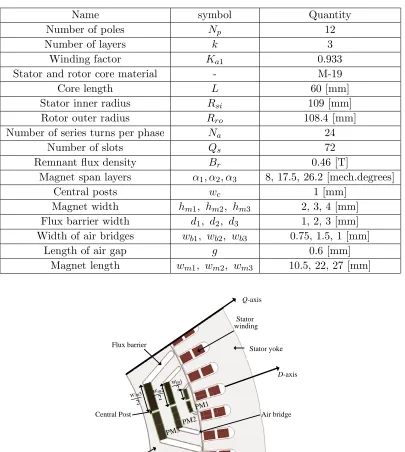
Table 1. IPMS machine parameters.
Name symbol Quantity
Number of poles Np 12
Number of layers k 3
Winding factor Ka1 0.933
Stator and rotor core material - M-19
Core length L 60 [mm]
Stator inner radius Rsi 109 [mm]
Rotor outer radius Rro 108.4 [mm]
Number of series turns per phase Na 24
Number of slots Qs 72
Remnant flux density Br 0.46 [T]
Magnet span layers α1, α2, α3 8, 17.5, 26.2 [mech.degrees]
Central posts wc 1 [mm]
Magnet width hm1, hm2, hm3 2, 3, 4 [mm]
Flux barrier width d1, d2, d3 1, 2, 3 [mm]
Width of air bridges wb1, wb2, wb3 0.75, 1.5, 1 [mm]
Length of air gap g 0.6 [mm]
Magnet length wm1, wm2, wm3 10.5, 22, 27 [mm]
Stator yoke
Rotor core Central Post
Flux barrier
Stator winding
Air bridge
Q-axis
D-axis
PM3 2
w w2 2
w
m3 m2 m1
PM1
PM2
2. ELECTROMAGNETIC TORQUE
Figure 1 shows one pole of a 12-pole IPMS machine. In this configuration, each rotor pole contains three buried magnets. Machine basic parameters are given in Table 1.
The main aim of this paper is to obtain electromagnetic torque analytically. The following equation can be used to calculate the electromagnetic torque [1].
Te= 3
Np 2
(λP MIq−(Lq−Ld)IqId) (1)
whereNp and λP M are the number of poles and PMs flux linkage, respectively. Lq,Ld,Iq andId areQ and D-axis inductances and current components, respectively. Although Equation (1) is typically used in linear LPM, it can be use for saturated LPM if the inductances are implicit functions of excitation [6]. Therefore, to obtainTe, one needs to calculate PM flux linkage andQand D-axis inductances by using the saturated LPM.
3. FLUX LINKAGE CALCULATION
The PM flux linkage, λP M, can be calculated using linear LPM. In this calculation, assumptions of constant magnetic vector potential in the stator and rotor cores, fixed magnet remanence, and saturated constant flux density iron bridges are made [3]. The PM flux linkage, λP M, is calculated using Equation (2) and linear magnetic circuit model [1, 3].
λP M =
4√2RroLNaKa1B1 Np
(2)
In this equation, B1 and Ka1 are fundamental air gap flux density and fundamental winding
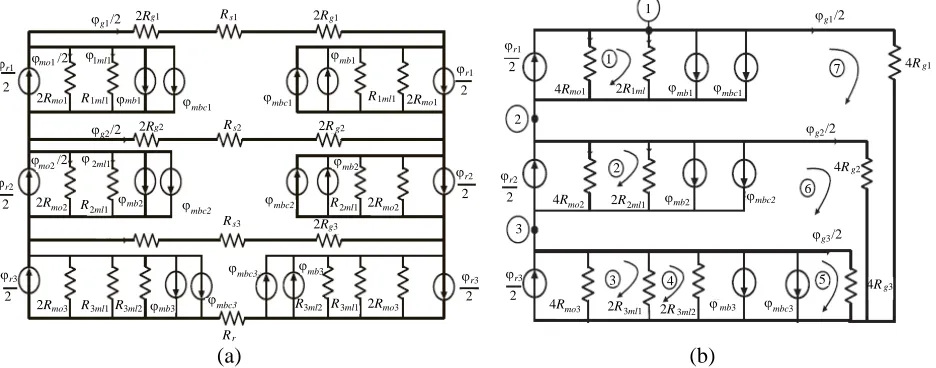
coefficient, respectively. Figure 2 shows three-layer IPMS machine designated as PM1, PM2 and PM3 with flux line. The calculated flux lines using FEA clearly shows the locations of reluctances and flux sources. According to the paths of flux line obtained from FEA, LPM can be extracted as shown in Figure 3. In Figure 3,ϕgk for (k= 1 to 3) are air gap flux densities while the corresponding reluctances areRgk =μ0Aggk, where:
Agk =
αp(k)−αp(k−1)
2π(Rsi−g2)
Np
L, for (k= 2,3) (3)
Agk = αp(k)
2π(Rsi−g2)
Np
L, for (k= 1) (4)
whereμ0 is the permeability of air, and (αpk = αk2Nπp) is the pole-arc to pole pitch ratio. ϕrk =BrwmkL,
ϕmbk = BsatbkLwbk, and ϕmbck = BsatckLwc are the flux sources, leakage fluxes of PMs through the
bridges, and leakage fluxes of PMs through the central posts, respectively. Bsatbk and Bsatck are the level of saturation in bridges and central posts, respectively. Since a part of flux lines of the third magnet flows through its own flux barrier and a part of it flows commonly through its own flux barrier and the flux barrier of the adjacent magnet, for LPMs, each flux barrier is divided into two reluctances. Hence, in Figure 2 the flux lines 1, 2, and 3 are corresponding to reluctances Rkml1,R1ml2 and Rmok, respectively.
Rmok =
hmk
μ0μrwmkL
(5)
Rkml1 =
2hmk
μ0L(hn+hn+1)
(k= 1, n= 1), (k= 2, n= 3), (k= 3, n= 5) (6)
R3ml2 =
4d3 μ0L(h7+h8)
(7)
where hn is the length of flux barrier. Since there is no saturation in stator and rotor yokes, Rs1,
ϕ g1/2 2Rg1 Rs1 2R
ϕr1 2 ϕr2 2 ϕr3 2 mo1
ϕ /2 ϕ1ml1
R1ml1 ϕmb1
2Rmo1 ϕ
mbc1
ϕ g2/2 2Rg2 Rs2 2Rg2
mo2
ϕ /2 ϕ2ml1
R2ml1 ϕmb2
2Rmo2 ϕmbc2
R3ml1R3ml2
2Rmo3 ϕmb3 ϕmbc3
ϕmbc3 Rs3 ϕmb2 ϕmbc2 ϕmbc1 ϕmb1
R1ml1 2Rmo1
2Rmo2 R2ml1 ϕr1 2 ϕr2 2 ϕr3 2 2Rmo3 R3ml1 R3ml2 ϕmb3 2Rg3 Rr ϕr1 2 ϕr2 2 ϕr3 2 2 3 4Rmo1 1 1
2R1ml ϕmb1 ϕmbc1
ϕ g1/2
ϕ g2/2
4Rg2 ϕmbc2 ϕmb2 2R2ml1 4Rmo2 2 3 4 ϕmbc3 2R3ml2 2R3ml1
4Rmo3 ϕmb3
ϕ g3/2
5 6
7 4Rg1
(a) (b)
g1
4Rg3
Figure 3. Lumped parameter model. (a) Lumped circuit model of IPMS. (b) Simplified lumped circuit
model.
Angle [Mech.deg]
Air gap flux density [T]
0 10 20 30 40 50 60
0.2 0.15 0.1 0.05 -0.05 -0.1 -0.15 0 -0.2
Rs2, Rs3, and Rr can be neglected in Figure 3(a) compared with Rgk. Therefore, Figure 3(a) can be simplified to Figure 3(b) due to symmetry. In this figure, the Kirchhoff’s law is applied to loops 1–7 and nodes 1–3. Soϕgk fork= 1 to 3 can be obtained, and the average air-gap flux densities are Bg1= ϕAg1g1,
Bg2= ϕAgg22,Bg3= ϕAgg33, respectively.
Figure 4 shows the resultant air gap flux without stator slot effects. For calculatingλP M, air gap
g is substituted with (ge = Kcg) in all the equations above, where Kc is the Carter coefficient. Flux linkage calculation using LPM yields 9.2 mwb while flux calculation using FEM yields 9.3 mwb.
4. D-AXIS INDUCTANCE
The D-axis inductance is the sum of magnetization inductance and leakage inductance [6].
Ld=Ldm+Ll (8)
Llcan be calculated as described in [1]. An analytical relationship between the unsaturatedQ-axis inductance and D-axis inductance was developed by Vagati et al. in [23]. Therefore, in this paper the
d-axis inductance will be given without detailed derivation of the equations. The D-axis magnetizing inductance is composed of ‘through’ and ‘circulating’ components. As described in [6]Ldt and Ldc are estimated using magnetic circuit analysis based on formulas given in [23].
Ldm=Ldt+Ldc (9)
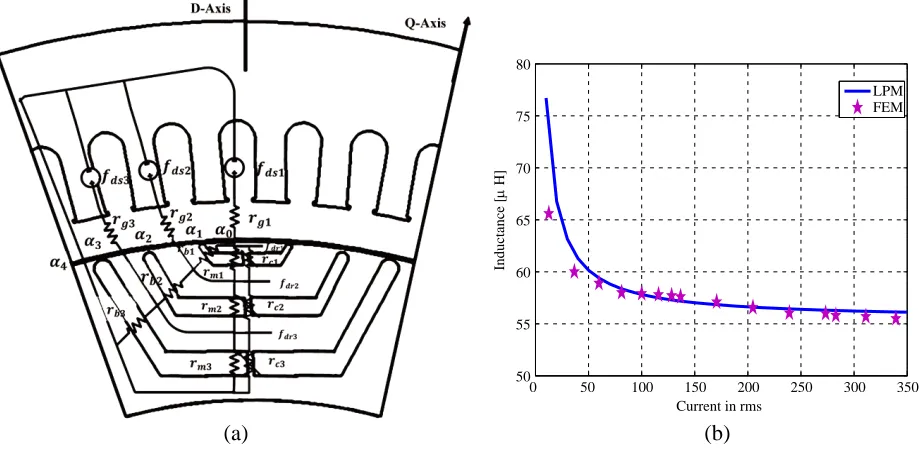
Figure 5(a) shows the per-unit magnetic circuit for IPMS machine with three layers, which is solved to determine the inductance components. Several geometric quantities in Figure 5(a) need further definitions. The angle, Δαk, is defined as the angular distance at the rotor surface between adjacent magnet flux paths such that Δαk=αk−α(k−1). The cross-sectional areas, for the total stator
air gap surfaceAr, stator tooth pitch As, each central post Ack, and each magnetAmk, are defined as
Ar = 2πRsiL,As= AQrs,Ack =wcL, and Amk =wmkL.
0 50 100 150 200 250 300 350
Current in rms
LPM FEM
50 55 60 65 70 75 80
Inductance [
μ
H]
(a) (b)
Figure 5. Equivalent circuit and inductance of d-axis. (a) Equivalent d-axis inductance LPM circuit.
Then per-unit circuit reluctance for magnet cavity and air gap segment can be defined as:
rmk =
2hmkAs
geAmk
(10)
rgk = Δαs Δαk
(11)
rck =
2hmkAs
geAck
Ids
Ib
(12)
rck is per-unit circuit reluctance for central post. Air bridge flux density variation with regard to changes in D-axis current is negligible. However, central post flux varies with the changes in d-axis current. Therefore, Ids
Ib coefficient is considered to compensate for these variations whereIds and Ib are
D-axis current and base current, respectively. The stator mmf per unit source for the kth peripheral segment is expressed as [12]:
fdsk=
cos(αk−1)−cos(αk)
Δαk
(13)
Start:
Estimating B for n=1 to 4gn
tn gn stn B = B / λ
Bryn= B (A /A ) gn gn ryn
syn
4
m=n gm gm syn
A A B B Σ
gn gn e mmf = B g /μ
ryn ryn ryn mmf = H l
stn stn stn mmf = H l
syn syn syn mmf = H l
gq Bgn n
B
g si a1
qm q
a B 4LR k N
L I
Input I current
qn 4k N I p No Rst4 D-AXIS Q-AXIS F N ) (3 2 4 π ( )
cos(α ) -cos(α )
αn-αn-1 q
q
Calculation of H Corresponding to B using
rotor and stator B-H curve
0
Sum of mmf in each loop
Sum mmf = 0
Yes m=nΣ = Δα p N ( )
( ) 0 1 2 3 4 5 6
× 105
H [A/meter] 0 0.5 1 1.5 2 2.5 B [Tesla]
Rsy4 Rsy3
Rsy2 Rsy1
Rst3 Rst2 Rst1
lsy1 lsy2 lsy3 lsy4 lst1
lst2 Asy lst3 Rst4
Rst4
Fqs4 Fqs3
Fqs2
Fqs1 Ag1
t1
λ Ag2 t2
λ Ag3 t3
λ Ag4 t4
λ
lst4
Rg4 Rg3
Rg2 Rg1
Rry4 Rry3
Rry2
Rry1α0 α1 α2 3 α 4 α Ary1 Ary2 lry2 Ary3 lry3
Ary4 lry3
(b)
(a)
(c)
a1 a n-1 n
=
= ) (
= ( )
Figure 6. Calculation of Q-axis reluctance. (a) LPM for Q-axis inductances. (b) Flowchart for
For calculating fdrk we can use the Kirchhoff’s law [3]. The D-axis inductance is calculated using the following equations [12, 23]:
Ldc
Lqm
= 1− 4
π
k
Δαkfdsk2 (14)
Ldt
Lqm = 4
π
k
fdsk(fdsk−fdrk)Δαk (15)
where Lqm is Q-axis magnetization inductance and can be calculated from round rotor air gap inductance [1]:
Lag=Lqm = 3 2
4
π
μ0Na2Ka21LRsi
Np
2
2 ge
(16)
The D-axis total magnetizing inductance is given by:
Ldm=
Ldc
Lqm + Ldt
Lqm
Lqm (17)
Figure 5(b) shows the variation of D-axis inductance (Ld=Ldm+Ll) versus the current for the LPM and FEM methods, which are in great agreement.
5. Q-AXIS INDUCTANCE
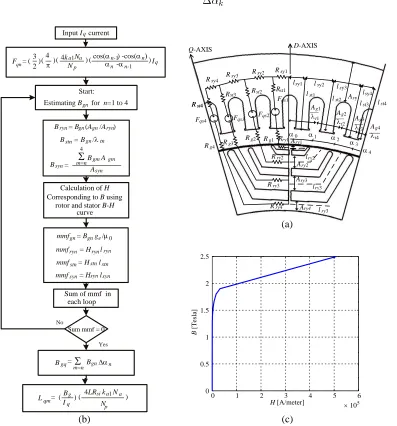
For high-performance applications, the exciting MMF is likely to drive Q-axis path into the saturation region of the core material. To accurately predict Lq under rated load condition, a saturated model of the LPM is used here [6]. Figure 6(a) shows Q-axis reluctance model of the stator and rotor. In this model, the stator is partitioned in a manner similar to rotor. It is assumed that the magnetic flux is carried in a single flux tube from each rotor segment through the stator back iron. The element lengths are defined as the average length through each segment and are shown in Figure 6(a). In this figure,λtn is the effective teeth area calculated using the air gap area scaled by the slot pitch fraction. The MMF drop across each reluctance is calculated instead of calculating the reluctances. For calculatingLqusing this model, the LPM is solved iteratively along each branch using the flowchart shown in Figure 6(b). Figure 6(c) showsB-H curve of M-19 steel for stator and rotor core.
Figure 7(a) shows the Q-axis inductances (Lq =Lqm+Ll) obtained from FEM and LPM which again shows great agreement.
0 50 100 150 200 250 300 350
Current in rms
LPM FEM
0 20 40 60 80 100 120 140 160 180
Angle [Elect. Degrees]
Torque [N m]
LPM FEM
(a) (b)
0 50 100 150 200 250 300
Inductance [
μ
H]
.
-200 -150 -100 -50 0 50 100 150 200
Figure 7. Comparison of Q-axis inductance and torque calculated. (a) Comparison of Q-axis
6. TORQUE CALCULATION
We are interested in calculating the electromagnetic torque produced by the IPMS machine using LPM analysis. To validate the model, the results are compared with FEM ones for a candidate IPMS machine. Figure 7(b) shows electromagnetic torque calculated using FEM and LPM versus torque angle with constant rms phase current, which shows good accuracy of LPM method.
7. CONCLUSION
Comparison of the results obtained by the two methods (LPM and FEA) for inductances of Dand Q -axes and electromagnetic torque shows the accuracy of the LPM method for three-layer IPMS machine having flux barrier and central posts. The improvement employed in the calculation of the D-axis inductance has resulted in more accuracy ofD-axis inductance in lower currents. Because of the small number of elements used for calculation of inductances in the proposed LPM method, it can be used as one of the most efficient methods in the design optimization process. The model is modified to include flux barriers, central posts, and saturation at heavy loading conditions.
REFERENCES
1. Miller, T. J. E., Brushless Permanent-magnet and Reluctance Motor Drives, 3rd Edition, Oxford University Press, 1989.
2. Boldea, I.,Reluctance Synchronous Machines and Drives, Oxford University Press, 1996.
3. Zhu, L., S. Z. Jiang, Z. Zhu, and C. Chan, “Analytical modeling of open-circuit air-gap field distributions in multisegment and multilayer interior permanent-magnet machines,” IEEE Trans. Mag., Vol. 45, No. 8, 3121–3130, 2009.
4. Zhu, Z., D. Howe, E. Bolte, and B. Ackermann, “Instantaneous magnetic field distribution in brushless permanent magnet DC motors. Part I. Open-circuit field,” IEEE Trans. Mag., Vol. 29, No. 1, 124–135, 1993.
5. Hwanga, C., C. Changa, C. Panb, and T. Changc, “Estimation of parameters of interior permanent magnet synchronous motors,” Journal of Magnetism and Magnetic Materials, Vol. 239, Nos. 1–3, 600–603, 2006.
6. Lovelace, E., T. Jahns, and J. H. Lang, “A saturating lumped-parameter model for an interior PM synchronous machine,”IEEE Transaction on Industry Applications, Vol. 38, No. 3, 645–650, 2002. 7. Tariq, A., C. Nino Baron, and E. Strangas, “Iron and magnet losses and torque calculation of interior permanent magnet synchronous machines using magnetic equivalent circuit,” IEEE Trans. Mag., Vol. 46, No. 12, 4073–4080, 2010.
8. Amrhein, M. and P. Krein, “Induction machine modeling approach based on 3-D magnetic equivalent circuit framework,”IEEE Transactions on Energy Conversion, Vol. 25, No. 2, 339–347, 2010.
9. Zhu, Z., Y. Pang, D. Howe, S. Iwasaki, R. Deodhar, and A. Pride, “Analysis of electromagnetic performance of flux-switching permanent-magnet Machines by nonlinear adaptive lumped parameter magnetic circuit model,” IEEE Trans. Mag., Vol. 41, No. 11, 4277–4287, 2005.
10. Bash, M. and S. Pekarek, “Modeling of salient-pole wound-rotor synchronous machines for population-based design,”IEEE Transaction on Energy Conversion, Vol. 26, No. 2, 381–392, 2011. 11. Zhu, Z., D. Howe, and C. Chan, “Improved analytical model for predicting the magnetic field distribution in brushless permanent-magnet machines,” IEEE Trans. Mag., Vol. 38, No. 1, 229– 238, 2002.
12. Lovelace, E. C. F., “Optimization of a magnetically saturable interior permanent-magnet synchronous machine drives,” Ph.D. Dissertation, MIT, 2000.
14. Rahman, M., T. Little, and G. Slemon, “Analytical models for interior-type permanent magnet synchronous motors,”IEEE Trans. Mag., Vol. 21, No. 5, 1741–1743, 1985.
15. Mirahki, H., M. Moallem, and S. Rahimi, “Design optimization of IPMSM for 42 V integrated starter-alternator using lumped parameter model and genetic algorithms,” IEEE Trans. Mag., Vol. 50, No. 3, 114–119, 2014.
16. Bracikowski, N., M. Hecquet, P. Brochet, and S. V. Shirinskii, “Multiphysics modeling of a permanent magnet synchronous machine by using lumped models,” IEEE Trans. Mag., Vol. 59, No. 6, 2426–2437, 2012.
17. Zhu, Z., D. Howe, and Z. Xia, “Prediction of open-circuit airgap field distribution in brushless machines having an inset permanent magnet rotor topology,” IEEE Trans. Mag., Vol. 30, No. 1, 98–107, 1994.
18. Wang, J., D. Lieu, W. Lorimer, and A. Hartman, “Comparison of lumped parameter and finite element magnetic modeling in a brushless DC motor,”IEEE Trans. Mag., Vol. 33, No. 5, 4092–4094, 1997.
19. Hsieh, M. F. and Y. C. Hsu, “A generalized magnetic circuit modeling approach for design of surface permanent-magnet machines,”IEEE Transactions on Industrial Electronics, Vol. 59, No. 2, 779–792, 2012.
20. Mi, C., M. Filippa, W. Liu, and R. Ma, “Analytical method for predicting the air-gap flux of interior-type permanent-magnet machines,” IEEE Transactions on Industrial Electronics, Vol. 40, No. 1, 50–58, 2004.
21. Vagati, A., M. Pastorelli, F. Scapino, and G. Franceschini, “Effect of magnetic cross-coupling in synchronous reluctance motors,”Intelligent Motion Conference, Vol. 1, 279–285, 1997.
22. Vagati, A., M. Pastorelli, F. Scapino, and G. Franceschini, “Cross-saturation in synchronous reluctance motors of the transverse-laminated type,” Industry Applications Conference, Thirty-Third IAS Annual Meeting, Vol. 1, 127–135, 1998.