Article 1
Detection of key organs in tomato based on deep migration learning in complex
2background
3Sun Jun*, He Xiaofei , Ge Xiao, Wu Xiaohong , Shen Jifeng and Song Yingying 4
School of Electrical and Information Engineering of Jiangsu University, Zhenjiang 212013, 5
China; [email protected] (J.S.); [email protected] (X.H.); [email protected] (X.G.) 6
[email protected] (X.W.); [email protected] (J.S.); [email protected] (Y.S.) 7
*Correspondence: [email protected]; Tel.: +13775544650 8
9
Abstract:In the current natural environment, due to the complexity of the background and the high 10
similarity of the color between immature green tomato and plant, the occlusion of the key organs 11
(flower and fruit) by the leaves and stems will lead to low recognition rate and poor generalization 12
of the detection model. Therefore, an improved tomato organ detection method based on 13
convolutional neural network has been proposed in this paper. Based on the original Faster R-CNN 14
algorithm, Resnet-50 with residual blocks was used to replace the traditional vgg16 feature 15
extraction network, and K-means clustering method was used to adjust more appropriate anchor 16
size than manual setting to improve detection accuracy. A variety of data augmentation techniques 17
were used to train the network. The test results showed that compared with the traditional Faster R-18
CNN model, the mean average precision (mAP) of the optimal model was improved from 85.2% to 19
90.7%, the memory requirement decreased from 546.9MB to 115.9 MB, and the average detection 20
time was shortened to 0.073S/sheet. As the performance greatly improved, the training model can 21
be transplanted to the embedded system, which lays a theoretical foundation for the development of 22
precise targeting pesticide application system and automatic picking device. 23
24
Key words: object detection; tomato organ; K-means clustering; Soft-NMS; migration learning; 25
convolutional neural network; deep learning 26
27
1. Introduction 28
Tomato is native to South America and has a cultivation history of more than 100 years in 29
China. It is one of the most popular fruits and vegetables, which has health effects of lowering blood 30
pressure, slowing down aging, slimming and supplementing vitamins[1]. 31
Due to the wide planting area, high yield and short maturity, tomato is difficult to be stored. 32
The picking of tomato is a labor-intensive and long-consuming operation. Therefore, the 33
development of the automatic picking robot for tomato is particularly important. The technology of 34
object detection based on image processing is the most basic and important link in the research of 35
picking robot.It is a typical object recognition problem that detecting the key organs (flower and 36
fruit) of tomato from the image of plants. Data from the internet display that immature green tomato 37
contains alkaloids, which may cause poisoning after eating, while mature red tomato does not 38
contain alkaloids. Therefore, it is significantly important to detect the key organs (tomato flower, 39
immature green tomato and mature red tomato) accurately and immediately. It will provide a 40
theoretical basis for the detection of pest and disease, targeting pesticide application system, and 41
development of picking robot [2]. Traditional tomato recognition methods mostly extract the 42
information of color, shape and some shallow features, then use classifier to detect and recognize 43
tomatoes. Zhao Yuanshen et al.[3] used the combination of Harr features and Adaboost classifier to 44
identify tomatoes, and the recognition rate of mature tomato in the test set was 93.3%; Jiang Huanyu 45
et al.[4]utilized the difference of color characteristics between mature tomatoes and background to 46
identify red mature tomatoes by threshold segmentation method. However, the recognition rate of 47
immature green tomato similar to the color of the leaf is not high; Zhang Ruihe et al.[5] transformed 48
the red tomato image to extract the edge features of background region, then segmented the tomato 49
from the background by fitting curve, and obtained the three-dimensional coordinates of the target 50
by using the principle of stereo vision imaging; K Yamamoto et al. [6] extracted the color 51
characteristics of leaves, stems and backgrounds, then constructed a decision tree through regression 52
tree classifier and extracted the pixels of tomato fruits by blob pixel segmentation to identify tomato. 53
But this method has a poor identification rate under the complex background. At present, most 54
traditional object recognition and detection methods are based on the shallow feature extraction to 55
detect and identify tomato organs. The overlapping and occlusion problems between tomatoes under 56
the complex background cannot be well solved, and the time cost for feature extraction is relatively 57
expensive and the applicability is not strong. 58
In recent years, with the emergence of deep learning, convolutional neural networks (CNN) 59
can extract hierarchical features by using unsupervised or semi-supervised feature learning, which 60
has stronger generalization than artificial features. It can not only learn shallow semantic 61
information, but also learn deep abstract information. In the field of generalized recognition (such 62
as object class [8], object detection [9] and object segmentation [10]), Faster R-CNN [11]and YOLO 63
[12] models have been widely used and achieved good results.Suchet Bargoti et al. [13] constructed 64
an image segmentation processing framework by using orchard image data. And multi-scale 65
multilayer perceptron (MLP) and convolutional neural network were include in the framework. The 66
image data captured from network was extended by context information, as well as some of the 67
appearance changes and category distributions observed in the data. Finally, Watershed 68
Segmentation (WS) and Circular Hough Transform (CHT) processing algorithms were used for fruit 69
detection and counting; Inkyu Sa et al. [14] constructed the Faster R-CNN model by pixel level 70
superposition of RGB and near infrared images, then the model was used for fruit detection by 71
migration learning, but the model parameter was too large; Zhou Yuncheng [15] proposed a Fast R-72
CNN model based on double convolutional chains. VGG Net-based feature extraction network was 73
trained by merging RGB and grayscale feature images of tomatoes, and then Fast R-CNN was 74
initialized with the parameters to identify flowers, fruits, and stem of the tomato in plant images. 75
The above literature proves that convolutional neural network can not only extract the shallow 76
texture and color of key organs of tomato automatically, but also learn deeper abstract features. This 77
will improve the detection accuracy of tomato flowers and fruits, and reduce the cost of feature 78
extraction, which is more robust to the detection and identification in complex environment. So it 79
is feasible to use deep learning methods to detect and identify tomato organs. However, the accuracy 80
of these models is not high under the conditions of overlapping and occlusion. And the anchor size 81
used in the above method was set artificially by the target in the VOC 2007 data set, without 82
updating according to the actual size of the key organs of tomato, which will have a certain impact 83
on the recognition accuracy. 84
Aiming at the problem of low recognition accuracy of key organ detection in tomato with fixed 85
size, overlap and occlusion, an improved Faster R-CNN model was proposed in this paper. Firstly, 86
Secondly, residual blocks were used to replace the basic feature extraction network of the original 88
model in order to improve the detection and recognition accuracy of tomato key organs. Finally, 89
Soft-NMS was used to attenuate the bounding boxes of the tomato organ instead of completely 90
removing them, which can solve the above problems to a certain extent. 91
2. Materials and Methods 92
2.1. Data sources 93
94
Figure1. Examples of key organ of tomato 95
A total of 5624 RGB images of tomato flowers, mature red tomatoes and immature green 96
tomatoes were collected from the agricultural digital greenhouse of Jiangsu University with high-97
definition camera. In order to prevent the poor performance of model caused by insufficient 98
diversity of training samples, following measures were taken during the process of image 99
acquisition: considering the difference in imaging results caused by different greenhouse ambient 100
light conditions, images were collected in sunny weather and cloudy days respectively; in the 101
process of sampling, different forms and occlusions of tomato organs were taken into account, and 102
fruits with different maturity were photographed from multiple angles to increase the diversity of 103
samples. In this paper, python script was used to augment a small number of sample maps, including 104
random flip (horizontal, vertical), transform angle (0 ~ 180), random scaling of the original image 105
scaling factor (1 ~ 1.5) etc. [16]. The total number of expanded samples was 8929, and tags were 106
produced according to the standard voc2007 dataset format, then the expanded set was randomly 107
divided into 4:1 ratios between the training set and the test set. 108
2.2. Structure of the detection model of tomato organs 109
Convolutional neural network (CNN) includes convolutional layer, pooling layer and fully 110
connected layer. The convolutional layer uses semi-supervised feature learning and hierarchical 111
feature extraction efficient algorithm to extract image abstract features. It can automatically extract 112
and reduce the dimension of input images, and has stronger generalization than the human-set 113
features. The fully connected layer mainly performs image classification based on the extracted 114
features. The neurons in the convolutional layer extract the primary visual features of the image by 115
using local receptive field and reduce the network parameters by sharing the weights. The pooling 116
scaling and distortion. The convolutional layer and pooling layer in CNN usually appear alternately, 118
and the activation unit is set to realize the nonlinear transformation, which accelerates the 119
convergence rate of the network. 120
The traditional Faster R-CNN object detection algorithm can be divided into two parts. Vgg16 121
was selected as the basic feature extraction network for image feature extraction and classification. 122
The network consists of eight convolutional layers, five maximum pooling layers and three fully 123
connected layers, and Re LU (Rectified Linear Unit) was used as the activation function. In region 124
proposal network (RPN), an arbitrary scale image is taken as input and outputs a series of object 125
proposals, and each proposal has an object score. In order to generate region proposals, slide on the 126
feature map of the last convolutional layer of vgg16, and multiple region proposals are predicted at 127
the same time in each sliding window position [17]. 128
2.3. Improved feature extraction network 129
Deep convolutional neural network makes a great progress in image recognition rate compared 130
with traditional methods. As the number of network layers deepens, the convolutional layer can 131
learn deeper abstract features, and the related research also shows that the extracted features can be 132
enriched by increasing network layers. Simon yan et al. [18] demonstrated that the accuracy of 133
recognition rises with the increase of the depth of network, but the simple stacked convolutional 134
layer cannot train the network smoothly due to the gradient explosion when propagating backward. 135
Although relevant literature has shown that the deep network can be trained through batch 136
normalization [19] and dropout [20], the problem of precision decline after a certain iteration still 137
exists. In order to break through the problems of precision degradation of deep network and the 138
limitation of network depth, He et al. proposed a deep residual resnet model by using the concept 139
of identity mapping. This method solved the degradation problem by fitting a residual map with a 140
multi-layer network [21]. For a stacked layer structure (stacked by several layers), if the residual is 141
zero, then the stacked layer only makes an identity map, the network performance will not decrease. 142
But in fact the residual is not zero, which can enable the stacked layers to learn new features based 143
on the input characteristics, thus having better performance. The basic idea is as follows (as shown 144
in Figure 2): Since direct mapping is difficult to learn, the basic mapping relationship from X to 145
H( ) is no longer being learned, but the difference between the two is learned, that is the residual, 146
then in order to calculate H( ), just add this residual to the input. 147
148
Figure2. Residual learning module 149
At this point, the original optimal solution mapping H( ) can be equivalent toF(X) + X, that is, the 150
quick connection can be expressed by formula (1): 152
Y = F( , { }) + (1) 153
Among the formula(1), X represents the input vector of the module, Y represents the output vector 154
of the module, represents the weighting layer parameters, and a linear projection is needed 155
to match the dimensions to ensure the consistency of the input and output dimensions. 156
ResNet-50 is consist of 50 modules with the same structure as shown in Figure 2. In this paper, 157
the vgg16 feature extraction model was replaced by the 50-layer residual network ResNet-50 to 158
improve the classical Faster R-CNN depth learning model, and the improved detection framework 159
was displayed in Figure 3. 160
161
Figure3. Improved framework for the Faster R-CNN model 162
2.4. Use K-means to cluster the appropriate anchor size 163
The purpose of the clustering algorithm (K-Means) is to divide objects into different 164
clusters according to their respective attributes, so that the similarity of each object in the cluster is 165
as high as possible, and the similarity between clusters is as small as possible. The criterion function 166
used for evaluating similarity is the sum of squared errors. Since the convolutional neural network 167
has translation invariance and the position of the anchor boxes is fixed by each grid, it is only 168
necessary to calculate the width and height of the anchor boxes by k-means. Due to the use of 169
euclidean distance will cause larger bounding boxes to produce more errors than smaller bounding 170
boxes, a new distance formula is defined for this purpose: 171
( , ) = 1 − IOU( , ) (2) 172
When the anchor boxes are calculated, the and coordinates of all boxes' center points will be 173
set to zero so all the boxes are in the same position, which is convenient for calculating the similarity 174
between boxes by the new distance formula [22]. 175
2.5. Region proposal network 176
The core idea of RPN is to directly generate region proposals by using convolutional neural 177
network, which is essentially a sliding window [23]. At the center of the sliding window, a total of 178
nine kinds of anchors are generated, corresponding to three scales (8*8, 16*16, 32*32) and three 179
aspect ratios (1:1, 1:2, 2:1) of the input image. Then the predicted region proposals are sent to two 180
fully connected layers: cls layer and reg layer, which are used for classification and box regression 181
respectively. And finally, the top 300 region proposals are selected as input of Fast R-CNN after 182
sorting according to the score of region proposals. 183
2.6. Soft-NMS 184
Non-maximum suppression (NMS), as the name implies is to suppress elements that are not 185
variable parameters: one is the dimension of the neighborhood, and the other is the size of the 187
neighborhood. Non-maximum suppression is an important part of the object detection process, 188
which generates the detection box based on the object detection score. The detection box with the 189
highest score is selected, while other detection boxes with obvious overlap with the selected 190
detection box are suppressed. This process is continuously recursively applied to the remaining 191
detection frames [24]. For example, In pedestrian detection, each window will get a score after 192
feature extraction and classifier recognition, but sliding window will also cause many windows to 193
overlap with other windows, so NMS is needed to select the detection box with the highest score in 194
the neighborhood, and suppress those boxes with low scores. 195
Soft-NMS has the same algorithmic complexity as traditional NMS. It only needs to make 196
simple changes to the traditional NMS algorithm without adding additional parameters and training, 197
and can be easily integrated into any object detection process with high efficiency and easy 198
implementation. 199
The score reset function of the traditional NMS (rescoring function) is calculated as follows: 200
,
(
, )
(
, )
0,
i t i i i tiou M b
N
s
s
iou M b
N
(3) 201In the above formula (3), a threshold is used in NMS to determine whether adjacent detection frames 202
are reserved. Among them, M is the bounding box with the highest current score, is the 203
adjacent detection box, is the score of detection box, and is the threshold. 204
The score reset function of the Soft-NMS (rescoring function) is calculated as follows: 205
,
(
, )
(1
(
, )),
(
, )
i i t
i
i i i t
s
iou M b
N
s
s
iou M b
iou M b
N
(4) 206The score of the adjacent detection box that overlaps with the detection frame M by attenuation is 207
an effective improvement to the NMS algorithm. The higher the overlap of M is, the more serious 208
the fractional attenuation may be. When the degree of overlap between the adjacent detection frame 209
and M exceeds the threshold , the detection score of the detection box is linearly attenuated. In 210
this case, the algorithm attenuates the detection score of the non-maximum detection frame instead 211
of completely removing it, and does not attenuate the original detection score of the detection frame 212
without overlapping. Therefore, the non-maximum detection box of the tomato under overlapping 213
and occlusion is retained, and the detection precision is improved. 214
3. Model training 215
3.1. Test platform 216
The test operating platform is the Ubuntu 16.04 system, which uses the Tensorflow as deep 217
learning framework. The computer memory is 32GB, equipped with Intel® Core™ i7-7700K 218
[email protected] ×8 processors, GPU uses NVIDIA GTX1080Ti, adopts 16nm production process, 219
memory type is GDDR5, and capacity is 11GB. 220
3.2. Test parameter setting 221
The mini-batch stochastic gradient descent (SGD) method with momentum factor was used to 222
train the network [25]. The number of mini-batch was 256, and the momentum factor was set to 0.9. 223
Since the initialization of weights affects the convergence speed of network, the gaussian 224
distribution (mean value was zero and the standard deviation was 0.01) was used to initialize the 225
fully connected layers were initialized to zero. The same learning rate was adopted for all layers in 227
the network, and the initial learning rate was set to 0.001. During the training process, the current 228
learning rate was reduced by 1/10 step by step, and the regularization coefficient was set to 0.0005. 229
4. Results and analysis 230
4.1. The effect of different anchor sizes on mAP 231
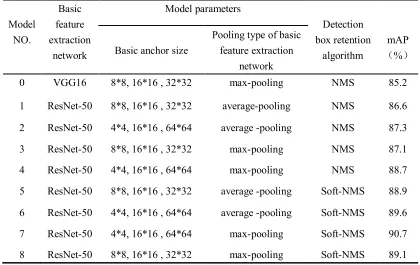
Table 1 shows the model parameter settings and mean average precision (mAP). Since anchors 232
were used to predict the bounding boxes, three sizes 8 * 8, 16 * 16, 32 * 32 and three conversion 233
ratios 1:1, 1:2, 2:1(a total of 9 kinds of anchors) were applied to the original Faster R-CNN. Because 234
the target size of the original voc dataset was very different, if the tomato dataset was used to train 235
the detection target, some anchors were unreasonable. Therefore, the appropriate anchor size by K-236
means clustering method was calculated in this paper. The original size was updated to 4*4, 16*16, 237
64*64, and the transformation ratio remained unchanged in order to improve the detection rate of 238
the bounding box. Generally, the threshold of mAP is 0.5, which means if the coincidence degree is 239
greater than 0.5, the key organs of the tomato are correctly detected. From Table 1, it can be seen 240
that the mAP of model 2, 4, 6 and 7 with anchor size 4 * 4, 16 * 16, 64 * 64 is 0.7, 1.6, 0.7 and 1.6 241
percentage points higher than model 1, 3, 5 and 8 with original size 8 * 8, 16 * 16, 32 * 32, 242
respectively. The above situation indicated that the updated anchor size is more suitable for the data 243
set of this paper, and the recognition rate of key organs of tomato is improved. 244
245
Table 1 Model parameter settings and mAP 246
Model NO.
Basic feature extraction
network
Model parameters Detection box retention
algorithm
mAP
(%)
Basic anchor size
Pooling type of basic feature extraction
network
0 VGG16 8*8, 16*16 , 32*32 max-pooling NMS 85.2
1 ResNet-50 8*8, 16*16 , 32*32 average-pooling NMS 86.6
2 ResNet-50 4*4, 16*16 , 64*64 average -pooling NMS 87.3
3 ResNet-50 8*8, 16*16 , 32*32 max-pooling NMS 87.1
4 ResNet-50 4*4, 16*16 , 64*64 max-pooling NMS 88.7
5 ResNet-50 8*8, 16*16 , 32*32 average -pooling Soft-NMS 88.9
6 ResNet-50 4*4, 16*16 , 64*64 average -pooling Soft-NMS 89.6
7 ResNet-50 4*4, 16*16 , 64*64 max-pooling Soft-NMS 90.7
8 ResNet-50 8*8, 16*16 , 32*32 max-pooling Soft-NMS 89.1
247
4.2. The effect of different pooling types of feature extraction convolutional layers on mAP 248
There are usually two types of pooling: maximum pooling and average pooling. In Table 1, 249
model 3, 4, 7, 8 and model 1, 2, 5, and 6 respectively adopts the maximum and average pooling 250
types. The results show that the effect of maximum pooling is better than the average pooling when 251
other conditions remain unchanged. Combining the literature [27] with internet data, it can be 252
can reduce the error caused by the increase of estimation variance due to the limited size of the 254
neighborhood, and retains more background information of the image. However, maximum pooling 255
can reduce the deviation of estimation mean caused by the error of convolutional layer parameters. 256
So using maximum pooling in the middle layer of convolution can preserve texture features more 257
and discard redundant features, which is beneficial to extracting the deep key features of target in 258
the image and improving the recognition accuracy. 259
4.3. The effect of Soft-NMS on mAP 260
It can be seen from Table 1 that the model 5, model 6, model 8 and model 7 retained by the 261
Soft-NMS method are 2.3, 2.3, 2 and 2 percentage points higher than those of the models 1, 2, 3 and 262
4 retained by the NMS method, respectively. In order to better demonstrate the effect of the Soft-263
NMS algorithm on the detection of tomato organs in the case of overlapping occlusion, the detection 264
effect was visualized. As shown from Figure 4, the optimal model 7 using Soft-NMS is based on 265
the area of overlapping portion to set an attenuation function for the adjacent detection frame instead 266
of completely zeroing its score. This operation can effectively solve the problem of low detection 267
and recognition rate of key organs of tomato under overlapping and occlusion. 268
269
Figure4. Visualization of detection effects in case of overlapping and occlusion. (a)Detection of 270
key tomato organs using a retention algorithm with non-maximum suppression; (b) Detection of 271
key tomato organs using a retention algorithm with Soft-NMS. 272
5. Indicators for model performance evaluation 274
The purpose of object detection is to find the target in a given image, classify the target, and 275
locate the target in the image. Target detection model is usually trained on a set of fixed classes, so 276
the model can only locate and classify the categories contained in the image. In addition, the location 277
of target is usually in the form of a boundary matrix, so target detection involves the location 278
information of target in the image and the classification of target. Mean average precision is an 279
algorithm that is particularly well-suited for the prediction of target category and its location, which 280
is very useful for the assessment of performance in the target detection model. Besides, there are 281
several important evaluation parameters: accuracy, recall and average precision [28]. 282
5.1. Precision & Recall 283
Precision is just the accuracy. In the field of information retrieval, precision and recall appear 284
together. For a query, a series of goals returned, and the correct rate refers to the proportion of the 285
relevant targets in the returned results. Precision is defined as: 286
= (5) 287
The recall rate is the ratio of relevant targets in the returned results to all relevant targets, and it is 288
defined as: 289
= (6) 290
Among these formulas (5,6), A represents the number of related targets in the return results, B
291
indicates the number of returned results and C represents the number of all relevant targets. 292
Suppose true positive (TP): predict the number of positive classes as a positive class, true 293
negative (TN): predict the number of negative classes as negative classes, false positive (FP): 294
predicts negative classes as positive ones (false rate), false negative (FN): predicts the positive class 295
as the number of negative classes (missing rate). Then = TP⁄(TP + FP), and 296
= TP⁄(TP + FN). The performance of object detection model is usually evaluated in the 297
paper using the recall and precision score curves with the threshold, that is, the R-P curve [29]. 298
Figure 5 shows the P-R curve of the original Faster R-CNN and the improved model 7. It can be 299
seen from the P-R curve that the detection accuracy of model 7 is higher and the performance is 300
better. 301
302
Figure5. Precision and recall curve of the model. (a) Precision-recall curve of original Faster R-303
305
5.2. Average Precision & Mean Average Precision 306
Compared to the graph, in some cases, the specific values can more clearly show the 307
performance of test model. Average recision (AP) is usually used as a metric, and the calculation 308
formula is: 309
AP = ∫ ( ) ( ) (7) 310
Among this formula(7), represents , represents , is a function of , so 311
average precision is equal to the area under the P-R curve, and mean average precision (mAP) equals 312
the average of all categories of average precision. It can be seen from Table 2 that the AP of the 313
flower, immature green tomato and the mature red tomato in improved model 7 is 13.7, 2.4 and 0.5 314
percentage points higher than that of the original Faster R-CNN, respectively. And the mAP is 5.5 315
percentage points higher. It indicates that the improved model 7 is better than the original model for 316
detection and recognition of tomato key organs. 317
318
Table 2 Model average precision and mean average precision 319
Model
Average precision(%)
mAP(%) Flower Green tomato Red tomato
Original Faster R-CNN 76.8 88.4 90.4 85.2
Improved model 7 90.5 90.8 90.9 90.7
320
5.3. Memory requirements and detection time of models 321
It can be seen from Table 3 that compared with the original Faster R-CNN model, the memory 322
requirement and detection time of the improved model 7 (using Resnet-50) as the basic feature 323
extraction network are reduced by about 79% and 23%, respectively, and the detection accuracy has 324
a large improvement. It indicates that the improved model reduced the model parameters and 325
improved the precision of model detection on the basis of guaranteeing no additional test time, 326
which lays a theoretical foundation for the subsequent implantation of the model into the embedded 327
system and the development of portable devices for accurate and real-time detection of tomato key 328
organs. 329
Table 3 Model parameter quantity and detection time 330
Model
Model memory requirement (MB)
Average testing
time(s) FPS
Original Faster R-CNN 546.9 0.095 10.5
Improved model 7 115.9 0.073 13.7
331
5.4. Detection effect of model 332
In order to verify the actual field prediction effect of the optimal model in this paper, the key 333
organs of tomato were tested at 9:00 am on a sunny morning in the greenhouse. It can be seen from 334
Table 1 and Figure 6 that the average precision of the improved model 7 for the detection of key 335
organs of tomato is higher, which can reach 90.7%. And the confidence of each object is basically 336
over 0.99. The above performance shows that the model has a good detection effect on tomato 337
339
Figure6. Examples of improved model detection 340
6. Conclusion 341
In this paper, convolutional neural network was used to detect and identify the key organs of 342
tomato. The original Faster R-CNN model based on vgg16 feature extraction network was improved, 343
the resnet-50 with residual structure was used to replace the vgg16 network. And K-means 344
clustering was adopted to fit the anchor size of the data set in this paper, avoiding the problem of 345
recognition accuracy reduction caused by artificial setting. Compared with the original Faster R-346
CNN model, this model used Soft-NMS to retain the generated detection frame, which solved the 347
problem of low detection accuracy of key tomato organs under overlapping and occlusion in a 348
certain extent. 349
The results shows that the APs of tomato flowers, immature green tomatoes and mature red 350
tomatoes were increased from 76.8%, 88.4%, 90.4% to 90.5%, 90.8%, 90.9%, respectively. And the 351
memory required by the model was reduced from 546.9 MB to 115.9 MB. The average detection 352
time was shortened from 0.095 S/sheet to 0.073 S/sheet. The mean average precision was increased 353
from 85.2% to 90.7%, and the performance of the model was greatly improved. 354
The training model can be transplanted to the embedded system in the future, which lays a 355
theoretical foundation for the development of precise targeting pesticide application system and 356
automatic picking robot device of tomato. 357
358
Author Contributions: Sun Jun and He Xiaofei contributed to the development of the systems, 359
including farm site data collection and the manuscript writing. He Xiaofei provided significant 360
suggestions on the development, and contributed to performance evaluation. Ge Xiao contributed 361
to the grammar modification. Sun Jun, He Xiaofei, Ge Xiao and Song Yingying analysed the results. 362
364
Funding: This work is partially supported by National natural science funds projects (31471413, 365
61875089), A Project Funded by the Priority Academic Program Development of Jiangsu Higher 366
Education Institutions (PAPD), Six Talent Peaks Project in Jiangsu Province (ZBZZ-019), Science 367
and Technology Support Project of Changzhou (Social Development) (CE20175042). 368
369
Conflicts of Interest: The authors declare no conflict of interest 370
371
References
3721. Paran, E.; Engelhard, Y. P-333: Effect of tomato's lycopene on blood pressure, serum 373
lipoproteins, plasma homocysteine and oxidative sress markers in grade I hypertensive patients. 374
Am. J Hypertens. 2001, 14, (4), A141-A141. 375
2. Geng, C.X.; Zhang, J.X.; Cao, Z.Y.;Li, W. Cucumber Disease Toward-target Agrochemical 376
Application Robot in Greenhouse. Trans. CSAM. 2011, 42(1):177-180. 377
3. Zhao, Y.S.; Gong, L.; Huang, Y.; Niu, Q. Object Recognition Algorithm of Tomato Harvesting 378
Robot Using Non-color Coding Approach. Trans. CSAM. 2016, 47(7):1-7. 379
4. Jiang, H.Y.; Peng, Y.H.; Shen, H.; Ying, Y. Recognizing and locating ripe tomatoes based on 380
binocular stereo vision technology. Trans. CSAE. 2008, 24(8):279-283. 381
5. Zhang, R.H.; Ji, C.Y.; Shen, M.X.; Cao, K. Application of Com puter V ision to Tomato 382
Harvesting. Trans. CSAM. 2001,32(5):50-52. 383
6. Yamamoto, K.; Guo, W.; Yoshioka, Y.; Ninomiya, S. On plant detection of intact tomato fruits 384
using image analysis and machine learning methods. Sensors 2014, 14, (7), 12191-12206. 385
7. Farabet, C.; Couprie, C.; Najman, L.; Lecun, Y. Learning Hierarchical Features for Scene 386
Labeling. IEEE T. Pattern.Anal.2013, 35, (8), 1915-1929. 387
8. Sun, J.; Tan, W.J; Mao, H.P.; Wu, X.H.; Chen, Y.; Wang, L. Recognition of multiple plant leaf 388
diseases based on improved convolutional neural network. Trans. CSAE. 2017, 33(19):209-215. 389
9. Xiang, X.; Lv, N.; Guo, X.; Wang, S.; Saddik, A. E. Engineering Vehicles Detection Based on 390
Modified Faster R-CNN for Power Grid Surveillance. Sensors 2018, 18, (7), 2258. 391
10. Philipsen, M.P.; Dueholm, J.V.; Jørgensen, A.; Escalera, S.; Moeslund, T.B. Organ 392
Segmentation in Poultry Viscera Using RGB-D. Sensors 2018, 18, (1), 117. 393
11. Zhang, L.; Lin, L.; Liang, X.; He, K. Is Faster R-CNN Doing Well for Pedestrian Detection? In 394
European Conference on Computer Vision(ECCV2016), Springer: Amsterdam, Netherlands, 395
11-14October2016; pp. 443-457. 396
12. Redmon, J.; Divvala, S.; Girshick, R.; Farhadi, A. You Only Look Once: Unified, Real-Time 397
Object Detection, In Computer Vision and Pattern Recognition(CVPR2016), Las Vegas, USA, 398
27-30 June2016; pp. 779-788. 399
13. Bargoti, S.; Underwood, J. Deep fruit detection in orchards, In IEEE International Conference 400
on Robotics and Automation(ICRA2017), Marina Bay Sands, Singapore,29May-3June2017. 401
14. Inkyu, S.; Ge, Z.; Feras, D.; Ben, U.; Tristan, P.; Chris, M. C., DeepFruits: A Fruit Detection 402
System Using Deep Neural Networks. Sensors 2016, 16, (8), 1222. 403
15. Zhou, Y.C.; Xu, T.Y; Zhen, W.; Deng, H.B. Classification and recognition approaches of tomato 404
main organs based on DCNN. Trans. CSAE. 2017, 33(15):219-226. 405
16. Sun, J.; He, X.F; Tan, W.J.; Wu, X.H.; Shen, J.F.; Lu, H. Recognition of crop seedling and weed 406
34(11):159-165. 408
17. Ren, S.; He, K.; Girshick, R.; Sun, J. Faster R-CNN: towards real-time object detection with 409
region proposal networks, In International Conference on Neural Information Processing 410
Systems(NIPS2015), Montreal,Canada, 7-12December2015; pp. 91-99. 411
18. Simonyan, K.; Zisserman, A. Very Deep Convolutional Networks for Large-Scale Image 412
Recognition. Computer Science. 2014, 14, (7), 123. 413
19. Ioffe, S.; Szegedy, C. Batch normalization: accelerating deep network training by reducing 414
internal covariate shift, In International Conference on International Conference on Machine 415
Learning(ICML2015), Lille, France, 6-11July2015; pp. 448-456. 416
20. Krizhevsky, A.; Sutskever, I.; Hinton, G.E. ImageNet classification with deep convolutional 417
neural networks, In International Conference on Neural Information Processing Systems 418
(NIPS2012), Lake Tahoe, NV, USA, 3-6December2012; pp. 1097-1105. 419
21. He, K.; Zhang, X.; Ren, S.; Sun, J. Identity Mappings in Deep Residual Networks, In European 420
Conference on Computer Vision(ECCV2014), Springer: Zurich, Switzerland, 6-12 September 421
2014; pp. 630-645. 422
22. Redmon, J.; Farhadi, A. YOLOv3: An Incremental Improvement. 2018. 423
23. Liu, J.; Li, P. F. A Mask R-CNN Model with Improved Region Proposal Network for Medical 424
Ultrasound Image, In International Conference on Intelligent Computing(ICIC2018), Wuhan, 425
China, 15-18August2018; pp. 26-33. 426
24. Neubeck, A.; Gool, L.V. Efficient Non-Maximum Suppression, In International Conference on 427
Pattern Recognition(ICPR2006), Hong Kong, China, 20-24August2006; pp. 850-855. 428
25. Wang, L.; Zang, J.; Zhang, Q.; Niu, Z.; Hua, G.; Zheng, N. Action Recognition by an Attention-429
Aware Temporal Weighted Convolutional Neural Network. Sensors 2018, 18, (7). 430
26. Barbedo, J.G.A. Factors influencing the use of deep learning for plant disease recognition. 431
Biosystems Engineering 2018, 172, 84-91. 432
27. Boureau, Y. L.; Bach, F.; Lecun, Y.; Ponce, J. Learning mid-level features for recognition, In 433
Computer Vision and Pattern Recognition(CVPR2010), San Francisco, CA, USA, 13-18 June 434
2010; pp. 2559-2566. 435
28. Everingham, M.; Gool, L.V.; Williams, C.K.I.; Winn, J.; Zisserman, A. The Pascal Visual Object 436
Classes (VOC) Challenge. Int J Comput Vision. 2010, 88, (2), 303-338. 437
29. Davis, J.; Goadrich, M. The relationship between Precision-Recall and ROC curves, In 438
Proceedings of the International Conference on Machine Learning(ICML2006), Pittsburgh, PA, 439
USA, 25-29June2006; pp. 233-240. 440
30. Li, K.; Huang, Z.; Cheng, Y.C.; Lee, C.H. A maximal figure-of-merit learning approach to 441
maximizing mean average precision with deep neural network based classifiers, In IEEE 442
International Conference on Acoustic, Speech and Signal Processing (ICASSP2014), Florence, 443
Italy, 4-9May2014; pp. 4503-4507. 444