Performance Analysis of Facts Controllers for
Transient Stability Enhancement of
Four Machine Two Area Test System
K. Revathi1, B. Viswanath2
PG Student [P&ID], Dept. of EEE, Vignan’s Institute of Information Technology, Visakhapatnam, Andhra Pradesh, India1
Associate Professor, Dept. of EEE, Vignan’s Institute of Information Technology, Visakhapatnam, Andhra Pradesh, India2
ABSTRACT: In this paper an investigation has been performed for the upgradation of transient stability limit in four machine two area test system using different FACTS Controllers. Flexible AC transmission systems (FACTS) controllers have been mainly used for solving various power system steady state control problems. However, latest studies reveal that the FACTS controllers could be employed to enhance power system stability in addition to their main function of power flow control. Modelling and simulation of Static Synchronous Series Compensator (SSSC), Static synchronous compensator (STATCOM) and Unified Power Flow Controller (UPFC) for power system stability enhancement and improvement of power transfer capability have been presented in this paper. The performance of unified power flow controller (UPFC) for the upgradation of transient stability limit has been investigated along with other FACTS devices such as static synchronous compensator (STATCOM) and static synchronous series compensator (SSSC) respectively. The paper establishes the superiority of UPFC over STATCOM & SSSC.
KEYWORDS: SSSC; STATCOM; UPFC; TWO AREA TEST SYSTEM; TRANSIENT STABILITY I. INTRODUCTION
In modern years, the electric power system has grown in size and difficulty with an enormous number of interconnections to meet the rise in the electric power demand. Moreover, the role of long distance and large power transmission lines become more important. However, the constructions of new transmission lines are becoming demanding due to economical, social and environmental problems. FACTS controllers are capable of controlling the network condition in a very fast manner and this feature of FACTS can be overloaded to improve the voltage stability, and steady state and transient stabilities of a complex power system. The availability of Flexible AC Transmission System (FACTS) controller, such as Static Synchronous Series Compensator (SSSC), StaticSynchronous Compensators (STATCOM), and Unified Power Flow Controller (UPFC), has led their use to damp inter-area oscillations.
FACTS controllers has the ability to control the power system network parameters in order to improve steady state stability, voltage stability or transient stability of a complex power systems. In addition, it also empowered the increased utilization of present network closer to its thermal limit, and hence avoids the need to construct new transmission lines.FACTS devices has been categorized predominantly into two categories one based on thyristor switched reactor like static var compensator (SVC), while others like STATCOM, SSSC and UPFC employing power electronics based voltage source converters (VSCs).
ISSN (Print) : 2320 – 3765 ISSN (Online): 2278 – 8875
I
nternational
J
ournal of
A
dvanced
R
esearch in
E
lectrical,
E
lectronics and
I
nstrumentation
E
ngineering
(An ISO 3297: 2007 Certified Organization)
Website: www.ijareeie.com
Vol. 6, Issue 7, July 2017
performance of the power system the SSSC has been applied to different power system studies. There has been some work done to utilize the characteristics of the SSSC to enhance power system stability. Wang investigated the damping control function of an SSSC installed in power systems.
STATIC SYNCHRONOUS COMPENSATOR (STATCOM):
The STATCOM is a shunt connected device of the FACTS families which regulates the voltage at the point of common coupling by injecting into or absorbing the reactive power from the power system. At the time of low voltage conditions in the system, STATCOM generates reactive power or enforce its controller to work in capacitive region. Whereas at system high voltage conditions, it absorbs reactive power from the system or apply controller to work in inductive region.From the power system dynamic stability viewpoint, the STATCOM provides better damping characteristics as it is able to transiently exchange active power with the system.
UNIFIED POWER FLOW CONTROLLER (UPFC):
A unified power flow controller (UPFC) is the most promising device in the FACTS concept. It has the ability to adjust the three control parameters, i.e. the bus voltage, transmission line reactance, and phase angle between two buses, either simultaneously or independently. A UPFC performs this through the control of the in-phase voltage, quadrature voltage, and shunt compensation.Among all the devices in FACTS family, the UPFC is most versatile FACTS device which can simultaneously control network impedance, bus voltage magnitude, angle and power flow through the transmission line in order to achieve optimal performance of power system. The paper explores the improvement in transient stability limit of a multi machine two area system using different FACTS controllers in the system. A Matlab Simulink based model has been developed for multi-machine system including FACTS controllers such as STATCOM, SSSC and UPFC. The performance of UPFC is compared with STATCOM and SSSC on transient stability improvement in two area system. The simulation results illustrate the effectiveness of UPFC over STATCOM and SSSC in two area power system by enhancing the transient stability.
II. TWO AREA TEST SYSTEM MODEL
In this paper, study has been carried out on two area four machine test system. The test system used for transient stability studies has shown in Fig.1. The test system consists of two areas connected by a weak transmission line between bus 7 and bus 9. Two generators, each having 900 MVA capacity has been installed at each area. Two constant loads are applied to the system at bus 7 and 9. The locations of FACTS devices such as SSSC, STATCOM and UPFC has been installed at bus 8.
Fig. 2 Inter Area Test System with SSSC
Fig. 3 Inter Area Test system with STATCOM
Fig.4 Inter Area Test System with UPFC III. SIMULATION RESULTS
Inter Area Test System with SSSC:
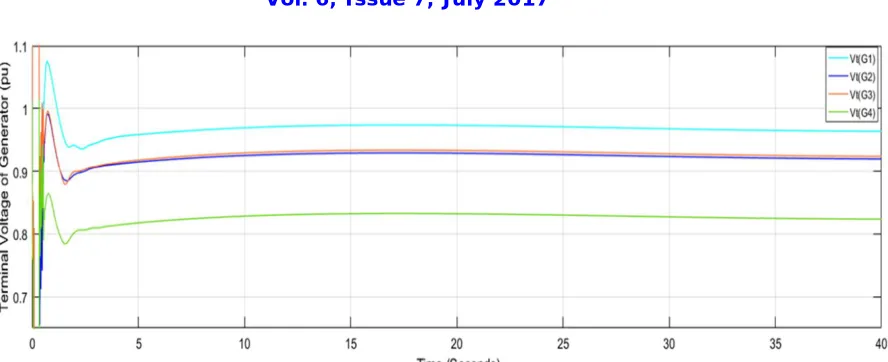
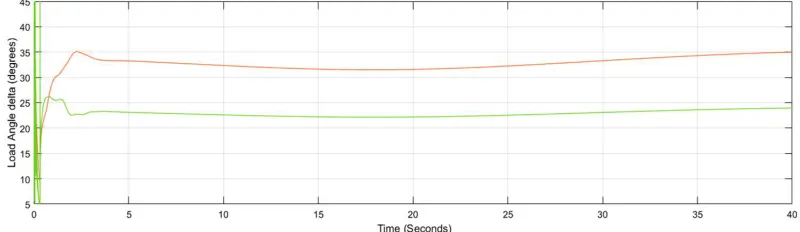
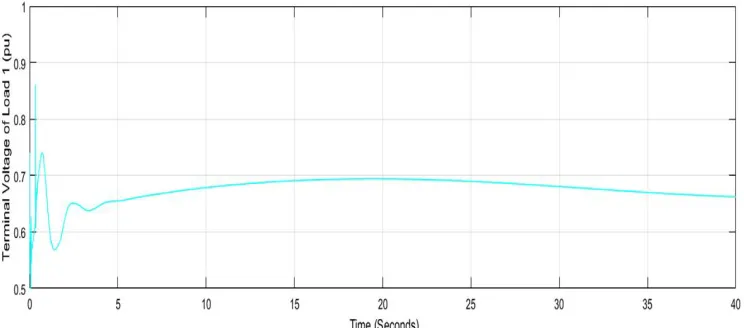
In this test system, SSSC is located at bus 8, and is in series with tie line Fig. 2. The phasor model of typical three levels PWM inverter has been used for SSSC with a rating of ± 100 MVA. To study the test system during disturbances, a three phase symmetrical short circuit fault of 20 cycle duration has been created at bus 7. The fault clearing time was taken 4 cycles after initiation of the fault. The variations of different parameters such as terminal
ISSN (Print) : 2320 – 3765 ISSN (Online): 2278 – 8875
I
nternational
J
ournal of
A
dvanced
R
esearch in
E
lectrical,
E
lectronics and
I
nstrumentation
E
ngineering
(An ISO 3297: 2007 Certified Organization)
Website: www.ijareeie.com
Vol. 6, Issue 7, July 2017
Fig. 5 Variations in Terminal Voltages of the Generators with SSSC
Fig. 6 Variation in Load Angle of the Generator with SSSC
Fig. 8 Variation of Terminal Voltage at Load 2 with SSSC INTER AREA TEST SYSTEM WITH STATCOM:
The test system with STATCOM has shown in Fig. 3. In this model, STATCOM has been placed in shunt position at bus 8 with a rating of ± 250 MVA. To study the test system during disturbances, a three phase symmetrical short circuit fault of 20 cycle duration has been created at bus 7. The fault clearing time was taken 4 cycles after initiation of the fault. The fault clearing time was taken 4 cycles after initiation of the fault. The variations of different parameters such
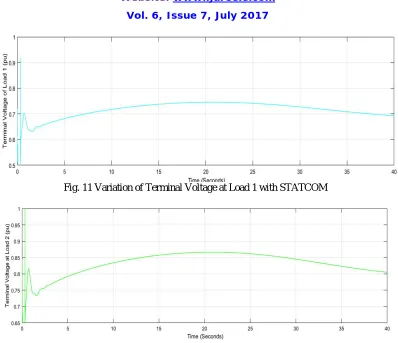
as terminal voltage of generators, load angle δ and terminal voltages of load 1 and load 2 are shown in Fig. 9 to Fig. 12. From the results it can be observed that terminal voltage of generators settles down to about 0.89 p. u. for G1,
0.8p. u. for G2, 0.8 p. u. for G3 and 0.82 for G4 under steady state conditions. From Fig. 8 it is evident that inter area oscillations have been damped out and generators G1, G2, G3 and G4 have settled at 35°, 23.9°, 35°and 23.9° respectively.
ISSN (Print) : 2320 – 3765 ISSN (Online): 2278 – 8875
I
nternational
J
ournal of
A
dvanced
R
esearch in
E
lectrical,
E
lectronics and
I
nstrumentation
E
ngineering
(An ISO 3297: 2007 Certified Organization)
Website: www.ijareeie.com
Vol. 6, Issue 7, July 2017
Fig. 11 Variation of Terminal Voltage at Load 1 with STATCOM
Fig. 12 Variation of Terminal Voltage at Load 2 with STATCOM INTER AREA TEST SYSTEM WITH UPFC:
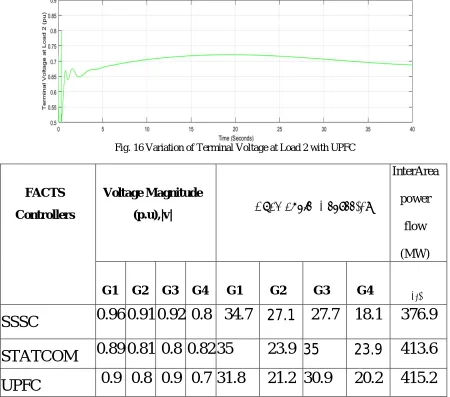
In this two area system, UPFC has been placed at bus 8 and is in series with the tie line. In the modified model of test system, the simulink based phasor model of UPFC comprising of two IGBT based converters one connected in shunt (±250 MVA) and other connected in series (± 100 MVA) with bus 8 has been used. Similar to SSSC and STATCOM, to study the system during disturbances, a three phase symmetrical short circuit fault of 20 cycle duration has been created at bus 7. The fault clearing time was taken 4 cycles after initiation of the fault. The simulated results of
terminal voltage of generators, load angle δ and terminal voltages of load 1 and load 2 are shown from Fig. 13 to Fig.
Fig. 13 Variations in Terminal Voltages of the Generators with UPFC
Fig. 14 Variation in Load Angle of the Generator with UPFC
ISSN (Print) : 2320 – 3765 ISSN (Online): 2278 – 8875
I
nternational
J
ournal of
A
dvanced
R
esearch in
E
lectrical,
E
lectronics and
I
nstrumentation
E
ngineering
(An ISO 3297: 2007 Certified Organization)
Website: www.ijareeie.com
Vol. 6, Issue 7, July 2017
Fig. 16 Variation of Terminal Voltage at Load 2 with UPFC
FACTS
Controllers
Voltage Magnitude
(p.u),|v|
Load angle (Degree), δ
InterArea
power
flow
(MW)
G1
G2
G3
G4
G1
G2
G3
G4
SSSC
0.96
0.91
0.92
0.8
34.7
27.1
27.7
18.1
376.9
STATCOM
0.89
0.81
0.8
0.82
35
23.9
35
23.9
413.6
UPFC
0.9
0.8
0.9
0.7
31.8
21.2
30.9
20.2
415.2
TABLE I. PERFORMANCE COMPARISIONS OF DIFFERENT FACTS CONTROLLERS FOR INTER AREA SYSTEM
Voltage Magnitude (p.u),
|v|
Load angle (Degree), δ
InterArea
power
flow
G1
G2
G3
G4
G1
G2
G3
G4
0.9
4
0.8
0.9
0.87
29.6
20.8
29.6
20.8
192.3
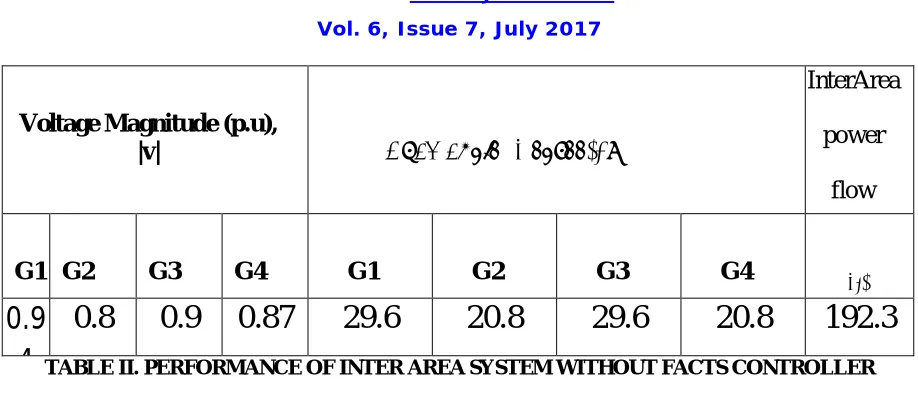
TABLE II. PERFORMANCE OF INTER AREA SYSTEM WITHOUT FACTS CONTROLLER
IV. CONCLUSION
In this paper, transient stability enhancement of two area multimachine power system including three different FACTS Controllers has been compared. The various performance of UPFC in terms of voltage magnitude of generators
(G1, G2,G3, and G4) and load (L1, L2) along with load angle (δ) are compared with other FACTS Controllers such as
SSSC and STATCOM. The test system without FACTS Controller is also studied the inter area power flow is decreased that means the settling time is more when compared to with FACTS Controllers. It is clear from simulation results that UPFC is most effective controller for transient stability improvement as compared to other FACTS Controllers.
REFERENCES
[1] P. Kundur, Power System Stability and Control, McGraw- Hill, New York, 1994. [2] P. M. Anderson, and A. A. Fouad, Power System Control and Stability, IEEE Press, 2003.
[3] P. Petitclair, Y. Besanger, S. Bacha, and N. Hadjsaid, “FACTS modelling and control: application to the insertion of a STATCOM on power aystem”, IEEE Industry Applications Conf., vol. 3, pp. 22132217, Oct. 1997.
[4] L. Chun, J. Qirong, and W. Zhunghong, “Study of STATCOM control for power swings damping improvement” IEEE Power System Tech. Conf., vol. 1, pp. 535- 540, 2000.
[5] M. H. Haque, “Damping improvement by FACTS devices: a comparison between STATCOM and SSSC” Elsevier Electric Power Systems Research, vol. 76, no. 9, pp. 865-872, June 2006.
[6] M. S. Rawat and R. N. Sharma, “The effective role of PSS in damping inter area mode of oscillation using MATLAB/Simulink”, in Proc. IEEE Conf. Computational Intelligence and Communication Networks, pp. 732-736, 2011.
[7] Vandana Dr. S. N. Verma,” Comparative Study of Different Facts Devices”, V3I6-IJERTV3IS061691, IJERT)- Vol. 3 Issue 6, June, 2014. [8] Sunil Singh, D. N. Vishwakarm,” Impact of Series FACTS Controllers on Distance protection- A Review”, (RDCAPE) - Singh 2015.
[9] Priyank Srivastava, RashmiPardhi “A Review on Power System Stability and Applications of FACTS Devices”, International Journal of Engineering Research and Applications (IJERA) issn: 2248-9622 www.ijera.com vol. 3, issue 3, pp.879-883, May 2016.