An Empirical Study of Multipath Routing
Protocols in Wireless Sensor Networks
Swati Lipsa
Department of IT, College of Engineering and Technology, Techno Campus Ghatikia, Bhubaneswar, India
Abstract— Wireless Sensor Networks (WSNs) consist of thousands of tiny nodes having limited sensing, computation, and communicating capabilities. Many routing, power management, and data dissemination protocols have been specifically designed for WSNs where energy consumption is an essential parameter to be considered. Since wireless sensor network protocols are application specific, the focus has been given to the routing protocols that might differ depending on the application and network architecture. In this piece of work, the study of various routing protocols for Wireless Sensor Networks presents a broad outlook of existing routing protocols for Wireless Sensor Network applications. Routing protocols for wireless sensor networks are responsible for maintaining the path from source to destination and have to ensure reliable multi-hop communication in a harsh environment. Further, the aim is to identify the various types of multipath routing protocols and to analyze the strength and limitations involved in it.
Keywords— Wireless sensor network, routing protocols, multipath routing
I. INTRODUCTION
Wireless sensor network (WSN) is widely considered as one of the most important technologies for the 21st century [1]. In the past decades, it has received tremendous attention from both academia and industry all over the world. Wireless sensor networks (WSNs) consist of densely deployed sensor nodes, which have limited computational capabilities, power supply, and communication bandwidth. These small, smart and inexpensive sensing and computing devices open up new horizons for scientists and engineers to observe and monitor physical phenomenon. The sensor nodes communicate over short distance via a wireless medium and collaborate to accomplish a common task. In general, WSN operates by small and limited battery. The basic philosophy behind WSNs is that, while the capability of each individual sensor node is limited, the aggregate power of the entire network is sufficient for the required mission.
II. RELATED WORKS
Routing is a process of determining a path between source and destination upon request of data transmission. In WSNs the network layer is used to implement the routing of the incoming data. It is known that generally in multi-hop networks the source node cannot reach the sink directly. So, intermediate sensor nodes have to relay their packets. The implementation of routing tables gives a better solution to the aforesaid problem. These contain the lists of node optionfor any given packet destination.
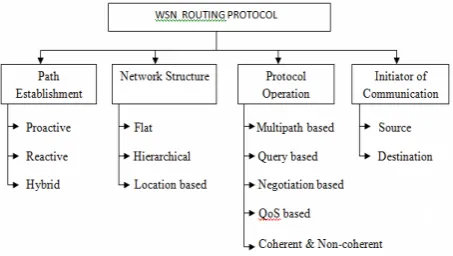
WSN routing protocols can be classified in four ways, according to the way of routing paths are established, according to the network structure, according to the protocol operation and according to the initiator of communications. Fig. 1 shows the classification of the WSN routing protocols.
Fig. 1 Classification of routing protocols in Wireless Sensor Networks
Routing paths can be established in one of three ways, namely proactive, reactive or hybrid. Proactive protocols compute all the routes before they are really needed and then store these routes in a routing table in each node. Reactive protocols [6] compute routes only when they are needed. Hybrid protocols use a combination of these two ideas. But in general, routing in WSNs can be divided into three categories named as flat-based routing, hierarchical-based routing and location hierarchical-based routing depending on the network structure. In flat-based routing, all nodes play the same role. In hierarchical-based routing, however, nodes will play different roles in the network. In location-based routing, sensor node positions are exploited to route data in the network. Furthermore, these protocols can be classified into multipath-based, query-based, negotiation-based, QoS-based, or coherent-based routing techniques depending on the protocol operation.
III. OBJECTIVES
With respect to the recent advances in the development of multipath routing protocols for wireless sensor networks, there is a need to investigate the significance as well as the detailed operation and classification of the proposed approaches. To fill this gap, this paper aims to identify the challenges pertaining to the design of multipath routing protocols for wireless sensor networks with alternative approaches to satisfy the performance requirements of different applications.
IV.METHODOLOGY
The term multipath routing has been used in the literature to describe the class of routing mechanisms that allow the establishment of multiple paths between source and destination. Classical multipath routing has been explored for two reasons. The first is load-balancing : traffic between a source-destination pair is split across multiple (partially or completely) disjoint paths. The second use of multipath routing is to increase the likelihood of reliable data delivery. In these approaches, multiple copies of data are sent along different paths, allowing for resilience to failure of a certain number of paths. Both these uses of multipath are applicable to wireless sensor networks. The previous studies in multipath routing introduce the following protocols.
Reliable and Energy-Aware Multipath Routing: It is designed to mitigate the energy efficiency requirement of wireless sensor networks, while provides reliable data transmission through maintaining a backup path from each source node towards the sink node. The routing operation in this protocol [12] is initialized by the sink node. In this, whenever the sink node receives an interest message from a source node and there is no active path towards the source node, it initiates a service-path discovery process through flooding a service-path request message. Upon reception of the service-path request message at the corresponding source node, the receiver node transmits a service-path reservation message towards the sink node (through the reverse path) to confirm the discovered path. While the service-path reservation message moves from the source node towards the sink node, whenever a node along the reverse path receives this message, it reserves a part of its residual battery level for data transmission over this path. The service-path construction process finishes by receiving the service-path reservation message at the sink node. Afterwards, the source node can transmit its data packets towards the sink node through the constructed path. After constructing the service-path, sink node initiates another path discovery process to establish a backup path towards the same source node by flooding a backup path discovery message. During this process, the intermediate nodes, which are not a member of the discovered service-path, broadcast the received backup path discovery message to their neighbours. Therefore, a node-disjoint path is created to provide fault tolerance in the case of service-path failure. Although this protocol provides energy-efficient and reliable data transmission, it still suffers from the main disadvantage, i.e, the end-to-end capacity of the protocol is limited to the capacity of a single path.
Source Routing: In Source Routing Protocol (SRP) [13] [10], each node keeps a database of different paths to the sink. The source specifies which route each message will take to reach the sink. The message follows the exact route specified by the source node. Since, each message would include the complete path that must be followed to the sink. The route selection seeks to smooth out traffic on the WSN, to optimize link capacity and to extend battery life.
Fig. 2 Source Routing
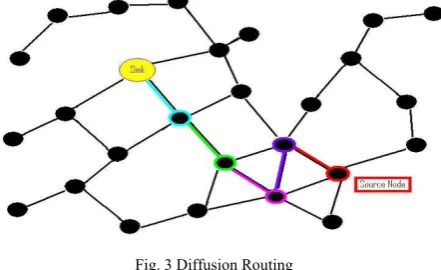
Diffusion routing: In Diffusion Routing Protocol (DRP) [14] [10] [15], each node keep a database of different paths to the sink. For each message to be sent to the sink, the source node will choose only the next node and forward the message to it. The source node will not specify the entire route to the sink. Instead, each node that receives the message will forward it one hop closer to the sink by choosing the next node from one of its known routes. The route selection seeks to smooth out traffic on the WSN, to optimize link capacity and to extend battery life.
Fig. 3 Diffusion Routing
Simultaneous Transmissions over Multiple Paths Routing: It is conceivable to use all or several of the multiple paths simultaneously to further shorten the time to delivery and to increase the delivery ratio of a given packet. The simplest idea is to assume node-disjoint paths and to send several copies of a given packet over these different paths to the destination. This trades off resource consumption and energy efficiency against packet error rates.
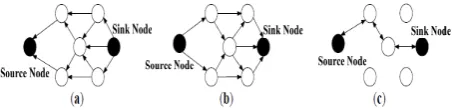
be performed by the sensor nodes. During this stage, all the intermediate nodes cache the interest messages received from their neighbours for later use. Moreover, upon reception of an interest message, the receiver node creates a gradient towards the node from which this message has been received. As it can be seen from Fig. 4(b), in this stage several paths can be discovered between each pair of source-sink nodes. After that, whenever a source node detects an event matched with the existing information in its interest table, it forwards its data packets towards the sink node through all the constructed gradients. The sink node receives its requested data through several paths with a low-data rate. Based on the packet reception performance over each path, the sink node can select the best path, i.e., the path with minimum latency, for data transmission. For this, the sink node reinforces the selected path by sending low-rate reinforcement messages towards the source node. Then, the source node merely transmits its data towards the sink node through the selected path. This process is demonstrated in Fig. 4(c). Furthermore, sink node continues to send low-rate interest messages over the remaining paths. This is to preserve the freshness of the established interest tables at the intermediate nodes, while it also maintains the discovered paths. When the active path fails to forward data packets, another available path can be used to provide fault-tolerant routing. Accordingly, whenever the data reception rate from the active path is reduced, the sink node reinforces the second available best path.
Fig. 4 A sample scenario for path creation in Directed Diffusion. (a) Interest propagation; (b) Gradient setup; (c) Path reinforcement and data transmission
Simulation results [17] show that directed diffusion can preserve event delivery ratio in the case of any node or link failure along the active path. Moreover, this protocol reduces data transmission delays caused by path failure by decreasing the frequency of route rediscovery. As directed diffusion depends on low-rate flooding for route discovery and path maintenance, this protocol does not provide an efficient route discovery mechanism. Furthermore, according to the main operation of this protocol, it can only be used in query-driven applications.
Braided multipath routing protocol: It is a seminal multipath routing protocol proposed to provide fault-tolerant routing in wireless sensor networks. This protocol uses a similar approach as Directed Diffusion to construct several partially disjoint paths. A general form of the established paths is presented in Fig. 5.
Fig. 5 Braided Multiple Path Routing
This protocol utilizes two types of path reinforcement messages to construct partially disjoint paths. Path construction is initiated through the sending of a primary path reinforcement message by the sink node to its best neighboring node towards the source node. For example, in Fig. 5, the sink node sends the primary path reinforcement message to node D. When an intermediate node receives a primary path reinforcement message, it forwards this message to its best next-hop neighboring node towards the source node. This process is repeated until the primary path reinforcement message reaches the source node. In addition to the primary path construction process, source node and all the intermediate nodes along the primary path construct an alternative path around their next-hop neighboring nodes. This alternative path passes through the neighboring node, which is not included in the primary path. To this aim, whenever the sink and intermediate nodes send out the primary path reinforcement message, they also generate an alternative path reinforcement message and send this message to their next preferred neighboring node towards the source node. For instance, in Fig. 5, the sink node sends an alternative path reinforcement message to node G in order to establish a backup path around node D. During this process, whenever an intermediate node, which is not a member of the primary path, receives an alternative path reinforcement message, it should forward this message to its best next-hop neighboring node. This process terminates upon reception of this message by one of the nodes along the primary path. As a result, each intermediate node along the primary path constructs a backup path around its next-hop neighboring node on the primary path via transmitting an alternative path reinforcement message. Through establishing a set of partially disjoint paths between the source and sink nodes, whenever the primary path fails to forward data packets towards the sink node, one of the constructed alternative paths can be utilized to avoid data transmission failure. Simulation results [18] show the lower overhead of braided multipath routing approach compared to the idealized node-disjoint multipath protocol. Furthermore, through performance evaluation of the proposed protocol under a wide range of failure probabilities, it is demonstrated that the proposed approach provides about 50% higher resilience against path failures, compared to the idealized node disjoint multipath protocol. However, since this protocol utilizes only one path for data transmission, the end-to-end throughput is limited to the capacity of a single path. Besides, since this approach is designed based on the principles of directed diffusion, the drawbacks of directed diffusion can be also applied to this protocol.
packets and sends multiple copies of the generated data packets over several paths. The source node determines the required number of paths to fulfill the reliability demands of the collected information according to the DPS fields of the data packets. During data transmission, all the intermediate nodes use the provided information by the DPS fields in the received data packets to determine the number of copies that should be transmitted to their next-hop neighboring nodes. This process continues until all the transmitted data packets reach to the sink node.
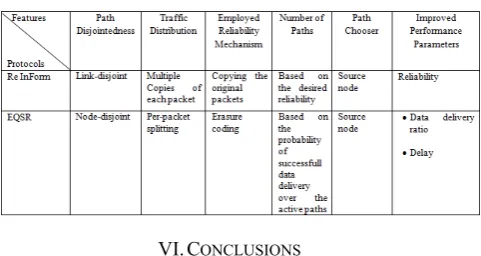
According to the main operation of this protocol, ReInForm[19] tries to improve data transmission reliability through utilizing the packet duplication technique at all the involved sensor nodes in the data transmission process. Accordingly, the elevated reliability of this protocol is achieved at the high cost of energy consumption and bandwidth utilization, which is in contrast with the primary demands of resource-constrained sensor nodes.
Energy-Efficient and QoS-based Multipath Routing Protocol (EQSR): This protocol is one of the recently proposed protocols designed to satisfy the reliability and delay requirements of real-time applications. EQSR[20] improves reliability through using a lightweight XOR-based Forward Error Correction (FEC) mechanism, which introduces data redundancy in the data transmission process. Furthermore, in order to fulfill the delay requirements of various applications, this protocol utilizes a service differentiation technique through employing a queuing model to manage real-time and non-real-time traffic. EQSR initializes through broadcasting a HELLO message by all the sensor nodes. During this phase, sensor nodes collect information regarding to the cost of data transmission though their neighboring nodes. In the second phase of this protocol, the sink node starts the route discovery process by sending a Route-request message to its preferred neighbor selected by the following equation. Intermediate nodes use the following equation to select the most preferred next-hop neighboring node towards the source node from their neighboring set N. This process continues among the intermediate nodes until the source node receives a Route-request message transmitted by the sink node:
Next_hop = MaxyNx{αEresd,y+βBbuffer,y+Iinterference,xy}
where Nx is the neighbor set of node x. αEresd,y and βBbuffer,y indicate the residual battery level and available buffer size at neighbor y, respectively. Iinterference,xy is the experienced SNR over the link between node x and node y. All the sensor nodes calculate the values of these parameters for their neighboring nodes during the first stage of this protocol. Besides the primary-path establishment process, the sink node also starts to construct additional paths by sending subsequent Route-request messages to its next-preferred neighbouring nodes. Whenever all the possible paths between a pair of source-sink nodes are discovered, a set of paths will be selected based on the probability of successful data transmission over each path. Furthermore, according to the propagation delay of the Route-request messages, EQSR estimates the data transmission delay of the paths and dedicates the best L paths for real-time traffic and the remaining paths for non-real-time traffic. At the last
stage of this protocol, EQSR uses a lightweight XOR-based FEC algorithm to calculate Error Correction Codes (ECC) for data packets. Finally, the source node distributes its traffic over the selected paths according to their end-to-end delay. While EQSR reduces transmission delay and improves reliability, nevertheless, the FEC mechanism which is used to compute ECCs and retrieval of the original messages, imposes high control overhead.
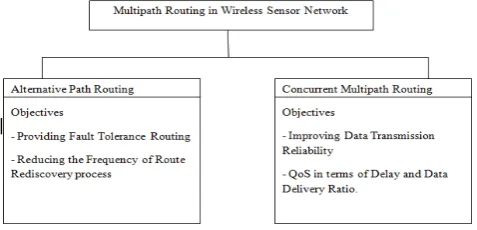
Taxonomy of Existing Multipath Routing Protocols: The different applications in Wireless Sensor Network demand for specific path selection and traffic distribution mechanisms. The proposed taxonomy classifies the existing multipath routing protocols into two main categories (i.e., alternative path routing, and concurrent path routing), based on the employed path selection and traffic distribution mechanisms.
Fig. 6 Taxonomy of the existing multipath routing protocols in wireless sensor networks
V. EXPERIMENTAL ANALYSIS
Alternative Path Routing: Most of the existing multipath routing protocols in this class were mainly developed to provide fault tolerance at the network layer of protocol stack. Since providing fault tolerance was the primary motivation of utilizing multipath routing approaches for reliable data transmission over unreliable links, most of the early works on multipath routing technique fall in this category. As link and node failures are the main causes of path failures, the primary objective of these protocols is to guarantee certain performance parameters through preserving multiple alternative paths as the backup routes. Table 1 summarizes few of the protocols from this category already described earlier.
Concurrent Multipath Routing: The ongoing research on multipath routing approach tries to cope with the resource limitations of low-cost sensor nodes through concurrent data forwarding over multiple paths. Table 2 summarizes few of the protocols from this category already described earlier.
Table 2 Summary of the multipath routing protocols with concurrent multipath routing approach
VI.CONCLUSIONS
Routing is a significant issue in Wireless Sensor Networks. This paper provides a comprehensive analysis of the recently proposed multipath routing protocols for wireless sensor networks. Nowadays, multipath routing techniques are considered an efficient approach to improve network capacity and resource utilization under heavy traffic conditions. With respect to the recent advances in the development of multipath routing protocols for wireless sensor networks, there is a need to investigate the significance as well as the detailed operation and classification of the proposed approaches. To fill this gap, in this paper has attempted to identify the challenges pertaining to the design of multipath routing protocols for wireless sensor networks. In addition, the work has highlighted the main advantages of using multipath routing approach to satisfy the performance requirements of different applications. This paper also introduces a new taxonomy on the multipath routing protocols designed for wireless sensor networks. The provided classification is performed based on the employed path utilization methods that can be used by multipath routing protocols to achieve various performance benefits.
REFERENCES
[1] “21 ideas for the 21st century”, Business Week, Aug. 30 1999, pp. 78-167.
[2] Haenggi, Martin. "Opportunities and challenges in wireless sensor networks."Handbook of Sensor Networks: Compact Wireless and Wired Sensing Systems (2005): 1-1. [3] Mainwaring, Alan, David Culler, Joseph Polastre, Robert
Szewczyk, and John Anderson. "Wireless sensor networks for habitat monitoring." In Proceedings of the 1st ACM international workshop on Wireless sensor networks and applications, pp. 88-97. ACM, 2002.
[4] Cerpa, Alberto, Jeremy Elson, Deborah Estrin, Lewis Girod, Michael Hamilton, and Jerry Zhao. "Habitat monitoring: Application driver for wireless communications technology." ACM SIGCOMM Computer Communication Review 31, no. 2 supplement (2001): 20-41.
[5] “Self-healingMines”
http://www.darpa.mil/ato/programs/SHM/
[6] Lee, CK-L., Xiao-Hui Lin, and Yu-Kwong Kwok. "A multipath ad hoc routing approach to combat wireless link insecurity." In Communications, 2003. ICC'03. IEEE International Conference on, vol. 1, pp. 448-452. IEEE, 2003.
[7] Krishnamachari, Bhaskar, Deborah Estrin, and Stephen Wicker. "Modelling data-centric routing in wireless sensor networks." In IEEE infocom, vol. 2, pp. 39-44. 2002. [8] Singh, Shio Kumar, M. P. Singh, and D. K. Singh. "A
Survey of Energy-Efficient Hierarchical Cluster-Based Routing in Wireless Sensor Networks." International Journal of Advanced Networking & Applications 2, no. 2 (2010).
[9] Johnson, David B., and David A. Maltz. "Dynamic source routing in ad hoc wireless networks." In Mobile computing, pp. 153-181. Springer US, 1996.
[10] Al-Karaki, Jamal N., and Ahmed E. Kamal. "Routing techniques in wireless sensor networks: a survey." Wireless communications, IEEE 11, no. 6 (2004): 6-28.
[11] Akyildiz, Ian F., Weilian Su, Yogesh Sankarasubramaniam, and Erdal Cayirci. "A survey on sensor networks." Communications magazine, IEEE 40, no. 8 (2002): 102-114.
[12] Hassanein, Hossam, and Jing Luo. "Reliable energy aware routing in wireless sensor networks." In Dependability and Security in Sensor Networks and Systems, 2006. DSSNS 2006. Second IEEE Workshop on, pp. 54-64. IEEE, 2006. [13] Lou, Wenjing. "An efficient N-to-1 multipath routing
protocol in wireless sensor networks." In Mobile Adhoc and Sensor Systems Conference, 2005. IEEE International Conference on, pp. 8-pp. IEEE, 2005.
[14] Maxemchuk, Nicholas F. "Dispersity routing." In Proceedings of ICC, vol. 75, pp. 41-10. 1975.
[15] Lou, Wenjing, Wei Liu, and Yanchao Zhang. "Performance optimization using multipath routing in mobile ad hoc and wireless sensor networks." InCombinatorial optimization in communication networks, pp. 117-146. Springer US, 2006.
[16] Shah, Rahul C., and Jan M. Rabaey. "Energy aware routing for low energy ad hoc sensor networks." In Wireless Communications and Networking Conference, 2002. WCNC2002. 2002 IEEE, vol. 1, pp. 350-355. IEEE, 2002. [17] Intanagonwiwat, Chalermek, Ramesh Govindan, and
Deborah Estrin. "Directed diffusion: a scalable and robust communication paradigm for sensor networks." In Proceedings of the 6th annual international conference on Mobile computing and networking, pp. 56-67. ACM, 2000.
[18] Ganesan, Deepak, Ramesh Govindan, Scott Shenker, and Deborah Estrin. "Highly-resilient, energy-efficient multipath routing in wireless sensor networks."ACM SIGMOBILE Mobile Computing and Communications Review 5, no. 4 (2001): 11-25.
[19] Deb, Budhaditya, Sudeept Bhatnagar, and Badri Nath. "ReInForM: Reliable information forwarding using multiple paths in sensor networks." In Local Computer Networks, 2003. LCN'03. Proceedings. 28th Annual IEEE International Conference on, pp. 406-415. IEEE, 2003. [20] Ben-Othman, Jalel, and Bashir Yahya. "Energy efficient