An Efficient Multiple PKG Compatible Identity Based
Authenticated Key Agreement protocol
Harish Karthikeyan3, Suvradip Chakraborty1, Kunwar Singh2 and C. Pandu Rangan1 1
Department of Computer Science and Engineering, Indian Institute of Technology Madras, India [email protected], [email protected]
2
Department of Computer Science and Engineering, National Institute of Technology,Tiruchirapalli, India,
3 Department of Computer Science (SEAS),
Columbia University in the City of New York, New York, USA [email protected]
Abstract. In this paper we propose an efficient single-round, two-party identity based authenti-cated key agreement protocol in the setting of multiple Private Key Generators (PKGs). One of the major advantages of our construction is that it does not involve any pairing operations. To date, existing protocols in the Identity Based Key Agreement domain revolves around a single PKG envi-ronment. Efforts to exploit the multiple PKGs paradigm have placed excessive reliance on Elliptic Curve Cryptography and bilinear pairings. These are computationally intensive and cannot be used when computation is premium, specially in applications such as in a Vehicular Ad-Hoc Network (VANET) where the vehicles in a VANET may need to perform a large number of key agreement sessions. Previous attempts to model identity based key agreement in multiple PKG scenario by Chen and Kundla, McCullagh have very limited scope and provide weak security guarantees. We propose a new security model for identity based key agreement protocols involving multiple PKGs based on the eCK security model which is much more stronger than the existing models and cap-tures additional properties like Key Compromise Impersonation and forward secrecy that were not captured by the previous models. Our protocol is proven secure in this new security model under the Gap Diffie Hellman (GDH) assumption in the Random Oracle (RO) model.
Keywords: Identity Based Key agreement (IDKA), Identity Based Authenticated Key agreement (ID-AKE), Provable Security, Random Oracle Model, eCK model, Multiple PKG, Pairing-Free
1
Introduction
Key Exchange Protocols are designed and conceived for the exchange of communication between two parties in a secure manner in an insecure environment with the help of the established key. The established key is a key shared between the two parties in question, calculated from the values exchanged between them. As can be inferred, the security pitfall of this concept is the lack of authentication of the received messages. This is remedied with the notion of Authenticated Key Exchange (AKE) which allows the parties to authenticate each other before the key is established.
The first Key Agreement Protocol was proposed in [DH76]. This was a public key based system where every party has a pair of keys, the public key and the private key. These keys were used to establish the key. This was the most primitive model with susceptibility to an active adversary for a man-in-the-middle-attack. Security was guaranteed with the adoption of a certificate based model to authenticate the two parties marking the advent of Authenticated Key Exchange. Certificates are signed documents by a trusted party. The parties involved are mandated to obtain and verify certificates whenever key establishment process happens. This brings in the issue of public key certificate management with re-gards to revocation and updation. The constant need for communication with the trusted authority to regenerate certificates could also give room for increased communication cost. These drawbacks were addressed in the identity-based key agreement model.
identity of the peer party with which the key needs to be established. Identity Based Key Agreement thus have their own relative merits over its Public Key version but is bogged down by a severely crippling cap on the number of users a PKG can deal with. This limitation curtails the versatility of the protocol and often diminishes the benefits of an Identity Based model. This stumbling block is remedied by the notion of multiple PKGs which guarantees scalability with a little additional overhead that might be considered negligible when compared to the benefits that it offers. For example in applications like Vehicular Ad-Hoc Networks (VANETs) a carAcan inform another carBabout an accident, or traffic congestion in an area. The point of this communication is to effectively manage traffic and at the same time pass on critical information about life threatening events on the road for speedy recovery attempts. Since vehicles on the road come from the manufacturing plants of several different companies, for security purposes, these companies would each want to have a PKG for vehicles from their plants. This is a very valid expectation and thus we cannot have communication between only vehicles of the same manufacturer. This provides the impetus for research into the domain of multiple PKGs.
2
Related Works and Our Contribution
Following Shamir’s proposal for the paradigm of identity based cryptography, a number of key agreement protocols were proposed in the identity based paradigm. Chen et al. present a comparison of these protocols in [CCS07]. But most of them involved pairing and hence their practical implementation was not efficient. For applications, where computation is premium, usage of bilinear pairings offers very little scope. Gunther [G¨un90] and Saeednia [Sae00] proposed protocols which did not involve pairing; Fiore et al.[FG10] proposed a key agreement protocol without pairing which was an improvement over them. The first two protocols namely [G¨un90] and [Sae00] lacked formal proof of security; whereas the protocol in [FG10] was formally proved in the Canetti-Krawczyk [CK01] model and is also more efficient in terms of computational complexity than the protocols in [G¨un90] and [Sae00]. However the same was analyzed and vulnerabilities identified in [MM13] and in [CM09]. An improvement on this was done by [VSVR13]. Fujiokaet al.[FSXY15] proposed an IDAKE in id-CK+ model which is the ID based analogue of CK+ model using a CCA secure ID based key Encapsulation Mechanism (ID-KEM), a CPA-secure ID-KEM and a secure Key derivation Function (KDF). The security proof is given in standard model. However all of these above mentioned protocols catered for single PKG framework.
2.1 Our Contribution
Through this paper, we aim to make contributions along the following lines:
1. New Security Model.We propose a new security model analogous to the eCK model (which is for
the PKI-based authenticated key exchange) exclusively for multiple PKG scenario. Hitherto security proofs have been based on heuristic proving or are proved under weaker security model analogous to the BR and BJM model for identity based key agreement. Compared to these models our model is much morestronger and provides the adversary with lot more capabilities not captured by earlier models. The security of our protocol is also established under this model.
2. Pairing-Free and Single Round. A major advantage of our protocol is that it is pairing-free.
Bilinear pairings have markedly higher computation cost when compared to regular group arith-metic computations. In general it is always desirable to have a protocol that involves simple group theoretic operations than pairing as it is slightly inefficient to find many pairing-friendly curves. The documentation of MIRACL [Sco13], the cryptography library, discusses the costs associated with various cryptographic primitives. The values show that the cost associated with point multiplication in the group G1 of a bilinear mape : G1×G1 →GT is roughly faster than the pairing operation by a factor of 3:8. Our protocol is also optimal in the sense that it consists of onlysingle round (a single message flow per party). This increases the efficiency and maintains its utility in applications where computation and time is premium. Besides in our protocol both the parties need not wait for the values sent across by the other party to begin its computation and both can send the messages simultaneously to each other; hence our protocol is alsosynchronous. The security of our protocol is proven under Gap-Diffie Hellman (GDH) assumption in the Random Oracle (RO) model.
3. Secure Against Active Attacks.Some of the standard protocols such as the ones in [FG10] and
[FAA14] are vulnerable to active attacks such as Key-Offset and Forgery. We overcome this limitation by incorporating appropriate verification mechanisms that would abort the protocol in case of any change in values to be agreed upon. We ensure this by including a term which is a signature of the ephemeral keys. This provides enhanced security for minimal extra overhead.
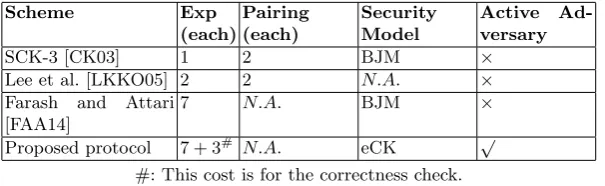
Table 1 compares our scheme with existing protocols. The comparison is based on the number of exponentiations (Exp), the number of pairing operations, the security model under which the schemes are proven secure and resistance to active adversary.
Scheme Exp
(each)
Pairing (each)
Security Model
Active Ad-versary
SCK-3 [CK03] 1 2 BJM ×
Lee et al. [LKKO05] 2 2 N.A. ×
Farash and Attari [FAA14]
7 N.A. BJM ×
Proposed protocol 7 + 3# N.A. eCK √
#: This cost is for the correctness check.
Table 1 :Comparison with the existing schemes
All of the protocols listed in the table have been designed for the multiple PKG model. From the table we can see that our protocol has been proven secure in a much stronger model when compared to existing protocols. It is also noteworthy that our protocol offers resistance to active adversary. This guarantees origin authentication, a feature missing in the other protocols. Alongside these our protocol also fixes all the attacks of the scheme presented in [FAA14] as reported in [MM13]. But for this we have to pay a cost of 3 extra exponentiations compared to [FAA14]. However this extra computation is justifiable when compared to the advantages our protocol provides.
3
Notations.
In this section we describe the notations we will be using throughout our paper. We denote the security parameter byκ. We assume that all the algorithms have implicit access to the security parameter written in unary. The set of integers is denoted by Z. [n] denotes the set {1, . . . , n} for n ≥ 1. We denote by
x∈RX the fact thatxis chosen uniformly at random from the setX. A functionν :N→R+is said to
benegligibleif∀c >0,∃k0 such thatν(k)< k−cfor allk0< k.Gdenotes a group of orderq(whereqis a
4
Our Security Model For Multiple PKG Identity Based Key Exchange
In this section we describe our new security model for Identity based key agreement protocols in the multiple PKG scenario. We assume that the number of PKGs is fixed at start up. Let us denote the number of PKGs byn. A protocol with the multiple PKG support is made up of two or more roles for the parties involved. The most common of these roles being the the initiatorI and the responderR. The parties involved are defined by their identityID(ik) which denotes that the partyIDi is registered with thekth PKG. We further assume that the identifiers of the users are unique globally, i.e., identifiers of different users registered under different PKGs are also unique among themselves. We assume that there is a binding between an identifier ID and the PKG under which it is registered with. This information may come hard-coded along with each identifier. This in turn provides uniqueness among the identities of the users even if two users in two different PKGs have the same identifier. Each of the protocol may have several sub protocols which are initiated by the parent protocol and these can happen multiple times leading to several instances of the protocol running at a party. Each instance of the protocol is called asession. With each session we associate aowner who initiates the session and the other party involved in the session is called as apeer. Messages are transmitted between the owner of the session and a peer of the session in the process of key establishment. These messages are from some message space
µ. These messages are based on local computations with some element of preprocessing. The messages that form the basis of communication constitutes the thesession state. The fundamental requirement of a key exchange protocol is that the parties involved have to compute the same session key. On successful completion of a session, each entity outputs thesession keyand thesession stateis deleted. If the session key establishment is unsuccessful, the session is said to be inabortstate, meaning that nosession keyis generated. Each entity participating in a session assigns a unique identifier to that session. The session identifiersidis defined bysid=IDi(k), IDj(l), out, in, ζ, where ID(ik)begins this session with its peer
IDj(l) andout andinare respectively the components or messages sent toIDj(l) and received byID(ik)
andζ indicates the role ,i.e., whether the party is the initiator (I) of the session or responder (R).
In an Identity based Key Agreement (IDKA) protocol in the multiple PKG settings each entity i is defined by a unique identity, IDi and is registered with a PKG. Each PKG (P KGk say) maintains its own public parameters paramsk which is available publicly and its own master secret keymskk which is its own secret, and generates the private key Si for each user i registered under the same PKG. A protocol consists of the following sub-functions:
ISetup:Each PKG chooses the public parameters and the master secret key. The public parameters are published and the master secret key is held confidential. The set up algorithm also outputs the number of PKGs which is fixed at start up.
IKey Generation:The useri submits its identityID(ik) to the P KGk (under which it is registered) and the PKG uses its own master secret key and public parameters to construct the private key Si(k)
corresponding to that user with identityID(ik).
IKey Agreement:To establish the shared secret key between two usersAandB with identitiesID(Ak)
and ID(Bl) registered with private key generators P KGk and P KGl respectively and possessing secret keysSA(k)andSB(l)respectively, the users engage in an interactive protocol by exchanging components and eventually set up theshared secret key at the end of that session. Either userAorB could initiate the protocol. In caseAstarts the protocol it takes as input the identity of the other user (peer) with whom it wants to communicate. However in multiple PKG scenario we need a minor technical requirement for each user. In a multiple PKG scenario each user also needs to learn the public parameters of the PKG under which its peer (with whom it wants to communicate) is registered with. In particular, in our case
Aneeds to the know the public params of theP KGl. SimilarlyB also needs to know the public params of theP KGk. We assume that the public parameters of all the PKGs come hardcoded with each user; thus requiring each user to store the public parameters of each PKG. However this is quite practical for most of the applications as the number of PKGs will be quite less. For e.g. in application like VANETs each car manufacturer will maintain its own PKGs and since the number of car manufacturers will be typically very less the number of PKGs will also be quite less in number. PartyAinitiates the protocol by taking the identity of its peer ,i.e.,IDB(l), the public parameters ofP KGland its own secret keyS
A with a messageout0 which in turn is computed as a function of ID(Ak), public parameters ofP KGk,
SB(l)and the message out received from its peer (in this case fromA). The out sent by Ais considered toin0 forB andout0 sent byB is considered to asinforA. After this exchange is over both the parties attempts to compute thesession key.
Adversary. We model the adversary as PPTM (Probabilistic Polynomial Turing Machine). In
addi-tion to passive eavesdropping, the adversary can control the communicaaddi-tion channel by modifying the outgoing messages and their sequence too. The modification can be altering, tampering, injecting new messages, delay the message delivery, reschedule the messages. In order to model more real life attacks the adversary is allowed to obtain much more information such as the long term secret key of parties (to modelForward Secrecy) or ephemeral key of parties (to modelKey Compromise Impersonation attack) or session keys of completed sessions between two parties (to model Known Session Key attack). The amount of information that the adversary gets is modeled by a set of oracle queries as follows:
1. Send(ID(ik),ID(jl), m):This query models the ability of an adversary to perform active attacks, i.e., to intercept all communication, send, receive, alter, delete and reschedule messages. It sends a message
mtoID(ik)on behalf ofIDj(l)and returnsID(ik)’s response to this message to the adversary. Ifm= 0, this query makes party ID(ik) to start an AKE session with ID(jl) and to provide communication from ID(jl) to ID(ik). Else it will send the message m from party ID(ik) to party ID(jl) and makes
ID(jl) respond to the supposed sessionIDi(lk, ID(jl), m, ?,I.
2. Corrupt(ID(ik)): This query allows an adversary to obtain the long term key of userIDi registered with private key generatorP KGk. Herek∈[n] wherenis the number of PKGs fixed at setup. 3. EphemeralKeyReveal(sid): This query allows the adversary to get the ephemeral keys of the session
sid.
4. SessionKeyReveal(sid):This query allows an adversary to learn the session key of a completed session with identifiersid.
5. MasterReveal(k): This query allows the adversary to learn the master secret key of the PKGP KGk.
6. EstablishParty(ID(ik)):This query allows an adversary to register a party with identityID(ik)to the system. A party against which this query is not issued is said to be honest, otherwise it is at the complete control of the adversary.
7. Test(sid): The adversary chooses a test session among all the completed and fresh sessions (see Definition 2 for freshness of a session). The challenger tosses a random bit b ∈R {0,1}. If b = 0 the challenger will give the adversary the correctly computed session key K0 of the test session. Otherwise the challenger will select a random shared secret key K1 from the distribution of session keys and provide the adversary withK1.
We now give the definition for amatching session and what it means for a session to befresh.
Definition 1 (Matching Sessions). Let Π be a protocol and sid = IDi(k), ID(jl), out, in, ζ and
sid0=ID(ay), ID (z)
b , out0, in0, ζ0
be the identifier of two sessions. Thensidandsid0are called matching sessions if:
• b=ianda=j
• z=k andy=l
• in0=outandout0 =inand
• ζ06=ζ
It is prudent to note thatkcan be equal to l. This would effectively be a single PKG scenario.
Definition 2 (Session Freshness). Let Π be a protocol, and sid = (IDi(k), IDj(l), out, in, ζ) be the identifier of a completed session. The session sid is said to be locally-exposed if any of the following conditions holds:
• A issued a SessionKeyReveal(sid) or SessionKeyReveal(sid0) (if the matching session sid0 exists).
• A matching session sid0 exists andAissued both Corrupt(ID(k)
• A matching session sid0 exists andAissued both Corrupt(ID(jl)) and EphemeralKeyReveal(sid0). • A issued an EstablishParty(IDi(k)) or EstablishParty(ID(jl)).
• A issued a MasterReveal(k) or MasterReveal(l) query.
• A matching session sid0 does not exist andAissued Corrupt(ID(jl)).
• A matching session sid0 does not exist andAissued both Corrupt(ID(ik)) and EphemeralKeyReveal(sid).
A sessionsidis said to be exposedif (a) it is locally exposed, or (b) its matching sessionsid0 exists and is locally exposed. A session that is not exposed is called fresh.
Definition 3. (IBKA- multiple(m)PKG security). LetΠ be a protocol with the property that if two
honest parties complete matching sessions, the two parties compute the same session key. This is defined as the correctness of the protocol. The protocol Π is said to beIBKA-mPKG-secure, if no polynomially bounded adversary can distinguish a fresh session key from a random value, chosen from the distribution of session keys, with probability significantly greater than 1/2.
The formal definition of a test query has been defined above. It is essential to note that only one query of this form is allowed. After theTestquery has been issued, the adversary can adaptively query the oracles like before provided the test session remains fresh in the sense of Definition 2. Finally, A outputs his guessb0 in the test session. An adversary wins the game if he guesses the challenge correctly i.e.,b0=b. The advantage ofAagainst Π in theIBKA-mPKGmodel is defined as
AdvIBKA−Π mPKG(A) =|Pr[b0=b]−1 2| The IBKA-mPKGsecurity ofΠ is defined as follows:
1. If two honest parties complete matching sessions, then with overwhelming probability they both com-pute the same session key.
2. For any probabilistic polynomial-time adversaryA,AdvΠ,AIBKA−mPKG is negligible.
5
Complexity Assumptions.
In this section we present the complexity assumptions required for our construction.
Definition 4. Computation Diffie-Hellman Problem (CDH) - Given (g, ga, gb) ∈
R G3 for
un-known a, b ∈Z∗q, where G is a cyclic prime order multiplicative group withg as a generator and q the order of the group, the CDH problem inGis to compute gab.
The advantage of any probabilistic polynomial time algorithm Ain solving the CDH problem inGis
defined as
AdvACDH=P r
A(g, ga, gb) =gab | a, b∈Z∗q
The CDH Assumption is that, for any probabilistic polynomial time algorithmA, the advantageAdvCDH
A
is negligibly small.
Definition 5. Decisional Diffie-Hellman Problem (DDH) -Given(g, ga, gb, h)∈
G4for unknown
a, b∈Z∗q, whereGis a cyclic prime order multiplicative group with g as a generator andq the order of
the group, the DDH problem in Gis to check whetherh=? gab.
The advantage of any probabilistic polynomial time algorithm Ain solving the DDH problem inGis
defined as
AdvADDH =|P r
A(g, ga, gb, gab) = 1
−P r
A(g, ga, gb, h) = 1
| |a, b∈Z∗
q
The DDH Assumption is that, for any probabilistic polynomial time algorithmA, the advantageAdvDDHA
is negligibly small.
Definition 6. Gap Diffie Hellman Assumption (GDH). Given (g, ga, gb)∈R G3 and access to a
Decision Diffie Hellman (DDH) oracle DDH(·,·,·) which on input ga, gb and gc outputs
only ifc=ab, the Gap Diffie Hellman problem is to computegab∈G.
The advantage of an adversaryA in solving the Gap Diffie Hellman problem is defined as
AdvGDHPA = PrhADDH(·,·,·)(g, ga, gb) =gabi
The Gap Diffie Hellman assumption holds in G if for all polynomial time adversaries A, AdvGDHPA is negligible.
6
Our Construction
In this section we present the detailed construction of our protocol. The following protocol is modified from the protocol proposed in [FAA14]. As demonstrated in [MM13], the protocol proposed by Farash and Attari suffers from attacks mounted by active adversary who has the power to intercept and modify the messages being exchanged. Ours construction fixes all these flaws that is pointed out by [MM13]. The intuitive idea of how our protocol avoids all these and other attacks is discussed in section 7.
We now present our protocol. Let IDA(k) and IDB(l) be the identities of two parties participating in the ID-AKE protocol. They may be registered under a single PKG or under two different PKGs.
Setup:On input the security parameter 1κ, this algorithm outputsparams, a set of system parameters. Each PKGi (i∈[n]) configure its parameters as follows:
• Choose a groupG(i)of orderq(i) whereq(i)is a prime and a generatorg(i)∈
G(i).
• Choose two hash functions,H1(i):{0,1}
∗
→Z∗
q(i) andH2(i):{0,1}
∗
→Z∗
q(i)
• Then it picks a randomx(i)←$
Z∗q(i) and setsy
(i)= (g(i))x(i) • Publishes the parameters hy(i), H(i)
1 , H (i)
2 ,G, q(i), g(i)i and keeps the master secret keymsk =x(i) private to itself.
Key Generation:A party with identifierIDi
U registered underP KGisends its attributes along with the hash of the attributes to the PKGi. The PKG verifies if these attributes are indeed bona-fide through out of band sensing. If the attributes are indeed valid, it checks if the hashed value is correct. After verifying it proceeds as follows:
• ChoosesrU $
← Z∗q(i) and computeRU = (g (i))rU • ComputeSU =rU+H
(i)
1 (IDU, RU)·x(i)
U’s long term private key ishSU, RUiand is transmitted via a secure channel.
Key Agreement: When a userA with identity IDA(k) registered with P KGk wants to communicate
with a userB with identityID(Bl)registered withP KGl, it sends a message toB initiating conversation. To generate this message,Achooses two ephemeral secret keys, one each from the group corresponding to the public paramsof P KGk and P KGl. It then generates the message components which are the ephemeral public keys and computes a Schnorr Signature on the ephemeral public keys (values). This signature is mainly used to provide safeguard against active adversary. It then performs a Diffie Hellman (DH) type shared key computation by raising the generator of P KGl to its long term secret key. This DH shared key is later used as a basis to compute one component of the final shared session key as shown in Step 5 of the Session Key Generation phase in our protocol. Once the components are in place, A
sends the message toB.Bchecks for the correctness of the message and responds with a similar message computed in a similar fashion. Once the message transfer is complete the users compute the session key. The details are outlined in Algorithm 1.
Key Sanity Check:After receiving the private key from the PKG in the Key Generation phase, the
user performs the following check to ensure the correctness of the components of the private key.
g(i)SU ?
=RU· y(i)
H1(i)(IDU,RU) . This can be verified as:
g(i)SU
= g(i)rU+H
(i)
1 (IDU,RU).x(i)
· · · ·(i) and
RU · y(i)
H1(i)(IDU,RU)
=grU ·(g(i))x (i)·H
1(i)(IDU,RU)
=grU+x(i)·H1(i)(IDU,RU)· · ·(ii)
Party A Party B
1.Choosesa(1)∈
RZq∗(1) and 1.Choosesb
(1)∈
RZq∗(1) and
a(2)∈RZq∗(2) b
(2)∈ RZq∗(2)
2.Compute: 2.Compute:
(a)TA(1)= (g(1))a(1) (a)T(1)
B = (g (1))b(1)
(b)TA(2)= (g (2)
)a
(2)
(b)TB(2)= (g (2)
)b
(2)
3.Compute: 3.Compute:
(a)VA(1)=SA+H (1) 2
IDA, T (1) A , T
(2) A
.a(1) (a)VB(1)= (g(1))SB
(b)VA(2)= (g(2))sA (b)VB(2)=SB+H2(2)
IDB, TB(1), TB(2)
.b(2)
hIDA,TA(1),T (2)
A ,RA,VA(1),V (2) A i
−−−−−−−−−−−−−−−−−−−−−−−−−−−−−−−−−−−−→
hIDB,TB(1),T (2)
B ,RB,VB(1),V (2) B i
←−−−−−−−−−−−−−−−−−−−−−−−−−−−−−−−−−−−−
Correctness Check: Correctness Check:
4.Computes and Checks: 4.Computes and Checks:
(a)CB=RB.(y(2))
H1(2)(IDB,RB)
(a)CA=RA.(y(1))
H1(1)(IDA,RA)
(b) (g(2))V
(2) B =? C
B.(T (2) B )
H2(2)(IDB,TB(1),T (2) B )
(b) (g(1))V
(1) A =? C
A.(T (1) A )
H(1)2 (IDA,TA(1),T (2) A )
If Check 4 is correctproceed: If Check 4 is correct,proceed:
5.Session Key Generation: 5.Session Key Generation:
(i)KA(1)= (VB(1).TB(1))(a
(1)+S A)
(i)KB(1)= (CA.TA(1))
(b(1)+SB)
(ii)KA(2)= (CB.TB(2))
(a(2)+SA)
(ii)KB(2)= (VA(2).TB(2))(b
(2)+S B)
(iii)KA(3)=TB(1)(
a(1))
(iii)KB(3)=TA(1)(
b(1))
(iv)KA(4)= (TB(2))(a
(2))
(iv)KB(4)= (TA(2))(b
(2))
Final Session Key Generation
A:KAB=H{IDA, IDB, T (1) A , T
(2) A , T
(1) B , T
(2) B , K
(1) A , K
(2) A , K
(3) A , K
(4) A } B:KBA=H{IDA, IDB, TA(1), T
(2) A , T
(1) B , T
(2) B , K
(1) B , K
(2) B , K
(3) B , K
(4) B }
Algorithm 1: Description of the Key Agreement protocol
Remark 1. It should be noted that in our protocol each PKG can choose different groups of different orders independent of the choice of other PKGs. The public parameters of each PKG also depends only on the group chosen by itself unlike some of the previous solutions like [CK03] which required the system parameters to be globally same for all PKGs.
Remark 2. The protocol is synchronous and consists of only one send per user per session. There is an initiator and a peer in this model.
Remark 3. The values ofIDi, Ri (i∈ {A, B}) are time invariant and they need to be sent only once at the time of first communication between the parties. From the next exchange onwards the parties can send onlyTi andVi values.
Remark 4. Correctness Check in Step 4 of the protocol ensures safeguard against an active adversary. An active adversary can tamper with the components exchanged which affects session key generation. This step essentially verifies the Schnorr signature on the ephemeral public keys.
Lemma 1. The shared secret key computed by both the parties are identical.
Proof. Assuming the correctness check goes through for both the parties, the key components can be constructed properly and also verified for equality with the shared key of the other party as show below:
KA(2)=K(2)B = g(2)(a(2)+SA)(b(2)+SB)
KA(3)=K(3)B = g(1)(a(1))(b(1)) KA(4) =K(4)B = (g(2))(a(2))(b(2)) Thus the session keysKAB andKBA are equal.
u t
7
Security Proof
In this section we present the formal security proof for our protocol described in the previous section. But before proceeding with the formal security proof we provide an informal discussion how our construction presented in Section 6 counters and fixes all the attacks presented in [MM13] for the protocol [FAA14].
1. Key Offset Attack: In this attack an adversary modifies the message being sent by multiplying the Ephemeral Public Key with its own exponentλ. This offsets the agreed session key by the same exponent unknown to either of the parties. This happens in protocols where key confirmation is absent. In the protocol proposed by Farash and Attari, the absence of origin authentication causes a vulnerability. The same is remedied in our protocol by adding an extra term in the message being sent. The extra term is effectively a Schnorr signature of the original terms being sent. The signature is verified in the correctness check of Step 4 in Algorithm 1. For an active adversary to successfully mount the attack in this model, it should have the ability to generate a new signature on the message being sent. This cannot be achieved as the signature generation involves the long term secret key of the user, which the adversary is unaware of.
2. Forgery Attack: In this attack, an eavesdropper intercepts the message that a user A broadcasts through the public channel. The eavesdropper uses the intercepted message to assume the identity of A and masquerade as A to other users. By a reasoning similar to that for Key Offset Attack, it is clear that the protocol of Farash and Attari has a vulnerability to this kind of attack and the extra terms being sent in our protocol remedies this vulnerability.
In addition to these attacks, as demonstrated in [MM13], the protocol in [FAA14] is vulnerable to Known Session Specific Temporary Information Attack (KSTIA) and Key Compromise Impersonation Attack (KCI).
3. KSTIA: In this attack the knowledge of the ephemeral secrets of both the parties gives the adversary the power to compute the session key. Our protocol completely overhauls the key computation aspect of the protocol proposed in [FAA14] to overcome this susceptibility. This is achieved by ensuring that the final key value is dependent onCDH(gSA, gSB) which has been incorporated in key componentsKµ λ whereλ∈ {A, B}andµ∈ {1,2}.
4. KCI: It is an attack where the adversary is able to use the compromised long-term key of a party
A to masquerade as another party B to A. It is obvious that when the long-term secret key of A
is compromised, the adversary can masquerade as A to other users. For the converse to happen, the adversary intercepts the message that B sends to A. The intercepted message is then modified with its own chosen values for the ephemeral secrets and the message is sent to A, effectively adversary masquerades asB to A. It then computes the session key. This attack works in [FAA14] since there is no correctness check. Our protocol avoids this problem by two ways - adding the signature and then checking the correctness and by making the key components dependent onSB andSA. For the adversary to be able to compute the session key it would need to successfully compute the values of KA(1) and
KA(2). This requires the knowledge ofSB which the adversary is not aware of. This shows our protocol’s resilience to KCI.
We now present the formal security proof of our protocol. The proof is based on the security model described for Identity Based Key Agreement in the Multiple PKG paradigm, (IBKA-mPKG) described in Section 4. The scheme is proved secure under the Gap Diffie-Hellman (GDH) assumption in the random oracle (RO) model. The security proof is modeled as a game between the challenger and the adversary.
Theorem 1. Under the GDH assumption inGand the RO model,the protocol in section 6 isIBKA −
Proof. As empowered by our security model, the adversary A is allowed to make session activation queries.
– A query of the formIDi(k), IDj(l)makes userIDi(k)registered with P KGk to performSteps 1-3 of our protocol, and create a session with identifierIDi(k), IDj(l),hTi(1), Ti(2), Ri, V
(1) i , V
(2) i i, ?,I
.
– On a queryID(ik), IDj(l),hTi(1), Ti(2), Ri, V (1) i , V
(2) i i
, userID(jl)performsSteps 1-3of our protocol and creates a session with identifierID(jl), IDi(k),hTj(1), Tj(2), Rj, V
(1) j , V
(2) j i,hT
(1) i , T
(2) i , Ri, V
(1) i , V
(2) i i,R
.
– The query IDi(k), IDj(l),hTi(1), Ti(2), Ri, V (1) i , V
(2) i i,hT
(1) j , T
(2) j , Rj, V
(1) j , V
(2) j i,R
makes A update
the session identifierIDi(k), IDj(l),hTi(1), Ti(2), Ri, V (1) i , V
(2) i i, ?,I
(if any) to
IDi(k), IDj(l),hTi(1), Ti(2), Ri, V (1) i , V
(2) i i,hT
(1) j , T
(2) j , Rj, V
(1) j , V
(2) j i,I
and performStep 4and then both the parties involve in session key generation phase of our protocol.
The adversary is also allowed to make the following queries:EphemeralKeyReveal, Corrupt, Session-KeyReveal, EstablishParty, andMasterReveal.
Let us assume that an adversaryAcan win the game, i.e, distinguish a fresh session key from a random session key chosen from the distribution of session keys, with probability significantly greater than 12.A can do this in one of the following ways:
– Guessing attack: Aguesses the test session key correctly.
– Key Replication attack:Asucceeds in making two non-matching sessions compute the same session
key and thenAsimply issues a session key reveal query on one of the sessions and uses that key in the other session.
– Forging attack:A computes the hash digest components correctly and queries theH digest query
to get the session key.
Since are proving in the random oracle model, the probability of success of the first two attacks are negligible. This is due to the collision resistance property of the hash function H. Thus it is enough to analyze the event E defined as the event “Asucceeds in forging the session key of a fresh session denoted bysid0=
IDi(k), IDj(l),hTi(k), Ti(l), Ri, V (k) i , V
(l) i i,hT
(k) j , T
(l) j , Rj, V
(k) j , V
(l) j i, ζ
”.
The event E is divided in two subcases – E.1: “A succeeds in forging the session key of a fresh session that has a matching session” and E.2: “A succeeds in forging the session key of a fresh session without a matching session”. So if suffices to show that neither E.1 nor E.2 can happen with non-negligible probability.
Analysis of E.1. If event E.1 occurs with non-negligible probability, using A we can build a GDH
solver that succeeds with non-negligible probability. Event E.1 can be further analyzed in each of these sub-cases:
– E.1.1: E.1∧ AissuesCorrupt(IDi(k)) andCorrupt(ID(jl)).
– E.1.2: E.1: ∧ Aissues anEphemeralKeyReveal query on bothsid0 andsid00.
– E.1.3: E.1: ∧ AissuesCorrupt(IDi(k)) and anEphemeralKeyReveal query on sid00.
– E.1.4: E.1: ∧ AissuesCorrupt(IDj(l)) and anEphemeralKeyReveal query onsid0.
Analysis of E.1.1. Suppose that E.1.1 occurs with non-negligible probability, usingAwe can build a polynomial time GDH solverS, which succeeds with non-negligible probability. The solver interacts with Aas follows:
S simulates A’s environment withnpkg(κ) separate PKGs, each PKG can support nu(κ) users whereκ
is the security parameter. SinceAis polynomial (in|q|), we suppose that each party may be involved in
ns(κ) sessions (npkg(κ), nu(κ), ns(κ)≤ L(|q|) for some polynomialL). We refer toID(ik)registered with
P KGk as ˆPi.Schooses ˆPl,Pˆm, andt∈R[ns(κ) + 1] (with these choices,S is guessing the test session). The challenger is given the CDH problem instancehG, g, q, p, C=ga, D=gbiof the corresponding GDH
instance. The challenger simulates the hash oracles in the following way:
H1 Oracle: The challenger is queried by the adversary for the hash value of the identityID (k)
before which is stored in the hash list Lh1 described below. Otherwise chooses ki ∈R Z∗q(k), computes
hi= g(i)
ki
, adds the tuplehhi, ID (k)
i , ki, Riito theLh1list.
Similarly, for oracle H2 the solver S looks up its corresponding listLh2 to see if the hash value corre-sponding to the query is already listed in the table.
Party corruption: The adversary presents the challenger with an identityID(ik) and the challenger should return the private key of that entity. The challenger proceeds as follows:
The challenger choosesr(ik)∈RZq∗(k). It then computesRi= (gi)r (k) i .
The challenger checks if theH1 Oracle was already queried forID (k)
i and Ri. If yes, it extracts ki,hi from the listLh1and proceeds to the next step. If not queried before, the challenger chooseski∈RZ∗q(k), computeshi= g(i)
ki
, adds the tuplehhi, ID (k)
i , ki, Riito theLh1 list. The challenger proceeds as per protocol to generate the long term keys.
Lemma 2. The private key returned by the challengerSduring the party corruption query are consistent with the system and it passes theKey Sanity Checkas it is generated as per the protocol only.
The solverS now interacts with Aas follows:
– S takes as inputC =Ti(1)
0 and D =T (1)
j0 ∈G. Here we assume that the paramsK has the groupG and generator as g. Note thatS does not know the values of a(1)i
0 anda (1)
j0 and the values ofa (1) i0 and
a(1)j
0 is implicitly set to aandbrespectively (from the GDH instance).
– On a session activation query of the form ( ˆPl,Pˆm),S does the following: • Choosei1,i2 as the ephemeral secrets.
• Create session identifiersid0=Pˆl,Pˆm,hRi, T (1) i , T
(2) i , V
(1) i , V
(2) i i, ?,I
and
• ProvideAwithPˆl,Pˆm,hRi, T (1) i , T
(2) i , V
(1) i , V
(2) i i
.
– On a session activation query of the form,Pˆm,Pˆl,hRj, T (1) j , T
(2) j , V
(1) j , V
(2) j i
,S does the following: • Choosei1,i2 as the ephemeral secrets.
Create session identifiersid0=Pˆl,Pˆm,hRi, T(1) i , T
(2) i , V
(1) i , V
(2)
i i,hRj, T (1) j , T
(2) j , V
(1) j , V
(2) j i,R
– ProvideAwithPˆl,Pˆm,hRi, T (1) i , T
(2) i , V
(1) i , V
(2) i i
• Completes the sessionPˆl,Pˆm,hRi, T (1) i , T
(2) i , V
(1) i , V
(2)
i i,hRj, T (1) j , T
(2) j , V
(1) j , V
(2) j i,R
.
– On the session activation queryPˆl,Pˆm,hRi, T (1) i , T
(2) i , V
(1) i , V
(2)
i i,hRj, T (1) j , T
(2) j , V
(1) j , V
(2) j i
,Sdoes the following:
• S updates the session identifierPˆl,Pˆm,hRi, T (1) i , T
(2) i , V
(1) i , V
(2) i i, ?,I
(if any) to
sid=Pˆl,Pˆm,hRi, T (1) i , T
(2) i , V
(1) i , V
(2)
i i,hRj, T (1) j , T
(2) j , V
(1) j , V
(2) j i,I
.
• If thesid0 session exists and is already completed,S sets thesidsession key to that ofsid0. – Else, if a digest query was previously issued on some
ψ =σ,Pˆl,Pˆm, Ri, T (1) i , T
(2) i , T
(1) j , T
(2)
j , Kλ1, Kλ2, Kλ3, Kλ4,
(in this case λ∈ {l, m}) S sets the
session key toH(ψ).
– Else S chooses Kij from the distribution of session keys and set the sid session key to Kij and updatesLh (the hash list ofH).
– IfA issues aCorrupt, an EphemeralKeyReveal, a SessionKeyReveal, or anEstablishParty query at a partyS answers faithfully.
– At the activation of thetthsession at atIDi(0k), if the peer is notIDj(l0),Saborts; otherwise, it provides Awith (IDi(k)
0 , ID (l) j0, T
(1) i0 , T
(2) i0 , V
(1) i0 , V
(2)
i0 , Ri0) (recall that the solver takes as inputT (1) i0 andT
(1) j0 ).
– WhenAactivates the session matching thetthsession at (ID(l)
j0,S providesAwith (IDj(l)
0, ID (k) i0 , T
(1) j0 , T
(2) j0 , V
(1) j0 , V
(2) j0 , Rj0).
– In any of the following situations,S aborts.
• Aissues aSessionKeyReveal query or anEphemeralKeyReveal query on ID(ik)
0 orID (l) j0. • Aissues anEstablishParty query onIDi(k)
0 or ID (l) j0.
– IfAhalts with a guess,S outputsKλ3 asCDH(C, D). OtherwiseS aborts.
The simulation remains perfect, except with negligible probability; the solverS guesses correctly the test
session with probability(npkg·nu)2ns
−1
. IfAsucceeds under this simulation, andSguesses correctly
the test session,SoutputsCDH(Ti(1)
0 , T (1)
j0 ). Hence ifAsucceeds with nonnegligible probability in E.1.1, S outputs with nonnegligible probabilityCDH(Ti(1)
0 , T (1)
j0 ),contradicting the GDH assumption.
Analysis of E.1.2. Suppose that E.1.2 occurs with non-negligible probability, usingAwe can build a polynomial time GDH solverS, which succeeds with non-negligible probability. We modify the interaction of event E.1.1 as follows:
– S takes as input C=Ri0 and D =V (1)
j0 ∈G. So it doesn’t know the values of ri0 andsj0. We have set ri0and Sj0 implicitly asaandbrespectively.
– On a session activation query of the form ( ˆPm,Pˆl,hRj, T (1) j , T
(2) j , V
(1) j , V
(2)
j i), with ˆPl = ID (k) i or
ID(jl),S does the following:
– On a session activation query of the form,Pˆm,Pˆl,hRj, T (1) j , T
(2) j , V
(1) j , V
(2) j i
,S does the following: • Choosei1,i2 as the ephemeral secrets.
• Create session identifiersid0=Pˆl,Pˆm,hRi, T (1) i , T
(2) i , V
(1) i , V
(2)
i i,hRj, T (1) j , T
(2) j , V
(1) j , V
(2) j i,R
• ProvideAwithPˆl,Pˆm,hRi, T (1) i , T
(2) i , V
(1) i , V
(2) i i
– On the session activation queryPˆl,Pˆm,hRi, T (1) i , T
(2) i , V
(1) i , V
(2)
i i,hRj, T (1) j , T
(2) j , V
(1) j , V
(2) j i,R
, with
ˆ
Pl=ID (k) i orID
(l)
j ,S does the following:
• S updates the session identifierPˆl,Pˆm,hRi, T (1) i , T
(2) i , V
(1) i , V
(2) i i, ?,I
(if any) to
sid=Pˆl,Pˆm,hRi, T (1) i , T
(2) i , V
(1) i , V
(2)
i i,hRj, T (1) j , T
(2) j , V
(1) j , V
(2) j i,I
• If thesid0 session exists and is already completed,S sets thesidsession key to that ofsid0.
• Else, if a digest query was previously issued on some
ψ=σ,Pˆl,Pˆm, Ri, T (1) i , T
(2) i , T
(1) j , T
(2)
j , Kλ1, Kλ2, Kλ3, Kλ4,
(in this caseλ∈ {l, m}) and ifKλ1=
CDHRi·
YkH1
(k)(ID
i,Ri)·T(1) i , V
(1) j ·T
(1) j
and
Kλ2=CDH
Vi(2)·Ti(2), Rj·
YlH1
(l)(ID(l) j ,Rj)
·Tj(2)(using theDDHoracle), S sets the session key toH(ψ).
• Else S chooses Kij from the distribution of session keys and set the sid session key to Kij and updatesLh.
– At A’s digest query on some ψ = σ,Pˆl,Pˆm, Ri, T (1) i , T
(2) i , T
(1) j , T
(2)
j , Kλ1, Kλ2, Kλ3, Kλ4,
(in this
caseλ∈ {l, m}) with ˆPl=IDiorIDj or with ˆPm=IDiorIDj,Schecks whether a valueKij already exists for the queriedψ, then it returnsKij as the completed session key, else
(i) if there is an already completed session with identifier
sid = Pˆl,Pˆm,hRi, T (1) i , T
(2) i , V
(1) i , V
(2)
i i,hRj, T (1) j , T
(2) j , V
(1) j , V
(2) j i,I
or sid0, and and if Kλ1 =
CDHRi.
YkH1
(k)(ID(k)
i ,Ri)·T(1) i , V
(1) j ·T
(1) j
andKλ2=CDH
Vi(2).Ti(2), Rj.
YlH1
(l)(ID(l)
j ,Rj).T(2) j
, thenS returns the completed session key, else
(ii) It choosesKij from the distribution of session keys and set thesidsession key toKij and provides AwithKij.
– At the activation of thetthsession at atID(k)
i0 , if the peer is notID (l)
j0,S aborts; otherwise, it chooses
i1, i2 as the ephemeral secrets and provide Awith
ID(ik)
0 , ID (l) j0, T
(1) i0 , T
(2) i0 , V
(1) i0 , V
(2) i0 , Ri
. Note that
– When A activates the session matching the tth session at ID(l)
j0, S chooses j1, j2 and provides A with (IDj(l0), IDi(0k), Tj(1)0 , Tj(2)0 , Vj(1)0 , Vj(2)0 , Rj). Note thatVj(1)0 is set asD, the input of the CDH problem instance.
– In any of the following situations,S aborts.
• Ahalts with a test session different from thetthsession atID(i0k). • Aissues aSessionKeyReveal atIDi(k)
0 or its matching session. • Aissues anEstablishParty orCorrupt query onIDi(k)
0 orID (l) j0.
– WhenAhalts with a guess σ0 for the test session,S outputs a guessCDH(C, D) fromKλ1, Ti1, Tj1 among other values known and determined by the challenger.
The simulation remains perfect, except with negligible probability. IfAsucceeds andS guesses correctly the test session (this happens with probability (npkg·nu)2ns
−1
· Pr(E.1.2)) S outputs CDH(C, D). Under the GDH assumption and RO model, this cannot happen, except with negligible probability.
Analysis of E.1.3 and E.1.4Events E.1.3 and E.1.4 are symmetrical to each other. So it suffices to analyze event E.1.3. Suppose that E.1.3 occurs with nonnegligible probability, using A we can build a polynomial time GDH solverS, which succeeds with non-negligible probability. The solver interacts with Aas follows:
– S takes as input C=Ti(1)
0 andD=V (1)
j0 ∈G. Note thatS does not know the private key ofj .
– On a session activation query of the formID(ik), IDj(l),hRi, T (1) i0 , T
(2) i0 , V
(1) i0 , V
(2) i0 i
,S does the follow-ing:
• Chooserj∈RZ∗p(l) and computeRj = (g(l)) rj
.
• Create a session with identifiersid0=IDj(l), IDi(k),hRj, T (1) j , T
(2) j , V
(1) j , V
(2)
j i,hRi, T (1) i , T
(2) i , V
(1) i , V
(2) i i,R
and provideAwithIDj(l), IDi(k),hRj, T (1) j , T
(2) j , V
(1) j , V
(2) j i
.
– ChooseKij from the distribution of session keys and set the session key toKij.
– On the queryIDj(l), IDi(k),hRj, T (1) j , T
(2) j , V
(1) j , V
(2)
j i,hRi, T (1) i , T
(2) i , V
(1) i , V
(2) i i
,S does the follow-ing:
Update the session identifierID(jl), IDi(k),hRj, T (1) j , T
(2) j , V
(1) j , V
(2) j i, ?,I
(if any) to
IDj, IDi,hRj, T (1) j , T
(2) j , V
(1) j , V
(2)
j i,hRi, T (1) i , T
(2) i , V
(1) i , V
(2) i i,I
.
– If a value is already assigned to thesid0 session key, set thesidsession key to that of sid0. Else, if a digest query was previously issued on some
ψ=σ,Pˆl,Pˆm, Ri, T (1) i , T
(2) i , T
(1) j , T
(2)
j , Kλ1, Kλ2, Kλ3, Kλ4,
(in this caseλ∈ {l, m}) and ifKλ1=
CDHRi·
YkH1
(k)(ID(k) i ,Ri)
·Ti(1), Vj(1)·Tj(1)and
Kλ2=CDH
Vi2·T
(2) i , Rj·
YlH1
(l)(ID(l)
j ,Rj)·T(2) j
, then set thesidsession key toH(ψ).
– Else,Kij from the distribution of session keys and set thesidsession key toKij.
– AtA’s digest query on some
ψ =σ,Pˆl,Pˆm, Ri, T (1) i , T
(2) i , T
(1) j , T
(2)
j , Kλ1, Kλ2, Kλ3, Kλ4,
(in this case λ∈ {l, m}) with Pl =IDj or Pm=IDi,S checks if the same query was made previously, if so it returns the previously returned value. Else it follows the steps as mentioned above.
– WhenAactivates the t-th session at ID(ik)
0 , if the peer is notID (l)
j0,S aborts; otherwise, it provides AwithIDi(k), IDj(l),hRi, T
(1) i , T
(2) i , V
(1) i , V
(2) i i
(recall that the solver takes as inputTi(1)
0 andV (1) j0 ).
– WhenAactivates the session matching thet-th session atID(i0k),S chooses rj ∈RZ∗p(l) if not chosen before and providesAwithIDj, IDi,hRj, T
(1) j , T
(2) j , V
(1) j , V
(2) j i
.
– In any of the following situations,S aborts.
• Ahalts with a test session different from thet-th session atIDi(k0). • Aissues aCorrupt(ID(jl)
0) query or anEstablishP arty query onID (k) i0 orID
(l) j0. • Aissues anEphemeralKeyReveal query on thet-th session atID(i0k).
– IfAhalts with a guess,Sproduces Ki1·
Ti(1)
0 ·Ri·(y (i))H1(k)
IDi(k),Ri
−j1 ·Vj(1)
0
−si
!
asCDH(C, D).
The simulation remains perfect, except with negligible probability; the solverS guesses correctly the test
session with probability(npkg·nu) 2
ns
−1
. IfAsucceeds under this simulation, andSguesses correctly the test session,S outputsCDH(C, D).
So from the analysis none of the events E.1.1, E.1.2, E.1.3,E.1.4 can occur with non-negligible probabil-ity,and hence we conclude that event E.1.1 cannot occur (except with negligible probability).
Analysis of E.2.Event E.2 can be further analyzed as follows:
– E.2.1: E.2∧ Aissues aCorrupt query on ID(ik)and
– E.2.2: E.2∧ Aissues aEphemeralKeyReveal query on the test session.
These are the strongest query thatAcan issue in event E.2.
Event E.2.1:To show that E.2.1 cannot happen with non-negligible probability, the simulation proceeds similar to the analysis of E.1.3. S takes as inputTi(1)0 and Vj(1)0 ∈RG(forID(ik),S chooseski ∈R Z∗q(k), computeshi= g(i)
ki
). The simulation environment remains perfect except with negligible probability. IfAsucceeds with a forgery andS guesses correctly the test session (S guesses correctly the test session
with probability(npkg·nu) 2
ns
−1
),S outputsCDH(C, D) which contradicts the GDH assumption.
Event E.2.2:We modify the analysis of event E.1.2 by aborting whenAactivates a session matching the
tthsession atID(k)
i0 . The simulation environment remains perfect except with negligible probability. IfA succeeds andS guesses correctly the test session thenS outputsCDH(Ri0, V
(1)
j0 ).S is polynomial, and if E.2.2 occurs with non-negligible probability,S yields a polynomial time CDH solver, which succeeds with non-negligible probability; contradicting the GDH assumption.
8
Conclusion
Traditional notions of key agreement in the identity based paradigm is constrained by a single PKG with an upward ceiling on the number of users it can serve. The issue has larger ramifications in the context of organizations which are situated in diverse locations with large number of users. The solution to overcome the constraint is to embrace the idea of multiple PKG. We have proposed an efficient, pairing-free, single round identity based key agreement protocol (IDKA) which supports communication between parties registered with distinct PKGs. The protocol offers scalability and enhanced utility in several applications like the Vehicular Networks. We have also proposed a new security model based on the eCK model exclusively for multiple PKGs which is much stronger than the existing security models for IDKA involving multiple PKG. Our protocol also provides security against active adversary. We show that our protocol is secure in our new security model under the Gap Diffie-Hellman complexity assumption in the RO model. We leave open the problem of constructing a single round IDKA protocol in multiple PKG scenario in standard model.
References
[BR94] Mihir Bellare and Phillip Rogaway. Entity authentication and key distribution. In Advances in CryptologyCRYPTO93, pages 232–249. Springer, 1994.
[BWJM97] Simon Blake-Wilson, Don Johnson, and Alfred Menezes. Key agreement protocols and their security analysis. Springer, 1997.
[CK01] Ran Canetti and Hugo Krawczyk. Analysis of key-exchange protocols and their use for building secure channels. InAdvances in CryptologyEUROCRYPT 2001, pages 453–474. Springer, 2001.
[CK03] Liqun Chen and Caroline Kudla. Identity based authenticated key agreement protocols from pairings. InComputer Security Foundations Workshop, 2003. Proceedings. 16th IEEE, pages 219–233. IEEE, 2003.
[CM09] Qingfeng Cheng and Chuangui Ma. Ephemeral key compromise attack on the ib-ka protocol. IACR Cryptology ePrint Archive, 2009:568, 2009.
[DH76] Whitfield Diffie and Martin E Hellman. New directions in cryptography. Information Theory, IEEE Transactions on, 22(6):644–654, 1976.
[DKPS13] Shlomi Dolev, Lukasz Krzywiecki, Nisha Panwar, and Michael Segal. Certificating vehicle public key with vehicle attributes a (periodical) licensing routine, against man-in-the-middle attacks and beyond. InSAFECOMP 2013-Workshop ASCoMS (Architecting Safety in Collaborative Mobile Systems) of the 32nd International Conference on Computer Safety, Reliability and Security, 2013.
[FAA14] Mohammad Sabzinejad Farash and Mahmoud Ahmadian-Attari. A pairing-free id-based key agree-ment protocol with different pkgs. IJ Network Security, 16(2):143–148, 2014.
[FG10] Dario Fiore and Rosario Gennaro. Making the diffie-hellman protocol identity-based. InTopics in Cryptology-CT-RSA 2010, pages 165–178. Springer, 2010.
[FSXY15] Atsushi Fujioka, Koutarou Suzuki, Keita Xagawa, and Kazuki Yoneyama. Strongly secure authenti-cated key exchange from factoring, codes, and lattices. Designs, Codes and Cryptography, 76(3):469– 504, 2015.
[G¨un90] Christoph G G¨unther. An identity-based key-exchange protocol. InAdvances in CryptologyEuro-crypt89, pages 29–37. Springer, 1990.
[LKKO05] Hoonjung Lee, Donghyun Kim, Sangjin Kim, and Heekuck Oh. Identity-based key agreement protocols in a multiple pkg environment. InComputational Science and Its Applications–ICCSA 2005, pages 877–886. Springer, 2005.
[LLM07] Brian LaMacchia, Kristin Lauter, and Anton Mityagin. Stronger security of authenticated key ex-change. InProvable Security, pages 1–16. Springer, 2007.
[MB05] Noel McCullagh and Paulo SLM Barreto. A new two-party identity-based authenticated key agree-ment. InTopics in Cryptology–CT-RSA 2005, pages 262–274. Springer, 2005.
[MM13] Dheerendra Mishra and Sourav Mukhopadhyay. Cryptanalysis of pairing-free identity-based authen-ticated key agreement protocols. InInformation Systems Security, pages 247–254. Springer, 2013. [Sae00] S. Saeednia. Improvement of gunther’s identity-based key exchange protocol. Electronics Letters,
36(18):1535–1536, 2000.
[Sco13] M Scott. Miracl-a multiprecision integer and rational arithmetic c/c++ library. shamus software ltd, 2013.
[VSVR13] S Sree Vivek, S Sharmila Deva Selvi, Layamrudhaa Renganathan Venkatesan, and C Pandu Rangan. Efficient, pairing-free, authenticated identity based key agreement in a single round. In Provable Security, pages 38–58. Springer, 2013.