Improvement of Voltage Stability of Multi –Machine
System Using FACTS
Prof. Sushil Kumar
Pragati College of Engineering and Management Raipur, India Email Id [email protected]
ABSTRACT
This paper deals with power system applications that have been studied by examining the SVC and STATCOM controller applications. The detailed models of the STATCOM, SVC were implemented. These models include a detailed representation of the valves. The models are applicable for transient stability analysis and cover broader range of frequency oscillation and are also suitable for simulations in unbalanced power conditions.
KEYWORDS
SVC, STATCOM, D-FACTS, D-STATCOM, FACTS
1. INTRODUCTION
A power quality problem is an occurrence manifested as a non-standard voltage, current or frequency that results in a failure or a mis-operation of end-user equipment. Utility distribution networks, sensitive industrial loads and critical commercial operations suffer from various types of outages and service interruptions which can cost significant financial losses. With the restructuring of power systems and with shifting trend towards distributed and dispersed generation, the issue of power
quality is going to take newer dimensions. In developing countries like India where the variation of power frequency and many such other determinants of power quality are themselves a serious question, it is very vital to take the positive steps in this direction. The present work is to identify the prominent concerns in this area and hence the measures that can enhance the quality of the power recommended
Electrical power losses in distribution system correspond to about 70% of total losses in electric power system. These electric losses can be considerably reduced through the installation and control of reactive support equipment such as capacitor banks, reducing reactive currents in distribution feeders and so on.
power flows in low voltage distribution
network.
This paper presents the enhancement of voltage sags/swell ; harmonic distortion and low power factor using distribution static compensator (D-STATCOM) .The model is based on the voltage source converter (VSC) principle. The D-STATCOM injects a current into the system to mitigate the voltage sags/swell to improve harmonic distortion and low power factor. The simulations were performed using MATLAB SIMULINK.
2. DESCRIPTION
2.1DESCRIPTION
OF
THE
TRANSMISSION LINE
The power systems today are complicated networks with hundreds of generating
stations and load centers being
interconnected through power transmission lines. An electric power system can be subdivided into four stages:
1. Generation
2. Transmission 3. Distribution and 4. Utilization (Load)
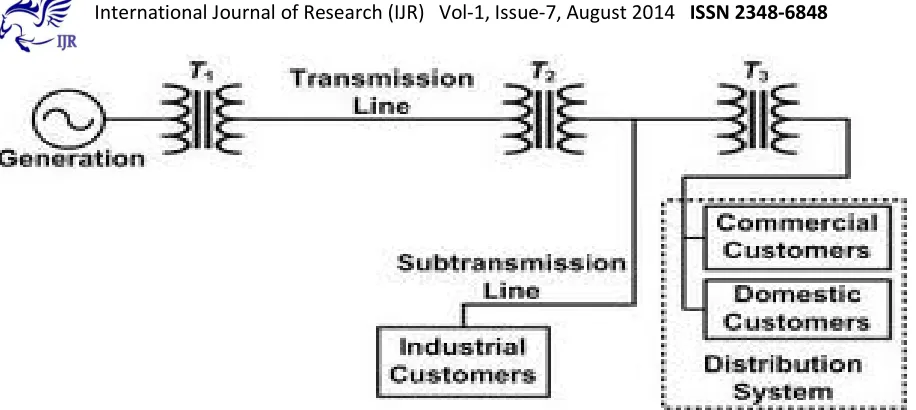
The basic structure of a power system is as shown in fig. It is composed of generating
plants, a transmission system and
distribution system. These subsystems are interconnected through transformers T1, T2 & T3.
FIG 1: TYPICAL POWER SYSTEMS
Now-a-days it is becoming very difficult to fully utilize the existing transmission systems assets due to various reasons, such as
environmental legislation, capital
investment, rights of ways issues,
construction costs of new lines, deregulation of policies, etc. Electric utilities are now forced to operate their system in such a way that makes better utilization of existing
transmission facilities. Flexible AC
transmission system (FACTS) controllers, based on the rapid development of power electronics technology, have been proposed in recent years for utilization of existing
transmission facilities. With the
development of FACTS technique, it become possible to increase the power flow controllability and enhance power systems stability. Recently, flexible alternative
current transmission system (FACTS)
controllers have been proposed to enhance the transient or dynamic stability of power systems.
During the last decade, a number of control devices under the term FACTS technology have been proposed and implemented. Application of FACTS devices in power systems, leads to better performance of system in many aspects. Voltage stability, voltage regulation and power system stability, damping can be improved by using these devices and their proper control. There are various forms of FACTS devices, some of which are connected in series with a line and the others are connected in shunt or a combination of series and shunt.
The FACTS technology is not a single high power controller but rather a collection of controllers which can be applied individually or in co-ordination with other to control one or more of the inter-related systems
parameters like voltage, current,
rated frequency. Among all FACTS devices,
static synchronous compensators
(STATCOM) plays much more important role in reactive power compensation and voltage support because of its steady state performance and operating characteristics.
The fundamental principle of a STATCOM installed in a power system is the generation ac voltage source by a voltage source inverter (VSI) connected to a dc capacitor. The active and reactive power transfer between the power system and the STATCOM is caused by the voltage difference across the reactance. The STATCOM can also increase transmission capacity, damping low
frequency oscillation and improving
transient stability. The STATCOM is represented by a voltage source, which is connected to the system through a coupling transformer .The voltage of the source is in phase with the ac system voltage at the point of connections, and the magnitude of the voltage is controllable . The current from the source is limited to a maximum value by
adjusting the voltage. Mathematical
modelling and analysis of static compensator (STATCOM) is presented in this. It explains the use of STATCOM for improvement of transient stability and power transfer.
2.2SIMULATION
MODELS
OF
SYSTEM
The system described in this section
illustrates modelling of a simple
transmission system containing two
hydraulic power plants. The FACT device
(SVC, STATCOM) and power system
stabilizers (PSS) are used to improve voltages stability and power oscillation damping of the system. The power system illustrated in this paper is quite simple. However, the phasor simulation method allows simulating more complex power grids.
The test system consists of three generators and three PQ bus (or load bus). This system which has been made in ring mode consisting of six buses (B1 TO B6) connected to each other through three phase transmission lines L12=450km, L14=300km,
L15=450km, L26=300km, L23=450km,
L25=200km, L24=250km, L36=250km,
L35=250km, L45=350km and
L56=150km,respectively.And the constant loads are connected of 700 MW at bus-4, 500 MW at bus-5 and 250 MW at bus-6 and variable dynamic load 2500+j1000 MVA at bus-6 as shown inFig.4.14.System has been supplied by three power plants with the phase-to-phase voltage equal to 11 kv. Active and reactive powers injected by power plants 1, 2 and 3 to the power system are presented in per unit by using base parameters Sb=2100 MVA and Vb=400KV, the power plants 1(G1), 2(G2) AND 3(G3) generated 1400MVA ,2100MVA and 700 MVA respectively.
transfer capability. Load flow has been
performed with machine G1 defined as a swing bus (V=11000V, 0 degrees), machine G2 defined as PV generation bus (V=11000V , P=534 MW). After the load flow has been solved, the reference mechanical powers and reference voltage for two machines have been automatically updated in the two constant blocks connected at the HTG and
excitation system inputs: pref1=0.750827pu (1051 MW), Vref1=1.0 pu; pref2= 0.761905
pu (1600MW), Vref2=1.01 pu;
pref2=0.761905pu (534 MW), Vref3=1.01pu.
FIGURE: 2
Conclusion
This paper deals with applications of the SVC and STATCOM. The detailed models of the SVC and STATCOM were implemented and tested in MATLAB / simulink environment. The models are applicable for voltage stability analysis and cover broader range of power transfer capability.
The effect of FACTS (SVC and STATCOM) installed in power transmission path are analyzed in this paper, and the conclusions are as follows:
1. The FACTS can improve voltage
stability limit observably and FACTS give better performance for power transfer capability for 4- bus system
transmission capacity increased
67.27 MVA (SVC) and 820.9 MVA (STATCOM).
2. The STATCOM give superior
REFERENCES
1. P. Kundur,“ Power System Stability and Control “, McGraw-Hill, 1994. 2. Y.H. Song and A.T. Johns, “Flexible ac
transmission systems (FACTS)”, The Institute of Electrical Engineers, London, 1999.
3. N.G. Hingorani and L. Gyugyi,” Understanding FACTS: concepts and
technology of flexible ac
transmission systems “, IEEE press, NY, 1999.
4. K.R. Padiyar “FACTS controllers in
power transmission and
distribution”, New Age International Publishers, 2007.
5. P.Rao, M.L. Crow and Z.Yang,”
STATCOM control for power system voltage control Applications “, IEEE Transactions on power delivery. 6. North American Electric Reliability
Council (NERC) report ‘Available Transfer Capability Definitions and Determination’ June 1996.
7. Duncan Wilson “Economic Provision of Reactive Power for System Voltage Control Market Options for Reactive Power”, IEE Colloquium- 9 October 1996.