IoT Based Cost Efficient Smart e-Parking
System
Mohammed Raheel Ahmed 1, T C Jermin Jeaunita 2
PG Student, Dept. of CSE, PESIT Bangalore South Campus, Bangalore, Karnataka, India1
Assistant Professor, Dept. of CSE, PESIT Bangalore South Campus, Bangalore, Karnataka, India2
ABSTRACT:The IOT based Cost Efficient Smart e-Parking System presents a novel method that builds the
proficiency of the present cloud-based brilliant parking framework and builds up system engineering in view of the IoT innovation. This project proposes a structure that helps customers actually locate an available slot in a parking area in any parking area view of new execution measurements and to compute the user parking cost by considering the separation and the aggregate total quantity of free unfastened location in every parking-area. This expense will be utilized to give an answer of finding an accessible parking spot upon a solicitation by the user and an answer of recommending another parking-area if the current parking area is full. Re-enactment consequences demonstrate that the calculation complements the likelihood of effective parking and reduces customer holding up time.
KEYWORDS: RFID, Smart e-Parking.
I. INTRODUCTION
In the developing cities, traffic is a major problem. Day by day vehicles are increasing, so parking is also a major issue and CO2 increases which leads to global warming. People will park their vehicle on a main road which
again leads to traffic and even vehicle unsafe. A new person in a city may not be aware of parking area, that person need to search manually to park vehicle. This may lead to waste of time in searching parking area, wastage of fuel, possibility of stuck in traffic. If parking area is full then driver has to wait for free parking area slot else search for another parking area which has free slot to park. In view of parking area, an administrator of parking area has to appoint more employees for vehicle security, check-out counter, monitoring parking slots and many more.
IOT based Cost Efficient Smart e-Parking System (CESePS) solve all this real time problem. In these proposed system, driver can view the list of parking areas, and make few minutes’ early reservation. This reduces time to search parking area, reduces fuel, avoid traffic, vehicle will be safe, optimal use of resources and parking area administrator has no need for appointing more employees, which leads the system to be cost efficient.
II. RELATED WORK
In [4], the research use community way finding to enhance productivity of shrewd parking frameworks and in this manner lessen activity blockage in metropolitan situations, while expanding proficiency and benefit of parking structures. A noteworthy part of movement in urban zones is represented by drivers looking for an accessible parking spot. Numerous urban areas have embraced a parking direction and data framework to attempt to lighten this movement blockage. Normally these frameworks involve advising the vehicle driver of the whereabouts of an available area, holding that area for the specific vehicle driver, and offering course to accomplish the target. Close to no report is taken of the amount of blockage will be brought on by numerous drivers being coordinated to the same vehicle park simultaneously. This research present the idea of community way finding to the issue. This research re-enact a shrewd parking framework for an urban situation, and demonstrate a novel way to deal with cooperatively arranging ways for various operators prompting lessened activity blockage on courses toward occupied with parking zones, while diminishing the measure of time when parking spots are empty, along these lines expanding the income earned.
multilevel reasonable model comprising of variables at the business, dyadic, and firm level to comprehend the drivers of co-opetition and talk about advantages and expenses of co-opetition for SMEs.
In [6], the research proposes another "brilliant parking" framework for an urban situation. The framework allocates and holds an ideal asset (parking spot) for a client (driver) taking into account the client's target work that consolidates nearness to destination and parking cost, while additionally guaranteeing that the general parking limit is effectively used. This research methodology understands a MIPL issue at each desire point in a period pushed grouping. The arrangement of each MILP is an ideal assignment in view of current state data and subject to irregular occasions, for example, new client demands or parking spots getting to be accessible. The allotment is redesigned at the following choice point guaranteeing that there may be no benefit reservation battle and that no customer is ever distributed an advantage with higher than the present expense capacity esteem. Reproduced contextual investigations are incorporated taking into account parking at part of the Boston school grounds demonstrating that this research will accomplish central alternate over uncontrolled parking systems or best in class direction based frameworks. Likewise depicts a research facility setting where this framework has been tried continuously.
The system proposed in [7], propels in distributed computing and IoT having given a promising chance to determine the challenges achieved by the expanding transportation issues. This research tends to be a blessing of a one of a kind multi-layered movement learning cloud stage by abuse distributed computing and IoT innovations to determine the difficulties brought on by the expanding transportation issues. This research exhibit a novel multi-layered vehicular information cloud stage by utilizing distributed computing and IoT innovations. Two inventive vehicular information cloud benefits, a shrewd parking cloud administration and a vehicular information mining cloud administration in the IoT environment are likewise introduced.
In [8], WMNs comprise of lattice switches and work customers, where network switches have negligible versatility and structure the foundation of WMNs. They give system access to both cross section and routine customers. The incorporation of WMNs with different systems can be expert through the entryway and crossing over capacities in the lattice switches. Network customers may be either desk bound or flexible, and might body a client community system amongst themselves and with go section switches. WMNs are anticipated to decide the constrainments and to out and out to improve the execution of specially appointed systems, WLANs, WPANs, and WMANs. They are experiencing quick advance and rousing various arrangements. WMNs will convey remote administrations for a vast assortment of uses in individual, nearby, grounds, and metropolitan territories. Regardless of late advances in remote cross section organizing, numerous examination challenges stay in all convention layers. This research exhibits a natty gritty study on late advances and open examination issues in WMNs. Framework models and utilizations of WMNs are portrayed, trailed by talking about the basic components impacting convention outline. Hypothetical system limit and the cutting edge conventions for WMNs are investigated with a goal to call attention to various open examination issues. At long last, test beds, mechanical practice, and current standard exercises identified with WMNs are highlighted.
In [9], the point of this research is to propose a configuration of an Automated Car Parking System directed by an Android application that manages the quantity of vehicles to be parked on assigned parking region via robotizing the Parking and Unpacking of the vehicle with the assistance of Commands of an Android Application. The investigation of some current frameworks demonstrates that the level of mechanization in them is restricted just to components like Number plate extraction, Comparison in light of Snapshots of parking spots, preparing of pictures or Mechanical lifts if there should arise an occurrence of multilevel parking. This research framework expects to decrease the human intercession to the negligible via robotizing the procedure of vehicle parking. This thus would end up being helpful in diminishing the time required for pursuit of free parking spot by physically driving through different spaces. The computerization in the vehicle is accomplished by method for highlight of Path Tracing utilizing Sensors. This research, thus, additionally display a numerical representation of our framework. This research additionally thus show the outcomes got lastly; concentrate on the future progressions for the task.
organizer and after that redesign database. The application layer can rapidly get the parking data through the Internet, and use points of interest of Web administration to assemble all the scattered parking data to convey accommodation to the general population who need to get a parking position.
In [4], this research mainly focus on addressing the problem oftraffic congestion in metropolitan cities, while increasing efficiency and profitability of parking areas.It enhance effectiveness of smartness of parking frameworks. In [5], Co-opetition entails the sharing of knowledge that may be a key source of competitive advantage. A driver for the formation of co-opetitive ties can originate from a company being challenged with a reduction in its competitive advantage, which, in turn, may endanger its profitability and reputation in the short run and/or its sustained survival in the long run. But [4] and [5], are complex framework. In [6], a driver get a response message from the system and can ensure the reservation. But this system works only in urban areas. In [7], have ability to provide Automobile service and it have better cloud computing. Drawback is challenges for the increasing transportation problems. In [8], provide network access for both mesh and conventional clients. It have ability to provide Wireless sensor networks. Drawback is large percentage of areas in between houses is not covered by wireless services. In [9] and [10], have ability to provide automated parking system, it is simple and based on Android Application. Drawback is choices are frequently more expensive than those of the cost-aware approach.
III. SYSTEM IMPLEMENTATION
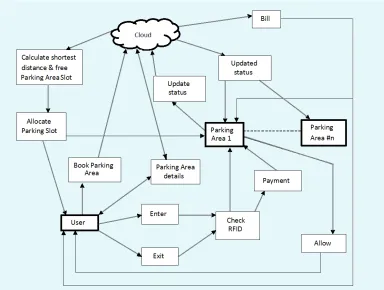
Fig 1: System Architecture.
parking area. Cloud sends a response message to user that entails allocated parking slot in particular parking area and respective parking area will receive user’s detail and slot. Once user enter into a parking area, RFID tag will be verified by check-point, allow to park and parking area details will be updated in a cloud. When user exits, again RFID tag will be verified by check-point, and a bill generated from cloud is sent to both user and respective parking area. Once payment done user is allowed to exit, parking area updates its status in cloud and cloud sends new updated status of parking area to its neighbour parking area.
IV. COMPONENTS IN THE FRAMEWORK
a. Cloud:
This is a Web substance that stores the asset data provided by check-point situated at every parking area. The framework permits a driver to make inquiry and finds data on parking slot from each parking area without the need to specifically get to the parking area server hub by straightforwardly getting to the cloud-based server. Cloud administrate all elements of parking framework and it also contain information about its parking areas and users.
b. Parking Admin:
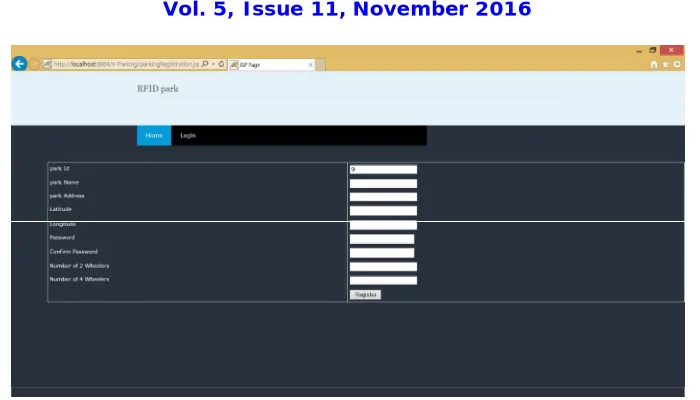
Parking admin will register its parking area and enter the details of parking area such as parking-area name, password, address along with latitude & longitude, two wheeler and four wheeler capacity. Cloud server provide a unique parking-area ID.
c. Parking Area:
This provides service to user to park his vehicle. Every parking area has limited number of two wheeler slots and four wheeler slots. Parking area entails neighbour and check-point.
d. User:
User is one who use a smart phone to book a parking slot. Initially user needs to register in any one parking area along with its details and a unique RFID tag/smart card will be issued to user. This user detail including RFID tag/smart card will be stored in the cloud.
e. Neighbors:
If nearest parking area has no slots to park a vehicle, then cloud sever search the slots in neighbor parking areas in a same location.
f. RFID Tag/Smart Card:
This is utilized to check and authenticate user data by check point.
g. Check-point:
This checks and authenticates user entry and exit of vehicle. It helps cloud to figure out the rate of aggregate free slots in each parking.
V. PARKING NETWORK
Fig 2: Engineering framework of the PAN architecture.
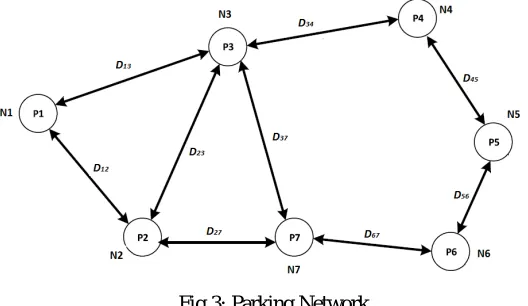
We have assumed that each parking area is a hub in a PAN, where each parking area is labelled as P1, P2, …, Pn are n number of parking areas; N1 is the total parking slots in P1, similarly N2 & Nn are the total parking slots in P2 & Pn.
The aggregate limit of the framework is N = N1 + N2 + N3 +… + Nn (slots). D is the distance between two hubs in the framework. Dij is the distance between hubs Pi and Pj. Figure 3 demonstrates our network.
Each hub has a neighbor table to keep up data on the present status of the system. The neighbor table for each hub contains data on the neighbouring hubs straightforwardly connected to it. In this proposed framework, each hub will telecast a message to cloud hubs after another hub joins or leaves it. This message incorporates data on its aggregate free assets. The cloud that gets this message will update the neighbor tables.
Fig 3: Parking Network
Algorithm as follow: Distance Algorithm
Step 1: collect the latitude 1, latitude 2, longitude 1 and longitude 2. Step 2: calculate theta, Theta= Lon 1-Lon 2.
Step 3: latitude, theta is in degree. Convert it to radians.
Step 4: then calculate sin value of latitude, cos value of latitude and cos value of theta. Step 5: calculate the Distance.
Distance = sin (lat 1) * sin (lat) + cos (lat 1) * cos (lat 2) * cos (theta) Step 6: distance= cos–l (calculated distance)
Step 7: dist = dist * 60 * 1.1515 Step 8: dist = dist * 1.609344 Step 9: dist = dist * 0.8684 Step 10: final distance is calculated.
a. Reservation Process:
If the user is searching for a free parking spot, he will send a solicitation message to the framework, which is done utilizing a cell phone. At the point when the framework gets this solicitation, it will discover parking area P1 with the
minimum cost[minimum estimation of F(α, β)] and forward this message to the user. For this situation, the minimum cost is the base estimation of function F(α, β). The estimation of F(α, β) is ascertained as the distance (between the
vehicle and parking areas) and the number of available slots in each parking area. On the off chance that this parking area has available slots to park, it will send a response message to the user. This message incorporates the location of parking area P1 and its direction. Since we utilize the rate of aggregate free slots in proposing another vehicle park, a high likelihood of accomplishment exists in finding a free parking slot.
b. Entering Process:
If a user enters parking area P1; he should be authenticated by RFID tag/smart card. In the event that approved, the entryway is opened, and the status will be updated in cloud. The framework will send a response message to the user to notify successful parking. In the event that the parking area P1 is right now full, it will send a message suggesting an alternating parking area, entails the information on new parking area P2, with the minimum cost.
VI. RESULT ANALYSIS
The screen shots describe the results or yields that are got after systematic execution of all modules of the structure. To assess the execution of this framework, determine the parameter for framework performance as the cost in terms of user time in the framework. The cost to the user is the time that user spends in the parking framework for service. On the off chance that this cost can be reduced, by decrease alternate costs, for example, financial, fuel, and environment pollution costs. The time is average waiting time of the user and the average aggregate time of the user in the framework, including the holding up, travel, and service times.
Fig 4: Parking Area Registration
The screenshot in figure 4 shows parking area registration in cloud server and user registration done by any parking area admin. The screenshot in figure 5 shows user registration done by any parking area admin.
Fig 5: Parking Area Layout
Fig 6: User Home Page
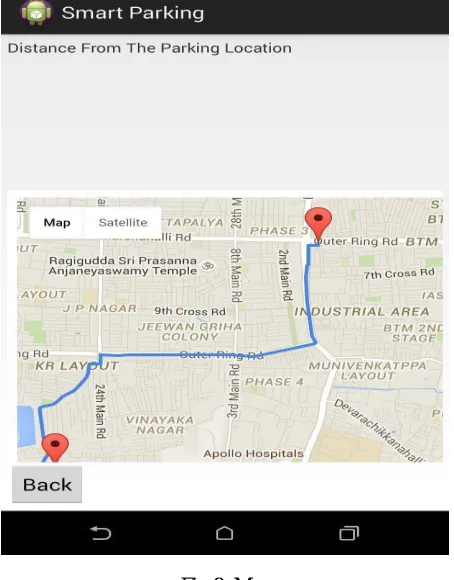
The screenshot in figure 6 shows after user login from android/smart phone by entering user Id and user password i.e., User’s home page. It contains following options: Book Slot, View Parking Area, View in Map, History.
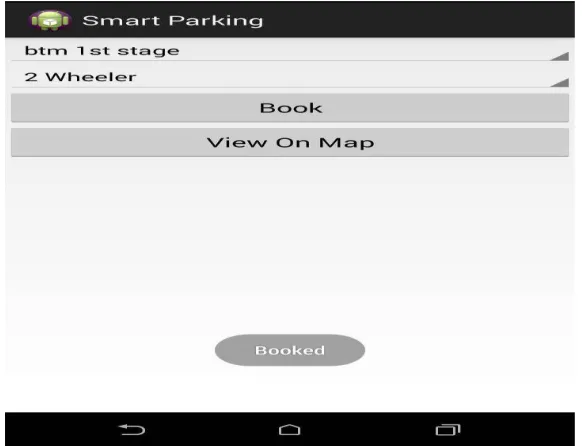
Fig 7: User Book Parking Area
The screenshot in figure 7 shows after User Booking a Parking Area to park his/her vehicle. User select’s area and vehicle type (two wheeler or four wheeler).
Fig 8: Map
VII.CONCLUSION & FUTURE ENHANCEMENTS
This project has proposed a parking framework that enhances performance by decreasing the number of users that fail to discover a parking slot and reduces the cost of moving between the parking slots. The results show that this system fundamentally decreases the average waiting time of users for parking. The average waiting time of each parking area for service becomes minimal, and the aggregate time of each vehicle in each parking area is decreased. In future study, consider the security parts of this framework and in addition actualize proposed framework in large scales in this present reality.
REFERENCES
1. Y. Geng and C. G. Cassandras, ``A new `smart parking' system based on optimal resource allocation and reservations,'' in Proc. 14th Int. IEEE Conf. Intell. Transp. Syst. (ITSC), Oct. 2011, pp. 979_984.
2. Y. Geng and C. G. Cassandras, ``New `smart parking' system based on resource allocation and reservations,'' IEEE Trans. Intell. Transp. Syst., vol. 14, no. 3, pp. 1129_1139, Sep. 2013.
3. X. Zhao, K. Zhao, and F. Hai, ``An algorithm of parking planning for smart parking system,'' in Proc. 11th World Congr. Intell. Control Autom. (WCICA), 2014, pp. 4965_4969.
4. C. Rhodes, W. Blewitt, C. Sharp, G. Ushaw and G. Morgan “Smart Routing: A Novel Application of Collaborative Path finding to Smart Parking Systems”.
5. Devi R. Gnyawali and Byung-Jin (Robert) Park “Co-opetition and Technological Innovation in Small and Medium-Sized Enterprises: A Multilevel Conceptual Model”.
6. YanfengGeng and Christos G. Cassandras “A New “Smart Parking” System Based on Optimal Resource Allocation and Reservations”.
7. K. Ashok kumar, R. B. Sam, and B. Arshadprabhu, ``Cloud based intelligent transport system,'' in Proc. 2nd Int. Symp. Big Data Cloud Comput. (ISBCC), vol. 50. 2015, pp. 58_63.
8. I. F. Akyildiz, X. Wang, and W. Wang, ``Wireless mesh networks: A survey,'' Comput. Netw., vol. 47, no. 4, pp. 445_487, Mar. 2005.
9. D. J. Bonde, R. S. Shende, K. S. Gaikwad, A. S. Kedari, and A. U. Bhokre,``Automated car parking system commanded by Android application,'' in Proc. Int. Conf. Comput. Commun. Inform. (ICCCI), 2014, pp. 1_4.
11. M. Du, J. Fang, and H. Cao, ``A new solution for city parking guiding based on Internet of Things and multi-level multi-agent,'' in Proc. Int. Conf. Electron., Commun. Control (ICECC), 2011, pp. 4093_4096.
12. L. Mainetti, L. Palano, L. Patrono, M. L. Stefanizzi, and R. Vergallo, ``Integration of RFID and WSN technologies in a smart parking system,'' in Proc. 22nd Int. Conf. Softw., Telecommun. Comput. Netw. (SoftCOM), 2014, pp. 104_110.
13. C. W. Hsu, M. H. Shih, H. Y. Huang, Y. C. Shiue, and S. C. Huang, ``Veri_cation of smart guiding system to search for parking space via DSRC communication,'' in Proc. 12th Int. Conf. ITS Telecommun. (ITST), 2012, pp. 77_81.