WILL IT FLOAT?
The effect of supporting fourth-grade students in drawing conclusions
whilst experimenting in the domain of buoyancy.
Bachelor thesis of Marit van der Pol
0186716 Psychology University of Twente
Faculty of Behavioural Sciences Department of Instructional Technology
Supervised by Dr. T. H. S. Eysink
Dr. A. H. Gijlers
TABLE OF CONTENTS
INTRODUCTION...4
Misconceptions regarding floating and sinking ...5
Conceptual change: From naïve to scientific ...6
Guided inquiry learning: providing students with instructional support ...8
Current study: Supporting students in drawing conclusions...10
METHOD ...11
Participants ...11
Materials ...12
EXPERIMENTAL SET...12
WORKSHEETS...13
THINKING ALOUD INSTRUCTION...14
Inquiry-learning task...15
Conditions ...16
Questionnaire and tests...16
PARTICIPANT CHARACTERISTICS QUESTIONNAIRE...16
PRETEST, POSTTEST AND RETENTION TEST...17
Procedure ...19
Data Analyses ...20
RESULTS...21
Reliability of the tests ...21
Main effect of condition on the pretest...21
MULTIPLE-CHOICE QUESTIONS...22
OPEN QUESTION...22
Main effect of condition on the posttest ...22
MULTIPLE-CHOICE QUESTIONS...23
Main effect of condition on the retention test ...24
MULTIPLE-CHOICE QUESTIONS...24
OPEN QUESTION...25
Main effect of the inquiry-learning task...25
MULTIPLE-CHOICE QUESTIONS...25
OPEN QUESTION...26
CONCLUSION AND DISCUSSION ...28
Hypotheses...28
Comments on the current study ...30
Practical implications and suggestions for further research ...31
Acknowledgements...32
REFERENCES ...33
ABSTRACT
Floating
I flattened out my plasticine And set it in the tank
And do you know the cheeky thing Turned round and slowly sank.
But when I took it out again And shaped it like a boat It wasn’t cheeky any more
For it began to float.
(Why did this happen?)
Albert Crawford
INTRODUCTION
WORKSHEET.
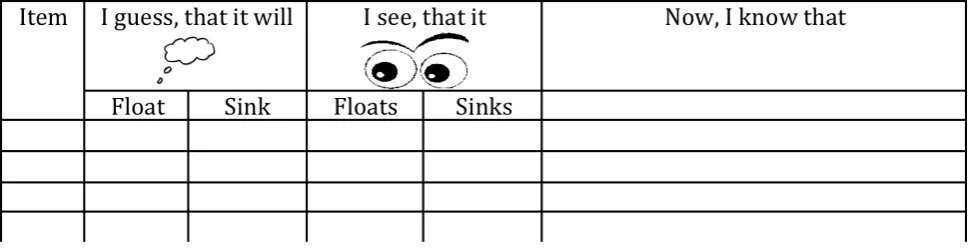
Participants had to fill in a worksheet whilst experimenting with the experimental set. See Figure 1 for the worksheet that the students in the control condition received. Through this worksheet, students were supported in the hypothesis generation phase and the experimentation phase. Students had to write down which cube they had chosen, and whether they expected it to float or sink (by ticking the corresponding box). After having put the cube in the water, they had to write down on the worksheet whether the cube floated or sank (by ticking the corresponding box). The weight of the cubes could be written down in the margin.
Figure 1. Worksheet for students in the control condition.
Besides support in hypothesis generation and experimentation, students in the experimental condition were also supported in the conclusion phase. They received a worksheet with an added column where they could write down their conclusions (see Figure 2). This worksheet followed a predict-observe-explain schema (Yin et al., 2008; White & Gunstone, 1992).
THINKING ALOUD INSTRUCTION.
Students received a aloud instruction consisting of a aloud example and think-aloud practice. Both involved solving a tangram (a Chinese dissection puzzle of seven pieces) while thinking aloud. The experimenter provided the example by solving a tangram while thinking aloud. The experimenter (a) thought about a possible solution but (b) discovered and indicated that it is not the right solution, (c) told what she thought of the assignment, (d) thought of an action plan for arriving at the solution, and (e) found the correct solution.
Figure 3. The tangram puzzle students had to solve while thinking aloud.
After this example the experimenter discussed it with the participant. After the think-aloud example, the learners had to try to solve a different tangram (see Figure 3) themselves while thinking aloud. Whenever the student fell silent, the experimenter prompted the learner to continue talking. After practicing, the experimenter indicated what went well and why, and how the learner could improve the think-aloud process.
Inquiry-learning task.
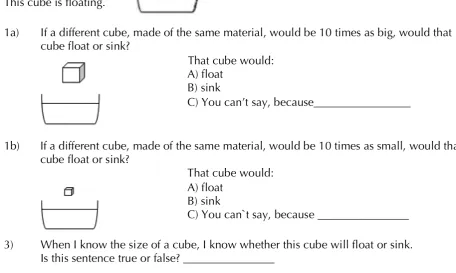
Mc_volume contained five questions about the influence of the size (volume) of the cube on floating or sinking (see Figure 4) whereas mc_mass asked five questions about the influence of the weight (mass) of the cube on floating and sinking (“This cube is floating/sinking; if this cube would be ten times heavier/lighter, would this cube float or sink?” and “When I know the weight of a cube, I know whether this cube will float or sink. Is this statement true or false?”).
Figure 4. Example of mc_volume: questions concerning the size of the cube.
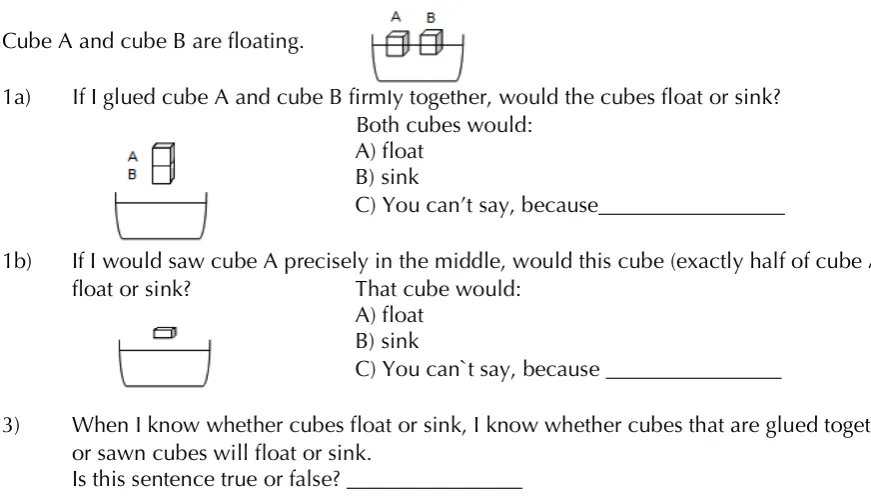
Figure 5. Example of mc_position: questions concerning the position of the cube compared to the water.
would indicate that they knew why objects float or sink and stopped experimenting, and others would try another one or two cubes or combinations of cubes).
Finally, participants had to fill in the posttest while thinking aloud. The children were then instructed not to communicate with the other students about the content and their findings, after which they could return to their classroom. Six weeks after these individual sessions the experimenter returned to the class and participants filled in the retention test in the classroom without thinking aloud.
Data Analyses
After gathering all data (school, gender, age, condition and answers on the questions of the pretest, posttest and retention test), the raw data was encoded. Whilst encoding the age in months, students born in the same month were considered to be of equal age.
Participants could receive one point for answering each multiple-choice question correctly. The scores on the multiple-choice questions are indicators of the misconceptions the children held in the measured dimensions (i.e., size (volume), weight (mass), color, position relative to the water and continuity of characteristics). The maximum score was 25 points (5 points per measured dimension.
RESULTS
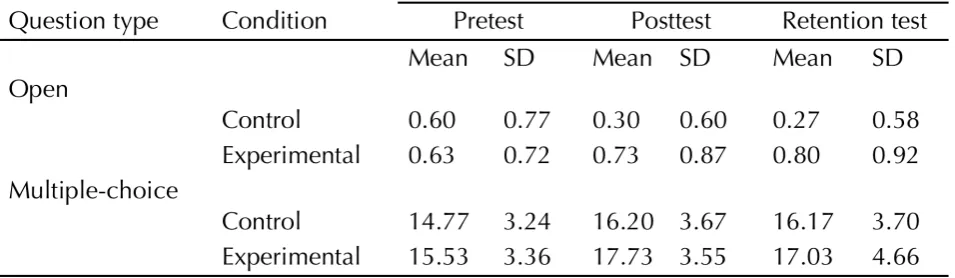
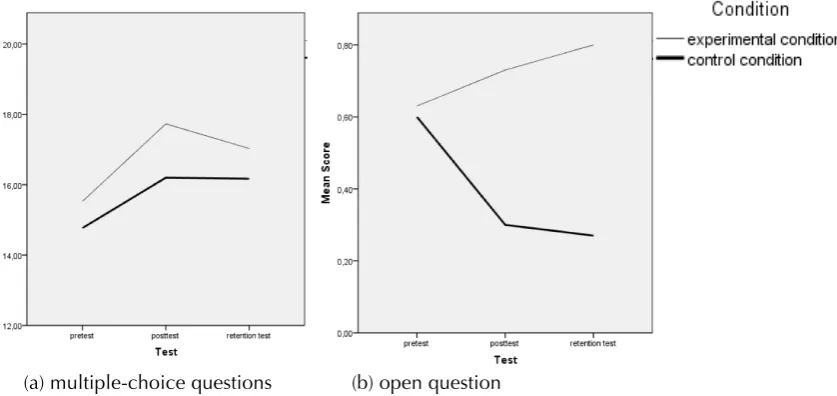
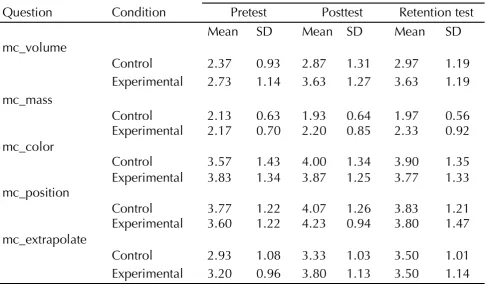
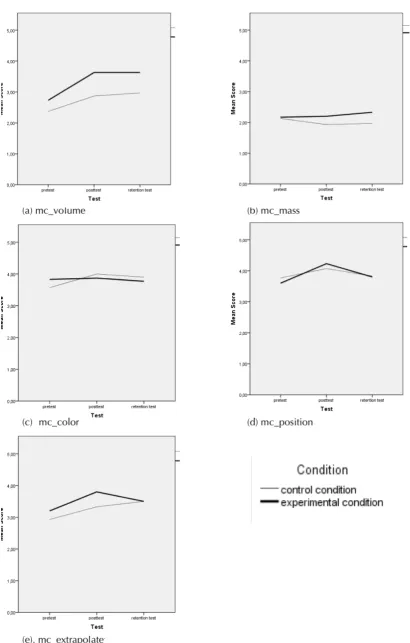
In the following section the results on the tests are presented. Differences between the control condition and the experimental condition have been explored based on the scores of the multiple-choice questions and the open question on the pretest, posttest and retention test. Considering research from Kopitzki and Gijlers (2011), the scores on the open question and the scores on the multiple-choice questions have been explored and tested separately. Furthermore, the multiple-choice questions have been subdivided in the subscales mc_volume, mc_mass, mc_color, mc_position and mc_extraploate and differences between the control condition and experimental condition on the pretest, posttest and retention test have been explored in these subscales as well. Mean scores and standard deviations can be found in Table 2 (multiple-choice questions and open question) and Table 3 (mc_volume, mc_mass, mc_color, mc_position and mc_extraploate). Mean scores have been visualized in Figure 7 (multiple-choice questions and open question), and Figure 8 (mc_volume, mc_mass, mc_color, mc_position and mc_extrapolate).
Reliability of the tests
The reliability of the multiple-choice questions on the pretest, posttest and retention test, as measured with Cronbach’s α, was α = 0.63, α = 0.75, and α = 0.80, respectively. Deleting items from the tests did not lead to significantly higher reliabilities. The reliability of the three tests concerning the open question has been calculated through the inter-rater reliability. A second coder rated 20% of the pretest, posttest and retention test. Cohen’s Kappa on the tests reached 0.92, which can be considered excellent.
Main effect of condition on the pretest
Table 2. Mean scores and standard deviations on the open question and multiple-choice questions of the pretest, posttest and retention test for the control and experimental condition.
MULTIPLE-CHOICE QUESTIONS
Scores on the pretest were normally distributed for both the control condition (skewness: 0.27; Shapiro-Wilk’s test of normality: W = 0.97 (p = 0.54)) and the experimental condition (skewness: 0.04; Shapiro-Wilk’s test of normality: W = 0.97 (p = 0.46)). An independent samples t-test showed no significant differences between the control and the experimental condition (t = -0.90, p = 0.37).
OPEN QUESTION
Scores on the pretest were not normally distributed for both the control condition Wilk’s test of normality: W = 0.72 (p < 0.001)) and the experimental condition (Shapiro-Wilk’s test of normality: W = 0.76 (p < 0.001)). An independent samples Mann-Whitney U test showed no significant differences between the control and experimental condition (U = 468.50, z = 0.30, p = 0.76, r = 0.04).
Main effect of condition on the posttest
(a) multiple-choice questions (b) open question
Figure 7. Mean scores on the multiple-choice questions (a) and the open question (b) of the pretest, posttest and retention test for the control and experimental condition.
MULTIPLE-CHOICE QUESTIONS
Scores on the posttest were normally distributed for both the control condition (skewness: -0.17; Shapiro-Wilk’s test of normality: W = 0.96, p = 0.26) and the experimental condition (skewness -0.45; Shapiro-Wilk’s test of normality: W = 0.97, p = 0.62). An independent samples t-test showed no significant differences between the control and experimental condition (t = -1.64, p = 0.11). When splitting the multiple-choice questions into the five different segments, an independent samples Mann-Whitney U test showed a significant difference between the control and the experimental condition (U = 606.00, z = 2.37, p < 0.05, r = 0.31) on mc_volume.
OPEN QUESTION
Table 3. Mean scores and standard deviations on mc_volume, mc_mass, mc_color, mc_position and mc_extrapolate of the pretest, posttest and retention test for the control and experimental condition.
Main effect of condition on the retention test
The mean scores and standard deviations can be found in Table 2 (multiple-choice questions and open question) and Table 3 (mc_volume, mc_mass, mc_color, mc_position and mc_extrapolate). Mean scores have also been visualized in Figure 7 (multiple-choice questions and open question) and Figure 8 (mc_volume, mc_mass, mc_color, mc_position and mc_extrapolate).
MULTIPLE-CHOICE QUESTIONS
samples Mann-Whitney U test showed a significant difference between the control and the experimental condition (U = 592.00, z = 2.19, p < 0.05, r = 0.28) on mc_volume.
OPEN QUESTION
Scores on the retention test are not normally distributed for both the control condition (Shapiro-Wilk’s test of normality: W = 0.52, p < 0.001) and the experimental condition (Shapiro-Wilk’s test of normality: W = 0.70, p < 0.001). An independent samples Mann-Whitney U test showed significant differences between the control and experimental condition (U = 586.00, z = 2.41, p < 0.05, r = 0.31).
Main effect of the inquiry-learning task
To test whether students actually gained knowledge about the domain of floating and sinking, a Repeated Measures ANOVA (with students’ scores on the open question and the multiple-choice questions on the pretest, posttest and retention test as within-subjects variable and condition as between-subjects variable) has been executed. The mean scores and standard deviations can be found in Table 2 (multiple-choice questions and open question) and Table 3 (mc_volume, mc_mass, mc_color, mc_position and mc_extrapolate). Mean scores have also been visualized in Figure 7 (multiple-choice questions and open question) and Figure 8 (mc_volume, mc_mass, mc_color, mc_position and mc_extrapolate).
MULTIPLE-CHOICE QUESTIONS
A post-hoc Bonferroni comparison showed a significant increase in the test scores between the pretest and the posttest (p < 0.01) and the retention test (p < 0.05) in the control condition and between the pretest and retention test in the experimental condition (p < 0.001). No significant decline has been found between the posttest and retention test in both conditions (p = 1.00). When splitting the multiple-choice questions into five different segments (mc_volume, mc_mass, mc_color, mc_position, mc_extrapolate), an independent samples Mann-Whitney U test revealed a few significant effects.
condition, students score significantly higher on the posttest (p < 0.01) and retention test (p < 0.01) than on the pretest. No significant decline has been found between the posttest and the retention test (p = 1.00).
No significant differences have been found on mc_mass and mc_color. However, interesting trends can be spotted in mc_mass (see Figure 8b) and mc_color (see Figure 8c). In mc_mass, scores of students in the control condition and in mc_color, scores of students in the experimental condition, seem to decrease after the inquiry-learning task, whereas all other scores (seem to) increase over time.
On mc_position a significant difference has been found in the experimental condition (F (2, 58) = 4.30, p < 0.05). A post-hoc Bonferroni comparison showed a significant increase in the scores between the pretest and the posttest (p < 0.05). No significant decline has been found between the posttest and the retention test (p = 0.22).
In both the control (F (2, 58) = 6.63, p < 0.01) and the experimental condition (F (2, 58) = 4.53, p < 0.05) significant differences have been found on mc_extrapolate. A post-hoc Bonferroni comparison showed a significant increase in the scores on the pretest and the retention test in both conditions (p < 0.01). In the experimental condition a significant increase has been found in the test scores between the pretest and the posttest (p < 0.01). No significant decline has been found between the posttest and the retention test (p = 0.46).
OPEN QUESTION
answer. They might also have avoided this specific answer alternative because of the need to explain their decision, which asks for deeper considerations and additional time and effort.
Practical implications and suggestions for further research
Many students fail to or are resistant to integrating more than one variable into one concept to explain a complex idea like density (Hardy et al., 2006). Most kids want to think that ultimately, floating depends on only one thing (usually they say weight). However, even after being confronted with the obvious inadequacies of this explanation, they come back to it time and time again, often forgetting that they experienced the effect of other factors, such as volume, on sinking and floating. Students need to be given many opportunities to investigate both volume independent of mass and mass independent of volume to gain a thorough understanding of the effects of each variable on floating. They also need to be given the time to systematically separate those two variables and then integrate them together (Duckworth, 1986). Elementary schools should therefore give their students many opportunities to experiment with buoyancy. To test whether children gain knowledge, teachers would do well to ask their students open questions. When forced to choose between different answering options, children often fall back on their initial conceptions.
ACKNOWLEDGEMENTS
The author gratefully acknowledges the support of her first mentor dr. T. H. S. Eysink. Thank you for all the valuable comments throughout the process and your patience and faith in me. I could not have done this without your support and guidance. I would also like to thank my second mentor A. H. Gijlers for her advice in the area of data analysis and SPSS, and her constructive feedback and enthusiasm. This thesis would not have been possible without the participation and support of the schools, teachers and students. I would like to thank the students and teachers of the fourth grade of ‘Drakensteyn’ and ‘Glanerbrug-Zuid’ in Glanerbrug and the ‘Kiezel en Kei’ in Borculo for their participation and cooperation. I would also like to thank my grandmother for helping me sort all the paperwork, and my mother for reviewing my work and helping me wherever she could. Many thanks go to J. H. H. Laenen, my friends and my parents for providing me with the much-needed kick in the ass and for their on-going support and love.
REFERENCES
Alfieri, L., Brooks, P. J., Aldrich, N. J. & Tenenbaum, H. (2011). Does discovery-based instruction enhance learning? Journal of Educational Psychology, 103(1): 1-18.
Ausubel, D. P. (1968). Educational psychology: A cognitive view. New York: Holt, Rinehart and Winston.
Biddulph, F. & Osborne, R. (1984). Pupils' ideas about floating and sinking. Research in Science Education, 14: 114-124.
Bransford, J. D., Brown, A. L. & Cocking, R. R. (1999). How people learn: Brain, mind, experience and school. Washington, DC: National Academy Press.
Brewer, W. F. (1999). Scientific theories and naïve theories as forms of mental representation: Psychologism revived. Science and Education, 8(5): 489-505.
Bruner, J. S. (1961). The act of discovery. Harvard Educational Review,31(1): 21–32.
Butts, D. P., Hofman, H. & Anderson, M. (1993). Is hands-on experience enough? A study of young children’s views of sinking and floating objects. Journal of elementary science education, 5(1): 50-64
Caravita, S. (2001). A re-framed conceptual change theory? Learning and Instruction, 11(4-5):
421-429.
Chi, M. T. H. (1996). Constructing self-explanations and scaffolded explanations in tutoring.
Applied Cognitive Psychology, 10: 33-49.
Chi, M. T. H. (2005). Commonsense conceptions of emergent processes: Why some misconceptions are robust. Journal of the Learning Sciences, 14: 161-199.
Chinn, C. A., & Malhotra, B. A. (2002). Children’s responses to anomalous scientific data: How is conceptual change impeded? Journal of Educational Psychology, 94: 327–343. Christianson, R. G., & Fisher, K. M. (1999). Comparison of student learning about diffusion and osmosis in constructivist and traditional classrooms. International Journal of Science Education, 21: 687–698.
De Jong, T. (2005). The guided discovery principle in multimedia learning. In R. E. Mayer,
Cambridge handbook of multimedia learning, pp.: 215-229. Cambridge: Cambridge University Press.
De Jong, T. (2006). Scaffolds for computer simulation based scientific discovery learning. In J. Elen and R. E. Clark, Dealing with complexity in learning environments, pp.: 107-128. London: Elsevier Science Publishers.
De Jong, T., Njoo, M. (1992). Learning and instruction with computer simulations: Learning processes involved. In E. de Corte, M. Linn, H. Mandl & L. Verschaffel (Eds.).
Computer-based learning environments and problem solving, pp.: 411-427. Berlin: Springer.
De Jong, T., & Van Joolingen, W. R. (1998). Scientific discovery learning with computer simulations of conceptual domains. Review of Educational Research,68(2): 179-201. Deslauriers, L., Schelew, E. & Wieman, C. (2011). Improved learning in a large-enrollment
physics class. Science, 332(6031): 862-864
Dewey, J. (1938). Logic: The Theory of Inquiry. New York: Holt, Rinehart and Winston. Driver, R. & Easley, J. (1978). Pupils and paradigms: A review of literature related to concept
development in adolescent science students. Studies in Science Education, 5: 61-84. Duckworth, E. (1986). Inventing density. Grand Forks: University of North Dakota, Center for
Teaching and Learning, North Dakota Study Group on Evalation.
Dunbar, K. (1993). Concept discovery in a scientific domain. Cognitive Science, 17: 397-434.
Eysink, T. H. S., de Jong, T., Berthold, K., Kolloffel, B., Opfermann, M., & Wouters, P. (2009). Learner performance in multimedia learning arrangements: An analysis across instructional approaches. American Educational Research Journal, 46, 1107-1149. Hardy, I., Jonen, A., Müller, K., Stern, E. (2006). Effects of instructional support within
constructivist learning environments for elementary school students’ understanding of “floating and Sinking”. Journal of Educational Psychology, 98(2): 307-326
Hogan, K. & Pressley, M. (1997). Scaffolding scientific competencies within classroom communities of inquiry. In K. Hogan & M. Pressley (Eds.), Scaffolding student learning: Instructional approaches & issues (pp. 74-107). Cambridge, MA: Brookline Books.
Kirschner, P. A., Sweller, J., Clark, R. E. (2006). Why minimal guidance during instruction does not work: An analysis of the failure of constructivist, discovery, problem-based, experiential, and inquiry-based teaching. Educational Psychologist, 41(2): 75–86. Klahr, D. & Dunbar, K. (1988). Dual-space search during scientific reasoning. Cognitive
Science, 12(1): 1-48.
Klayman, J. & Ha, Y. W. (1987). Confirmation, disconfirmation, and information in hypothesis-testing. Psychological Review,94(2): 211-228.
Kohn, A. S. (1993). Preschoolers` reasoning about density: Will it float? Child development, 64: 1637-1650.
Kopitzki, E. & Gijlers, A. H. (2011). Guided inquiry learning: How much support is most effective for children’s learning?
Koran, J. J. & Longino, S. J. (1982). Curiosity and children's science learning. Science and Children, 20: 18-19.
Limón, M. (2001). On the cognitive conflict as an instructional strategy for conceptual change: a critical appraisal. Learning and Instruction, 11 (4-5): 357-380
Linn, M. C., Lee, H. S., Tinker, R., Husic, F. & Chiu, J. L. (2006). Teaching and assessing knowledge integration in science. Science, 313: 1049–1050.
Mayer, R. E. (2004). Should there be a three-strikes rule against pure discovery learning? The case for guided methods of instruction. American Psychologist, 59(1): 14-19.
McCloskey, M. & Kargon, R. (1988). The meaning and use of historical models in the study of intuitive physics. In S. Strauss (Ed.), Ontogeny, phylogeny and historical development
(pp. 49-67). Norwood, NJ Ablex.
Vosniadou, S., Ioannides, C., Dimitrakopoulou, A., & Papademetriou, E. (2001). Designing learning environments to promote conceptual change in science. Learning and Instruction, 15: 317-419.
Wandersee, J.H., Mintzes, J.J. & Novak, J.D. (1994). Research on alternative conceptions in science. In: Handbook of Research on Science Teaching and Learning, ed. D. Gabel, New York: Simon & Schuster Macmillan, pp.: 177–210.
White, R. & Gunstone, R. (1992). Probing understanding. London and New York: The Falmer Press.
Yin, Y., Tomita, M. K., Schavelson, R. J. (2008). Diagnosing and dealing with student misconceptions: floating and sinking. Science Scope 31(8): 34-39.