International Journal of Scientific Research in Computer Science, Engineering and Information Technology © 2018 IJSRCSEIT | Volume 3 | Issue 4 | ISSN : 2456-3307
Design and Implementation of a Brain-Computer Interface using
Brain Gate
K. Pavan kumar1, B. MasthanBaba2
1Department of MCA, Sree Vidyanikethan Institute of Management, Sri Venkateswara University, Tirupati, Andhra Pradesh, India
2Assistant Professor, Department of MCA, Sree Vidyanikethan Institute of Management, Tirupati, Andhra Pradesh, India
ABSTRACT
Neural Interface System grounded on the Cybernetics platform innovation to detect, transmit, dissect and apply dialect of neurons to brain. The System comprises of a sensor that is dug in on the engine cortex of the brain and looks at cerebrum signals. The standard behind the Brain Gate framework is that, signals are produced in the engine cortex and they can't be sent straightforwardly to the arms, hands and legs because of spinal rope damage, stroke or other condition. The cerebrum signals are interpreted and converted into cursor developments, offering the client a substitute pathway through the Brain Gate System to control a PC just by considering, similarly as people who can move a PC mouse utilizing their hands.
Keywords: Brain–Computer Interface, Functional Model, Electroencephalography.
I.
INTRODUCTION
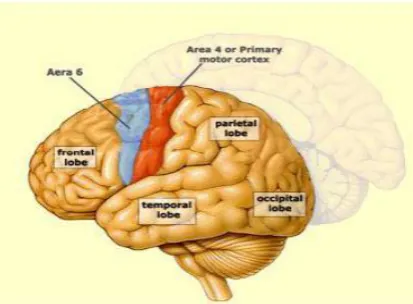
Body's wilful developments are controlled by the cerebrum. The brain territory is likewise associated with controlling these deliberate developments i.e. engine cortex. The engine cortex is arranged in the back bit of the frontal projection, just before the focal sulcus that separations the frontal flap from the parietal flap. The engine cortex is separated into two fundamental zones, Area 4 and Area 6. Territory 4, otherwise called the essential engine cortex, shapes a thin band along the focal sulcus. Region 6 lies quickly forward of Area 4. Territory 6 is more extensive and is additionally subdivided into two particular sub-regions.
Figure 1. Structure of Brain
choice to get a glass of water is escorted by expanded electrical action in the frontal locale of the cortex. The neurons in the frontal cortex send driving forces down their axons to actuate the engine cortex itself. The engine cortex designs the perfect way for the hand to take after to achieve the glass. The engine cortex at that point approaches different parts of the brain, for example, the focal dim cores and the cerebellum, which help to start and co-ordinate the actuation of the muscles in arrangement. The axons of the neurons of the essential engine cortex slip the distance into the spinal rope, where they make the last transfer of data to the engine neurons of the spinal string. These neurons are associated specifically to the muscles and make them contract.
II.
BRAIN GATE
It is a terminal chip. The chip contains 96 hair-thin cathodes that insight the electro-attractive indication of neurons terminating in particular zones of the brain. For instance the region that boards arm campaign. When it is connected in cerebrum, the electrical flag dealt by neurons inside the brain. These signs are sent to the brain and it devices body development. All the flagging is touched by exceptional programming. Eg (Custom Decoding Software, calculations are composed in C, JAVA and MATLAB).The flag advisers for the PC and after that the PC is skilful by tolerant. At the point when a man overlooked his past because of certain unplanned issue or he had lost his piece of his body, around then this anode chip can be comprehended on his brain and incredible the man also.
2.1 Types of Brain Computer Interface
1.one way BCI - Computers either accept commands from the brain
2. Two way BCI - Allow brains and external devices to exchange information in both directions.
2.2 Principle: The framework comprises of a gadget that is embedded on the engine cortex of the
cerebrum. The guideline is that the entire brain capacities, cerebrum signals are created despite the fact that they are not sent to the arms, hands and legs. The signs are implicit and deciphered into cursor developments, offering the client another "Cerebrum GATE TRAJECTORY" to control a PC with assumed, similarly as social orders that can move their fingers.
2.3 Challenges Faced By Brain Gate: 1. It is very luxurious.
2. Curb in information transform rate. The latest technology is about 20 bits/min.
3. Difficulty in adaptation and learning.
In 2008 the bio-tech organization Cyber energy grows a framework i.e. brain door in total with the Department of Neuroscience at Brown University. The cerebrum door framework is planned to those patients who have lost control of their appendages, real capacities, for example, patients with amyotrophic lateral sclerosis (ALS), spinal rope damage. The action is deciphered into electrically charged flags and is then sent and decoded utilizing a program which can move a lethargic arm.
2.4 Side effect:The firm has deep rooted that one patient (Matt Nagle) has spinal string damage while another has progressed amyotrophic sidelong sclerosis. A potential utilization of this component would be for a neurologist to think about apportionment designs in a patient with epilepsy. Brain Gate contemplate side is to make a plan i.e.
1. Quite literally turns thought into action. 2. Neurological disease.
3. Injury 4. Limb loss.
Currently, the system consists
1. Sensor: - A device entrenched in the brain that records indications directly related to imagine limbcrusade.
3. External Device:-Which could be a standard PC work area or other specialized gadget, a mechanized wheelchair, a prosthetic or mechanical appendage or a useful electrical incitement practical that can move incapacitated appendages straight. At the point when a man winds up incapacitated, neural signs from the cerebrum is ended. The brain keeps on conveying these signs in spite of the fact that they don't achieve their endpoint. Brain entryway framework picks the signs and they should be available in rules.
1. BCI framework may utilize event highlights i.e. is μ, β in the zone of brain.
2. Each BCI utilizes a particular calculation to translate its contribution to yield control signals. 3. The disparity between a component as a picture of an exact part of sensory system working and life structures and a training as a method for estimating the element is all the more clear for a few highlights (e.g., the shooting rate of a solitary cortical neuron, which is apparently the same anyway it is unhurried) than for others (e.g., autoregressive strictures, which rely upon the subtle elements of the investigation strategy.
4. Brain PC impedance indicates particular highlights like time-space highlights, (for example, activity conceivable of neurons).
III.
MODEL OF BRAIN COMPUTER
INTERFERENCE
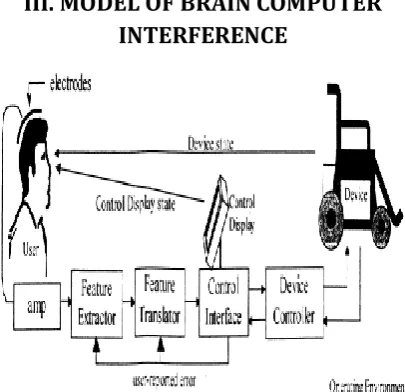
Figure 2. Functional BCI System model In this fig a boundless BCI System in which a man sheets a gadget in a working situation through a progression of functional hardware. The User shows
the convenient state to controller the consequence of his or her control endeavours. The User may likewise be reachable with a Control Display, which presentations his control contributions inside a semantic proposition. The User and the Device Supervisor will be viewed as BCI interface innovation. BCI innovation is produced to assist a board masses with exact capacities play out specific errands with a Device inside a working circumstance. The part definitions and the useful limits between apparatuses were designated to meet various outline objects.
1) The apparatuses in the model ought to be a negligible however adequate set to successfully speak to existing and future BCI Systems.
2) The limits between the useful parts ought to adjust however much as could be expected with existing examination disciplines, (for example, design acknowledgment, assistive innovation improvement, and HCI) to amplify the utilization of existing learning and innovation.
3) The limits between the useful parts ought to adjust however much as could reasonably be expected with existing interface innovation to encourage examinations between BCI advances and non-BCI UI advances. The model in Fig. 1 does not demonstrate the outer tactile stimulator utilized by some BCI Systems to bring out brain action in the User. It was let alone for this outline to streamline the introduction. In a few frameworks, the stimulator might be incorporated into the Control Display. The utilitarian model will be displayed without the outer stimulator.
IV.
COORDINATE INTERFERENCE SCHEME
faunas and even people. It has embedded a particular conductor into the engine cortex of various deadened patients. These anodes contain a neurotropic issue that influences development of neural tissue inside the resounding cathode tip. By work out, patients concentrate to control the gunfire rates of the various recorded neurons. One of them can vitality a pointer and interchanges have logged the activity of groups of neurons with miniaturized scale wire accumulation dug in different cortical territories engaged with engine switch, as monkeys performed arm developments. From these signs they have exact constant gauges of arm courses and have possessed the capacity to duplicate the courses with a robot arm. Despite the fact that these hearings don't mark a genuine BCI, they convey the ability of administrative complicated prosthetic limbs specifically by cerebrum action. Nicolelis and associates demonstrated that neural indicators can be inferred for rats embedded with a similar sort of hearings in people utilizing non-intrusion neuron imaging abilities as interfaces. Signs logged have been utilized to control muscle joins and restore deficient campaign in another colleague. At the point when electromagnetic breakers moulded by the neuron, non-intrusive embed scrounger advantaged sign determination since the skull reduces motions, disbanding and darkening. Electroencephalography is the most chivalrous conceivable non-intrusive interface, essentially because of its satisfactory fleeting, solace of utilization, movability and low set-up cost. At the point when innovation's helplessness to clamour, extra significant hindrance to utilizing EEG as a cerebrum PC interface is the wide exercise required before clients can work the innovation. Neil's Braymer utilized EEG recordings of ease back cortical comprehensible to give incapacitated
patients inadequate change over a processor pointer. Birbaumer's has charmed on developing learning that would enable clients to pick the brain signals they discovered coolest to work a BCI, tallying and beta whitecaps. Extra utmost is the strategy for reaction utilized and this is appeared in investigations of P300 signals. Examples of P300 surfs are produced unwillingly. At the point when individuals perceive and may enable BCIs to decipher gatherings of considerations without practice patients first. In 2000 Jessica Bayliss demonstrated that volunteers tiring PC created reality caps could control components in a PC produced biosphere utilizing their P300 EEG readings, including turning lights on and off and transporting a reproduction wagon to a stop. Electric neural have been sorted out which change the data point from the client to the PC. Fraunhofer Society 2004 utilizing neural nets prompted clear upgrades inside 30 notes of exercise. Eduardo Miranda utilize EEG recordings of cerebral activity related with tune to enable the weakened to quick themselves tunefully through an encephalophone. Magneto encephalography and utilitarian attractive reverberation imaging have both been utilized effectively as non-obtrusive BCIs. It passable two clients being skimmed to creation Pong in genuine by changing their hemodynamic reaction or acumen gut development through biofeedback techniques. It additionally been utilized to control robot weapons with a seven additional rescheduling among thought and drive.
V.
APPLICATIONS
1. in characterization of EEG flag. 2. in hypermedia dispatch.
3. Enacted control of portable robot by human EEG.
4. As a brain controlled switch for no concurrent control.
5. In assessing the machine learning strategies. 6. The Brain Gate Neural Interface System is
for physically debilitated individuals by enabling them too rapidly and dependably control an extensive variety of gadgets.
7. The Brain Gate System may permit those with serious engine incapacities to utilize their own arms and hands once more.
8. It might have the capacity to give an individual the capacity to control gadgets that permit breathing, bladder and solid discharges.
9. The Brain Gate System is intended to reestablish usefulness for seriously engine hindered people.
VI.
CONCLUSION
Rendition to the Cyber energy paired patients has been settled in with the Brain Gate framework. Utilizing this framework the patient can read email, play videogames, turn lights on or off and change stations or alter the volume of a TV. The outcomes are momentous and relatively staggering. Cerebrum Gate can enable incapacitated individuals to move by controlling their own electrical wheelchairs, interface by utilizing email and Internet-based telephone frameworks, and be autonomous by controlling things, for example, TVs and indoor regulators. At last Brain Gate has appeared to be a gift from heaven for incapacitated patient.
VII.
REFERENCES
[1]. Donchinet E. The mental prosthesis: Assessing the speed of a P300 based brain-computer interface.IEEE Trans. Rehab. Eng.2000 vol. 8, pp.174-179.
[2]. Kennedy P.R. Direct control of a computer from the huma central nervous system.IEEE Trans. Rehab.Eng.2000 vol. 8, pp. 198-202. [3]. Middendor M. Brain-computer interfaces based
on steady-state visual-evoked response. IEEE Trans.Rehab. Eng.2000 vol. 8, pp. 211-214, [4]. Special issue on brain-computer interfaces.
IEEE Trans. Rehab. Eng.2000 vol. 8, pp. 1-270.
[5]. Kennedy P.R., Bakay R.A.E., Moor., M.M., Adams, K., Goldwaithe J. Direct control of a computerfrom the human central nervous system. IEEE Trans. On Rehab. Eng.2000 8:198-202.
[6]. Wessberg J., Stambaugh C.R., Kralik J.D., Beck P.D., Laubach M., Chapin J.K., Kim Biggs S.J.,Srinivassan M.A., Nicolelis M.A.L. Real-time prediction of hand trajectory by ensembles of corticalneurons in primates. Nature 2000; 408:361-365
[9]. Wolpaw J.R. Brain-computer interface technology: A review of the first international meeting, IEEETrans. on Rehab. Eng 2000; 8:164-173.
[10]. Birbaumer N., Ghanayim N., Hinterberger T., Iversen I., Kotchoubey B., Kubler A., Perelmouter J.,Taub E., and Flor H. A spelling device for the paralysed. Nature1999; 398:297-298.
[11]. Kalcher J., Flotzinger D., Neuper C., Golly S., and PfurtschellerG.Graz Brain computer interface II.Med. & Biol. Eng. & Comput. 1999; 34:382-388
[12]. Kostov A., Polak M. Parallel man-machine training in development EEG-based cursor control. IEEETrans. Rehab. Eng.2000; vol. 8.pp. 203-205.
[13]. Pfurtscheller G. Current trends in Graz brain-computer interface. IEEE Trans. Rehab. Eng 2000. vol. 8,pp. 216-219.
[14]. WolpawJ.R.Brain-computer interface research at the Wadsworth Center. IEEE Trans. Rehab.Eng.2000 vol. 8, pp. 222-226.
[15]. Penny WD.EEG-based communication: A
About Authors:
Mr. K.PavanKumar is currently pursuing his Master of Computer Applications, Sree Vidyanikethan Institute of Management, Tirupati, A.P. He received his Master of Computer Applications from Sri Venkateswara University, Tirupati