International Journal of Scientific Research in Computer Science, Engineering and Information Technology
© 2018 IJSRCSEIT | Volume 3 | Issue 4 | ISSN : 2456-3307
DevOp Architecture and Implementation in Software
Development
Kunduru Siva Reddy1, Parnapalli Pushpanjali2
1Department of MCA, Sree Vidyanikethan Institute of Management, Sri Venkateswara University, Tirupati, Andhra
Pradesh, India
2Assistant Professor, Department of MCA, Sree Vidyanikethan Institute of Management, Tirupati, Andhra Pradesh,
India
ABSTRACT
Development and Operations (DevOps) with regards to Continuous Deployment (CD) have risen as an alluring software development, which tries to build up a solid association amongst development and tasks groups. Compact disc is characterized as the capacity to rapidly put new discharges into creation. We trust that DevOps/CD brings new difficulties for modelers, which extensively impacts both on their (structural) outline choices and their hierarchical duties. We affirm that there is a vital and critical need of adequate research work to pick up a profound comprehension of how DevOps/CD selection can impact architecting, structural basic leadership forms and their results in an association. This PhD inquire about is gone for comprehension and tending to new difficulties for outlining models for supporting DevOps with regards to CD.
Keywords: Software architecture, DevOps, continuous deployment.
I.
INTRODUCTION
With increasing complexity of software escalated frameworks, the part of software engineering as methods for comprehension and overseeing large‐
scale software concentrated frameworks has been progressively getting to be imperative. It has been perceived that distinctive spaces and settings bring diverse difficulties for modelers. Subsequently, a given setting can have significant effect on compositional outline choices and hierarchical practices for architecting related exercises and ancient rarities. Development and Operations (DevOps) with regards to Continuous Deployment (CD) is a rising software industry development to conquer any hindrance amongst development and tasks groups. Album is characterized as the capacity to every now and again and dependably put new discharges into generation, with however much
Integration (CI), Continuous DElivery (CDE) and Continuous Deployment (CD). A sound engineering guarantees a coveted level of value traits (e.g., deployability, testability, and loggability) and can empower short criticism process duration including moment input from activities. Be that as it may, architecting forms and their results in an association. Hence, this PhD examines looks for building components, practices, and examples that help DevOps and consistent arrangement.
II.
RELATED WORK
Whilst there has been some examination on the appropriation of DevOps, continuous deployment (CD) and persistent conveyance in the product development industry, there has been no orderly push to investigate the effect of DevOps and CD on software engineering. Applauds at el. considered the specialized and social difficulties of receiving nonstop sending for a situation software organization and announced the moderation procedures that had been embraced by the case organization. Group understanding, constant mix and foundation to give some examples have been accounted for as difficulties of CD appropriation. It has been accounted for in that persistent conveyance and organization give the accompanying advantages: (i) getting increasingly and speedy input from software development process and clients; (ii) having continuous and dependable discharge, which prompts enhanced consumer loyalty and item quality. To date, there are just two investigations, which have investigated the part of software engineering as a contributing variable while embracing CD and DevOps. Chen revealed an affair of architecting 25 software applications for persistent conveyance and additionally proposed an arrangement of structurally
critical prerequisites that ought to be adequately met with a specific end goal to accomplish the most extreme advantages from ceaseless conveyance. Bellomo et al. have led an exact examination on three ventures that had received ceaseless coordination and constant conveyance. The examination reasoned that the vast majority of choices made to accomplish the want condition of organization (i.e., deployability) were building ones. The gathered deployability objectives and strategies from three undertakings have been utilized as building obstructs for shaping the deployability strategies tree.
III.
RESEARCH DESIGN
This examination is gone for experimentally constructing and assessing a system and related vary from that for non-DevOps/CD settings?
RQ3. How might we systematize (i.e., catch, report, and compose) the compositional practices and standards to make them helpful for building DevOps/CD-amiable applications?
3.1 Research Methods
picked in light of the idea of the considered issue and the examination inquiries to be addressed. Since there is a little research on the effects of DevOps/CD on architecting, we chose to complete an exploratory contextual analysis in different little and expansive software development associations. Contextual investigation is viewed as a reasonable research strategy to examine a contemporary wonder inside its genuine setting. Our examination is an exploratory contextual investigation as it for the most part manages the "How" and "What" questions. Since this examination has wide and abnormal state objectives and there is little exactly assembled information about architecting for DevOps/CD, we locate an exploratory contextual investigation utilizing interviews as information gathering technique proper. For instance, study can be followed up after the underlying aftereffects of the meetings.
Data Collection Methods We will utilize vis-à-vis meet as the principle information gathering strategy. Be that as it may, in particular cases (e.g., travel confinement), different kinds of meeting (e.g., Skype meet) might be utilized. Since investigating the effect of DevOps/CD on software design is another theme and we would prefer not to limit the appropriate responses of interviewees ahead of time, we will do the semi-organized meetings, which include open-finished inquiries. Members will be selected utilizing purposive testing with a specific end goal to incorporate professionals who either have profitable encounters in (re-) architecting for DevOps/CD (e.g., modeler) or are nearly affected by design (e.g., DevOps build). Notwithstanding interviews, where conceivable we will assemble information from documentations (e.g., engineering report) gave by members to confirm encounters and talks shared by members. Utilizing the two meetings and documentation (i.e., information triangulation) as information sources can build the dependability of our investigation.
Data Analysis The gathered information (e.g., the meeting transcripts) will be examined utilizing topical investigation technique. We will break down the information to recognize the ramifications of DevOps/CD on architecting, the difficulties that the members confront while architecting for DevOps/CD and engineering rehearses (i.e., examples and strategies) they utilize. We intend to send the aftereffects of this examination to the members engaged with the meetings. The advantages of this method (i.e., part checking) are twofold: (i) members can reinforce the discoveries with additionally concrete and genuine cases; (ii) we can inquire as to whether they concur with the discoveries and the preparatory evaluation can be performed by them. For promote approval, we need to compose a progression of workshops with partners engaged with architecting exercises with regards to DevOps/CD for getting their inputs on the underlying discoveries from our examination. The input from workshops can help us to confirm and refine the discoveries of the examination.
IV.
DEVOP CULTURE TOOLS
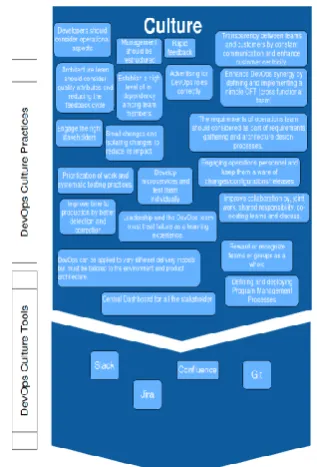
Culture
Contingent upon the design of the framework, a few applications ought to be created diversely to guarantee autonomy. For instance, in frameworks that requires microservices design. The microservices ought to be created independently by group and sub teams. Groups ought to guarantee that microservices are teaming up. Such approach facilitates the procedure 41 of arrangement for the dev and operations groups and makes the development and generation condition more workable, stateless and reproducible. Designers should take more obligations, Developers ought to be capable of building up a framework while remembering the operational viewpoints and bolster the structural changes on the development and operational sides. At the point when dev group is given more duties, the code they deliver turns out to be more activities inviting, which decreases the disappointment effects of framework setups and arrangements
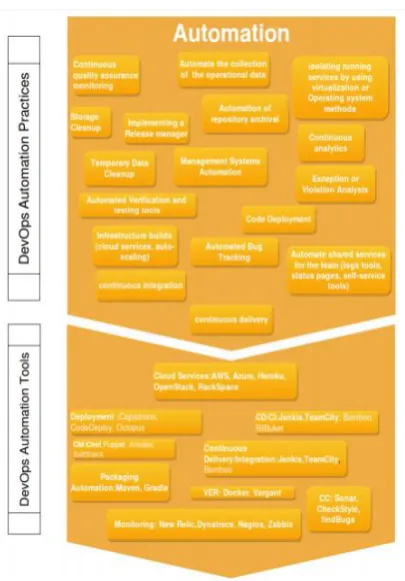
Automation
Figure 2. Automation tools and practices.
Continuous software quality confirmation monitoring is a case of automation execution, amid SQA monitoring automation process the operations
code and act. The framework continues observing the status of the application until the point when it recognizes an error and reports it progressively and adds the distinguished issue to issue tracker. Administrations Automatic Isolation is another case of mechanization joined with virtualization, it is critical for the support of be statelessness on the servers and 44 customers, this can accomplish disconnecting the administrations by utilizing virtualization strategies so as to virtualize a particular working framework utilizing containerization. The utilization of automation isn't restricted to dev or operations groups, nonstop examination can profit business division or help an organization to accomplish their business points and destinations. Contemplating the business needs of associations by executing consistent examination in the IT framework, so the business group could screen, gather and get data continuously to meet the business points.
Figure 3. DevOps Culture to Organization.
The proposals thought about and used to change the model (check informative supplement 6). The model refined and split into 4 primary figures, each figure speaks to one DevOps center values.
V.
CONCLUSION
confirmation based collection of learning to help assist development and reception of DevOps/CD hones; (iii) distinguish and systematize a rundown of engineering rehearses also, designs as a system and Architectural Technical Debt: Contagious Debt and Vicious Circles. In Proceedings of 12th Working IEEE/IFIP Conference on Software Architecture (WICSA), 1-10.
[2]. Newman, S. 2015. Building Microservices. O'Reilly Media, Inc.
[3]. Stol, K.J., and Fitzgerald, B. 2014. Research Protocol for a Case Study of Crowdsourcing Software Development. Technical Report.
[4]. Waterman, M.G. 2014. Reconciling agility and architecture: a theory of agile architecture. Doctoral Thesis, Victoria University ofWellington.
[5]. Bass, L., Clements, P., and Kazman, R. 2012. Software architecture in practice. Addison Wesley.
[6]. Bass, L., Weber, I., and Zhu, L. 2015. DevOps: A Software Architect's Perspective. Addison-Wesley Professional.
[7]. Bellomo, S., Ernst, N., Nord, R., and Kazman, R. 2014. Toward Design Decisions to Enable Deployability: Empirical Study of Three Projects Reaching for the Continuous Delivery Holy Grail. In Proceedings of 44th Annual IEEE/IFIP International Conference on Dependable Systems and Networks (DSN), 702-707.
[8]. Braun, V. and Clarke, V. 2006. Using thematic analysis in psychology. Qualitative research in psychology. 3, 2, 77-101.
[9]. Chen, L. 2015. Towards Architecting for Continuous Delivery. In Proceedings of 12th Working IEEE/IFIP Conference on Software Architecture (WICSA), 131-134.
[10]. Claps, G.G., Svensson, R.B, and Aurum, A. 2015. On the journey to continuous deployment: Technical and social challenges along the way. Information and Software Technology 57, 21-31.
[11]. Easterbrook, S., Singer, J., Storey, M.-A., and Damian, D. 2008. Selecting Empirical Methods for Software Engineering Research. In Guide to Advanced Empirical Software Engineering, F. Shull, J. Singer and D.K. Sjøberg Eds. Springer London, 285-311.
[12]. Kitchenham, B.A. and Charters, S. 2007. Guidelines for performing systematic literature reviews in software engineering. Technical Report. Rapid Releases. Proc. 8th ACM/IEEE International Symposium on Empirical Software Engineering and Measurement. New York: ACM Press: 1–8.
[15]. Kim G, Behr K & Spafford G (2013) The phoenix project: A novel about IT, DevOps, and helping your business win. Portland: IT Revolution.
[16]. Kitchenham BA, Budgen D & Pearl Brereton O (2011) Using mapping studies as the basis for further research – A participant-observer case study. Information and Software Technology 53(6): 638– 651.
About Authors:
Kunduru siva reddy is currently pursuing his Master of Computer Applications, Sree Vidyanikethan Institute of Management, Tirupati, A.P. He received his Master of Computer Applications from Sri Venkateswara University, Tirupati