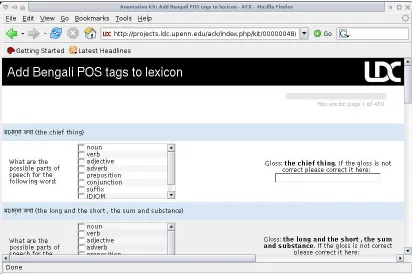
Figure 1: GScout Web Data Scouting Tool
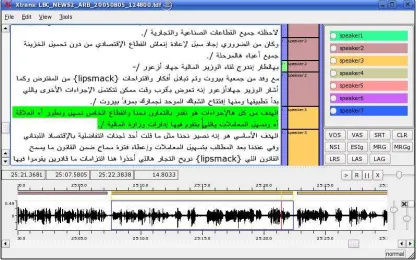
Figure 3: XTrans
The distillation annotation task involves responding to a se-ries of user quese-ries. For each query, annotators first iden-tify snippets of text which contains relevant information in the Arabic, Chinese or English source document. For each snippet, they create anugget, which is a fact or a statement extracted from the snippet.
The annotation task is done using LDC’s GALE Distilla-tion AnnotaDistilla-tion Tool. The query module of the tool uses a search engine that was created by LDC. This search engine is already used by the LDC Online5, and other projects. The tool is implemented in Python, using Qt and PyQt; the annotations are saved in a MySQL database. The snippets and nuggets are dumped into an XML file format for data deliveries.
7. GALE MT Post Editing Workflow
Management System
One of LDC’s important tasks for the GALE MT Evalua-tion is the MT post editing – this is a process where skilled editors edit the MT output so that it has thesame meaning as the gold-standard human translation and is understand-able. The system output is then automatically scored in terms of edit distance from the gold-standard translation. LDC has developed a web-based workflow management system for managing task assignments for the post editors who are working outside of the LDC facility. The system managed the assignment ofkits, sets of gold-standard trans-lations and MT output, to post editors.
Each post editor has an account, and logs onto their ac-count to get their assigned kit. The editor works on the kit, and submits the kit through the workflow management interface. The editor has an option of marking the kit as
“broken”, indicating that there were some technical prob-lems with the kit. Quality control (QC) measures are ap-plied upon check-in and kits that did not pass the QC are returned to the editors. The scorer automatically runs on the checked-in kits, and the scores are saved.
The editors are divided into the first-pass editors and the second-pass editors, who have more experience than the first-pass editors. The roles of the first-pass and second-pass editors are defined in the guidelines. The system pro-vides methods to communicate between the first-pass editor and the second-pass editor who work on the same kit. There is a comment function and there is anudgefunction which sends a reminder to the first-pass editor that the second-pass editor is waiting for the kit to be first-passed.
This system was initially created for the GALE Phase 1 Evaluation, and then was completely redesigned and reim-plemented for GALE Phase 2 Evaluation. The workflow and detailed functionalities for the second version were de-signed by the developer and the project manager, with input from other project members.
8. Summary
9. Acknowledgment
This work was supported in part by the Defense Ad-vanced Research Projects Agency, GALE Program Grant No. HR0011-06-1-0003. The content of this paper does not necessarily reflect the position or the policy of the Govern-ment, and no official endorsement should be inferred.
10. References
Steven Bird, Kazuaki Maeda, Xiaoyi Ma, Haejoong Lee, Beth Randall, and Salim Zayat. 2002. TableTrans, Mul-tiTrans, InterTrans and TreeTrans: Diverse tools built on the annotation graph toolkit. InProceedings of the Third International Conference on Language Resources and Evaluation.
LDC. 2006. English broadcast QRTR guidelines.
http://projects.ldc.upenn.edu/gale/
Transcription/.
LDC. 2007. Distillation training data annotation guide-lines v2.3.http://projects.ldc.upenn.edu/
gale/Distillation/.
Kazuaki Maeda and Stephanie Strassel. 2004. Annotation tools for large-scale corpus development: Using AGTK at the Linguistic Data Consortium. InProceedings of the Fourth International Conference on Language Resources and Evaluation.
Kazuaki Maeda, Haejoong Lee, Julie Medero, and Stephanie Strassel. 2006. A new phase in annotation tool development at the linguistic data consortium: The evolution of the annotation graph toolkit. In Proceed-ings of the Fifth International Conference on Language Resources and Evaluation.
Heather Simpson, Christopher Cieri, Kazuaki Maeda, Kathryn Baker, and Boyan Onyshkevych. 2008. Human language technology resources for less commonly taught languages: Lessons learned toward creation of basic lan-guage resources. In Proceedings of LREC 2008 Work-shop - Collaboration: Interoperability between People in the Creation of Language Resources for Less-resourced Languages.