P R O C E E D I N G S
Open Access
Identification of functional genetic variation in
exome sequence analysis
Andrew Jaffe
1†, Genevieve Wojcik
1†, Audrey Chu
1, Asieh Golozar
1,2, Ankit Maroo
1, Priya Duggal
1, Alison P Klein
1,3,4*From
Genetic Analysis Workshop 17
Boston, MA, USA. 13-16 October 2010
Abstract
Recent technological advances have allowed us to study individual genomes at a base-pair resolution and have demonstrated that the average exome harbors more than 15,000 genetic variants. However, our ability to understand the biological significance of the identified variants and to connect these observed variants with phenotypes is limited. The first step in this process is to identify genetic variation that is likely to result in changes to protein structure and function, because detailed studies, either population based or functional, for each of the identified variants are not practicable. Therefore algorithms that yield valid predictions of a variant’s functional significance are needed. Over the past decade, several programs have been developed to predict the probability that an observed sequence variant will have a deleterious effect on protein function. These algorithms range from empirical programs that classify using known biochemical properties to statistical algorithms trained using a variety of data sources, including sequence conservation data, biochemical properties, and functional data. Using data from the pilot3 study of the 1000 Genomes Project available through Genetic Analysis Workshop 17, we compared the results of four programs (SIFT, PolyPhen, MAPP, and VarioWatch) used to predict the functional relevance of variants in 101 genes. Analysis was conducted without knowledge of the simulation model. Agreement between programs was modest ranging from 59.4% to 71.4% and only 3.5% of variants were classified as deleterious and 10.9% as tolerated across all four programs.
Background
Identification of genetic variation that affects human health has resulted in improvements in public health through the development of better treatments, diagnos-tics, and preventive strategies. One major source of this genetic variation is single-base changes in the DNA sequence, some of which lead to alterations in protein structure and function. These single-nucleotide poly-morphisms (SNPs) occur in the genome approximately once every 1,200–1,500 base pairs and are nonrandomly distributed [1]. Variants that occur in the protein coding regions are further classified into synonymous and non-synonymous variants. Synonymous SNPs are defined as DNA changes without an associated change in the
amino acid sequence, and nonsynonymous SNPs are defined as DNA changes that result in an amino acid substitution or insertion of a stop codon. In one of the first examples of complete sequence analysis of an indi-vidual genome, 10,569 nonsynonymous SNPs were found, of which only 8,996 had been previously observed [2]. This discovery of 1,573 novel nonsynonymous SNPs demonstrates the magnitude of novel information that can be gained from genome sequencing.
Although it may be difficult to know with certainty the effect of a single amino acid change on protein func-tion, some understanding can be gained through our knowledge of protein biochemistry or gene sequence itself. One sequence-based feature that can be examined is whether or not the sequence variant results in a codon change. If a nonsynonymous SNP results in a stop codon, then the variant is likely to be deleterious, unless this premature stop occurs near the end of a gene. The effect of an amino acid substitution can range * Correspondence: [email protected]
†Contributed equally
1
Department of Epidemiology, Johns Hopkins Bloomberg School of Public Health, 615 N Wolfe Street, Baltimore, MD 21205, USA
Full list of author information is available at the end of the article
from negligible to severe depending on the biochemical properties of the substituted amino acid. In addition to examining the amino acids found at the mutation site, one can use phylogeny to determine conserved sequences within a gene. Conserved sites are likely to have arisen because genetic variation in these regions is not tolerated across species as a result of strong negative selective pressure against variation in these regions. Thus variants that occur in nonconserved regions are more likely to be tolerated.
In the past decade several programs have been devel-oped with the goal of predicting whether or not an observed sequence variant is likely to have a deleterious effect on the protein product. These programs combine data from a variety of sources and use differing compu-tational algorithms to estimate the probability that an observed genetic variant is deleterious. In this paper, we compare the findings of four nucleotide- and amino acid–based algorithms aimed at predicting the effect of an observed nonsynonymous sequence variation. We predict functional results for nonsynonymous SNPs using the nucleotide version of SIFT, PolyPhen-2, Vario-Watch, and MAPP. Based on the predictions made by the various programs, we classify variants as deleterious or tolerated and calculate the agreement between programs.
Methods
The data set consists of variants observed in the indivi-dual sequences as part of phase 3 of the 1000 Genomes Project, as released for Genetic Analysis Workshop 17 (GAW17). We selected 101 autosomal genes and ana-lyzed only those nonsynonymous SNPs that caused a missense mutation in the subsequent amino acid. Over-all, 3,781 nonsynonymous SNPs were identified within these genes. We identified amino acid changes using the ANNOVAR program [3] by mapping the genomic coor-dinates of each variant to the RefSeq gene database (build hg18/36.3). The result was an average of 37.4 nonsynonymous variants (standard deviation: 23.4 variants) per gene. There were 1,867 (49.4%) private variants (one copy present, minor allele frequency [MAF] < 0.001), 1,310 (34.6%) very rare variants (0.001 < MAF < 0.01), 371(9.8%) rare variants (0.01 < MAF < 0.05), and 233 (6.2%) common variants (MAF > 0.05).
The functional analysis programs we examined (SIFT, PolyPhen-2, MAPP, and VarioWatch) fall into two cate-gories: nucleotide-based and amino acid–based. Some programs provide probabilities, whereas others classify their predictions into levels of functional threats. To carry out this analysis, we dichotomize predictions as either tolerated or deleterious. We also give an overview of each program.
To compare our results to a gold standard, we exam-ined the entire GAW17 data set to identify variants that had been previously analyzed in experimental models providing true functional results. Because the simulated GAW17 data do not represent true biological function, the simulated data could not be used as a gold standard. We identified functional variants by searching for infor-mation by gene name for each amino acid change in the Online Mendelian Inheritance in Man (OMIM) database [4] along with the term “functional” using an R pro-gram. We were able to identify 19 functional variants using this method, 13 of which were verified as tested in mouse or cell line models. We identified an additional two variants (in BRCA2andMFTRR) by searching the literature.
Programs
By querying data from five databases (Ensembl, UCSC BLAT, Rescue-ESE, Fas-ESS, and SIFT), VarioWatch provides functional annotation for SNPs. We used the following criteria, as implemented in the program: (1) whether or not the mutation affects the protein struc-ture, (2) whether the SNP is in an exon-splicing enhan-cer or silenenhan-cer, and (3) whether or not the SNPs abolish the protein domain [5]. Once VarioWatch is provided with information on variant location, it returns predic-tions in terms of high, medium, and low levels of threat using the three criteria. In our analyses we classified VarioWatch’s very high and high-level threats as deleter-ious and its low- and medium-level threats as tolerated.
Multivariate Analysis of Protein Polymorphism (MAPP) is a phylogeny-based Java-script program that estimates the average deviation from six physiochemical properties (hydropathy, polarity, charge, volume, free energy in alpha-helix conformation, and free energy in beta-strand conformation) at an amino acid position across species to assess the effect of a substitution at a particular amino acid site [6]. Provided with a set of pre-aligned orthologous protein sequences and a tree relating the sequences, MAPP can be used to estimate the effect of a newly detected polymorphism on protein function. We obtained homologous sequences for the same 10 species from the UCSC database for each gene (rhesus, mouse, dog, elephant, opossum, platypus, chicken, stickleback, lizard,Xenopus tropicalis). For this analysis, the severe and moderate levels were classified as deleterious, and the minor level was classified as tolerated.
protein function [7,8]. A semiautomated approach allows the user to input homologous sequences or align-ments to improve accuracy. Input includes the reference and variant nucleotide and their chromosomal position. SIFT provides binary classification of variants as either tolerated or deleterious.
The PolyPhen-2 program predicts the effect of a var-iant using eight sequence-based and three structure-based features previously selected by an iterative greedy algorithm [9,10]. Sequence-based features include whether the variant is in an active or binding site and whether other functionally important regions or motifs are present. Sequences are pulled from Uniprot. Struc-tural components include whether or not the variant alters the polarity of the structure, potentially changing the hydrophobic core of a protein, and whether its inter-actions are with itself or with other proteins. The func-tional prediction is determined by a naïve Bayes classifier into deleterious and nondeleterious groups. Input is amino acid changes with the reference and var-iant amino acid and their position in the protein sequence. The output levels of possibly damaging and probably damaging were classified as deleterious for this analysis, with the benign level being classified as tolerated.
Results
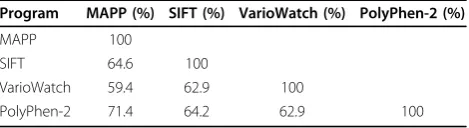
We obtained moderate levels of agreement for the four programs, with agreement ranging from 59% to 71% (Table 1). The highest agreement was observed between MAPP and PolyPhen-2: 71%. The lowest agreement, 59%, was observed between VarioWatch and MAPP.
We also saw trends in the leniency of the predictions across the 101 genes, with some programs categorizing fewer variants as deleterious compared to others. To further examine the correlation between programs, we calculated the proportion of variants classified as deleter-ious per program. In addition, we examined the condi-tional probability that a variant classified as deleterious by a given program would also be classified as deleterious in a second program. For example, in Table 2, MAPP classified 1,472 of the 3,199 variants for which predictions
were available as deleterious. Of these 1,472, 65.4% were also classified as deleterious by VarioWatch [i.e., Prob (deleterious in VarioWatch | deleterious in MAPP)]. Con-versely, of the 1,882 variants that were classified as dele-terious in VarioWatch (n= 1,882), only 54.6% were also classified as deleterious by MAPP. Overall, 135 (3.57%) variants were called deleterious by all programs, whereas only 414 (10.9%) were classified as tolerant by all four programs. Of the 3,781 variants examined, 876 were clas-sified as deleterious by three or more programs, and 1,274 were classified as tolerated by three or four pro-grams. This suggests that these programs are more likely to agree on benign variants than on potentially damaging variants.
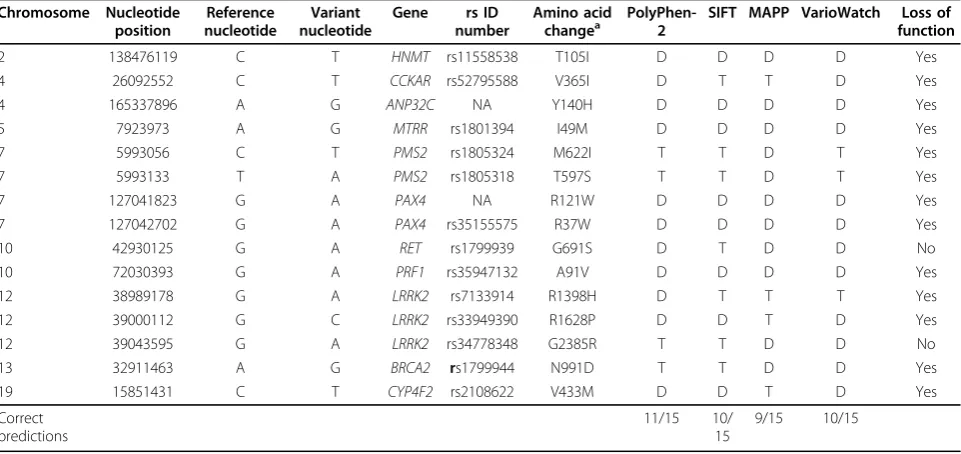
We next compared the predictions obtained from these four programs to the results of the functional stu-dies conducted on the 15 genetic variants for which functional data were available. Of these 15 variants, 13 had been demonstrated to result in a loss of function. However, only 6 of these 13 loss-of-function mutations were predicted to have a deleterious effect on protein function by all four programs (Table 3). Interestingly, even within these known functional variants, no variant was predicted as benign or tolerated by all four pro-grams. Of the four programs, PolyPhen-2 had the great-est accuracy, predicting the function of 11 of the 15 variants correctly. VarioWatch and SIFT predicted 10 out of 15 correctly, and MAPP predicted 9 out of 15 correctly.
Discussion
Although the four prediction programs did have some pairwise agreement in identifying deleterious mutations, only 3.5% of variants were classified as deleterious and 10.9% as tolerated across all four programs. The observed differences may be due to different classifica-tion cutoff points on the probability of being deleterious but are most likely due to the different methods used to classify variants.
Although functional data are not available for most of the variants examined, they were available for a small number of variants. However, even for variants with func-tional data, the programs did not provide consistent results. We highlight two examples from Table 3. Kuz-netsov et al. [11] used a functional assay to determine that the N991D variant of theBRCA2gene was a neutral mutation. A missense variant, N991D was introduced into the cells using Bacterial Artificial Chromosome BACs, and the mutant cells were subjected to various DNA-damaging agents and then compared to control cells. Kuznetsov et al. [11] found that N991D showed no difference in its sensitivity to these agents compared with control cells, whereas cells deficient in theBRCA2 pro-tein were highly sensitive to these DNA-damaging agents.
Table 1 Agreement between prediction programs
Program MAPP (%) SIFT (%) VarioWatch (%) PolyPhen-2 (%)
MAPP 100
SIFT 64.6 100
VarioWatch 59.4 62.9 100
PolyPhen-2 71.4 64.2 62.9 100
Thus the N991D mutation was classified as a neutral mutation. However, MAPP and VarioWatch predicted the mutation to be damaging, whereas SIFT and Poly-Phen-2 tolerated the mutation. This may reflect the dif-ferent methods, because MAPP relies primarily on sequence-based features, such as phylogeny and what the amino acid change is in regards to the surrounding sequence. On the other hand, both SIFT and PolyPhen-2 rely heavily on structural features, such as how the var-iant affects the protein’s tertiary structure and its interac-tions with ligands. Wilson et al. [12] examined the role of a common mutation at rs1801394 in the gene for methionine synthase reductase (MTRR) and its associa-tion with an increased risk for spina bifida. Fibroblast lines were isolated from patients with homocystinuria to isolate and identify mutations in the MTRRgene using reverse transcription polymerase chain reaction (PCR). Wilson and colleagues found that rs1801394 has the sub-stitution I22M, or I49M, depending on the isomer. A population of individuals with spina bifida and their
mothers was analyzed for the presence of this mutation. Two copies of the mutation in mothers resulted in 5 times the risk of their child having a neural tube defect compared to mothers lacking two copies of this mutation. This mutation was predicted to have a deleterious effect in all the programs (Table 3).
Although all four programs had the same relative suc-cess in predicting the functional status of the 15 variants for which functional data were available, only about two-thirds of variants were correctly classified. The small sample size of variants would have been more informa-tive if any of the programs had been a distinct outlier, but this was not the case. A more comprehensive look at functional variants using additional exome sequencing data is warranted, as several hundred variants may better discriminate the predictive ability of the programs.
There were some limitations in this study, including a lack of reference sequence. Therefore we used Build 36 from the National Center for Biotechnology Information (NCBI) to determine the location of each variant.
Table 2 Comparison of deleterious SNPs across programs
Program Number of variants classified Deleterious Conditional probability of pairwise prediction
Number % MAPP (%) SIFT (%) VarioWatch (%) PolyPhen-2 (%)
MAPP 3,199 1,472 46.0 100 58 65 78
SIFT 3,562 1,603 45.0 62 100 71 69
VarioWatch 3,429 1,882 54.9 55 58 100 64
PolyPhen-2 3,333 1,757 52.7 65 58 67 100
Each program characterizes a different number of deleterious alleles. The pairwise prediction is calculated by conditioning on the probability of a program predicting a variant as deleterious, given that the comparison program already has predicted it as deleterious. For example, in the first row, among those 1,472 variants that MAPP classifies as deleterious, only 58% are also classified as deleterious by SIFT.
Table 3 Comparison of prediction programs with 15 functional variants
Chromosome Nucleotide position
Reference nucleotide
Variant nucleotide
Gene rs ID number
Amino acid
changea PolyPhen-2 SIFT MAPP VarioWatch functionLoss of
2 138476119 C T HNMT rs11558538 T105I D D D D Yes
4 26092552 C T CCKAR rs52795588 V365I D T T D Yes
4 165337896 A G ANP32C NA Y140H D D D D Yes
5 7923973 A G MTRR rs1801394 I49M D D D D Yes
7 5993056 C T PMS2 rs1805324 M622I T T D T Yes
7 5993133 T A PMS2 rs1805318 T597S T T D T Yes
7 127041823 G A PAX4 NA R121W D D D D Yes
7 127042702 G A PAX4 rs35155575 R37W D D D D Yes
10 42930125 G A RET rs1799939 G691S D T D D No
10 72030393 G A PRF1 rs35947132 A91V D D D D Yes
12 38989178 G A LRRK2 rs7133914 R1398H D T T T Yes
12 39000112 G C LRRK2 rs33949390 R1628P D D T D Yes
12 39043595 G A LRRK2 rs34778348 G2385R T T D D No
13 32911463 A G BRCA2 rs1799944 N991D T T D D Yes
19 15851431 C T CYP4F2 rs2108622 V433M D D T D Yes
Correct predictions
11/15 10/ 15
9/15 10/15
This table highlights the 15 variants that were a gold standard in a functional study.
a
However, this assumption resulted in several instances in which the variant provided was identical to the refer-ence allele according to the dbSNP database, showing inconsistencies between the reference sequence for this data set and the substitute reference sequence used from the UCSC Genome Browser. To determine the amino acid changes, we used coordinates of the nucleo-tide variant that were taken from the GAW17 data, and the nucleotide and amino acid sequences were taken from the CCDS sequence. We also likely missed func-tional variants, given the search terms in OMIM used to identify functional variants.
Conclusions
The four programs compared in this analysis (SIFT, MAPP, PolyPhen-2, and VarioWatch) differ greatly in their predictions of the probability that a SNP variant will be functionally deleterious. When selecting variants for experimental or functional follow-up study, a conser-vative approach, such as SIFT, should be used to mini-mize false positives. However, if the program is being used to select variants for further statistical analysis, a less conservative approach, such as PolyPhen-2, may be preferred to capture all possible deleterious variants. It is important to note that these programs have different methods and discordant results, so we do not recom-mend using any program as a true substitute for func-tional assays.
Acknowledgements
This article has been published as part ofBMC ProceedingsVolume 5 Supplement 9, 2011: Genetic Analysis Workshop 17. The full contents of the supplement are available online at http://www.biomedcentral.com/1753-6561/5?issue=S9.
Author details
1Department of Epidemiology, Johns Hopkins Bloomberg School of Public
Health, 615 N Wolfe Street, Baltimore, MD 21205, USA.2Division of Cancer
Epidemiology and Genetics, National Cancer Institute, National Institutes of Health, 6120 Executive Boulevard, Bethesda, MD 20892, USA.3Department of Oncology, Sidney Kimmel Comprehensive Cancer Center, Johns Hopkins School of Medicine, Harry and Jeanette Weinberg Building, 401 North Broadway, Baltimore, MD 21231, USA.4Department of Pathology, Johns
Hopkins School of Medicine, 600 North Wolfe Street, Baltimore, MD 21287, USA.
Authors’contributions
AJ, GW, AC, AG, AM conducted primary analysis of the data. PD and APK conceived of the study and participated in its design and coordination. AJ, GW, PD and APK drafted the manuscript. All authors participated in edited and final approval of the manuscript.
Competing interests
The authors declare that there are no competing interests.
Published: 29 November 2011
References
1. Venter JC, Adams MD, Myers EW, Li PW, Mural RJ, Sutton GG, Smith HO, Yandell M, Evans CA, Holt RA,et al:The sequence of the human genome. Science2001,291:1304-1351.
2. Wheeler DA, Srinivasan M, Egholm M, Shen Y, Chen L, McGuire A, He W, Chen YJ, Makhijani V, Roth GT,et al:The complete genome of an individual by massively parallel DNA sequencing.Nature2008, 452:872-876.
3. Wang K, Li M, Hakonarson H:ANNOVAR: functional annotation of genetic variants from high-throughput sequencing data.Nucleic Acids Res2010, 38:e164.
4. National Center for Biotechnology Information:Online Mendelian Inheritance in Man, OMIM.McKusick-Nathans Institute of Genetic Medicine, Johns Hopkins University (Baltimore, MD) and National Center for Biotechnology Information, National Library of Medicine (Bethesda, MD); 2011 [http://www.ncbi.nlm.nih.gov/omim/].
5. Chen YH, Liu CK, Chang SC, Lin YJ, Tsai MF, Chen YT, Yao A:GenoWatch: a disease gene mining browser for association study.Nucleic Acids Res
2008,36:W336-W340.
6. Stone EA, Sidow A:Physicochemical constraint violation by missense substitutions mediates impairment of protein function and disease severity.Genome Res2005,15:978-986.
7. Ng PC, Henikoff S:Predicting deleterious amino acid substitutions. Genome Res2001,11:863-874.
8. Ng PC, Henikoff S:SIFT: Predicting amino acid changes that affect protein function.Nucleic Acids Res2003,31:3812-3814.
9. Sunyaev S, Ramensky V, Koch I, Lathe W, Kondrashov AS, Bork P:Prediction of deleterious human alleles.Hum Mol Genet2001,10:591-597. 10. Adzhubei IA, Schmidt S, Peshkin L, Ramensky VE, Gerasimova A, Bork P,
Kondrashov AS, Sunyaev SR:A method and server for predicting damaging missense mutations.Nat Meth2010,7:248-249. 11. Kuznetsov SG, Liu P, Sharan SK:Mouse embryonic stem cell-based
functional assay to evaluate mutations inBRCA2.Nat Med2008, 14:875-881.
12. Wilson A, Platt R, Wu Q, Leclerc D, Christensen B, Yang H, Gravel RA, Rozen R:A common variant in methionine synthase reductase combined with low cobalamin (vitamin B12) increases risk for spina bifida.Mol Genet Metab1999,67:317-323.
doi:10.1186/1753-6561-5-S9-S13
Cite this article as:Jaffeet al.:Identification of functional genetic variation in exome sequence analysis.BMC Proceedings20115(Suppl 9): S13.
Submit your next manuscript to BioMed Central and take full advantage of:
• Convenient online submission
• Thorough peer review
• No space constraints or color figure charges
• Immediate publication on acceptance
• Inclusion in PubMed, CAS, Scopus and Google Scholar
• Research which is freely available for redistribution