2017 3rd International Conference on Electronic Information Technology and Intellectualization (ICEITI 2017) ISBN: 978-1-60595-512-4
Research on Parameter Identification Method
of Lithium-ion Battery Model Based on
Particle Swarm Optimization Algorithm
Jialing Yu, Rui Li, Yingchao Zhang, Yu Lei and Junqiang He
ABSTRACT
Aiming at the problem of parameter selection and optimization of the mathematical model of lithium-ion battery, a method of using the particle swarm optimization (PSO) algorithm to optimize the parameters identification is proposed. The experimental results show that the algorithm has small average error and less time elapse, and the parameterization ability of the optimized parameters is improved. The speed and accuracy of the parameters of the battery model are improved, which solves the problem that the manual calibration is time-consuming and difficult to guarantee accuracy.
INTRODUCTION
Battery plays an important role in human’s industry and social life as energy storage device, lithium-ion battery has comparatively high energy density and stable characteristic during the process of charge and discharge. Therefore, its proportion in energy storage application increases rapidly. Lithium-ion battery is widely used in different power requirement area, such as smart phone, laptop, wearable smart devices and other low power degree application, as well as orbit satellite power, electric vehicle power, new energy storage power station and other high power demanding occasion.
_______________________
Battery management system (BMS) is essential part of lithium-ion battery power system, for improving battery performance, safety and reliability. The core function of BMS is to precisely estimate battery state, include state of charge and cycle life, whose accuracy depends on battery model. So far, there are several different types of lithium-ion battery model. Equivalence circuit model based on experimental outside electric characteristic, such as the venin model and PNGV model[1], these type model could simulate dynamic behavior at some degree by using RC circuit, but its high computation demanding limit the usage in real project, especially when the model has more order. Smart algorithm model based on machine learning, the typical one is three tier neural networks battery model, which can describe non-linear characteristic of battery[2]. However its anti-interference ability is weak, and can only be used in the scope of the original training data, this model rarely be taken in the real project. Mathematic model coming from inner chemical reaction of battery, the representative model is Shepherd mathematic model[3], which builds the relationship of battery inner parameters from cathode and anode potential. The model can accurately reflect the discharge behavior of battery, and widely be used in battery state estimation.
Although the way to identify mathematic model parameters is relatively easy, the process to optimize parameters is very difficult and time-consuming. This paper will take PSO algorithm as basic method to identify and optimize the parameters of Shepherd mathematic battery model. PSO algorithm is a population-based iteration, which is the particle in the solution space to follow the optimal particle search. Whose advantage is simple, easy to implement, it is very suitable for the problem of optimal parameters seeking because of its natural real coding characteristic. This method can be used in battery mathematic model parameters offline calibration, could eliminate the limitation of mathematic model using in the project application.
CONVENTIONAL SHEPHERD MODEL PARAMETER IDENTIFICATION
Shepherd Lithium-ion Battery Model
Shepherd lithium-ion battery model is a mathematic description which is established from the principle of battery charge and discharge chemical reaction and characteristic of battery structure. Firstly, Shepherd model builds cathode potential energy equation as
( c )
c sc c
c
Q
E E K i
Q it
(1)
Where Ec is cathode potential during discharge; Esc is a constant potential; Kc is the
cathode coefficient of polarization; i is the active material current density; Qc is the
amount of available cathode active material expressed in units such as ampere hours;
Similarly, anode can be described in Eq.(2).
( a )
a sa a
a
Q
E E K i
Q it
(2)
Eq. (2) plus Eq. (1), Eq. (3) can be obtained.
( )
s
Q
E E K i
Q it
(3)
Where Q=Qa=Qc is the available amount of active material; E=Ea+Ec is the
potential of the battery at any time t during the discharge.
Because of the battery voltage drop at the beginning of discharge process, internal resistance is considered, Eq. (3) becomes
( )
s
Q
E E K i Ni
Q it
(4)
Where N, the internal resistance per unit area, is measured in ohm cm2.
When Eq. (3) is evaluated mathematically, a set of curves is obtained, there are some differences by comparing to the actual battery discharge curves. In order to minimize the model error is to bring new factor to the Eq. (4), form the final equation
1
( ) exp( )
s
Q
E E K i Ni A BQ it Cit
Q it
(5)
Parameters Identification of Shepherd Lithium-ion Battery Model
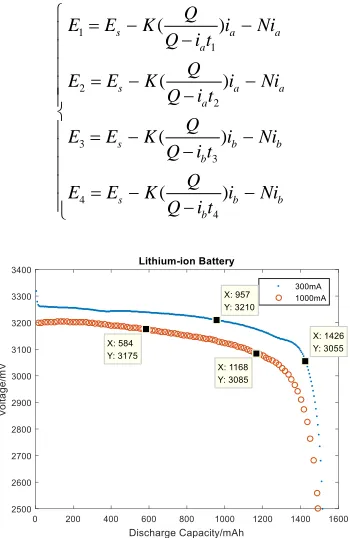
According to Eq. (5), the Shepherd model parameters include Es,K,Q, N,A,B and C. But A, B and C just reflect the quick drop process at the discharge beginning, in order to reduce identification computational complexity, these three parameters identification don’t be considered in this paper. The way to identify other parameters shown in Figure 1 is to gain four feature points from two different discharge curves.
1 1 2 2 3 3 4 4 ( ) ( ) ( ) ( )
s a a
a
s a a
a
s b b
b
s b b
b Q
E E K i Ni
Q i t Q
E E K i Ni
Q i t
Q
E E K i Ni
Q i t
Q
E E K i Ni
Q i t
[image:4.612.207.382.86.355.2] (6)
Figure 1. Model identification discharge curves.
Where t1, t2, t3 and t4 are the time points; E1, E2, E3and E4 are the battery voltage of respective time points; the solutions of Eq. (6) are the value of model parameters.
Parameters Identification Effect of Shepherd Lithium-ion Battery Model
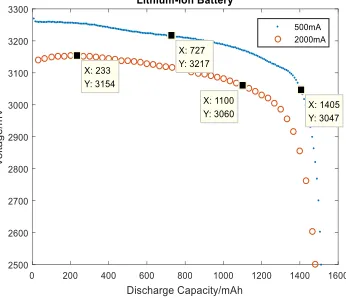
After the four feature points are selected, the model parameters can be obtained by solving the equation set. This method is simple, but the fitting effect of the model depends on whether the feature points are appropriate. Select 500mA and 2000mA discharge curve as ia and ib , the four feature points shown in Figure 2 are used to
calculate the parameters. Plug the numerical data into Eq. (4), the comparison of actual discharges with points calculated from equations atia and ib is shown in Fig. 3.
Figure 2. The first set of feature points. Figure 3. Comparison of actual discharges with fitting curve used first set of feature points.
Figure 4. The second set of feature points. Figure 5. Comparison of actual discharges with fitting curve used second set of feature points.
In Figure 5 the fitting effect of the 500mA is significantly improved, however the fitting effect of 2000mA is worse by moving forward the feature point 4. The traditional parameter identification method usually need several adjustments according to the experience to obtain better parameter identification effect, therefore the calculation time is long.
PARAMETERS IDENTIFICATION BASED ON PSO ALGORITHM
Basic PSO Algorithm
[image:5.612.304.480.279.424.2]particle represents a candidate solution in the search-space. The optimal solution is found through iteration, and a fitness function according to the optimization objective is defined to determine the solution is good or bad. The movements of the particles are guided by their own best known position in the search-space as well as the entire swarm's best known position. For particle i, its position represent asxi=[xi1,xi2,···,xid], its velocity represent asvi=[vi1,vi2,···,vid], its own best known position represent as pi=[pi1,pi2,···,pid](called pbest), the entire swarm’s best known position represent as g=[g1,g2,···,gd](called gbest). The calculating formula to update particle’s position and velocity is
1
1 1 1 1
1 1
( ) ( )
t t t t t t
i i i i i
t t t
i i i
c r c r
v v p x g x
x x v (7)
Where i=1,2,···, M, M is the number of particles in the swarm; t is the current iteration number; ω is the inertia weight, make the particles has a trend to expand the search-space[5]; c1 and c2 are learning factors, accelerate the particles’ movement
toward pbest and gbest; r1 and r2 are random numbers of uniform distribution on [0, 1]
in order to ensure the diversity of the population [6]. Particles update their position by continuous learning, eventually fly to the optimal solution in the search-space. The termination criterion can be number of iterations performed, or a solution with adequate fitness value is found.
The Parameter Identification Method of Lithium-ion Battery Model based on PSO Algorithm
The essence of parameter identification based on PSO, is to translate it into an optimization problem in parameter space. Then using the PSO algorithm for parallel search in the entire parameter space efficiently, in order to obtain optimal estimates of the system parameters. Regard the horizontal coordinates of four feature points (discharge capacity) as position vectors of the particle, and regard the mean absolute percentage error as fitness function. Specific steps are as follows:
1. Initialize the PSO parameters include the number of particles in the swarm, inertia weight, learning factors, maximum iteration number, search-space range, and the initial position and velocity of particles.
2. Calculate the initial fitness of particles, initialize the particles' best known position to their initial position, and update the swarm's best known position.
3. Update the particles' position, velocity, and fitness, then update the particles' best known position and the swarm's best known position.
Simulating Experiment
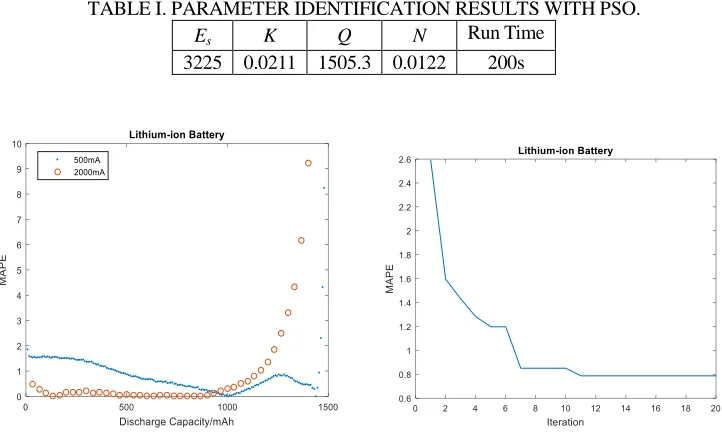
In order to make comparison with traditional model parameter identification method, select 500mA and 2000mA discharge curve as ia and ib. Set the number of
particles in the swarm at 20, inertia weight at 0.8, learning factors at 2, maximum iteration number at 20. The model parameters are identified by the standard particle swarm algorithm, and the results are shown in TABLE I.
The mathematical model of lithium-ion battery can be obtained by substituting parameter identification results into Eq. (4). The comparison of actual discharges with points calculated from equations is shown in Figure 6. The mean absolute percentage error of each iteration is shown in Figure 7. Therefore, using the PSO algorithm can determine the feature points’ position quickly and directly without manual adjustment, and obtain good fit.
CONCLUSIONS
[image:7.612.115.476.425.649.2]Battery model parameters are the vital data of battery characteristics, are the essence to estimate battery real time capacity and life cycle. BMS works effectively based on the battery model parameters identification precisely. This paper identify and optimize lithium-ion shepherd battery model by using PSO algorithm, the experimental result shows the validity and stability of the method. The way proposed is mainly used in the battery state initial parameters calibration, how to identify and optimize online parameters dynamically is the next study goal.
TABLE I. PARAMETER IDENTIFICATION RESULTS WITH PSO.
Es K Q N Run Time
3225 0.0211 1505.3 0.0122 200s
REFERENCES
1. Gregory L. Plett. 2002. “LiPB Dynamic Cell Models for Kalman-Filter SOC Estimation,” presented at Proceedings of the 19th Electric Vehicle Symposium (EVS19), October 19-23, 2002.
2. Yutao Luo, Baojie Zhang, Kegang Zhao. 2007. “SOC Estimation of Power Battery Pack based on Neural Network,” Chinese Journal of Power Sources,131(17):914-917.
3. Shuhui Li, Bao Ke. 2011. “Study of Battery Modeling using Mathematical and Circuit Oriented Approaches,” presented at IEEE Power & Energy Society General Meeting, July 24-28, 2011.
4. Wenxin Liu, Li Liu, Il-Yop Chung, and David A. Cartes. 2011. “Real-time Particle Swarm Optimization based Parameter Identification applied to Permanent Magnet Synchronous Machine,” Applied SoftComputing,11(2):2556-2564.
5. Yang Zhao, Li Wei, Yicheng Zhang and Jianan Sun. 2012. “Structure and Parameter Identification of Supercapacitors based on Particle Swarm Optimization,” Proceedings of the CSEE, 32(15):155-161.